
Plate, Eastern Steppes, Northern China Or Inner Mongolia, Ordos Tradition
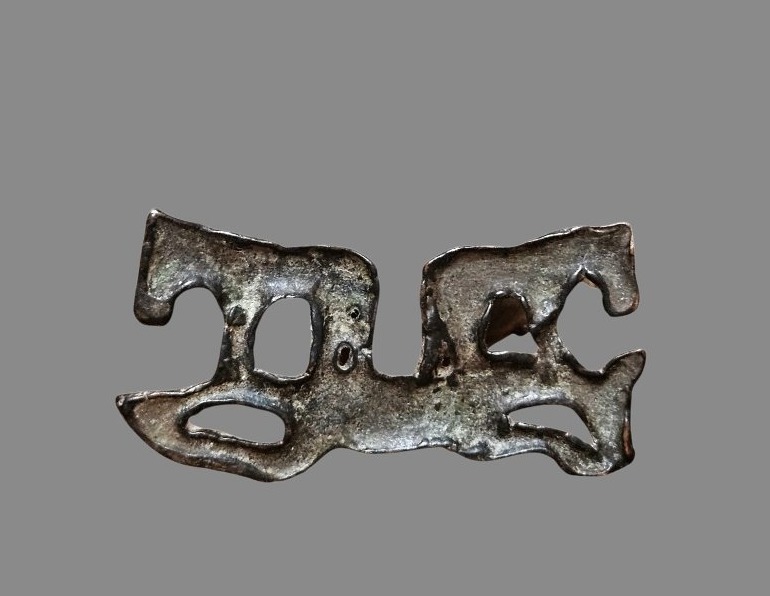
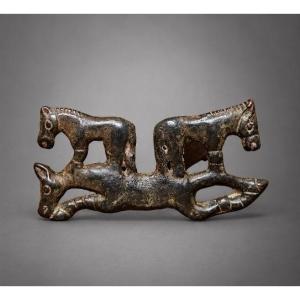
Ornamental or harness plate depicting two horses, likely standing over a reclining deer
Bronze with a brown patina; shows signs of age. In good overall condition.
Eastern steppes, northern China, or Inner Mongolia; part of the so-called Ordos tradition.
Approximately 3rd–1st century BCE.
Dimensions: 8.6 × 4.1 cm
Provenance: former Drouot auction, Paris, 2021, according to the information provided.
This openwork plaque depicts two horses arranged back-to-back, likely standing over a reclining deer. The supple modeling of the bodies and the balance between solid areas and openings lend this composition a beautiful naturalistic quality. The perforations were intended for attaching the plaque to a leather or textile backing, such as part of a garment or horse tack.
"The so-called Ordos tradition belongs to the vast world of the pastoralists of the eastern steppes. This regional designation encompasses several communities linked by livestock herding, mobility on horseback, and long-distance trade. Their animal art shares motifs with the Scytho-Siberian traditions, which spread across southern Siberia, Central Asia, and the northern borders of China."
"Beginning in the late 3rd century B.C., some of these societies became part of the Xiongnu empire, which brought together populations of diverse origins. Our plaque is part of this cultural landscape.
These regions maintained close ties with the Chinese kingdoms, and later with the Qin and Han empires. Terracotta molds used to cast steppe-style animal plaques, found among the artifacts of a Qin artisan, attest to these connections between artisanal traditions. This object symbolizes a world of encounters where animals, goods, techniques, and artistic forms circulated.”
Background Bibliography:
— Jenny F. So and Emma C. Bunker, Traders and Raiders on China’s Northern Frontier, Arthur M. Sackler Gallery and University of Washington Press, 1995.
— Yan Liu et al., “China and the Steppe: A Technological Study of Precious Metalwork from Xigoupan Tomb 2 (4th–3rd c. BCE) in the Ordos Region, Inner Mongolia,” Heritage Science, 9, article 46, 2021.
Sold with a certificate of authenticity from expert Serge Reynes and an invoice.
* Free shipping within France; shipping to other countries available upon request.
580 €
Period: Before 16th century
Style: Asian art
Condition: Good condition
Material: Bronze
Length: 8,6 cm
Height: 4,1 cm
Reference (ID): 1845527
Availability: In stock
Print