

Mélingue, François Rabelais, Antique Bronze, Signed Bust Portrait, 19th Century
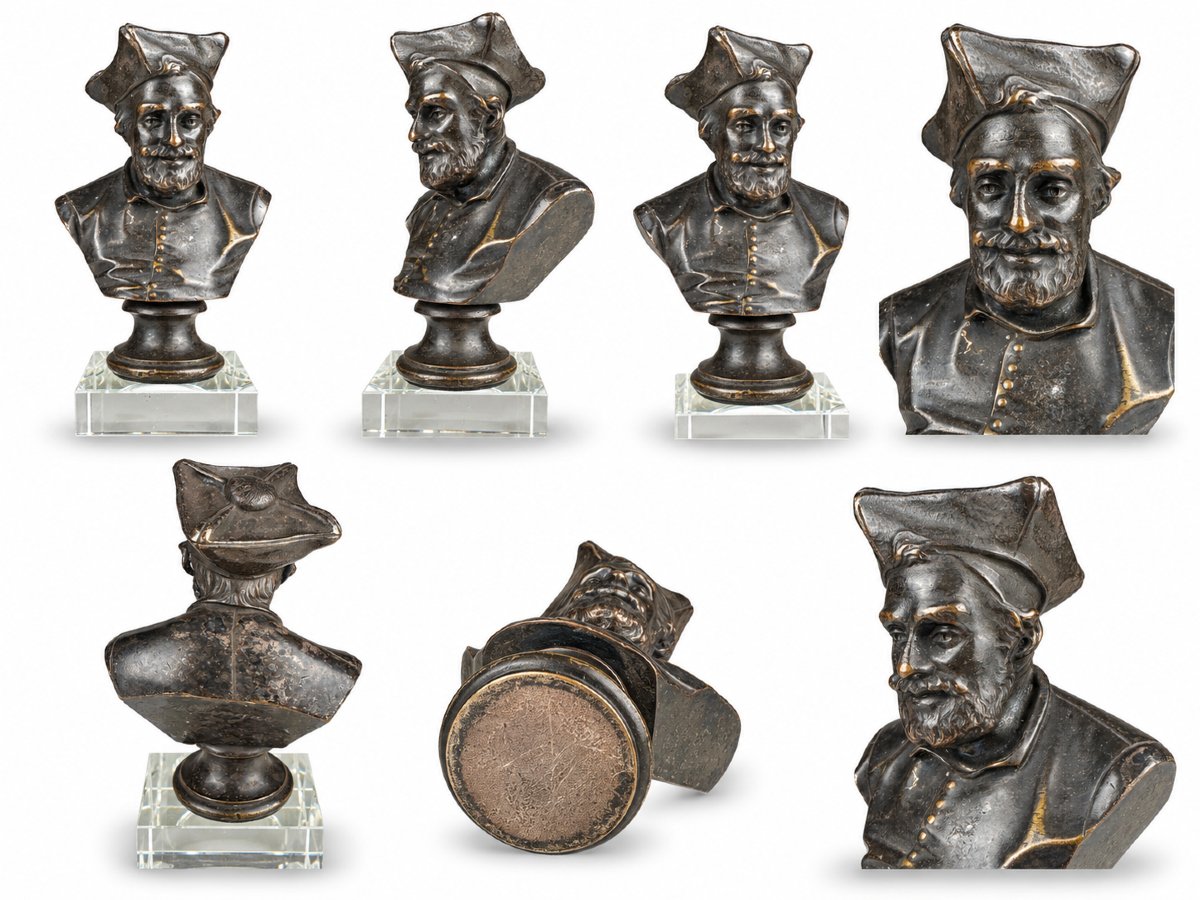
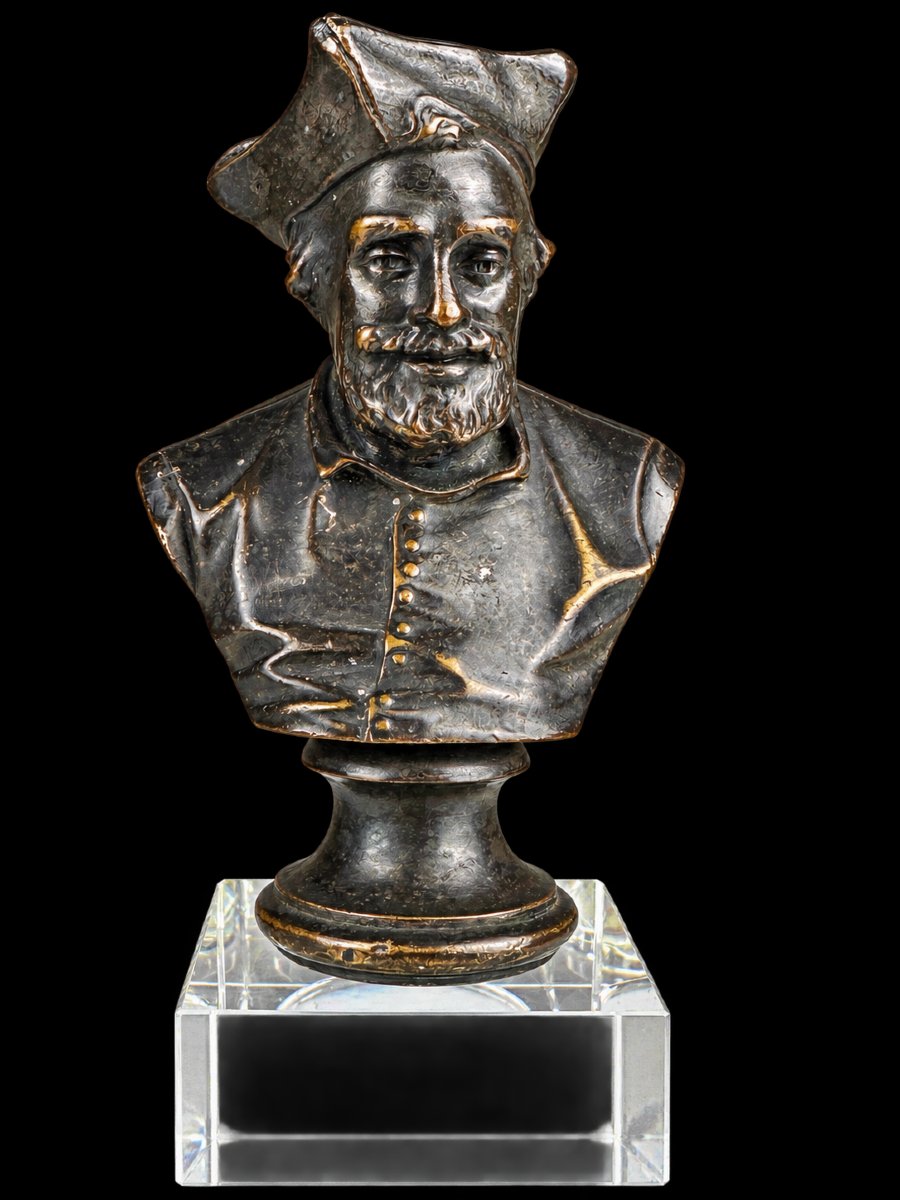
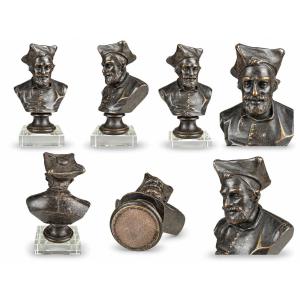
Bronze bust with a brown-black patina depicting François Rabelais (c. 1494–1553), a work by Étienne Marin Mélingue, a French sculptor, painter, and actor of the Romantic era. The figure is depicted as a Renaissance man, wearing a wide cap, his face framed by a mustache and a short beard, and dressed in a doublet fastened with a row of small buttons. The bust rests on a circular, fluted pedestal.
The identification of Rabelais is supported by a comparison with the Seated Rabelais modeled by Mélingue, signed and dated 1845, and later produced by the firm Susse Frères. Both sculptures share an identical facial expression.
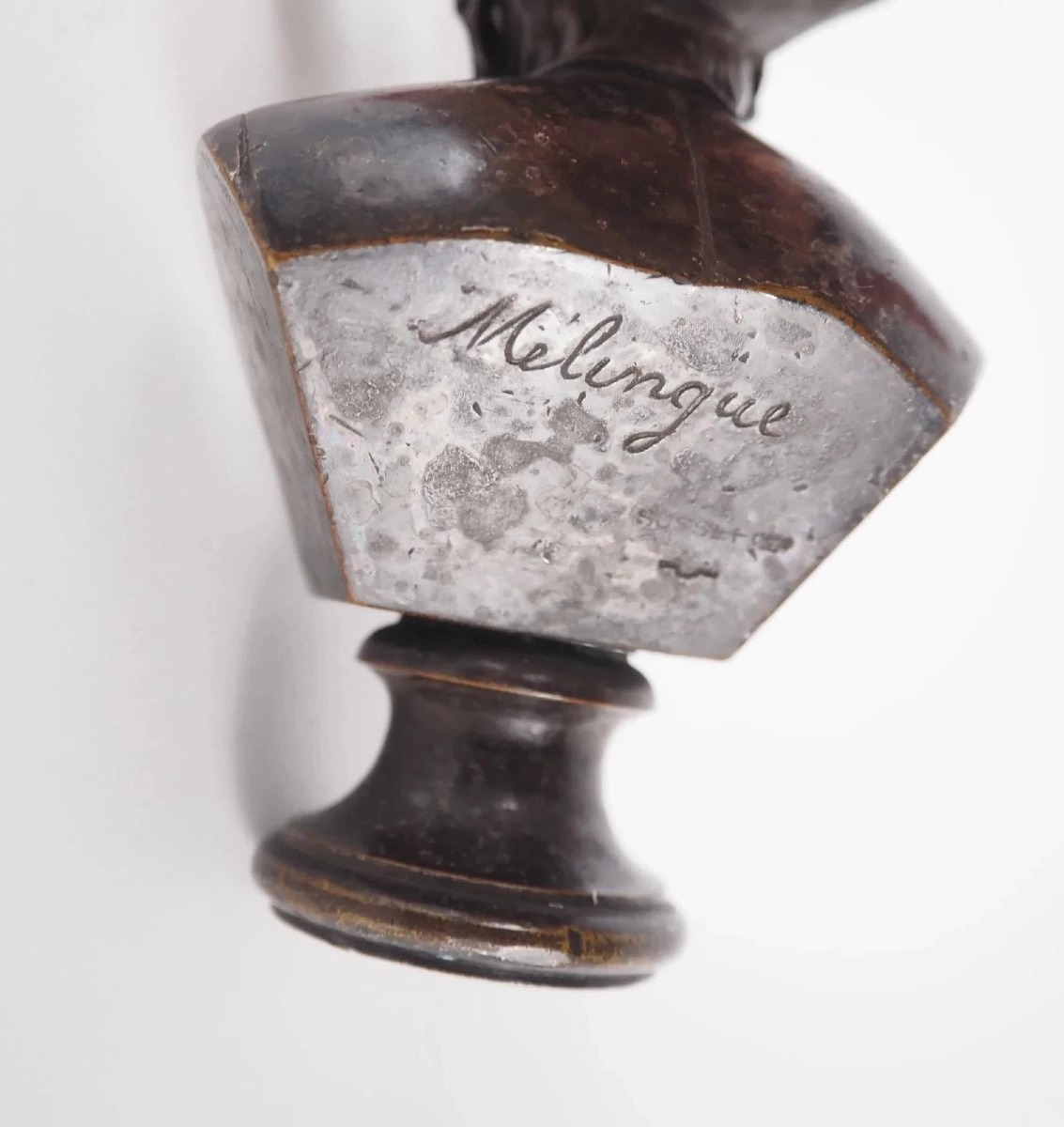
This example constitutes a variant in the form of a bust on a pedestal, based on the effigy of Rabelais created by Mélingue. The reverse bears the incised signature “Mélingue”. The vigorous rendering of the face and the accentuation of the features reflect the Romantic taste for the great figures of French history and literature. Beautiful incised signature on the back. Presumably an unpublished work.
Étienne Marin Mélingue (Caen, 1807 – Paris, 1875) pursued both a career in theater and a career as a sculptor. His body of work includes numerous writers, artists, and historical figures, among them Molière, Corneille, Racine, La Fontaine, Lamartine, Ambroise Paré, Francis I, and Charles V. He was among the first sculptors to sign a publishing contract with the Susse company.
The iconography of François Rabelais is interesting because no indisputable painted portrait executed during his lifetime is known today; however, an engraved profile appears as early as the 1569 Lyon edition.
In the 17th century, the traditional image of the writer gradually took shape: a bearded man wearing a Renaissance cap and often clad in a coat or cape. POP
This appearance subsequently became recognizable enough to allow artists of the 18th and 19th centuries to transform Rabelais into a true historical and literary figure.
In the 19th century, the Romantic revival of interest in the great French writers led to new painted, sculpted, and engraved depictions of the author of Gargantua.
Eugène Delacroix thus created a portrait of Rabelais in 1833, reflecting this renewed interest in the writer during the Romantic era.
It was in this context that Mélingue sculpted his Rabelais in 1845, emphasizing the cap, the bearded face, and the Renaissance costume to make the figure immediately recognizable.
Monumental sculpture also took up the subject: the Louvre, in particular, houses a large retrospective stone statue of Rabelais, standing over three meters tall.
A few years after Mélingue, Gustave Doré profoundly revitalized the visual world of Rabelais by illustrating his works for the first time in 1854, and then in the major edition of 1873. Musée d’Orsay
Doré also produced a portrait of Rabelais that incorporates several attributes that had become traditional representations of the writer.
This small bronze thus fully belongs to this Romantic rediscovery of Rabelais and to the development, in the 19th century, of a veritable iconography of the great men of French literature.
Artist: Étienne Marin Mélingue (1807–1875)
Subject: François Rabelais (c. 1494–1553)
Technique: bronze with a brown-black patina
Period: mid-19th century, circa 1845
Dimensions: height 10 cm
Signature: “Mélingue” incised on the reverse
Condition: good original condition, wear and irregularities in the patina, lighter shades on the protruding parts.
Period: 19th century
Style: Louis 14th, Regency
Condition: Good condition
Material: Bronze
Height: 10
Reference (ID): 1844280
Availability: In stock