

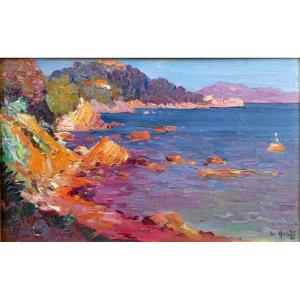


François Nardi (1861–1936) Toulon, Seaside At Cap Brun
Artist: François Nardi (1861-1936)
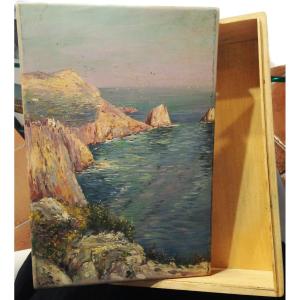
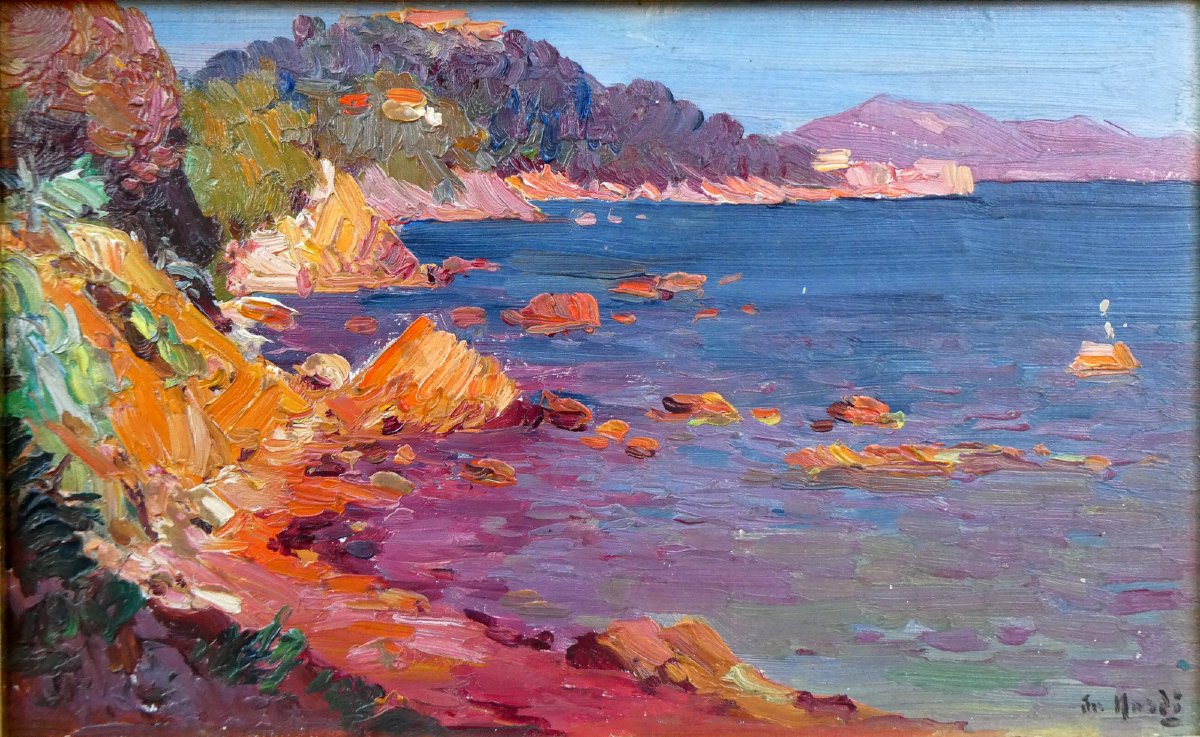
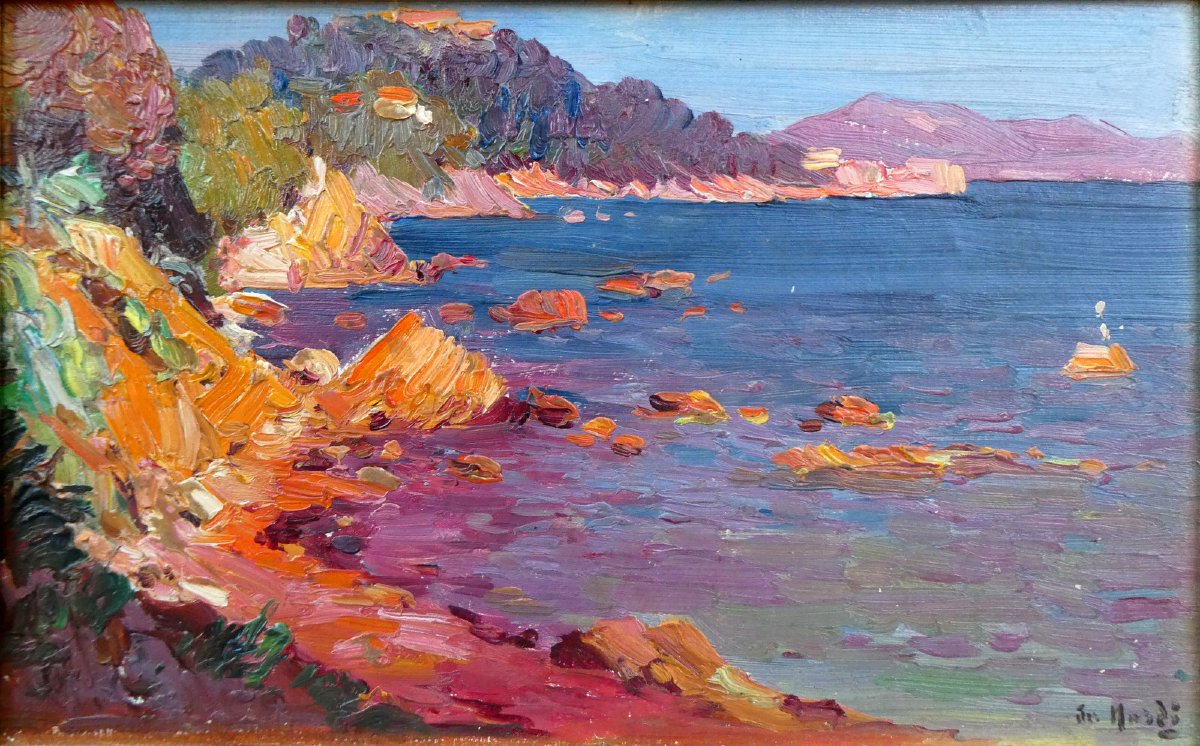
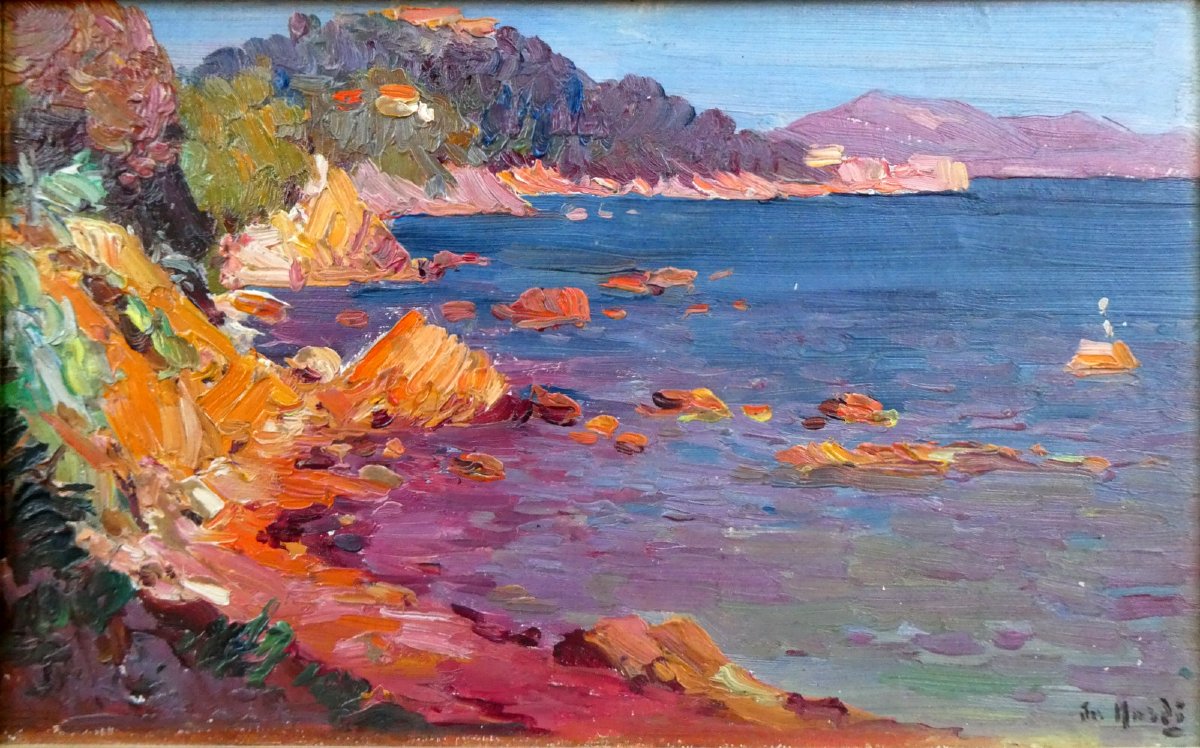
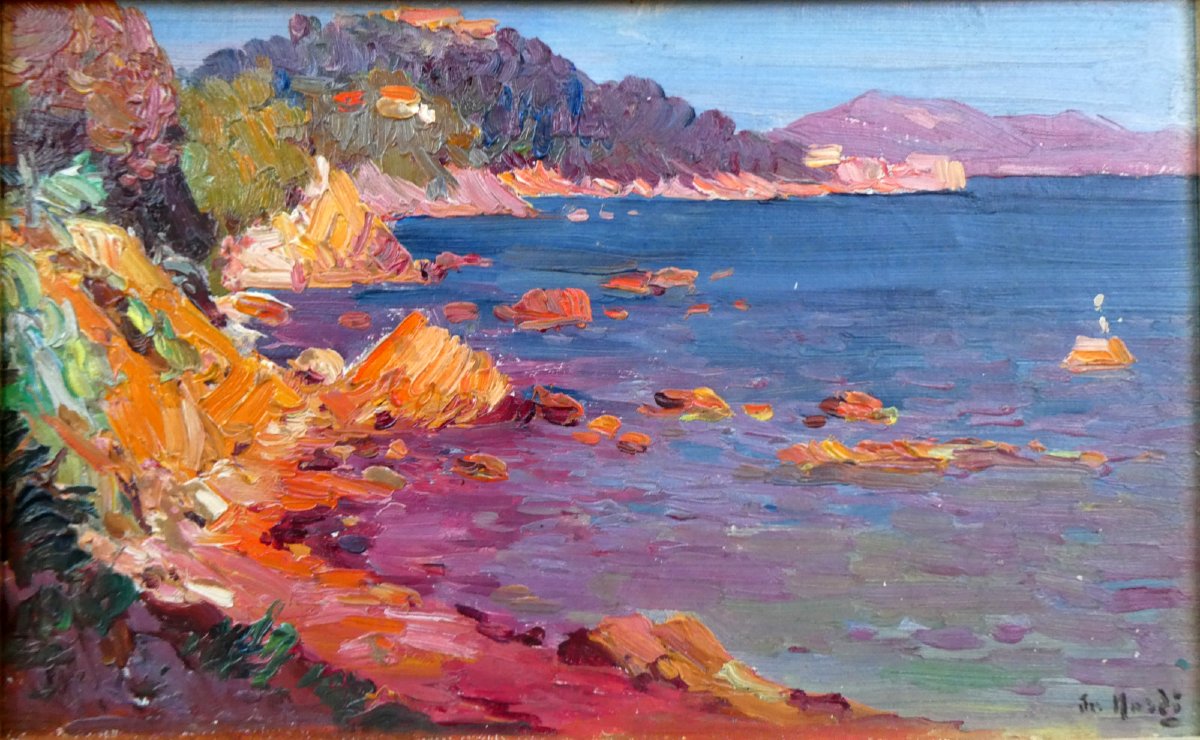
A bold touch with the knife and a broad brush, with beautiful impasto on the rocks where the paint catches the light.
The brushstrokes follow the contours of the forms—hatching on the slopes, horizontal strokes on the water—which lend energy and movement.
Painted in oil on a cardboard panel, the work conveys a sense of rapid execution, done from life, typical of a study or sketch.
The cardboard support, commonly used for this type of work, is well-suited to this kind of rough draft painting.
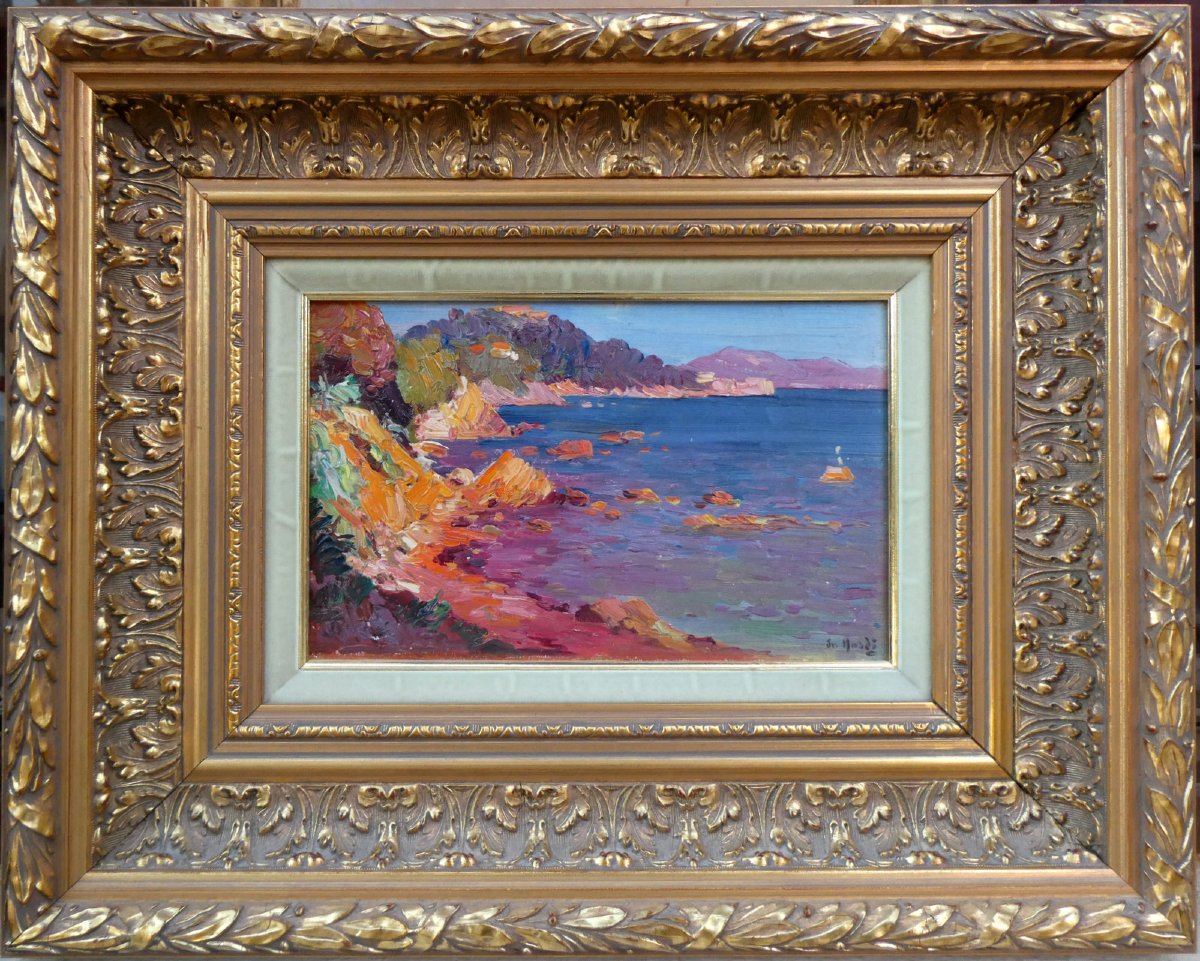
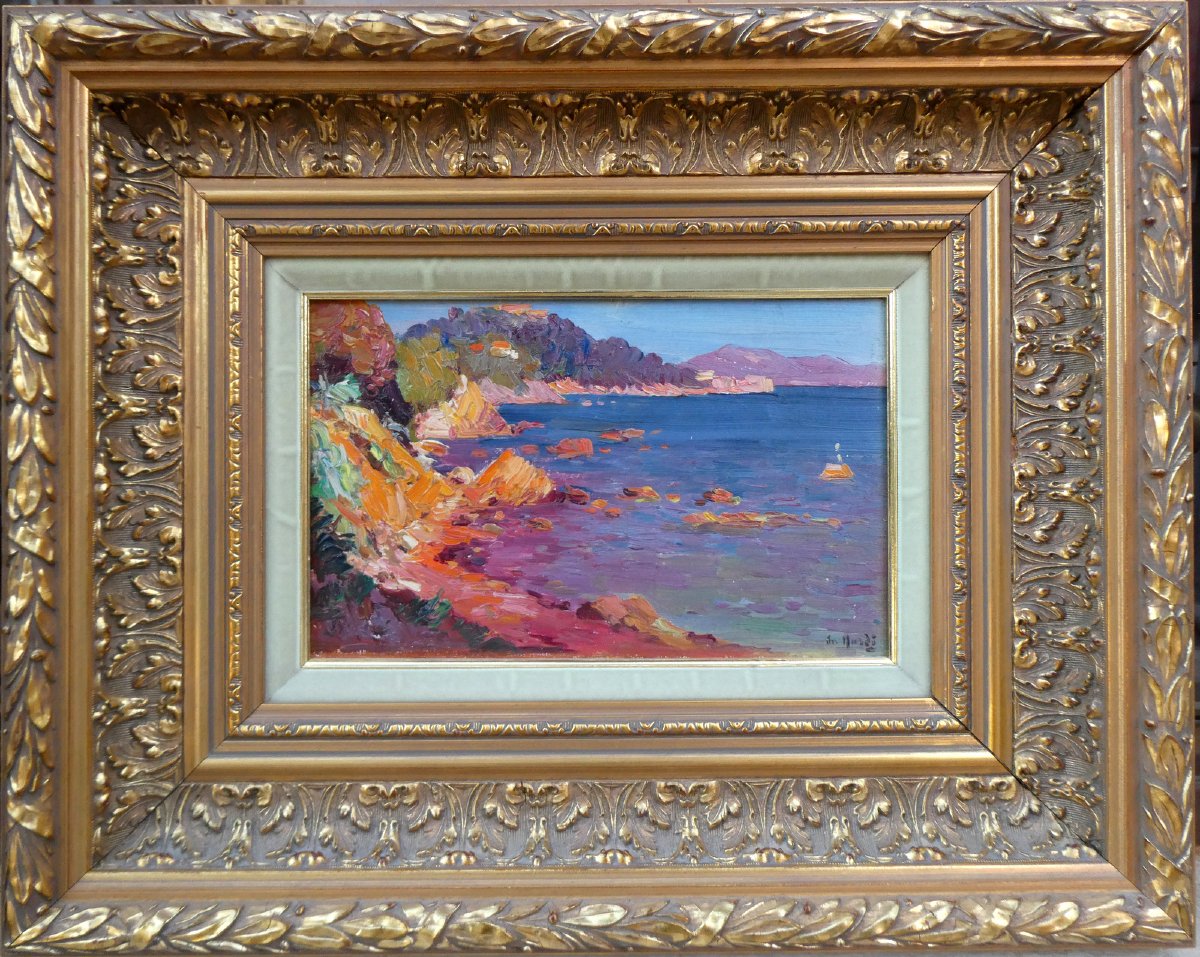
The work is presented in a carved, gilded frame measuring 39 cm by 49 cm, with the cardboard panel measuring 17 cm by 27 cm.
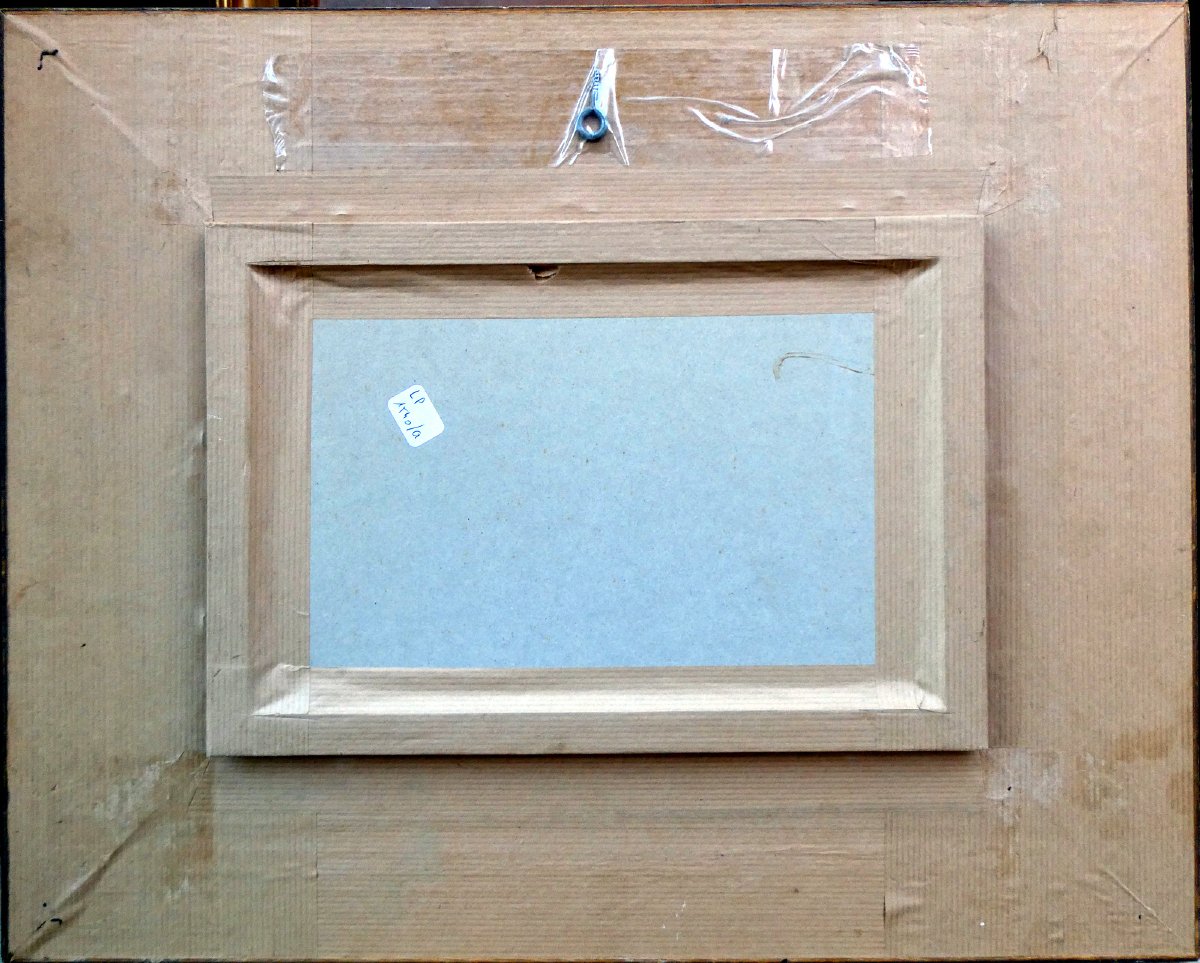
A quick note: the cardboard panel visible in the photo of the back is a backing board added by the framer and conceals the original cardboard used by the artist.
In good condition, it is signed in the lower right corner and depicts a seaside scene in Toulon, with Fort du Cap Brun and the Sainte Marguerite cliffs in the background.
An effective and fairly understated composition, with the orange slope in the foreground on the left sloping down toward the center, then the coastline stretching into the background to Fort du Cap Brun, surrounded by trees and the Sainte Marguerite cliffs.
This succession of planes in intense colors—ochre, dark purple, pink, and mauve—creates a real sense of depth despite the small format.
The rocks in the water serve as focal points, guiding the viewer’s gaze from the foreground toward the horizon.
With great skill, the artist makes marvelous use of color, playing on the contrasts between orange and yellow on the rocks, ultramarine blue and violet in the sea, and the red of the Var coastline, which lends an almost Fauvist intensity.
As for the sea, it shifts from deep blue offshore to purple and pink near the shore, suggesting both the transparency of the seabed and the reflections from the shoreline.
A lovely little study—spontaneous, lively, and luminous, well-composed—that captures the brilliance of the Mediterranean sun on the red rocks.
A self-taught artist, he was noticed by Frédéric Montenard, who offered him advice and encouraged him to go to Paris. After attending the Académie Julian (1887-1889) and exhibiting his works at the Salon des Artistes Français, he quickly achieved international success with his landscapes of the Mediterranean and Provence. In his early work, he shared similarities with his contemporary, Claude Monet, but seems to have been only slightly influenced by the artistic movements of his time. Nevertheless, he remained closely aligned with the Impressionists. Returning to Toulon in 1909, he continued to paint until his death. His oeuvre comprises more than 3,500 works, including paintings, oil paintings on wood, watercolors, and drawings.
With a style reminiscent of the Impressionists – François Nardi is often called the "painter of atmosphere, effects, and deep waters" –
His style remains relatively consistent from beginning to end, though this doesn't preclude a certain diversity. His work is characterized above all by a deep connection to the Mediterranean and Provence.
It features the movement of the sea, the harbor of Toulon, sails, fishing boats and squadron views, leaning pines, and tranquil coves. Ports abound, Toulon of course, but also those of Nice, Cannes, Cassis, and Marseille. The landscapes, with their paths, flowering trees, rivers, and houses, are almost all located in the Toulon hinterland. From the towns, he particularly focuses on the steep streets, squares, markets, facades, and church steeples.
Often painting the same places, he captures their changing appearances through the effects of the mistral wind, clouds, or sunshine, and the skies of morning and evening. He enjoys depicting the vastness of the sea, whether calm or choppy, as much as the coastlines with their turbulent waves or, conversely, peaceful ones into which one can plunge, often through the pines, into the depths.
In Paris, his southern soul is primarily drawn to the Seine, with its bridges and boats, around the Île de la Cité and Notre-Dame. He has a particular fondness for the Place de la Concorde, which he portrays from every angle, not forgetting the Place de la République and the Place Pigalle.
In Venice, he delights in capturing the interplay of light and shadow on the water and the facades in the canals. The sails of the bragozzi (traditional fishing boats) or the large ships, as well as the gondolas, often capture his interest. Drawing was a central part of François Nardi's artistic training, from his early studies in nature to his later work as a form of study. His painting output is primarily concentrated between 1887 and 1909. Afterward, due to his limited mobility, he produced more oil paintings on wood and watercolors than canvases.
His oeuvre comprises no fewer than 3,500 works.
Main Exhibitions
Paris, Salon des Artistes Français
• 1889: Fishing Boat in Provence (1988)
• 1890: Toulon Harbor, Mistral Wind Effect (1775); A Corner of the Old Port, Toulon (1776)
• 1891: A Quay at Sunset, Toulon (1229); The City of Toulon (1230)
• 1892: Mistral Wind Effect, Morning (1273); Mistral and Dust (1274)
• 1893: In Provence (Road of the "Lovers' River")
• 1894: Misty Morning in Toulon Harbor (1374); Landscape in Provence (1375)
• 1895: Sunset (1423) A Corner of Toulon Harbor (1424)
• 1896: Effect of Gray Weather in Provence, Toulon (1493)
• 1897: Toulon Harbor, Mistral Wind Effect (1252); Landscape in Provence, Toulon (1253)
• 1898: First Days of Autumn in Provence (1525)
• 1899: Magaud Bay at Sunset, Provence (1469); Road in Provence in the Sun (1470)
• 1900: Olive Trees and the Road to Cap Brun, Toulon (986)
• 1901: A Path in Provence (1527); Boat Under Repair, Toulon (1528)
• 1902: Transparencies of the Sea (1231) Olive Trees in Provence (1232)
• 1903: The Grand Canal in Venice (1332)
• 1904: The Old Port of Toulon (1345)
• 1905: Sanary through the pines and olive trees, Provence (1409)
• 1906: On the heights of Bormes, Provence (1243)
• 1907: The Market of Place Saint-Jean, Toulon (1196)
• 1908: Cap Brun, Toulon (1363)
• 1909: In the Old Port of Marseille (1348)
• 1931: Transparencies of the Sea (French Riviera) (1659)
Main Exhibitions
Paris, Salon des Indépendants
• 1892: Four Views of Paris
• 1893: Mistral Wind Effect, Evening; Seascape with pine branch; Calm morning on the coast (Provence); Magaud rocks; Entrance to the commercial port (Toulon); Forges and shipyards of La Seyne
• 1894: A Corner of the Merchant Port; A Corner of Toulon Harbor; Le Mourillon Seen from the Coast; Morning Effect, at L'Estaque; Tartanes at L'Estaque
• 1895: Tartane Leaving; Fort Saint-Louis, Toulon; Battleship in Calm Weather, Toulon Harbor; Market at Toulon; Riverside Cafés at Les Sablettes; Tartanes; Gray Weather; Old Farmhouse at Les Sablettes
Other Exhibitions
• Bordeaux: Society of Friends of the Arts in 1892, then from 1894 to 1908 (except 1903)
• Chicago (United States): World's Columbian Exposition of 1893 (French section, out of competition), Mistral Wind Effect, Morning, Toulon Harbor
• Florence (Italy): Society of Fine Arts in 1891 and 1892
• Hyères: Society of Friends of the Arts, from 1913 to 1914, and from 1919 to 1915
• Monaco: International Exhibition, from 1895 to 1913 (except 1897), 1920 and 1922
• Nantes: 1894 to 1902, 1905, 1906
• Nice: Society of Fine Arts in 1894, 1903, 1906, 1908, 1910, 1914 and 1921
• Saint Petersburg (Russia): Palace of Fine Arts in 1901, Torpedo boats battered by the mistral wind in the Toulon roadstead; First days of autumn in Provence; Magaud Bay at Sunset (near Toulon)
• Toulon: Society of Friends of the Arts in 1903, 1906, 1909, 1911, and from 1923 to 1936
• Toulouse: from 1893 to 1903 (except 1897), and from 1906 to 1909
Posthumous Exhibitions
• Paris: Salon of French Artists of 1937, Pine Tree by the Sea and Cliff (no. 953)
• Toulon: Society of Friends of the Arts in 1937, Honorary Panel
• Toulon: Municipal Museum of Fine Arts in 1984, François Nardi
• Hyères: Municipal Museum Les Palmiers in 1986, François Nardi. From Venice to Paris
• Toulon: Maritime Museum in 1986, François Nardi. The Toulon harbor
• Toulon: National Maritime Museum, 1989, François Nardi. The sea, the ports, Provence
• Hyères: Municipal Museum Les Palmiers, 1994, François Nardi in Provence
1 800 €
Period: 19th century
Style: Other Style
Condition: Good condition
Material: Oil painting on cardboard
Length: 27 cm
Height: 17 cm
Reference (ID): 1843481
Availability: In stock
Print