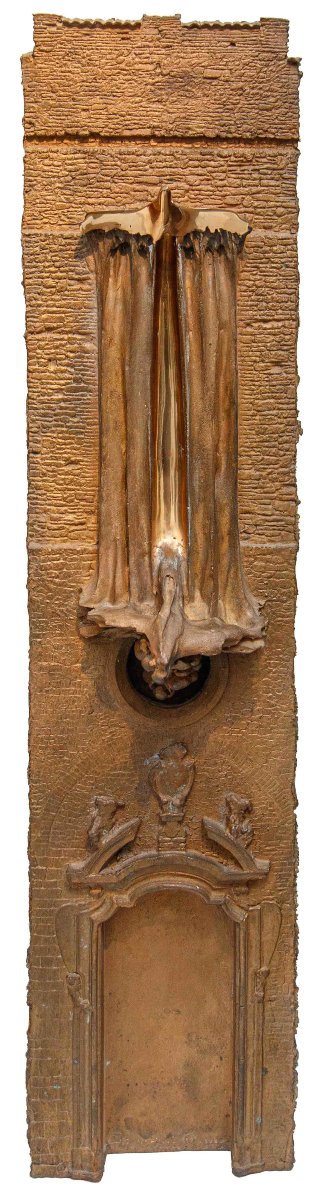
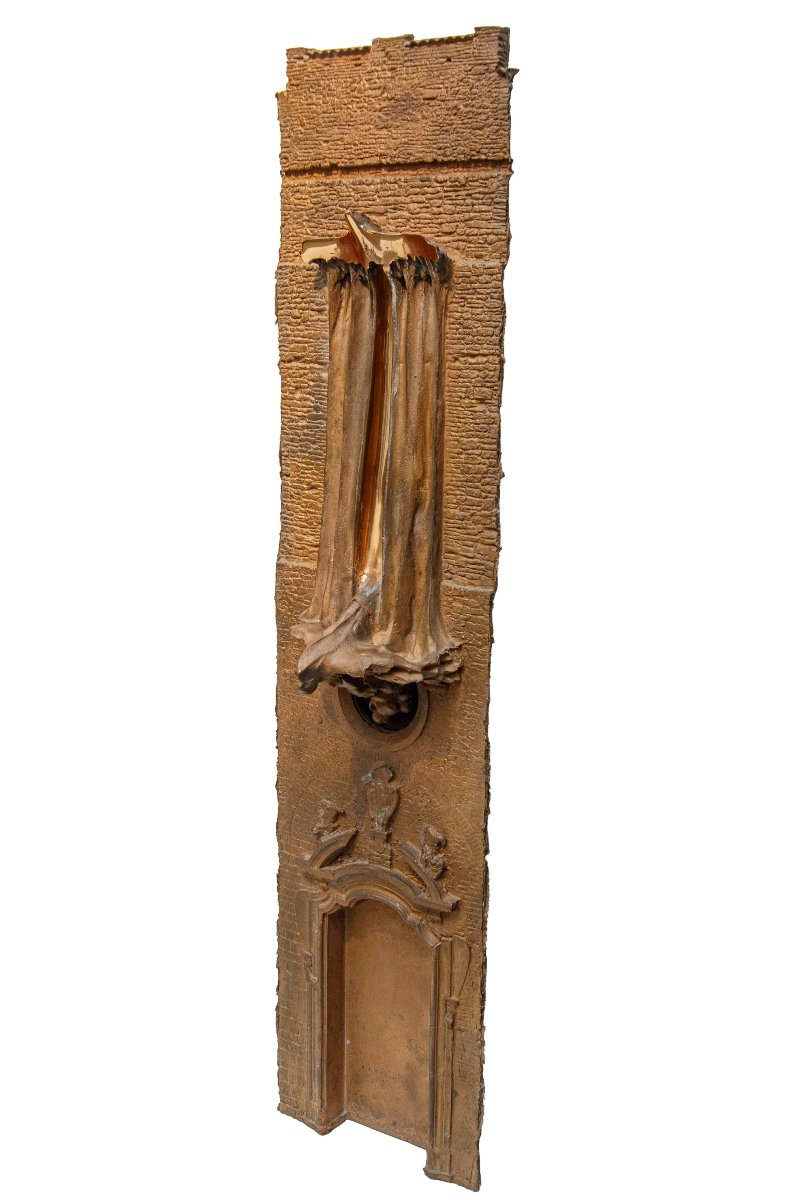
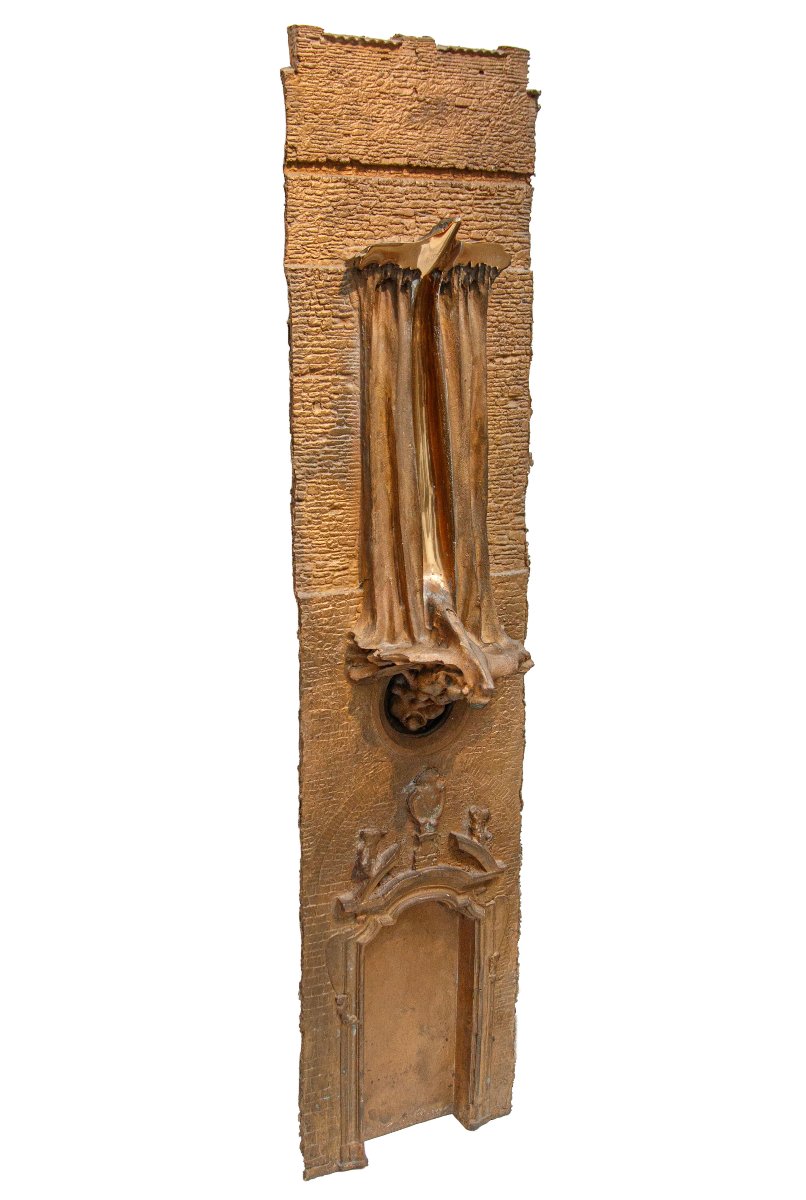
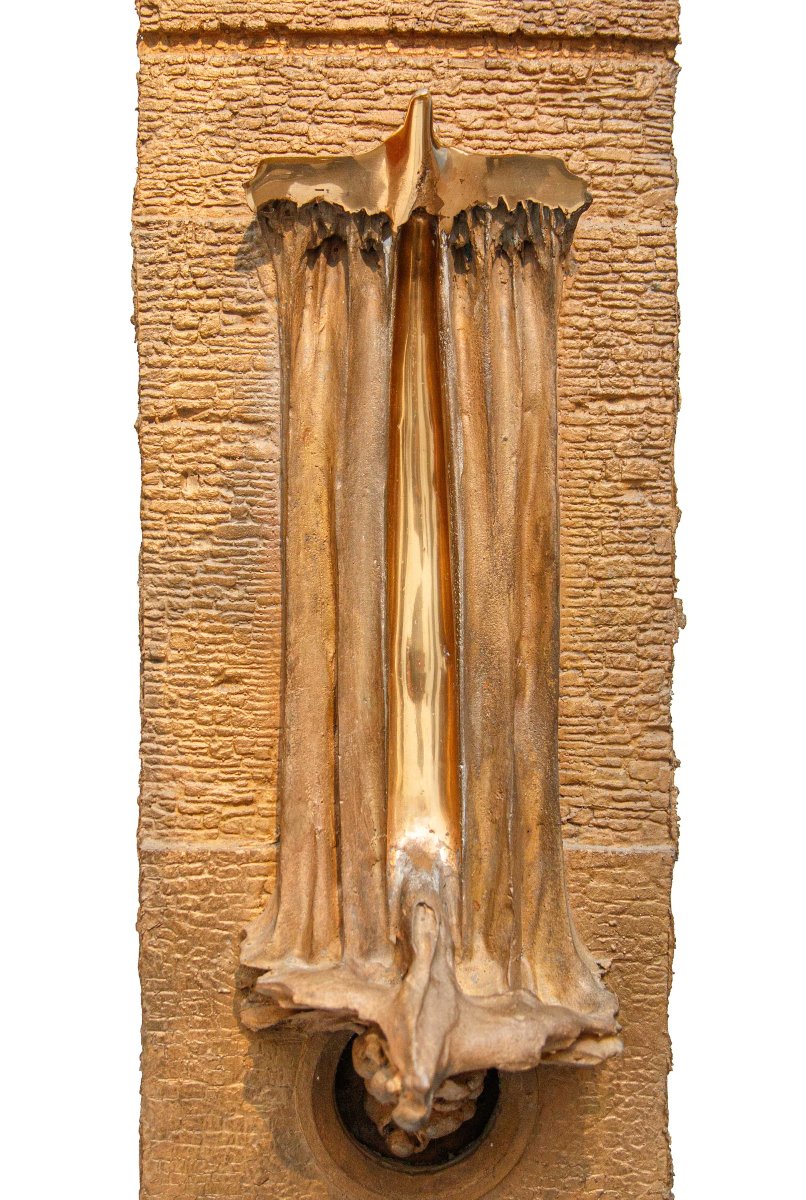




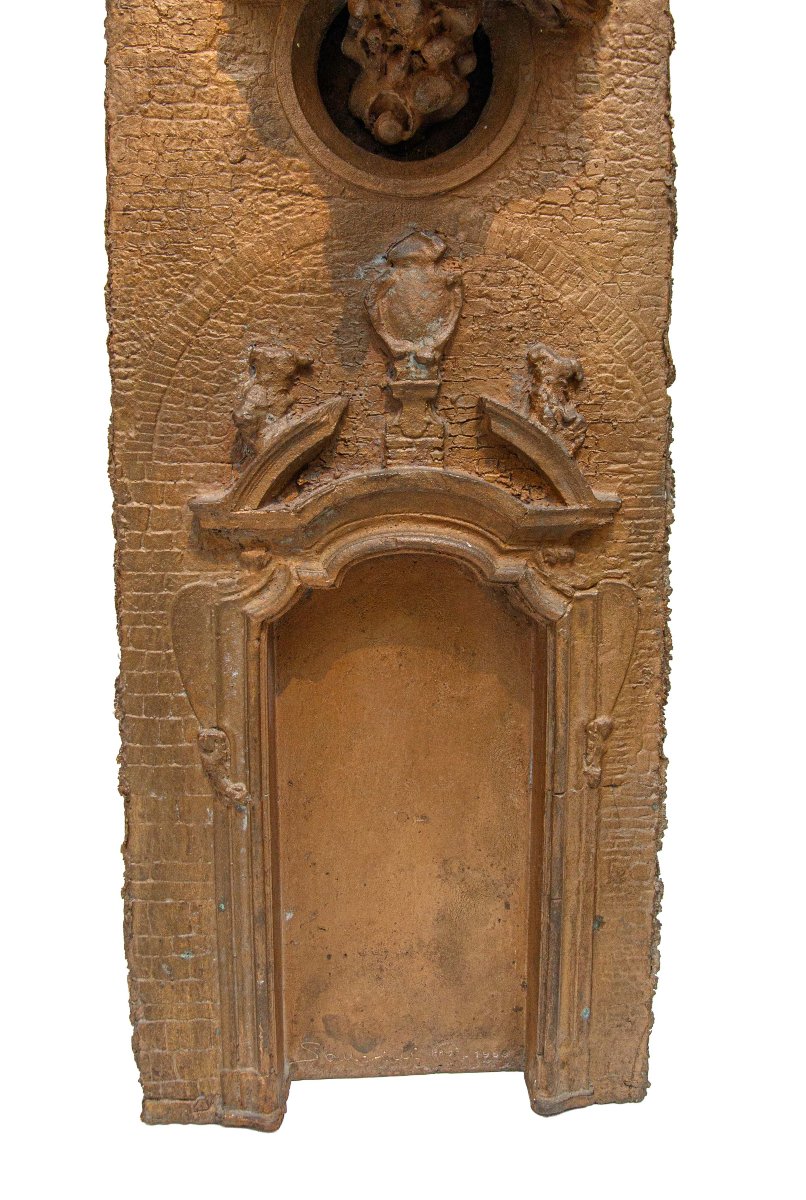

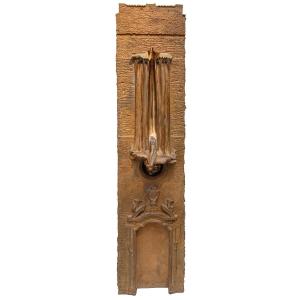


Francesco Somaini (lomazzo, 1926 – Como, 2005), The Descent Of The Holy Spirit, 1969
Francesco Somaini (Lomazzo 1926 – Como 2005)
Descent of the Holy Spirit, 1969
Bronze sketch, 120 cm
Signed lower center
Model for the façade of the Church of Santo Spirito in Bergamo
Certificate of Authenticity from the Francesco Somaini Sculptor Foundation
Francesco Somaini (1926–2005) occupies a position of preeminent importance in the international sculpture scene of the second half of the 20th century, distinguishing himself through a sculptural exploration capable of combining the impetuosity of Informal art with a rigorous reflection on monumentality and the relationship between the sculptural form and urban space. Trained at the Brera Academy under the guidance of Giacomo Manzù and holding a law degree, the artist early on distanced himself from traditional figurative art to arrive at a language in which matter is understood as a site of event and existential rupture.
The core of Somaini’s work lies in his relentless “hand-to-hand struggle” with materials: from bronze to iron, from lead to experiments with marble and stone. In the 1950s, his adherence to the principles of the Nuclear Movement and Informal Art resulted in a series of works—among which the famous *Martìri* and *Feriti* stand out—in which form seems to emerge from an internal explosion. The surfaces are ravaged by gashes and cavities that evoke the collective trauma of the postwar period, transforming the sculpture into a tangible testament to suffering and vital force. Beginning in the 1960s, the artist introduced a revolutionary technical innovation: the use of high-pressure sandblasting for sculpting. This method allowed him to work through erosion, creating sculptural contrasts between the smoothness of the surface and the roughness of the carved recesses, as if the stone were being worn away by a relentless natural force. In this phase, the theme of metamorphosis became central: the organic body merged with almost architectural geometries, a prelude to the great mature period dedicated to “urban” sculpture.
In the final decades of his career, Somaini moved beyond the conception of the artwork as an isolated object to embrace an environmental dimension. Through the concepts of “Trace” and “Anamorphosis,” he theorized a form of sculpture capable of engaging in an organic dialogue with architecture and the urban fabric. His monumental works, found in cities such as Milan, Bergamo, and New York, do not merely occupy a space but seek to redefine it, acting as historical imprints that engage with the surrounding landscape. Today, Somaini’s critical acclaim is cemented by the presence of his works in the world’s most prestigious museums, from New York’s MoMA to the Centre Pompidou in Paris.
The work on display is an important piece of Francesco Somaini’s monumental oeuvre: it is the model for the façade of the Church of the Holy Spirit in Bergamo, commissioned from the artist in the second half of the 1960s and unveiled in 1972. With these sketches, the artist won the public competition for the decoration of the church, an important sacred site in Bergamo that houses works by Lotto, Bergognone, and Previtali.
This model documents the artist’s creative process, during which he produced several preparatory sketches; one of them was gifted to John Paul II, who had stayed at that very church during his youth. Somaini would later be appointed by the Pope himself as Full Professor at the Pontifical Academy of Fine Arts and Letters of the Virtuosi al Pantheon.
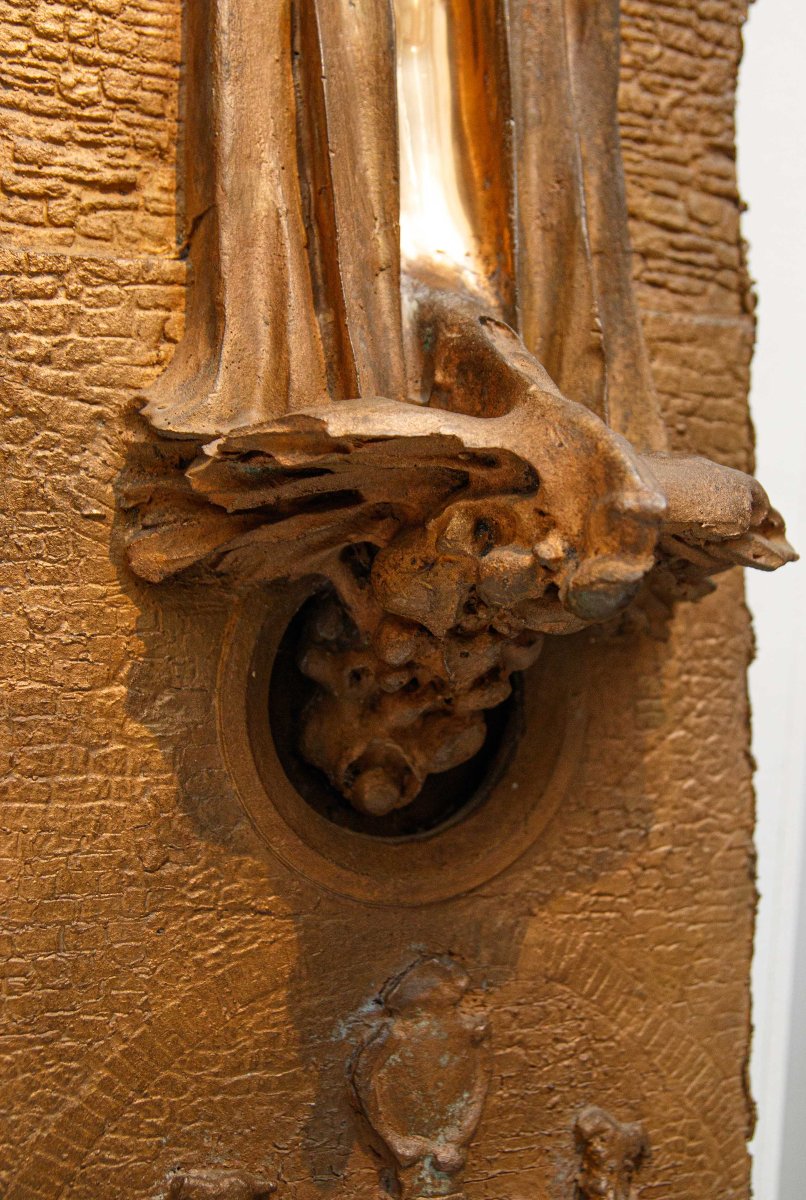
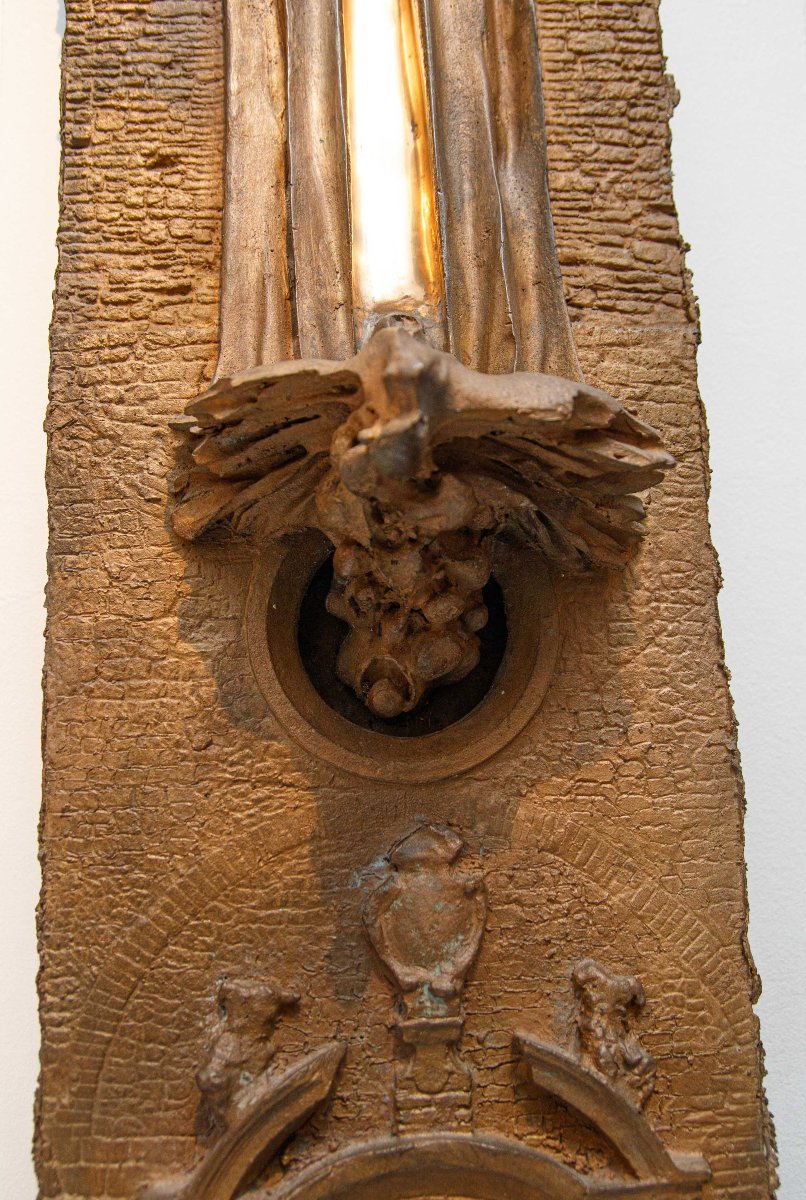
The sculpture interprets the theme of Pentecost by depicting a dove swooping down, leaving a sculptural “trail” that culminates in an explosion of outspread wings. The work was designed to serve as a pendant to Bergognone’s 1508 altarpiece, which is also dedicated to the Descent of the Holy Spirit. Here, Somaini transforms metal into an energetic event where real light, reflected in the central slit, becomes a metaphor for the divine and a visible “trace” of the invisible. The composition thus blends a solid architectural foundation with the dynamism of the Christian symbol, establishing a close dialogue between ancient and contemporary art.
Period: 20th century
Style: Other Style
Condition: Good condition
Material: Bronze
Height: 120
Reference (ID): 1842188
Availability: In stock