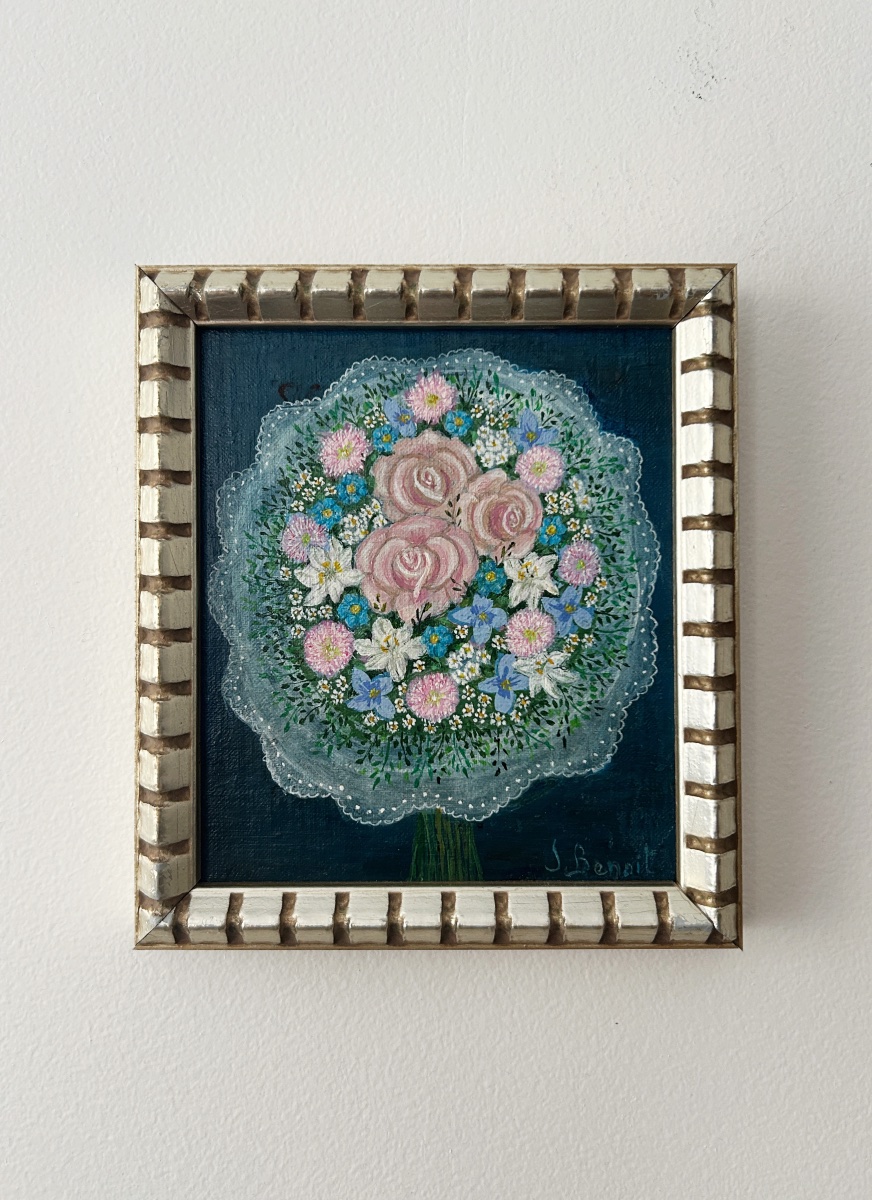
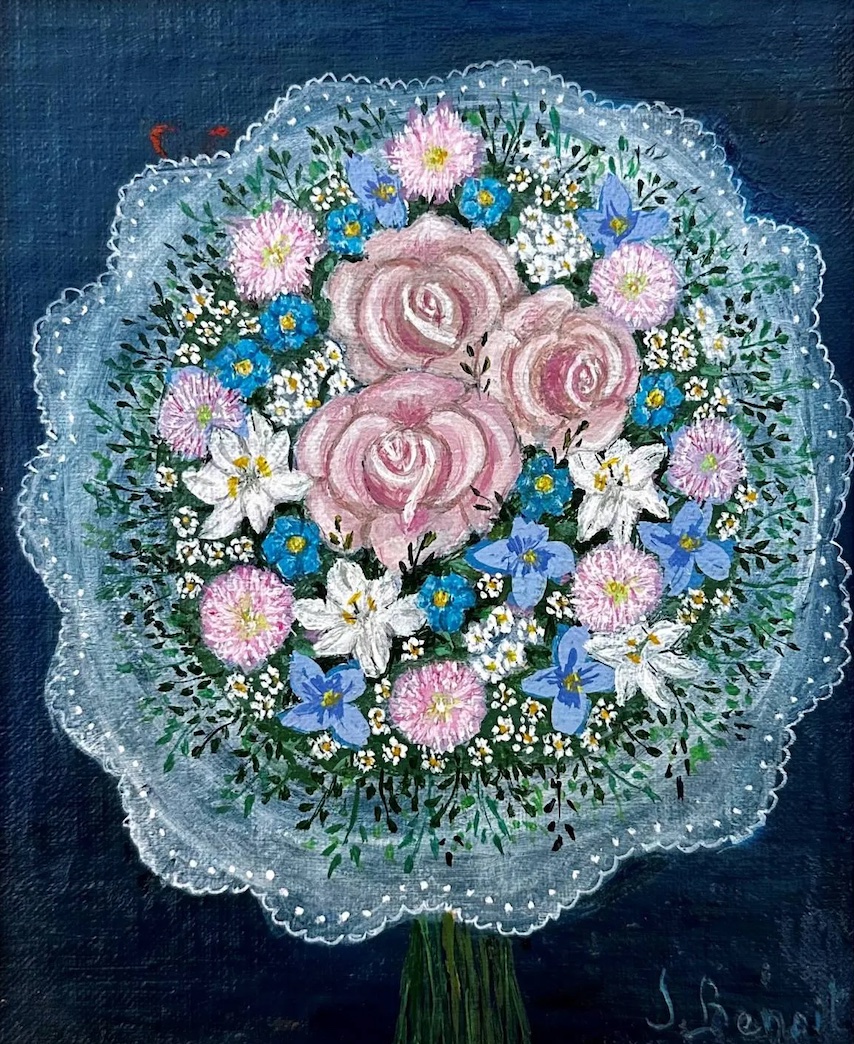
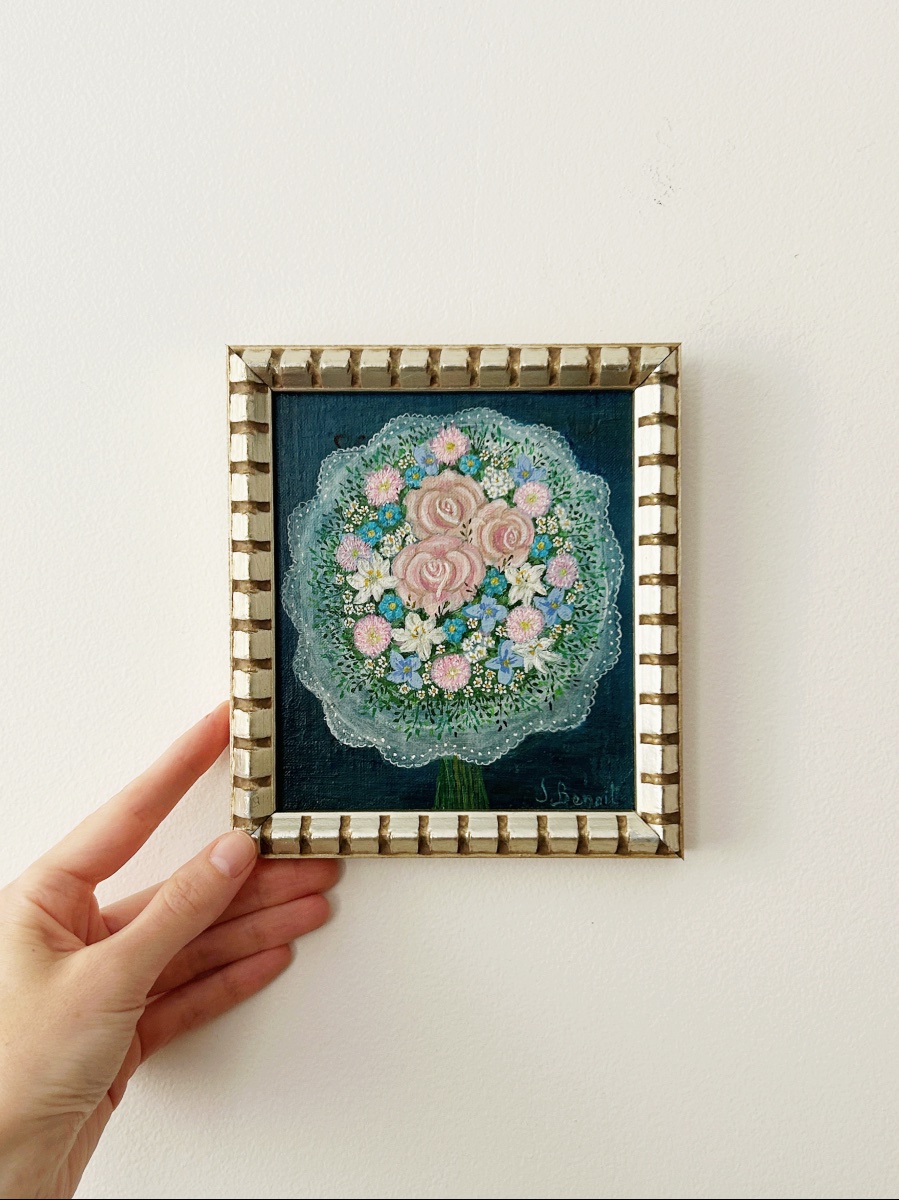
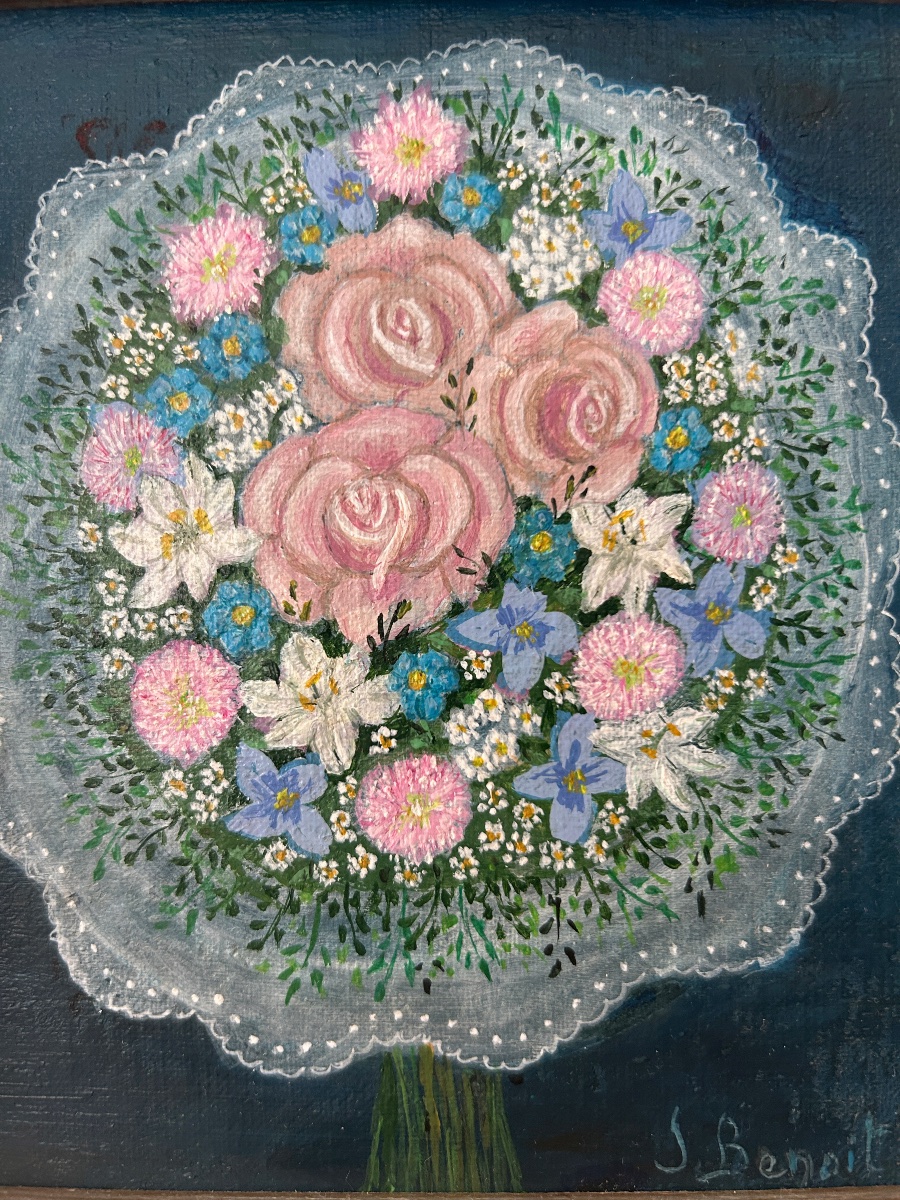
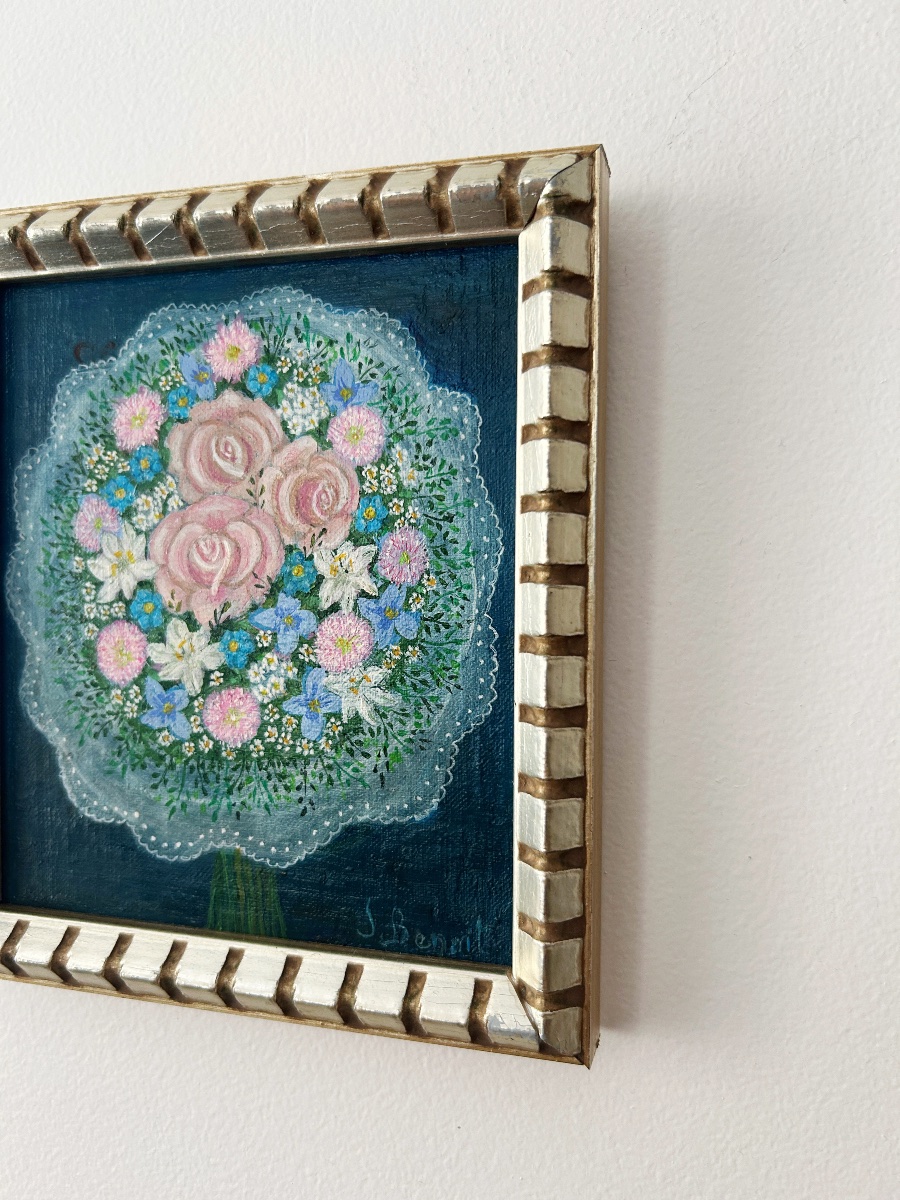


Naïve Art By Jacqueline Benoit (born In 1925), Bridal Bouquet, C. 1982
Art Naïf
Jacqueline BENOÎT
1925–2012
Bridal Bouquet, c. 1982
Oil on canvas mounted on cardboard
Signed “J. Benoit” lower right
14.5 x 11 cm
Born in 1925 in Paris, Jacqueline Benoît showed an interest in painting from childhood. She first experimented with gouache before turning to oil painting in the 1950s. From then on, she devoted her life to painting, secluded in her bedroom-studio in Orléans. She participated in the Salon d’Automne and, beginning in 1964, in the Salon Comparaisons, as well as in several exhibitions at museums dedicated to naïve art in France, Switzerland, and the United States. Her work, though produced later in her career, follows in the tradition of Le Douanier Rousseau, Séraphine de Senlis, and Balthus.
Her meeting with the Franco-Italian writer Joseph-Marie Lo Duca in 1964 helped spread awareness of her work, as he introduced her to the art naïf theorist Anatole Jakovsky (1907–1983). An art critic and collector, Jakovsky was responsible for the donation that led to the creation of the International Museum of Naïve Art in Nice, which opened in 1982 and whose collection includes, among others, works by Henri Rousseau, Séraphine de Senlis, André Bauchant, and Louis Vivin. The Museum of Naïve Art and Singular Arts in Laval, which also houses works by the artist, dedicated a solo exhibition to her in 1975.
Influenced by early Italian painting, Jacqueline Benoît’s art is mysterious and veiled. Solitude is a recurring theme in her work. Her compositions reveal the inner lives of melancholic young women for whom love seems like an illusion. Endowed with a vivid imagination, she depicts both scenes from daily life and religious scenes such as weddings, most often set against lush, verdant landscapes.
The painting we are presenting depicts a bridal bouquet that seems to foreshadow a larger-scale work. Its size and the delicate rendering of the flowers lend it a great sense of sensitivity. The choice of the pink rose evokes the tenderness and purity of the bride-to-be, while the white lily symbolizes innocence. We find these same flowers in another painting depicting a similar bouquet.
Period: 20th century
Style: Other Style
Condition: Excellent condition
Material: Oil painting
Reference (ID): 1837344
Availability: In stock