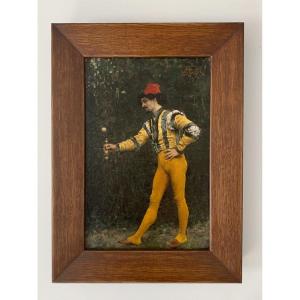



Pierre De Maria (1896-1984), Man At Arms, 1968, Oil On Canvas
Artist: Pierre De Maria (1896-1984)
Pierre DE MARIA (1896-1984)
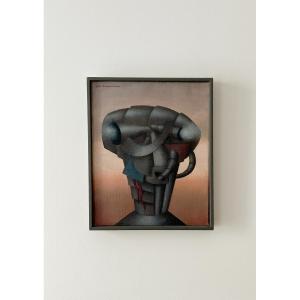
Homme d'armes, 1968
Oil on canvas
Signed top left
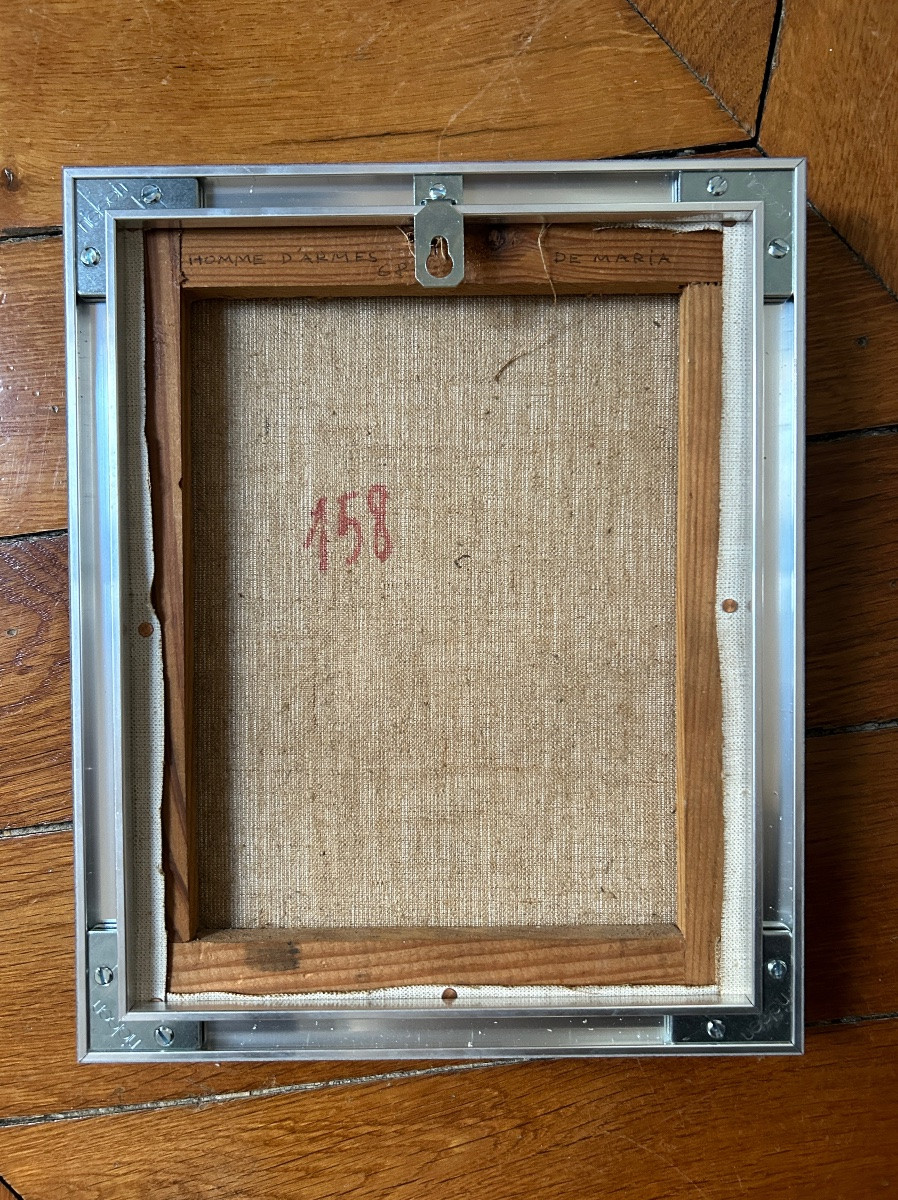
Dated and titled on the back
25 x 20 cm
Born in Paris in 1896, Pierre de Maria is a painter with a singular trajectory, free from any doctrine. Fascinated by mechanics, machines and their metallic cogs, he grew up in a family of industrialists, manufacturers of optical instruments for photography and cinema, established in the Canal Saint-Martin district of Paris.
After obtaining an engineering degree, Pierre de Maria enlisted in 1914. The spectacle of the atrocities of war and its killing machines would leave a lasting mark on his memory. "I enlisted in 1914 out of a taste for rare spectacle. It was long and atrocious, but I acquired a love of charred landscapes, of iron and steel monsters spitting fire. », Pierre de Maria, 1980, interview with Jean-Roger Soubiran, honorary professor of art history at the University of Poitiers.
In the aftermath of the First World War, he decided to devote himself to painting. He first worked in the Ronsin et Laverdet decoration workshop, which created sets for avant-garde theater companies. He exhibited for the first time at the Salon d'Automne in 1923, where he received an honorary prize in the Modern Painting section. From 1925, he worked in the studio of the architect-decorator Djo Bourgeois (1898-1937) and participated in the creation of the furniture for the ground floor of the Studium-Louvre at the International Exhibition of Modern Decorative and Industrial Arts. At the same time, he frequented the Surrealist group, from which he remained on the fringes.
After a brief stay in Geneva with his wife and children, he returned to Paris before settling in Nice in 1953. This was the beginning of his so-called “machinist” period, with the recurrence of the theme of machines in his painting. In 1958, his second exhibition in Paris (JC de Chaudun gallery) marked the beginning of recognition by the Parisian artistic community, the press and collectors (among others Henri Roché, Jacques Prévert, André Pieyre de Mandiargues, Jean Cocteau, and Salvador Dali).
In 1964, the discovery of his pictorial work by the fashionable gallery owner Iris Clert gave new impetus to his career. “Pierre de Maria uses the technique of the ancients to express the future,” Iris Clert. The 1968 oil on canvas titled “Man at Arms” that we are presenting belongs to this period when critics praised his painting. The following year, a first retrospective exhibition was organized by the museums of the city of Nice at the Galerie des Ponchettes.
Pierre de Maria maintains a critical vision of technological progress, which he sometimes ridicules. He transcribes a paradoxical world where the now omnipresent machine coexists with man in a relationship of fascination and fear. The concerns that drive him resonate with current debates on alienation by the robot-machine and artificial intelligence.
Homme d'armes, 1968
Oil on canvas
Signed top left
Dated and titled on the back
25 x 20 cm
Born in Paris in 1896, Pierre de Maria is a painter with a singular trajectory, free from any doctrine. Fascinated by mechanics, machines and their metallic cogs, he grew up in a family of industrialists, manufacturers of optical instruments for photography and cinema, established in the Canal Saint-Martin district of Paris.
After obtaining an engineering degree, Pierre de Maria enlisted in 1914. The spectacle of the atrocities of war and its killing machines would leave a lasting mark on his memory. "I enlisted in 1914 out of a taste for rare spectacle. It was long and atrocious, but I acquired a love of charred landscapes, of iron and steel monsters spitting fire. », Pierre de Maria, 1980, interview with Jean-Roger Soubiran, honorary professor of art history at the University of Poitiers.
In the aftermath of the First World War, he decided to devote himself to painting. He first worked in the Ronsin et Laverdet decoration workshop, which created sets for avant-garde theater companies. He exhibited for the first time at the Salon d'Automne in 1923, where he received an honorary prize in the Modern Painting section. From 1925, he worked in the studio of the architect-decorator Djo Bourgeois (1898-1937) and participated in the creation of the furniture for the ground floor of the Studium-Louvre at the International Exhibition of Modern Decorative and Industrial Arts. At the same time, he frequented the Surrealist group, from which he remained on the fringes.
After a brief stay in Geneva with his wife and children, he returned to Paris before settling in Nice in 1953. This was the beginning of his so-called “machinist” period, with the recurrence of the theme of machines in his painting. In 1958, his second exhibition in Paris (JC de Chaudun gallery) marked the beginning of recognition by the Parisian artistic community, the press and collectors (among others Henri Roché, Jacques Prévert, André Pieyre de Mandiargues, Jean Cocteau, and Salvador Dali).
In 1964, the discovery of his pictorial work by the fashionable gallery owner Iris Clert gave new impetus to his career. “Pierre de Maria uses the technique of the ancients to express the future,” Iris Clert. The 1968 oil on canvas titled “Man at Arms” that we are presenting belongs to this period when critics praised his painting. The following year, a first retrospective exhibition was organized by the museums of the city of Nice at the Galerie des Ponchettes.
Pierre de Maria maintains a critical vision of technological progress, which he sometimes ridicules. He transcribes a paradoxical world where the now omnipresent machine coexists with man in a relationship of fascination and fear. The concerns that drive him resonate with current debates on alienation by the robot-machine and artificial intelligence.
1 800 €
Period: 20th century
Style: Other Style
Condition: Excellent condition
Material: Oil painting
Reference (ID): 1617121
Availability: In stock
Print