
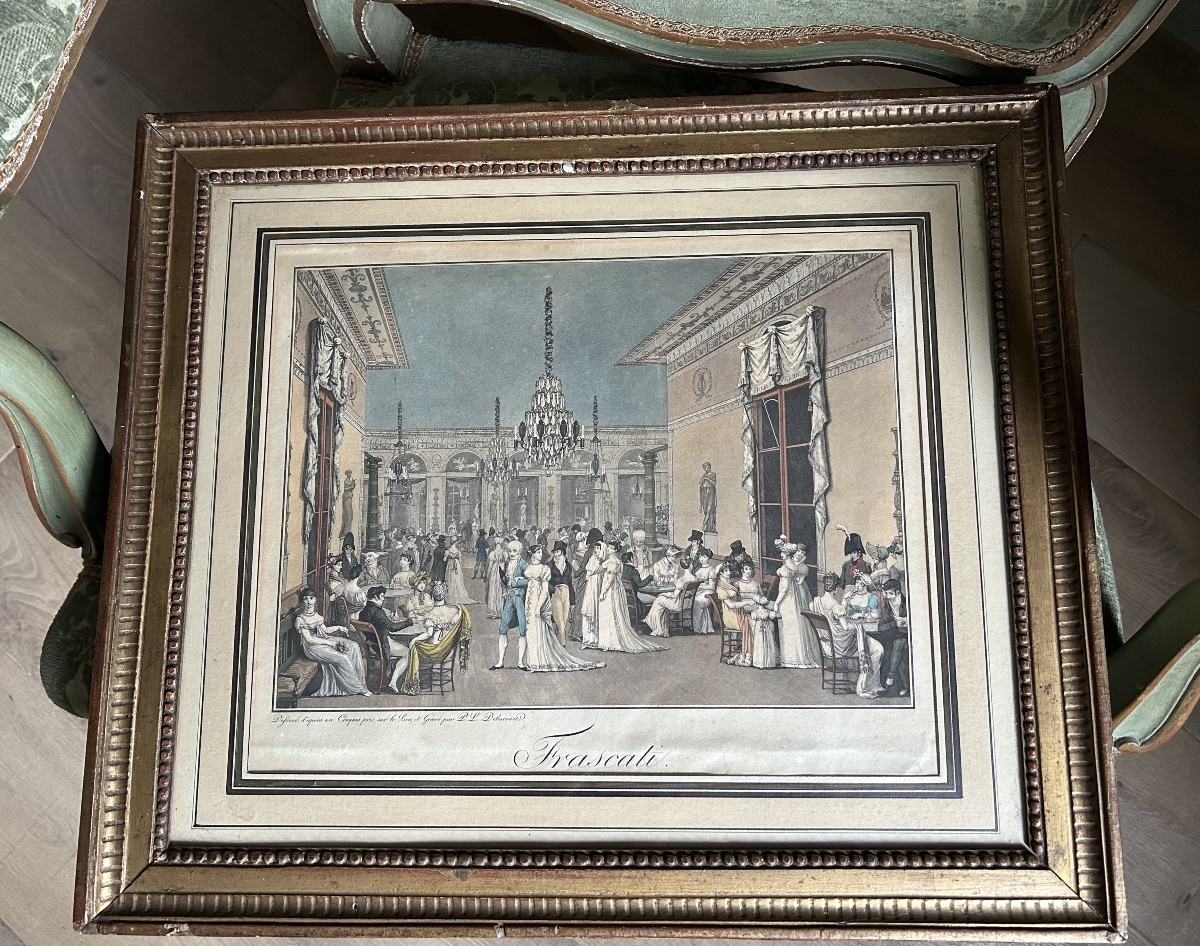
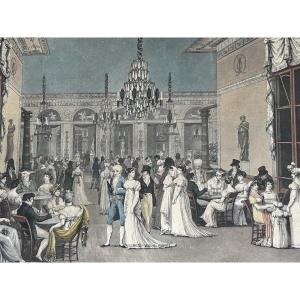


The Frascati Glacier During The First Empire, 1807, Engraved By Philibert Louis Debucourt
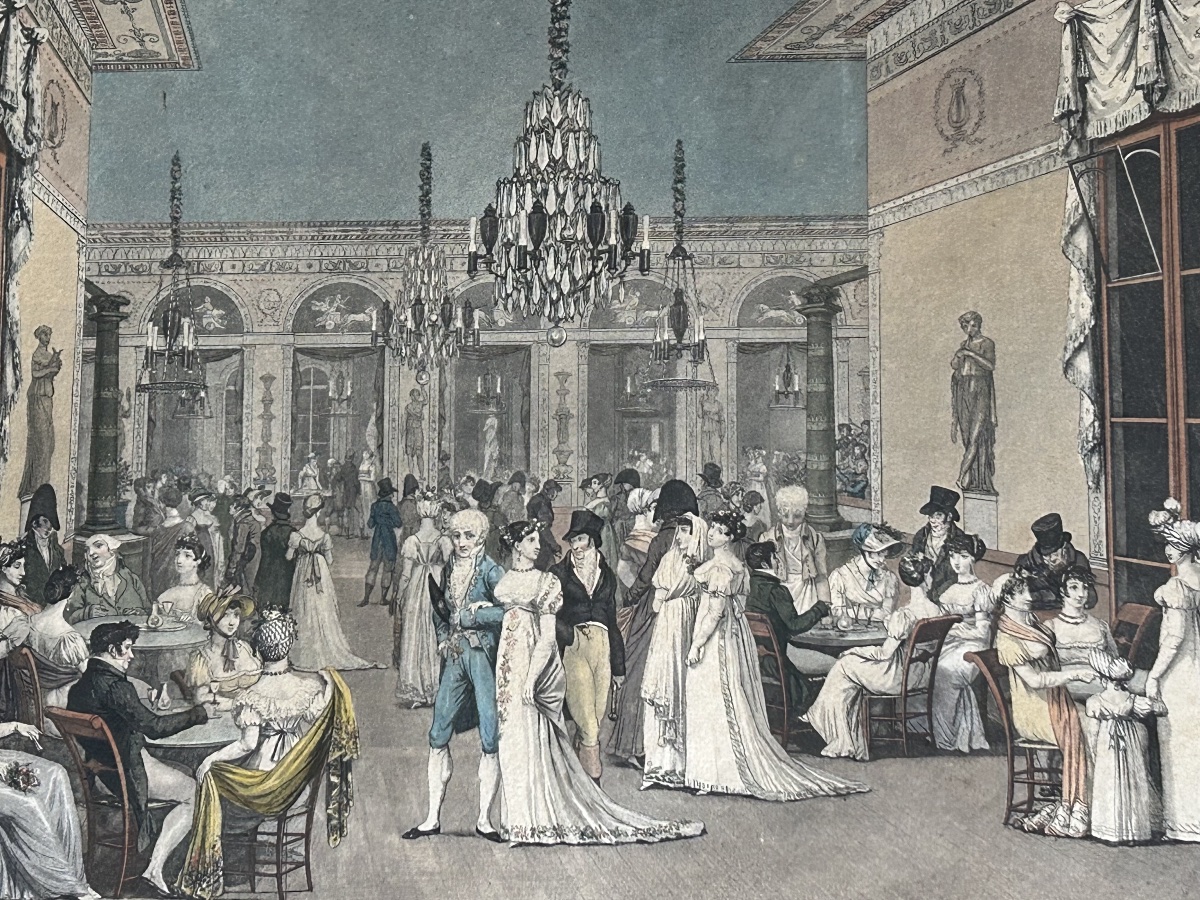
A large engraving from the First Empire period, titled "Frascati", created by the famous Parisian painter and engraver Philibert-Louis Debucourt (1755–1832). Published in 1807, this masterful aquatint is a definitive work of early 19th-century printmaking.
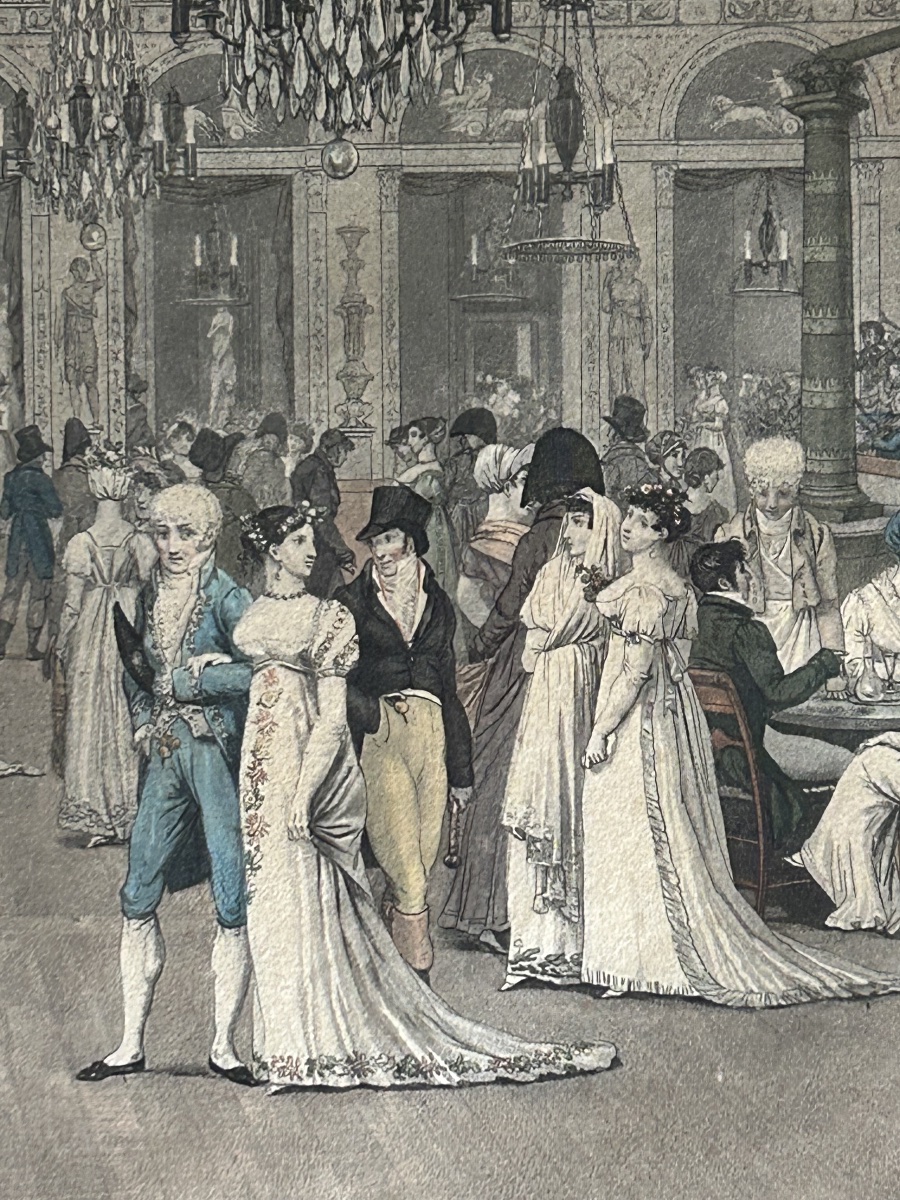
It offers a bird’s-eye view, rendered with infinite precision, of the grand hall of the legendary Café Frascati, a mecca for pleasure, nightlife, and social gatherings in Parisian society, then located at the corner of Boulevard Montmartre and Rue de Richelieu.
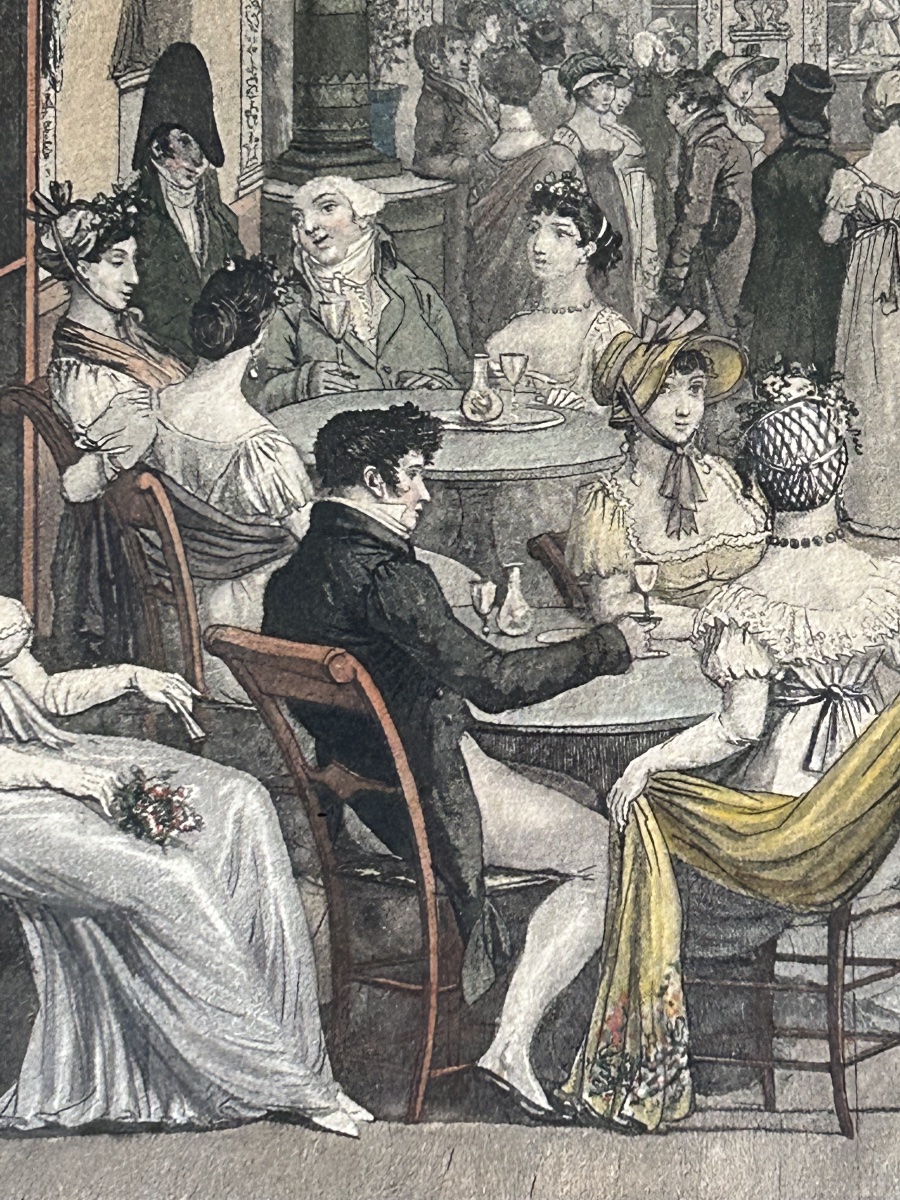
The scene depicts an elegant crowd of men in frock coats and women in Empire-waisted gowns, moving beneath majestic crystal chandeliers, large mirrors, and meticulously arranged draperies characteristic of the taste of the era. The Secret Connection Between Frascati and the Élysée This work is intimately linked to a famous chapter in the history of what is now the Élysée Palace. During the Revolution and the Directory, the former Hôtel d’Évreux was confiscated and leased to private entrepreneurs, who transformed its grounds into public pleasure gardens (the “Jardins d’Idalie” and later the “Jardin de l’Élysée”). It was there that a famous ice cream maker and confectioner named Garchi set up shop in 1797 to treat the upper middle class, the Incroyables, and the Merveilleuses to his sorbets, which were then considered the ultimate luxury. Building on his immense success at the Élysée, this same artisan ice cream maker, Garchi, later founded the famous Café Frascati, immortalized here by the genius of Debucourt. This print thus captures the quintessence of this world of post-revolutionary galant parties and sophisticated delicacies.
- Notes and Inscriptions: Below the square line in the lower left corner, one can make out the original inscription: "Drawn from a Sketch Made on Site, and Engraved by P. L. Debucourt". The title "Frascati" appears majestically in the center.
- Frame: Presented in its rich, gilded wood and stucco frame with fluted channels from a later period (19th century), enhanced by an elegant beaded frieze that emphasizes the depth of the composition.
- Artist: Philibert-Louis Debucourt (1755–1832), signed on the plate.
- Period: First Empire (1807).
- Technique: Etching and aquatint.
- Condition: The print is in fine overall condition. Slight overall sun fading and scattered age spots typical of the period, which in no way detract from the fineness of the details or the historical charm of the scene. Frame in good condition with gilding, showing minimal signs of wear over time.
- Viewed (print only): 36 x 29 cm
- With frame: 53 x 45 cm
420 €
Period: 19th century
Style: Consulat, Empire
Condition: Good condition
Material: Paper
Reference (ID): 1836866
Availability: In stock
Print