

Portrait Of Anna Maria Luisa d'Orléans, Oil On Canvas, 17th Century
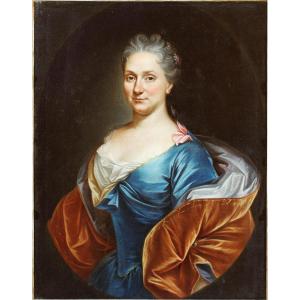
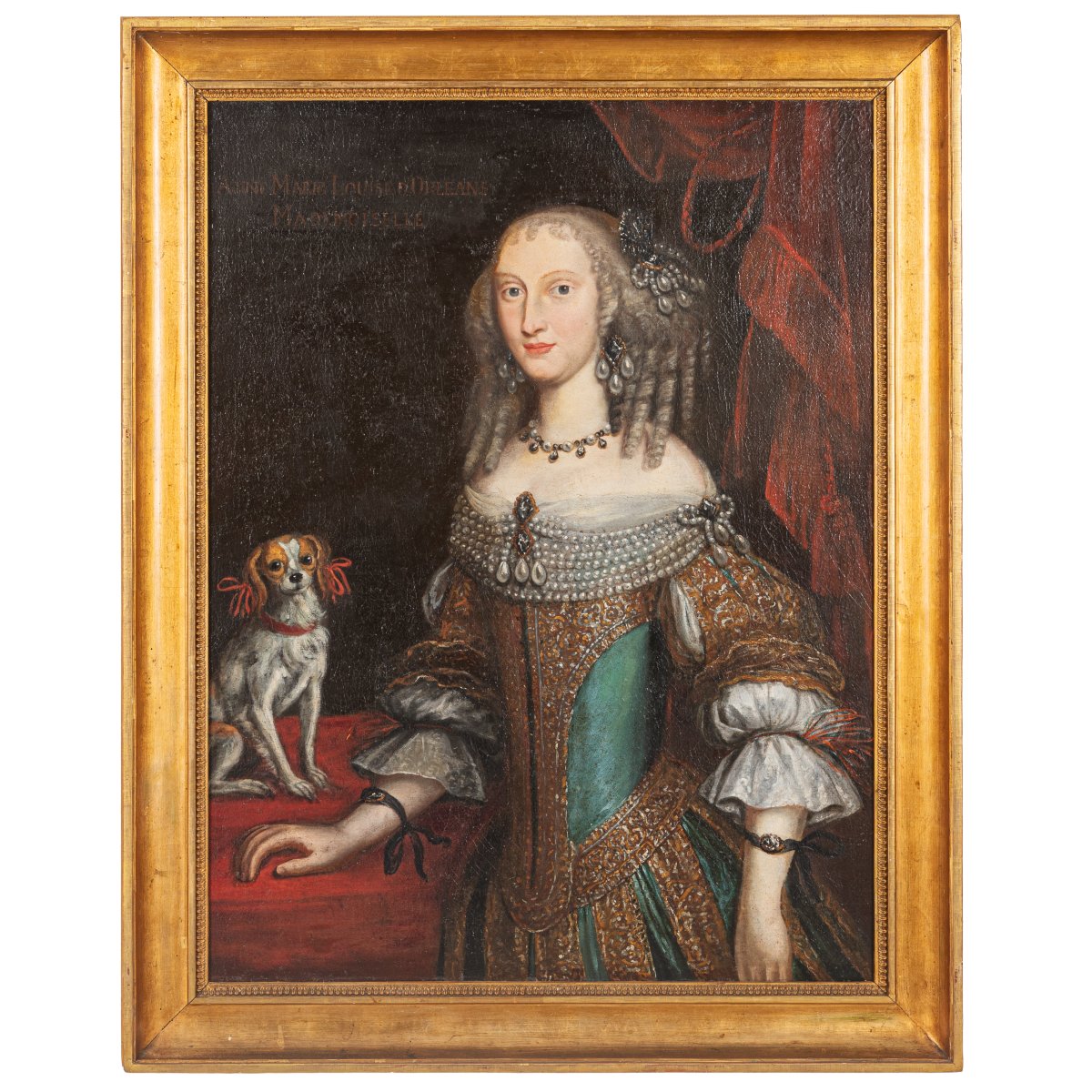
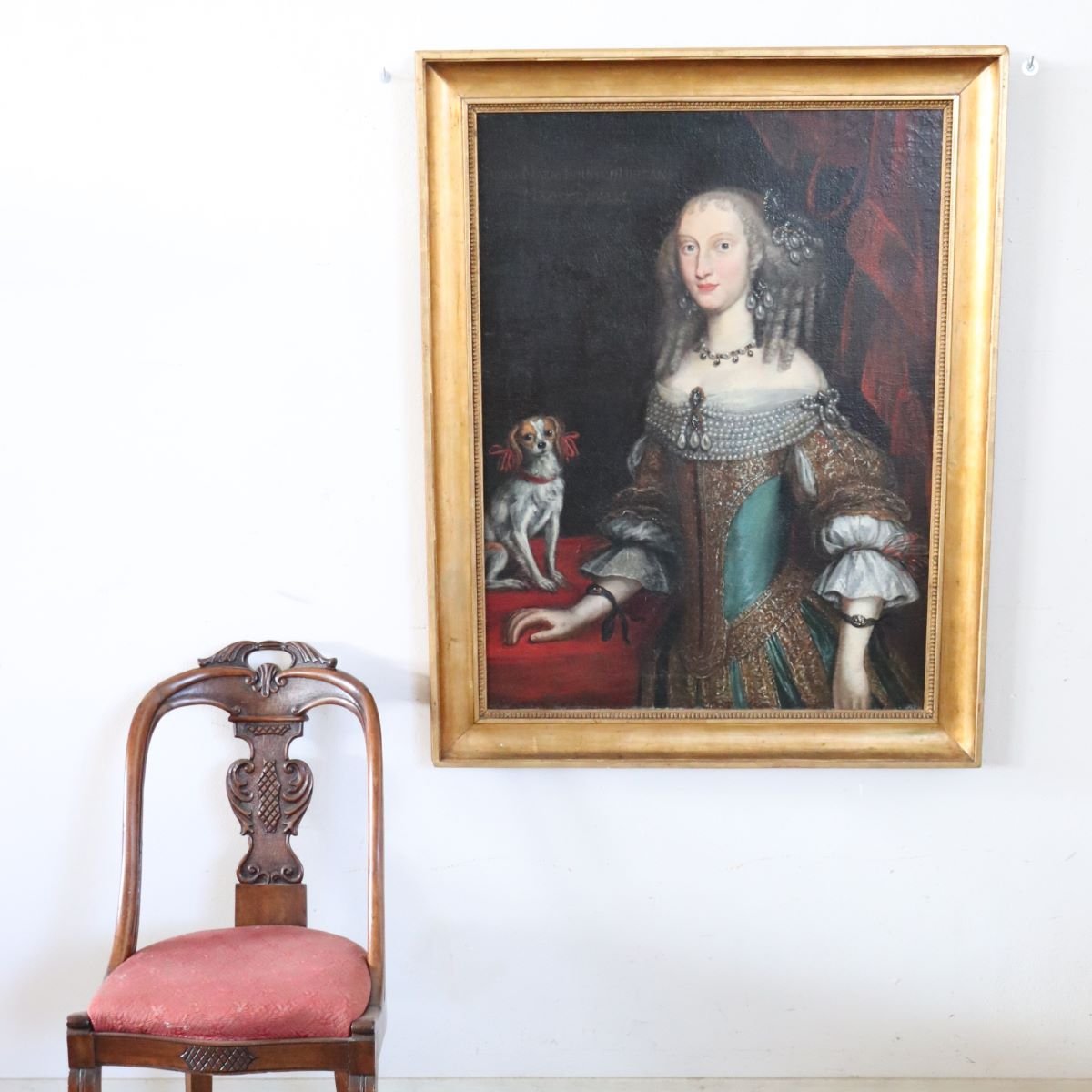
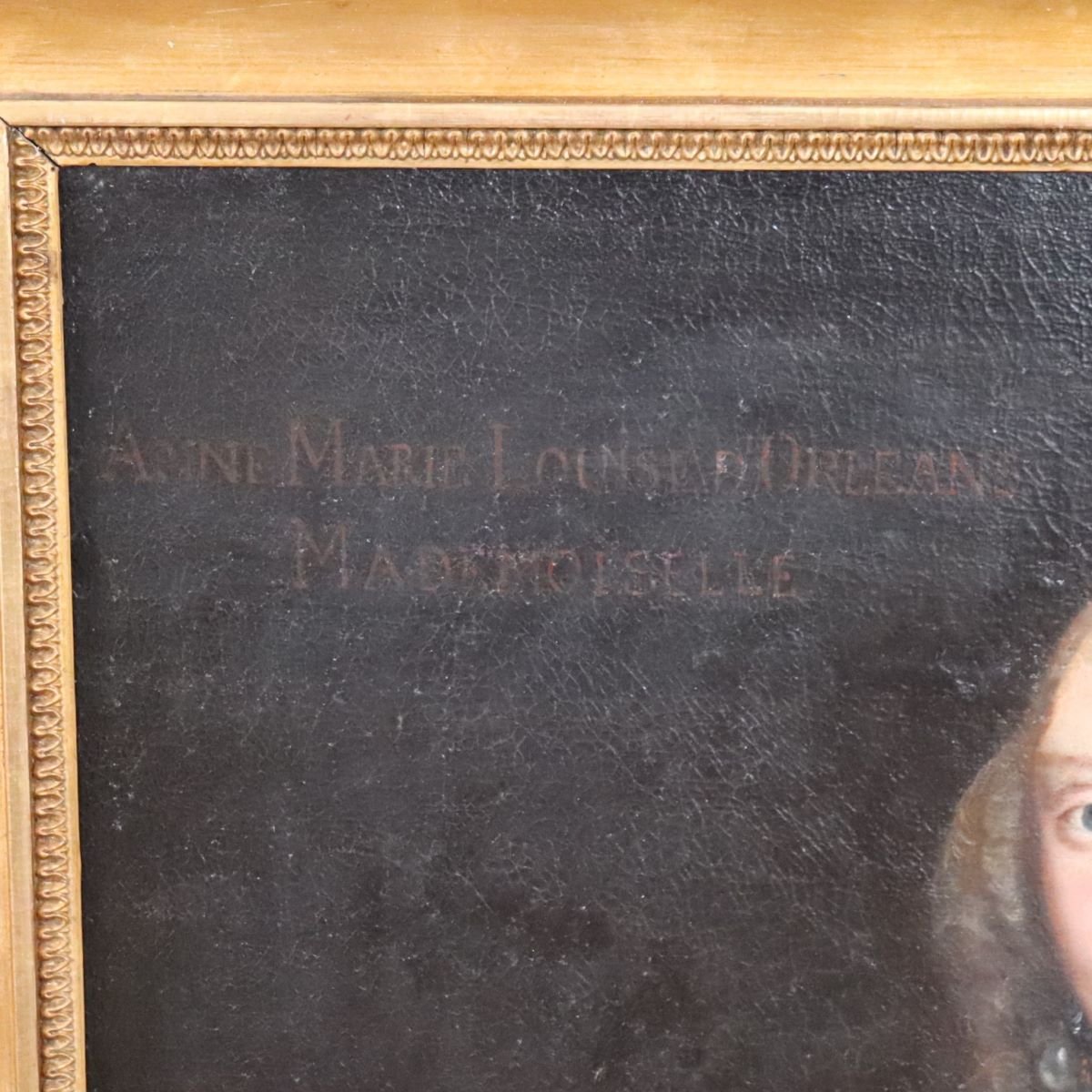
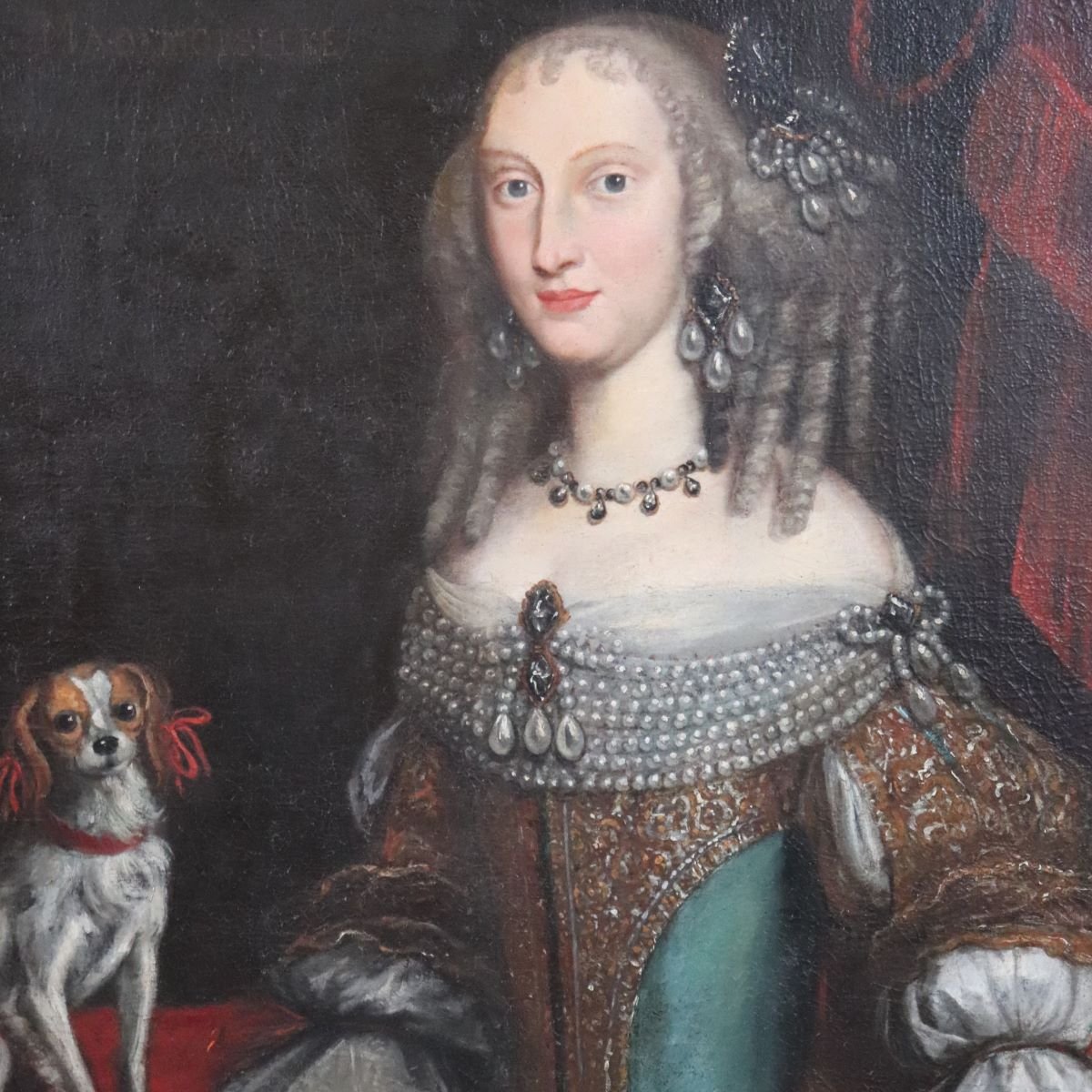
We are pleased to present this splendid oil-on-canvas painting, dating to the mid-17th century. It is a beautiful portrait of Anne Maria Louise d'Orléans (Paris, May 29, 1627 – Paris, April 5, 1693), as indicated by the inscription in the upper right corner.
Anne Maria Louise d'Orléans, known as "La Grande Mademoiselle," was a French princess and one of the wealthiest and highest-ranking women in 17th-century Europe. Her father was Gaston, Duke of Orléans—known as *Monsieur*—the only surviving brother of the then-reigning King Louis XIII of France. Her mother, the twenty-one-year-old Maria de Bourbon, Duchess of Montpensier—the sole member of the Montpensier branch of the House of Bourbon until her daughter's birth—died five days after giving birth to Anne Maria Louise. Anne Maria always possessed a strong sense of her own importance. During the Wars of the Fronde (1652), she sided with the rebels against Cardinal Mazarin and ordered the cannons of the Bastille to fire upon royal troops to save the Prince of Condé—an act that resulted in a period of exile. She rejected numerous marriage proposals from powerful European sovereigns (including Charles II of England and Alfonso VI of Portugal). Later, she fell in love with the courtier Antoine Nompar de Caumont (Duke of Lauzun), sparking major scandals at court. She remained unmarried and childless, leaving her immense fortune to her cousin Philippe I, Duke of Orléans. She is also known for writing her celebrated *Mémoires* and for introducing the musician Jean-Baptiste Lully to the French court.
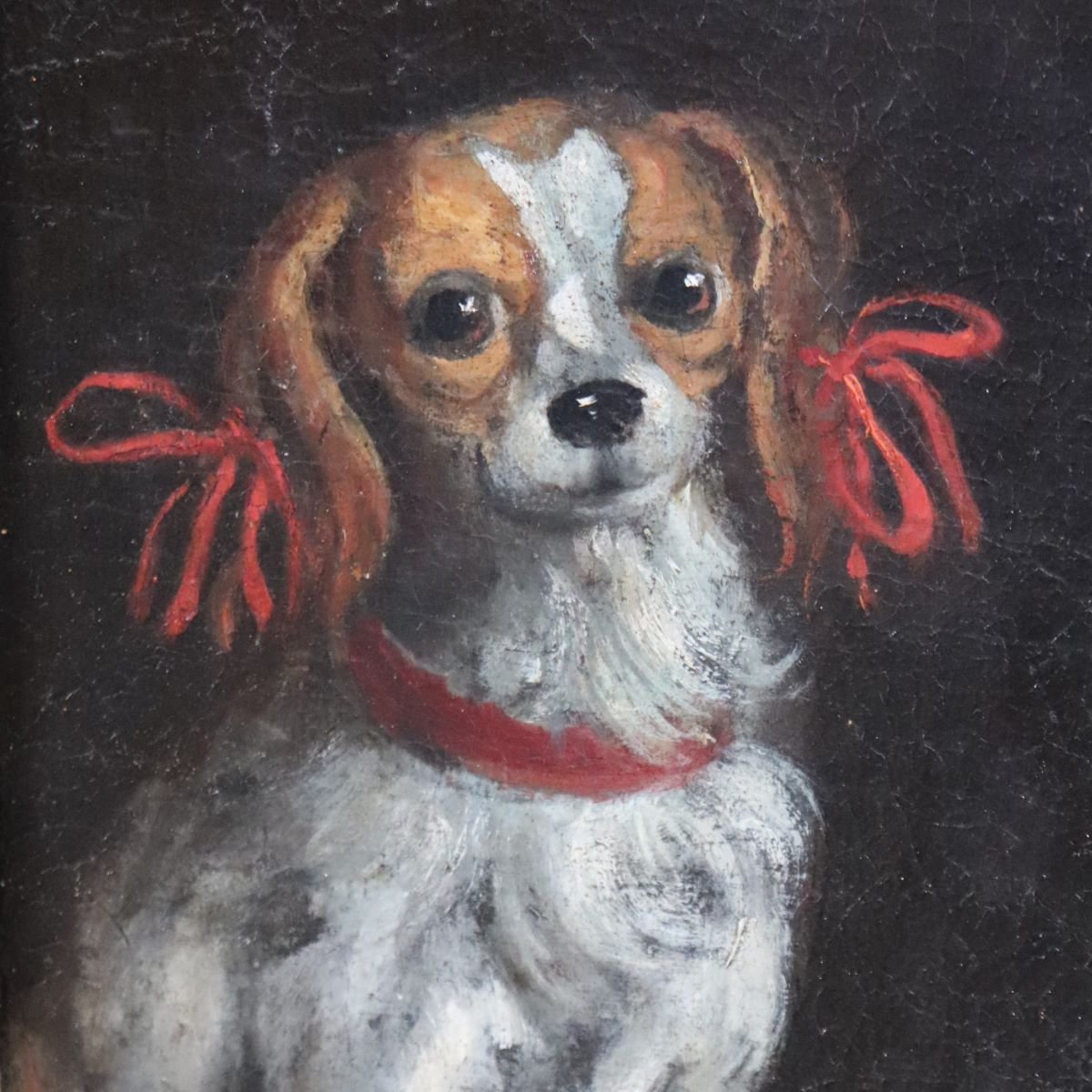
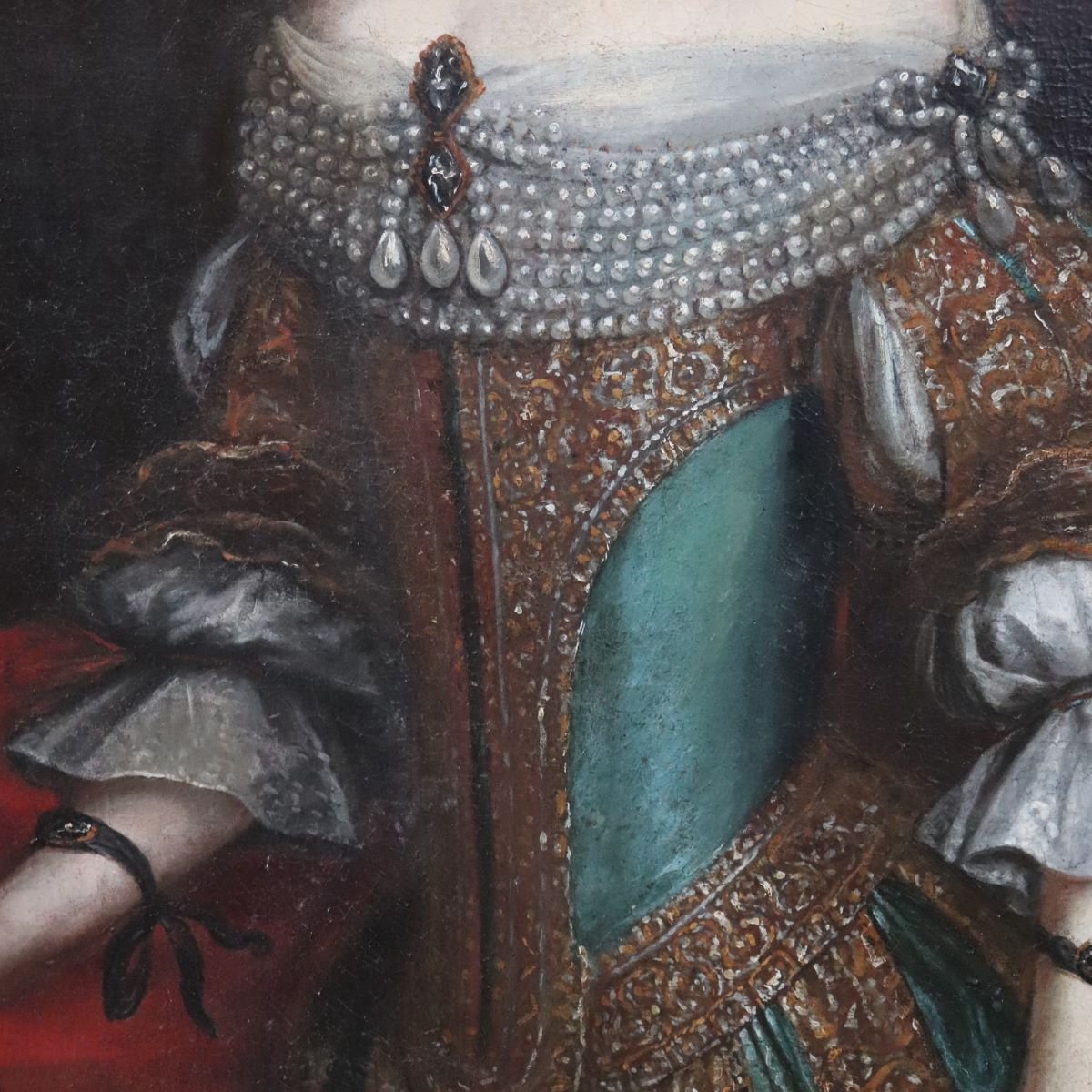
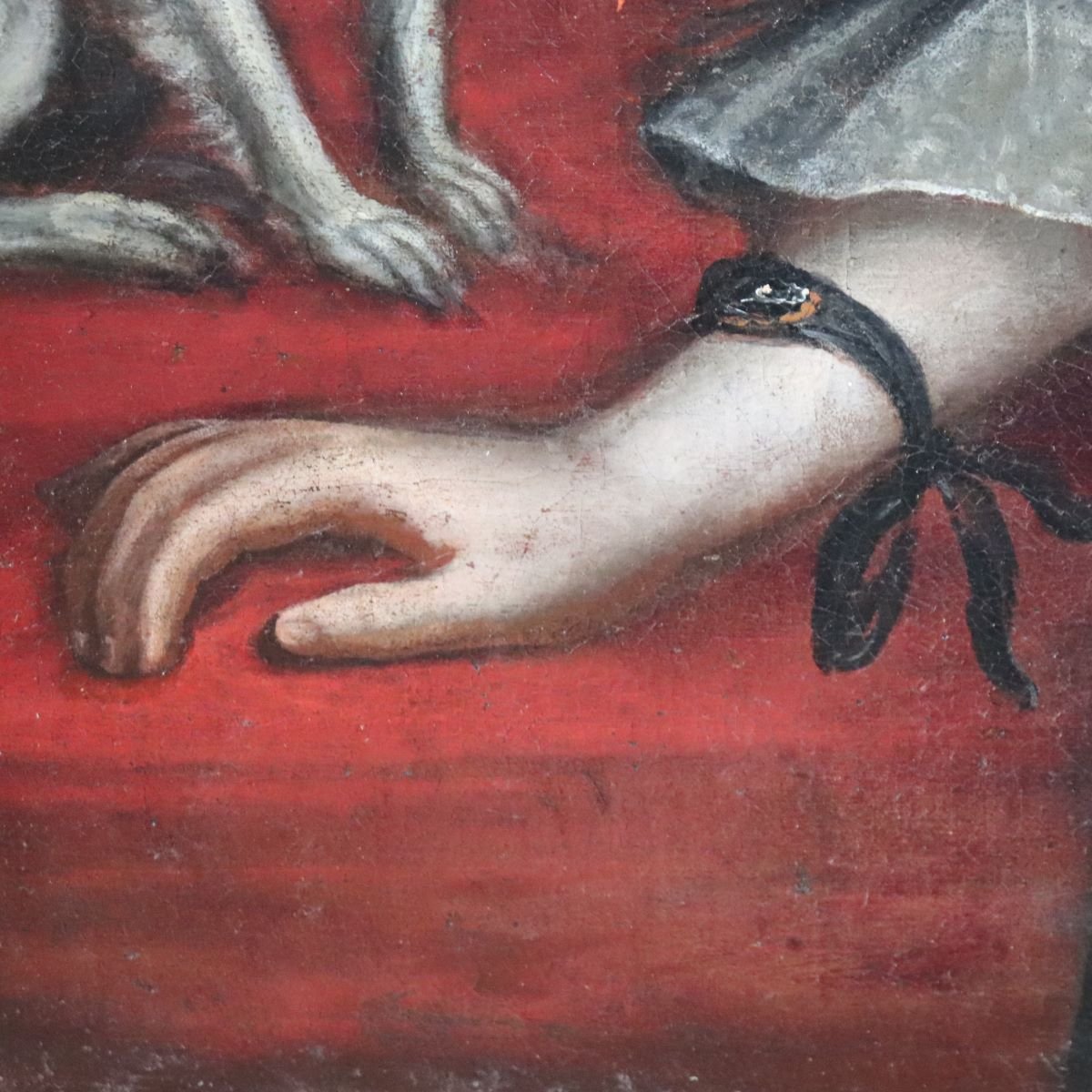
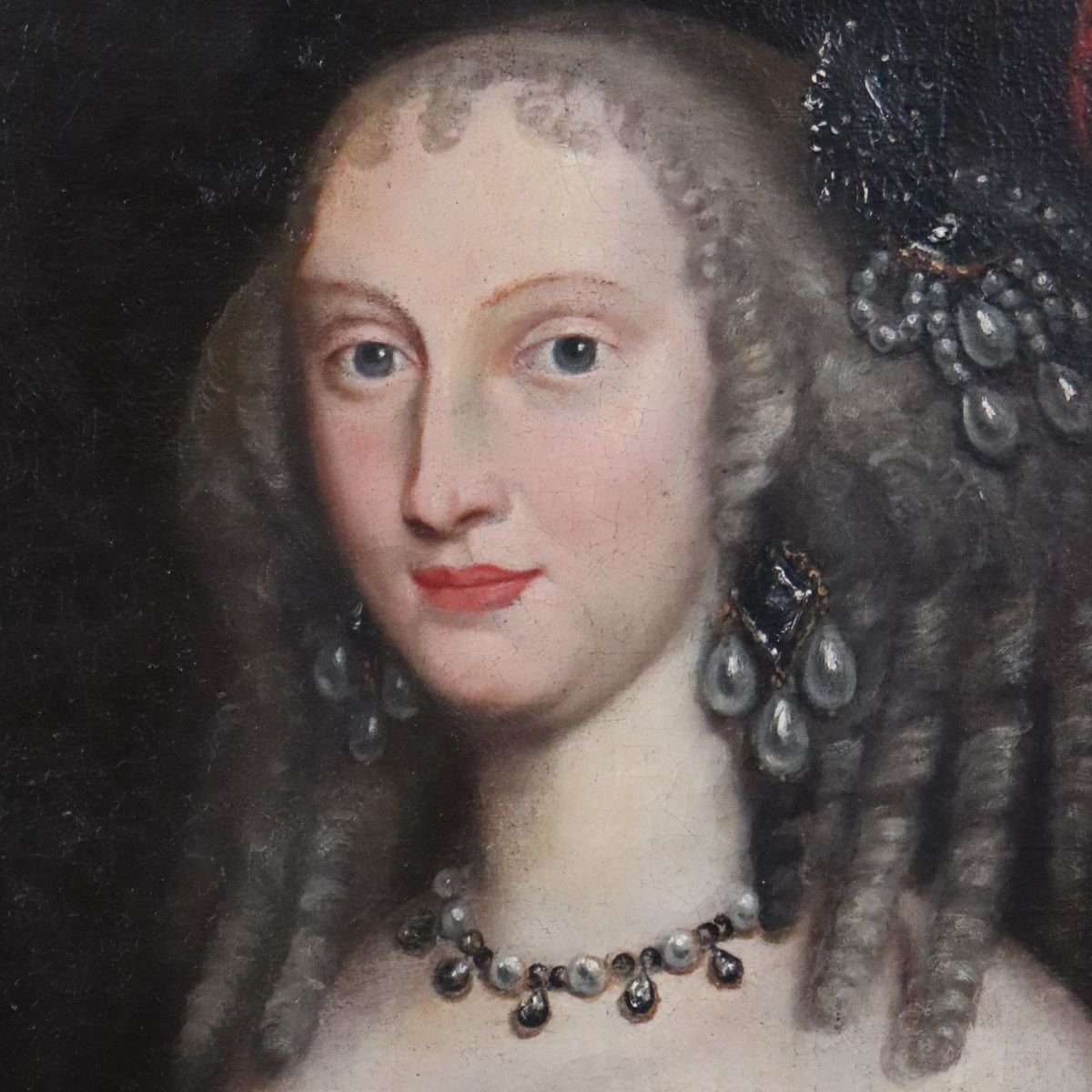
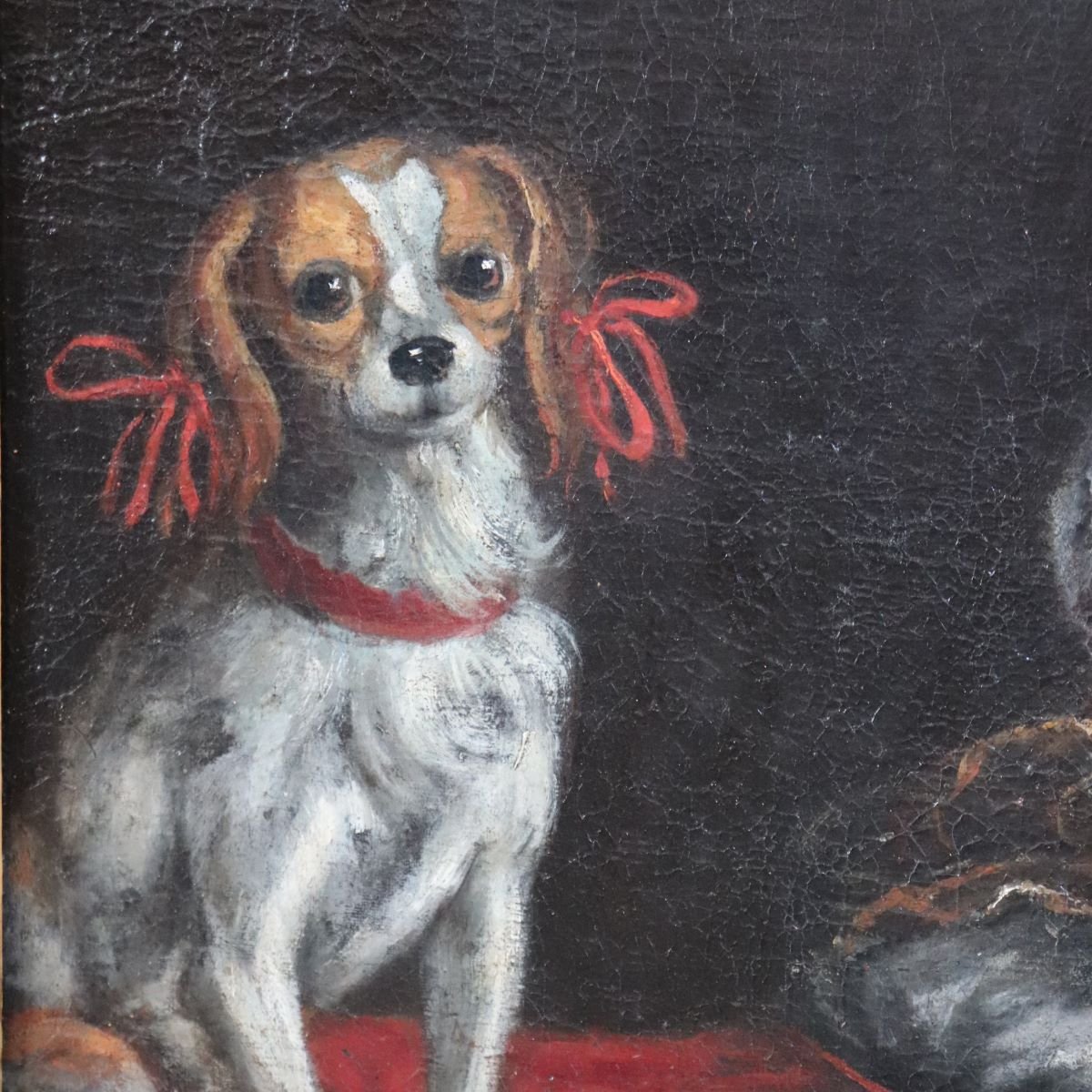
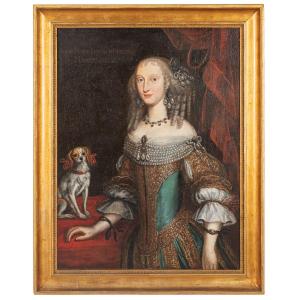
The magnificent painting we offer here is a classic example of high-commission Baroque aristocratic portraiture. The composition celebrates the social status, wealth, and elegance of the noblewoman portrayed (Anna Maria Luisa d'Orléans). She is depicted in a half-length, upright pose, gazing directly at the viewer and conveying a sense of composure and proud dignity. She wears a sumptuous gown typical of 17th-century court fashion. The bodice features elaborate embroidery in gold and bronze brocade, opening to reveal a central panel of satin in an aqua-green or turquoise hue. Large, white puffed sleeves made of lightweight fabric or silk emerge from shorter, heavier outer sleeves, finished with a contrasting dark ribbon at the wrist. Her generous décolletage is almost entirely covered by an extraordinary stole—or collar—composed entirely of multiple strands of pearls, fastened at the center of the chest by a large brooch featuring drop pearls. Her hair is styled according to the complex fashions of the era: gathered at the nape of the neck and puffed out at the sides of the face in dense, orderly ash-grey curls that cascade down to her shoulders. In addition to the striking necklace and chest brooch, the lady wears impressive drop earrings featuring large pearls and a precious hair ornament on the left side that echoes the pearl motif. To the left, perched on a surface draped in vivid red cloth, sits a small lapdog wearing a red collar and sporting charming bows on its ears. The background is dark and austere, designed to accentuate the luminosity of her complexion and the colors of her gown. On the right, one catches a glimpse of a heavy, dark red curtain drawn back—a classic Baroque device used to lend theatricality and depth to the scene.
A significant Baroque portrait where nothing is left to chance: every element—from the choice of jewelry to the inclusion of animals or fabrics—serves as a visual code communicating the subject's rank, virtues, and social status.
The small dog: In Renaissance and Baroque art, the dog is a universal symbol of fidelity. As the subject is an unmarried young woman, the dog represents loyalty to family values and the dynasty. It is not a working dog (used for hunting or guarding) but a lapdog or companion animal. Owning such small animals was an exclusive aristocratic luxury in the seventeenth century, signifying that the owner belonged to a social class exempt from manual labor.
The jewelry: The lady is literally adorned with an abundance of pearls (in her earrings, hairstyle, and necklace, as well as on her massive, multi-row collar). Since antiquity and within the Christian tradition, the pearl has symbolized purity and chastity. Displaying such a vast quantity of perfectly spherical, uniform pearls—which were extremely rare and costly before the advent of cultured pearls—was a statement of immense wealth and political power.
The colors: The deep red and scarlet of the background drapery and the cloth on the table signify royalty, power, and noble blood. The raised curtain symbolizes a revelation: the figure is "unveiled" to the world in all her magnificence. The turquoise-aquamarine hue of the bodice—often associated with expensive pigments like malachite or fine blends—contrasts sharply with the golds and reds, symbolizing youth, renewal, and nobility of spirit. Black ribbons tied around the wrists or neck could signify recent family mourning or, conversely, romantic submission to a fiancé (a "bond" of love).
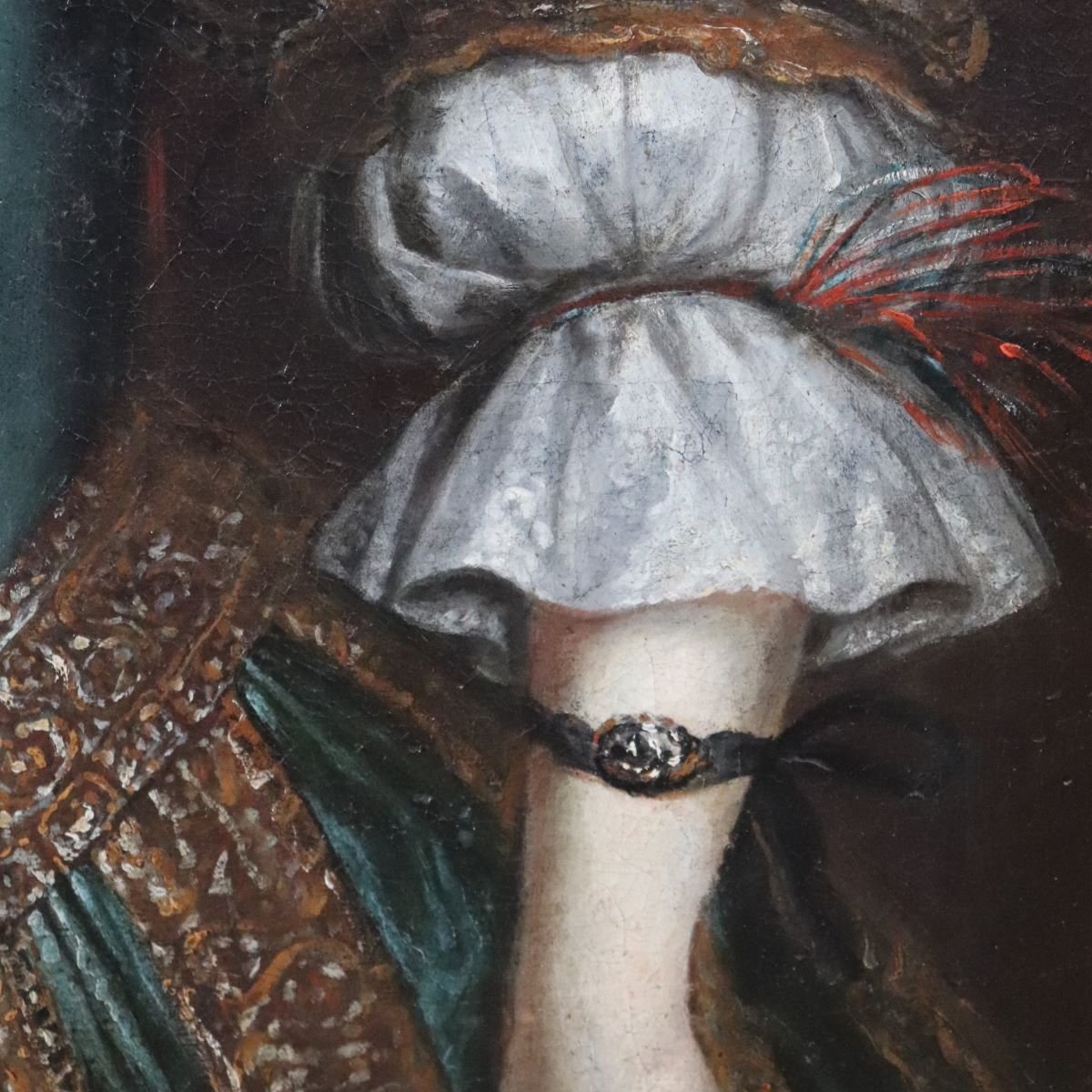
This magnificent portrait is of such excellent artistic quality that it might well be attributed to a major painter of the era. The work is distinguished by superb technical execution in the rendering of textures, even while displaying the formal stiffness typical of official court portraiture. The monumental pearl-studded capelet is far from flat; each individual sphere is highlighted with a tiny dot of white paint (lead white) to simulate the refraction of light on the nacreous surface. The large teardrop pearls of the earrings exhibit remarkable volume and translucency. There is a striking contrast in quality between the rigid heaviness of the bodice’s gold brocade—rendered with thick, impasto-like strokes to mimic precious metal threads—and the ethereal lightness of the white silk or linen puffed sleeves, where the folds appear soft and subtly shaded. Light enters from the left (from the viewer's perspective), fully illuminating the noblewoman's face, chest, and hand, while casting the rest of her body and the background into a theatrical semi-darkness. Her skin possesses an almost porcelain-like quality, characteristic of Northern European court portraits. The transitions from light to shadow on her neck and cheeks are carefully modulated to create a sense of three-dimensionality, avoiding any harsh or crude contrasts. Her facial features are delineated with precision. Her gaze is expressive and penetrating, and the lips are painted with delicate strokes that lend a softness to the mouth. Her overall posture—though slightly stiff and geometric, as dictated by the conventions of aristocratic portraiture and the boned bodices of the time—maintains a solid, monumental presence within the space. The small dog on the left is not merely a background detail; it is painted with remarkable freshness. The brushstrokes defining its fur are rapid, wispy, and fluid, successfully capturing the softness of the coat and the expressive liveliness of the animal's large, dark eyes.
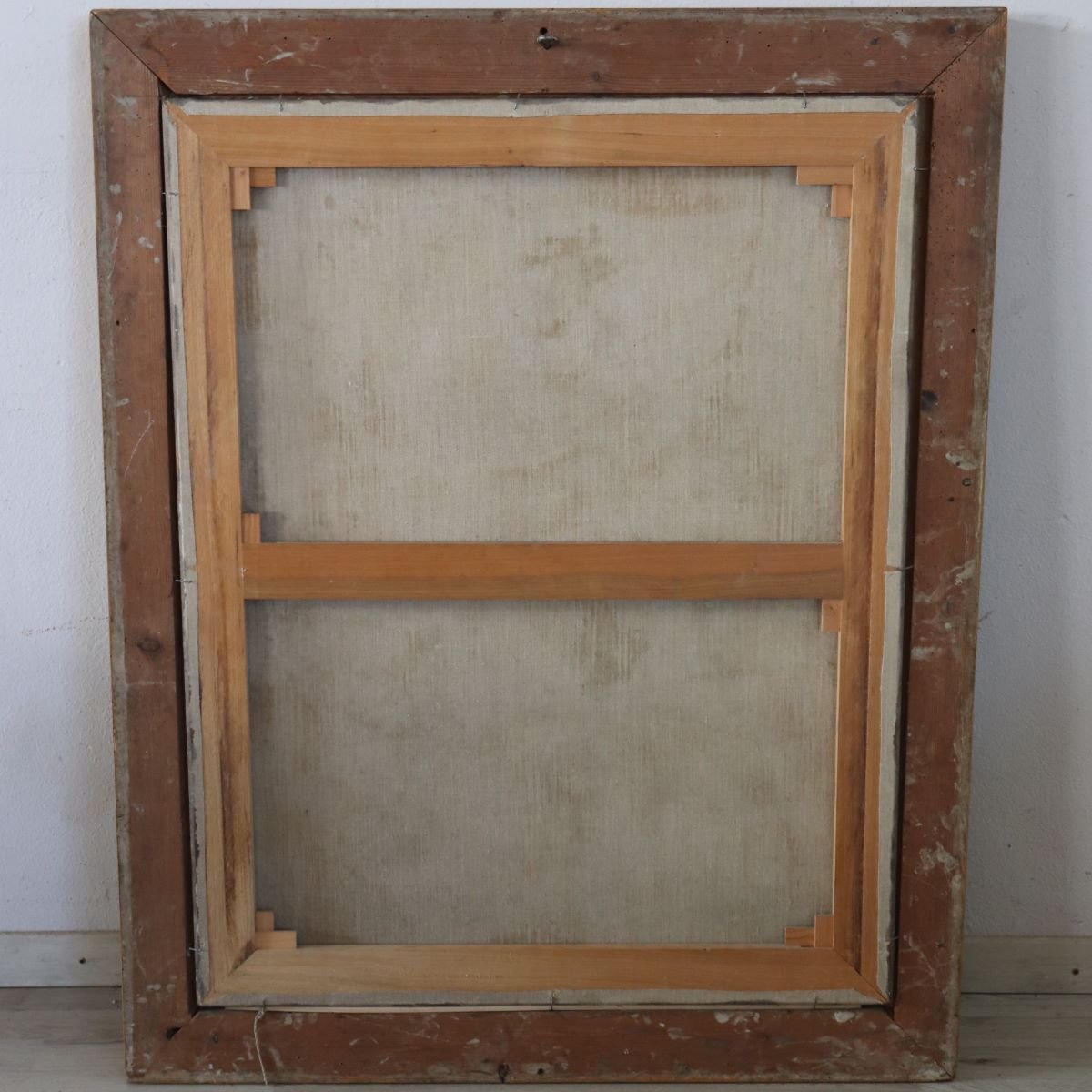
The painting has undergone restoration: it has been relined, and there are some touch-ups to the paint layer—though these do not detract from the beauty or importance of the artwork.
If you love 17th-century portraiture, this magnificent painting is a must-have for your collection. You will never tire of admiring it, discovering new details each time.
A wonderful painting that is sure to enchant your guests!
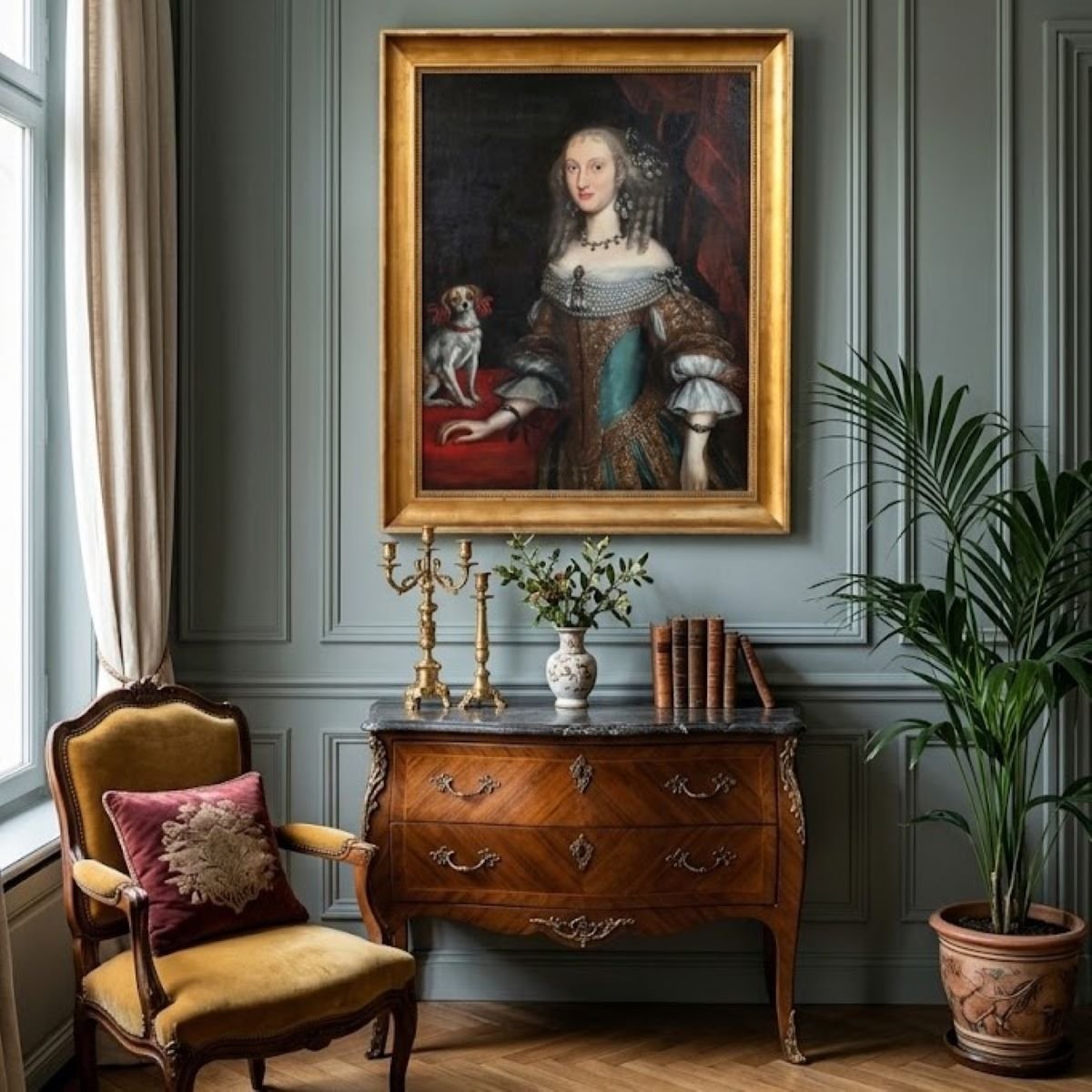
The painting is enhanced by a splendid 19th-century gilded wood frame.
Frame dimensions (cm):
Height: 119
Width: 94
Depth: 6,5
Painting dimensions (cm):
Height: 100
Width: 78,5
Anne Maria Louise d'Orléans, known as "La Grande Mademoiselle," was a French princess and one of the wealthiest and highest-ranking women in 17th-century Europe. Her father was Gaston, Duke of Orléans—known as *Monsieur*—the only surviving brother of the then-reigning King Louis XIII of France. Her mother, the twenty-one-year-old Maria de Bourbon, Duchess of Montpensier—the sole member of the Montpensier branch of the House of Bourbon until her daughter's birth—died five days after giving birth to Anne Maria Louise. Anne Maria always possessed a strong sense of her own importance. During the Wars of the Fronde (1652), she sided with the rebels against Cardinal Mazarin and ordered the cannons of the Bastille to fire upon royal troops to save the Prince of Condé—an act that resulted in a period of exile. She rejected numerous marriage proposals from powerful European sovereigns (including Charles II of England and Alfonso VI of Portugal). Later, she fell in love with the courtier Antoine Nompar de Caumont (Duke of Lauzun), sparking major scandals at court. She remained unmarried and childless, leaving her immense fortune to her cousin Philippe I, Duke of Orléans. She is also known for writing her celebrated *Mémoires* and for introducing the musician Jean-Baptiste Lully to the French court.
The magnificent painting we offer here is a classic example of high-commission Baroque aristocratic portraiture. The composition celebrates the social status, wealth, and elegance of the noblewoman portrayed (Anna Maria Luisa d'Orléans). She is depicted in a half-length, upright pose, gazing directly at the viewer and conveying a sense of composure and proud dignity. She wears a sumptuous gown typical of 17th-century court fashion. The bodice features elaborate embroidery in gold and bronze brocade, opening to reveal a central panel of satin in an aqua-green or turquoise hue. Large, white puffed sleeves made of lightweight fabric or silk emerge from shorter, heavier outer sleeves, finished with a contrasting dark ribbon at the wrist. Her generous décolletage is almost entirely covered by an extraordinary stole—or collar—composed entirely of multiple strands of pearls, fastened at the center of the chest by a large brooch featuring drop pearls. Her hair is styled according to the complex fashions of the era: gathered at the nape of the neck and puffed out at the sides of the face in dense, orderly ash-grey curls that cascade down to her shoulders. In addition to the striking necklace and chest brooch, the lady wears impressive drop earrings featuring large pearls and a precious hair ornament on the left side that echoes the pearl motif. To the left, perched on a surface draped in vivid red cloth, sits a small lapdog wearing a red collar and sporting charming bows on its ears. The background is dark and austere, designed to accentuate the luminosity of her complexion and the colors of her gown. On the right, one catches a glimpse of a heavy, dark red curtain drawn back—a classic Baroque device used to lend theatricality and depth to the scene.
A significant Baroque portrait where nothing is left to chance: every element—from the choice of jewelry to the inclusion of animals or fabrics—serves as a visual code communicating the subject's rank, virtues, and social status.
The small dog: In Renaissance and Baroque art, the dog is a universal symbol of fidelity. As the subject is an unmarried young woman, the dog represents loyalty to family values and the dynasty. It is not a working dog (used for hunting or guarding) but a lapdog or companion animal. Owning such small animals was an exclusive aristocratic luxury in the seventeenth century, signifying that the owner belonged to a social class exempt from manual labor.
The jewelry: The lady is literally adorned with an abundance of pearls (in her earrings, hairstyle, and necklace, as well as on her massive, multi-row collar). Since antiquity and within the Christian tradition, the pearl has symbolized purity and chastity. Displaying such a vast quantity of perfectly spherical, uniform pearls—which were extremely rare and costly before the advent of cultured pearls—was a statement of immense wealth and political power.
The colors: The deep red and scarlet of the background drapery and the cloth on the table signify royalty, power, and noble blood. The raised curtain symbolizes a revelation: the figure is "unveiled" to the world in all her magnificence. The turquoise-aquamarine hue of the bodice—often associated with expensive pigments like malachite or fine blends—contrasts sharply with the golds and reds, symbolizing youth, renewal, and nobility of spirit. Black ribbons tied around the wrists or neck could signify recent family mourning or, conversely, romantic submission to a fiancé (a "bond" of love).
This magnificent portrait is of such excellent artistic quality that it might well be attributed to a major painter of the era. The work is distinguished by superb technical execution in the rendering of textures, even while displaying the formal stiffness typical of official court portraiture. The monumental pearl-studded capelet is far from flat; each individual sphere is highlighted with a tiny dot of white paint (lead white) to simulate the refraction of light on the nacreous surface. The large teardrop pearls of the earrings exhibit remarkable volume and translucency. There is a striking contrast in quality between the rigid heaviness of the bodice’s gold brocade—rendered with thick, impasto-like strokes to mimic precious metal threads—and the ethereal lightness of the white silk or linen puffed sleeves, where the folds appear soft and subtly shaded. Light enters from the left (from the viewer's perspective), fully illuminating the noblewoman's face, chest, and hand, while casting the rest of her body and the background into a theatrical semi-darkness. Her skin possesses an almost porcelain-like quality, characteristic of Northern European court portraits. The transitions from light to shadow on her neck and cheeks are carefully modulated to create a sense of three-dimensionality, avoiding any harsh or crude contrasts. Her facial features are delineated with precision. Her gaze is expressive and penetrating, and the lips are painted with delicate strokes that lend a softness to the mouth. Her overall posture—though slightly stiff and geometric, as dictated by the conventions of aristocratic portraiture and the boned bodices of the time—maintains a solid, monumental presence within the space. The small dog on the left is not merely a background detail; it is painted with remarkable freshness. The brushstrokes defining its fur are rapid, wispy, and fluid, successfully capturing the softness of the coat and the expressive liveliness of the animal's large, dark eyes.
The painting has undergone restoration: it has been relined, and there are some touch-ups to the paint layer—though these do not detract from the beauty or importance of the artwork.
If you love 17th-century portraiture, this magnificent painting is a must-have for your collection. You will never tire of admiring it, discovering new details each time.
A wonderful painting that is sure to enchant your guests!
The painting is enhanced by a splendid 19th-century gilded wood frame.
Frame dimensions (cm):
Height: 119
Width: 94
Depth: 6,5
Painting dimensions (cm):
Height: 100
Width: 78,5
8 000 €
Period: 17th century
Style: Other Style
Condition: Excellent condition
Material: Oil painting
Width: 94
Height: 119
Depth: 6,5
Reference (ID): 1836069
Availability: In stock
Print