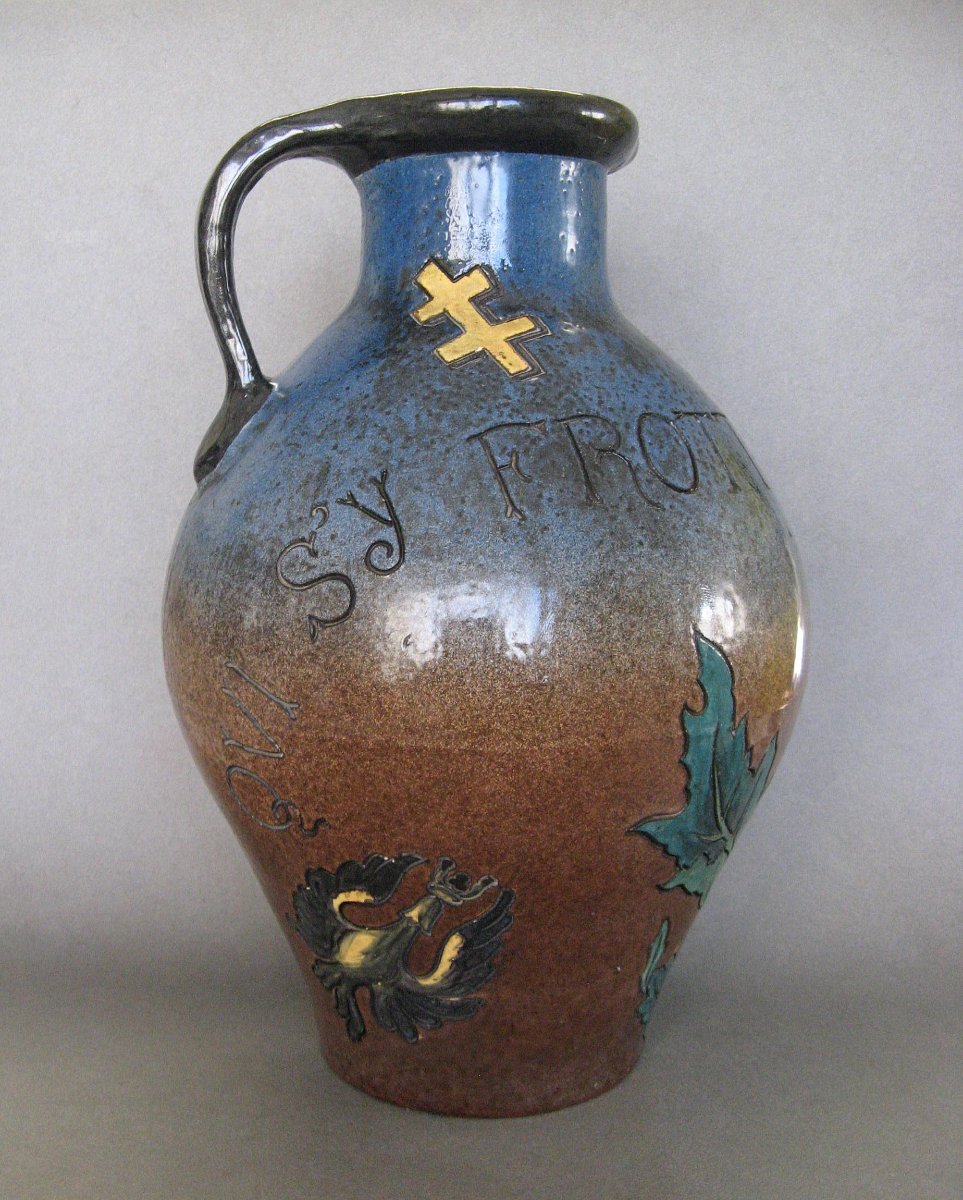
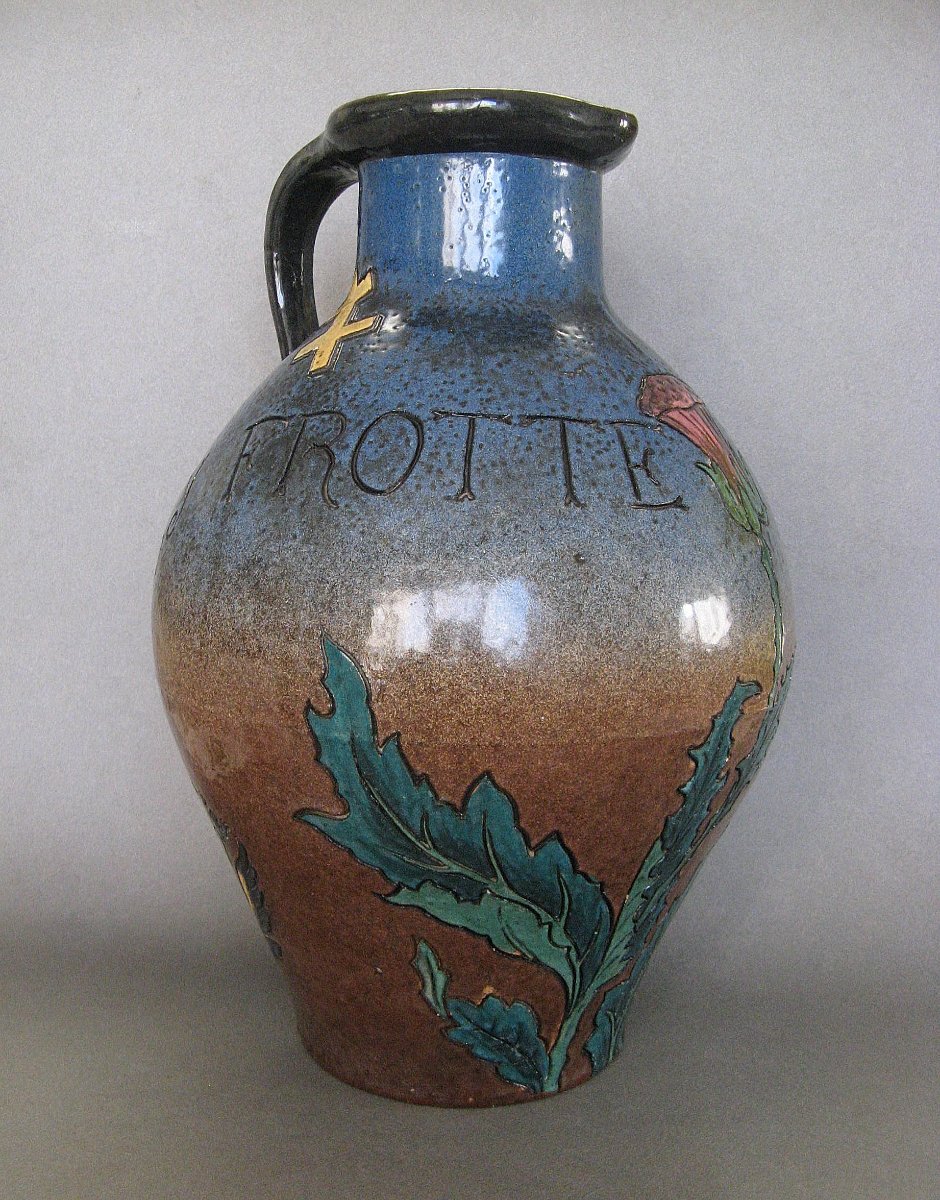

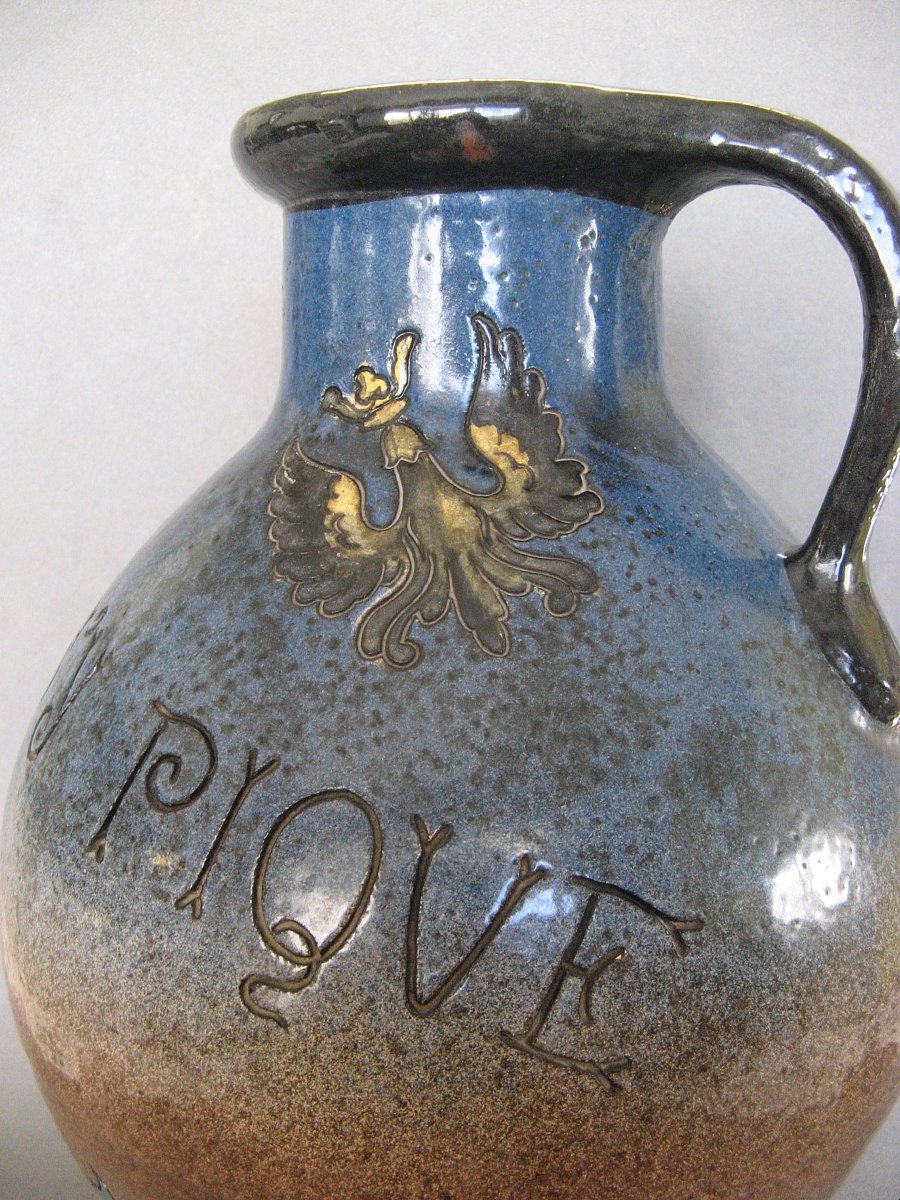

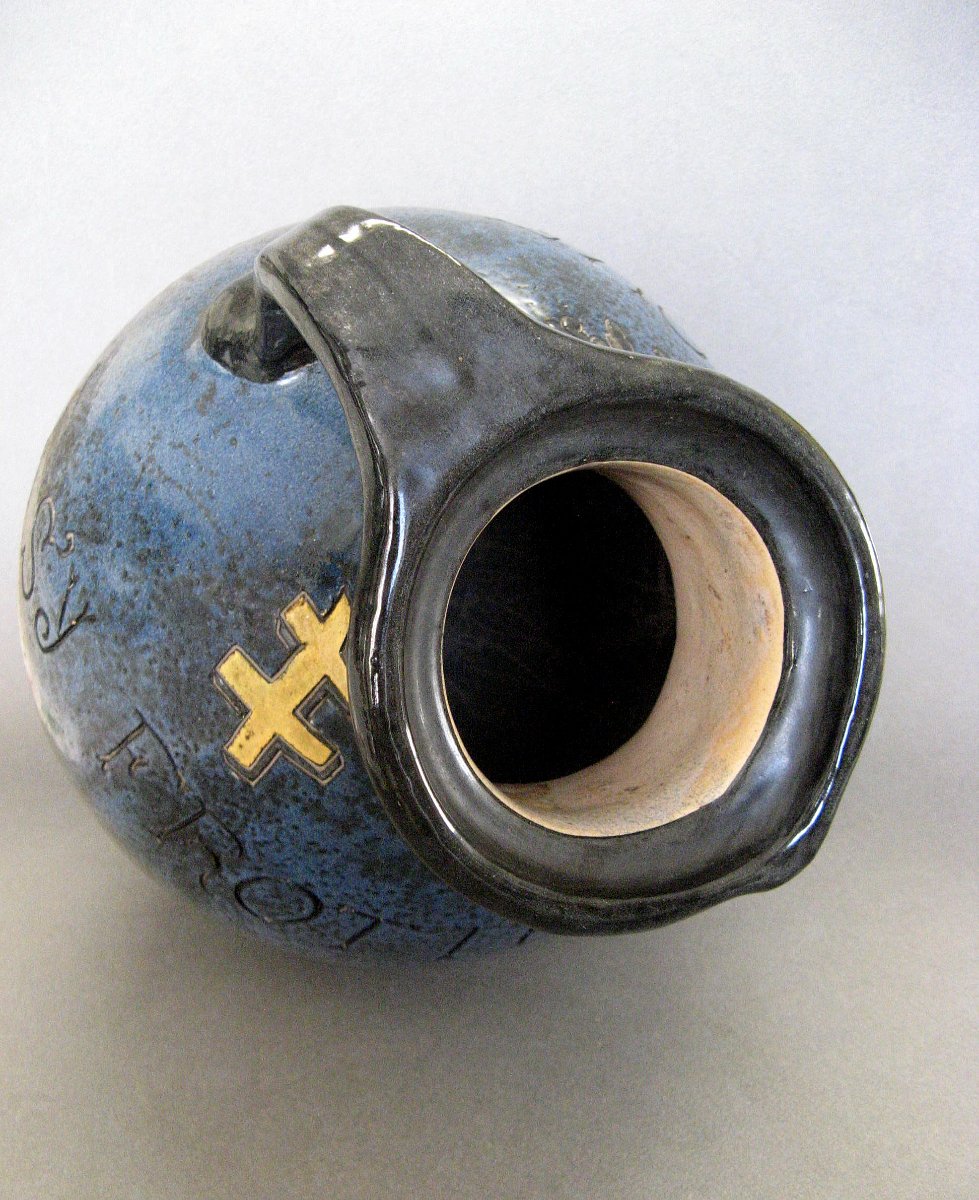


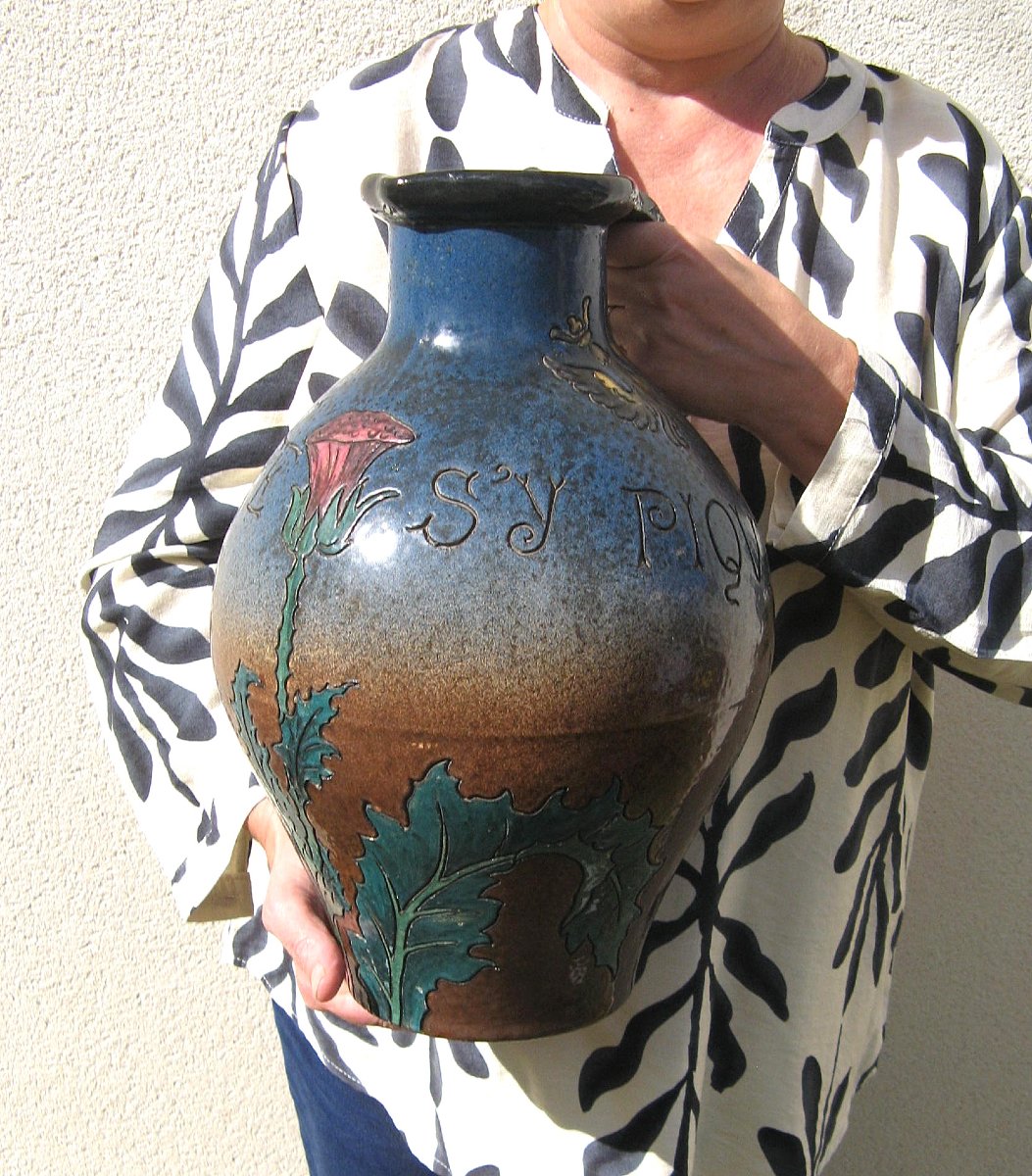


Large Art Nouveau Pitchers With The Lorraine Coat Of Arms, Saint Clément K&g.
A magnificent production from the Saint-Clément manufactory (Meurthe-et-Moselle), created under the historic leadership of Keller & Guérin.
Incised mark on the base of the ceramic, consisting of the intertwined initials K and G.
The Saint-Clément pottery works were reunited and acquired by the renowned Keller & Guérin family in 1892.
Under their direction, art pieces frequently bore this heraldic monogram—incised by hand into the base, sometimes topped with a semicircle—to designate exceptional creations from their Lorraine workshops.
Although the mark belongs to the Keller & Guérin manufactory, the piece's style—its handling of the material (stoneware or glazed earthenware with drip-glaze effects) and the combination of the motto ("Qui s'y frotte s'y pique" / "He who rubs against it gets pricked") with the thistle and the Cross of Lorraine—stems directly from designs initiated by Émile Gallé.
Gallé worked closely with Saint-Clément to produce his heraldic and patriotic designs following the War of 1870. Even after his departure, the pottery continued to produce pitchers and vases that faithfully reproduced this Lorraine decorative style, which was highly sought after at the turn of the 20th century. The incised "1-1" marks correspond to the size or mold numbering, allowing workers and turners to calibrate the exact dimensions of this type of heraldic pitcher from Lorraine.
The fluid, elaborate handwritten monogram on the left [image_Sch96i.png] is characteristic of elite artisans trained at the Nancy School and in the techniques of Émile Gallé (who left a lasting mark on the pottery works). During this period, the manufactory relied on distinguished families of painters and workshop foremen.
The Milet family (Optat, Félix, or Lazare Milet): Highly active in collaborations and art studios across eastern France, members of this dynasty of ceramists and decorators frequently signed their work with a similarly incised monogram featuring intertwined letters.
Height: 40 cm. Firing a 40 cm stoneware piece without it warping or cracking in the kiln posed a significant challenge for ceramists of the Art Nouveau era (Keller & Guérin period, circa 1890–1910).
- This item is available for immediate purchase, payable via PayPal; we also accept bank transfer or French check.
- We do not accept sales over the phone sales will be conducted exclusively via email or through the Proantic messaging.
- We ensure our items are shipped with care, with insurance and tracking. Colissimo shipping costs for Europe Union €45.
Incised mark on the base of the ceramic, consisting of the intertwined initials K and G.
The Saint-Clément pottery works were reunited and acquired by the renowned Keller & Guérin family in 1892.
Under their direction, art pieces frequently bore this heraldic monogram—incised by hand into the base, sometimes topped with a semicircle—to designate exceptional creations from their Lorraine workshops.
Although the mark belongs to the Keller & Guérin manufactory, the piece's style—its handling of the material (stoneware or glazed earthenware with drip-glaze effects) and the combination of the motto ("Qui s'y frotte s'y pique" / "He who rubs against it gets pricked") with the thistle and the Cross of Lorraine—stems directly from designs initiated by Émile Gallé.
Gallé worked closely with Saint-Clément to produce his heraldic and patriotic designs following the War of 1870. Even after his departure, the pottery continued to produce pitchers and vases that faithfully reproduced this Lorraine decorative style, which was highly sought after at the turn of the 20th century. The incised "1-1" marks correspond to the size or mold numbering, allowing workers and turners to calibrate the exact dimensions of this type of heraldic pitcher from Lorraine.
The fluid, elaborate handwritten monogram on the left [image_Sch96i.png] is characteristic of elite artisans trained at the Nancy School and in the techniques of Émile Gallé (who left a lasting mark on the pottery works). During this period, the manufactory relied on distinguished families of painters and workshop foremen.
The Milet family (Optat, Félix, or Lazare Milet): Highly active in collaborations and art studios across eastern France, members of this dynasty of ceramists and decorators frequently signed their work with a similarly incised monogram featuring intertwined letters.
Height: 40 cm. Firing a 40 cm stoneware piece without it warping or cracking in the kiln posed a significant challenge for ceramists of the Art Nouveau era (Keller & Guérin period, circa 1890–1910).
- This item is available for immediate purchase, payable via PayPal; we also accept bank transfer or French check.
- We do not accept sales over the phone sales will be conducted exclusively via email or through the Proantic messaging.
- We ensure our items are shipped with care, with insurance and tracking. Colissimo shipping costs for Europe Union €45.
700 €
Period: 19th century
Style: Art Nouveau
Condition: Good condition
Material: Ceramic
Reference (ID): 1833543
Availability: In stock
Print