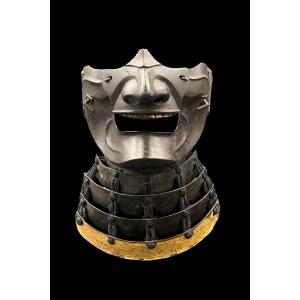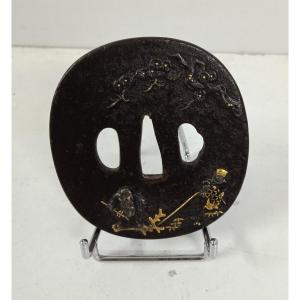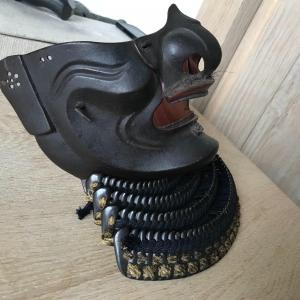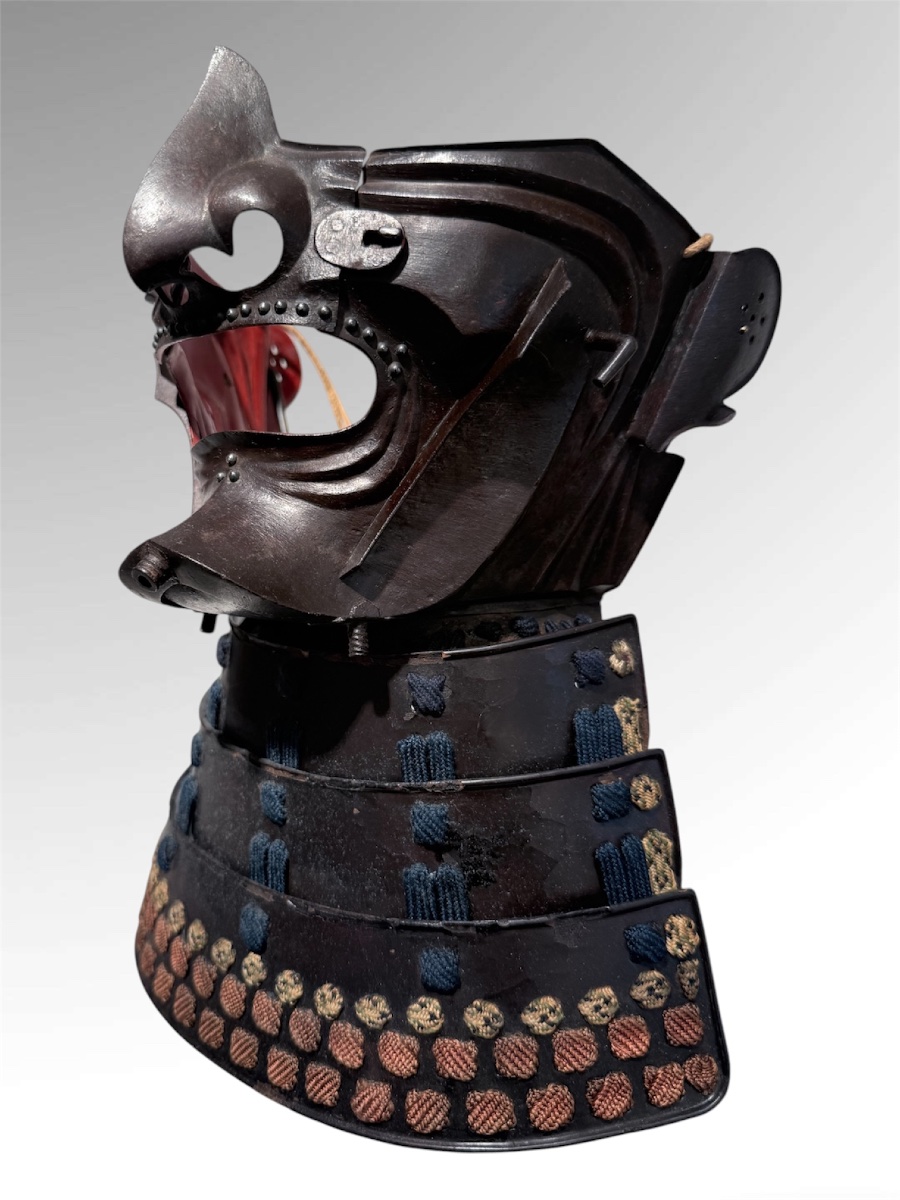
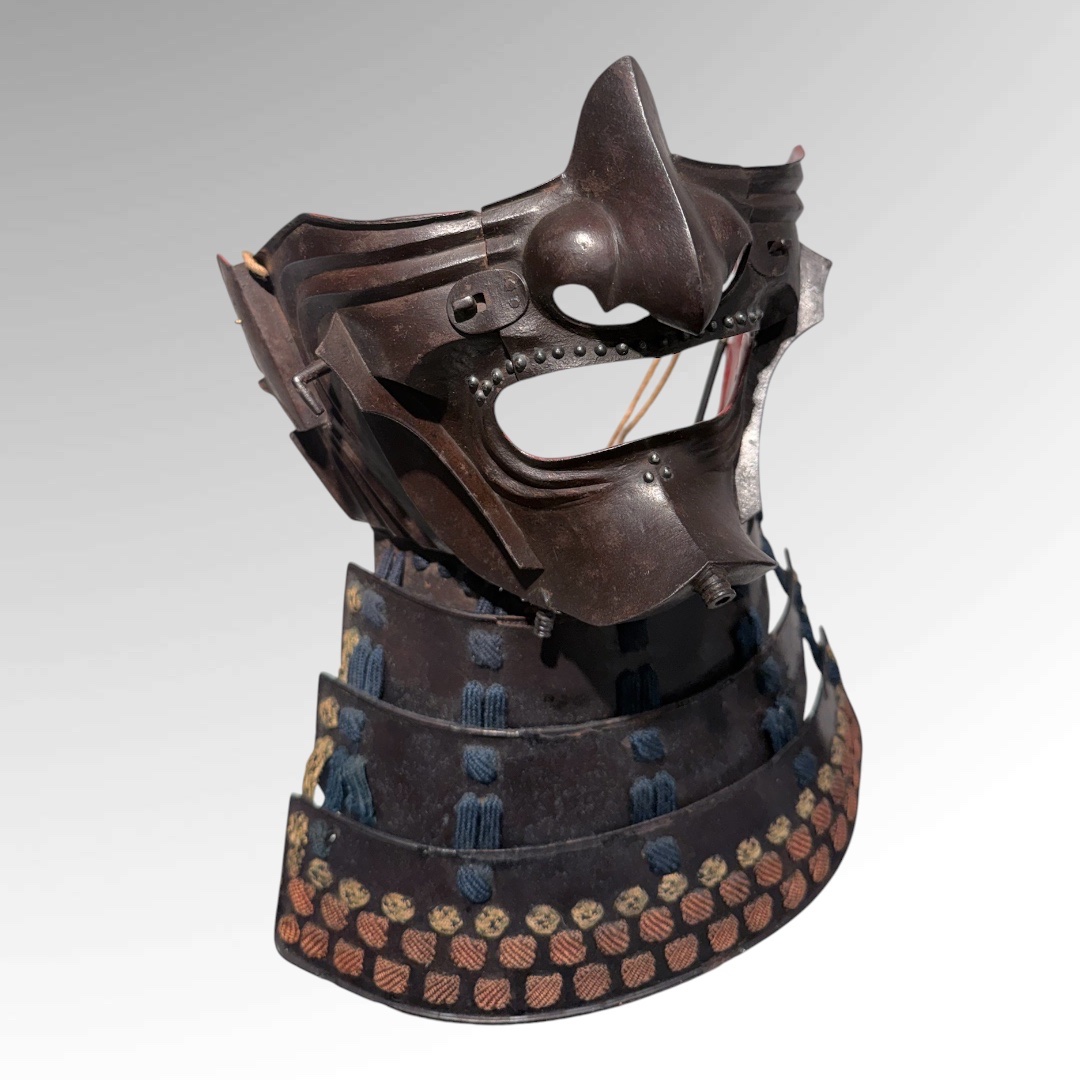
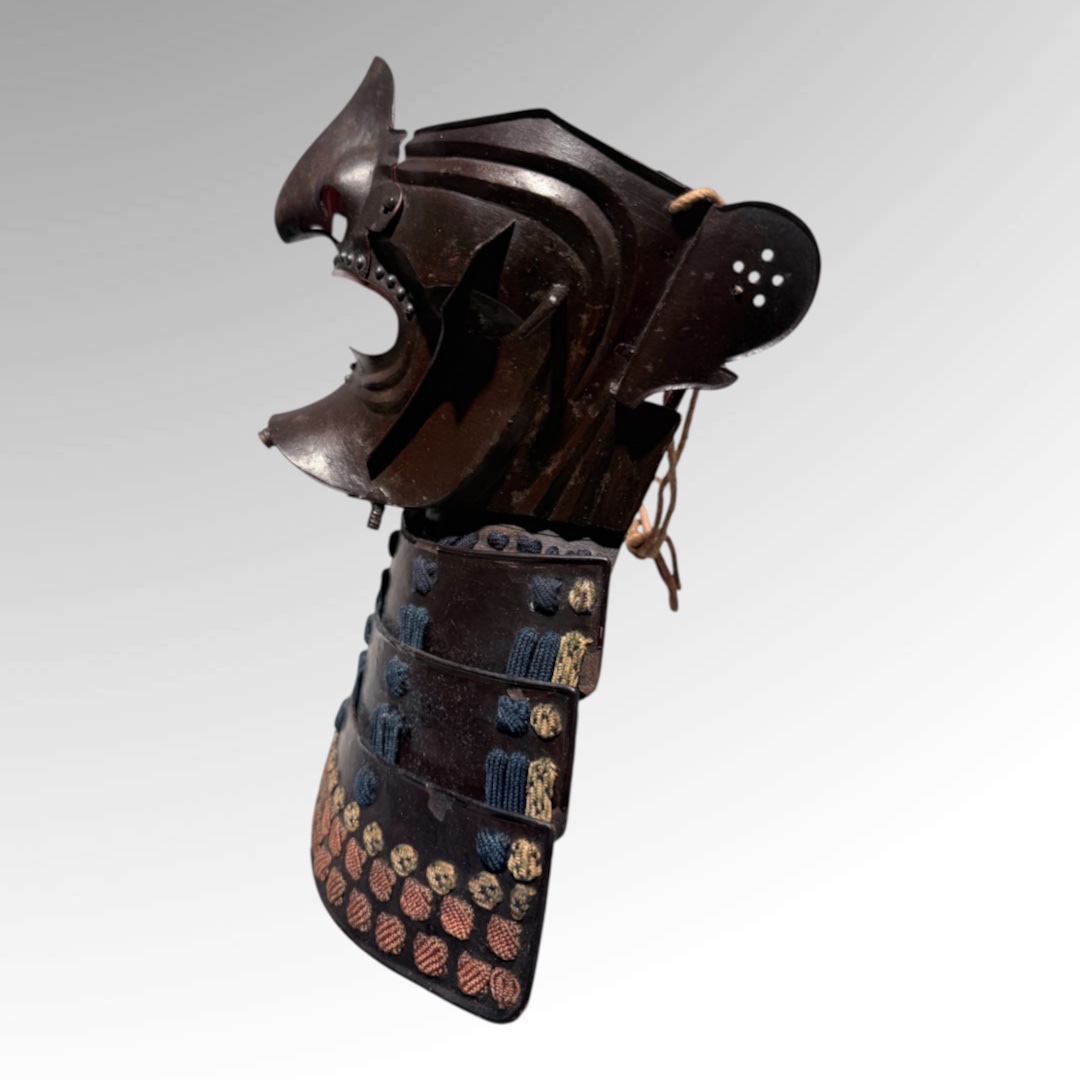
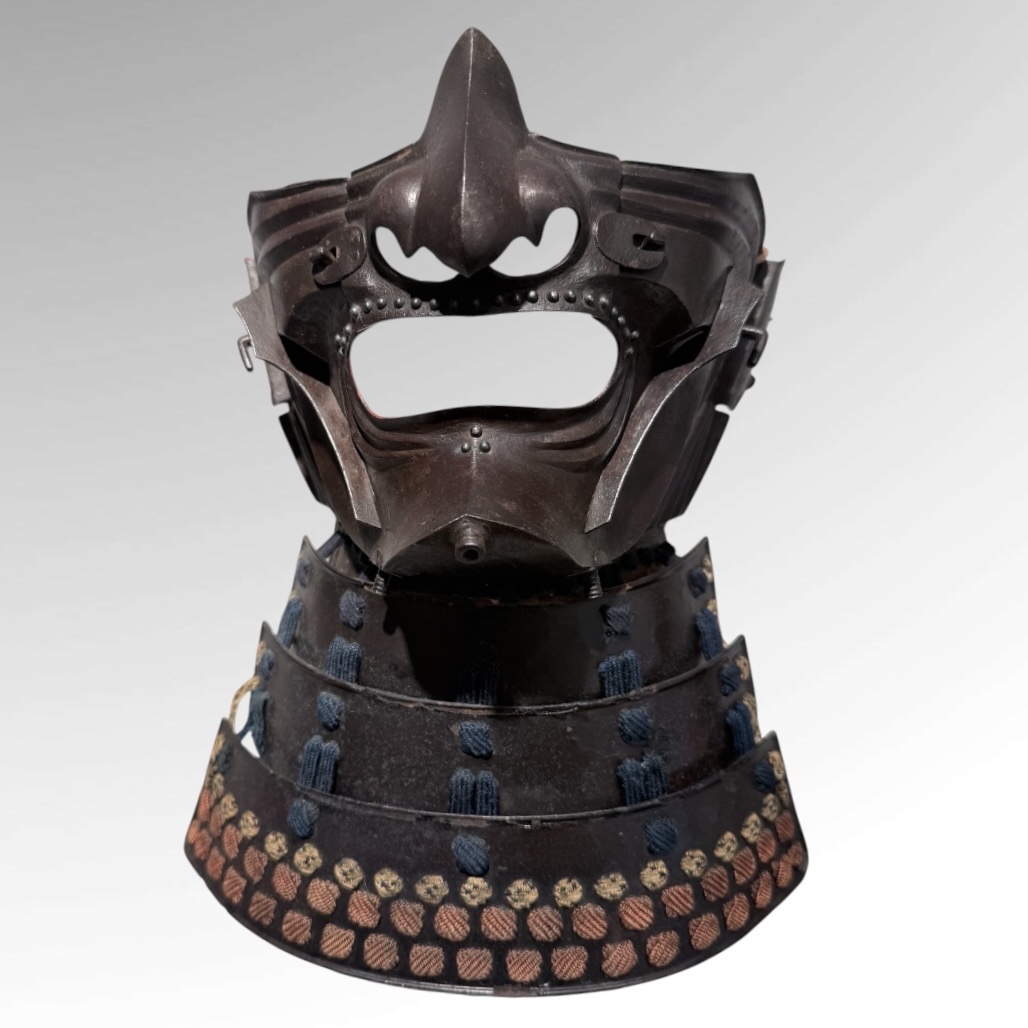
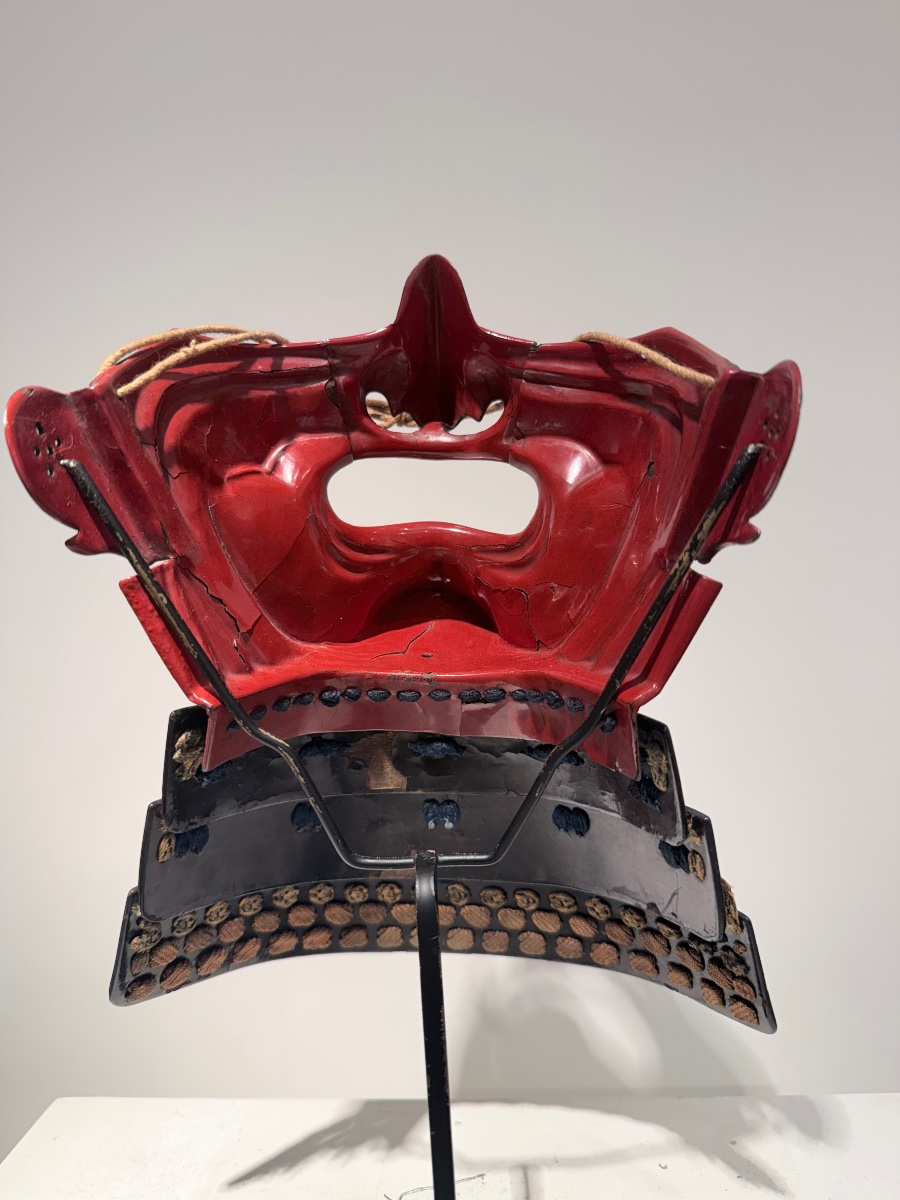
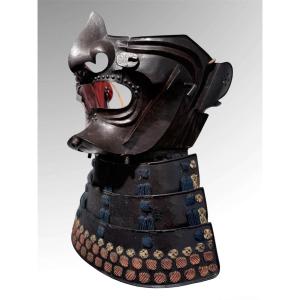


Karasu Tengu Menpo, Edo, Japan
Karasu Tengu Menpo, Mid-Edo Period
Rare mustache and beard with silver dots
A karasu menpō (烏面頬) is a traditional Japanese face mask wornby samurai. Its shape resembles a crow’s beak and is inspired by themythical Karasu Tengu. Design and History
Meaning: Karasu means“crow,” and menpō refers to a samurai half-mask covering theface from the eyes down to the eyelids.
Symbolism: Featuring a prominent andexaggerated beak, these masks were worn during the Edo period (and earlier) tostrike terror into enemies. They symbolized vigilance, aggression,and the supernatural power of mountain spirits. •The striking appearance of the karasu menpō isdeeply rooted in Japanese folklore. It directly personifies theKarasu Tengu (烏天狗),ancient winged spirits of themountains, masters ofmartial arts and swordsmanship. Mythical Origins: The Karasu Tengu The strikingstriking appearance of the karasu menpō is deeply rooted in Japanese folklore.It directly personifies the Karasu Tengu (烏天狗), ancient winged spirits of themountains, masters ofmartial arts and swordsmanship.
TheBird-Like Form: While traditional Daitengu are depicted with along, red nose, similar to that of a human, the Karasu Tengu arelower-ranking, more predatory spirits, endowed with a head and a sharp beakof a bird of prey (often a raven or a crow).
Protectors of War: According to mythology, these creatures inhabited thedeep forests and trained legendary warriors in secretcombat techniques. Wearing their mask allowed a samurai to channel thedivine protection, agility, and absolute ferocity of a woodland deity. •Psychological Warfare: Beyond the spiritual dimension, theand the bird’s beak created a monstrous and intimidating silhouetteon the battlefield, intended to completely unsettle opponents.
Evolutionduring the Edo period: From the battlefield to a symbol of social status Duringthe peaceful Edo period (1603–1867), samurai armor underwent amajor cultural transformation. As pitched battles became rare,armorers (katchūshi) moved away from purely functional protection infavor of creating highly decorative ceremonial pieces.
Artin Peacetime: Armor was rarely worn during armed conflicts.Instead, it was commissioned for ceremonial processions, palaceguards, and as family heirlooms. This allowed artisans to experiment withelaborate, highly stylized, and avant-garde masks, such as the karasu menpō. •The Rise of the Mengu: Face protection (mengu) diversified intoseveral highly specialized categories. While half-masks such as the menpō(covering from the nose to the chin) were common, this period alsosaw the rise of the sōmen, iron face masks covering the entire face,
: high-ranking samurai used theseexotic masks to reflect their clan’s prestige, their personal tastes, andtheir respect for traditional martial arts.
Rare mustache and beard with silver dots
A karasu menpō (烏面頬) is a traditional Japanese face mask wornby samurai. Its shape resembles a crow’s beak and is inspired by themythical Karasu Tengu. Design and History
Meaning: Karasu means“crow,” and menpō refers to a samurai half-mask covering theface from the eyes down to the eyelids.
Symbolism: Featuring a prominent andexaggerated beak, these masks were worn during the Edo period (and earlier) tostrike terror into enemies. They symbolized vigilance, aggression,and the supernatural power of mountain spirits. •The striking appearance of the karasu menpō isdeeply rooted in Japanese folklore. It directly personifies theKarasu Tengu (烏天狗),ancient winged spirits of themountains, masters ofmartial arts and swordsmanship. Mythical Origins: The Karasu Tengu The strikingstriking appearance of the karasu menpō is deeply rooted in Japanese folklore.It directly personifies the Karasu Tengu (烏天狗), ancient winged spirits of themountains, masters ofmartial arts and swordsmanship.
TheBird-Like Form: While traditional Daitengu are depicted with along, red nose, similar to that of a human, the Karasu Tengu arelower-ranking, more predatory spirits, endowed with a head and a sharp beakof a bird of prey (often a raven or a crow).
Protectors of War: According to mythology, these creatures inhabited thedeep forests and trained legendary warriors in secretcombat techniques. Wearing their mask allowed a samurai to channel thedivine protection, agility, and absolute ferocity of a woodland deity. •Psychological Warfare: Beyond the spiritual dimension, theand the bird’s beak created a monstrous and intimidating silhouetteon the battlefield, intended to completely unsettle opponents.
Evolutionduring the Edo period: From the battlefield to a symbol of social status Duringthe peaceful Edo period (1603–1867), samurai armor underwent amajor cultural transformation. As pitched battles became rare,armorers (katchūshi) moved away from purely functional protection infavor of creating highly decorative ceremonial pieces.
Artin Peacetime: Armor was rarely worn during armed conflicts.Instead, it was commissioned for ceremonial processions, palaceguards, and as family heirlooms. This allowed artisans to experiment withelaborate, highly stylized, and avant-garde masks, such as the karasu menpō. •The Rise of the Mengu: Face protection (mengu) diversified intoseveral highly specialized categories. While half-masks such as the menpō(covering from the nose to the chin) were common, this period alsosaw the rise of the sōmen, iron face masks covering the entire face,
: high-ranking samurai used theseexotic masks to reflect their clan’s prestige, their personal tastes, andtheir respect for traditional martial arts.
12 000 €
Period: 18th century
Style: Asian art
Condition: Good condition
Material: Wrought iron
Reference (ID): 1829546
Availability: In stock
Print