

Neo-renaissance Clock
Artist: L.-a. Marquis, M.-j.-n. Liénard
L.-A. Marquis, M.-J.-N.LIENARD
Bronzeworker, Draftsman
(1811–1885), (1810–1870)
Neo-Renaissance Clock
France - Circa 1860
Gilded and silver-plated bronze
Height: 51 cm; Width: 25 cm; Depth : 14 cm
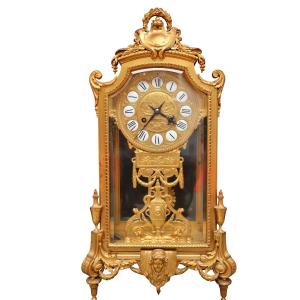
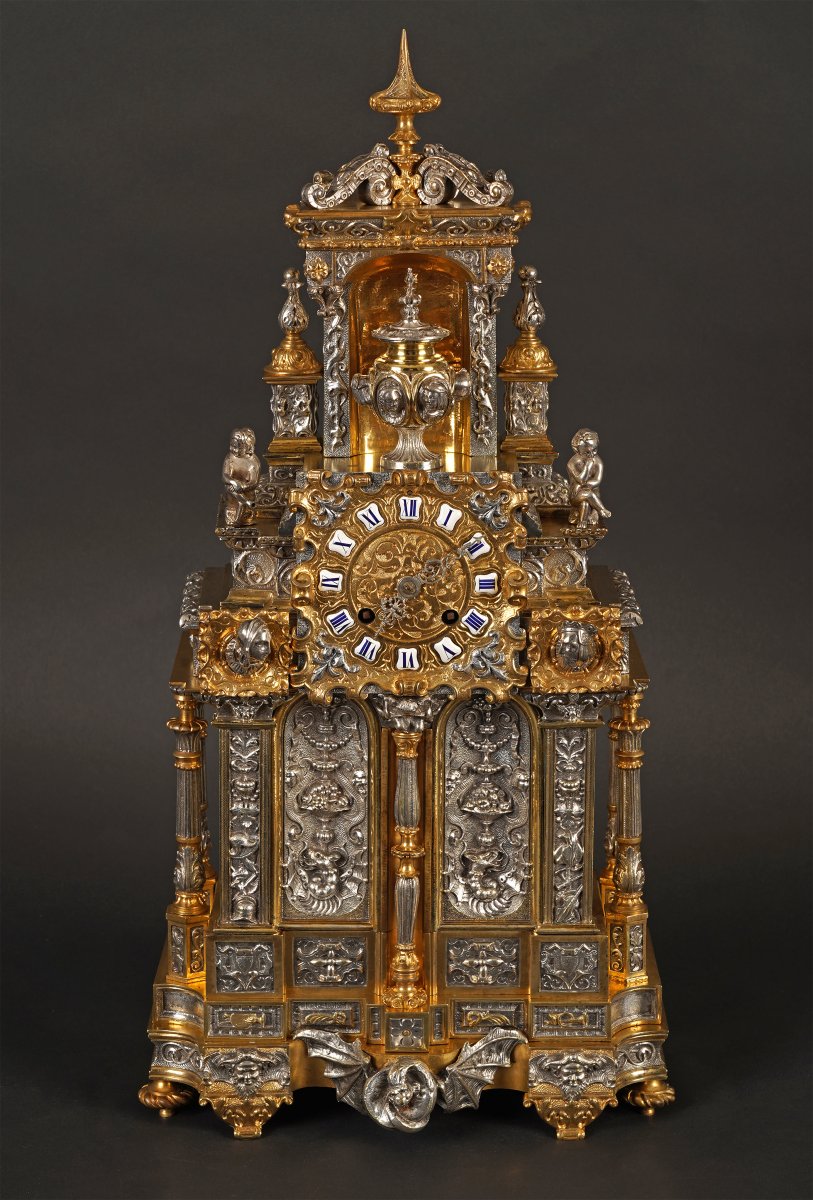
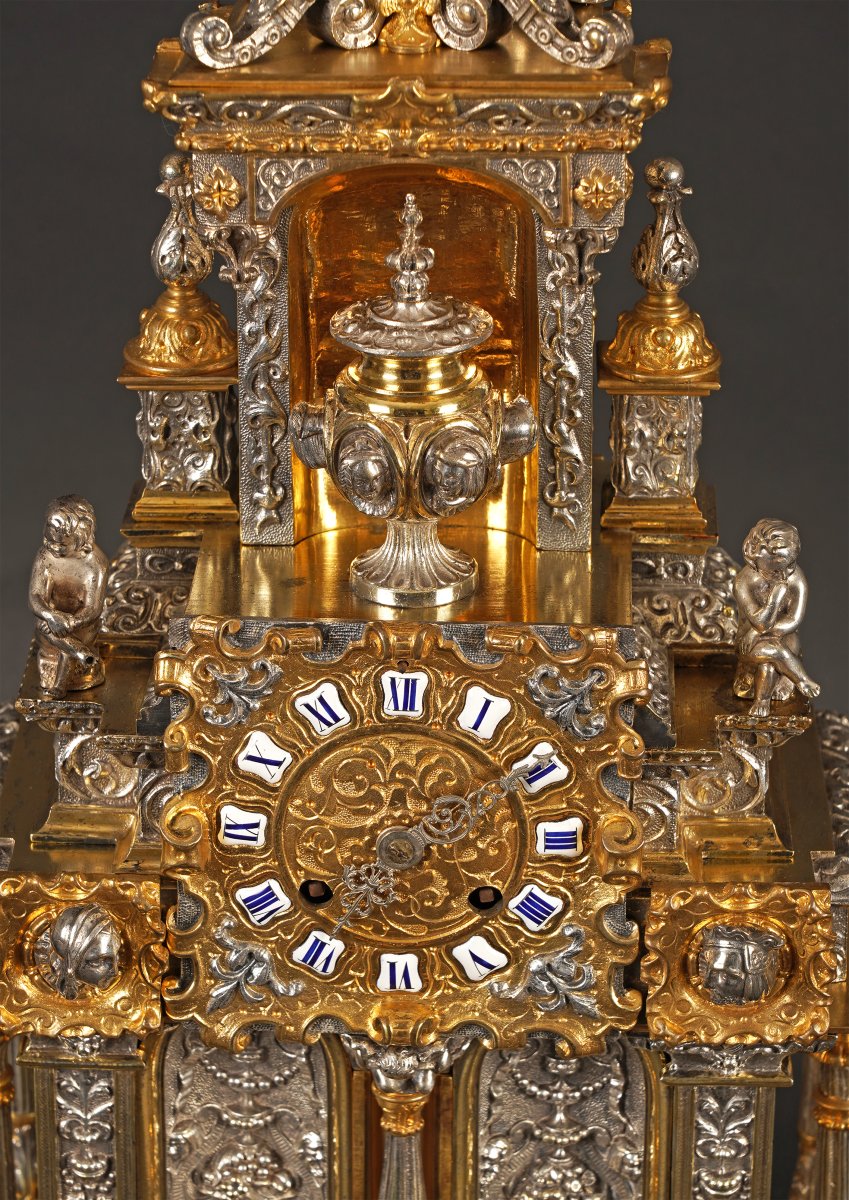
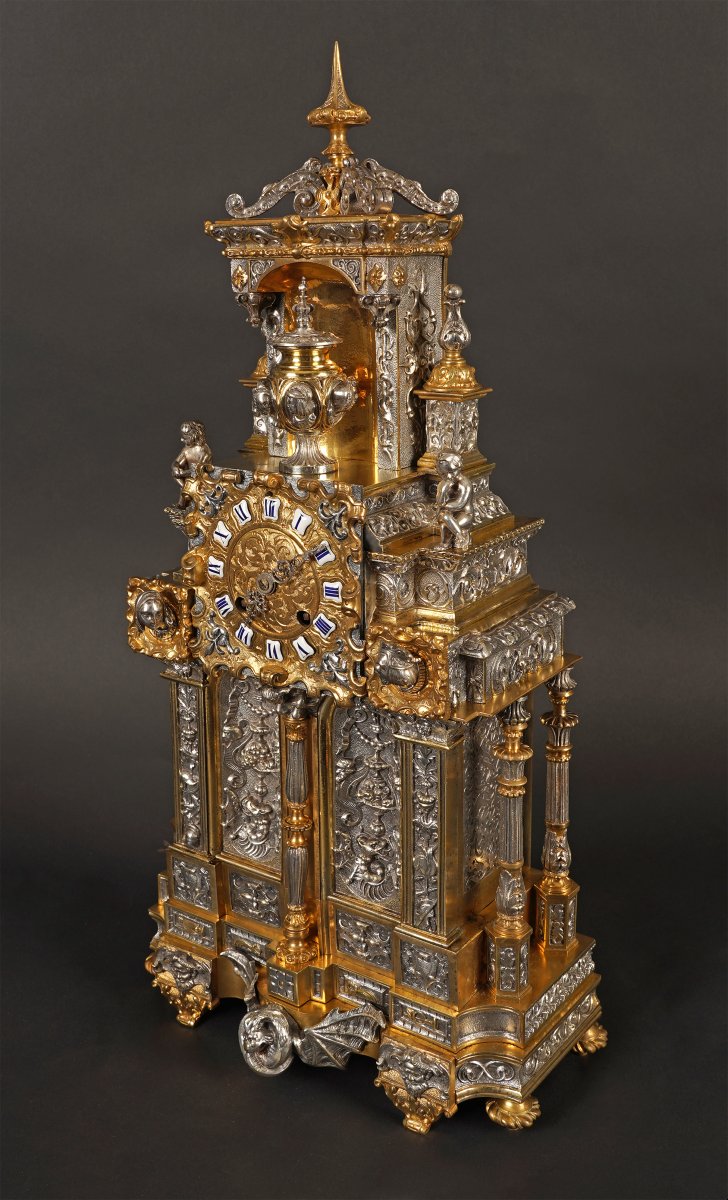
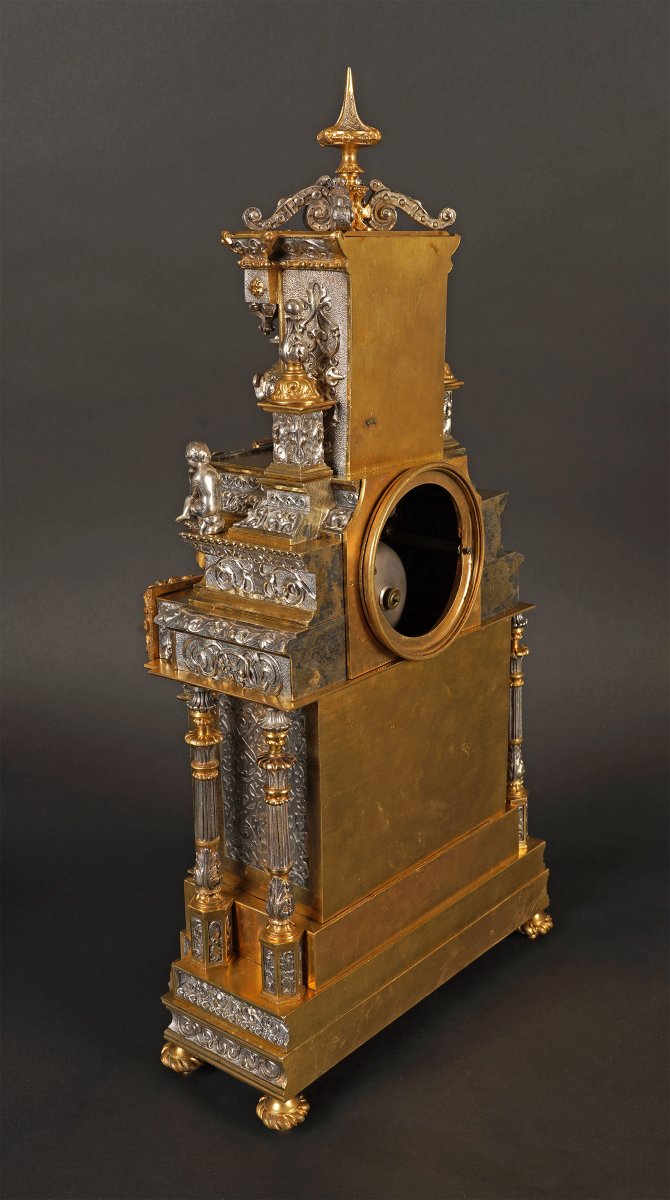
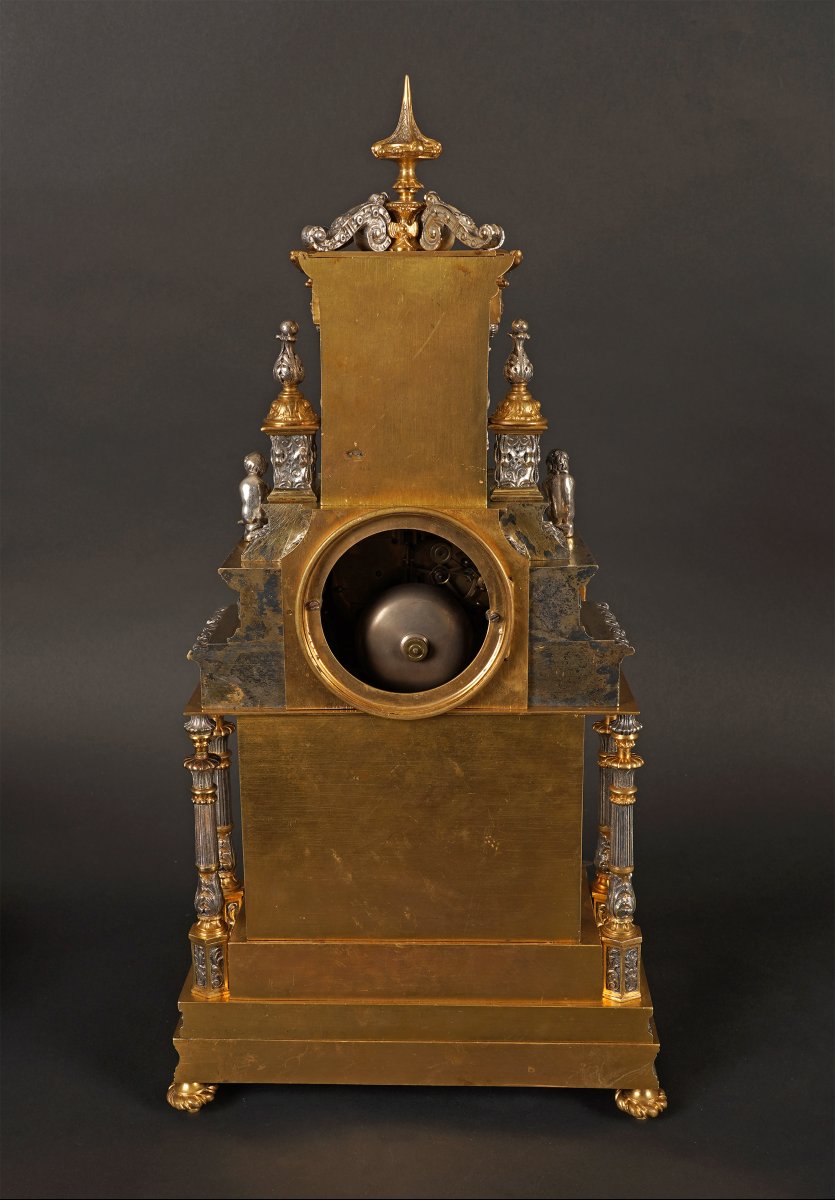
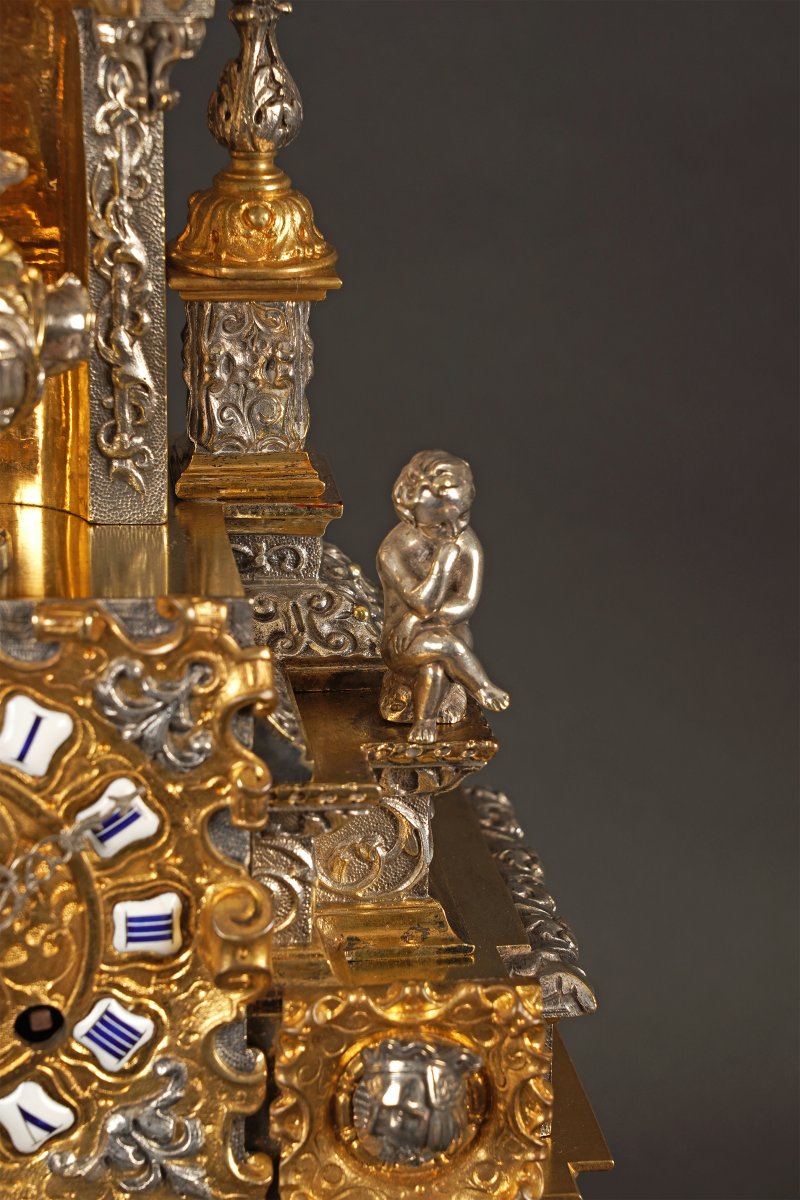
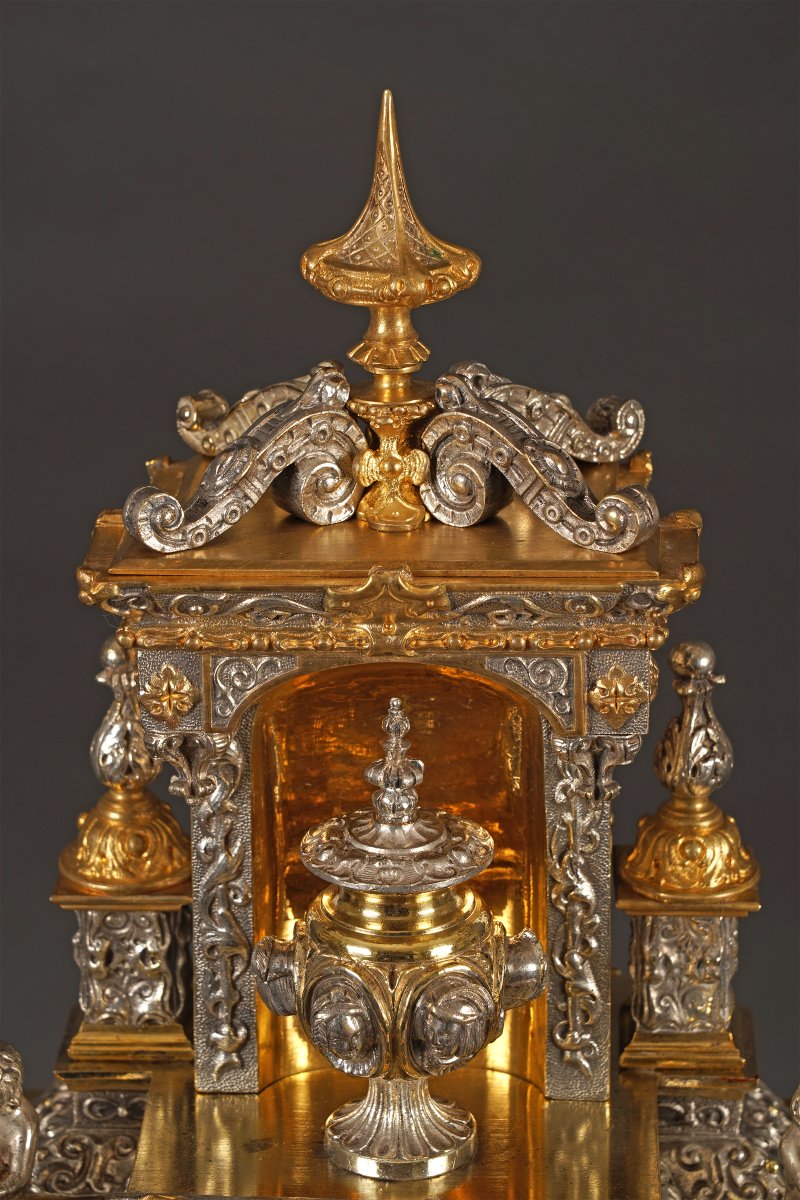
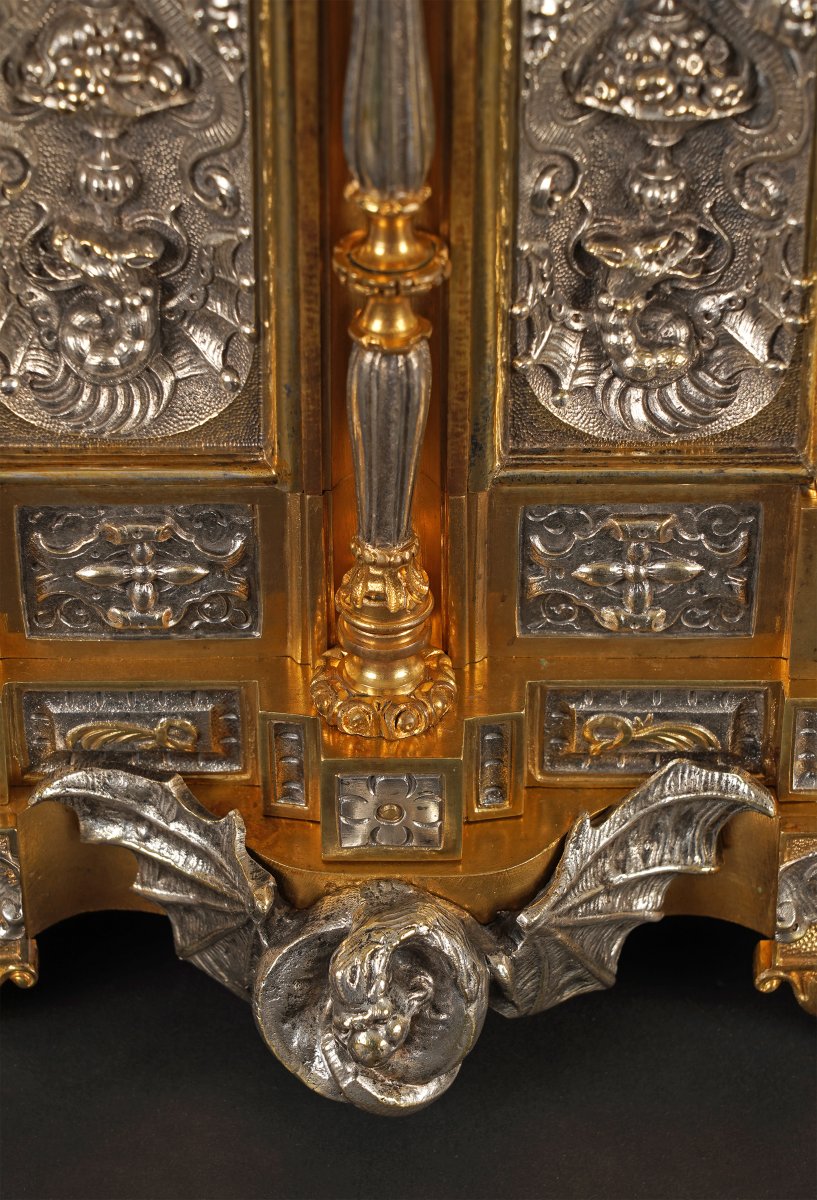
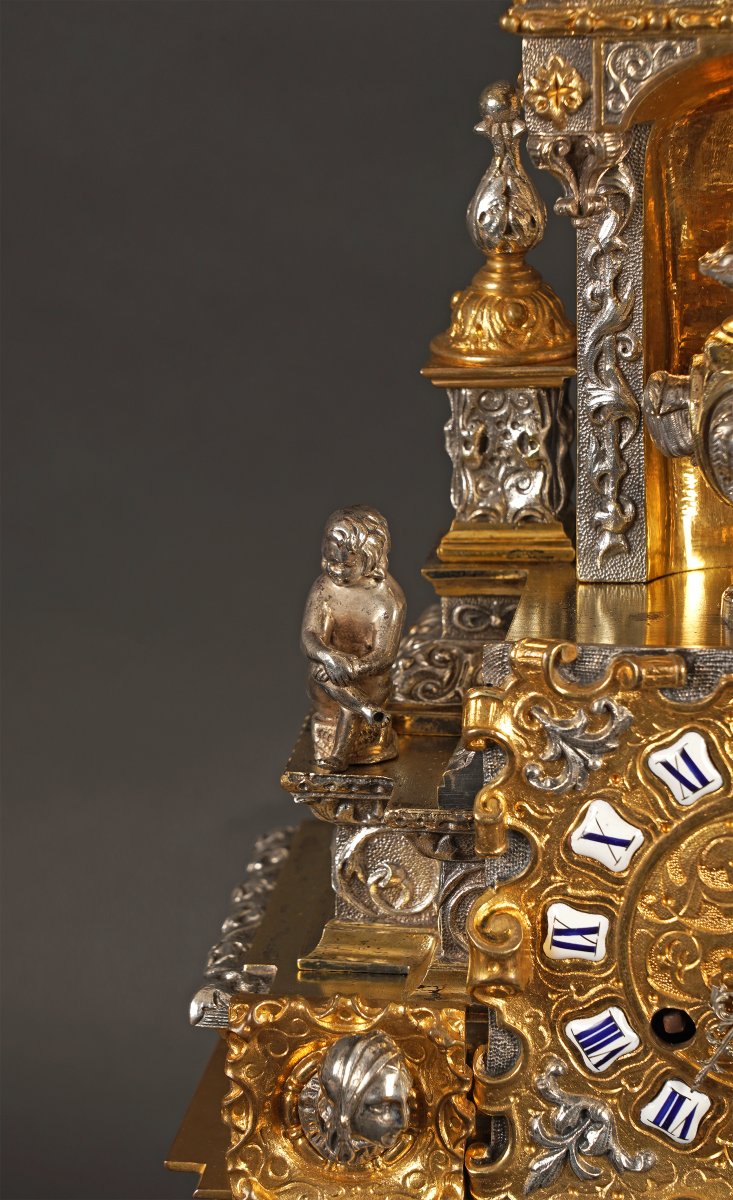
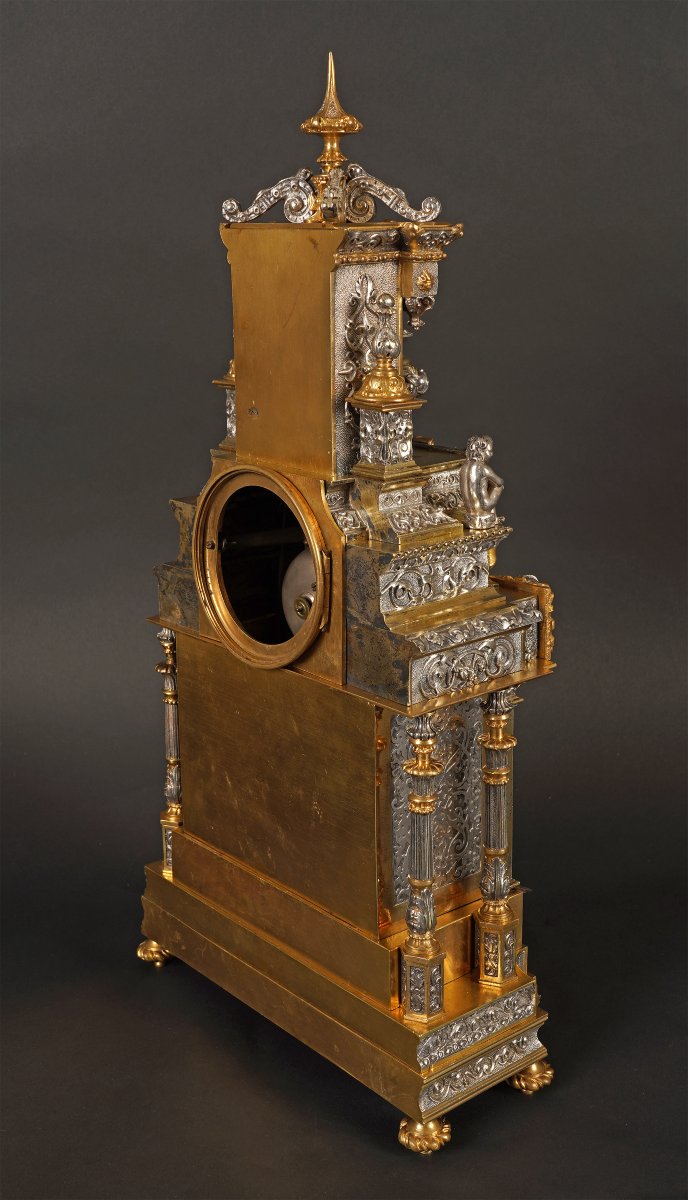
The work presented here is an architectural table clock of exceptional ornamental craftsmanship, following in the grand tradition of Renaissance- or Neo-Renaissance-style metalwork. Designed as a miniature building, it features overlapping levels and abounds with classical references in a style characterized by horror vacui, where no space is left empty. Constructed in the manner of a palatial façade or an altar, this piece features a main level punctuated by fluted columns in silver-plated metal, topped with gilded Corinthian capitals. These load-bearing elements frame bas-relief panels teeming with a decorative repertoire of grotesques, urns, drapery, and foliage, typical of 16th-century treatises on ornamentation.The systematic contrast between the dazzling gilding and the matte silver plating structures the perception of volume and emphasizes the piece’s three-dimensionality. At the heart of this composition, the focal point remains the dial, where the hours are indicated by blue Roman numerals painted on individual white enamel cartouches. The center of this dial, just like the plate that frames it, is entirely covered by a latticework of finely chased gilded foliage, while below, a central gilded column divides the lower space into two symmetrical niches. The base of the clock, which rests on flattened spinning-top legs, is centered by a grotesque mask framed by bat or dragon wings, anchoring the work in a fantastical realm.Rising toward greater lightness, the upper register features two putti figures in silver-plated full relief seated at the ends of the cornice. In the center, a gilded archway shelters a finely crafted covered vase or urn, the ensemble majestically crowned by a classical aedicule in the shape of a dome or lantern topped by a tapered pinnacle. Thus, this piece transcends its primary function of measuring time to become a true sculptural microcosm, designed to dazzle with the virtuosity of its carving, the richness of its materials, and the erudition of its architectural references.
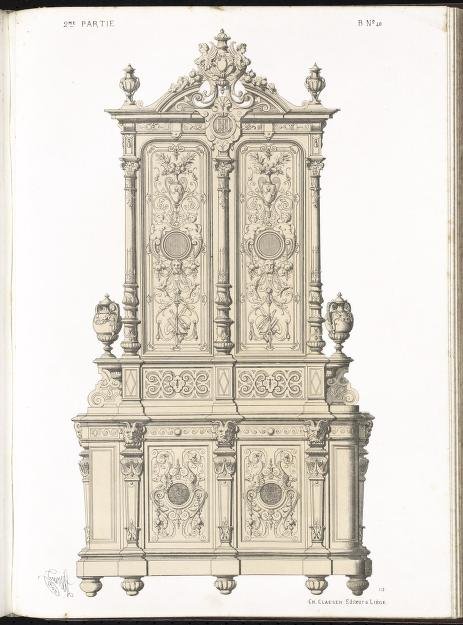
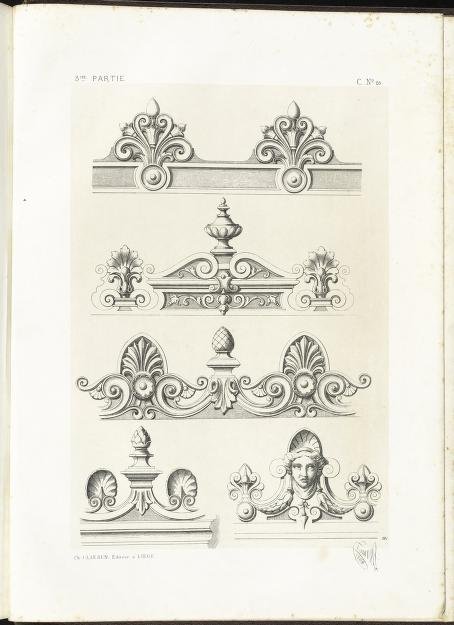
This piece, which combines goldsmithing and watchmaking and features highly complex ornamentation, reflects the Neo-Renaissance inspiration that was in vogue in the mid-19th century. Its ornamentation draws inspiration from various plates taken from *Spécimens de la décoration et de l’ornementation au XIXe siècle* (Specimens of 19th-Century Decoration and Ornamentation), a work published by Michel Joseph Napoléon Liénard in 1872.
Biography
Louis-Auguste Marquis (1811–1885) was a leading 19th-century French bronze artist, known primarily for his luxury furnishings and ceremonial lighting fixtures created during the July Monarchy and the Second Empire.In 1838–1839, he went into partnership with Gilbert-Honoré Chaumont (1790–1868), an already highly renowned manufacturer specializing in chandeliers. This collaboration propelled Marquis’s career, and he subsequently succeeded Chaumont around 1844. Although Marquis produced clocks and exceptional mantelpieces—often in the Louis XVI style or inspired by the 18th century—his true specialty remained monumental light fixtures. His talent as a chaser earned him prestigious commissions from the government. His works adorn, notably, the Ministry of Foreign Affairs building, and several of his pieces are now preserved and cataloged in the collections of the French Mobilier National.
Michel Joseph Napoléon Liénard (1810–1870) was a French sculptor, draftsman, and ornamental artist considered one of the leading figures in 19th-century decorative arts and ornamentation. He provided a multitude of models and drawings to the artisans of his time(bronze casters, goldsmiths, cabinetmakers, and art foundries), and in 1866, he published his famous collection of ornamentation titled *Spécimens de la décoration et de l’ornementation au XIXe siècle* (*Specimens of Decoration and Ornamentation in the 19th Century*), whose theoretical and practical significance greatly influenced many artists. He collaborated with the renowned art foundries of the Val d’Osne (notably with the sculptor Mathurin Moreau) and with architects such as Hippolyte Destailleur.
Bronzeworker, Draftsman
(1811–1885), (1810–1870)
Neo-Renaissance Clock
France - Circa 1860
Gilded and silver-plated bronze
Height: 51 cm; Width: 25 cm; Depth : 14 cm
The work presented here is an architectural table clock of exceptional ornamental craftsmanship, following in the grand tradition of Renaissance- or Neo-Renaissance-style metalwork. Designed as a miniature building, it features overlapping levels and abounds with classical references in a style characterized by horror vacui, where no space is left empty. Constructed in the manner of a palatial façade or an altar, this piece features a main level punctuated by fluted columns in silver-plated metal, topped with gilded Corinthian capitals. These load-bearing elements frame bas-relief panels teeming with a decorative repertoire of grotesques, urns, drapery, and foliage, typical of 16th-century treatises on ornamentation.The systematic contrast between the dazzling gilding and the matte silver plating structures the perception of volume and emphasizes the piece’s three-dimensionality. At the heart of this composition, the focal point remains the dial, where the hours are indicated by blue Roman numerals painted on individual white enamel cartouches. The center of this dial, just like the plate that frames it, is entirely covered by a latticework of finely chased gilded foliage, while below, a central gilded column divides the lower space into two symmetrical niches. The base of the clock, which rests on flattened spinning-top legs, is centered by a grotesque mask framed by bat or dragon wings, anchoring the work in a fantastical realm.Rising toward greater lightness, the upper register features two putti figures in silver-plated full relief seated at the ends of the cornice. In the center, a gilded archway shelters a finely crafted covered vase or urn, the ensemble majestically crowned by a classical aedicule in the shape of a dome or lantern topped by a tapered pinnacle. Thus, this piece transcends its primary function of measuring time to become a true sculptural microcosm, designed to dazzle with the virtuosity of its carving, the richness of its materials, and the erudition of its architectural references.
This piece, which combines goldsmithing and watchmaking and features highly complex ornamentation, reflects the Neo-Renaissance inspiration that was in vogue in the mid-19th century. Its ornamentation draws inspiration from various plates taken from *Spécimens de la décoration et de l’ornementation au XIXe siècle* (Specimens of 19th-Century Decoration and Ornamentation), a work published by Michel Joseph Napoléon Liénard in 1872.
Biography
Louis-Auguste Marquis (1811–1885) was a leading 19th-century French bronze artist, known primarily for his luxury furnishings and ceremonial lighting fixtures created during the July Monarchy and the Second Empire.In 1838–1839, he went into partnership with Gilbert-Honoré Chaumont (1790–1868), an already highly renowned manufacturer specializing in chandeliers. This collaboration propelled Marquis’s career, and he subsequently succeeded Chaumont around 1844. Although Marquis produced clocks and exceptional mantelpieces—often in the Louis XVI style or inspired by the 18th century—his true specialty remained monumental light fixtures. His talent as a chaser earned him prestigious commissions from the government. His works adorn, notably, the Ministry of Foreign Affairs building, and several of his pieces are now preserved and cataloged in the collections of the French Mobilier National.
Michel Joseph Napoléon Liénard (1810–1870) was a French sculptor, draftsman, and ornamental artist considered one of the leading figures in 19th-century decorative arts and ornamentation. He provided a multitude of models and drawings to the artisans of his time(bronze casters, goldsmiths, cabinetmakers, and art foundries), and in 1866, he published his famous collection of ornamentation titled *Spécimens de la décoration et de l’ornementation au XIXe siècle* (*Specimens of Decoration and Ornamentation in the 19th Century*), whose theoretical and practical significance greatly influenced many artists. He collaborated with the renowned art foundries of the Val d’Osne (notably with the sculptor Mathurin Moreau) and with architects such as Hippolyte Destailleur.
11 000 €
Period: 19th century
Style: Napoleon 3rd
Condition: Fully restored in our whorkshop
Material: Bronze
Width: 25 cm
Height: 51 cm
Depth: 14 cm
Reference (ID): 1826935
Availability: In stock
Print