

Josep Maria Miralles Tinturé (1894–1971) - On A Terrace Facing The Sea / Sitges 1954
Artist: Josep Maria Miralles Tinturé (1894 - 1971)
JOSEP MARIA MIRALLES TINTURÉ -
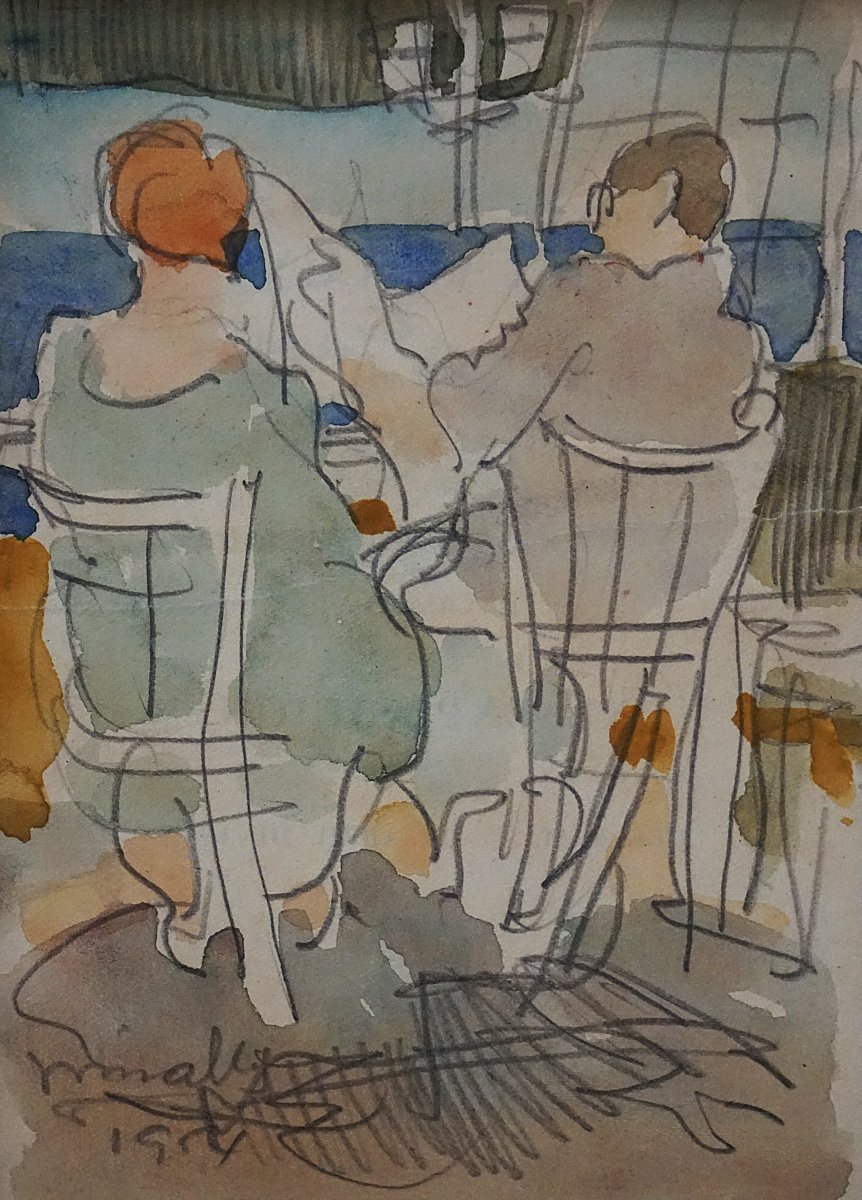
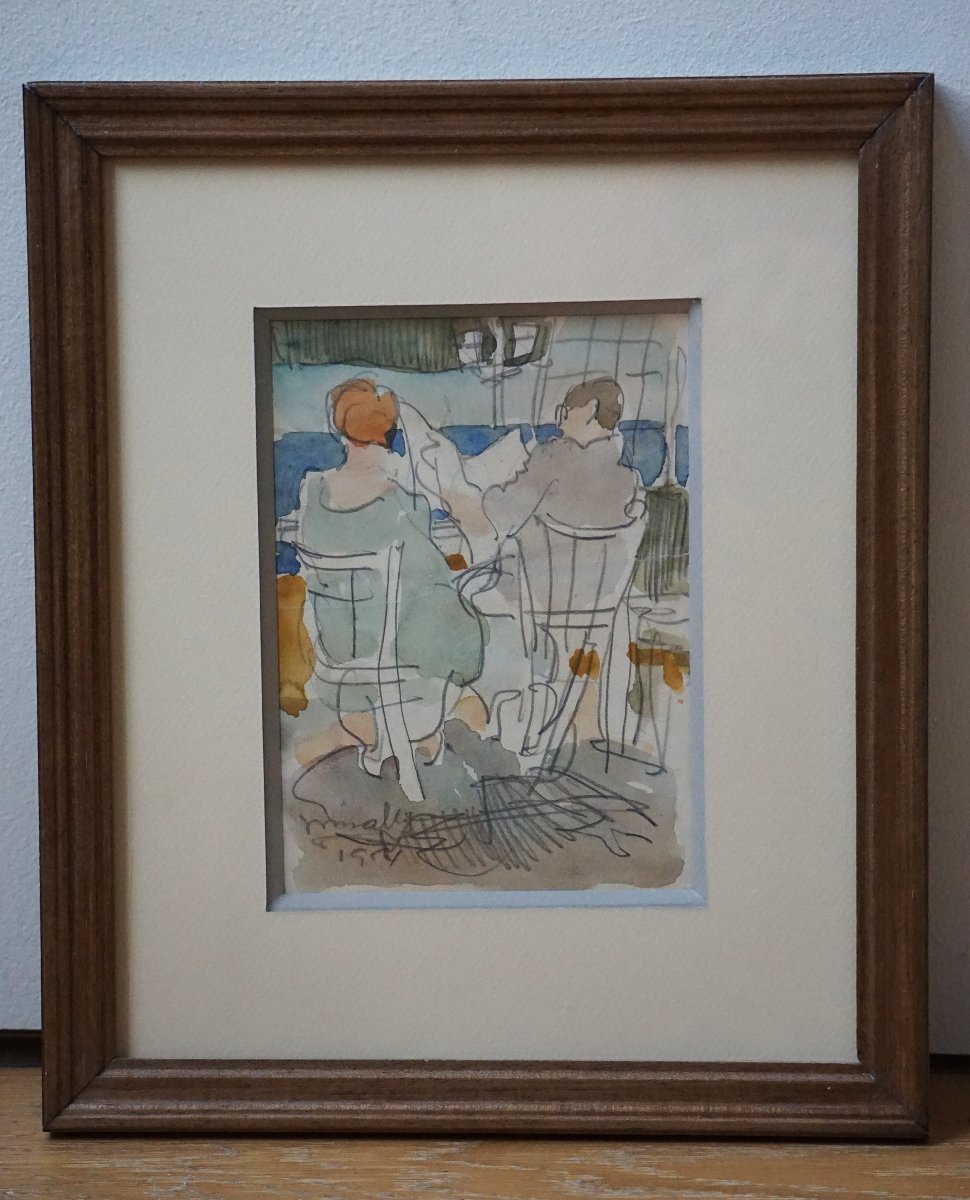
On a terrace facing the sea, Sitges, 1954
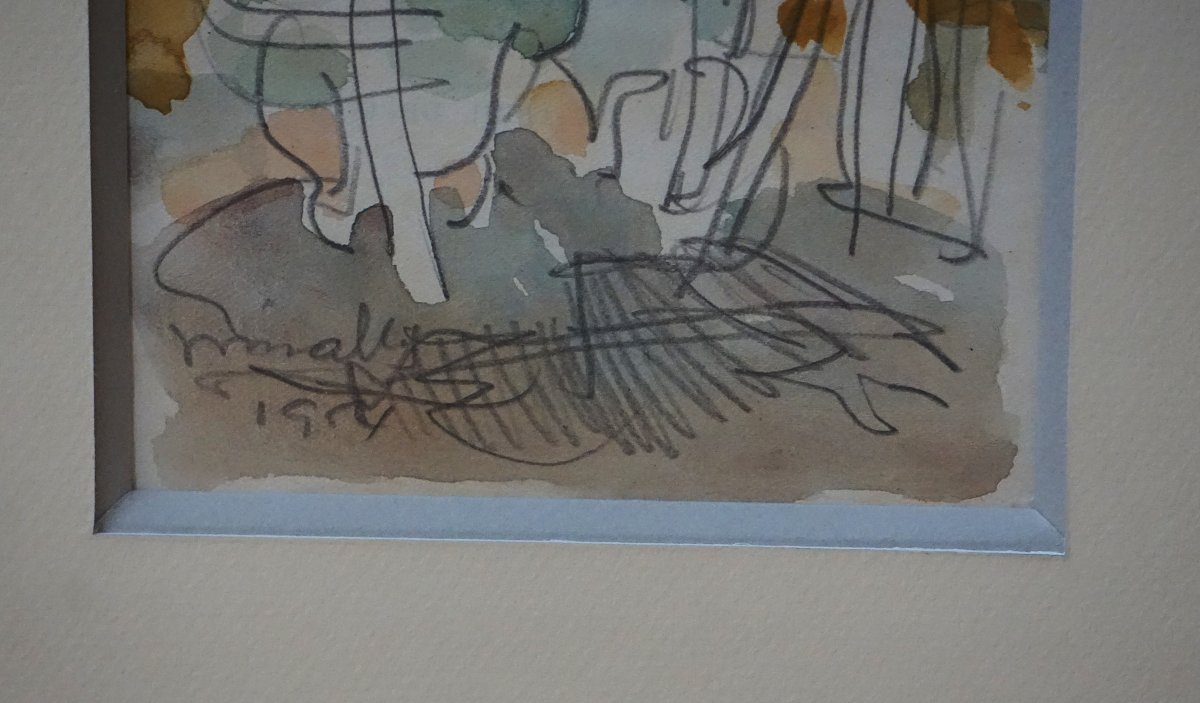
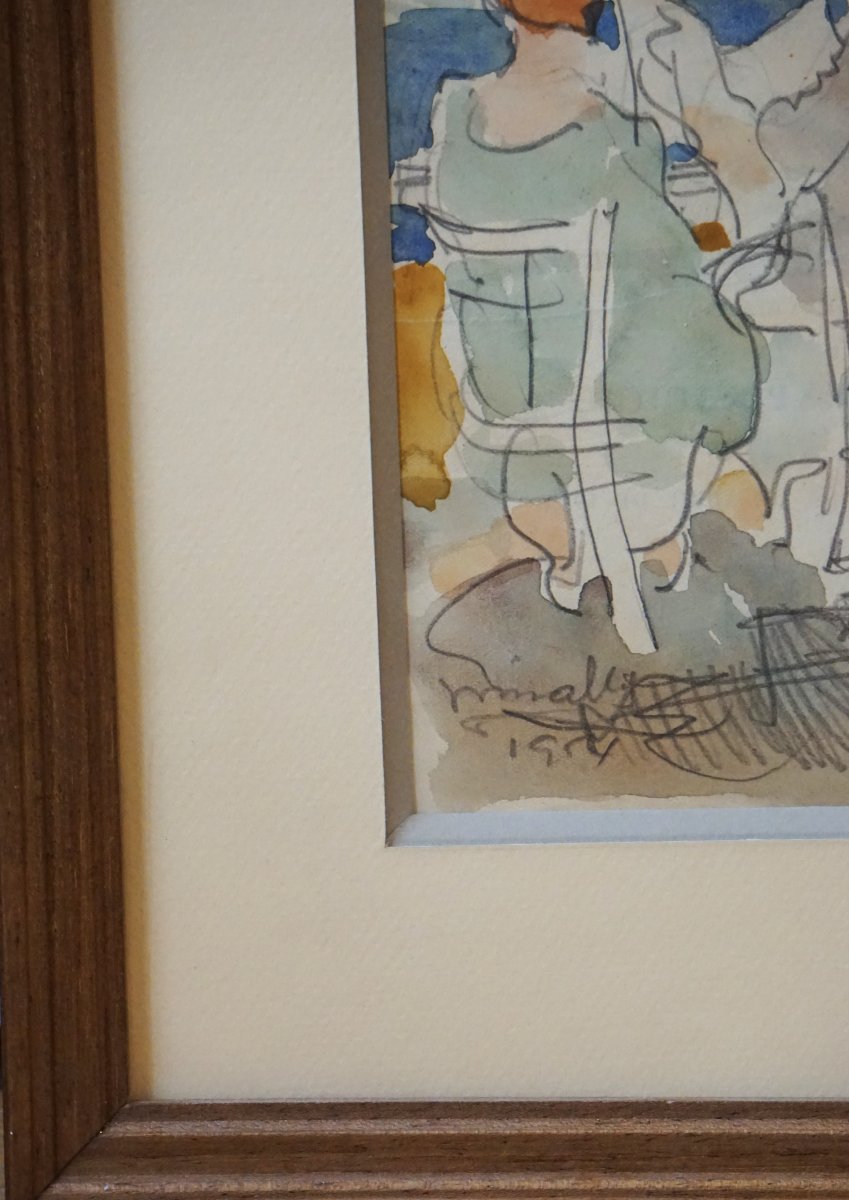
Watercolor and graphite on paper Signed and dated lower left
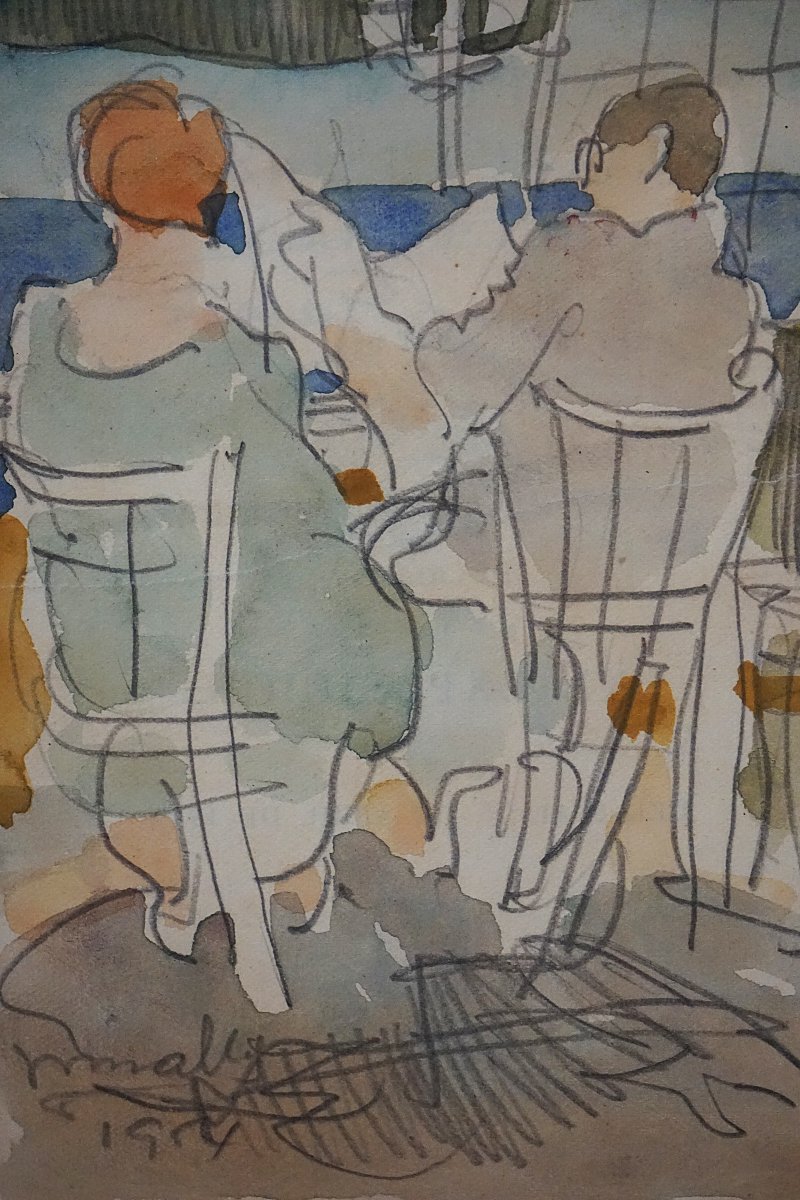
Miralles 1954
16.5 x 11.5 (image size)
30 x 25 with frame
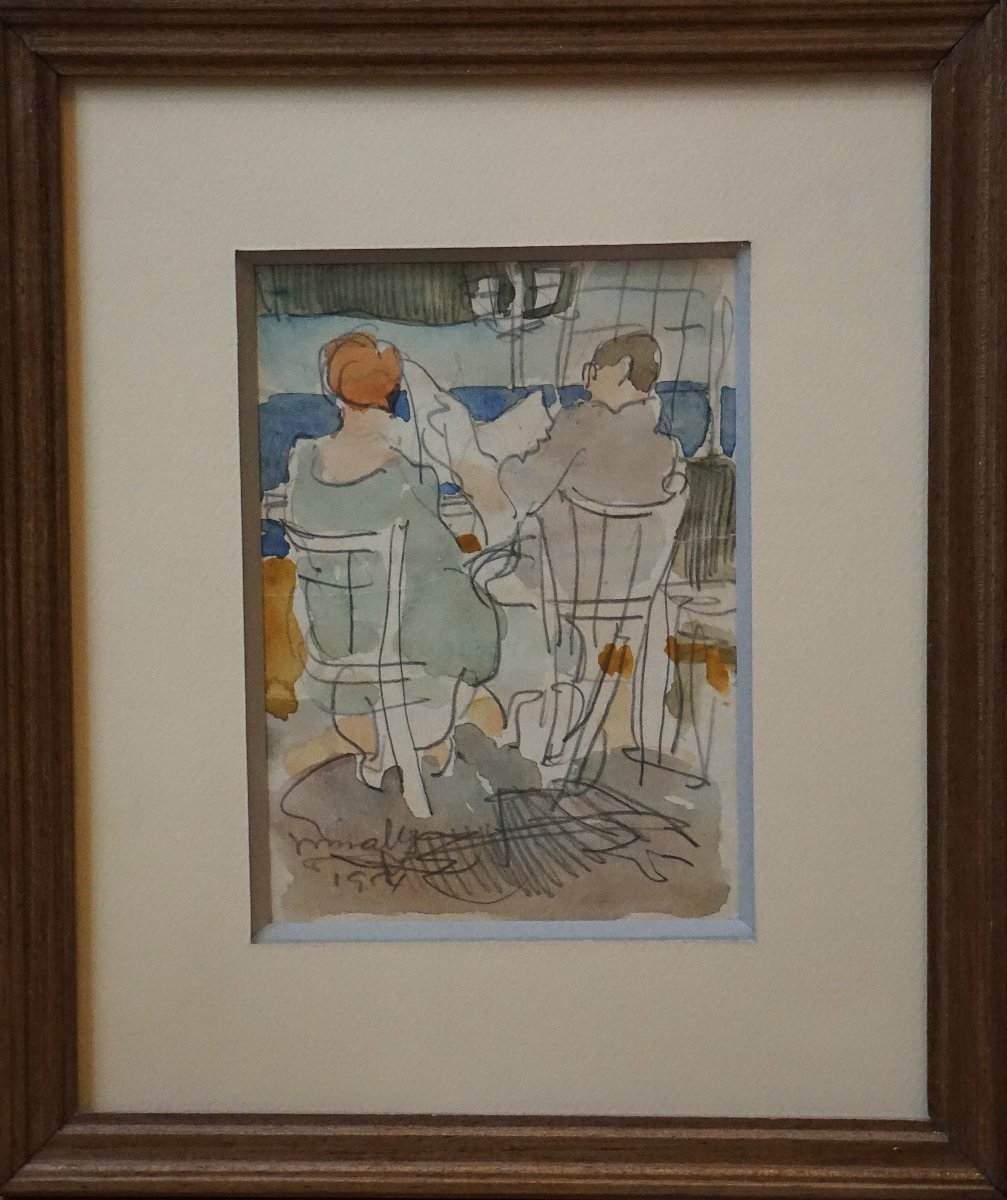
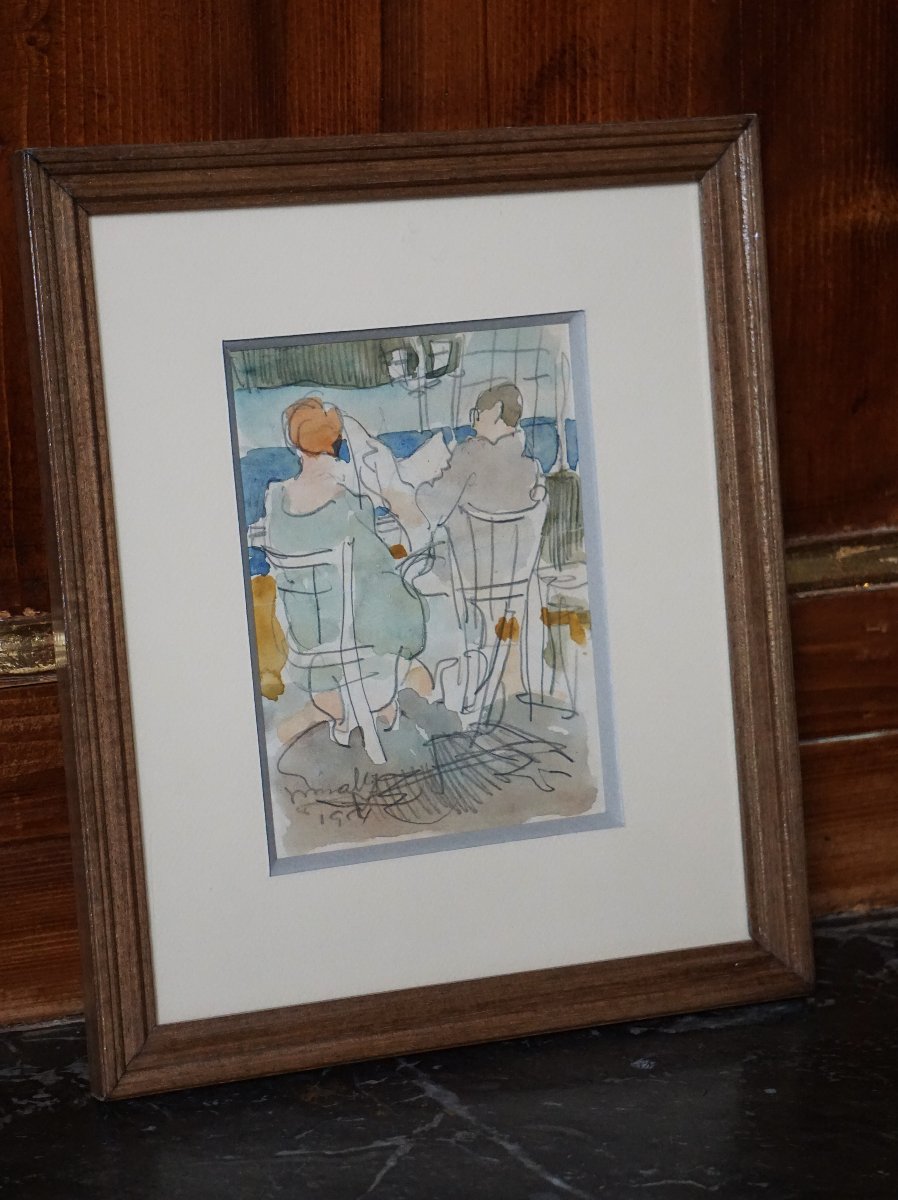
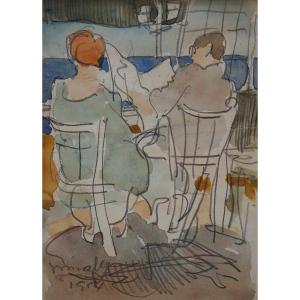
Two chairs. Two backs. The world ends there. A redheaded woman with her hair in a high bun, wearing a sea-green dress. A man in a light-colored jacket, wearing glasses. They aren’t posing. They’re captured on the spot, from behind, just like you and me on the terrace of a café on the Passeig de la Ribera. Before them, the intense, almost abstract blue of the Mediterranean. Behind them, the slender rigging of a sailboat.
The essence of Miralles Tinturé’s art lies right there, in this miraculous economy of form. A bold, energetic pencil stroke that captures the pose in three lines.
Then three splashes of watercolor: the reddish ochre of the bun, the Prussian blue of the sea, the mustard yellow of a table. That’s all. And that’s Sitges in its entirety. It’s 1954. The postwar light. Silence regained. He isn’t painting the sea; he’s painting the moment when two people gaze at the sea together. It’s intimate, suspended, wildly modern. It brings to mind Raoul Dufy, a Catalan Bonnard who has retained a sense of modesty. It’s a scene from life—elegant, nostalgic. It speaks of the Mediterranean, of the couple, of Catalan gentleness. A very Art Deco palette: blue, aqua, ochre, pearl gray.
JOSEP MARIA MIRALLES TINTURÉ (1894–1971)
Painter and draftsman born in Manresa in 1894 and died in Maó (Menorca) in 1971. In his youth, he attended the prestigious Escola de Llotja in Barcelona—the cradle of all great Catalan painters—where he studied under Joan Serra and Alfred Sisquella, two leading figures of Noucentisme. He later moved to Paris, then to Argentina, where he became an architect. This dual training as an architect and painter explains it all: his sense of structure, his line so precise, so well-constructed. In 1928, he returned to Barcelona, until, after the Spanish Civil War, he settled permanently in Sitges. Sitges became his home, his open-air studio. Although he exhibited in France in 1938 and in Sitges in 1946, it was not until after his death that exhibitions began to multiply and his work was finally recognized. His work was exhibited in Barcelona (at the Rovira and Prócer Galleries) and in Sitges, where, in 1973, a retrospective tribute was dedicated to him at the Palau de Maricel—the crowning achievement of his career. In 1977, another posthumous exhibition in his honor was held at the Sala Xipell in Manresa. Today, his works are on display at the Palau Maricel in Sitges and the Museu de Manresa. His technique: He primarily worked in aguada and watercolor, techniques he applied to landscapes, seascapes, gardens, and female nudes. He also practiced engraving, although it was perhaps in his aguadas that he expressed himself with the greatest flexibility and originality.
On a terrace facing the sea, Sitges, 1954
Watercolor and graphite on paper Signed and dated lower left
Miralles 1954
16.5 x 11.5 (image size)
30 x 25 with frame
Two chairs. Two backs. The world ends there. A redheaded woman with her hair in a high bun, wearing a sea-green dress. A man in a light-colored jacket, wearing glasses. They aren’t posing. They’re captured on the spot, from behind, just like you and me on the terrace of a café on the Passeig de la Ribera. Before them, the intense, almost abstract blue of the Mediterranean. Behind them, the slender rigging of a sailboat.
The essence of Miralles Tinturé’s art lies right there, in this miraculous economy of form. A bold, energetic pencil stroke that captures the pose in three lines.
Then three splashes of watercolor: the reddish ochre of the bun, the Prussian blue of the sea, the mustard yellow of a table. That’s all. And that’s Sitges in its entirety. It’s 1954. The postwar light. Silence regained. He isn’t painting the sea; he’s painting the moment when two people gaze at the sea together. It’s intimate, suspended, wildly modern. It brings to mind Raoul Dufy, a Catalan Bonnard who has retained a sense of modesty. It’s a scene from life—elegant, nostalgic. It speaks of the Mediterranean, of the couple, of Catalan gentleness. A very Art Deco palette: blue, aqua, ochre, pearl gray.
JOSEP MARIA MIRALLES TINTURÉ (1894–1971)
Painter and draftsman born in Manresa in 1894 and died in Maó (Menorca) in 1971. In his youth, he attended the prestigious Escola de Llotja in Barcelona—the cradle of all great Catalan painters—where he studied under Joan Serra and Alfred Sisquella, two leading figures of Noucentisme. He later moved to Paris, then to Argentina, where he became an architect. This dual training as an architect and painter explains it all: his sense of structure, his line so precise, so well-constructed. In 1928, he returned to Barcelona, until, after the Spanish Civil War, he settled permanently in Sitges. Sitges became his home, his open-air studio. Although he exhibited in France in 1938 and in Sitges in 1946, it was not until after his death that exhibitions began to multiply and his work was finally recognized. His work was exhibited in Barcelona (at the Rovira and Prócer Galleries) and in Sitges, where, in 1973, a retrospective tribute was dedicated to him at the Palau de Maricel—the crowning achievement of his career. In 1977, another posthumous exhibition in his honor was held at the Sala Xipell in Manresa. Today, his works are on display at the Palau Maricel in Sitges and the Museu de Manresa. His technique: He primarily worked in aguada and watercolor, techniques he applied to landscapes, seascapes, gardens, and female nudes. He also practiced engraving, although it was perhaps in his aguadas that he expressed himself with the greatest flexibility and originality.
350 €
Period: 20th century
Style: Other Style
Condition: Excellent condition
Material: Paper
Reference (ID): 1826117
Availability: In stock
Print