Léonce Chabry—temple Of Montouhotep II At Deir El-bahari—archaeological Landscape Of Egypt—1882
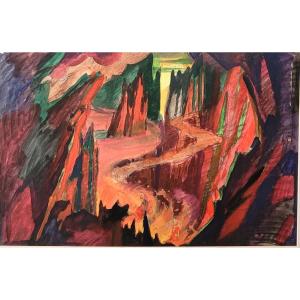
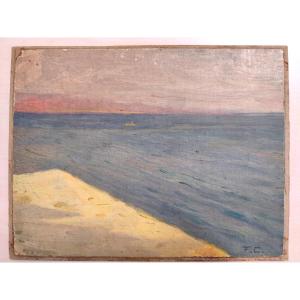
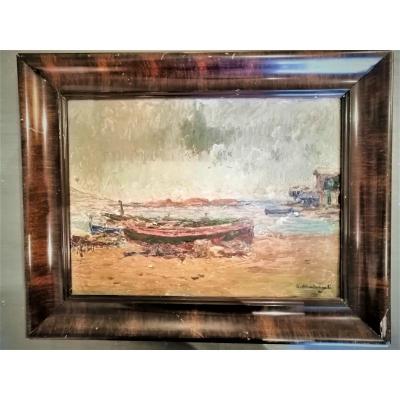
Oil on canvas by Léonce Chabry depicting the ruins of the Deir el-Bahari site, located across from Luxor in Upper Egypt. Monogrammed on the left and labeled “Deir-el-Bahari” on the right, this work was painted in late 1881 or early 1882, just as the site was gaining fame following the archaeological discoveries reported by Gaston Maspero.
The painting depicts a rocky, arid landscape dominated by the ruins of the temple of Montuhotep II, set against the Theban cliff. The composition is characterized by a free and energetic brushstroke, almost expressionistic, in which the ochre hues of the rocks and sands contrast with the luminous intensity of the Egyptian blue sky. This unadorned and powerful painting reveals an artist at the height of his art, prioritizing the pictorial force of the subject over any orientalist anecdote.
Along with Adrien Dauzats, Léonce Chabry ranks among the few 19th-century Orientalist painters from Bordeaux. Between 1880 and 1882, he undertook a long journey to the East, traveling through the Balkans, Greece, Constantinople, Lebanon, and Palestine before traveling up the Nile through Lower and Upper Egypt. The surviving journals from this journey document his explorations and his interest in the landscapes, monuments, and scenes he observed during the expedition.
At the very time Chabry was staying in Egypt, a major archaeological discovery shook the scholarly world: the discovery at Deir el-Bahari of a royal cache containing several dozen pharaonic mummies that had been moved in antiquity to protect them from looting. The excavations led by Gaston Maspéro revealed, in particular, the remains of prestigious rulers such as Ramses II, Thutmose III, and Seti I.
It is likely that the immense impact of this discovery led Chabry to visit this site, which had become legendary. A few years later, excavations by the Swiss Egyptologist Édouard Naville would unearth the buried temple of Montuhotep II, revealing the major archaeological significance of the Deir el-Bahari funerary complex.
ConditionGood overall condition. Some slight wear and minor historical restorations consistent with the work’s age. Beautiful paint texture and excellent visual impact.
Dimensions35 x 41 cm
Sold with its certificate of authenticity.
Period: 19th century
Style: Other Style
Condition: Excellent condition
Material: Oil painting
Length: 41 cm
Width: 35 cm
Reference (ID): 1824737
Availability: In stock