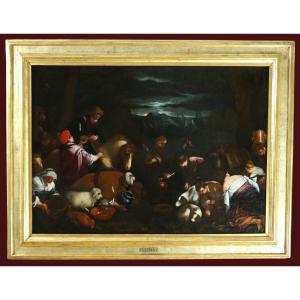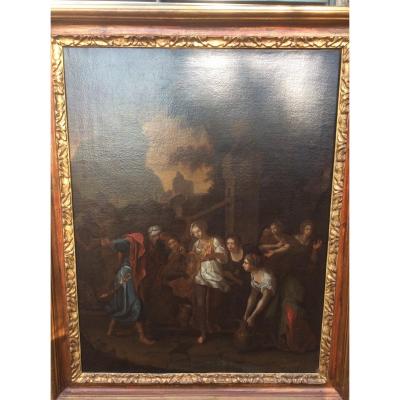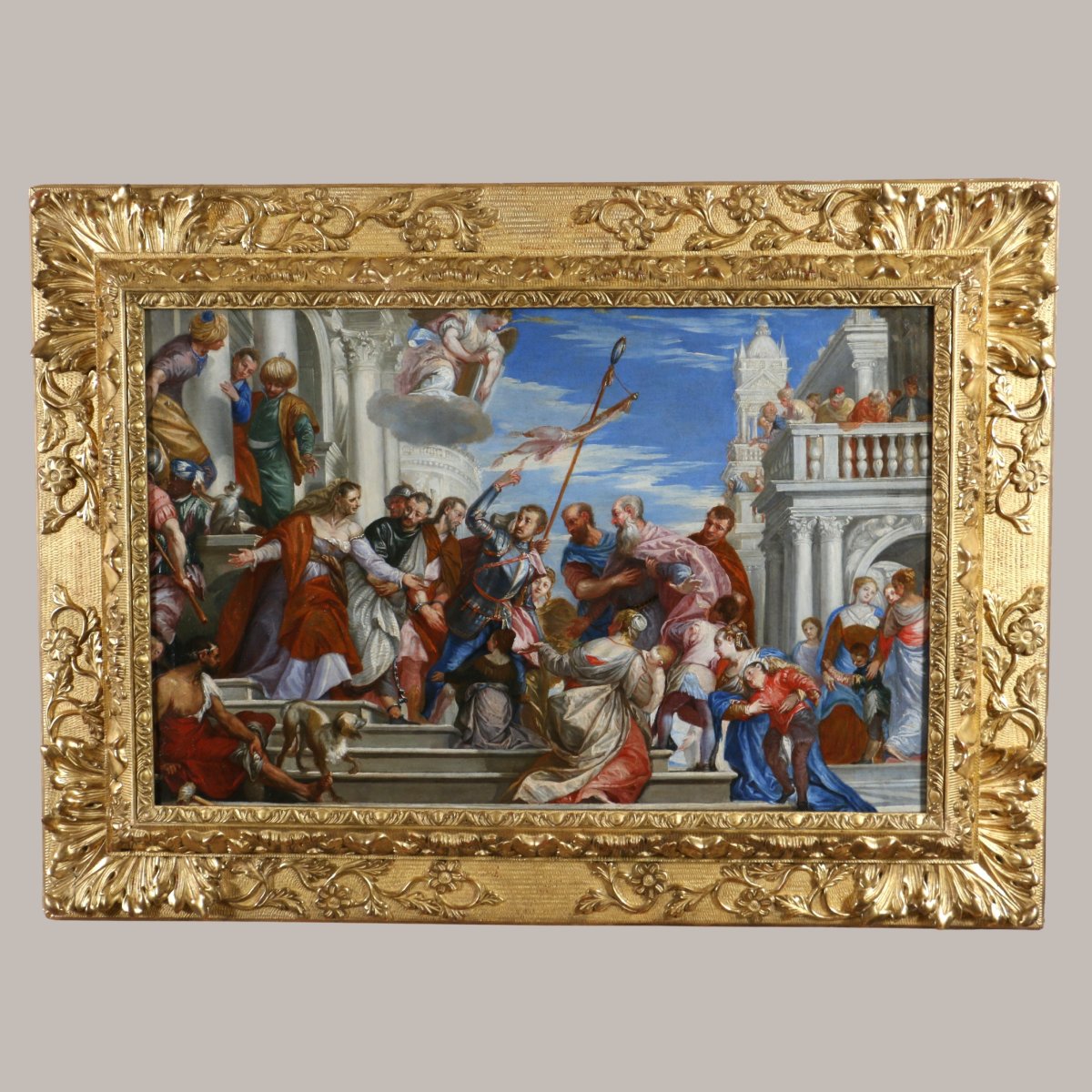
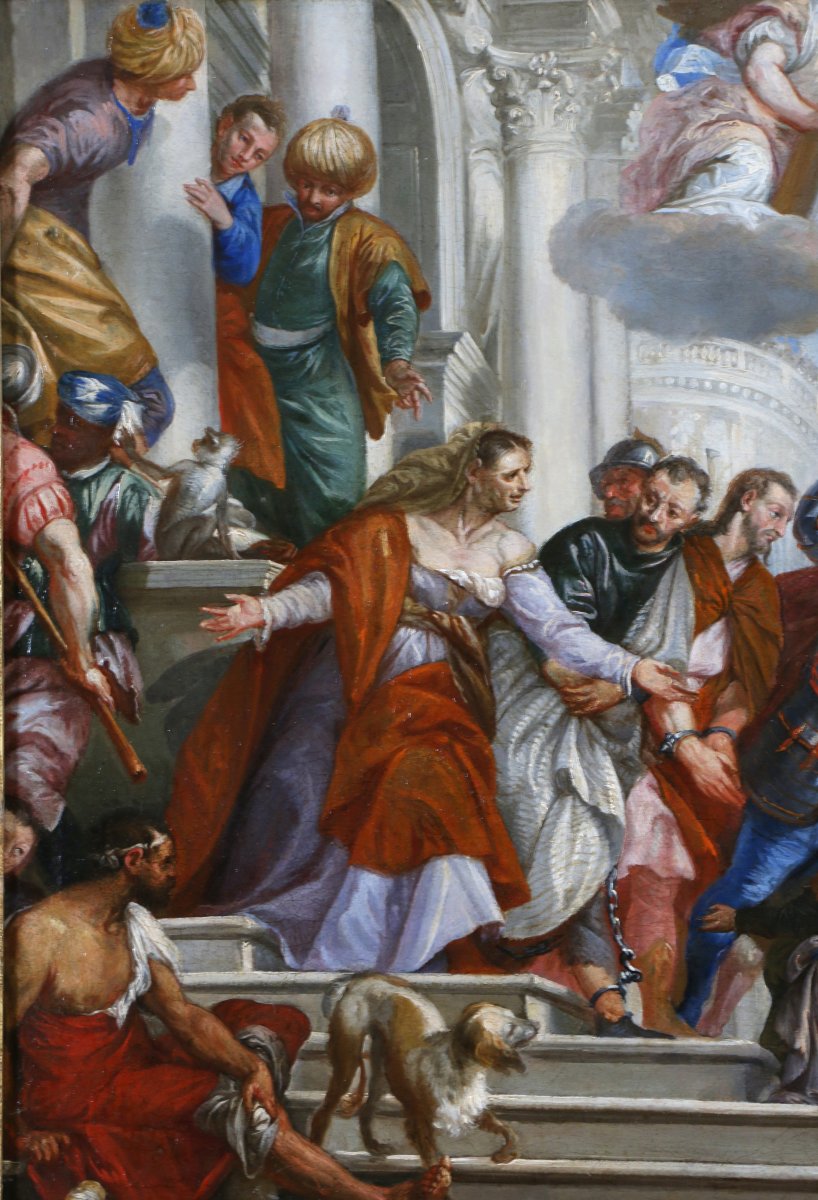
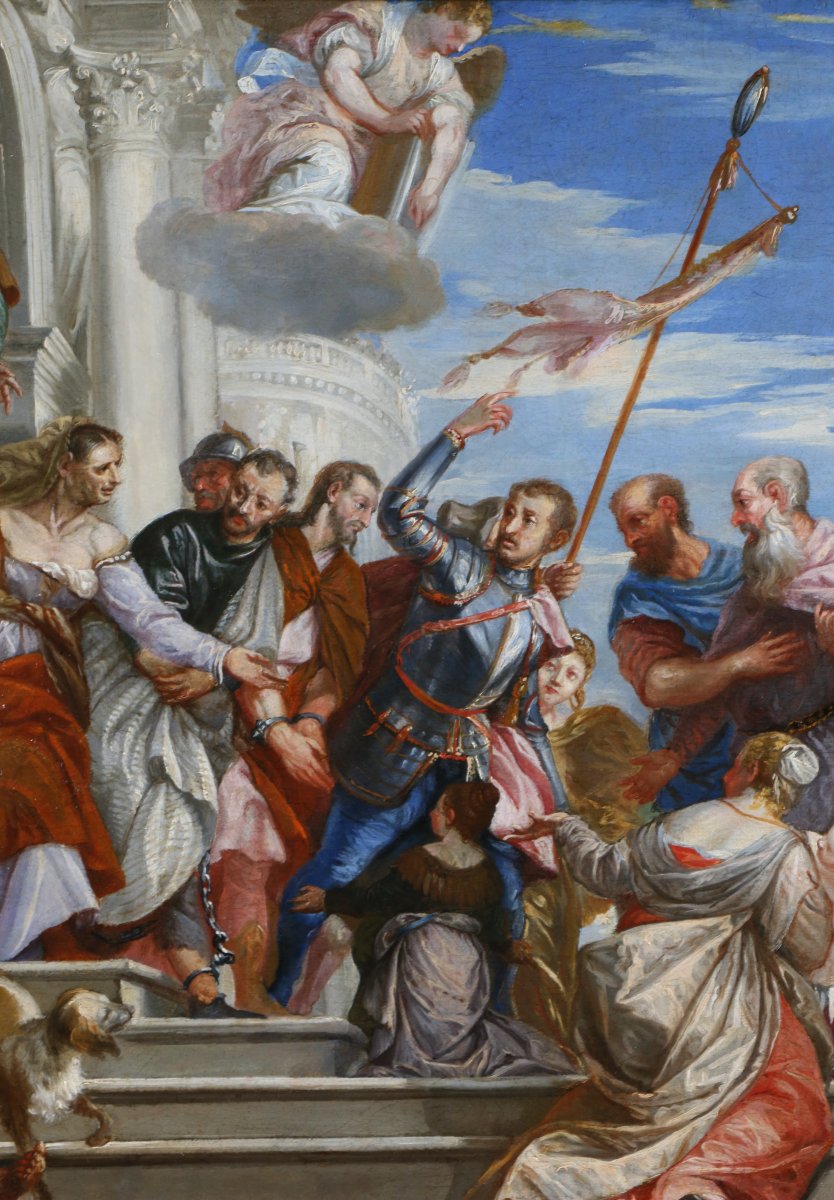
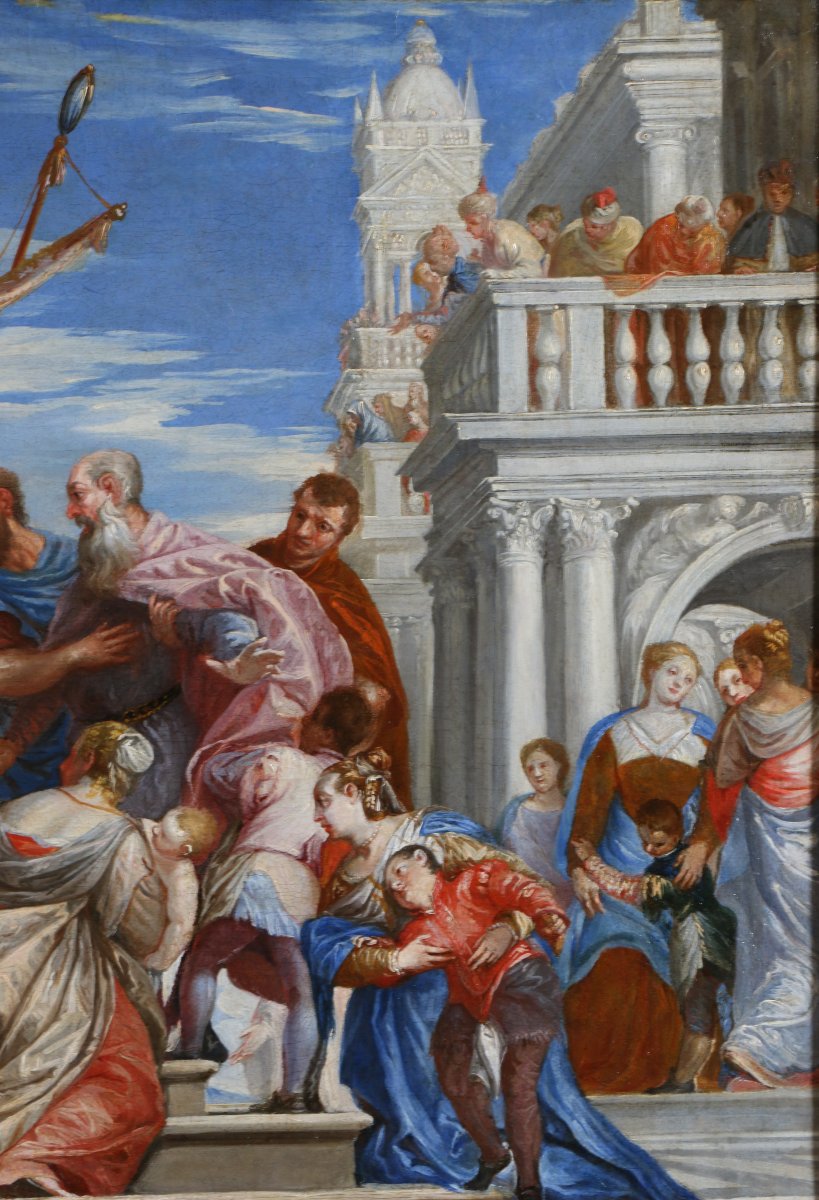
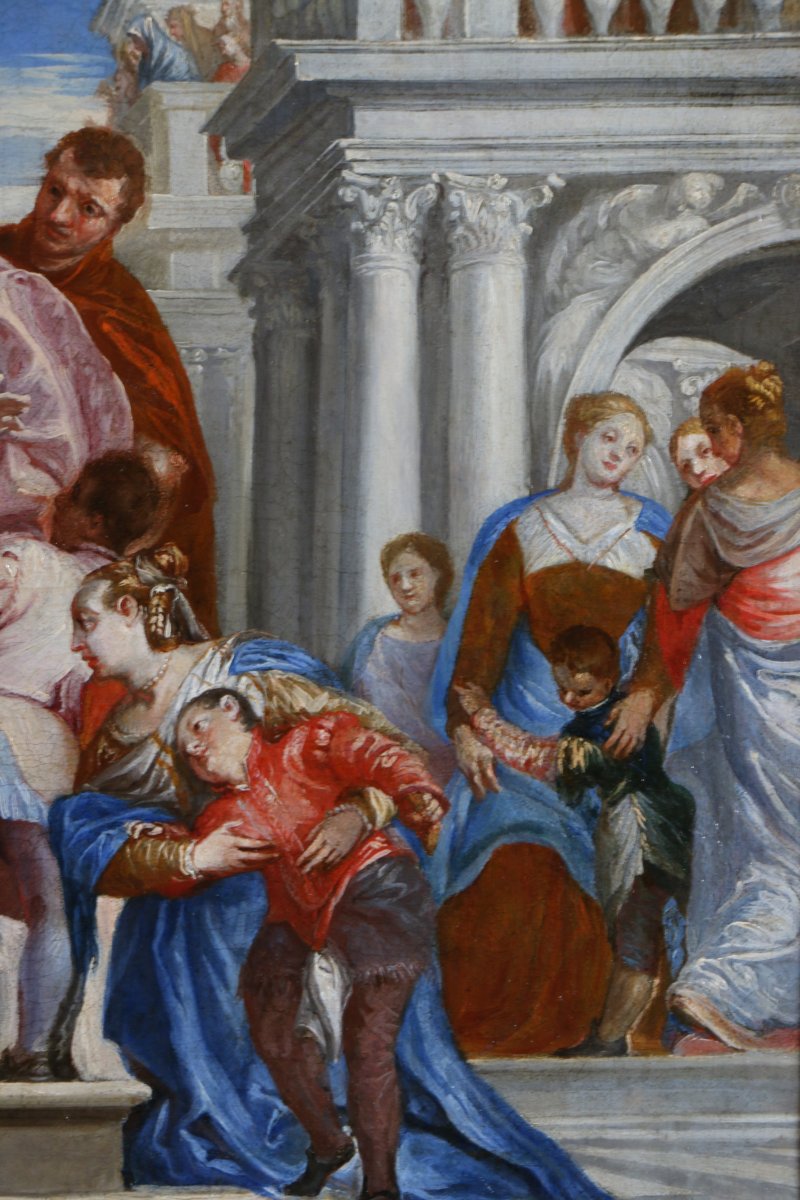
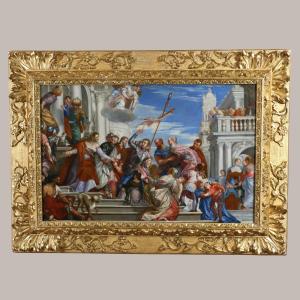


Venice, C. 1710–1720, *marc And Marcellin Led To Martyrdom*, After Veronese.
Artist: Gaspard Diziani (1689-1767) Attribué
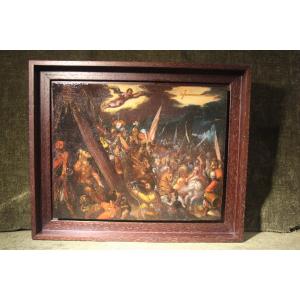
Venice, c. 1710–1720: *Saints Mark and Marcellinus Led to Martyrdom*, after Veronese.
Oil on canvas (relined), 82 x 52 cm.
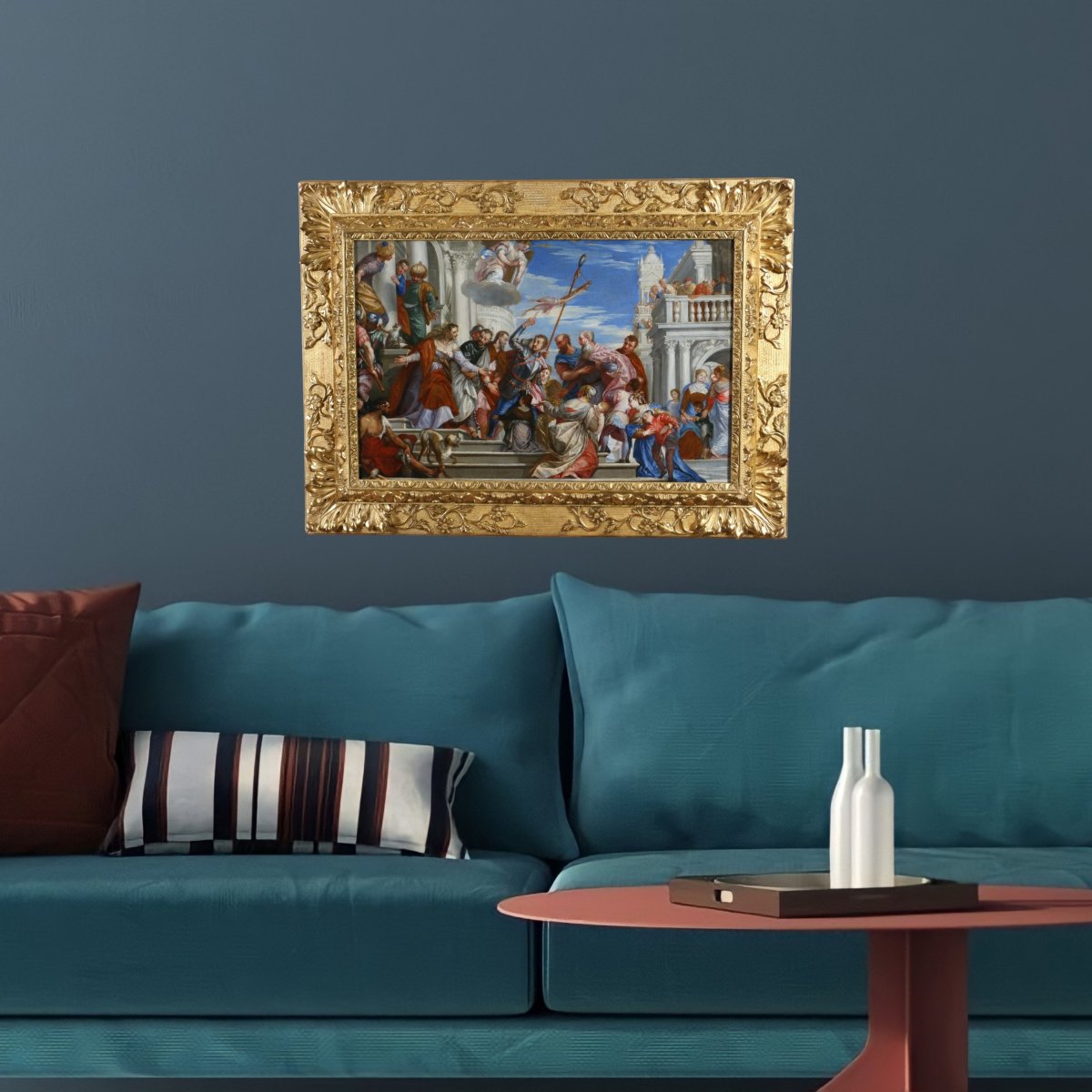
Important period frame, 104 x 76 cm.
Possible attribution to Gaspare Diziani (1689–1767).
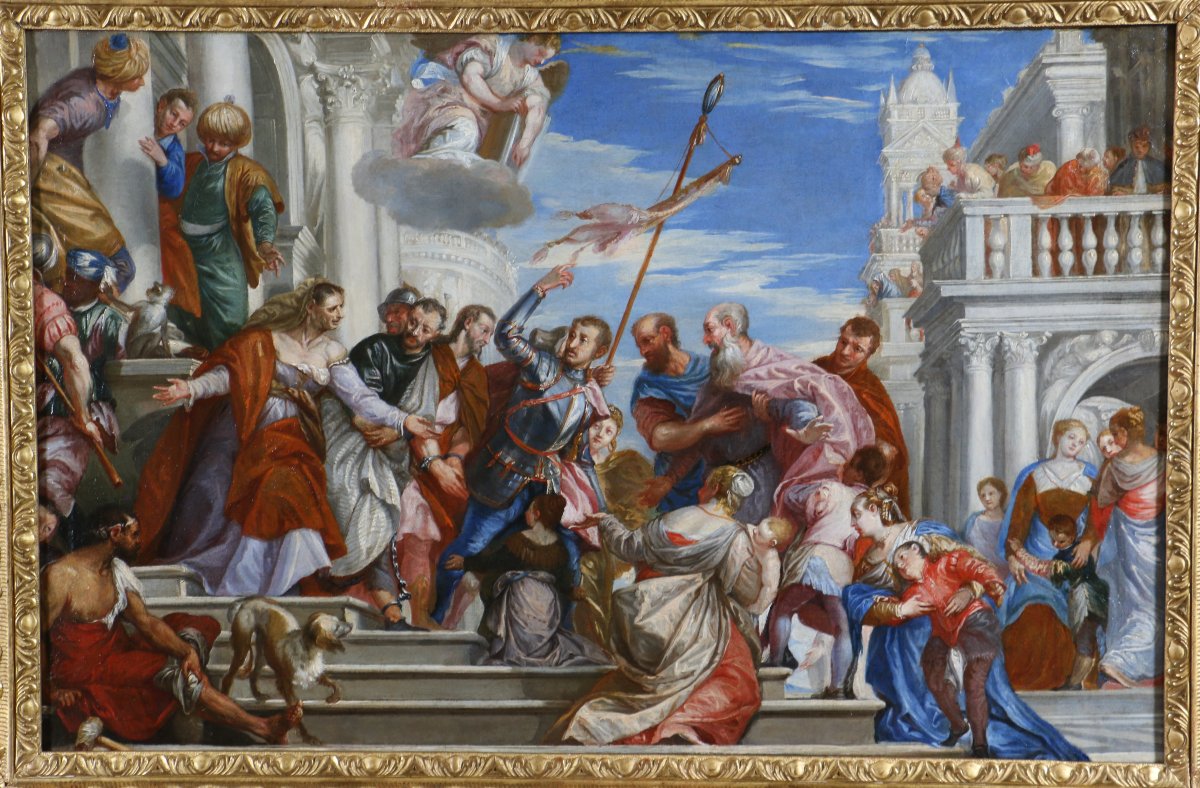
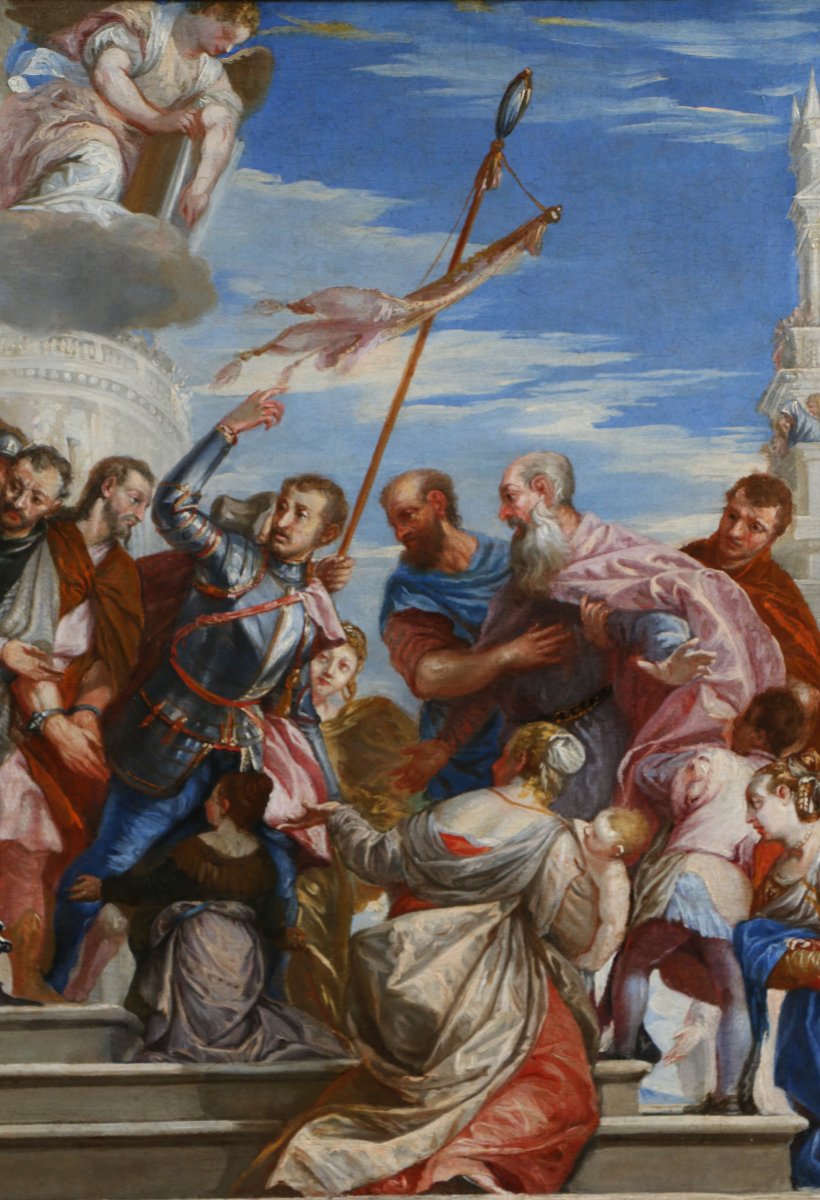
Our painting reproduces the large-scale composition executed by Paolo Veronese around 1565 for the chancel of the Church of San Sebastiano in Venice. The monumental original—measuring approximately 355 x 540 cm—depicts Saints Mark and Marcellinus being led to martyrdom, their faith bolstered by Saint Sebastian despite the pleas of their loved ones.
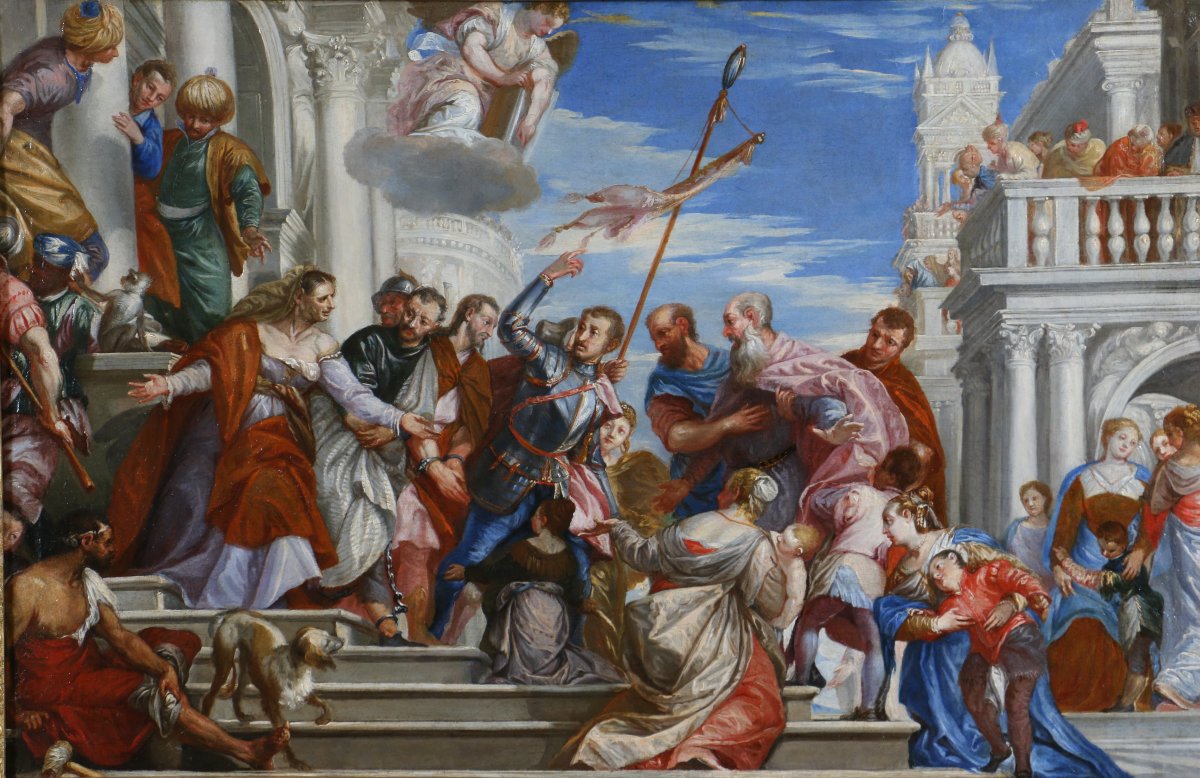
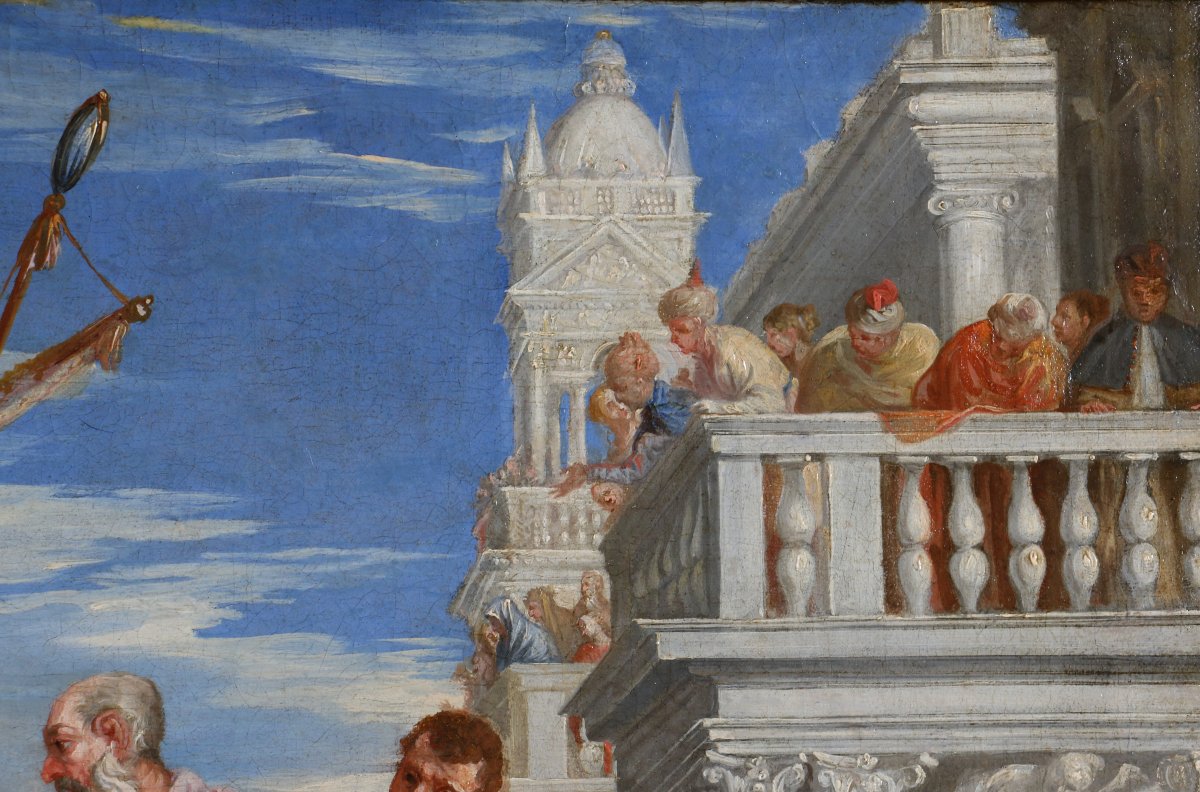
This version preserves the complex arrangement of the prototype with remarkable fidelity: the multitude of figures, the flow of the groups, the variety of poses, and the distribution of large color masses. However, the transition from a monumental composition to a canvas measuring only 82 x 52 cm required the painter to simplify the brushwork.
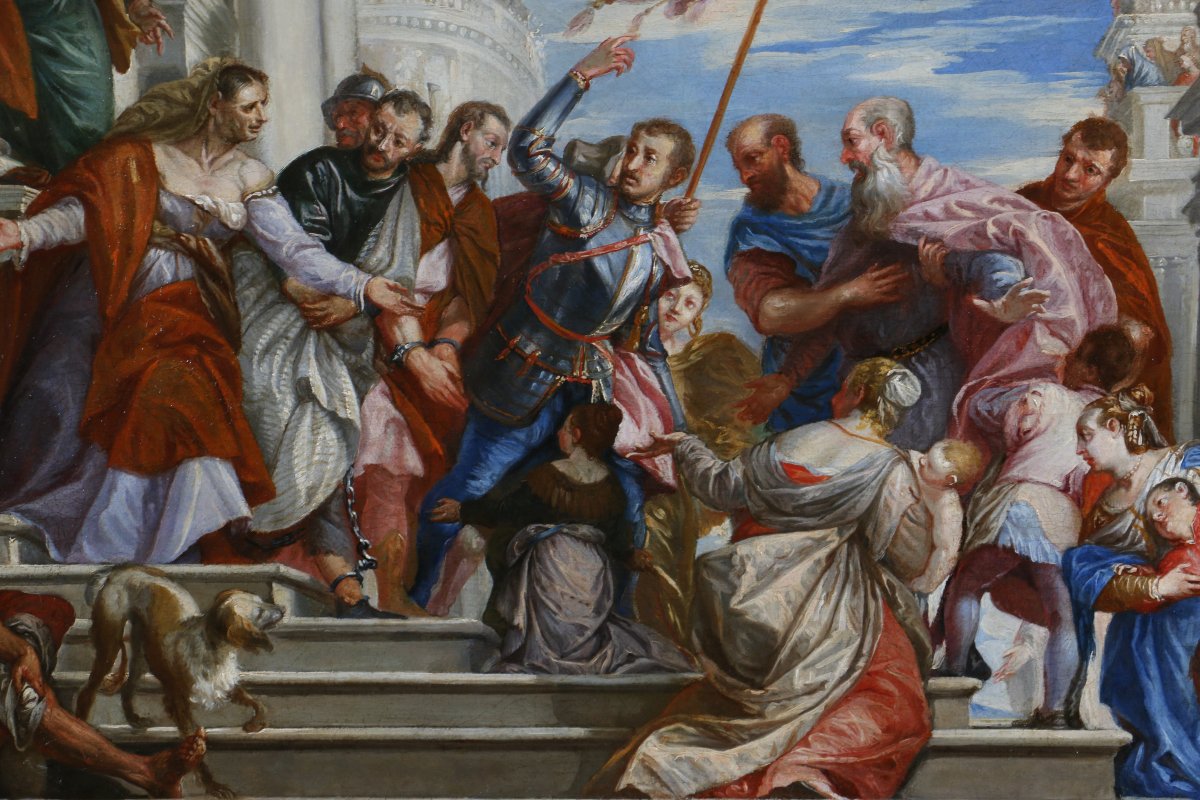
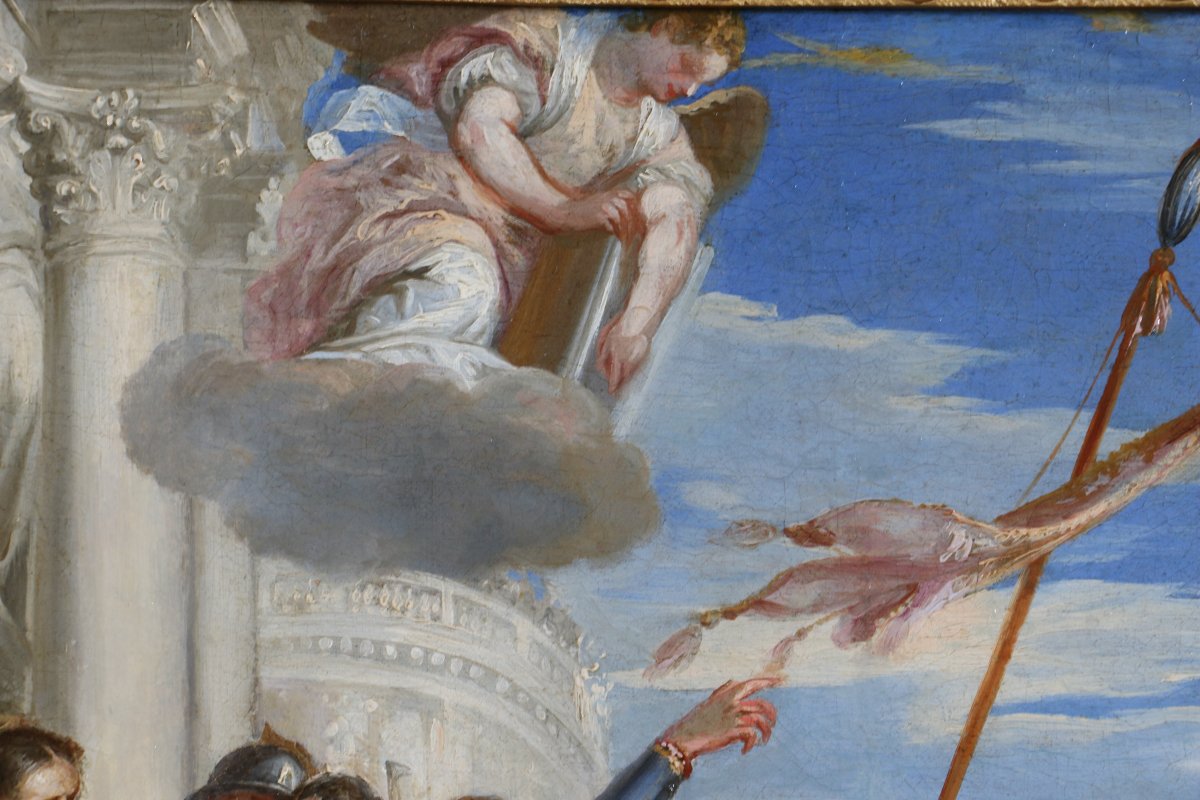
It is precisely in this reduction of forms that one of the work's most interesting characteristics lies. The small figures are not rendered with meticulous, blended modeling; instead, the faces are constructed through the juxtaposition of short strokes—featuring warm reddish-brown shadows, dark accents for the eyes, and light highlights on the forehead, the bridge of the nose, and the cheekbones. Beards and hair are rapidly sketched with a few spirited strokes. In the drapery, highlights are often applied as opaque, relatively bold accents rather than being gradually blended into the underlying color.
These stylistic traits suggest a possible attribution to Gaspare Diziani, specifically to his early period. Born in Belluno in 1689, Diziani received the bulk of his artistic training in Venice between roughly 1709 and 1711—first in the studio of Gregorio Lazzarini, and subsequently within the orbit of Sebastiano Ricci. His activities during the second decade of the eighteenth century remain imperfectly documented.
One document is of particular interest in this context: the Metropolitan Museum of Art holds a drawing by Diziani titled *The Family of Darius before Alexander* (dated 1717), executed in pen, wash, and black chalk, and squared for transfer. The subject derives from one of Veronese’s most famous compositions. Regardless of the attribution of the painting currently under discussion, this sheet serves as invaluable evidence of the young Diziani’s interest in Veronese’s great compositional inventions.
This connection to Veronese was not merely fleeting, however. Another version of *The Family of Darius before Alexander*—attributed to Diziani and now in the Nationalmuseum, Stockholm—demonstrates the enduring influence of this model on his work as late as 1740–1750; the museum explicitly notes the likely inspiration drawn from Veronese.
The attribution to Diziani is further supported by the visible painting technique: rapid execution, an expressive simplification of facial features, bold highlights, warm flesh tones, and a form-building approach based on brushstrokes. Both early and modern sources emphasize his great facility of execution; Antonio Morassi describes his brushwork as broad and heavily loaded, while Treccani highlights the importance of his particularly vibrant *bozzetti* (oil sketches) and preparatory drawings. A contemporary account cited by Christie’s characterizes his style as decisive and rapid, in the manner of Tintoretto.
The proposed dating of circa 1710–1720 should, however, be viewed as a stylistic hypothesis rather than a confirmed date. It corresponds to the years of Diziani’s training and early career—a period for which paintings are notably poorly documented.
The Rediscovery of Veronese in Venice Between the 17th and 18th Centuries
The death of Paolo Veronese in 1588 did not put an end to his influence in Venice. His large-scale compositions remained visible in the city’s churches and palaces, while his artistic language was initially perpetuated by his workshop and his followers. Throughout the 17th century, his work remained a major point of reference, serving as the basis for copies, reduced-scale versions, and reinterpretations.
At the turn of the 18th century, however, this legacy experienced a particularly marked resurgence of interest. A new generation of Venetian painters returned to the color, light, and decorative grandeur of the *Cinquecento*. Centered notably around Sebastiano Ricci, Veronese’s example contributed to the renewal of Venetian painting and paved the way for its brilliant flourishing in the 18th century.
Trained in Venice around 1709–1711, Gaspare Diziani belonged precisely to this generation. His interest in Veronese is directly evidenced by a drawing dated 1717—now in the Metropolitan Museum—in which he reprises the famous composition of *The Family of Darius before Alexander*. This sheet demonstrates that the young painter was studying Veronese’s great compositional inventions firsthand at the time.
It is against this backdrop that the present reduced-scale version of *Saint Sebastian Strengthening the Faith of Saints Mark and Marcellinus on Their Way to Martyrdom* should be viewed. Transitioning from Veronese’s monumental composition to a canvas measuring 82 × 52 cm necessitated a significant simplification of the figures and a rapid execution.
Oil on canvas (relined), 82 x 52 cm.
Important period frame, 104 x 76 cm.
Possible attribution to Gaspare Diziani (1689–1767).
Our painting reproduces the large-scale composition executed by Paolo Veronese around 1565 for the chancel of the Church of San Sebastiano in Venice. The monumental original—measuring approximately 355 x 540 cm—depicts Saints Mark and Marcellinus being led to martyrdom, their faith bolstered by Saint Sebastian despite the pleas of their loved ones.
This version preserves the complex arrangement of the prototype with remarkable fidelity: the multitude of figures, the flow of the groups, the variety of poses, and the distribution of large color masses. However, the transition from a monumental composition to a canvas measuring only 82 x 52 cm required the painter to simplify the brushwork.
It is precisely in this reduction of forms that one of the work's most interesting characteristics lies. The small figures are not rendered with meticulous, blended modeling; instead, the faces are constructed through the juxtaposition of short strokes—featuring warm reddish-brown shadows, dark accents for the eyes, and light highlights on the forehead, the bridge of the nose, and the cheekbones. Beards and hair are rapidly sketched with a few spirited strokes. In the drapery, highlights are often applied as opaque, relatively bold accents rather than being gradually blended into the underlying color.
These stylistic traits suggest a possible attribution to Gaspare Diziani, specifically to his early period. Born in Belluno in 1689, Diziani received the bulk of his artistic training in Venice between roughly 1709 and 1711—first in the studio of Gregorio Lazzarini, and subsequently within the orbit of Sebastiano Ricci. His activities during the second decade of the eighteenth century remain imperfectly documented.
One document is of particular interest in this context: the Metropolitan Museum of Art holds a drawing by Diziani titled *The Family of Darius before Alexander* (dated 1717), executed in pen, wash, and black chalk, and squared for transfer. The subject derives from one of Veronese’s most famous compositions. Regardless of the attribution of the painting currently under discussion, this sheet serves as invaluable evidence of the young Diziani’s interest in Veronese’s great compositional inventions.
This connection to Veronese was not merely fleeting, however. Another version of *The Family of Darius before Alexander*—attributed to Diziani and now in the Nationalmuseum, Stockholm—demonstrates the enduring influence of this model on his work as late as 1740–1750; the museum explicitly notes the likely inspiration drawn from Veronese.
The attribution to Diziani is further supported by the visible painting technique: rapid execution, an expressive simplification of facial features, bold highlights, warm flesh tones, and a form-building approach based on brushstrokes. Both early and modern sources emphasize his great facility of execution; Antonio Morassi describes his brushwork as broad and heavily loaded, while Treccani highlights the importance of his particularly vibrant *bozzetti* (oil sketches) and preparatory drawings. A contemporary account cited by Christie’s characterizes his style as decisive and rapid, in the manner of Tintoretto.
The proposed dating of circa 1710–1720 should, however, be viewed as a stylistic hypothesis rather than a confirmed date. It corresponds to the years of Diziani’s training and early career—a period for which paintings are notably poorly documented.
The Rediscovery of Veronese in Venice Between the 17th and 18th Centuries
The death of Paolo Veronese in 1588 did not put an end to his influence in Venice. His large-scale compositions remained visible in the city’s churches and palaces, while his artistic language was initially perpetuated by his workshop and his followers. Throughout the 17th century, his work remained a major point of reference, serving as the basis for copies, reduced-scale versions, and reinterpretations.
At the turn of the 18th century, however, this legacy experienced a particularly marked resurgence of interest. A new generation of Venetian painters returned to the color, light, and decorative grandeur of the *Cinquecento*. Centered notably around Sebastiano Ricci, Veronese’s example contributed to the renewal of Venetian painting and paved the way for its brilliant flourishing in the 18th century.
Trained in Venice around 1709–1711, Gaspare Diziani belonged precisely to this generation. His interest in Veronese is directly evidenced by a drawing dated 1717—now in the Metropolitan Museum—in which he reprises the famous composition of *The Family of Darius before Alexander*. This sheet demonstrates that the young painter was studying Veronese’s great compositional inventions firsthand at the time.
It is against this backdrop that the present reduced-scale version of *Saint Sebastian Strengthening the Faith of Saints Mark and Marcellinus on Their Way to Martyrdom* should be viewed. Transitioning from Veronese’s monumental composition to a canvas measuring 82 × 52 cm necessitated a significant simplification of the figures and a rapid execution.
12 800 €
Period: 18th century
Style: Louis 14th, Regency
Condition: Excellent condition
Material: Oil painting
Length: 82 cm, 104 cm avec le cadre
Width: 52 cm, 76 cm avec le cadre
Reference (ID): 1824714
Availability: In stock
Print