

Federico Moja (milan, October 20, 1802 – Dolo (ve), March 29, 1885), *mass Among The Ruins*
Federico Moja (Milan, October 20, 1802 – Dolo (VE), March 29, 1885)
Mass Among the Ruins
Oil on canvas, 45 x 59.5 cm
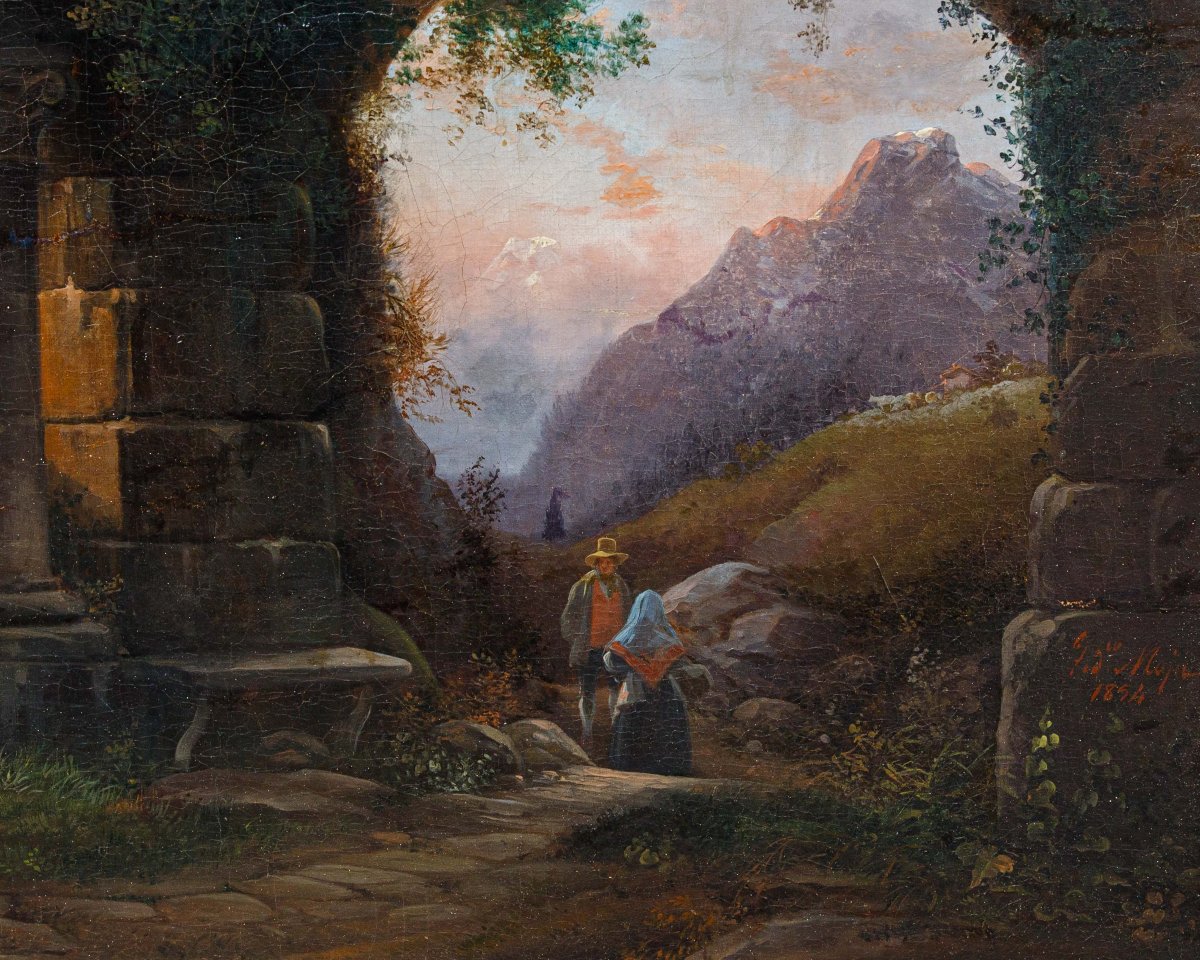
Signed and dated Federico Moja 1854
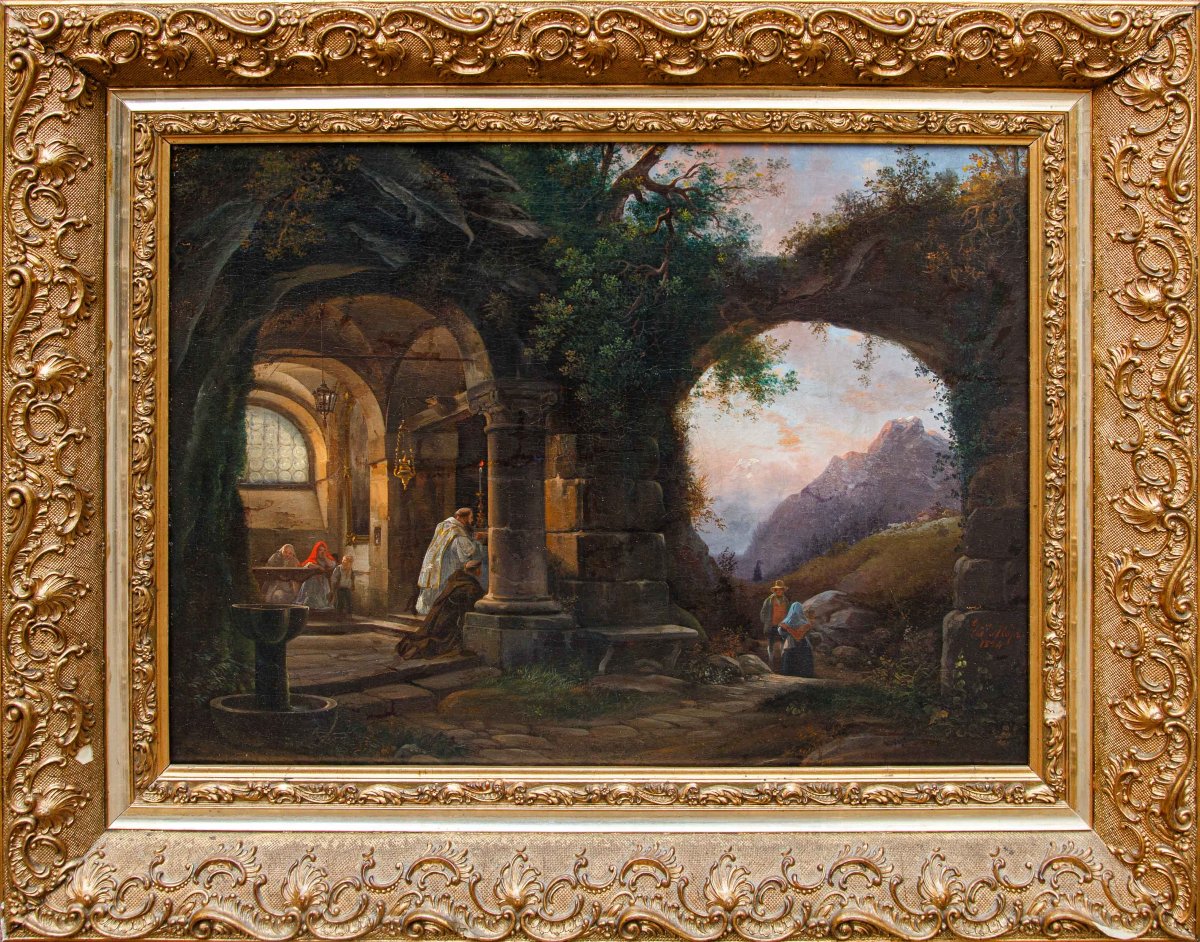
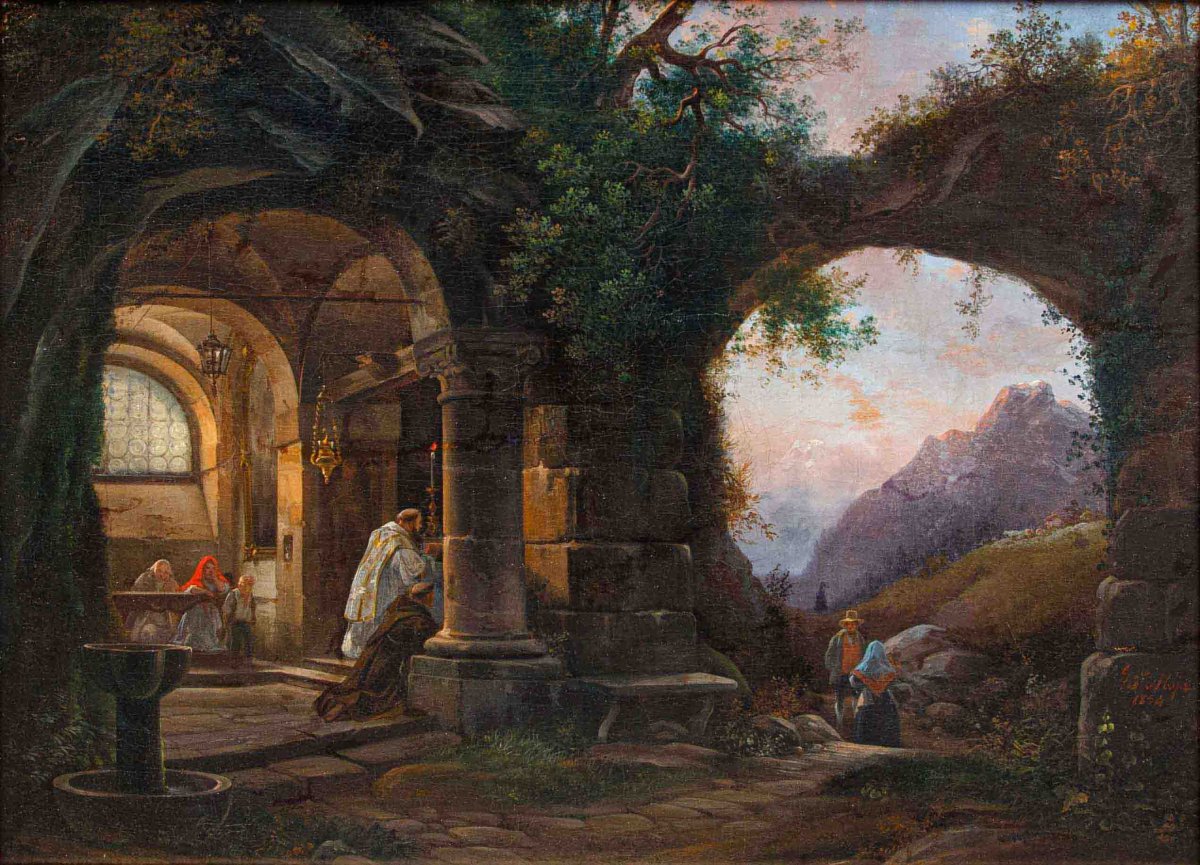
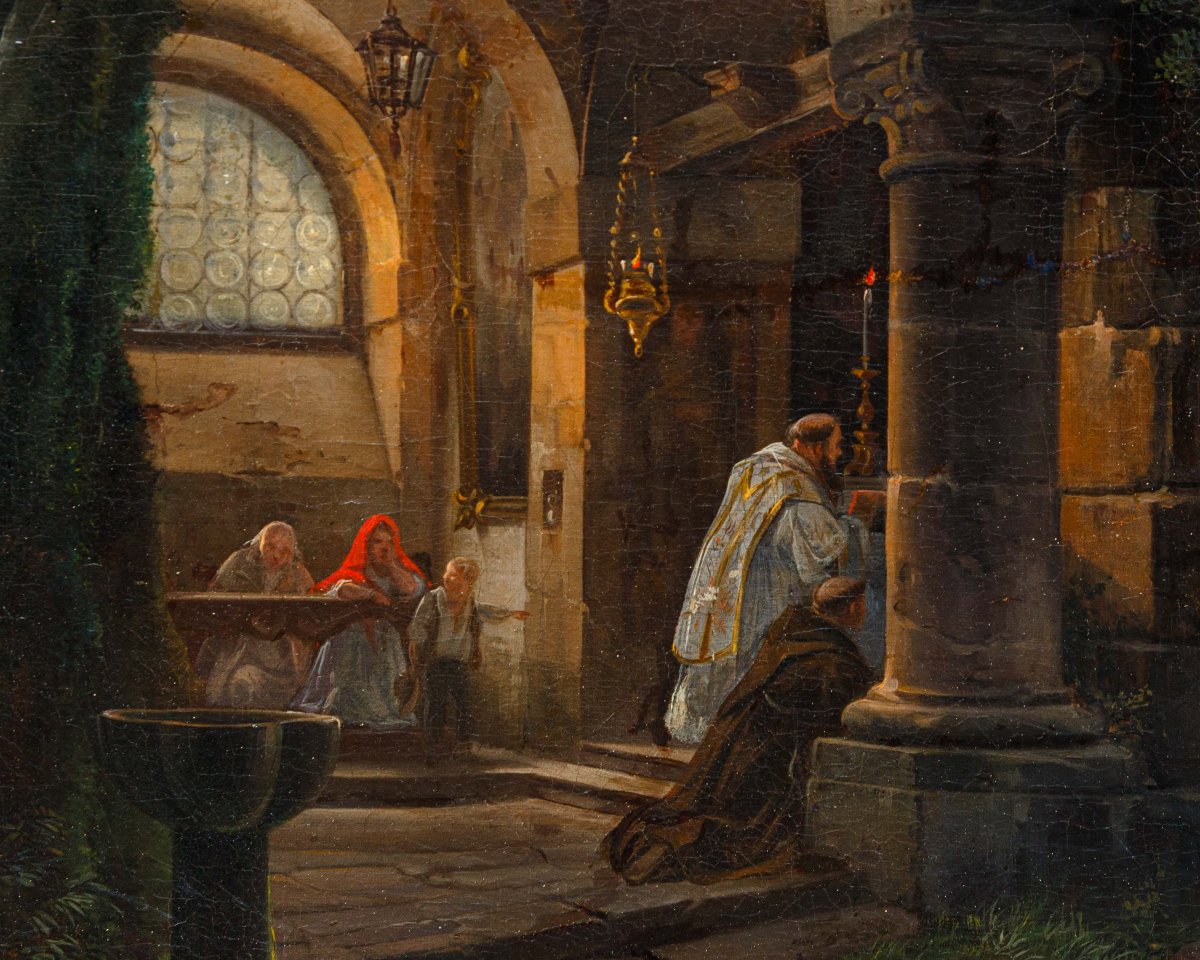
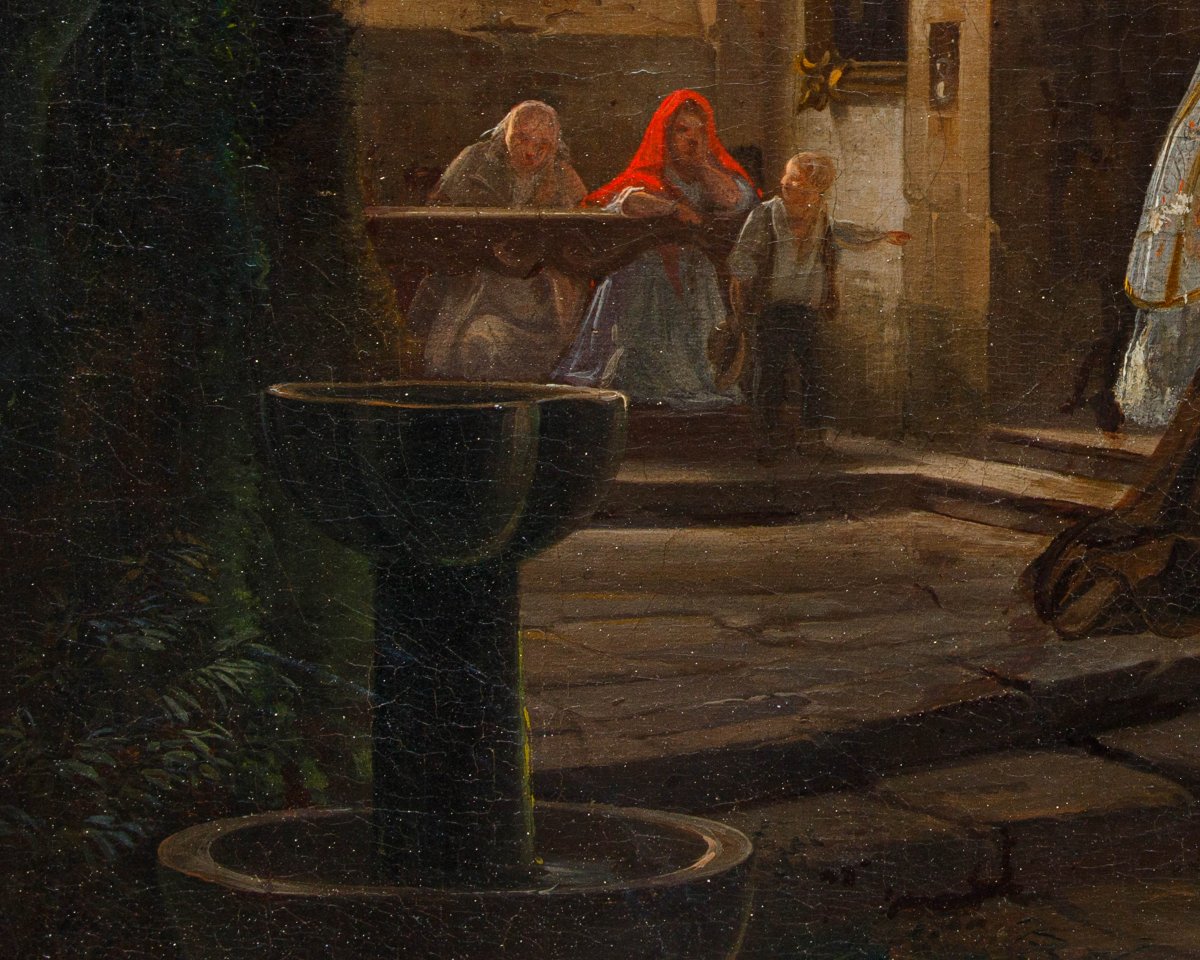
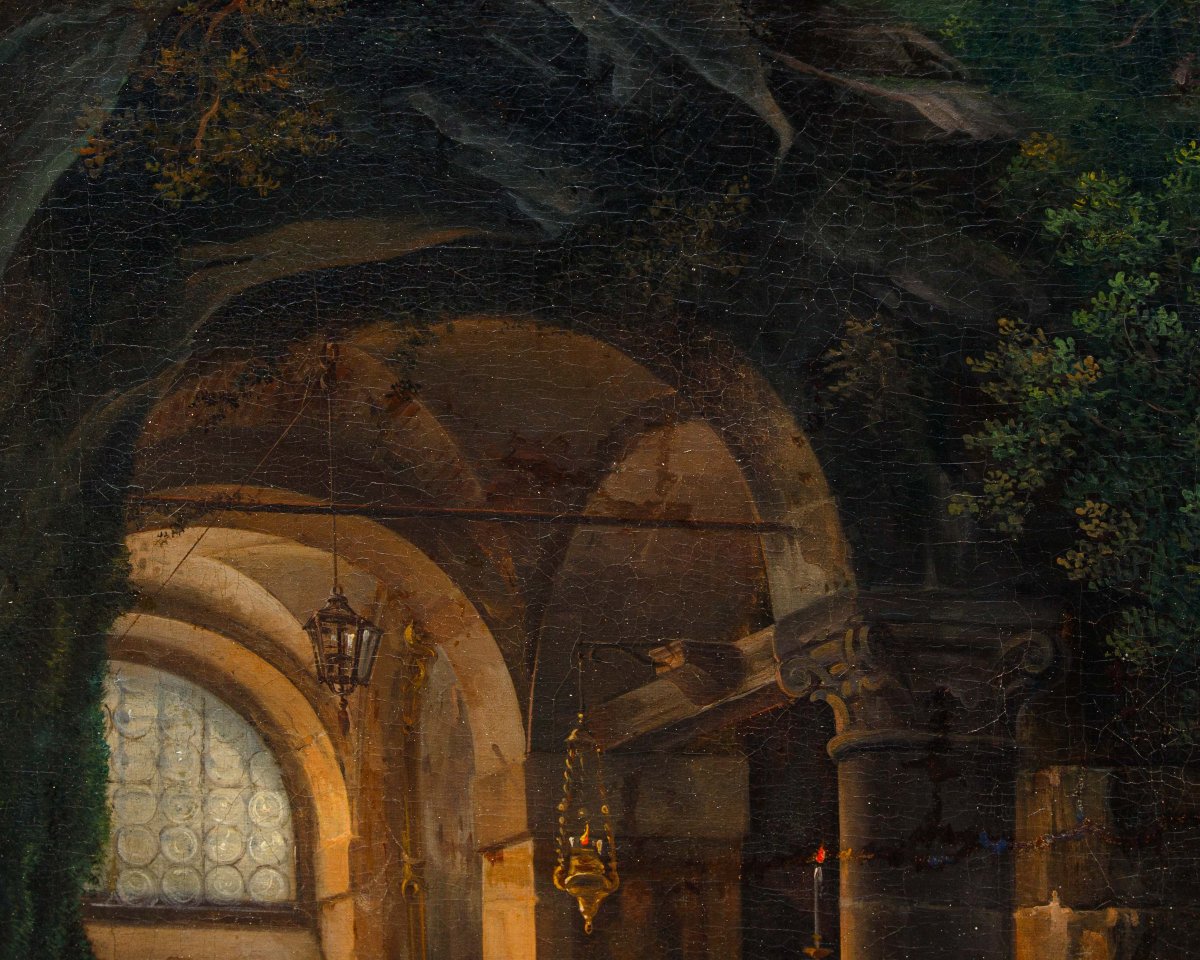
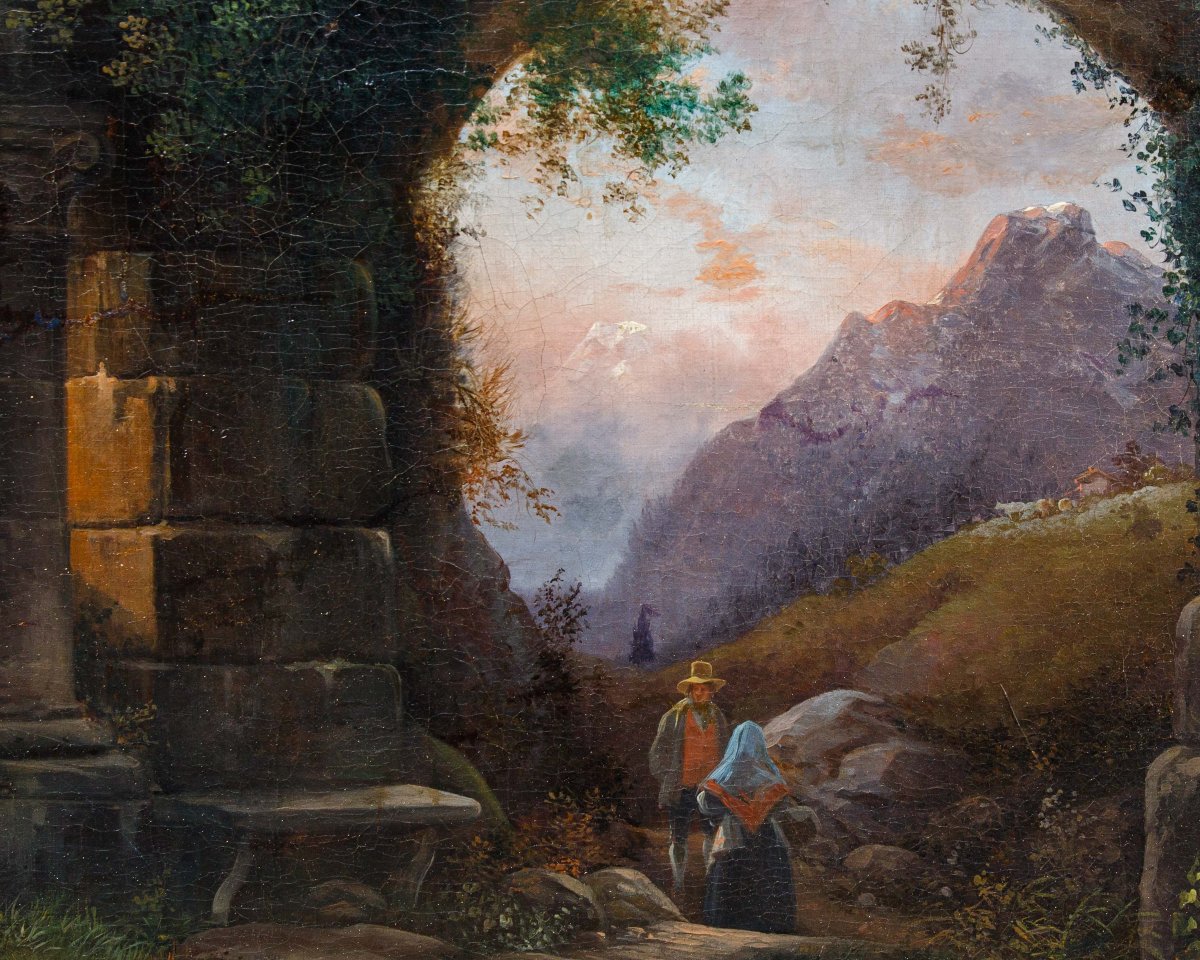
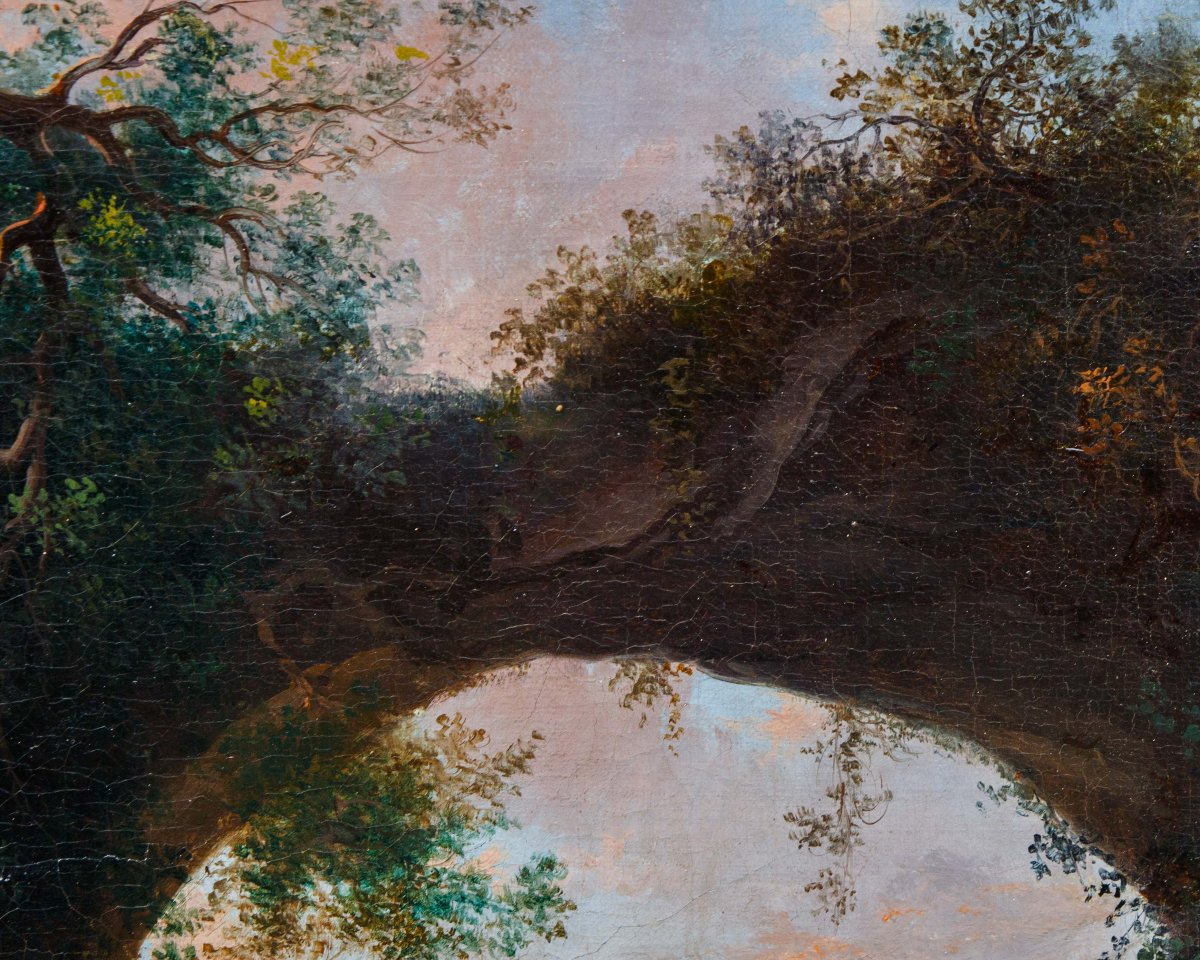
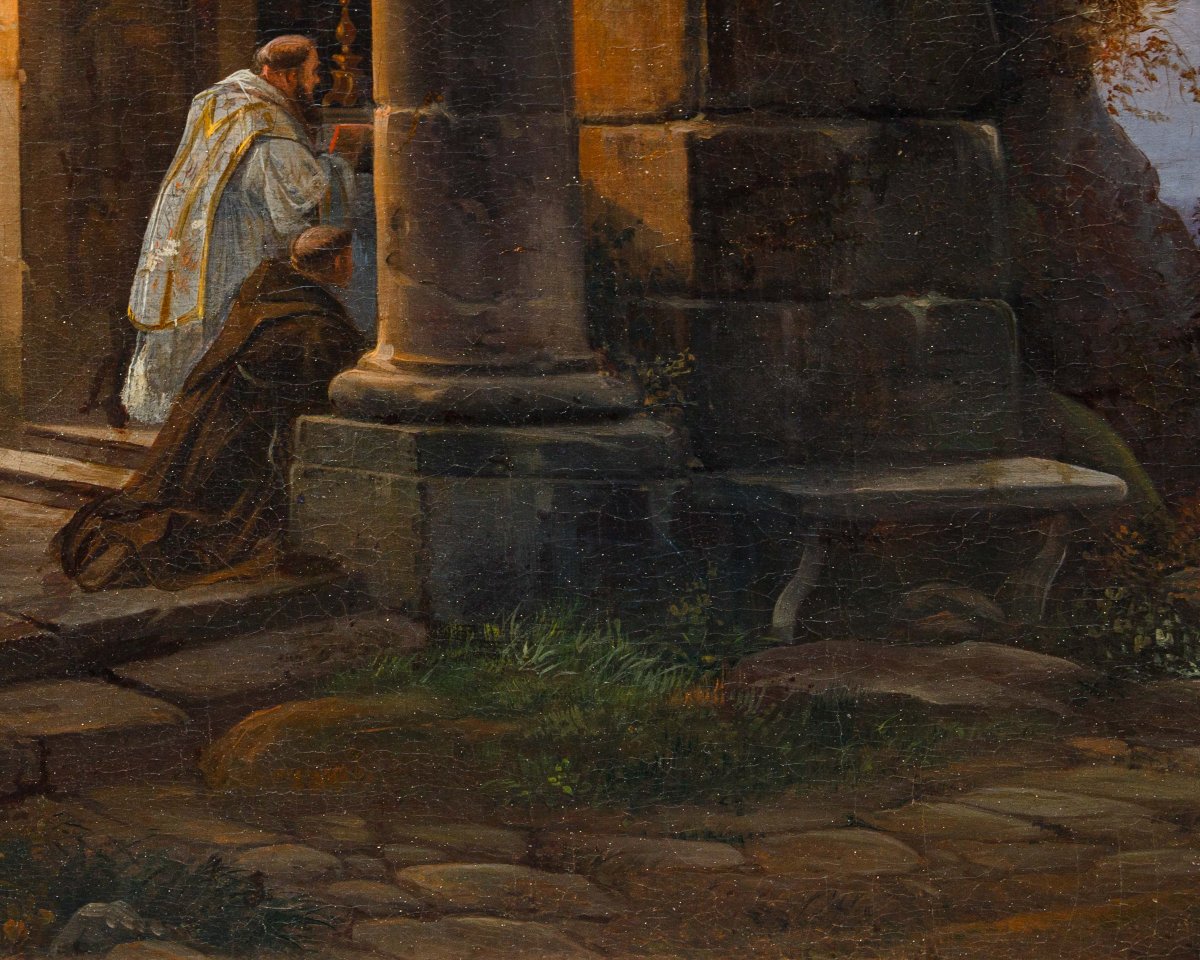
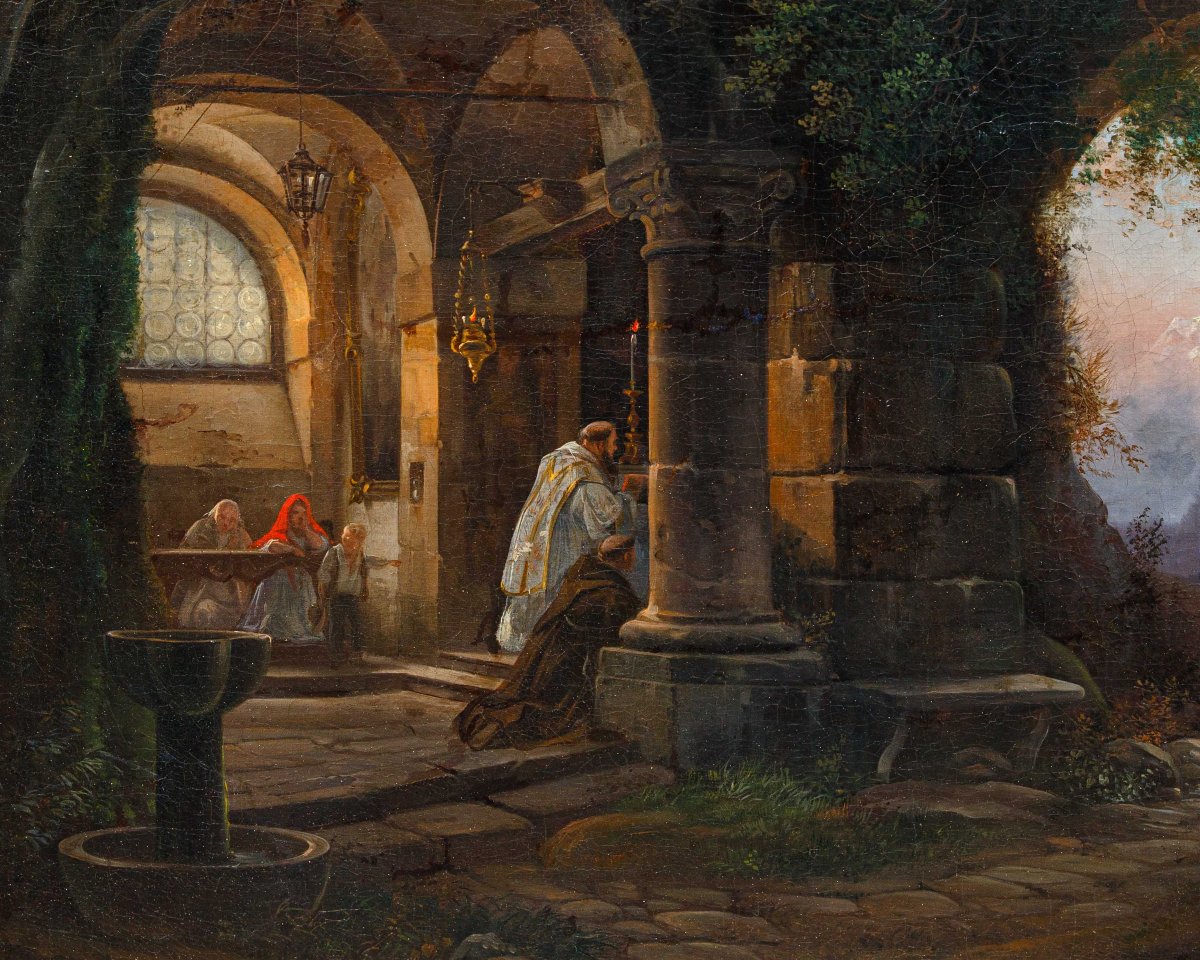
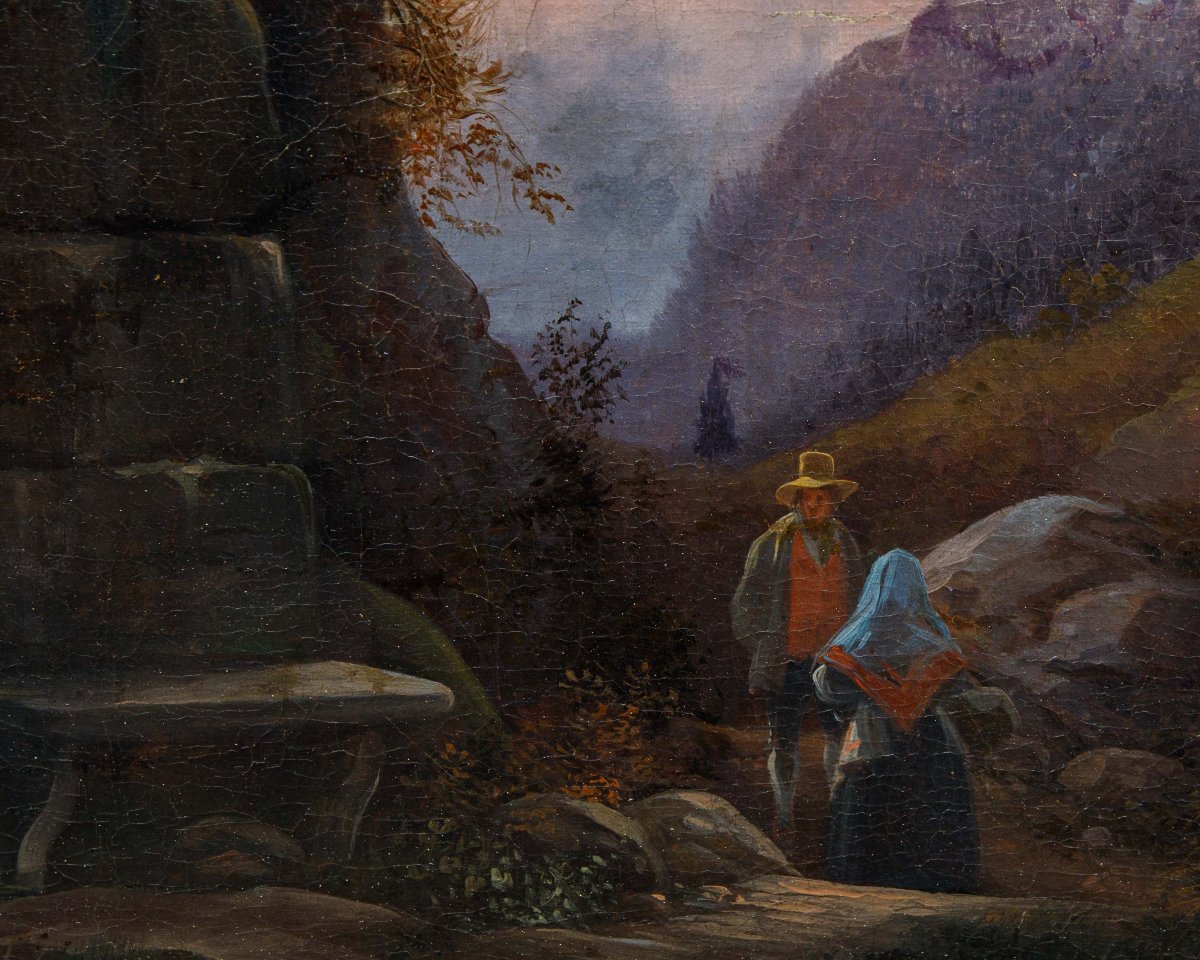
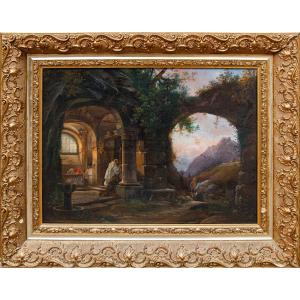
A ray of golden light filters through the crumbling arches and illuminates the sacred scene unfolding amid the ruins of an ancient religious building: a priest, kneeling before a makeshift altar, celebrates Mass while several female figures watch, gathered in prayer on the left, near an ogival window that remains intact. The Gothic vault, overgrown with vegetation and tangled branches that weave their way through the weathered stones, opens into a large, broken arch through which a vast mountain landscape is visible, rendered in atmospheric tones shifting from the pink of dawn to the blue of distant peaks, populated by tiny figures of travelers. The contrast between the intimate half-light of the interior and the diffused light of the exterior landscape creates a highly evocative visual effect, typical of nineteenth-century Romantic sensibility.
The work, signed and dated 1854, belongs to a genre favored by Federico Moja—that of ecclesiastical interiors—but differs from it in one significant respect: while most of his religious paintings depict real-life settings, studied from life within institutions that are still active and recognizable—such as the Certosa di Pavia, the Church of Saints John and Paul in Venice, or the Basilica of Sant’Eustorgio in Milan— here the artist constructs an imaginary scene, set in a ruined building that serves as a pretext for a freer reflection on the relationship between architecture, nature, and devotion. The mountainous landscape that opens up beyond the arch recalls similar approaches adopted by the painter on other occasions, such as in the *Mountain Landscape* housed at the Gallerie dell’Accademia in Venice or in the *Landscape with the Latte River near Lecco*, now at the Ospedale Mauriziano Umberto I in Turin, works in which the atmospheric and luminous rendering of the peaks plays a central role in the composition.
Federico Moja was born in Milan in 1802 into a family of artists and began his training in 1818 at the Brera Academy of Fine Arts, where he became a student of Giovanni Migliara. His early work is characterized by perspective cityscapes, convent interiors, and subjects inspired by history and literature, executed in close adherence to his teacher’s methods. His stay in Paris and his travels throughout France between 1830 and 1834 provided him with new thematic inspiration, to which he would return repeatedly even many years later. In 1841, while Luigi Bisi was establishing himself on the Milanese art scene, Moja moved to Venice, a city that became the center of his artistic maturity: there he was appointed professor of Perspective at the Academy of Fine Arts in 1845, a position he would hold for thirty years, until 1875. During this period, he specialized in depicting views of Venice and other cities in the Veneto region, works that he consistently submitted to exhibitions at the Brera Academy and the Società Promotrice in Turin. Upon retiring from teaching, he moved to Dolo, where he continued his painting until his death, without substantially altering the figurative style he had developed in previous years, remaining faithful to a rigorous perspective and a descriptive style attentive to architectural and atmospheric details.
Period: 19th century
Style: Other Style
Condition: Good condition
Material: Oil painting
Width: 59,5
Height: 45
Reference (ID): 1820540
Availability: In stock