

Henri Cueco, Signed Lithograph, 1968, Narrative Figurative Abstract Art, *la Gréve*, Mourlot
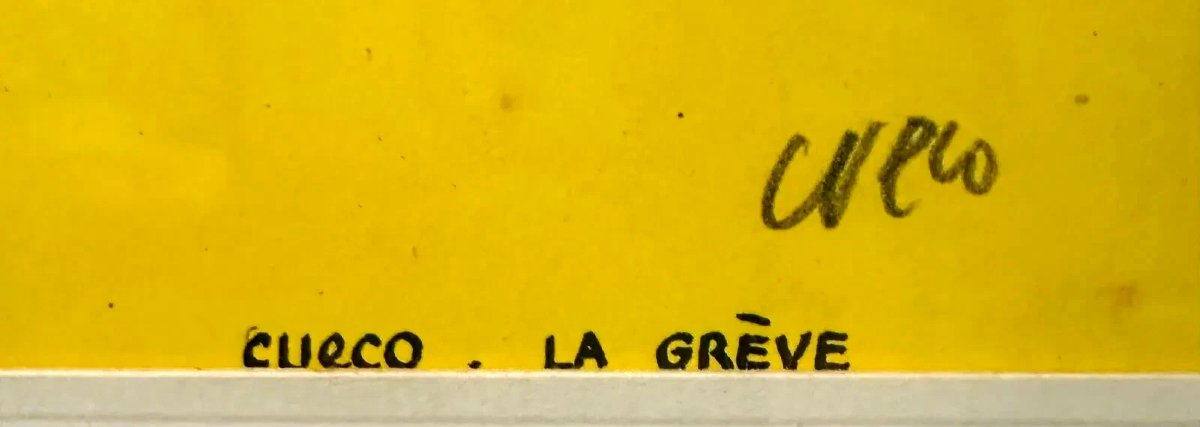
Original color lithograph by Henri Cueco, titled “La Grève,” dated 1969 and signed in pencil in the lower right corner.
“La Grève” is directly related to the large painting of the same name created by Cueco in 1969 and now housed at the Musée d’Art moderne de Paris. The museum dates the work to 1969 and associates it with the Cueco-Parré exhibition held at the ARC in 1970.
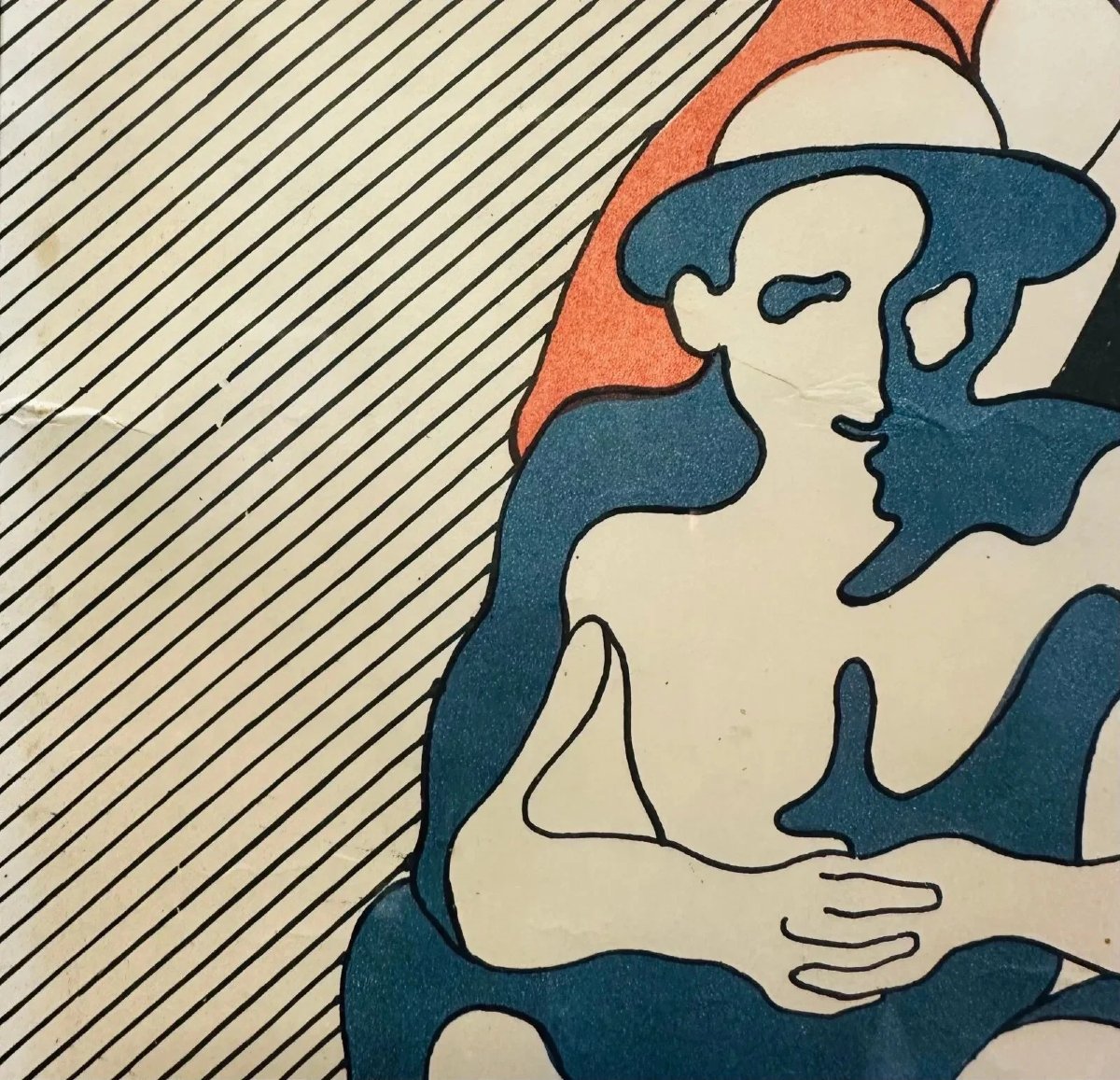
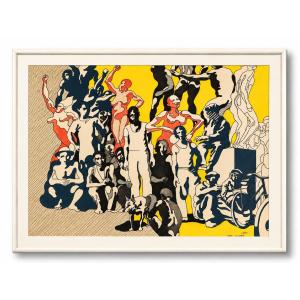
The composition brings together a dense crowd of male and female figures—workers, protesters, laborers, and silhouettes sitting or standing—along with a dog, a cyclist, and several nude or stylized bodies. The figures are rendered in flat areas of bright yellow, orange-red, dark blue, black, and white. The drawing alternates between thick outlines, hatched areas, and highly graphic silhouettes.
Here, Cueco transforms the crowd into a political image. He does not depict a realistic scene in the documentary sense, but rather constructs a kind of collective theater where the strike becomes a state of social tension. The bodies overlap, respond to one another, raise their fists, sit down, wait, or occupy the space. The crowd is not anonymous: it becomes the very subject of the work.
This silkscreen print is rooted in the immediacy of May 1968, the workers’, student, and labor union movements, as well as the renewal of political painting in France. Cueco belongs to a generation that rejects both the dominant trend of abstraction and a return to simple descriptive painting.
His work is generally associated with Narrative Figuration, a French movement that developed in the 1960s around artists who reintroduced imagery, narrative, current events, politics, advertising, comics, and the media into painting. Unlike American Pop Art, Narrative Figuration is often more critical, more socially and politically engaged, and more interested in power relations, social conflicts, and collective representations.
In 1969, Cueco founded the Coopérative des Malassis with Lucien Fleury, Jean-Claude Latil, Michel Parré, and Gérard Tisserand. This collective developed monumental and political paintings, often designed for public spaces, that appropriated art history and popular imagery to critique consumer society and political power.
In “La Grève,” Cueco also draws on the history of painting. Some scholars have noted echoes of Delacroix and *Liberty Leading the People*, particularly in certain female figures and in the dynamic organization of the crowd. Other parallels have been drawn with Fernand Léger in the monumental scale of the bodies and the presence of the bicycle.
The very limited color palette—yellow, red, blue, black, and white—reinforces the visual impact. It brings the work closer to activist posters, printed imagery, and political communication.
Period: 20th century
Style: Design 50's and 60's
Condition: Good condition
Material: Paper
Width: 65
Height: 50
Reference (ID): 1819338
Availability: In stock