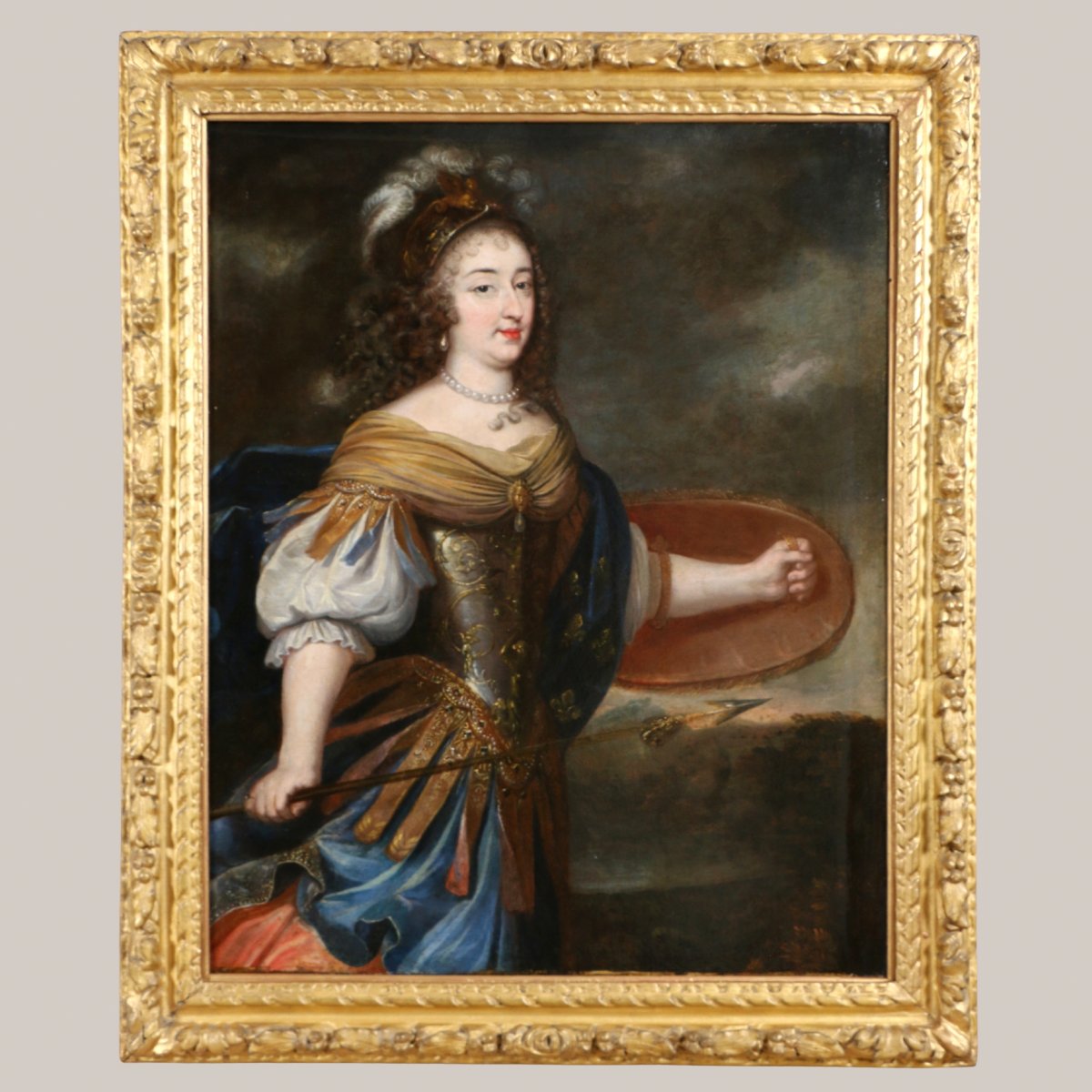
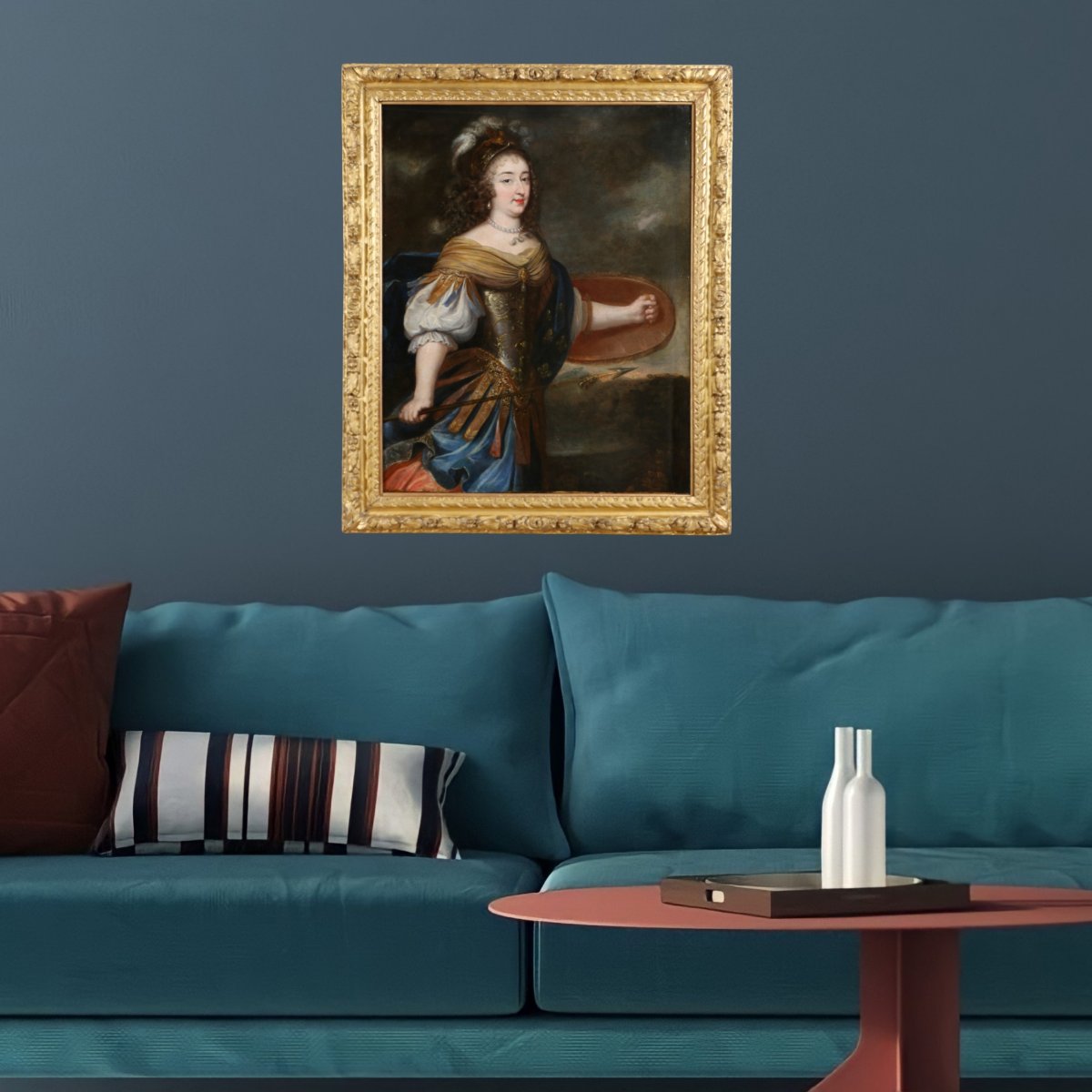


Anne-marie-louise D’orléans, Known As “la Grande Mademoiselle,” Attributed To The Beaubruns, Circa 1660.
Artist: Henri Et Charles Beaubrun Attribué.
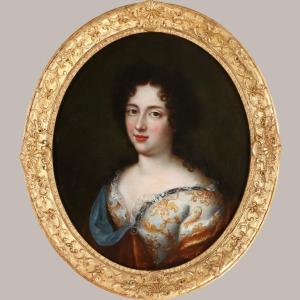
Portrait of Anne-Marie-Louise d’Orléans, known as "la Grande Mademoiselle," attributed to the Beaubrun brothers, c. 1660.
Oil on canvas (relined), measuring 91 cm by 73.5 cm.
Period frame, measuring 108 cm by 91 cm.
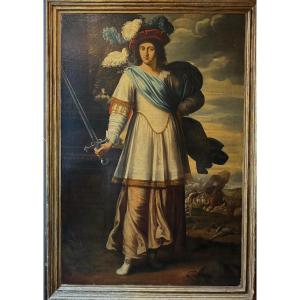
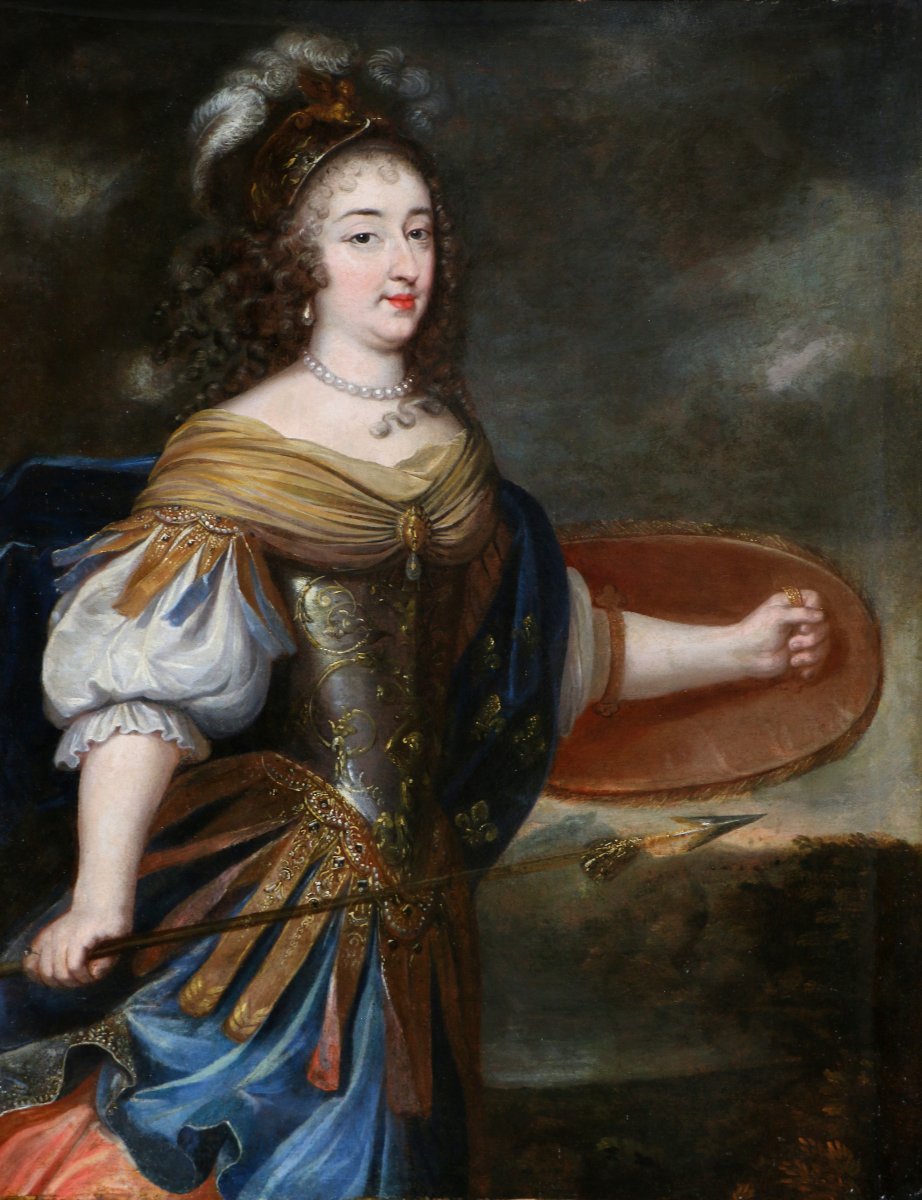
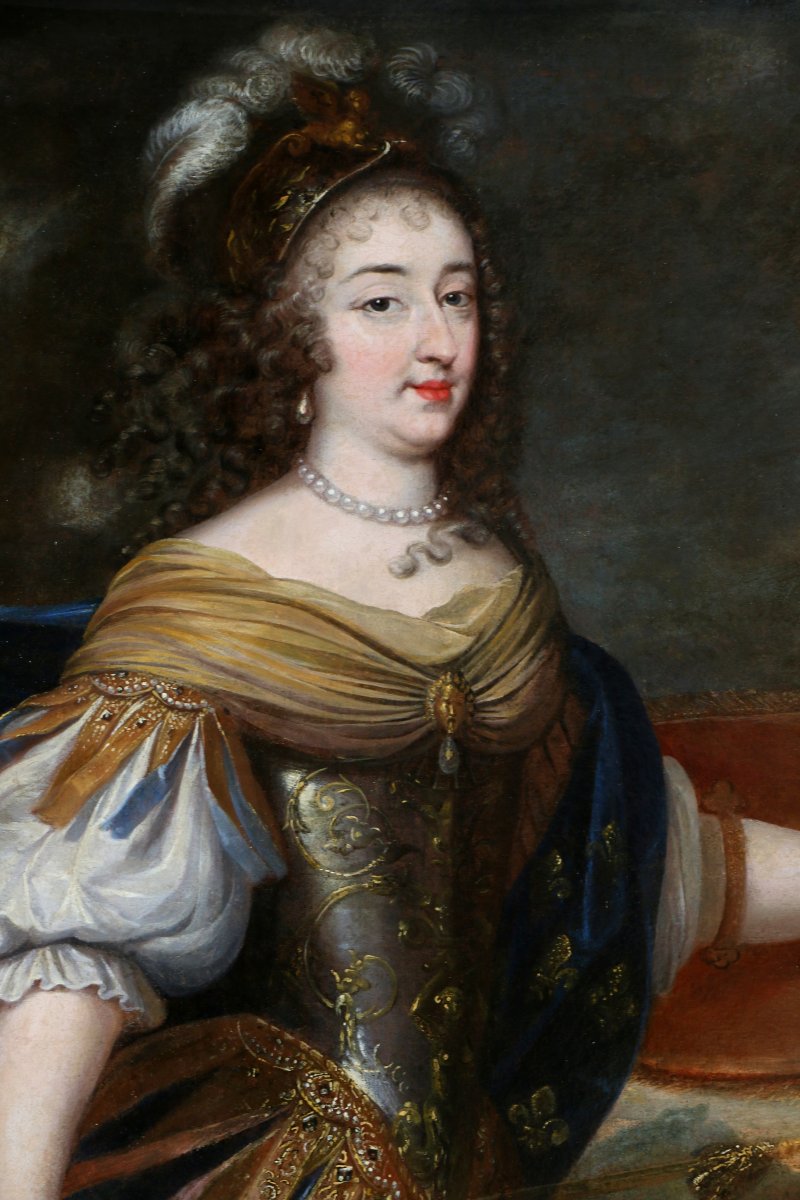
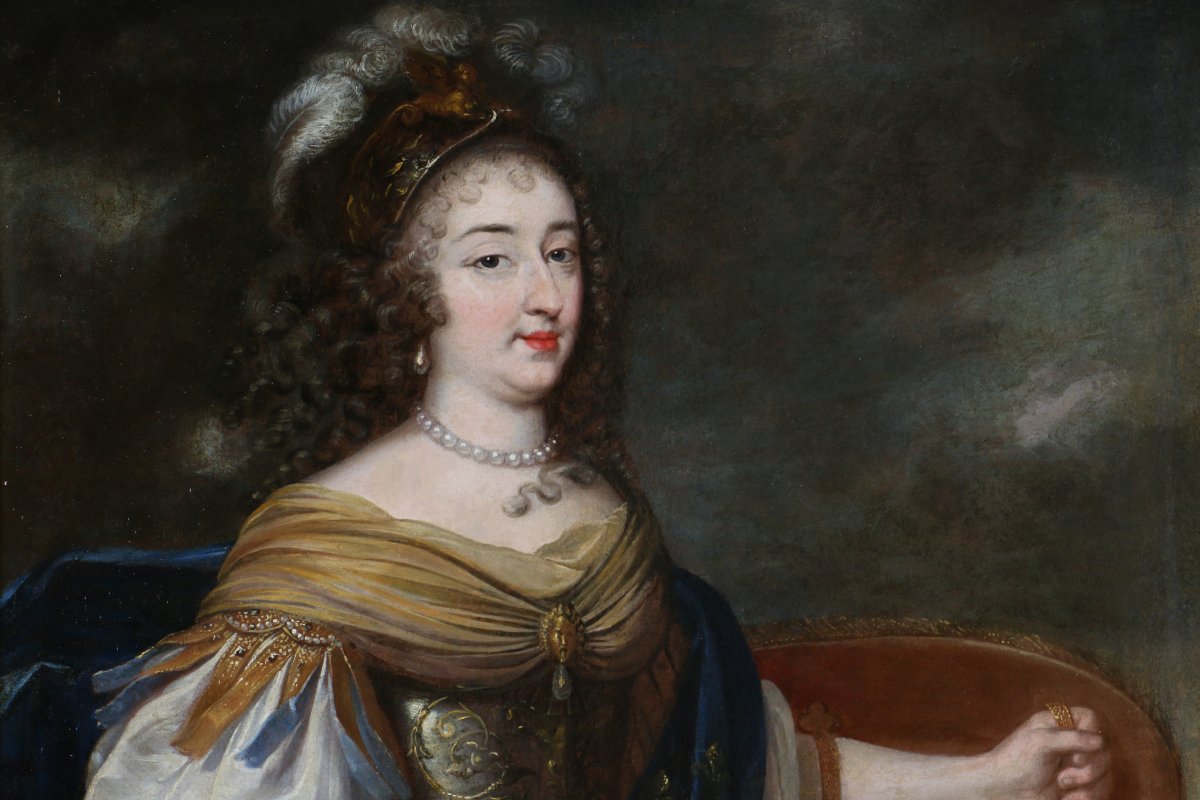
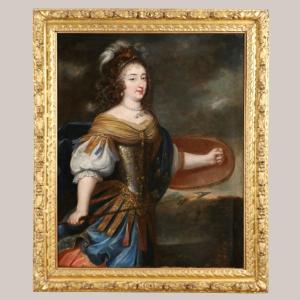
The painting depicts a young woman of the high aristocracy—shown in a half-length pose against a dark background—in the guise of Pallas-Minerva, the ancient goddess of wisdom and war.
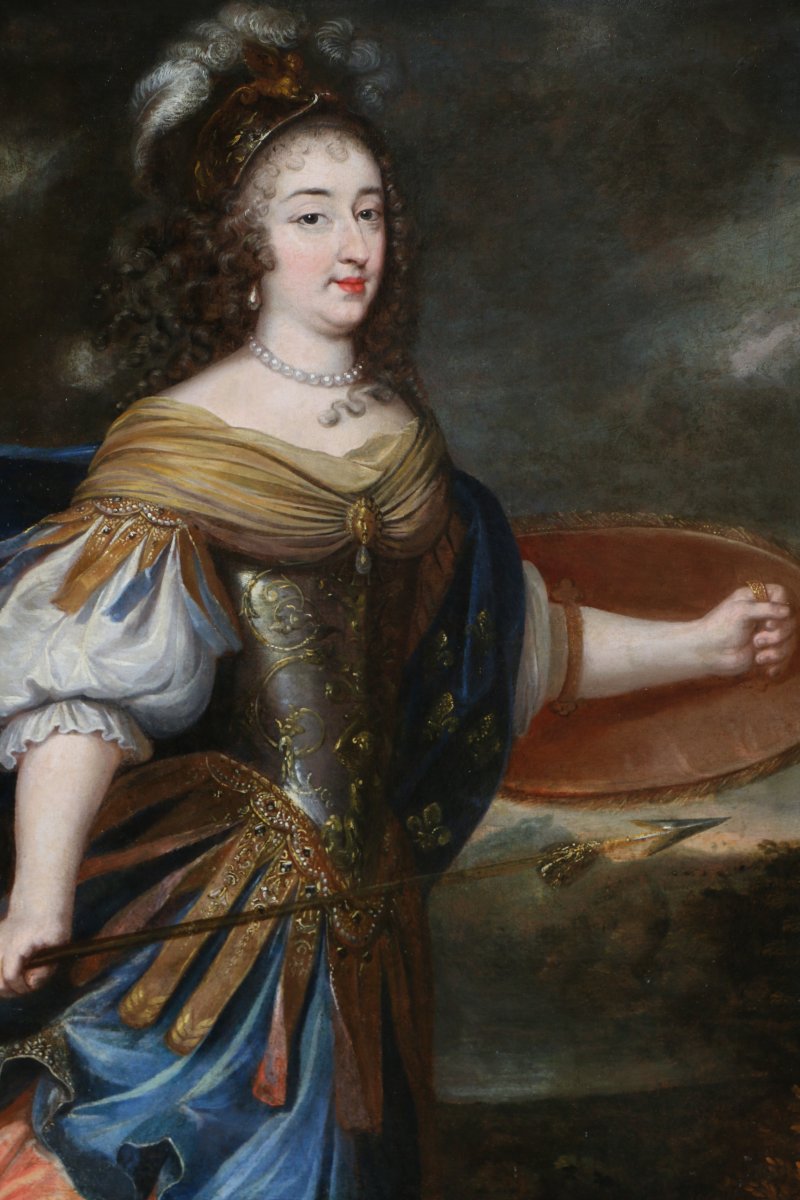
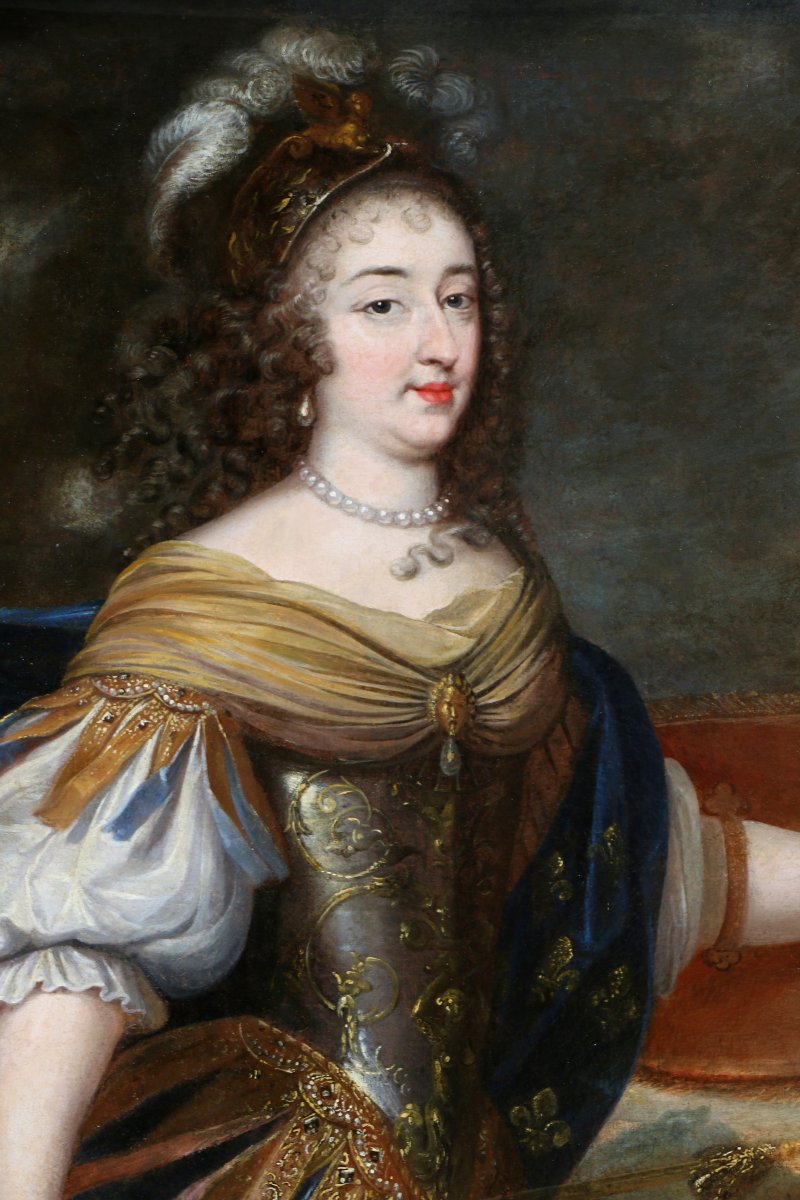
The sitter, turned slightly in a three-quarter view, gazes toward the spectator. Her oval face, with a fair complexion delicately tinged with pink, stands out sharply against the brown background. Her high, clear forehead is framed by small, uniform curls, while abundant brown hair, styled in long, wavy locks, falls on either side of her face and onto her shoulders. Her features are characterized by wide-set eyes, a straight nose, and a small mouth with rosy lips.
The exquisite nature of her jewelry contrasts with the martial character of the depiction. She wears a necklace of large pearls, echoed by matching pearl earrings.
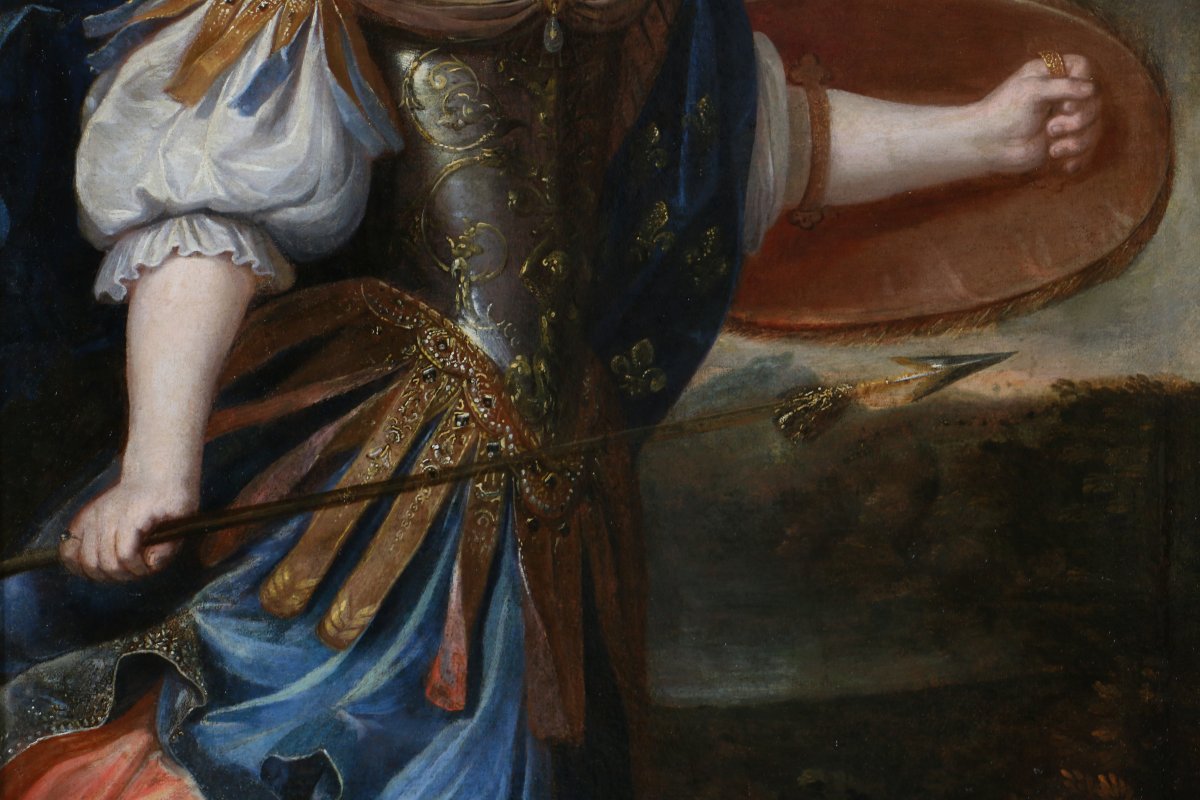
She is dressed in a sumptuous, fanciful costume "à l’antique," adapted to the conventions of 17th-century French court portraiture. Her bodice is covered by a corselet resembling a cuirass, richly embellished with gold motifs, metal ornaments, and cabochons. Beneath this ceremonial armor, the voluminous folds of a white chemise with puffed sleeves are visible.
A voluminous blue mantle, scattered with golden fleurs-de-lis, partially envelops the figure. This highly significant heraldic element introduces an explicit reference to the French monarchy into the composition, suggesting the sitter's membership in the House of France. Her allegorical identity is established by martial attributes. The young woman wears an imposing helmet in the antique style, richly ornamented and topped with a spectacular plume of white and grey-brown feathers that fans out across the upper part of the composition.
A long spear, held diagonally, cuts across the painting and provides a strong structural element to the composition. To the right stands a large shield; its dark mass and metallic ornamentation echo the helmet and cuirass.
The helmet, spear, shield, and cuirass are the traditional attributes of Pallas-Minerva. The work thus belongs to the genre of the *portrait historié* (portrait in character), which was highly prized in aristocratic circles and at the French court during the 17th century.
The composition relies on a deliberate contrast between refined femininity and martial power. The pearls, the whiteness of her skin, the carefully arranged curls, and the exquisite fabrics are balanced by the metal of the cuirass, the helmet, the spear, and the shield. Assuming the guise of Minerva symbolically exalts the qualities attributed to the sitter: nobility, wisdom, authority, courage, and virtue.
Anne-Marie-Louise d’Orléans, known as "La Grande Mademoiselle"
Anne-Marie-Louise d’Orléans, Duchess of Montpensier (1627–1693), known as "La Grande Mademoiselle"
She was the daughter of Gaston d’Orléans—brother of Louis XIII—and Marie de Bourbon-Montpensier. As the granddaughter of Henry IV and first cousin of Louis XIV, she held the highest rank within the French royal house; thanks to the immense maternal inheritance she received at birth, she was one of the wealthiest princesses in Europe.
An independent figure keenly aware of her rank, she played a particularly active role during the Fronde. In 1652, she sided with the Prince of Condé against royal forces and intervened directly in events in Paris. Her involvement led to her temporary exile from court and helped cement her enduring image as a warrior princess and a rebel.
Having gradually regained Louis XIV’s favor, she lived the life of a great princess, patronized artists and writers, and left behind significant memoirs—a valuable record of court life and aristocratic society during the *Grand Siècle*. Her late-life passion for Antonin Nompar de Caumont, Duke of Lauzun, and the obstacles surrounding their union form one of the most famous episodes of her life.
"La Grande Mademoiselle" was the subject of numerous portraits, sometimes in allegorical or heroic guises. Her depiction as Pallas-Minerva—armed with a helmet, spear, and shield—takes on special significance given her personality and her role during the Fronde, as the ancient goddess embodied the virtues of wisdom, authority, and martial courage.
The Musée Carnavalet holds a portrait of Anne-Marie-Louise d’Orléans showing her wearing a helmet and carrying a shield—a prime example of this heroic iconography.
https://www.parismuseescollections.paris.fr/fr/musee-carnavalet/oeuvres/portrait-d-anne-marie-louise-d-orleans-duchesse-de-montpensier-dite-la?utm
She died in Paris on April 5, 1693, leaving behind the unique image of a *princesse du sang*—a princess of the royal blood—who, through her wealth, character, and ambitions, holds a distinctive place among the great female figures of the 17th century.
Henri and Charles Beaubrun
Henri Beaubrun (1603–1677) and Charles Beaubrun (1604–1692) were cousins, born in Amboise, who ranked among the leading portraitists at the French court during the mid-17th century. Their careers were closely linked to the royal family, and particularly to the women of the court. The Louvre Museum lists their dates as 1603–1677 for Henri and 1604–1692 for Charles.
The two artists collaborated so closely that it is often difficult, if not impossible, to distinguish one’s hand from the other’s. This partnership is a defining characteristic of their work. The Palace of Versailles notes that they liked to claim they could swap brushes while working on the same portrait; this explains why many of their paintings are today attributed jointly to "Henri and Charles Beaubrun."
Introduced to court circles at an early stage, the Beaubruns enjoyed the particular favor of Anne of Austria. They depicted the queen on significant occasions—notably during her pregnancy—and painted the future Louis XIV just days after his birth. Their closeness to the royal family allowed them to become privileged witnesses to the young sovereign’s childhood and the female entourage of the monarchy. A particularly significant example of this activity is the *Portrait of Anne of Austria, Regent of France, and Her Son Louis XIV*, painted around 1644–1645 and acquired by the Palace of Versailles in 2025. This work combines a family portrait with a genuine political depiction of the monarchy during the regency of Anne of Austria.
The Beaubruns gradually specialized in female court portraiture. Princesses, queens, and noblewomen made up a significant portion of their clientele. They developed a visual language particularly suited to this aristocratic society: carefully modeled faces, fair complexions, elaborate hairstyles, pearls and jewelry, fine fabrics, embroidery, and sumptuous costumes all feature prominently in their compositions.
Their approach thus addresses the need to preserve the sitter's likeness while simultaneously conveying their rank, beauty, and status within court society. The portrait becomes a social and dynastic statement as much as an individual likeness.
Their reputation reached its zenith during the reign of Louis XIV. The King himself commissioned them to paint portraits of princesses of the royal family and prominent ladies of the court, intended notably for his residences. These works contributed to the vogue for "galleries of beauties"—collections of female portraits highly prized at European courts at the time. Versailles notes that the Beaubruns' portraits enjoyed immense success until the late 1660s.
Their work was not limited to Anne of Austria and the early years of the reign. The two cousins also worked for Maria Theresa of Austria, Louis XIV’s wife, and painted the Grand Dauphin. They thus held a privileged position in depicting successive generations of the royal family.
Furthermore, Charles Beaubrun was a member of the Royal Academy of Painting and Sculpture from September 2, 1651. INHA records also indicate that he received numerous royal commissions for portraits of court ladies.
The Beaubruns' art is characterized, in particular, by an elegant and refined style. Female sitters frequently appear in lavish court gowns, adorned with pearls, jewelry, and rich drapery. Yet the portrait could also take on an allegorical or mythological dimension: the noblewoman would partially shed her everyday identity to appear in the guise of a goddess or a heroine from antiquity.
This type of *portrait historié* (narrative or allegorical portrait) allowed physical likeness to be combined with symbolic qualities: Diana, for instance, evoked chastity or the hunt, while Pallas-Minerva embodied wisdom, intelligence, authority, and martial virtue. Classical attire, helmets, spears, or shields might thus appear alongside the hairstyles, pearls, and fabrics characteristic of contemporary French fashion.
This proximity between court portraiture and allegorical representation explains why certain long-standing attributions to the Beaubruns remain a subject of debate today. The Louvre, for instance, holds a *Portrait of an Unknown Woman as Diana*—formerly attributed to Charles Beaubrun and once identified as Madame de Montespan—which is now classified as the work of an anonymous artist of the 17th-century French school. Such reattributions demonstrate just how complex the understanding of their body of work remains.
This difficulty also stems from the very way their studio operated. The constant collaboration between the two cousins, the likely involvement of assistants in certain parts of the paintings, and the success of their portrait formulas make it challenging to distinguish between autograph works by the two painters, studio contributions, replicas, and works by their circle. Consequently, studying a painting attributable to their milieu requires examining not only the sitter’s features but also the rendering of flesh, hands, hair, pearls, fabrics, and ornaments.
Henri Beaubrun died in Paris in 1677. Charles outlived him by some fifteen years, dying in Paris in 1692.
Today, the Beaubruns are regarded as key figures in French court portraiture during the Regency of Anne of Austria and the early decades of Louis XIV’s personal reign. Their work constitutes a veritable gallery of aristocratic society during the *Grand Siècle* and offers unique insight into how women of the royal family and high nobility constructed their public image through portraiture.
The Palace of Versailles holds several of their works and actively researches their output. It notably characterizes Henri and Charles Beaubrun as "two cousins in the service of queens"—a phrase that aptly summarizes the role they played in the history of French portraiture.
Oil on canvas (relined), measuring 91 cm by 73.5 cm.
Period frame, measuring 108 cm by 91 cm.
The painting depicts a young woman of the high aristocracy—shown in a half-length pose against a dark background—in the guise of Pallas-Minerva, the ancient goddess of wisdom and war.
The sitter, turned slightly in a three-quarter view, gazes toward the spectator. Her oval face, with a fair complexion delicately tinged with pink, stands out sharply against the brown background. Her high, clear forehead is framed by small, uniform curls, while abundant brown hair, styled in long, wavy locks, falls on either side of her face and onto her shoulders. Her features are characterized by wide-set eyes, a straight nose, and a small mouth with rosy lips.
The exquisite nature of her jewelry contrasts with the martial character of the depiction. She wears a necklace of large pearls, echoed by matching pearl earrings.
She is dressed in a sumptuous, fanciful costume "à l’antique," adapted to the conventions of 17th-century French court portraiture. Her bodice is covered by a corselet resembling a cuirass, richly embellished with gold motifs, metal ornaments, and cabochons. Beneath this ceremonial armor, the voluminous folds of a white chemise with puffed sleeves are visible.
A voluminous blue mantle, scattered with golden fleurs-de-lis, partially envelops the figure. This highly significant heraldic element introduces an explicit reference to the French monarchy into the composition, suggesting the sitter's membership in the House of France. Her allegorical identity is established by martial attributes. The young woman wears an imposing helmet in the antique style, richly ornamented and topped with a spectacular plume of white and grey-brown feathers that fans out across the upper part of the composition.
A long spear, held diagonally, cuts across the painting and provides a strong structural element to the composition. To the right stands a large shield; its dark mass and metallic ornamentation echo the helmet and cuirass.
The helmet, spear, shield, and cuirass are the traditional attributes of Pallas-Minerva. The work thus belongs to the genre of the *portrait historié* (portrait in character), which was highly prized in aristocratic circles and at the French court during the 17th century.
The composition relies on a deliberate contrast between refined femininity and martial power. The pearls, the whiteness of her skin, the carefully arranged curls, and the exquisite fabrics are balanced by the metal of the cuirass, the helmet, the spear, and the shield. Assuming the guise of Minerva symbolically exalts the qualities attributed to the sitter: nobility, wisdom, authority, courage, and virtue.
Anne-Marie-Louise d’Orléans, known as "La Grande Mademoiselle"
Anne-Marie-Louise d’Orléans, Duchess of Montpensier (1627–1693), known as "La Grande Mademoiselle"
She was the daughter of Gaston d’Orléans—brother of Louis XIII—and Marie de Bourbon-Montpensier. As the granddaughter of Henry IV and first cousin of Louis XIV, she held the highest rank within the French royal house; thanks to the immense maternal inheritance she received at birth, she was one of the wealthiest princesses in Europe.
An independent figure keenly aware of her rank, she played a particularly active role during the Fronde. In 1652, she sided with the Prince of Condé against royal forces and intervened directly in events in Paris. Her involvement led to her temporary exile from court and helped cement her enduring image as a warrior princess and a rebel.
Having gradually regained Louis XIV’s favor, she lived the life of a great princess, patronized artists and writers, and left behind significant memoirs—a valuable record of court life and aristocratic society during the *Grand Siècle*. Her late-life passion for Antonin Nompar de Caumont, Duke of Lauzun, and the obstacles surrounding their union form one of the most famous episodes of her life.
"La Grande Mademoiselle" was the subject of numerous portraits, sometimes in allegorical or heroic guises. Her depiction as Pallas-Minerva—armed with a helmet, spear, and shield—takes on special significance given her personality and her role during the Fronde, as the ancient goddess embodied the virtues of wisdom, authority, and martial courage.
The Musée Carnavalet holds a portrait of Anne-Marie-Louise d’Orléans showing her wearing a helmet and carrying a shield—a prime example of this heroic iconography.
https://www.parismuseescollections.paris.fr/fr/musee-carnavalet/oeuvres/portrait-d-anne-marie-louise-d-orleans-duchesse-de-montpensier-dite-la?utm
She died in Paris on April 5, 1693, leaving behind the unique image of a *princesse du sang*—a princess of the royal blood—who, through her wealth, character, and ambitions, holds a distinctive place among the great female figures of the 17th century.
Henri and Charles Beaubrun
Henri Beaubrun (1603–1677) and Charles Beaubrun (1604–1692) were cousins, born in Amboise, who ranked among the leading portraitists at the French court during the mid-17th century. Their careers were closely linked to the royal family, and particularly to the women of the court. The Louvre Museum lists their dates as 1603–1677 for Henri and 1604–1692 for Charles.
The two artists collaborated so closely that it is often difficult, if not impossible, to distinguish one’s hand from the other’s. This partnership is a defining characteristic of their work. The Palace of Versailles notes that they liked to claim they could swap brushes while working on the same portrait; this explains why many of their paintings are today attributed jointly to "Henri and Charles Beaubrun."
Introduced to court circles at an early stage, the Beaubruns enjoyed the particular favor of Anne of Austria. They depicted the queen on significant occasions—notably during her pregnancy—and painted the future Louis XIV just days after his birth. Their closeness to the royal family allowed them to become privileged witnesses to the young sovereign’s childhood and the female entourage of the monarchy. A particularly significant example of this activity is the *Portrait of Anne of Austria, Regent of France, and Her Son Louis XIV*, painted around 1644–1645 and acquired by the Palace of Versailles in 2025. This work combines a family portrait with a genuine political depiction of the monarchy during the regency of Anne of Austria.
The Beaubruns gradually specialized in female court portraiture. Princesses, queens, and noblewomen made up a significant portion of their clientele. They developed a visual language particularly suited to this aristocratic society: carefully modeled faces, fair complexions, elaborate hairstyles, pearls and jewelry, fine fabrics, embroidery, and sumptuous costumes all feature prominently in their compositions.
Their approach thus addresses the need to preserve the sitter's likeness while simultaneously conveying their rank, beauty, and status within court society. The portrait becomes a social and dynastic statement as much as an individual likeness.
Their reputation reached its zenith during the reign of Louis XIV. The King himself commissioned them to paint portraits of princesses of the royal family and prominent ladies of the court, intended notably for his residences. These works contributed to the vogue for "galleries of beauties"—collections of female portraits highly prized at European courts at the time. Versailles notes that the Beaubruns' portraits enjoyed immense success until the late 1660s.
Their work was not limited to Anne of Austria and the early years of the reign. The two cousins also worked for Maria Theresa of Austria, Louis XIV’s wife, and painted the Grand Dauphin. They thus held a privileged position in depicting successive generations of the royal family.
Furthermore, Charles Beaubrun was a member of the Royal Academy of Painting and Sculpture from September 2, 1651. INHA records also indicate that he received numerous royal commissions for portraits of court ladies.
The Beaubruns' art is characterized, in particular, by an elegant and refined style. Female sitters frequently appear in lavish court gowns, adorned with pearls, jewelry, and rich drapery. Yet the portrait could also take on an allegorical or mythological dimension: the noblewoman would partially shed her everyday identity to appear in the guise of a goddess or a heroine from antiquity.
This type of *portrait historié* (narrative or allegorical portrait) allowed physical likeness to be combined with symbolic qualities: Diana, for instance, evoked chastity or the hunt, while Pallas-Minerva embodied wisdom, intelligence, authority, and martial virtue. Classical attire, helmets, spears, or shields might thus appear alongside the hairstyles, pearls, and fabrics characteristic of contemporary French fashion.
This proximity between court portraiture and allegorical representation explains why certain long-standing attributions to the Beaubruns remain a subject of debate today. The Louvre, for instance, holds a *Portrait of an Unknown Woman as Diana*—formerly attributed to Charles Beaubrun and once identified as Madame de Montespan—which is now classified as the work of an anonymous artist of the 17th-century French school. Such reattributions demonstrate just how complex the understanding of their body of work remains.
This difficulty also stems from the very way their studio operated. The constant collaboration between the two cousins, the likely involvement of assistants in certain parts of the paintings, and the success of their portrait formulas make it challenging to distinguish between autograph works by the two painters, studio contributions, replicas, and works by their circle. Consequently, studying a painting attributable to their milieu requires examining not only the sitter’s features but also the rendering of flesh, hands, hair, pearls, fabrics, and ornaments.
Henri Beaubrun died in Paris in 1677. Charles outlived him by some fifteen years, dying in Paris in 1692.
Today, the Beaubruns are regarded as key figures in French court portraiture during the Regency of Anne of Austria and the early decades of Louis XIV’s personal reign. Their work constitutes a veritable gallery of aristocratic society during the *Grand Siècle* and offers unique insight into how women of the royal family and high nobility constructed their public image through portraiture.
The Palace of Versailles holds several of their works and actively researches their output. It notably characterizes Henri and Charles Beaubrun as "two cousins in the service of queens"—a phrase that aptly summarizes the role they played in the history of French portraiture.
16 800 €
Period: 17th century
Style: Louis 14th, Regency
Condition: Excellent condition
Material: Oil painting
Length: 91 cm, 108 cm avec le cadre
Width: 73.5 cm, 91 cm avec le cadre
Reference (ID): 1813715
Availability: In stock
Print