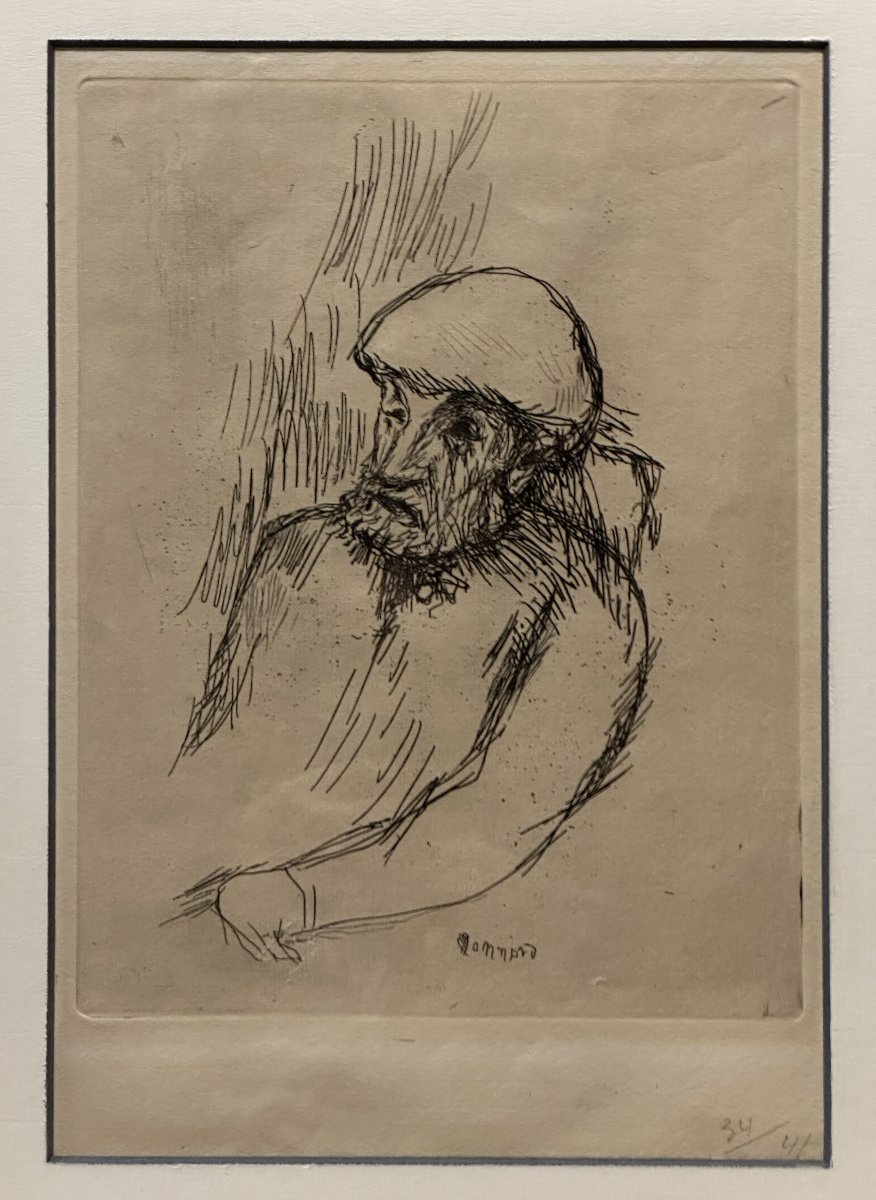
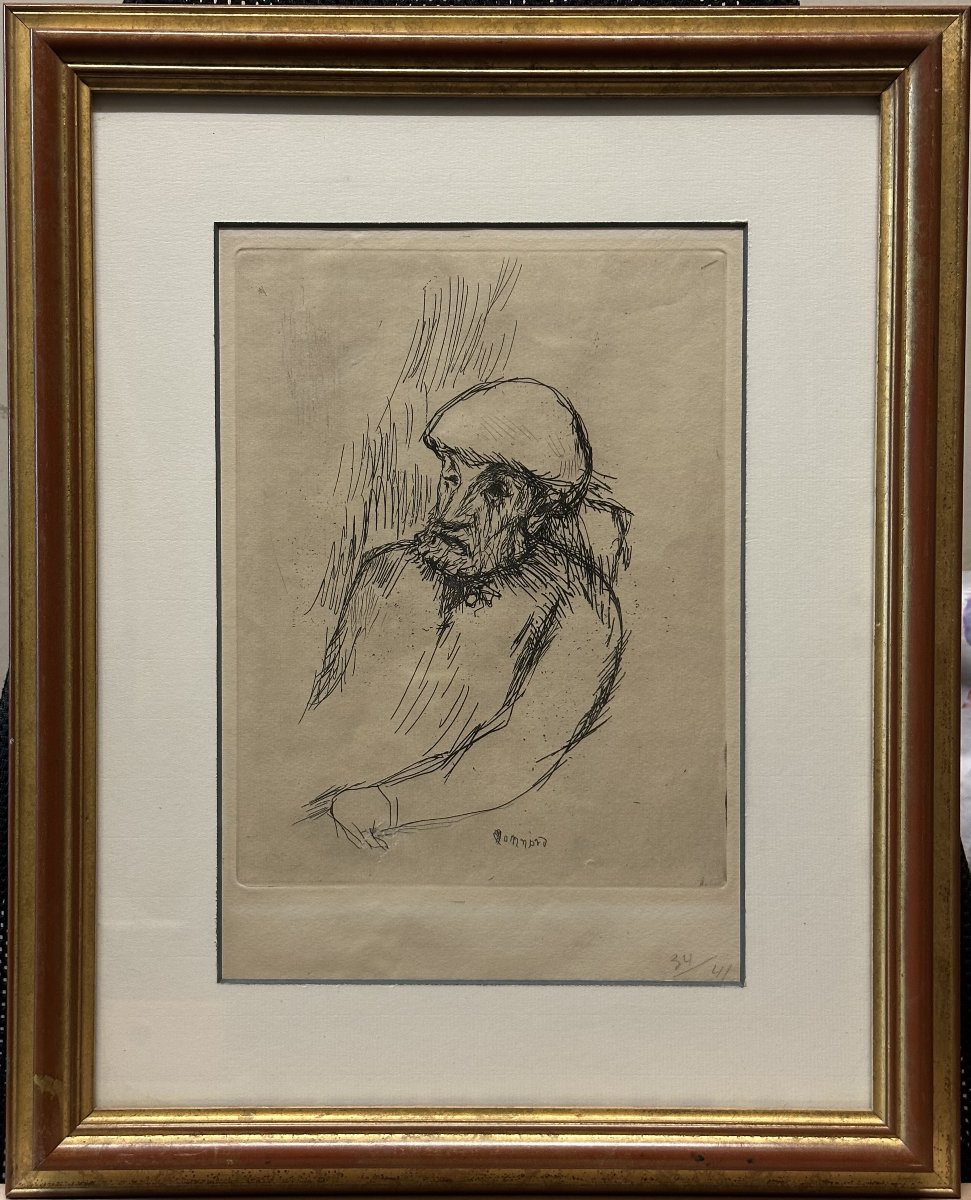
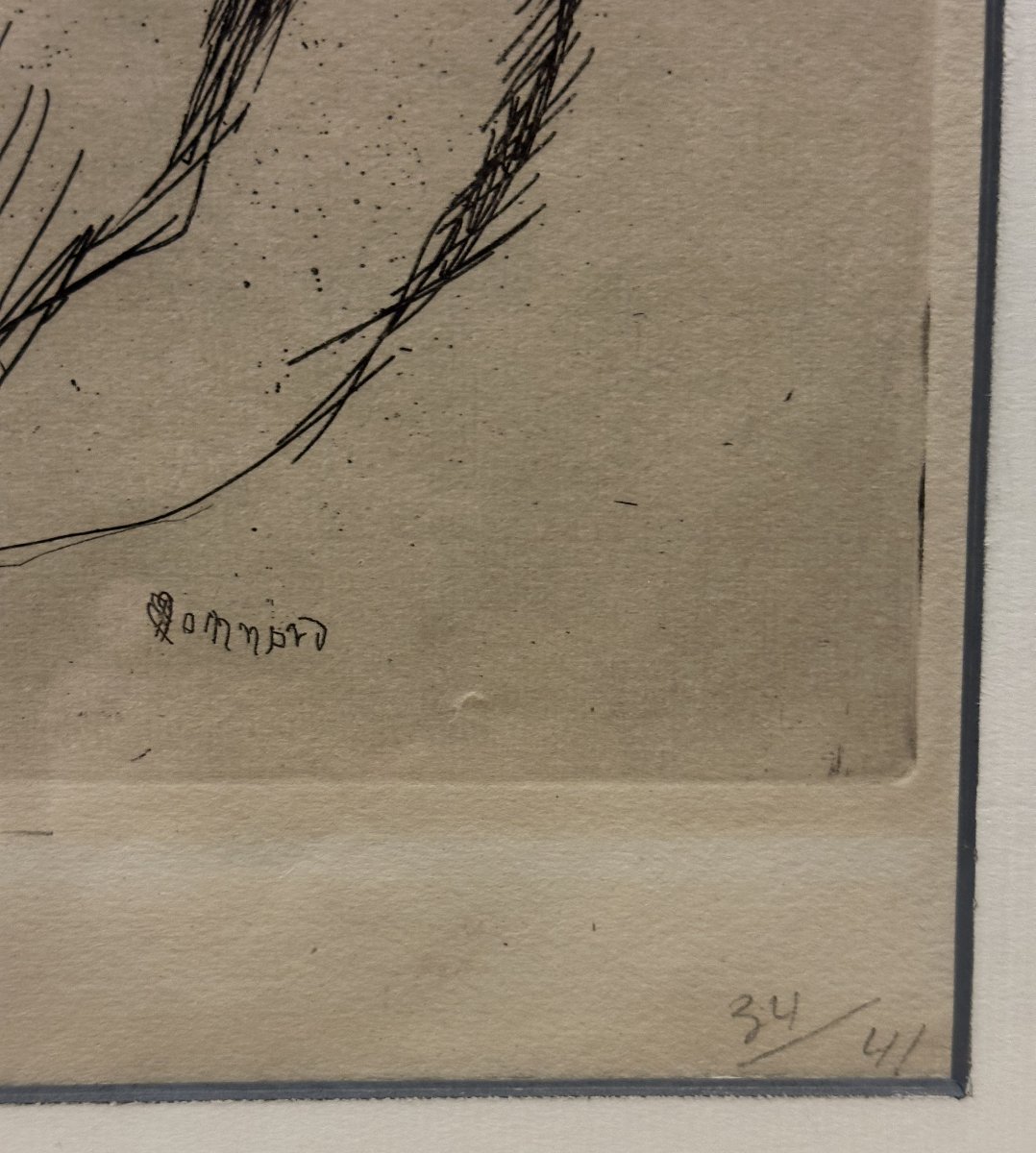
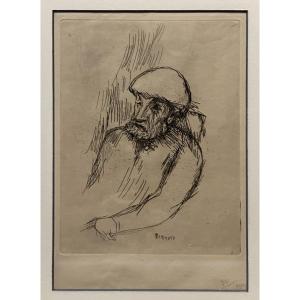


Pierre Bonnard (1867–1947) “portrait Of Renoir (c. 1916)” Etching, 25.6 X 19.7 Cm
Pierre BONNARD (1867–1947) “Portrait of Renoir (c. 1916)” Etching, 25.6 x 19.7 cm
In 1909, Bonnard took up etching, a process that pushed him to even greater precision in his drawing. He used this technique to illustrate Octave Mirbeau’s *Dingo* and Vollard’s *Sainte Monique*. Although his small landscapes in *Dingo* are exceptionally delicate, he experimented little with this technique. After 1923, his lithographs took on a more serious tone: he became more interested in light and in understanding people and things[301]. Having retired to Le Cannet in 1939, he drew inspiration mainly from interiors or the surrounding landscapes[302]. In 1942, Louis Carré commissioned drawings from him, which Bonnard executed in gouache; Jacques Villon, who worked in constant collaboration with him, produced lithographs from these drawings in 80 numbered copies until 1946[303].
Bouvet lists a total of 525 prints in his catalog raisonné[304], of which Watkins counts 250 lithographs. These, however, predominate in a fairly extensive body of print work and in two of the three books that Bonnard illustrated most lavishly, *Parallèlement* and *Daphnis and Chloe*[305],[306]. As for *Aspects of Parisian Life*, they demonstrate the extent to which Bonnard’s prints align with his paintings in terms of the “immediate expression of an emotion”[302]. “The trajectory of his engravings is not distinct from that of his paintings; it complements them, completes them, and, at certain moments, reinforces them,” summarizes Antoine Terrasse[56].
In 1909, Bonnard took up etching, a process that pushed him to even greater precision in his drawing. He used this technique to illustrate Octave Mirbeau’s *Dingo* and Vollard’s *Sainte Monique*. Although his small landscapes in *Dingo* are exceptionally delicate, he experimented little with this technique. After 1923, his lithographs took on a more serious tone: he became more interested in light and in understanding people and things[301]. Having retired to Le Cannet in 1939, he drew inspiration mainly from interiors or the surrounding landscapes[302]. In 1942, Louis Carré commissioned drawings from him, which Bonnard executed in gouache; Jacques Villon, who worked in constant collaboration with him, produced lithographs from these drawings in 80 numbered copies until 1946[303].
Bouvet lists a total of 525 prints in his catalog raisonné[304], of which Watkins counts 250 lithographs. These, however, predominate in a fairly extensive body of print work and in two of the three books that Bonnard illustrated most lavishly, *Parallèlement* and *Daphnis and Chloe*[305],[306]. As for *Aspects of Parisian Life*, they demonstrate the extent to which Bonnard’s prints align with his paintings in terms of the “immediate expression of an emotion”[302]. “The trajectory of his engravings is not distinct from that of his paintings; it complements them, completes them, and, at certain moments, reinforces them,” summarizes Antoine Terrasse[56].
220 €
Period: 20th century
Style: Other Style
Condition: Condition of use
Material: Paper
Width: 19,7
Height: 25,6
Reference (ID): 1813387
Availability: In stock
Print