THIS OBJECT WAS SOLD
Small Inkstand With A Sitting Dog, Empire Period, Early 19th Century.
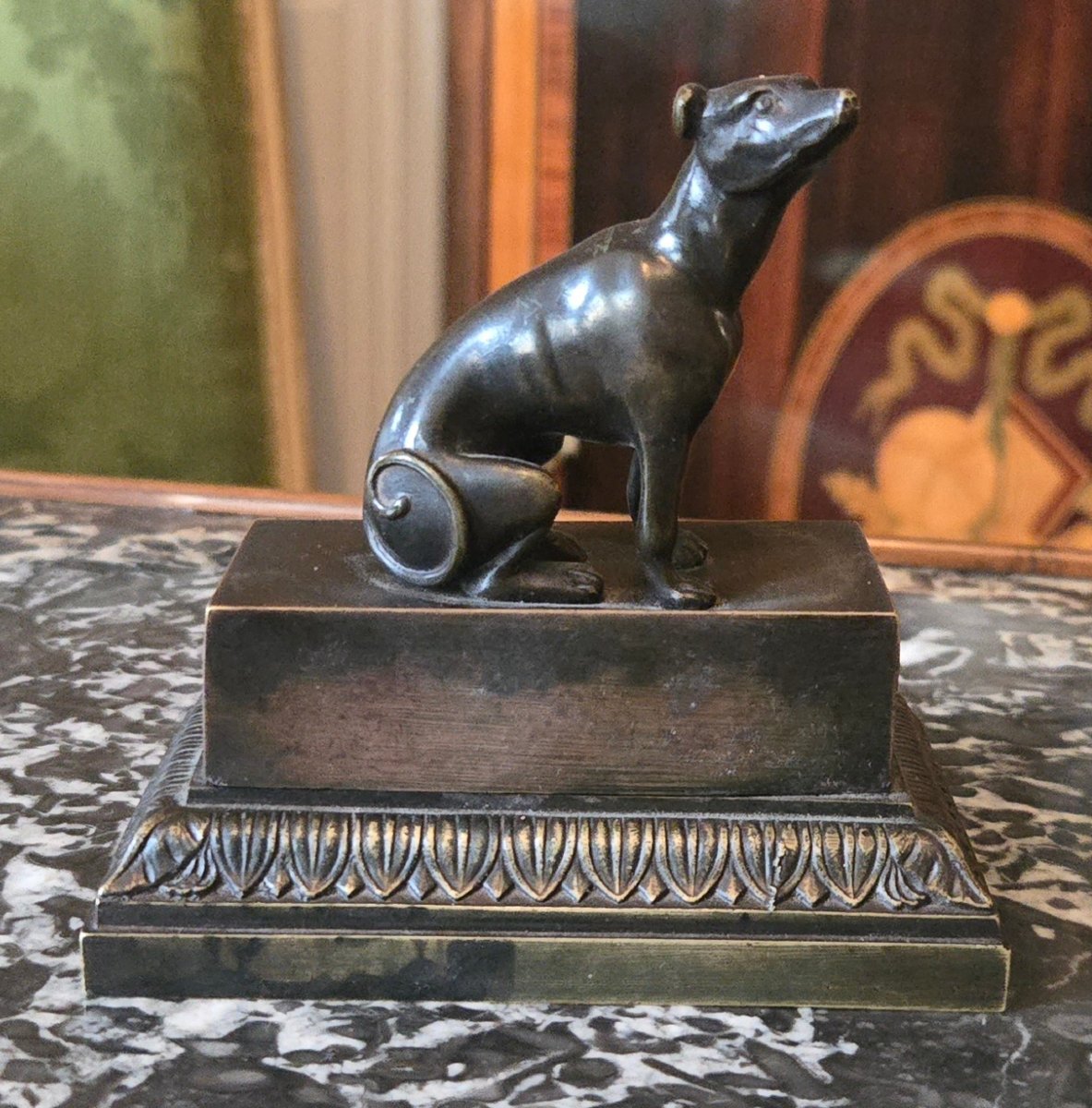
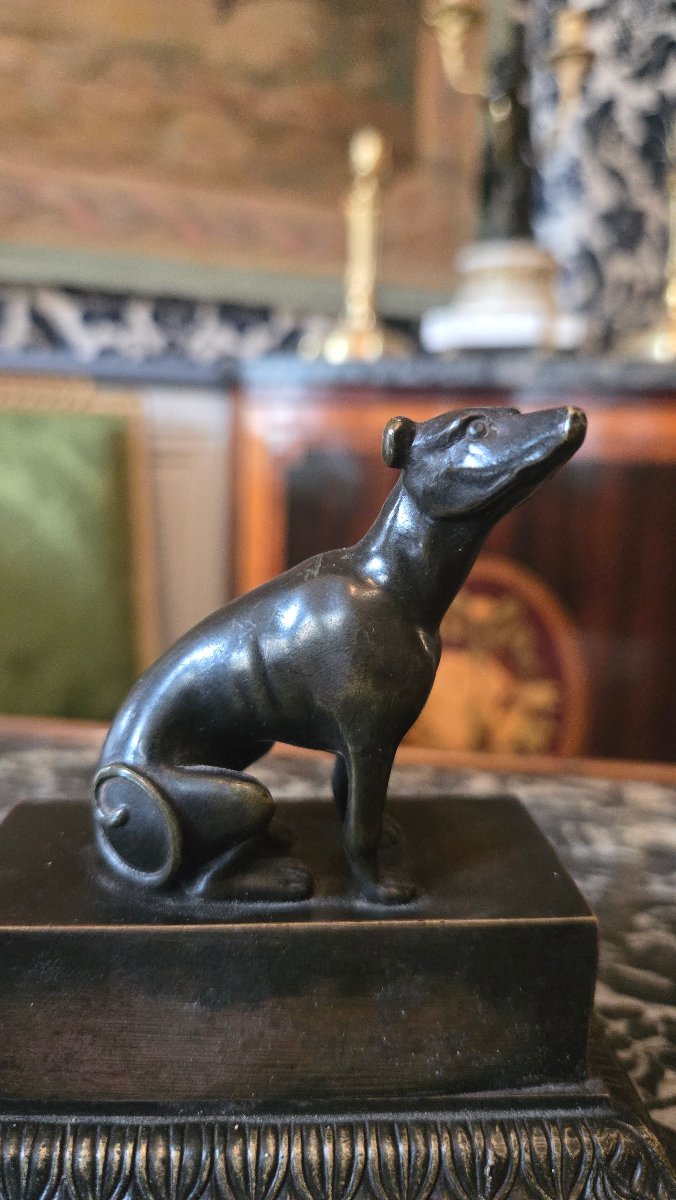
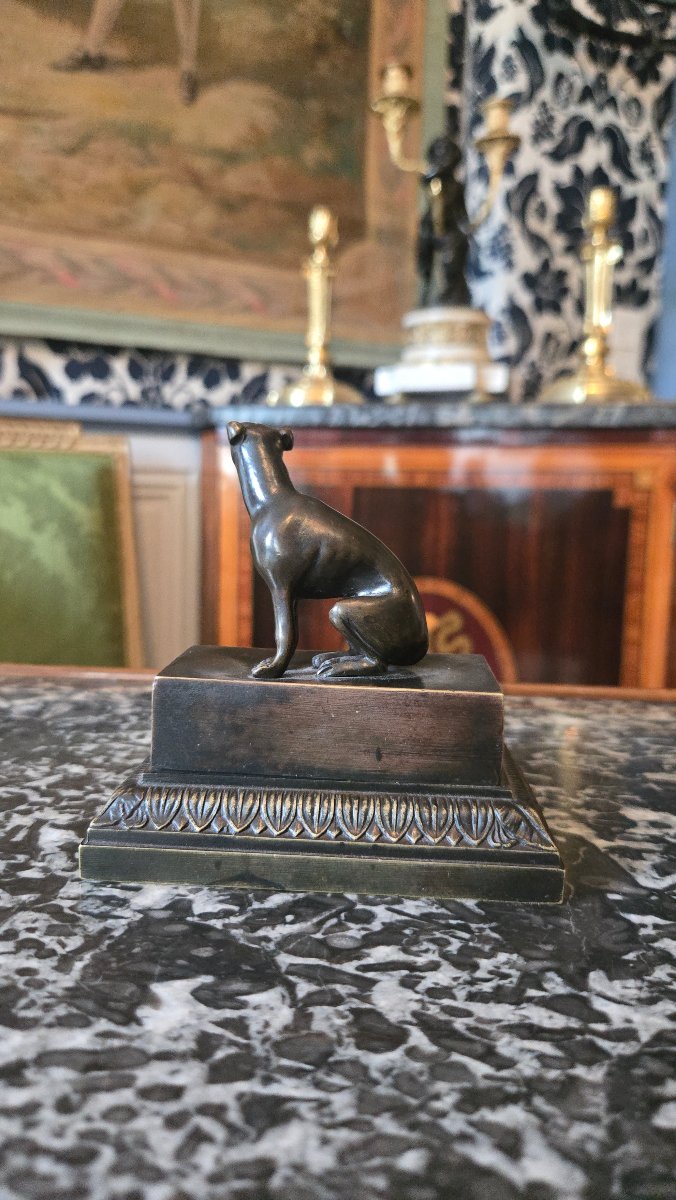
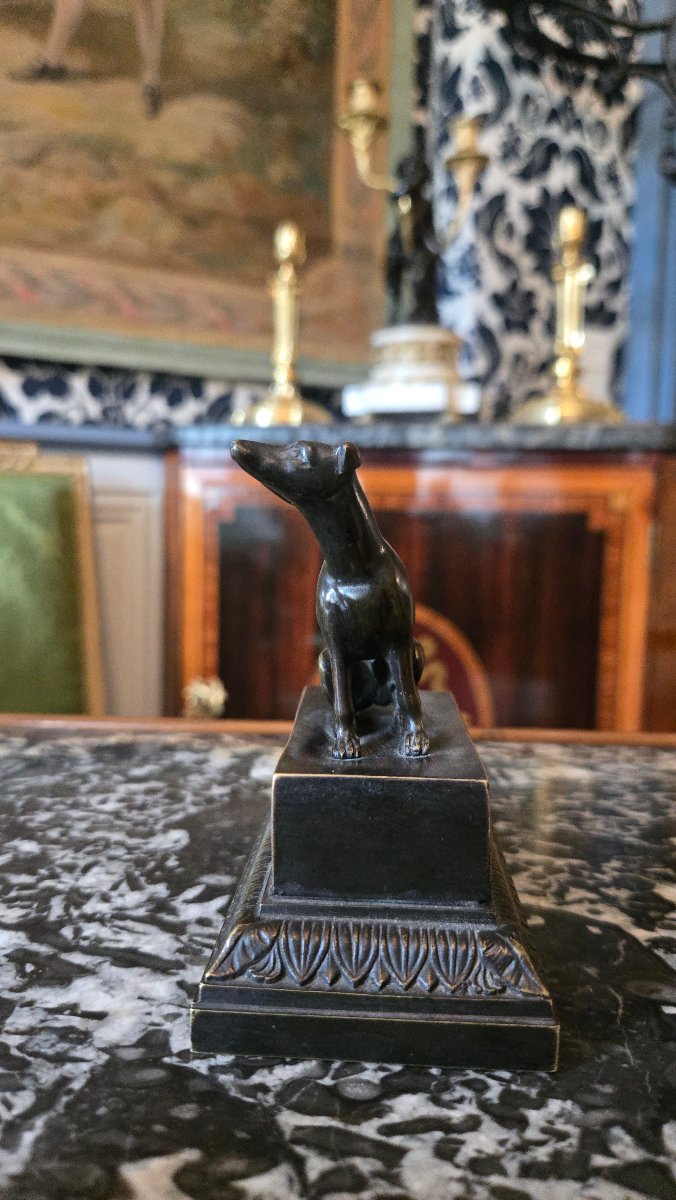
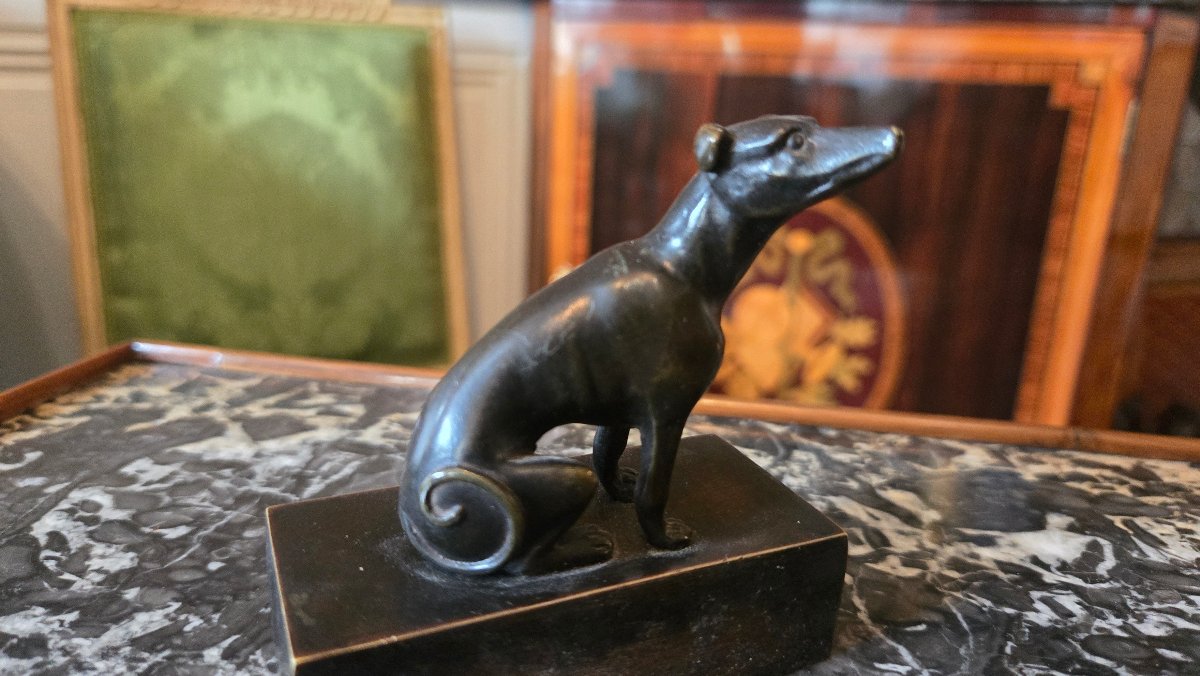
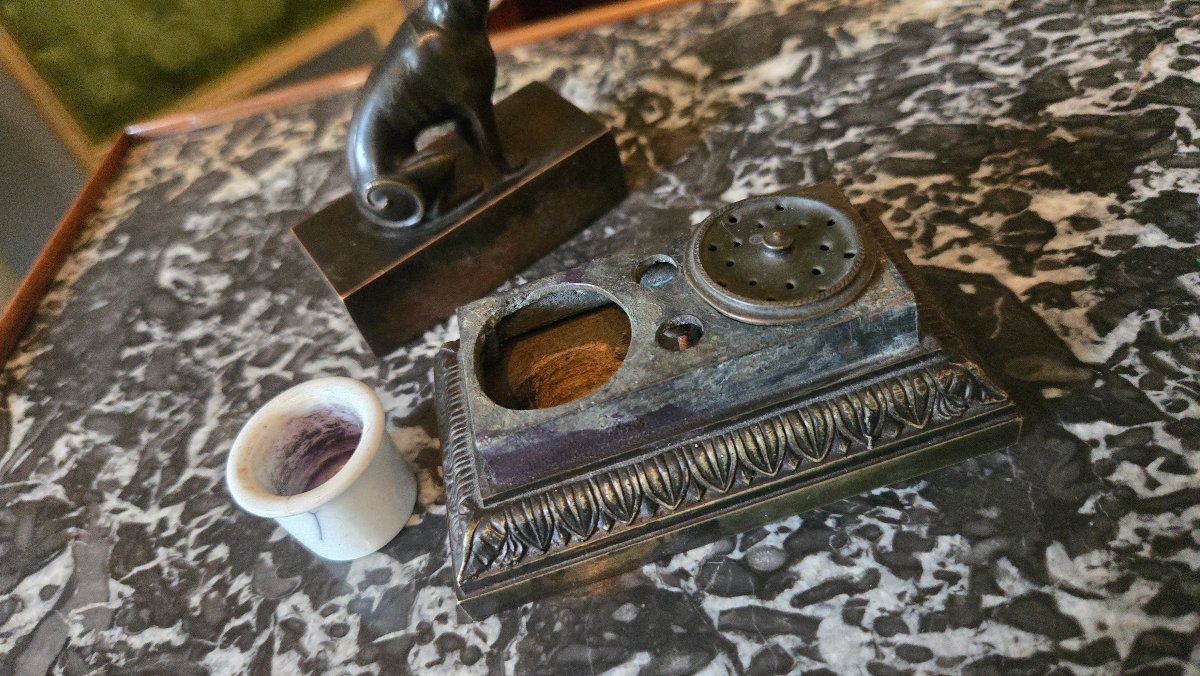
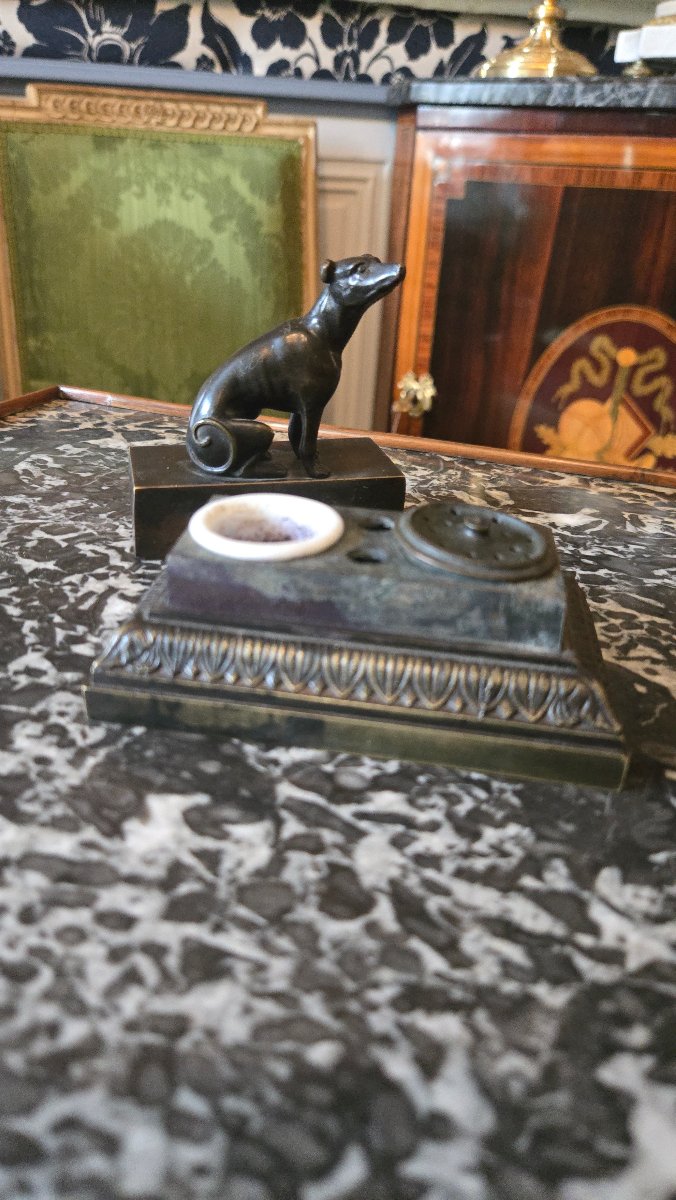
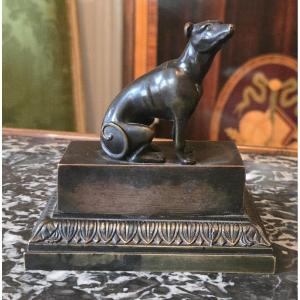


Small Empire-period inkwell in bronze with a nuanced antique green patina, featuring a stepped rectangular base topped by a sitting dog rendered in the round.
The animal is depicted in an alert pose, sitting on its hind legs, chest out and head raised. Its tapered muzzle, small folded-back ears, compact body, and slender forelimbs suggest a resemblance to the small terrier-type dogs used for hunting as early as the 18th century, though it cannot be identified as a specific, codified breed.
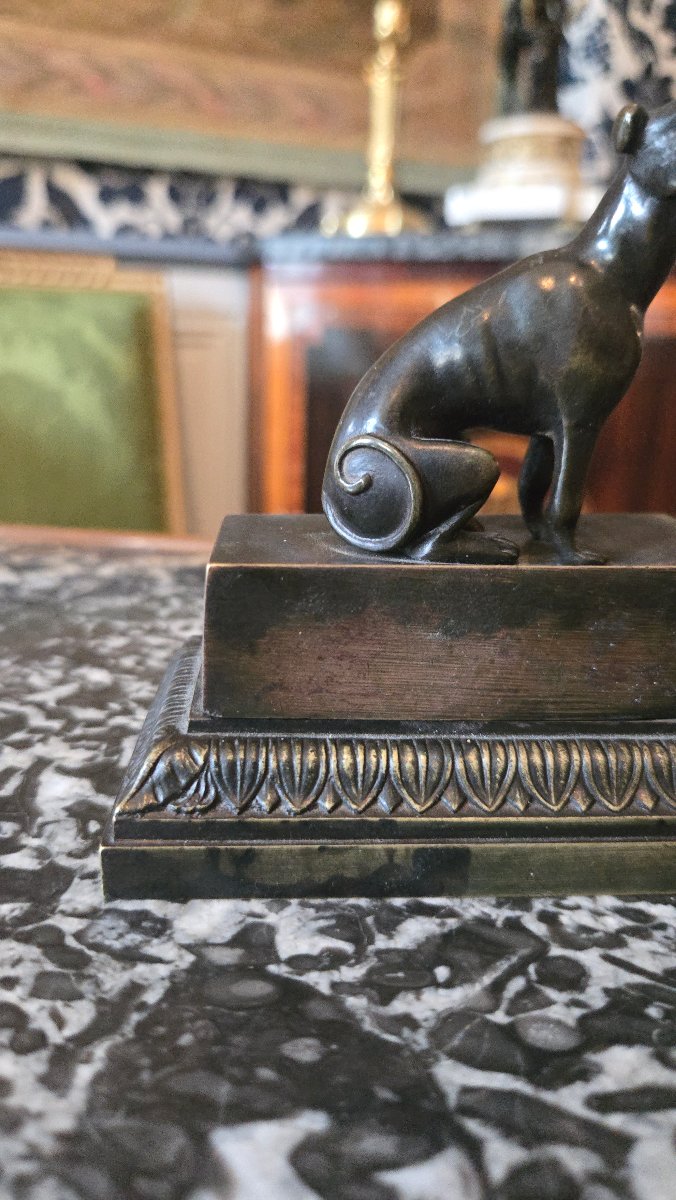
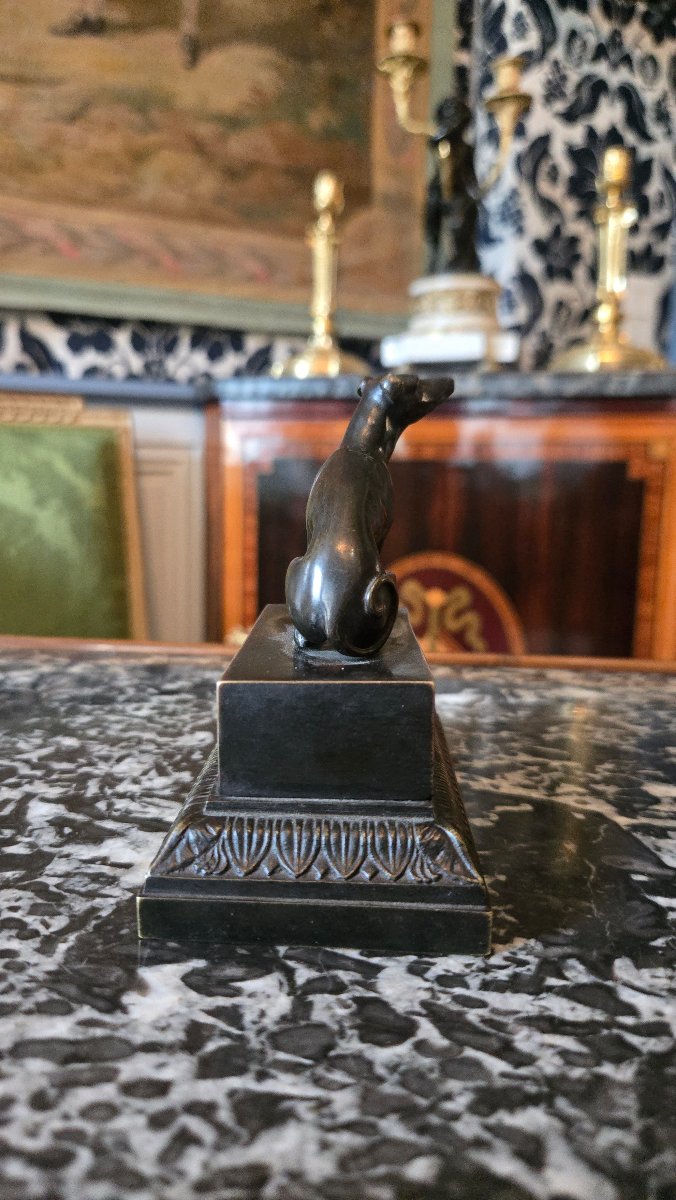
The dog is distinguished by the stylized treatment of its tail, which lies flat against its right thigh and forms a regular spiral. This spiral establishes a formal link between the animal figure and the neoclassical vocabulary of the base.
The smooth, simplified modeling of the body is complemented by details finely rendered after casting: the incisions for the eyes and muzzle, the contours of the ears, the separation of the limbs, and the definition of the toes. The quality of the casting is particularly evident in the sharp definition of the head, legs, and tail.
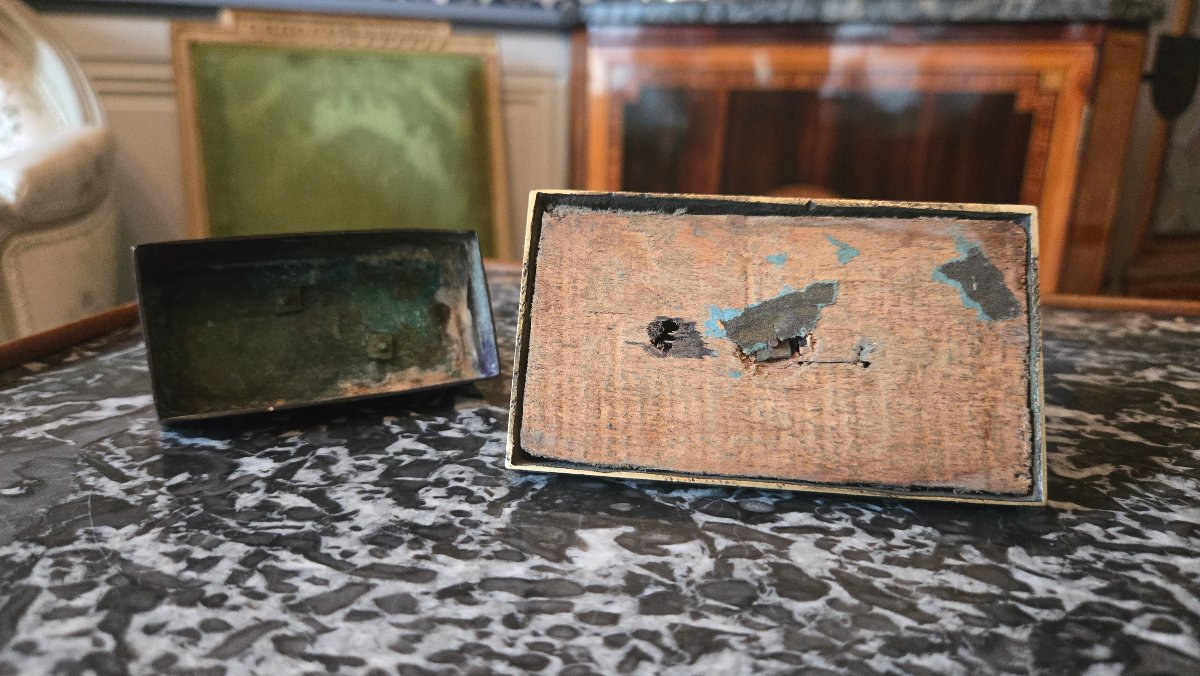
The figurine is mounted on the rectangular lid and secured by two threaded rods that pass through it, tightened on the underside with square nuts.
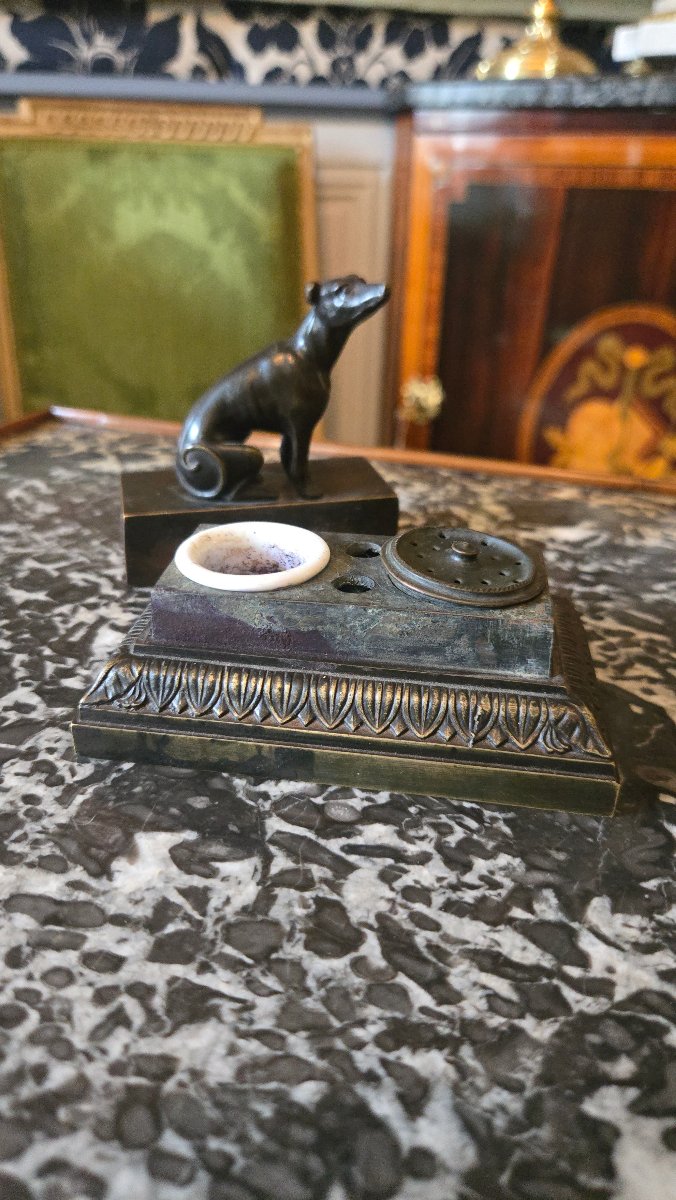
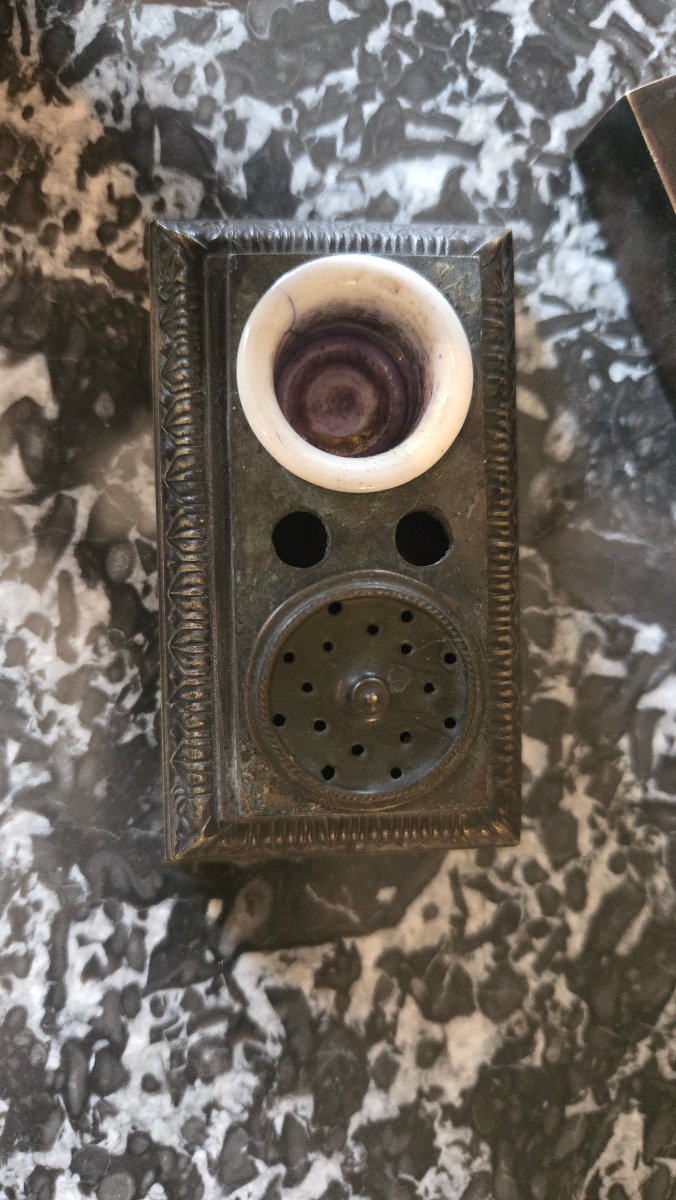
The lid is fully removable, revealing an interior layout that includes a cylindrical white porcelain inkwell, a sand container closed by a perforated circular lid, and two openings for holding quills.
Before blotting paper became widespread, fine sand was sprinkled over fresh ink to absorb excess ink. The combination of the inkwell, the sand container, and the two pen holders thus forms a compact writing set designed to sit on a desk.
The base features a multi-tiered architectural design. Its lower section is encircled by a frieze of water leaves arranged in a regular pattern and rendered in chiseled relief. It rests on a slightly projecting rectangular plinth, whose geometric simplicity complements the stylized depiction of the animal.
The tiered construction, the frieze of water leaves, and the nuanced antique green patina are all part of the neoclassical vocabulary developed during the Empire. The patina exhibits shades of brown and green, as well as natural wear on the protruding parts. This wear occasionally reveals the warm tone of the underlying bronze, particularly on the edges, the water leaves, the dog’s legs, and its tail.
The bottom of the inkwell is closed by an original wooden panel.
Condition: age-related wear on the patina, occasionally revealing the bronze on the reliefs and edges; traces of oxidation on the interior. The porcelain cup has a crack and retains old traces of purple ink.
H. 10.6 × W. 10.7 × D. 6.1 cm
The animal is depicted in an alert pose, sitting on its hind legs, chest out and head raised. Its tapered muzzle, small folded-back ears, compact body, and slender forelimbs suggest a resemblance to the small terrier-type dogs used for hunting as early as the 18th century, though it cannot be identified as a specific, codified breed.
The dog is distinguished by the stylized treatment of its tail, which lies flat against its right thigh and forms a regular spiral. This spiral establishes a formal link between the animal figure and the neoclassical vocabulary of the base.
The smooth, simplified modeling of the body is complemented by details finely rendered after casting: the incisions for the eyes and muzzle, the contours of the ears, the separation of the limbs, and the definition of the toes. The quality of the casting is particularly evident in the sharp definition of the head, legs, and tail.
The figurine is mounted on the rectangular lid and secured by two threaded rods that pass through it, tightened on the underside with square nuts.
The lid is fully removable, revealing an interior layout that includes a cylindrical white porcelain inkwell, a sand container closed by a perforated circular lid, and two openings for holding quills.
Before blotting paper became widespread, fine sand was sprinkled over fresh ink to absorb excess ink. The combination of the inkwell, the sand container, and the two pen holders thus forms a compact writing set designed to sit on a desk.
The base features a multi-tiered architectural design. Its lower section is encircled by a frieze of water leaves arranged in a regular pattern and rendered in chiseled relief. It rests on a slightly projecting rectangular plinth, whose geometric simplicity complements the stylized depiction of the animal.
The tiered construction, the frieze of water leaves, and the nuanced antique green patina are all part of the neoclassical vocabulary developed during the Empire. The patina exhibits shades of brown and green, as well as natural wear on the protruding parts. This wear occasionally reveals the warm tone of the underlying bronze, particularly on the edges, the water leaves, the dog’s legs, and its tail.
The bottom of the inkwell is closed by an original wooden panel.
Condition: age-related wear on the patina, occasionally revealing the bronze on the reliefs and edges; traces of oxidation on the interior. The porcelain cup has a crack and retains old traces of purple ink.
H. 10.6 × W. 10.7 × D. 6.1 cm
Explore similar pieces and discover your ideal find:
Inkwells, Desks Accessories