

Rare Sino-tibetan Ritual Horn With Cloisonné Enamel
China, Qing Dynasty, 19th century
Copper or copper alloy, polychrome cloisonné enamel, and gilded metal
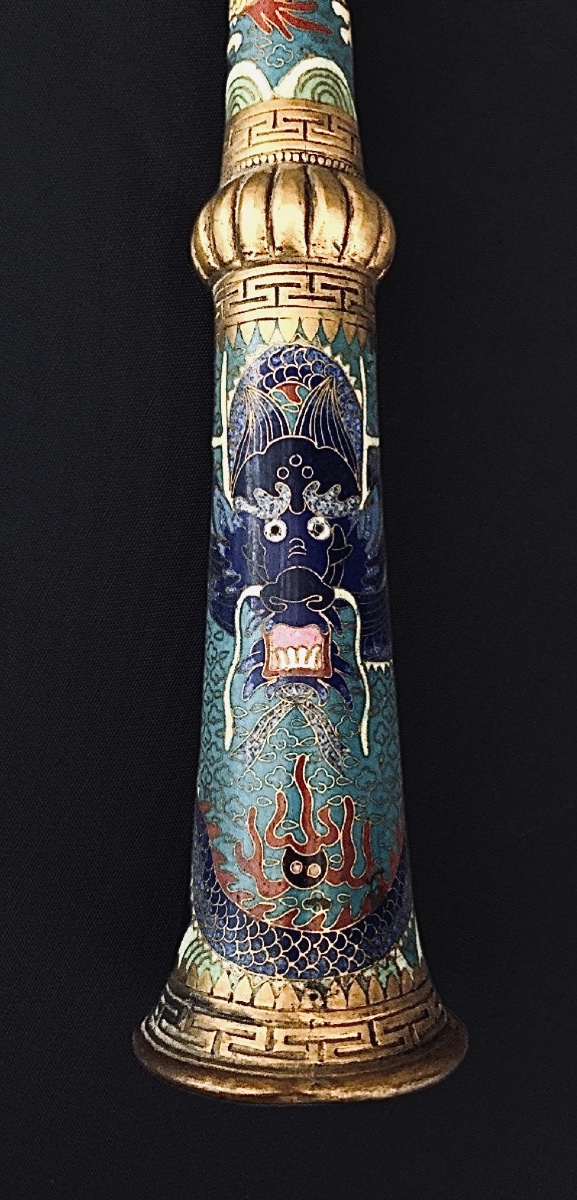
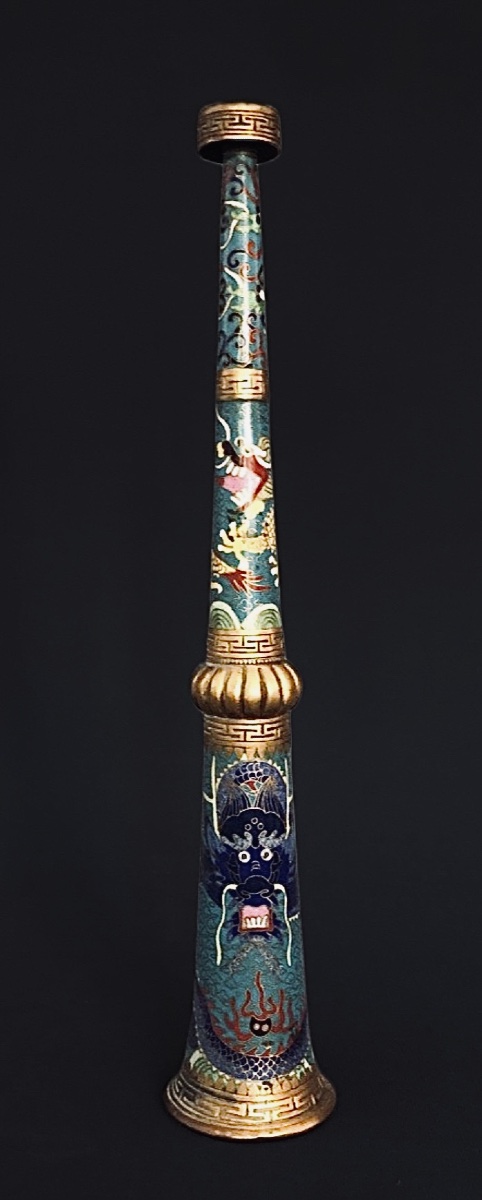
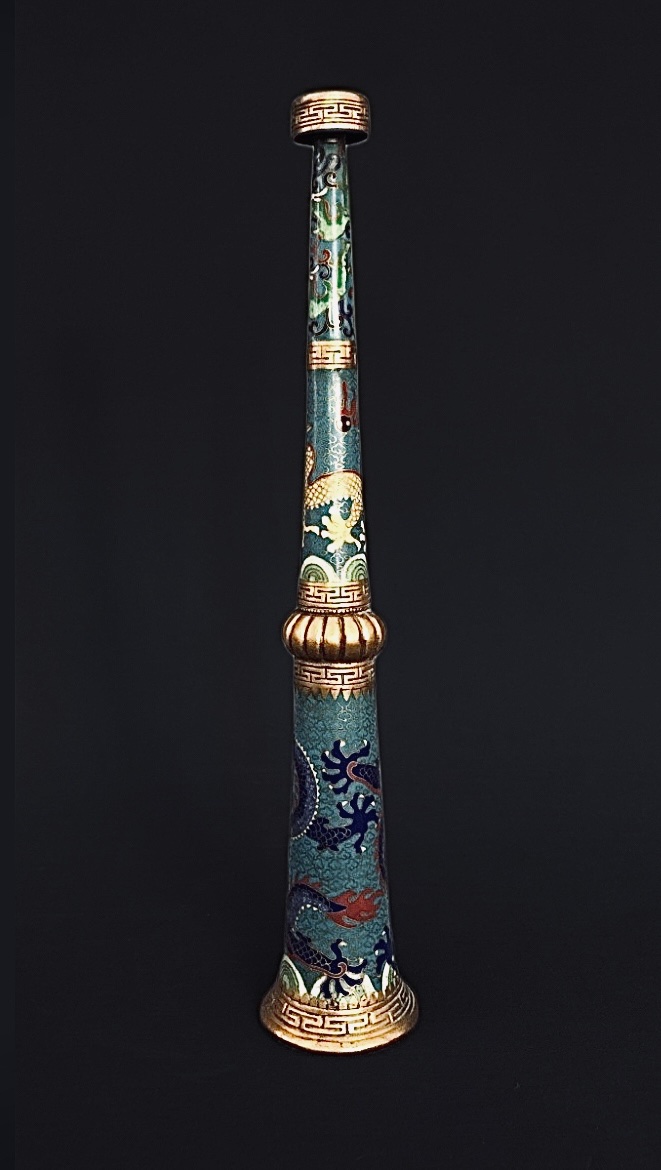
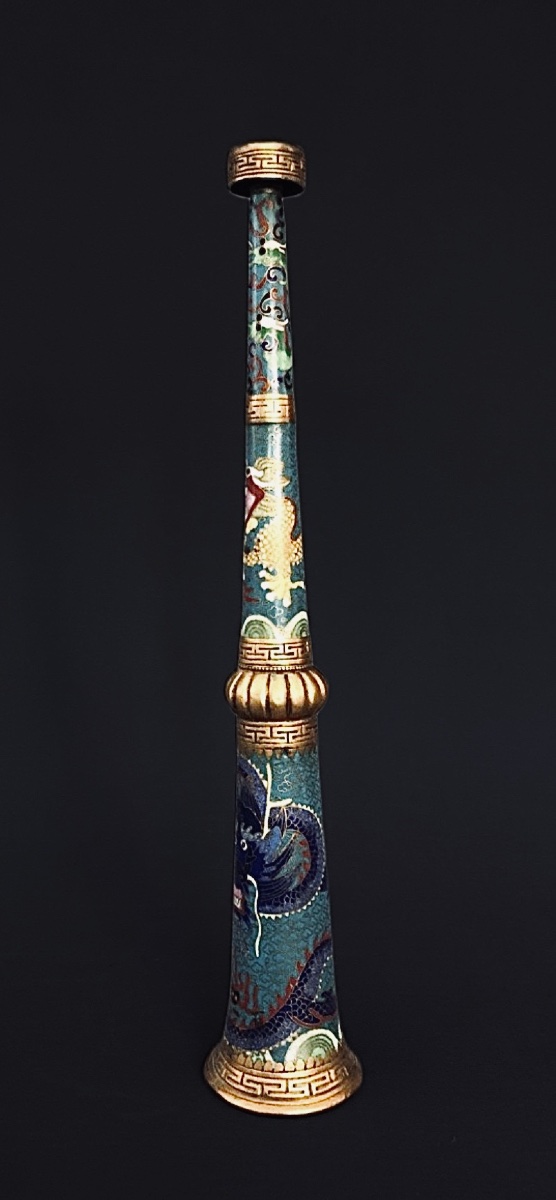
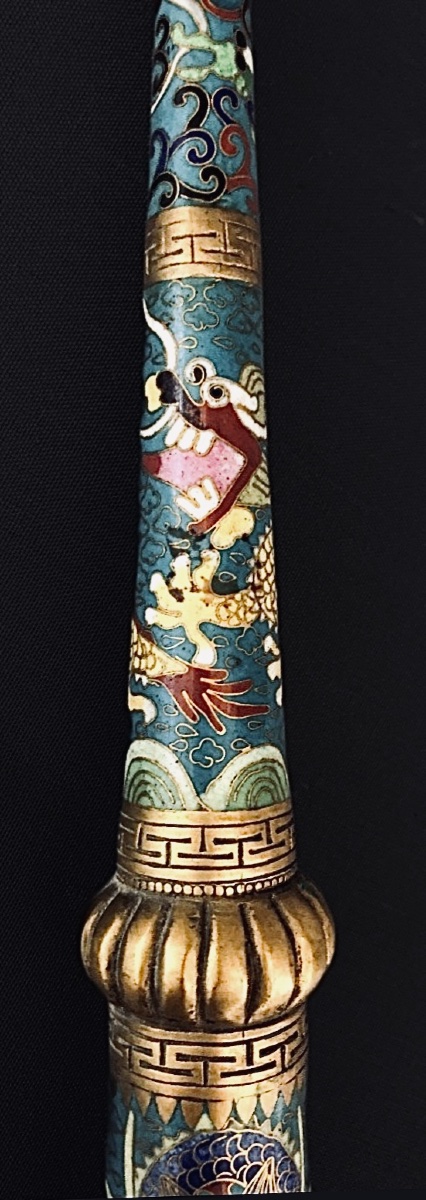
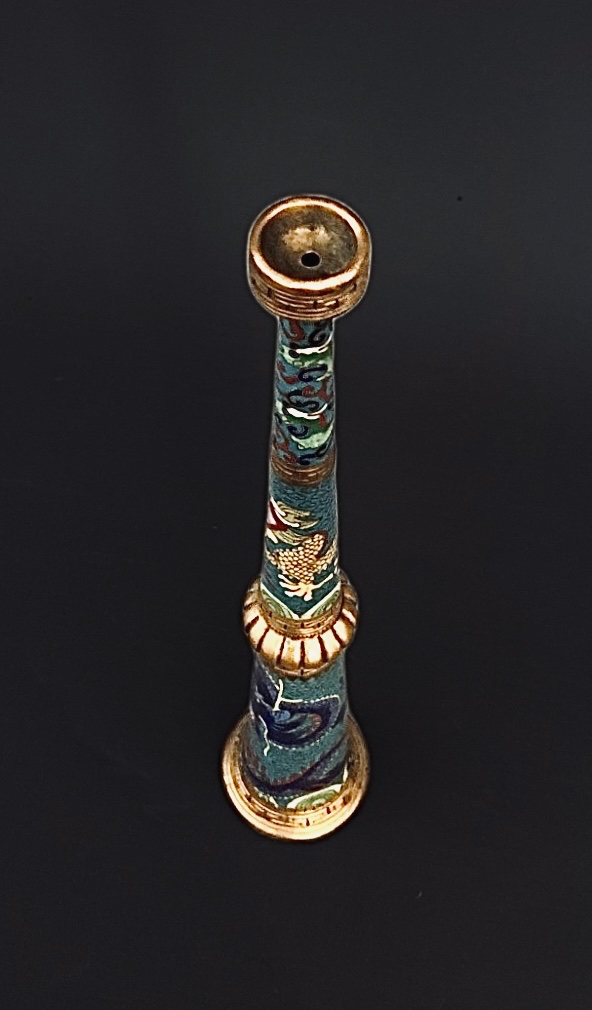
A rare wind instrument made from a single piece, belonging to the family of lip-vibrating aerophones. Straight and slightly conical in shape, it features a small cylindrical mouthpiece at one end and gradually widens to form a flared bell. Its surface is entirely adorned with polychrome cloisonné enamel on a turquoise background.
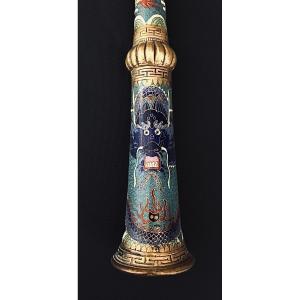
The decoration is organized into three successive registers—rather than three assembled elements—separated by gilded bands adorned with a continuous Chinese geometric pattern. A prominent central band, formed by a fluted bulge of gilded metal, marks the transition between the two main decorative sections. The mouthpiece and the rim of the bell feature the same geometric friezes.
The enameled registers are animated by mythical Chinese creatures moving among the clouds, waves, and stylized mountains. The lower register is dominated by a dragon depicted from the front, with its mouth open, positioned above the flaming pearl. Other dragons, depicted in profile, are spread across the body of the instrument. The piece thus combines Chinese iconography with an instrument form associated with the ceremonial practices of Tibetan Buddhism.
Museum Comparison
The Metropolitan Museum of Art in New York holds a large Chinese dung-chen made of brass, copper, and cloisonné enamel, attributed to the Ming Dynasty (no. 1988.349). This instrument features a similar design: enameled registers decorated with dragons, separated by gilded bands with geometric motifs. The museum highlights the unusual and prestigious nature of Chinese musical instruments decorated with cloisonné, which were sometimes made in China to be presented to dignitaries in Tibetan territories.
This particular example differs from them in its smaller size and, above all, in its fixed, one-piece construction, lacking telescoping sections. It is therefore a small-scale ritual horn rather than a telescoping dung-chen. Its length may resemble that of a traditional suona, but its mechanism is different: the suona has a double reed and finger holes, neither of which are present here.
Classification
Sino-Tibetan ritual horn made of cloisonné enamel—a lip-vibrating aerophone.
Estimate and Price
Estimate: €2,500 to €4,000.
Reference: Metropolitan Museum of Art, New York, Dung-Chen, China, Ming Dynasty, no. 1988.349, gallery 684.
Period: 19th century
Style: Asian art
Condition: Excellent condition
Reference (ID): 1810794
Availability: In stock