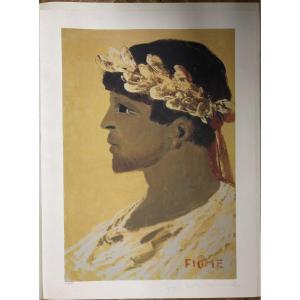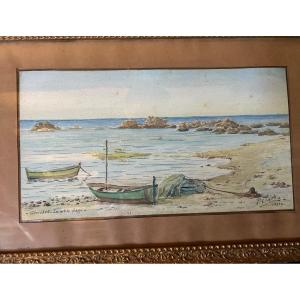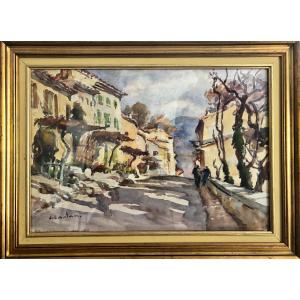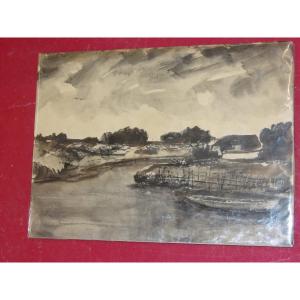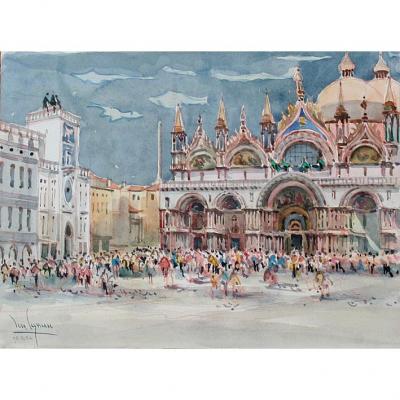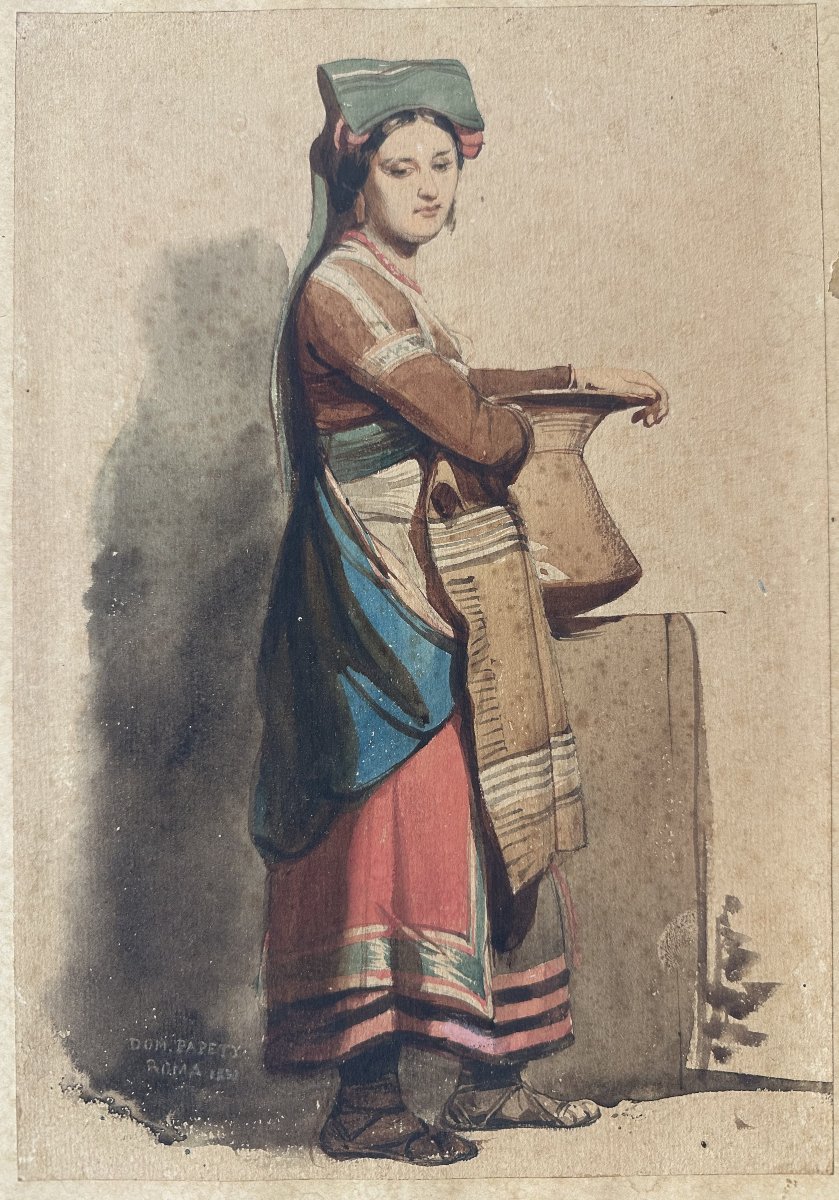
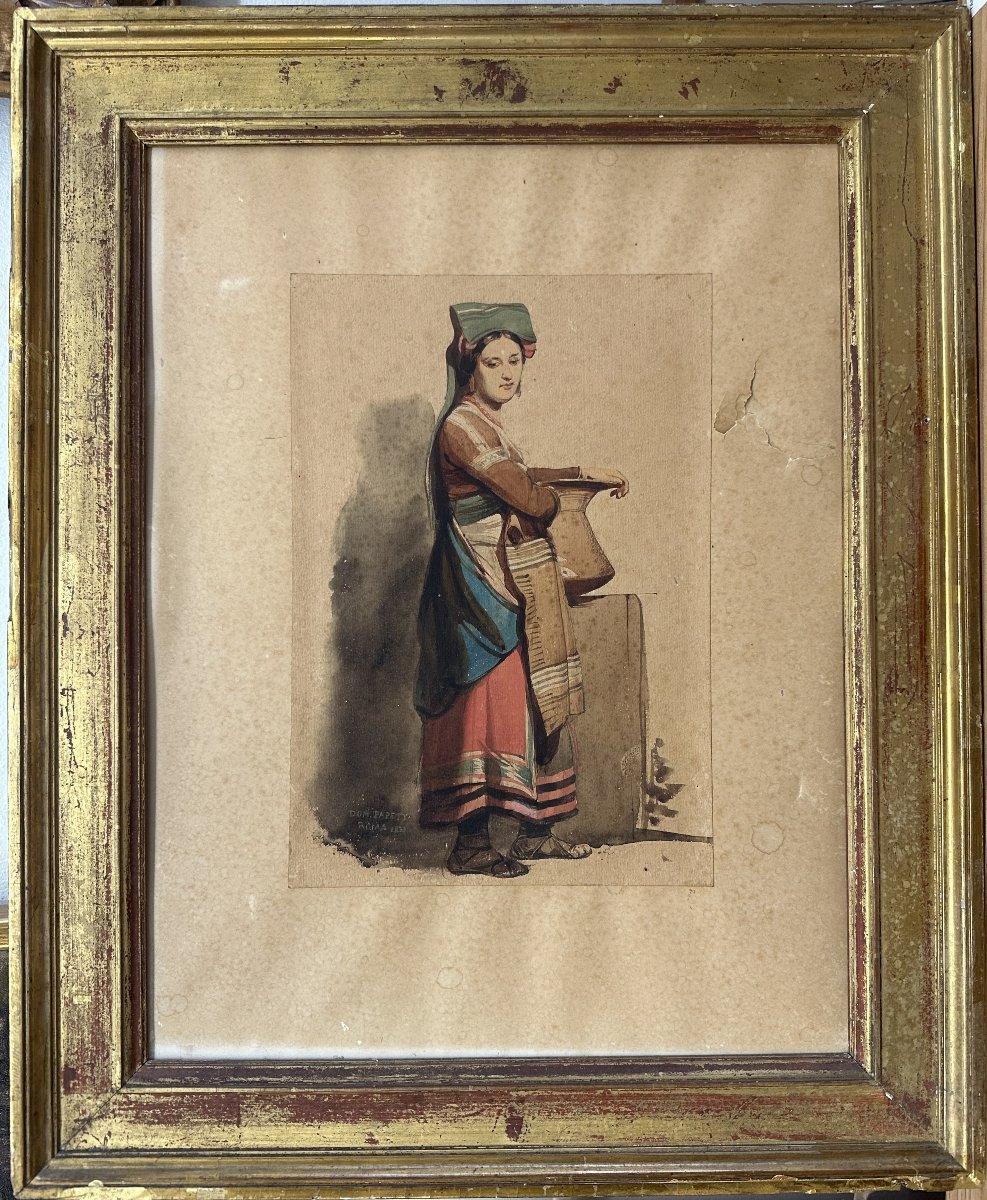
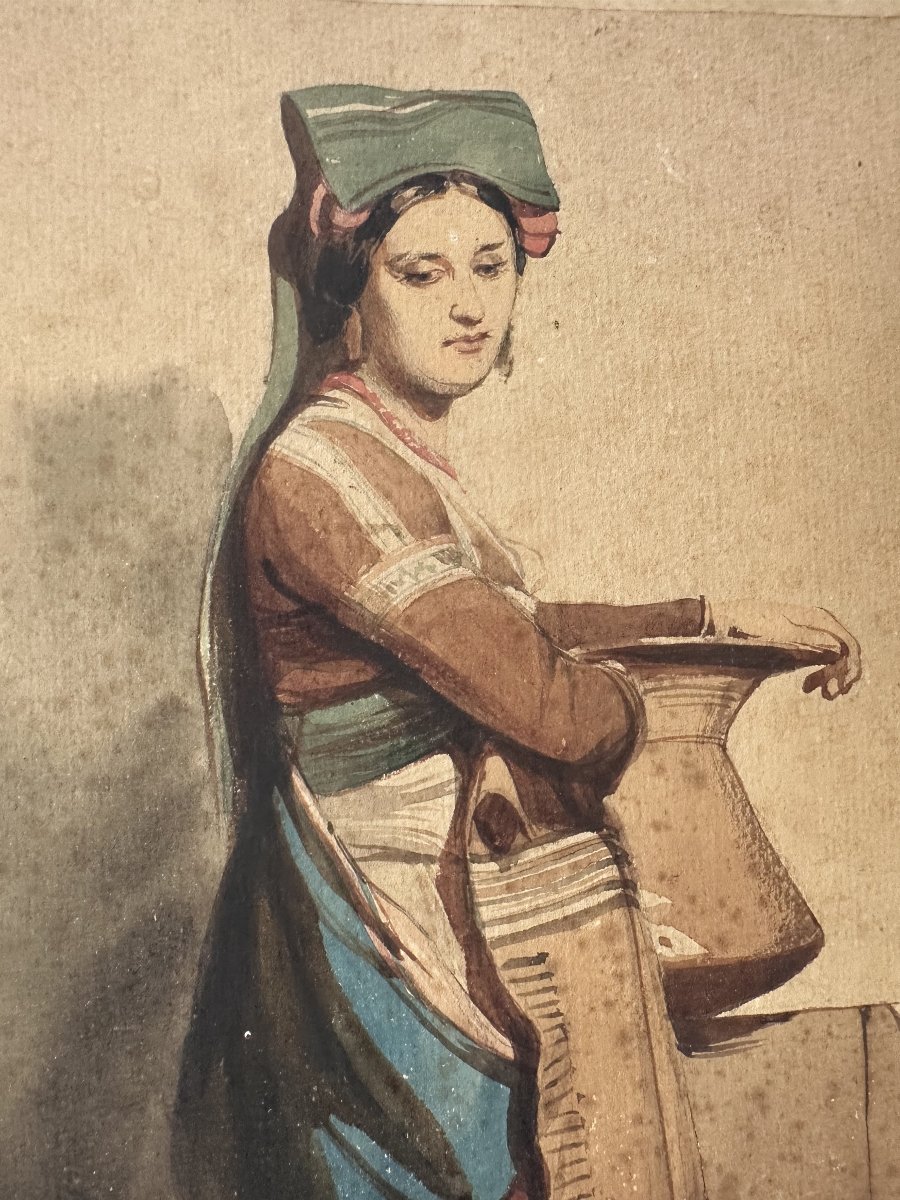
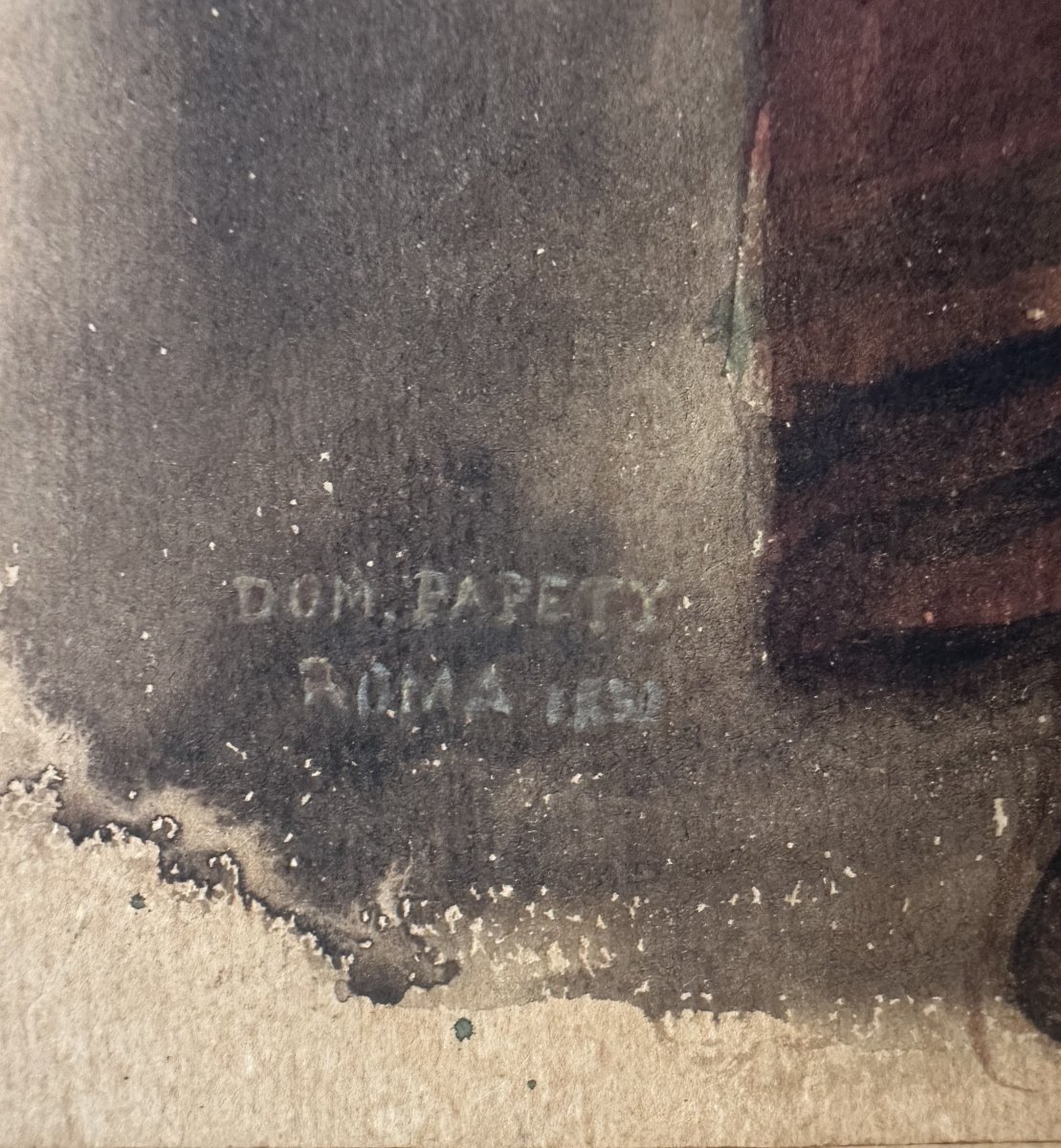
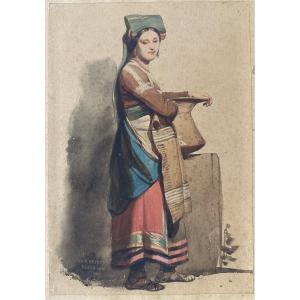


Dominique Louis Papety (1815–1849), Marseille, “young Roman Woman,” Watercolor, Signed And Dated 1830; 28 X 19 Cm
Born in Marseille on Rue Longue des Capucins, where his father worked as a soapmaker, he studied drawing under Augustin Aubert (1781–1857) and, in 1835, joined Léon Cogniet’s studio at the École des Beaux-Arts in Paris[Note 2]. In 1836, he won the Grand Prix de Rome, with the theme being a biblical subject depicting Moses striking the rock to bring forth a spring.
He left for the Villa Medici in Rome, where he stayed from 1837 to 1842. He was influenced by Ingres, who greatly admired his student and would say of him, “He was never a student; he was a master from the moment he picked up a brush[1].” He met François Sabatier, a great lover of antiquities, with whom he became friends and whom he accompanied to Greece between April and August 1846. He visited the twenty-three monasteries of Mount Athos. He brought back hundreds of drawings from this trip and, in 1847, published an account of his journey in the Revue des deux Mondes titled Byzantine Paintings and the Monasteries of Athos[2]. He was influenced by the ideas of Charles Fourier, and it was based on Fourier’s theories that he painted his most famous work: The Dream of Happiness, a very large painting measuring 366 × 632 cm, which belongs to the Antoine-Vivenel Museum in Compiègne but is on display at the Musée d’Orsay[3]. He made a second trip to Greece in August 1847, following the coronation of King Otto I of Greece, and brought back documentation that was used, among other things, for the decoration of the Panthéon in Paris. From this trip, as from the previous one, he brought back a considerable amount of documentation, enriching our knowledge of costumes, landscapes, monuments, and local customs, and annotating his drawings with observations—which made him a journalist, a true ethnologist, and a documentarian for archaeological sites. At the suggestion of the Duke of Montpensier, he was invited to depict the court and the royal family in a scene commemorating a recent event: the visit to the monuments of Athens on September 12, 1845.
He returned to Marseille, suffering from cholera contracted in the Morea. During a stay in the Camargue, his bouts of fever intensified. He died in Marseille in 1849,surrounded by his family. The cholera epidemic ravaging the region prevented artists from staging a grand tribute at his funeral.
Period: 19th century
Style: Other Style
Condition: Condition of use
Material: Paper
Width: 19
Height: 28
Reference (ID): 1809454
Availability: In stock