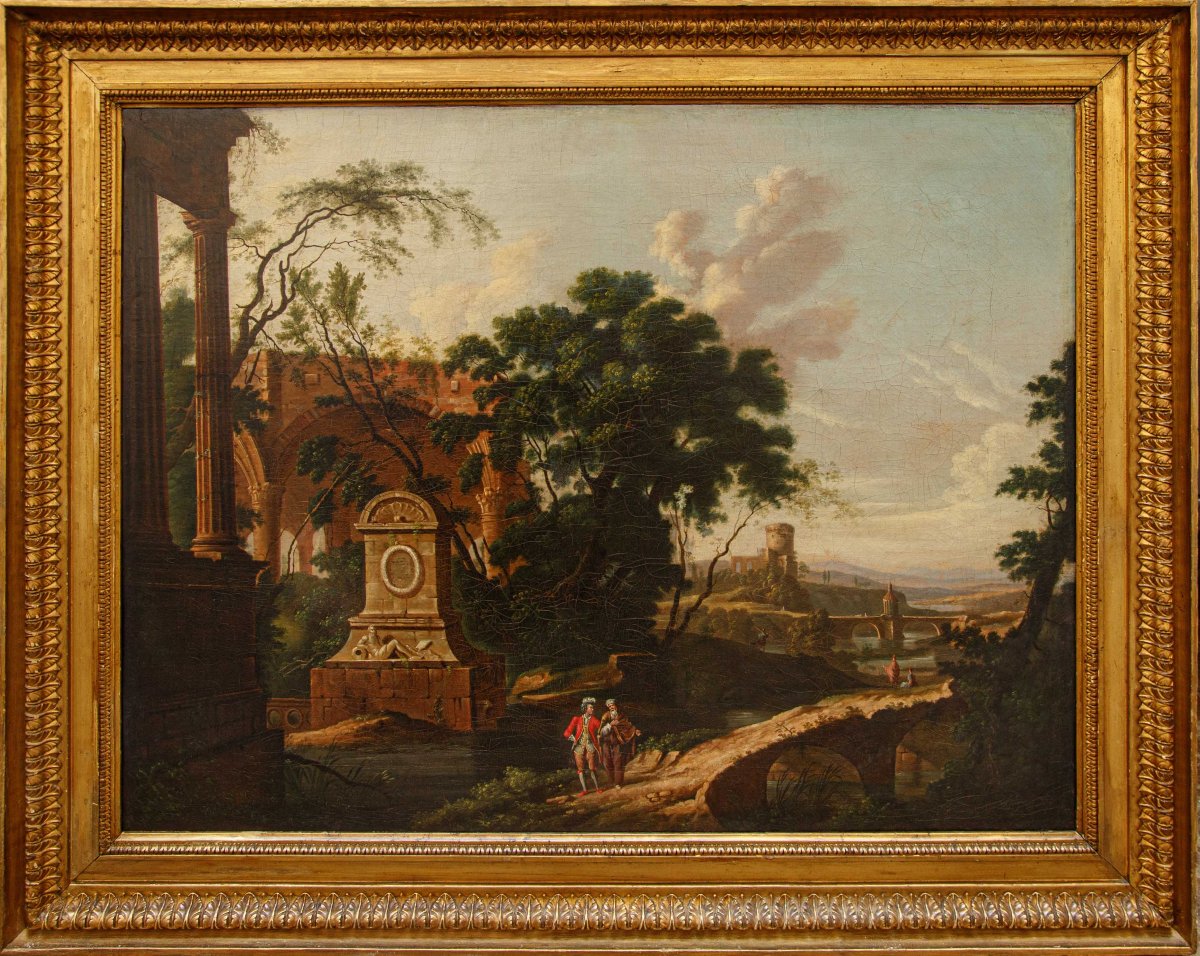
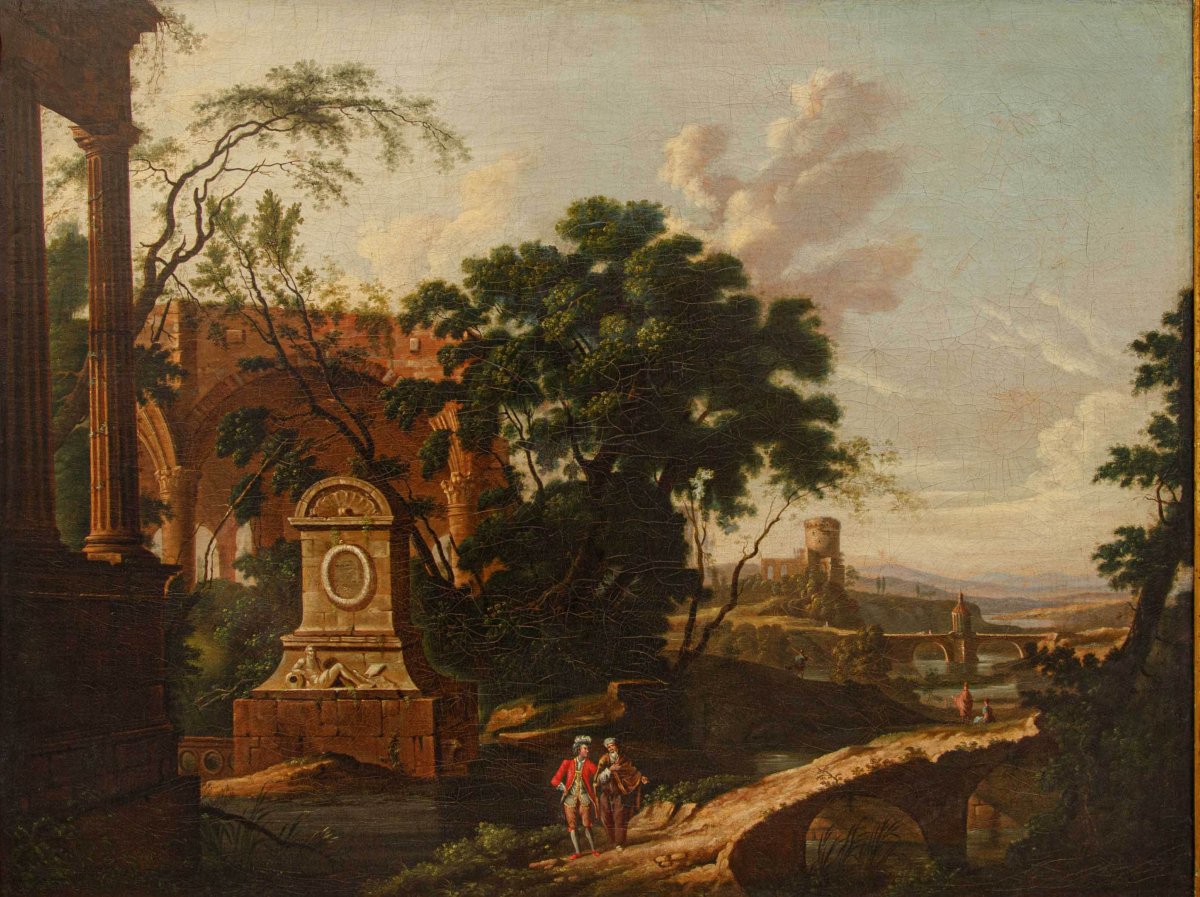




Giuseppe Bacigalupo (tribogna (ge), 1744 – Genoa, 1821), Attributed, Landscape With Ruins
Giuseppe Bacigalupo (Tribogna (GE), 1744 – Genoa, 1821), attr.
Paisage with Ruins
Oil on canvas, 70 x 90 cm – with frame, 90 x 110 cm
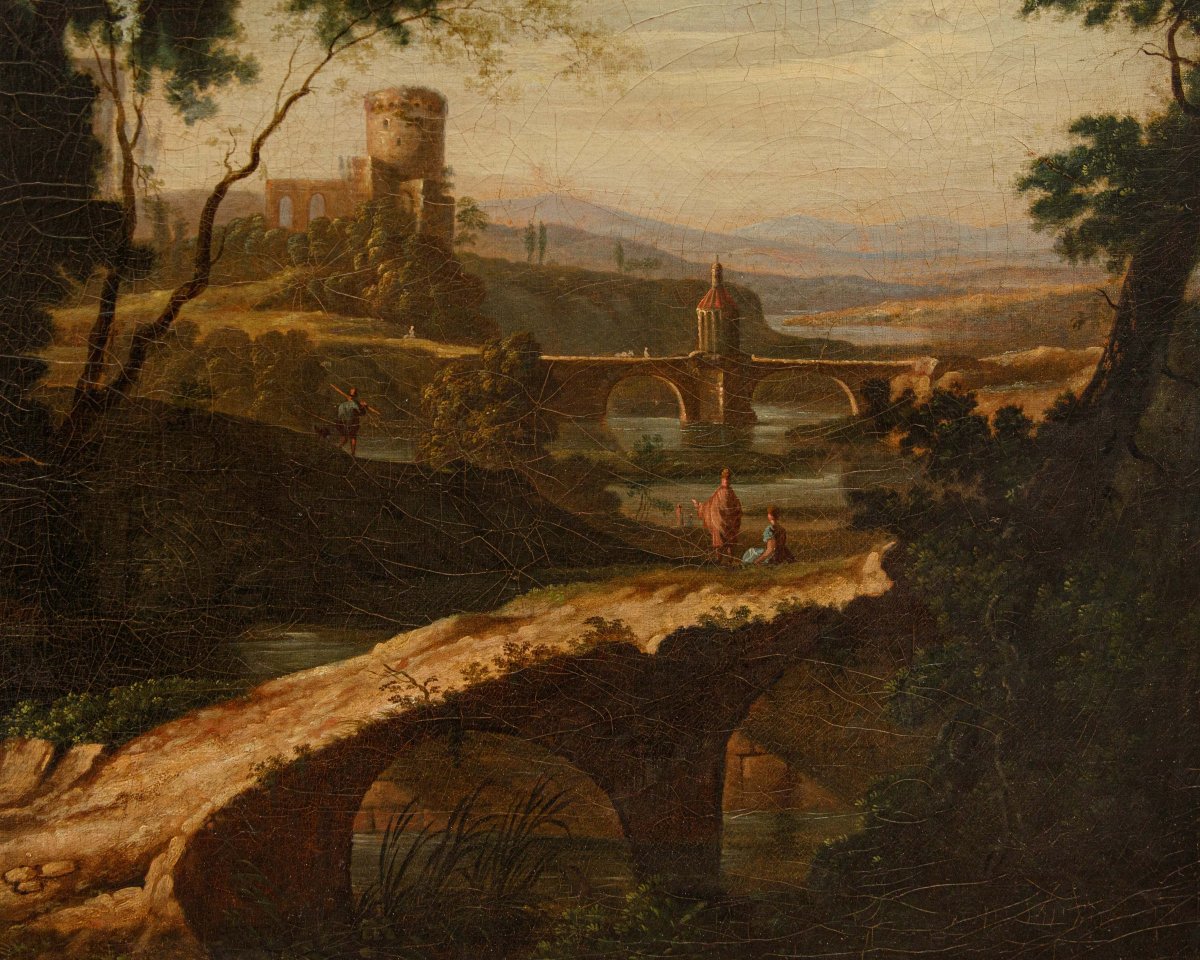
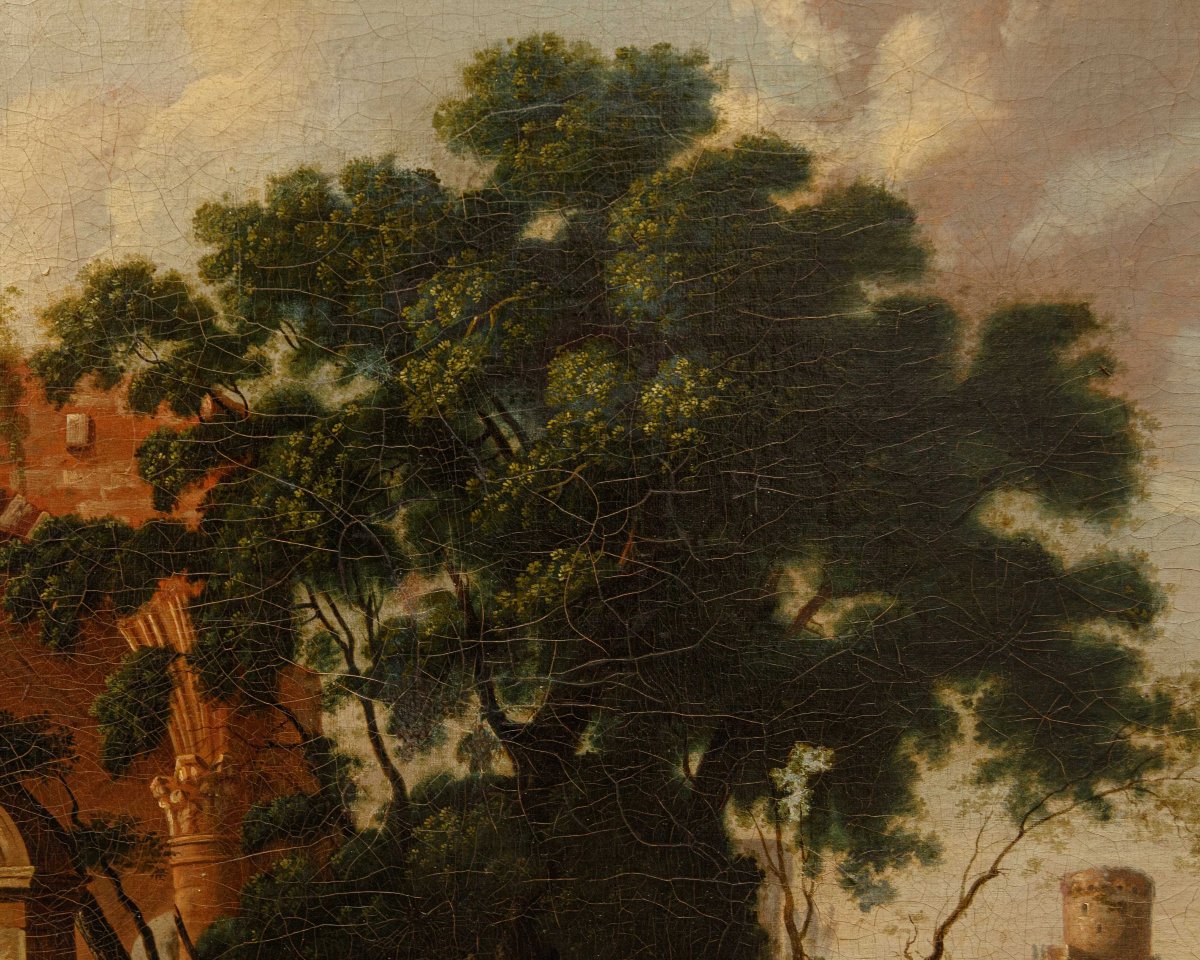
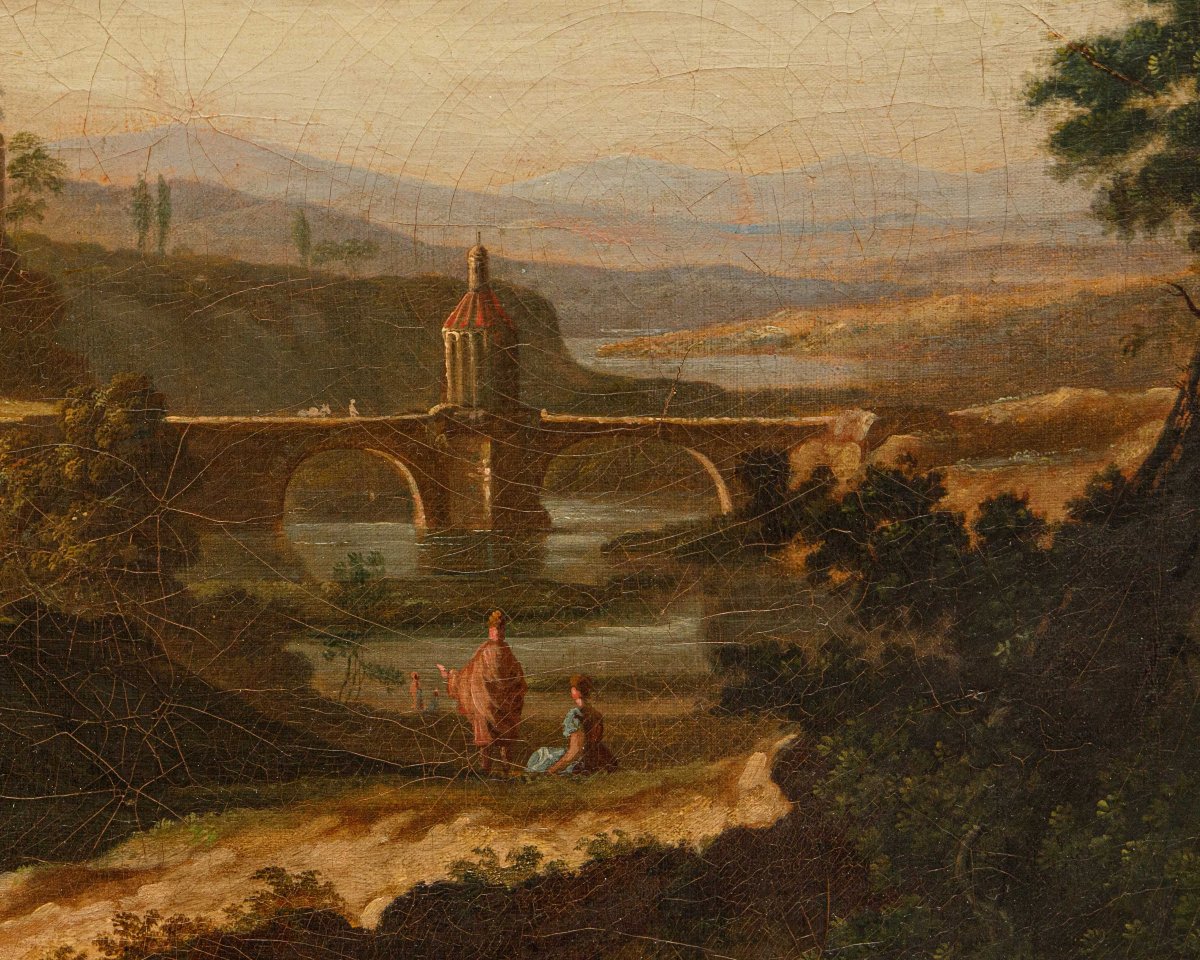
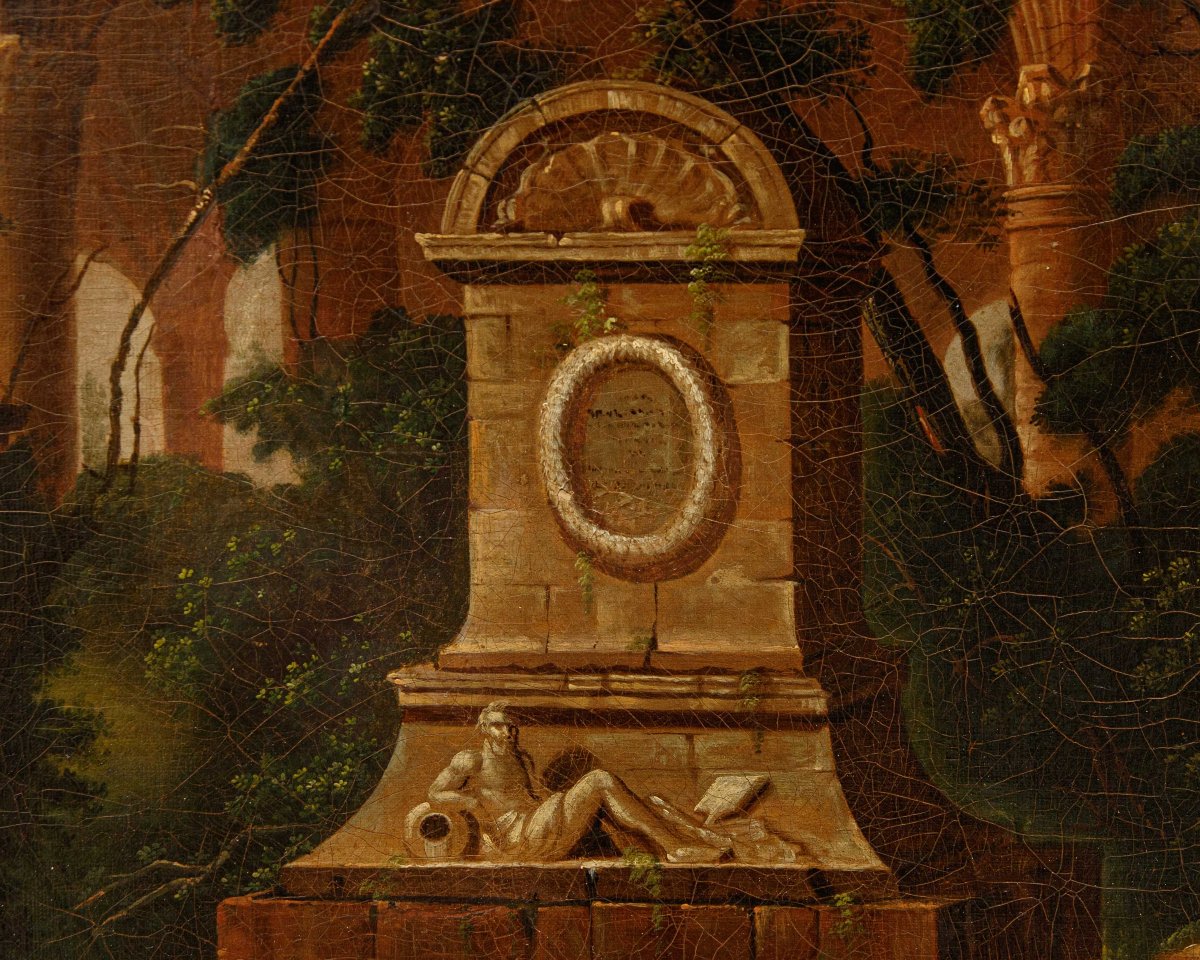
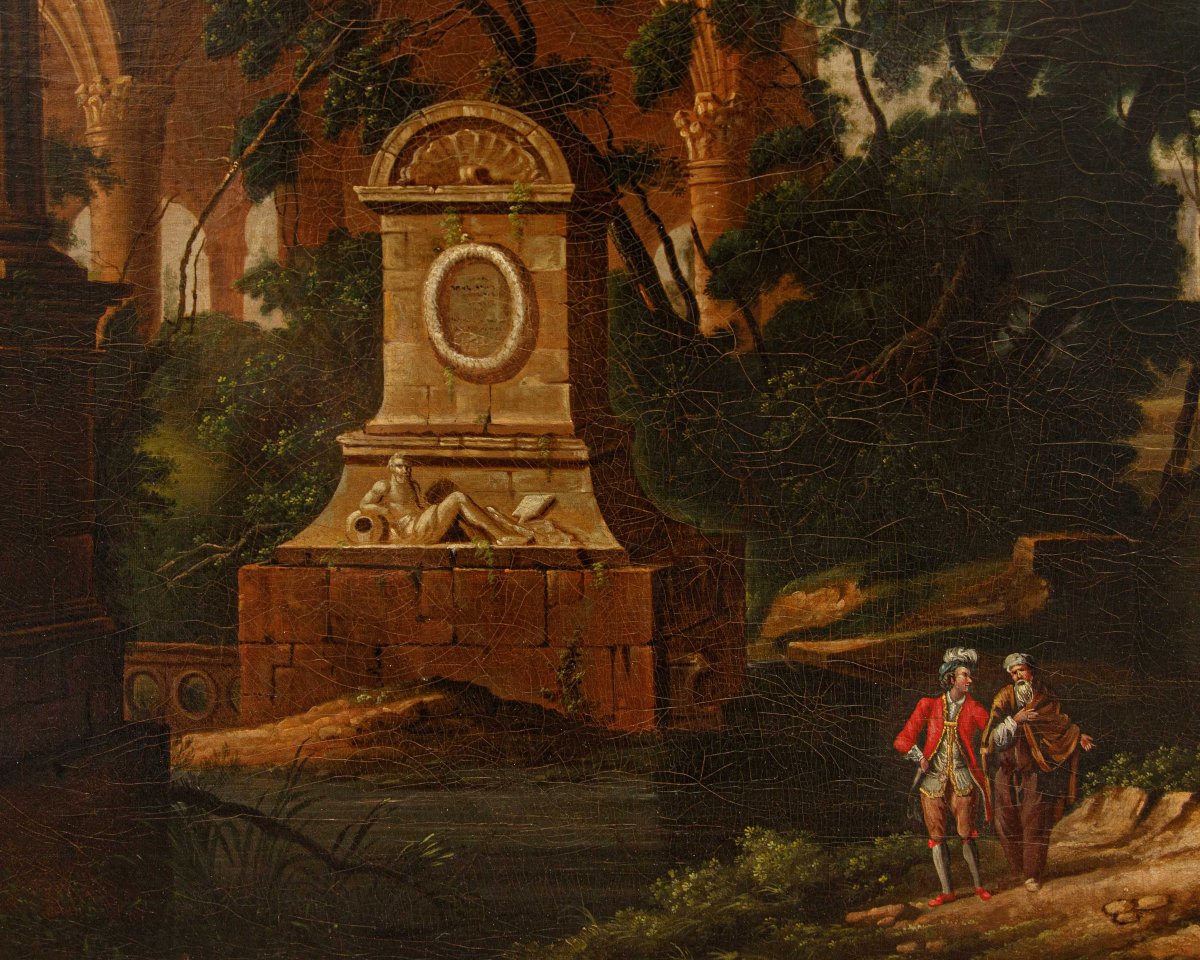
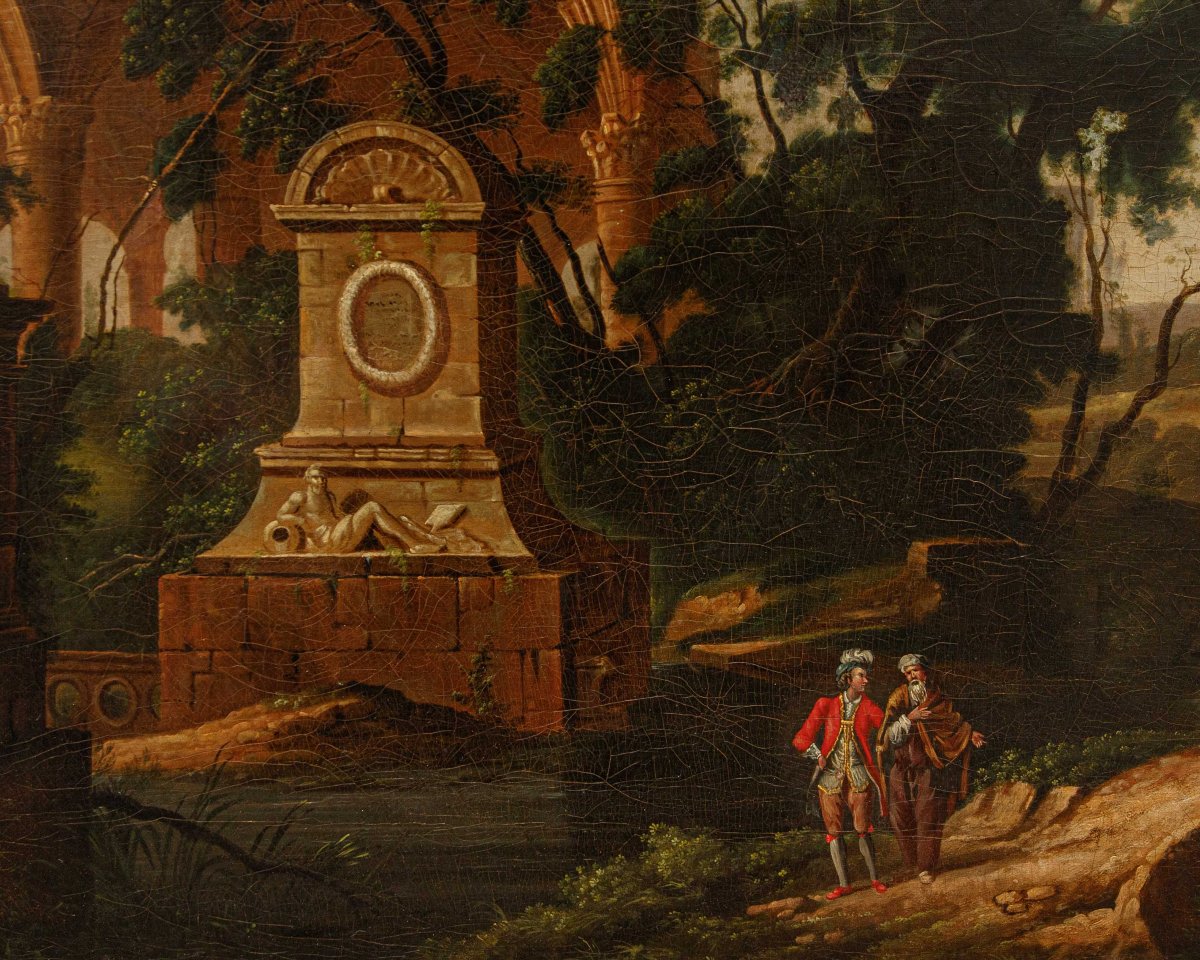
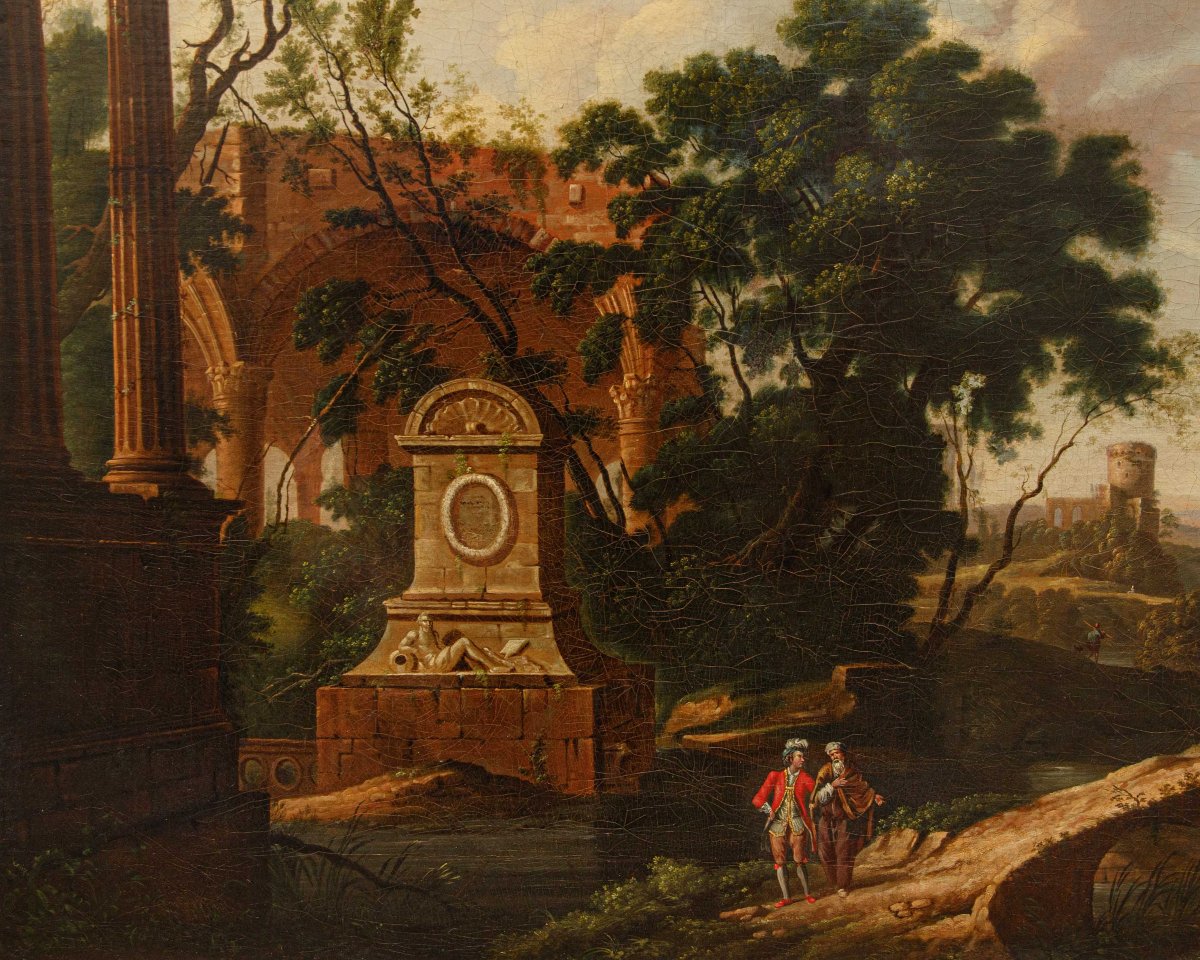
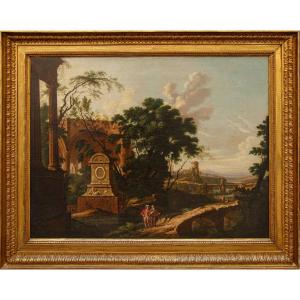
The painting is a typical “capriccio di rovine” (capriccio of ruins), a genre that enjoyed great popularity in landscape painting between the 18th and 19th centuries and found one of its most interesting interpreters in the Genoese art scene in Giuseppe Bacigalupo. The composition is divided into two sections: on the left stands an imposing architectural ruin, marked by Ionic columns and a partially collapsed brick arch, at the foot of which lies a funerary base with a recumbent figure carved in bas-relief—a motif that evokes the tradition of classical-style monuments cherished by the Neoclassical taste. In the center, two figures in 18th-century attire stroll along the path, while on the right the landscape opens up to a river view featuring a masonry bridge, a ruined tower, and mountains on the horizon, beneath a sky streaked with pink clouds. A significant comparison can be drawn with a substantially identical painting that was auctioned in 2011 and is now in a private collection; it features the same compositional layout with slight chromatic variations, particularly in the clothing of the figures in the foreground, confirming the practice—common in Bacigalupo’s work—of replicating successful subjects with minor modifications. Even more interesting is the comparison with a work attributed to Jan van Huijsum, which appears to have served as the direct model for the scenographic layout of our painting: the arrangement of the ruined architecture, the central tree that blocks the view and then opens up toward the river in the background, and the lighting effect in the sky suggest a derivation from Flemish and Northern European models—circulating in Rome through prints and copies—which Bacigalupo reworked according to his own painterly taste. Born in Pian dei Preti on December 17, 1744, Bacigalupo trained at the Accademia Ligustica in Genoa, making his debut with works on religious and mythological subjects. In 1772, with financial support from Marquis Giacomo Gentile, he moved to Rome, where he associated with Christoph and Ignaz Unterberger and deepened his study of the 17th-century landscape painters—Poussin, Claude Lorrain, and Domenichino—while also coming into contact with Batoni, Mengs, and De Capo. Upon his return to Genoa in 1778, he worked for the Cattaneo and Spinola families and, above all, for Filippo Durazzo, for whom he painted mythological scenes influenced by Lorrain, Van Lint, and Tavella. In 1792, he became an academician of merit at the Ligustica Academy, directing the school of ornamentation from 1806 to 1809; Having gone blind in his later years, some of his paintings were completed by his daughter Rosa Bacigalupo Correa, herself a painter who emulated her father’s compositions and served as his biographer. The attribution of the painting finds further support in a comparison with other works in Bucigalupo’s catalog: the *Landscape with Ancient Tombs*, now in a private collection, shares the same repertoire of funerary ruins and crumbling monuments; *La Cuccagna di Napoli*, held in the Genoa collection of BPER Banca, shows similarities in the lively rendering of the small figures that animate the scenes—a recurring element in the artist’s work, which successfully combines a Roman classicist framework with an anecdotal and landscape-oriented style that became increasingly pronounced in his later years.
Period: 19th century
Style: Other Style
Condition: Good condition
Material: Oil painting
Width: 90
Height: 70
Reference (ID): 1802200
Availability: In stock