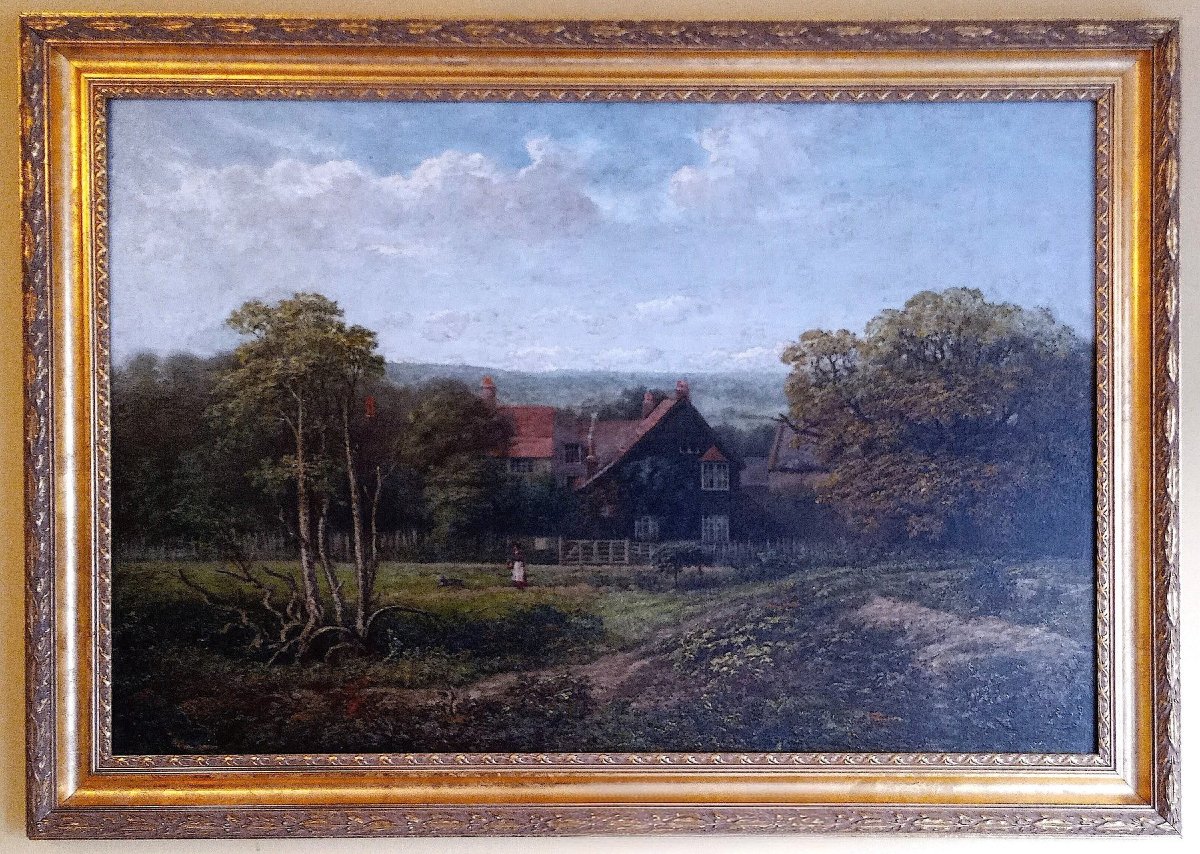
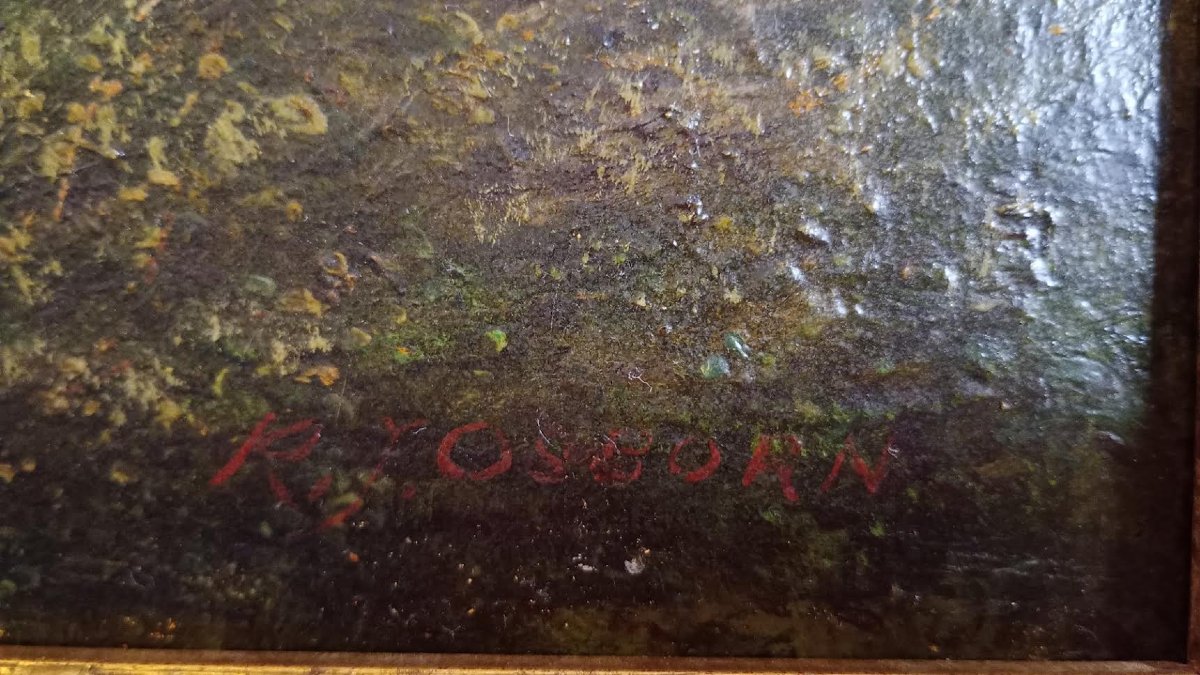
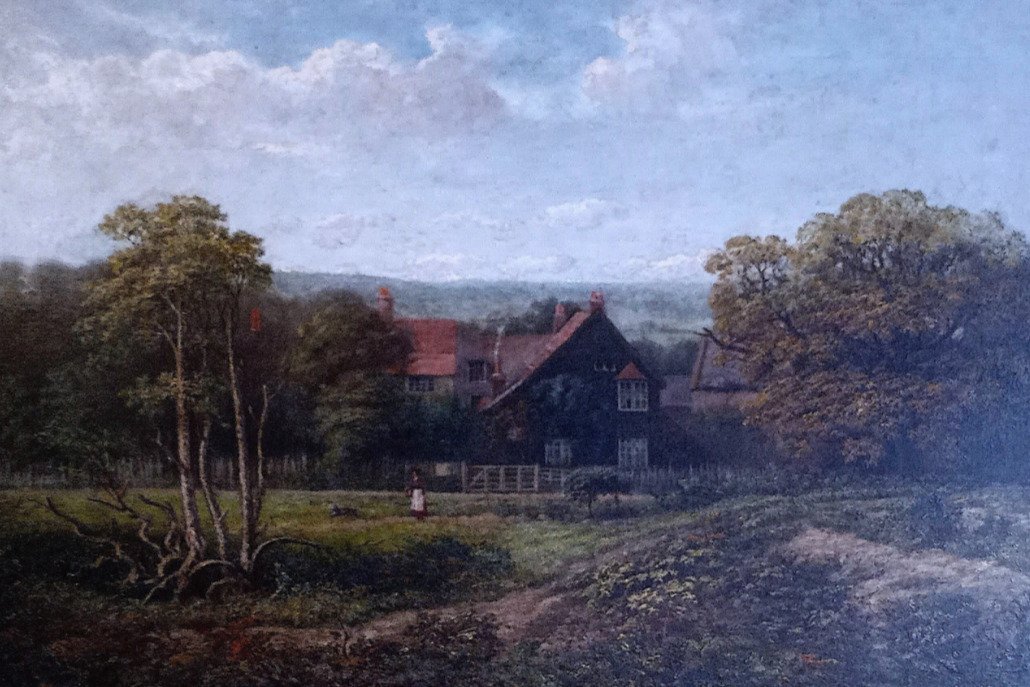
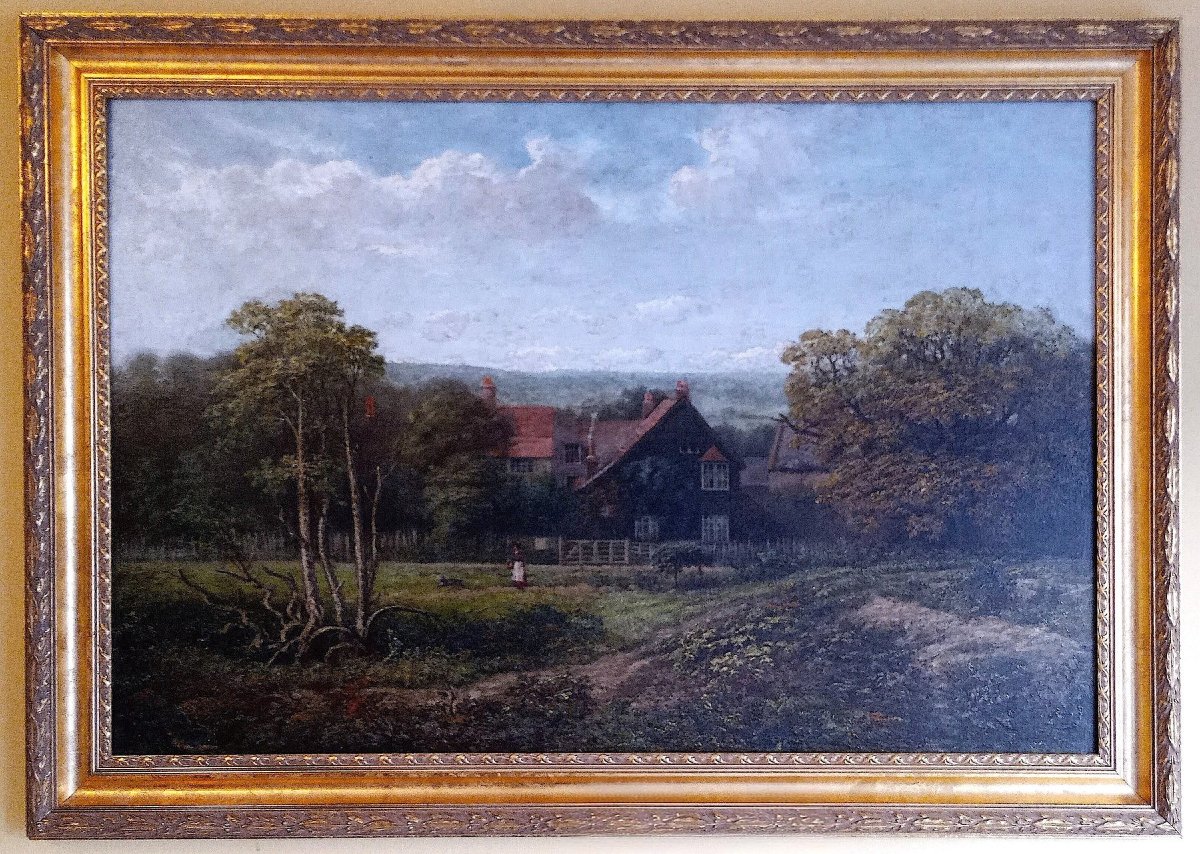
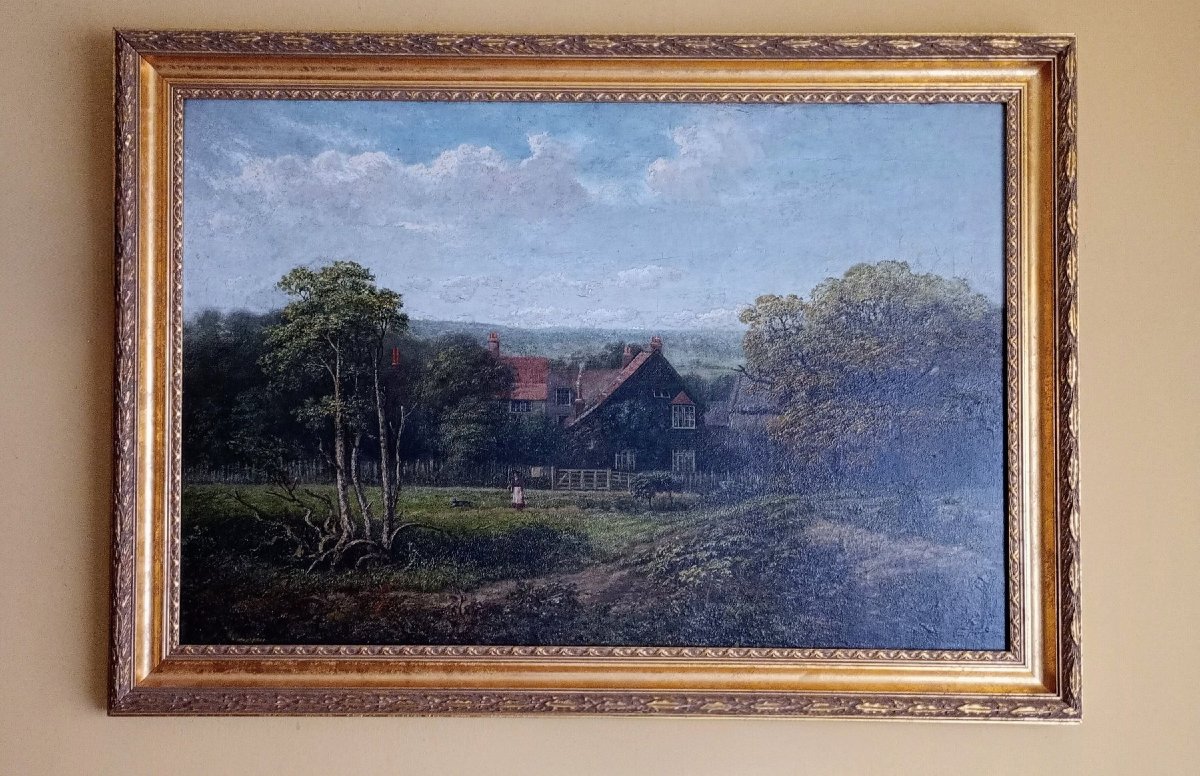
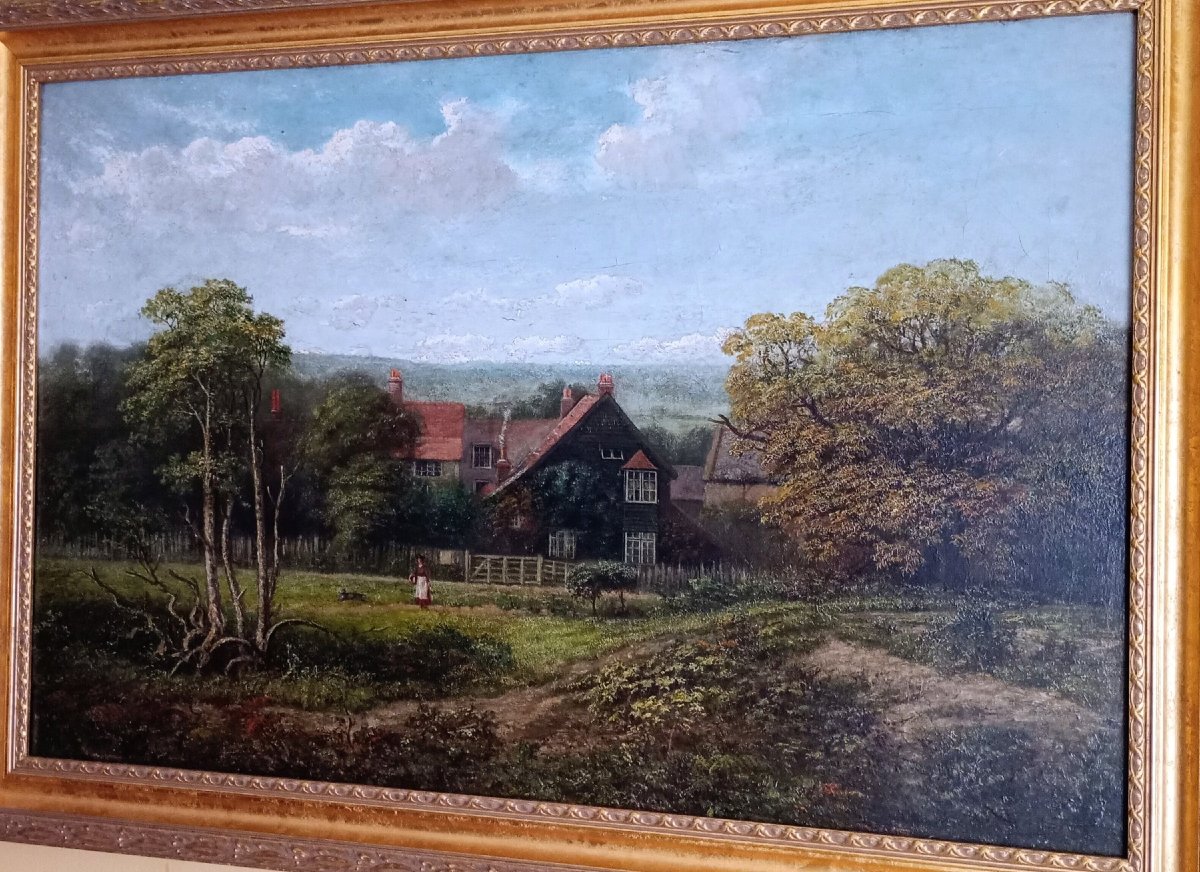
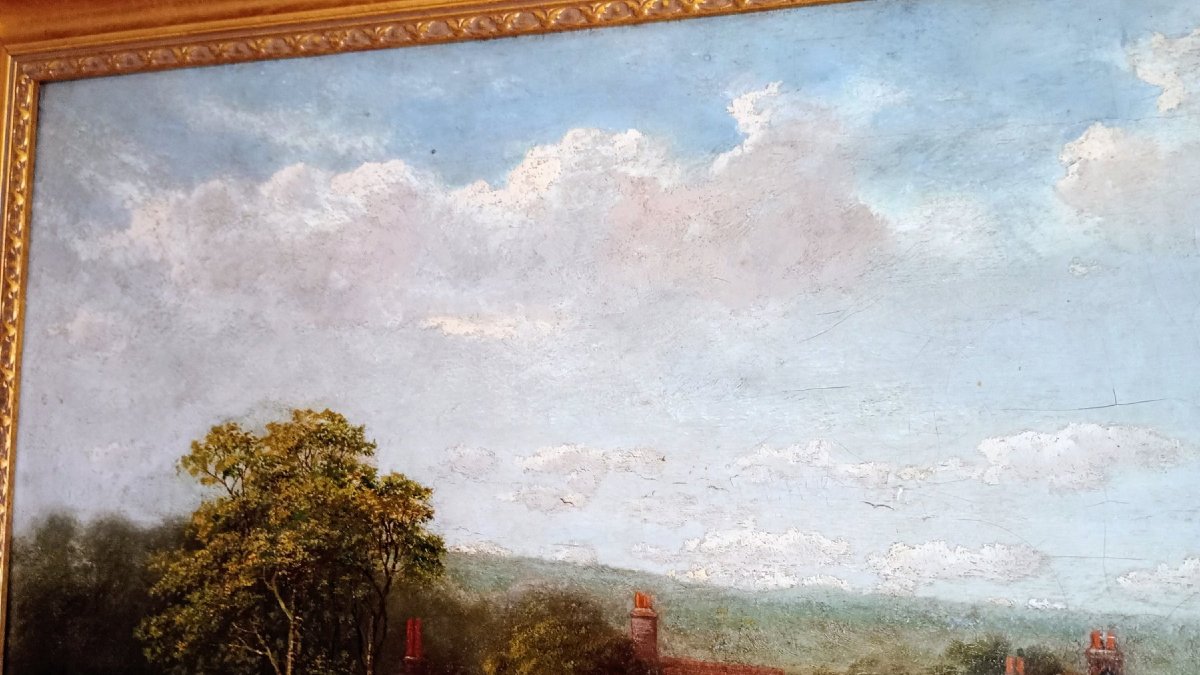
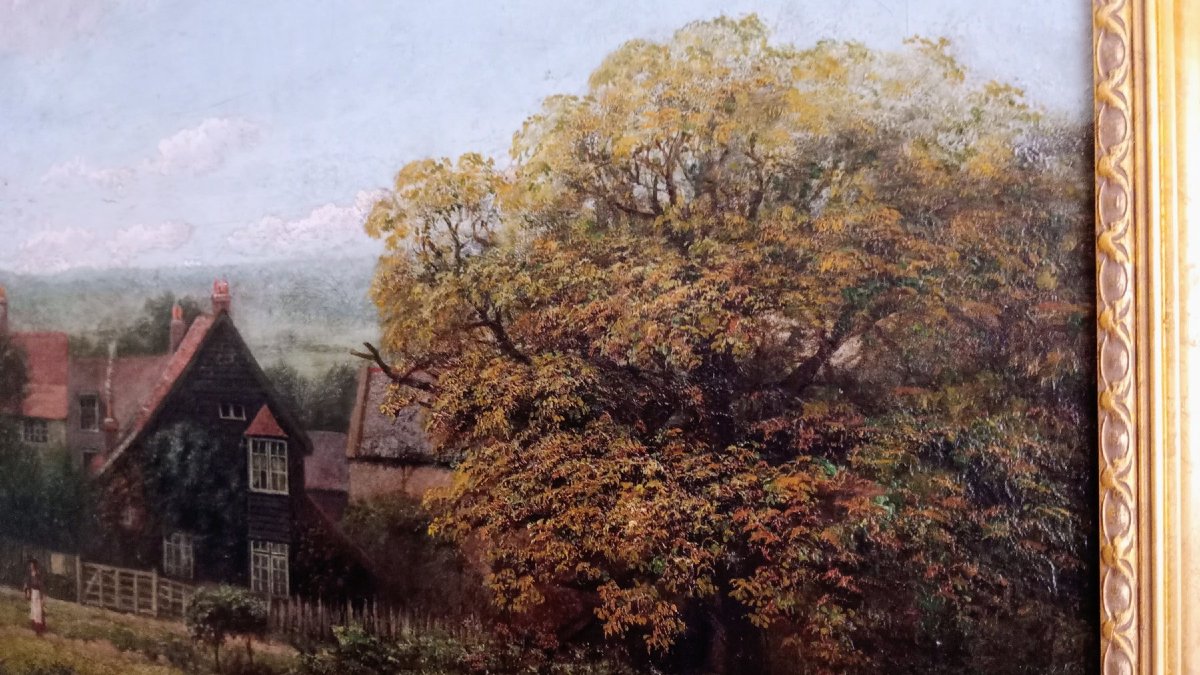
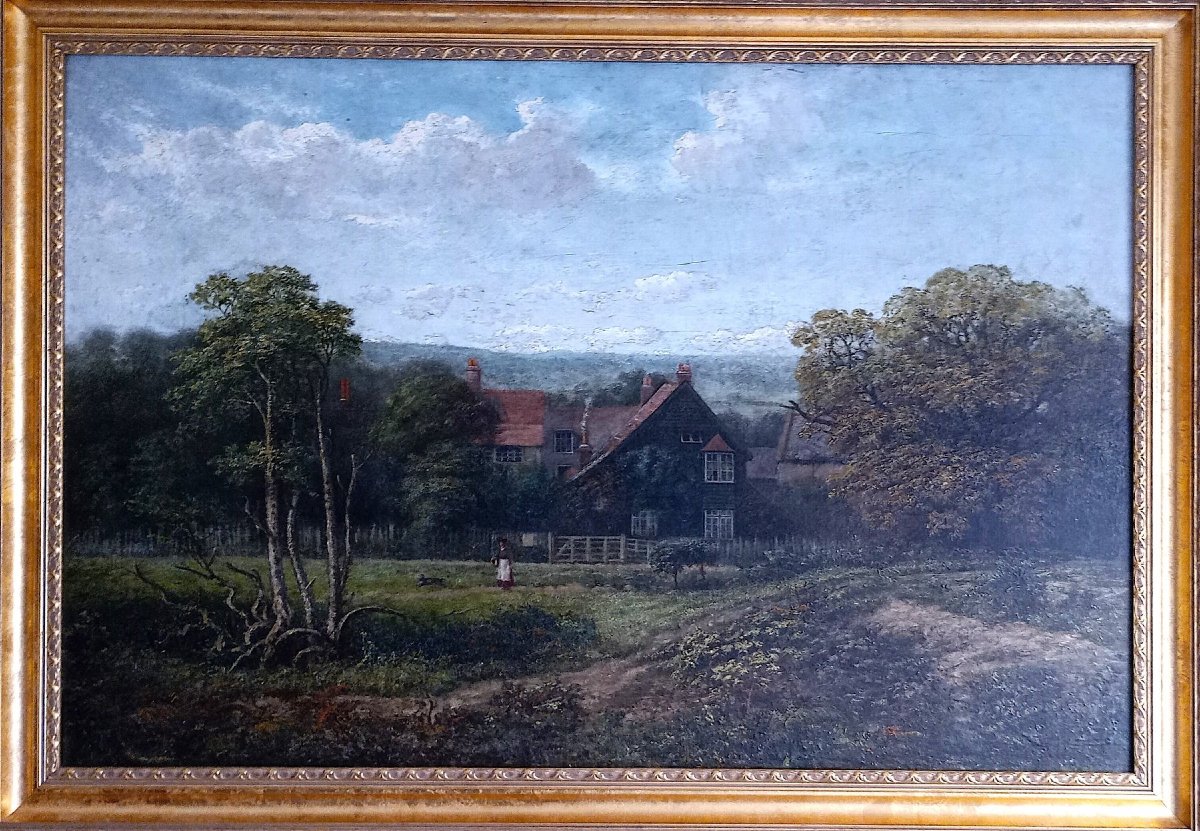
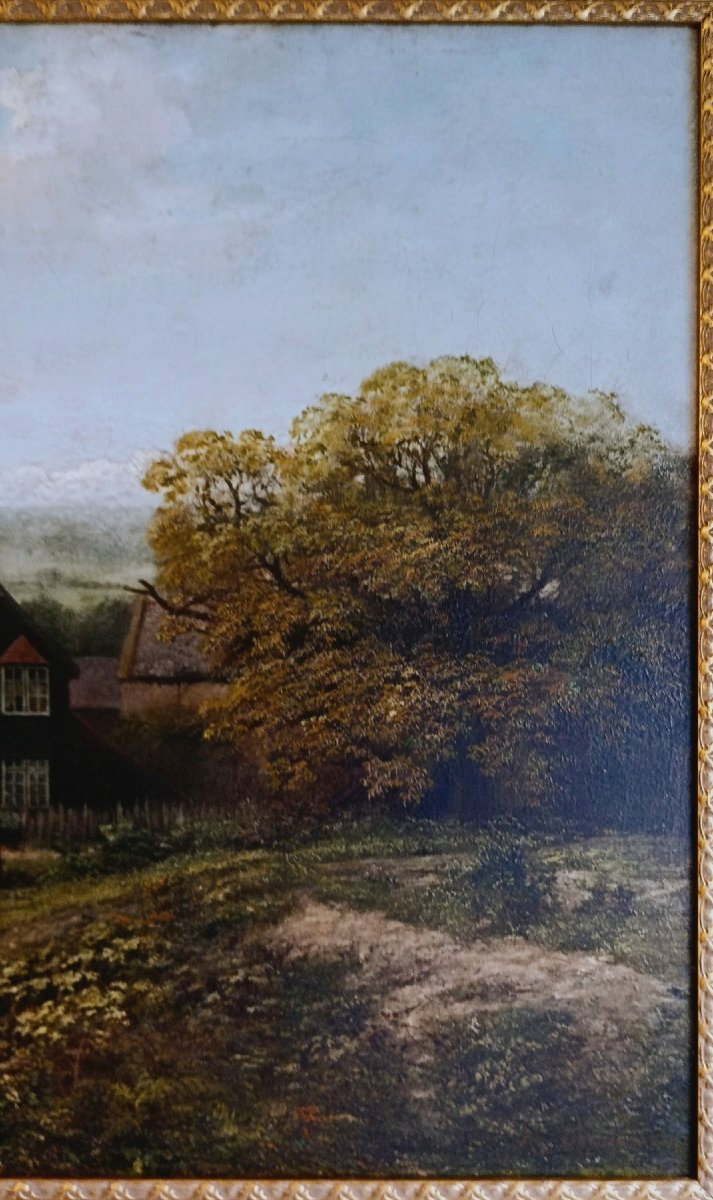


R. J. Osborn (british, 19th Century) “wylde Farm In Hampstead,” Circa 1860.
The work shows a Mid-Victorian Romantic Farm View with an undeniable dreamy, partially naïve charm. It is about Wylde's Farm, (formerly Collins's Farm), in Old Wylde's New End - Hampstead, on the celebrated Greater London's Garden Suburb. A construction which is linked to a myriad of historical particulars so rich, that its label as "Britain’s most artistic Farmhouse" becomes perfectly rightful and well-earned.
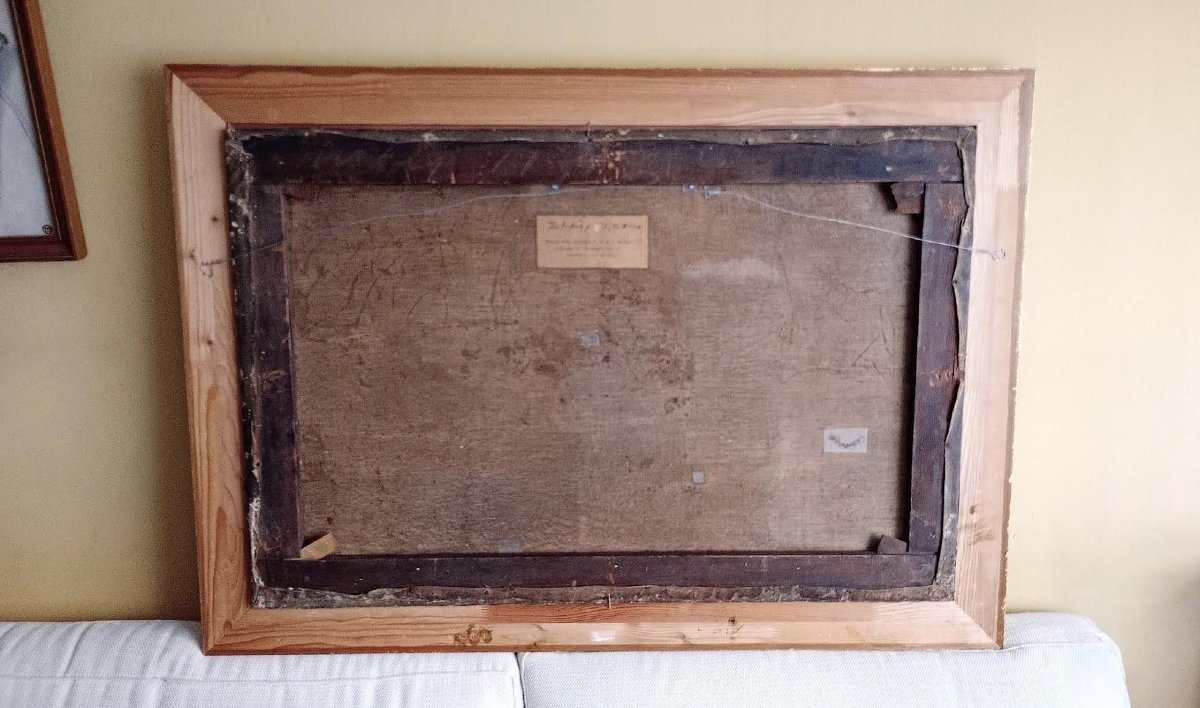
Beyond the obvious the painting's core value isn't that of a celebrated signature. On the painter's subject, there's very little to be known. R. J. Osborn was apparently not a painter with a solid record. However, this landscape happens to have an amazingly surprising amount of ties to the London Borough of Hampstead due to an outstandingly relevance diversity, with an historical mention record & place depiction (as early as 12th c.), as well as a background as beloved both literary and pictorial dwell, work and gathering place which expands for over two centuries. Besides the evident specific direct London Urbanism historical significance or the interest linked to the history of British Art Movements this painting embodies, in addition to its strong architectural heritage, the extremely interesting and historically relevant provenance makes the aspect regarding the less known pictorial signing hand of the painting itself become almost an anecdote. A fact that rounds up the confirmation of this landscape’s strong historical provenance is the circumstance that the work bears a typed paper label glued to the canvase's rear side which reads;
The Property of E. L. Newton.
"WYLDES FARM, HAMPSTEAD,” BY R. J. OSBORN.
PURCHASED AT THE BARRATT SALE AT
CHRISTIE'S, 11th MAY 1916.
There is a massive amount of literature about Wylde's Farm, (formerly Collins's Farm, a.o.) at Old Wylde's New End - Hampstead, considered one of Britain's most historical urban dwellings, now belonging to the celebrated Greater London's Garden Suburb. To sum up a bit about so many historical facts; Inhabitants like the painter John Linnell, Charles Dickens after him (in 1837, just during the production of "Pickwick", Dickens was so deeply affected by the death, at just 17, of his wife’s sister, Mary, that it became impossible for him to sustain the effort of writing, and the publication of the work was suspended for two months. Change of scene was advised, he moved to Hampstead, and there, in 1837, his biographer John Forster visited him. The novelist took up his abode at Collins’s Farm (as it was then called) North End, Hamp-stead, May this same year. On "Oliver Twist", after the horrific murder of Nancy, Bill Sikes seeks escape in Hampstead and Highgate. A few months after that stay, when Dickens was residing in Doughty Street, he wrote to Forster:
“...You don’t feel disposed, do you, to muffle yourself up, and start off with me for a good brisk walk over Hampstead Heath? I knows a good ’ouse where we can have a red-hot chop for dinner, and a glass of goodwine...”
And there are more subsequent literary ties (on Oliver Twist, Bill Sikes sleeps in a field near "Wyldes Farm", while fleeing from London, and in The Old Curiosity Shop, Dick Swiveller moves to a cottage in Hampstead (which was most probably based on Wyldes). Clearly Charles Dickens was one the most ardent of Hampstead lovers, but the artistic association list is so illustrious, that a summarizing becomes challenging; Thackeray, Ainsworth, Daphne Du Maurier, George Elliot, Herbert Spencer, Philip William May, Robert Louis Stevenson, and so many others. Regular visitors as influential in painting as John Constable, William Blake (seminal figure in the history of British and European poetry and visual arts) resided at Old Wylde’s. One of Blake's best friends and kindest patrons, John Linnell (RA) settled in Collin’s Farm between 1823 and 1828, taking up his abode at the house. He and his family occupied four rooms and there, for the next five or six years; the Linnells continued to live, being frequently visited by Wiliam Blake, Varley, Samuel Palmer, Dr. R. J. Thornton, and other kindred spirits. For an increase of accommodation Linnell built a lean-to kitchen with his own hands in 1820, contributing thus to the upgrading of Collins Farm. When Blake remained for the night, as he sometimes did, he had to be put up at Hope Cottage, near The Bull & Bush, where Linnell himself had resided in 1822. To this period belong several of Linnell’s earlier landscapes, and the Hampstead pictures of his later years were mostly worked up from studies made while he was living at Collins's Farm.
John Constable and William Collins were also Hampstead residents at the time, and sometimes joined the old cottage's reunions. Mysticism was more or less in the air, and with such intense students of the occult as Blake, Varley, Palmer, and Thornton to sustain the flood of argument, the conversation would be kept 106x76 cm
Beyond the obvious the painting's core value isn't that of a celebrated signature. On the painter's subject, there's very little to be known. R. J. Osborn was apparently not a painter with a solid record. However, this landscape happens to have an amazingly surprising amount of ties to the London Borough of Hampstead due to an outstandingly relevance diversity, with an historical mention record & place depiction (as early as 12th c.), as well as a background as beloved both literary and pictorial dwell, work and gathering place which expands for over two centuries. Besides the evident specific direct London Urbanism historical significance or the interest linked to the history of British Art Movements this painting embodies, in addition to its strong architectural heritage, the extremely interesting and historically relevant provenance makes the aspect regarding the less known pictorial signing hand of the painting itself become almost an anecdote. A fact that rounds up the confirmation of this landscape’s strong historical provenance is the circumstance that the work bears a typed paper label glued to the canvase's rear side which reads;
The Property of E. L. Newton.
"WYLDES FARM, HAMPSTEAD,” BY R. J. OSBORN.
PURCHASED AT THE BARRATT SALE AT
CHRISTIE'S, 11th MAY 1916.
There is a massive amount of literature about Wylde's Farm, (formerly Collins's Farm, a.o.) at Old Wylde's New End - Hampstead, considered one of Britain's most historical urban dwellings, now belonging to the celebrated Greater London's Garden Suburb. To sum up a bit about so many historical facts; Inhabitants like the painter John Linnell, Charles Dickens after him (in 1837, just during the production of "Pickwick", Dickens was so deeply affected by the death, at just 17, of his wife’s sister, Mary, that it became impossible for him to sustain the effort of writing, and the publication of the work was suspended for two months. Change of scene was advised, he moved to Hampstead, and there, in 1837, his biographer John Forster visited him. The novelist took up his abode at Collins’s Farm (as it was then called) North End, Hamp-stead, May this same year. On "Oliver Twist", after the horrific murder of Nancy, Bill Sikes seeks escape in Hampstead and Highgate. A few months after that stay, when Dickens was residing in Doughty Street, he wrote to Forster:
“...You don’t feel disposed, do you, to muffle yourself up, and start off with me for a good brisk walk over Hampstead Heath? I knows a good ’ouse where we can have a red-hot chop for dinner, and a glass of goodwine...”
And there are more subsequent literary ties (on Oliver Twist, Bill Sikes sleeps in a field near "Wyldes Farm", while fleeing from London, and in The Old Curiosity Shop, Dick Swiveller moves to a cottage in Hampstead (which was most probably based on Wyldes). Clearly Charles Dickens was one the most ardent of Hampstead lovers, but the artistic association list is so illustrious, that a summarizing becomes challenging; Thackeray, Ainsworth, Daphne Du Maurier, George Elliot, Herbert Spencer, Philip William May, Robert Louis Stevenson, and so many others. Regular visitors as influential in painting as John Constable, William Blake (seminal figure in the history of British and European poetry and visual arts) resided at Old Wylde’s. One of Blake's best friends and kindest patrons, John Linnell (RA) settled in Collin’s Farm between 1823 and 1828, taking up his abode at the house. He and his family occupied four rooms and there, for the next five or six years; the Linnells continued to live, being frequently visited by Wiliam Blake, Varley, Samuel Palmer, Dr. R. J. Thornton, and other kindred spirits. For an increase of accommodation Linnell built a lean-to kitchen with his own hands in 1820, contributing thus to the upgrading of Collins Farm. When Blake remained for the night, as he sometimes did, he had to be put up at Hope Cottage, near The Bull & Bush, where Linnell himself had resided in 1822. To this period belong several of Linnell’s earlier landscapes, and the Hampstead pictures of his later years were mostly worked up from studies made while he was living at Collins's Farm.
John Constable and William Collins were also Hampstead residents at the time, and sometimes joined the old cottage's reunions. Mysticism was more or less in the air, and with such intense students of the occult as Blake, Varley, Palmer, and Thornton to sustain the flood of argument, the conversation would be kept 106x76 cm
7 000 €
Period: 19th century
Style: Other Style
Condition: Excellent condition
Material: Oil painting
Reference (ID): 1800295
Availability: In stock
Print