

Emile Stahl (1847–1938) “landscape With A Rainbow” — Alsace — Schiltigheim — Strasbourg
Schiltigheim, 1847 - 1938, Schiltigheim
« Paysage à l'arc-en-ciel »
Oil on canvas, 44,5x58,5cm
Signed lower left
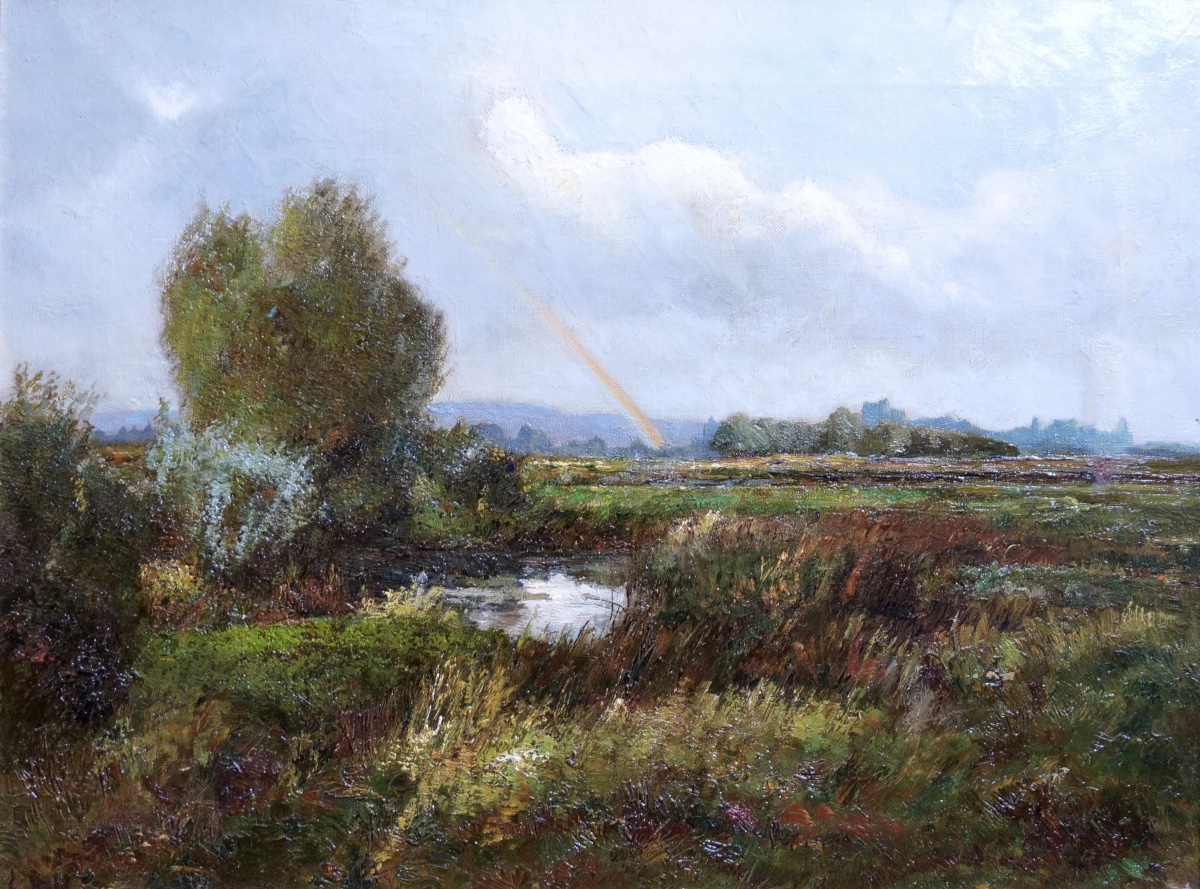
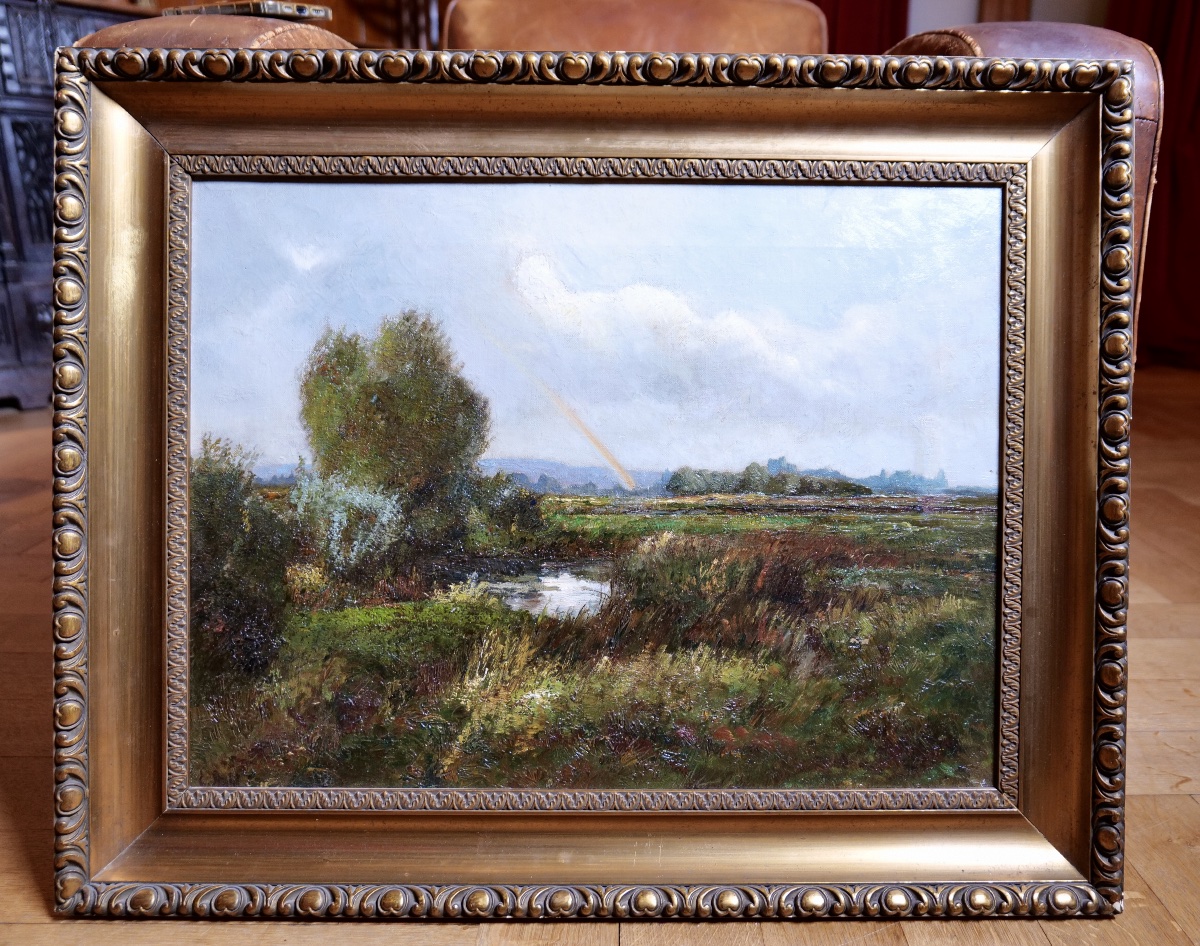
This delicate oil on canvas by Émile Stahl exemplifies, with remarkable sensitivity, the tradition of Alsatian landscape painting at the close of the nineteenth and the beginning of the twentieth century. Faithful to his predilection for expansive horizons and tranquil countryside, the artist captures a fleeting moment in which nature seems to hold its breath: the last clouds of a passing shower drift away while a rainbow illuminates the plain. This encounter between the elements elevates the composition beyond a simple observation of nature, transforming it into a profoundly poetic evocation.
The viewer's eye is naturally drawn toward the luminous arch that discreetly emerges on the horizon. Rather than occupying the center of the composition, the rainbow appears as an almost secret apparition, delicately suspended between earth and sky. This compositional choice reveals Émile Stahl's subtle artistic sensibility, for he deliberately avoids theatrical effect in favor of suggestion. The atmospheric phenomenon does not dominate the landscape; instead, it becomes its silent soul.
The foreground is animated by luxuriant vegetation, where tall grasses, reeds, and shrubs are rendered with fluid, vibrant brushstrokes. A tranquil stretch of water reflects the breaks in the clouds and introduces a moment of calm within the richness of the surrounding landscape. Beyond, meadows extend toward a gently undulating horizon, where wooded masses quietly close the composition without ever weighing it down. The entire work breathes the balance and harmony of an unspoiled rural landscape.
The palette demonstrates the artist's refined mastery of color. Deep greens of the marshland converse with the warm ochres and browns of autumn grasses, while the sky unfolds in subtle gradations of bluish greys, pearly whites, and delicate silvery reflections. This shifting light, so characteristic of landscapes after rain, envelops the scene in a moist atmosphere where every leaf appears laden with the final drops of the passing shower. The brushwork remains supple and restrained, never sacrificing spontaneity to excessive finish.
It is above all the rainbow that lends the painting its symbolic depth. Since Antiquity, this natural phenomenon has occupied a privileged place in the imagination of civilizations. In Greek mythology, it marks the path of Iris, the divine messenger who connects Mount Olympus with the world of humankind. In Norse tradition, it becomes Bifröst, the radiant bridge leading to the realm of the gods, while numerous cultures throughout Asia, Africa, and the Americas have interpreted it as a passage linking the earthly and the spiritual worlds.
Biblical tradition invests it with equally profound significance. Following the Great Flood, the rainbow becomes the sign of God's Covenant with humanity (Genesis 9:8–17), a promise of peace and reconciliation. This symbolic reading harmonizes perfectly with Émile Stahl's painting. Here, the rainbow appears precisely after the storm: it is not merely a meteorological phenomenon, but the herald of returning light, serenity, and renewal.
Yet this spiritual dimension remains perfectly integrated within the landscape itself. Nothing is overtly demonstrative. Nature alone seems to convey the message. The restored calm of the waters, the gentle meadows, and the renewed clarity of the sky together form a genuine hymn to the permanence of nature's cycles. Within this deeply humanistic vision, humanity is physically absent, yet implicitly present through the cultivated landscape, carefully shaped with respect, where nature and human activity coexist in harmonious equilibrium.
Through its delicacy of execution, this painting belongs to the great tradition of French Naturalist landscape painting while preserving a distinctly Alsatian sensibility. At a time when many artists were exploring Impressionist investigations into light, Émile Stahl remained faithful to an art of close observation, enriching the truthful depiction of nature with a discreet poetic resonance. His aim is not to reproduce a specific location with topographical precision, but rather to convey an emotion—the fragile, ephemeral moment when sunlight returns after the rain.
Rarely encountered on the art market, this composition admirably illustrates the qualities that define Émile Stahl's distinctive artistic legacy: an exceptional sensitivity to atmosphere, a palette of remarkable subtlety, and the ability to transform a simple landscape of the Alsatian plain into a silent meditation on nature, time, and hope. The rainbow, a fragile bridge between earth and sky, becomes here a universal symbol of reconciliation, inviting the viewer not only to contemplate the beauty of the landscape but also to reflect upon its deeper meaning.
Period: 19th century
Style: Other Style
Condition: Good condition
Material: Oil painting
Width: 58,5cm
Height: 44,5cm
Reference (ID): 1798130
Availability: In stock