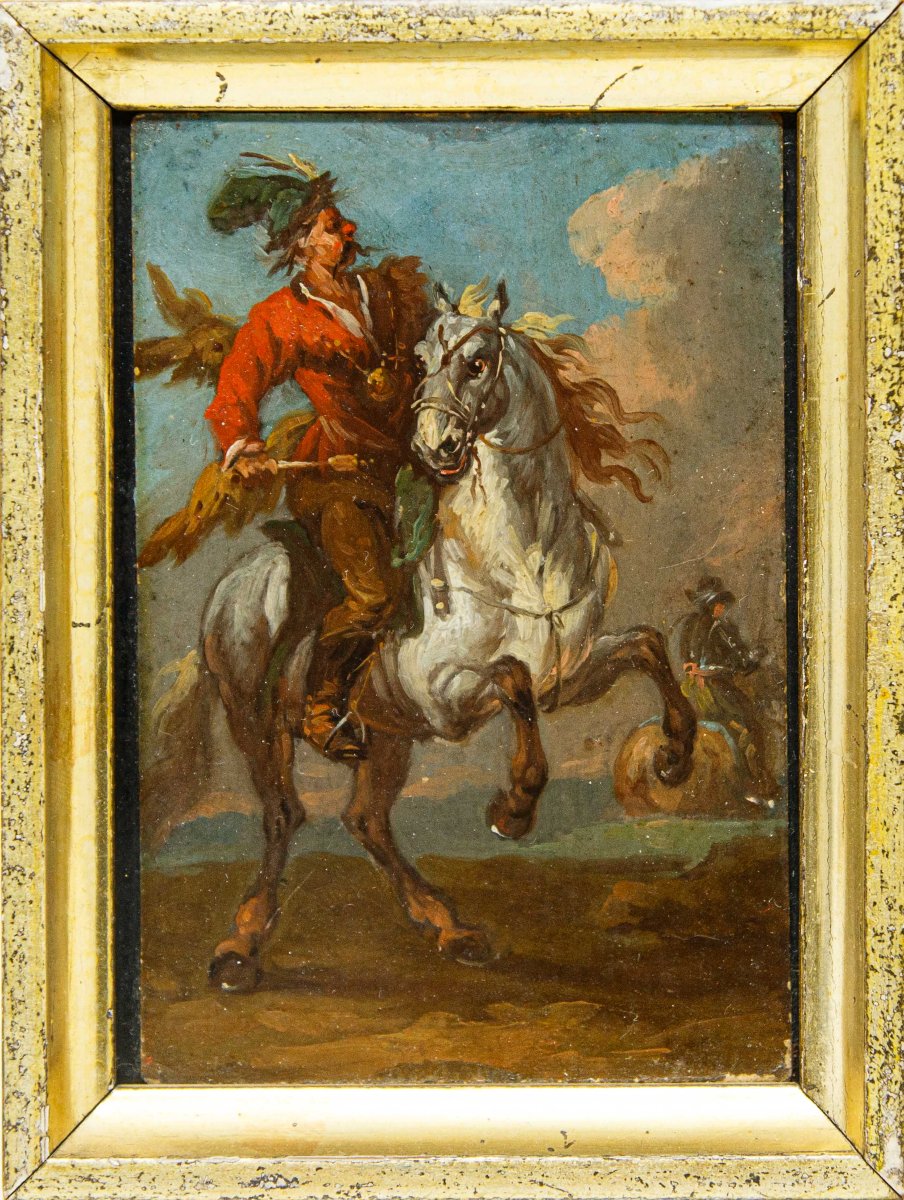
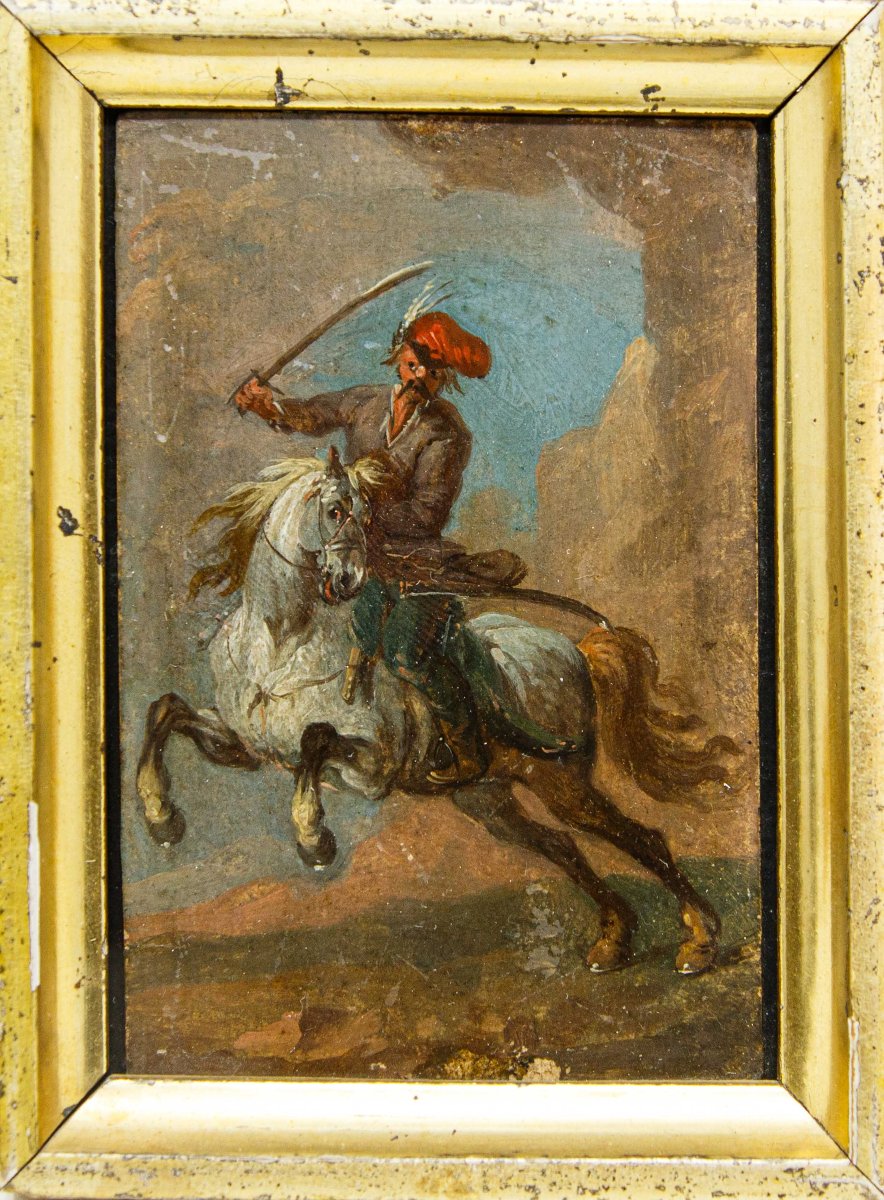
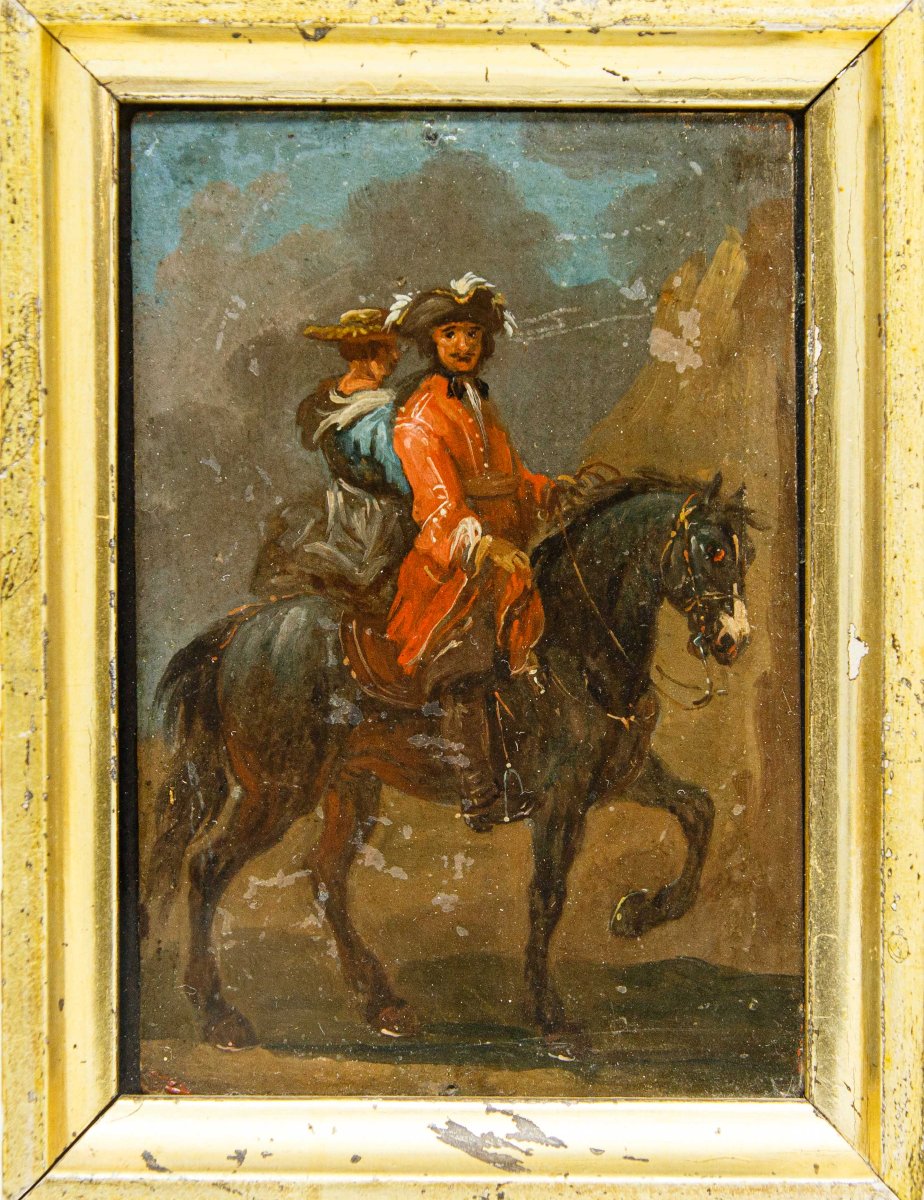
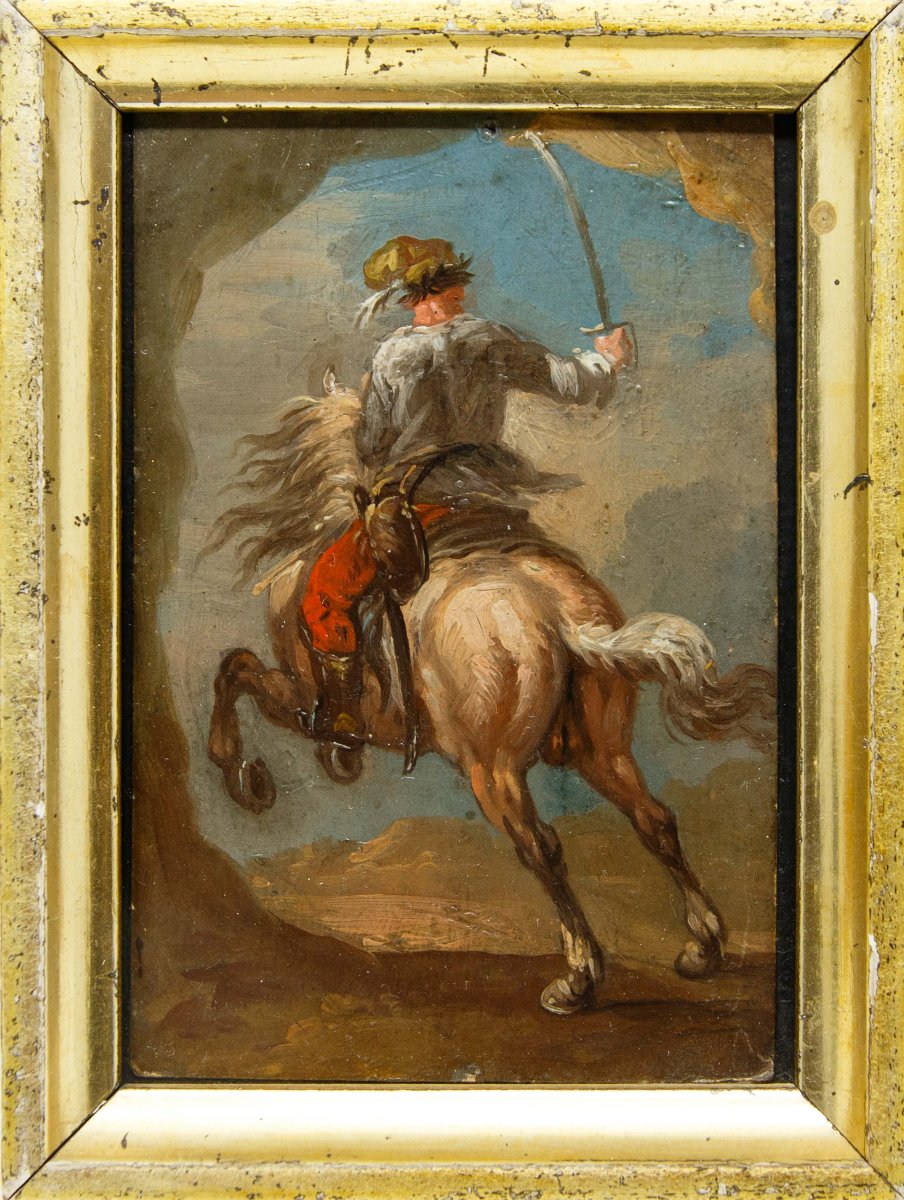
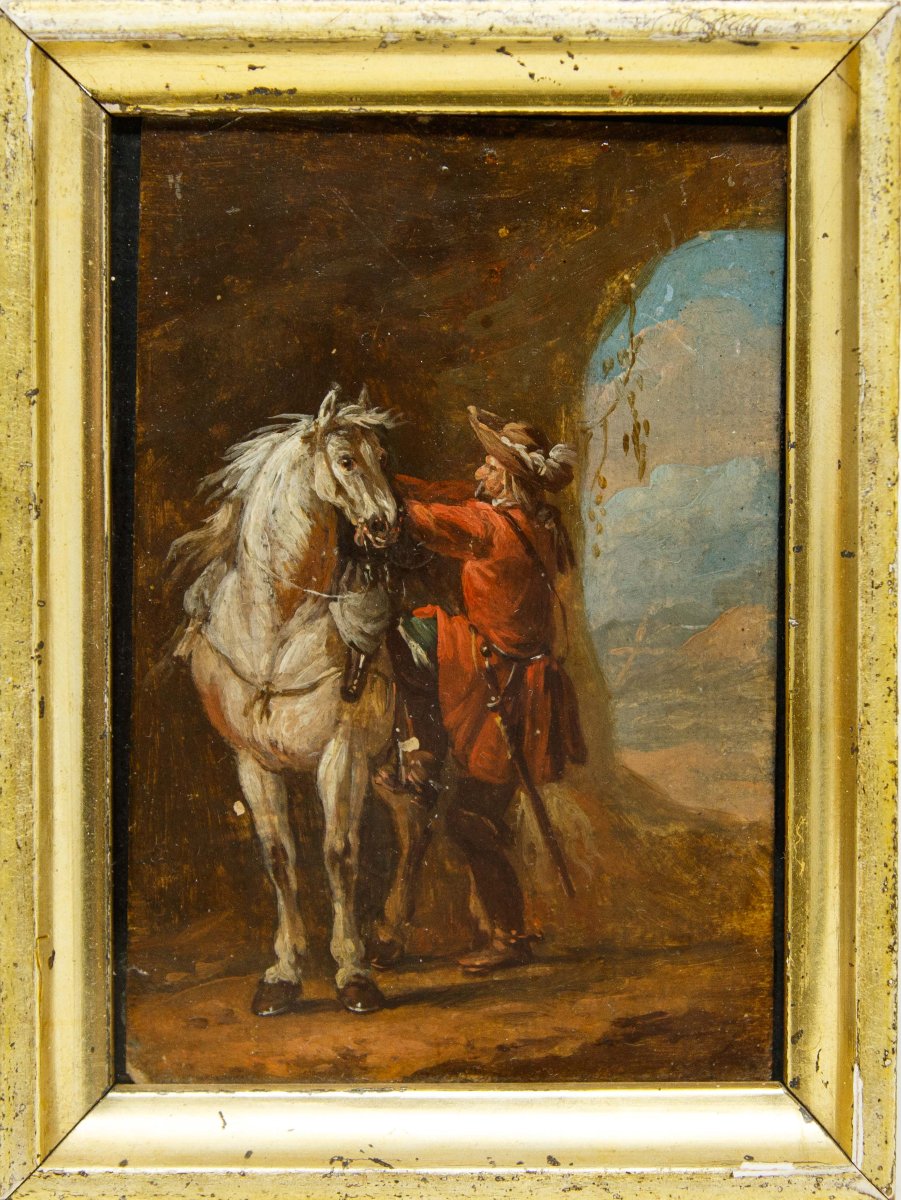
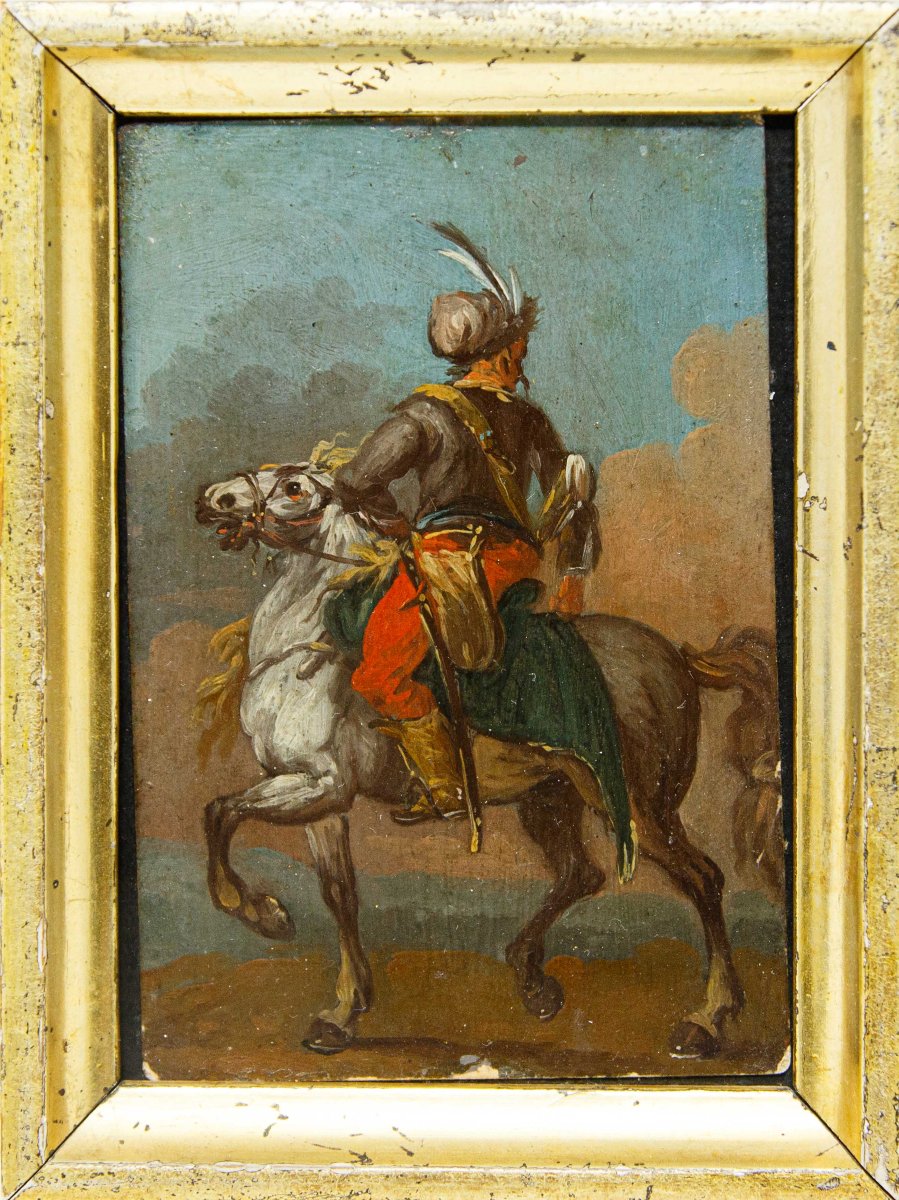


August Querfurt (1696, Wolfenbüttel – 1761, Vienna), Attributed To, Compositions With Knights
August Querfurt (1696, Wolfenbüttel – 1761, Vienna), attributed to
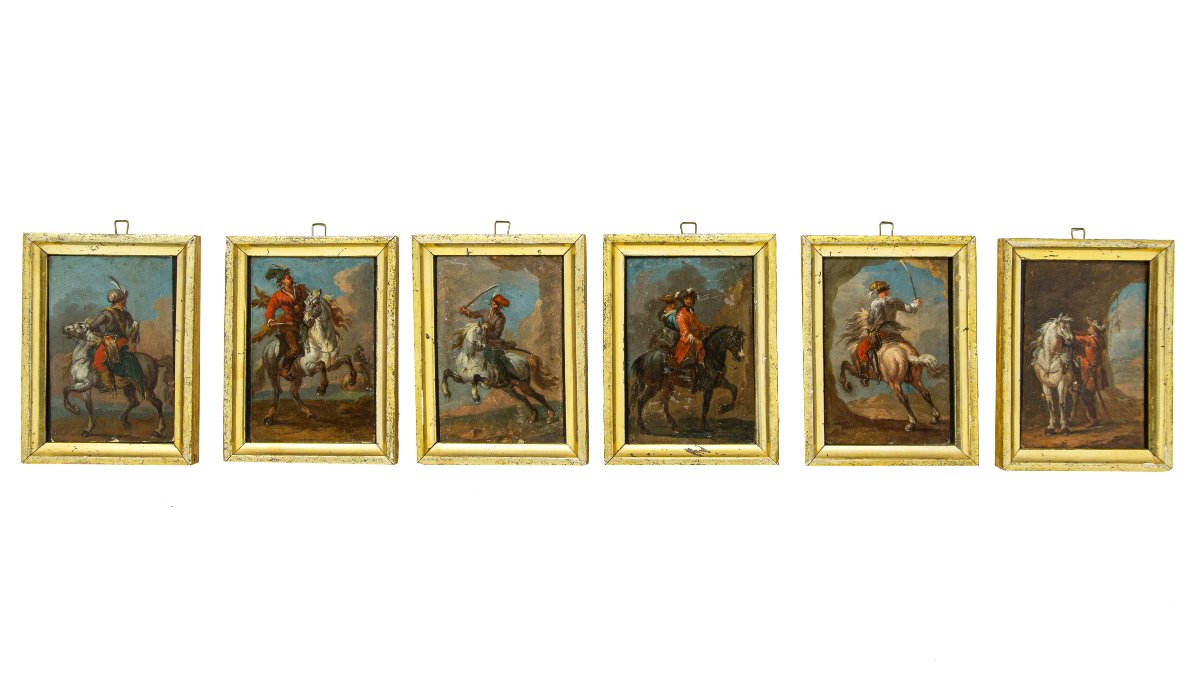
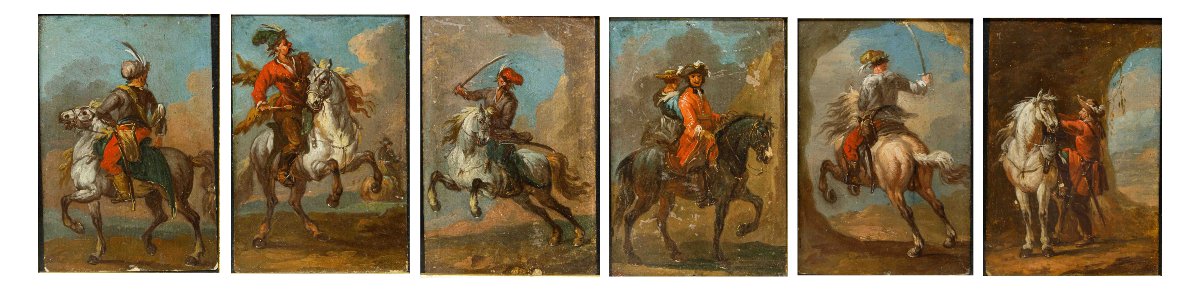
Compositions with Horsemen
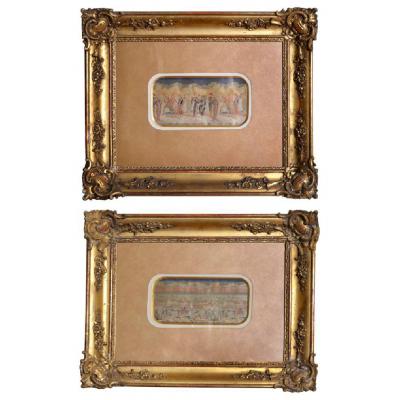
Oil on paper mounted on cardboard, 9.5 x 6.5 cm – framed, 11 x 8 cm
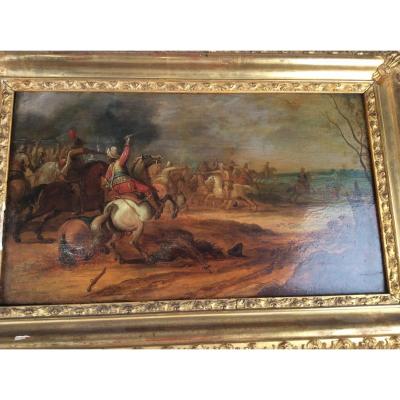
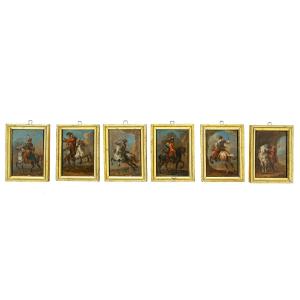
This group of six oil paintings on paper mounted on cardboard forms a cohesive collection of sketches with equestrian subjects attributed to August Querfurt. Their modest dimensions, the speed of execution, and the fragmentary nature of the scenes—isolated horsemen captured in dynamic poses, set against a cloudy sky or a barely sketched landscape—suggest that these are not finished, stand-alone works, but rather preparatory studies: a sort of repertoire of figures and horses that the artist kept on hand in his workshop to reuse—with variations in pose or attire—within larger-scale compositions depicting great cavalry battles. Ottoman horsemen appear in at least two of these small scenes, recognizable by their feathered turbans, curved sabers, and Oriental-style garments—a recurring motif in works depicting battles against the Turks. One of the compositions, however, appears to derive from a hunting painting or a genre scene, as the horse in the foreground is walking at a trot while a female figure, also on horseback, can be glimpsed in the background.
A comparison with the artist’s known catalog allows us to identify precise correspondences. In the Battle Scene at the Hermitage in St. Petersburg, the horseman seen from behind on the left side of the canvas, with his horse shown in three-quarter view, has an exact counterpart in one of our sketches. Even more telling is the large canvas depicting *The Turks Besieging Vienna*, now in a private collection, where the multitude of horsemen arranged across multiple planes clearly illustrates the artist’s working method, as he drew upon a vast repertoire of figures and horses to populate even the most crowded battle scenes. Similar stylistic parallels can be found in *The Battle Against the Turks* (now in Warsaw), in *The Palace on the Water*, in *The Horse Market with River Landscape* at the Landesmuseum in Oldenburg, and in the *Two Scenes of Horsemen* attributed to Querfurt himself and housed at the Correr Museum in Venice: in all these paintings, the same horse postures, the same play of light on the harnesses, and the identical agitated poses of the horsemen recur, confirming a practice based on the combination of tried-and-true figurative motifs.
August Querfurt was born in Augsburg and trained first under his father Tobias, then honed his skills with Georg Philipp Rugendas, in whose workshop he developed a taste for battle painting. He specialized in equestrian subjects, favoring isolated cavalry skirmishes, military encampments, and hunting scenes. His artistic style drew primarily on the example of Jacques Courtois, from whom he derived the realistic animation and dynamism of his compositions, but his training was in fact eclectic: his works reveal echoes of Wouwerman, van der Meulen, the Parrocel brothers, and Rugendas himself. He likely also spent time in Italy, coming into contact with Venetian specialists in the battle genre, with whom he was sometimes confused by critics. His stylistic and painterly characteristics have, however, made it possible to compile a now substantial catalog, enriched by the reappearance of signed works on the antiquities market.
Period: 18th century
Style: Other Style
Condition: Good condition
Material: Oil painting on paper
Width: 6,5
Height: 9,5
Reference (ID): 1796979
Availability: In stock