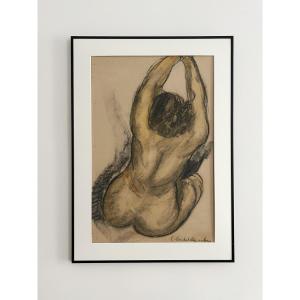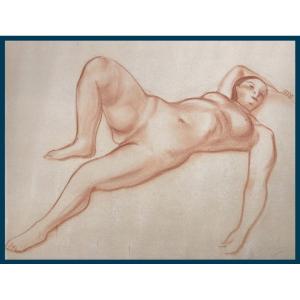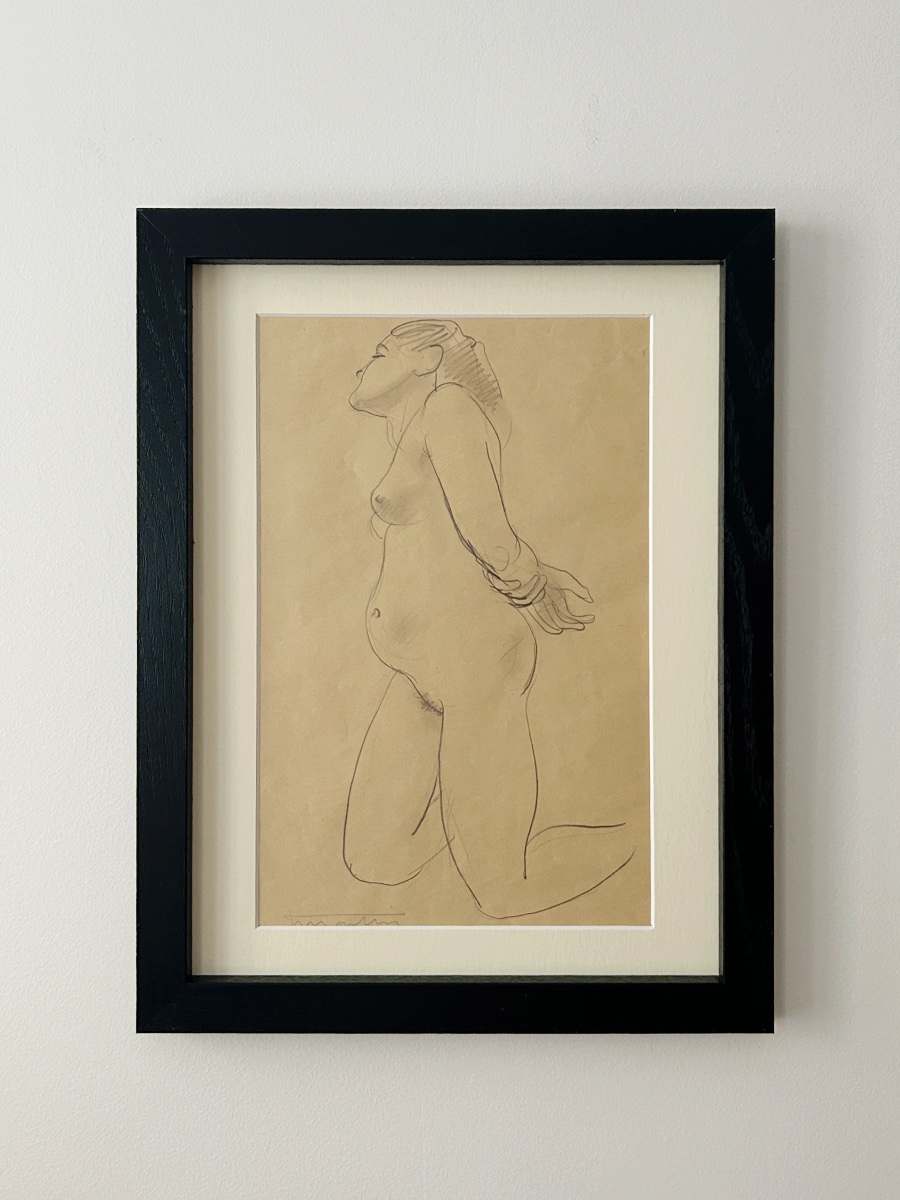
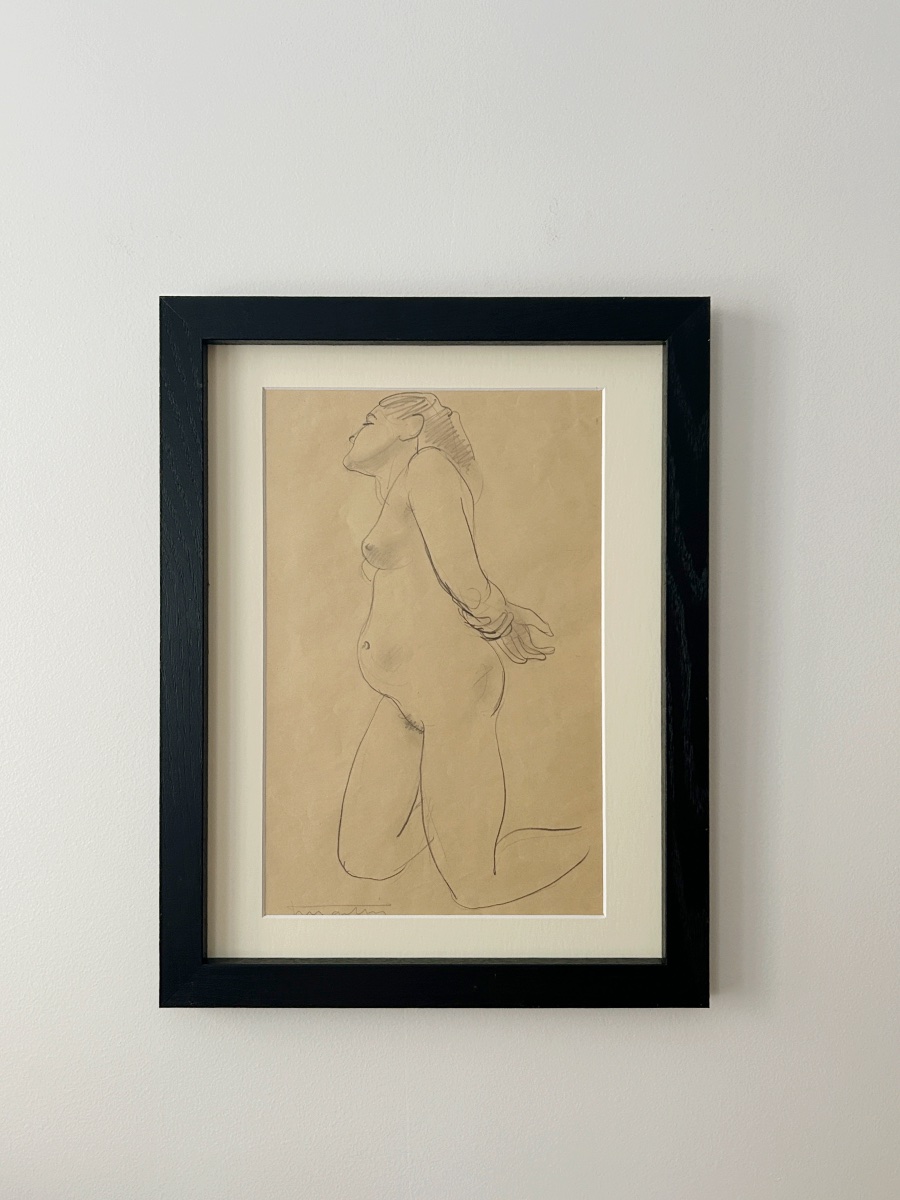
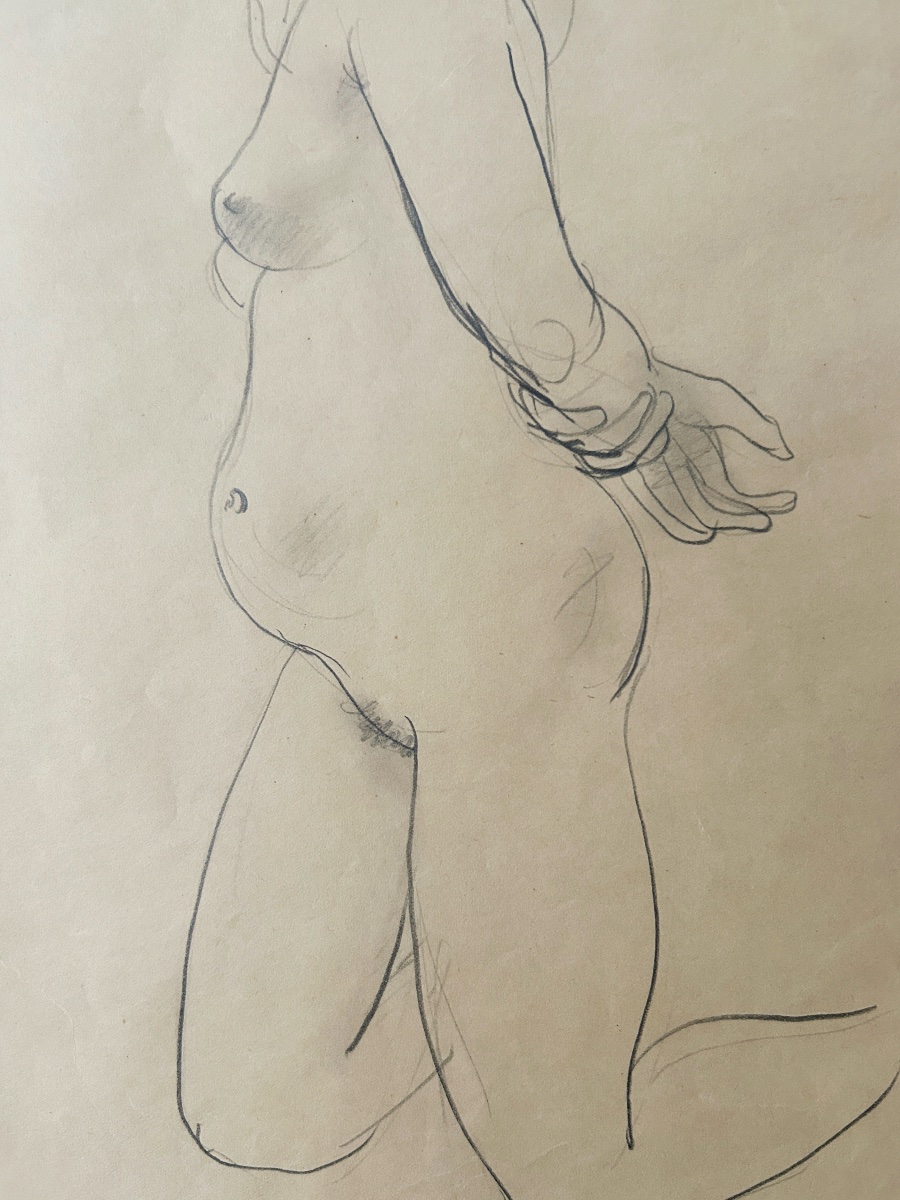
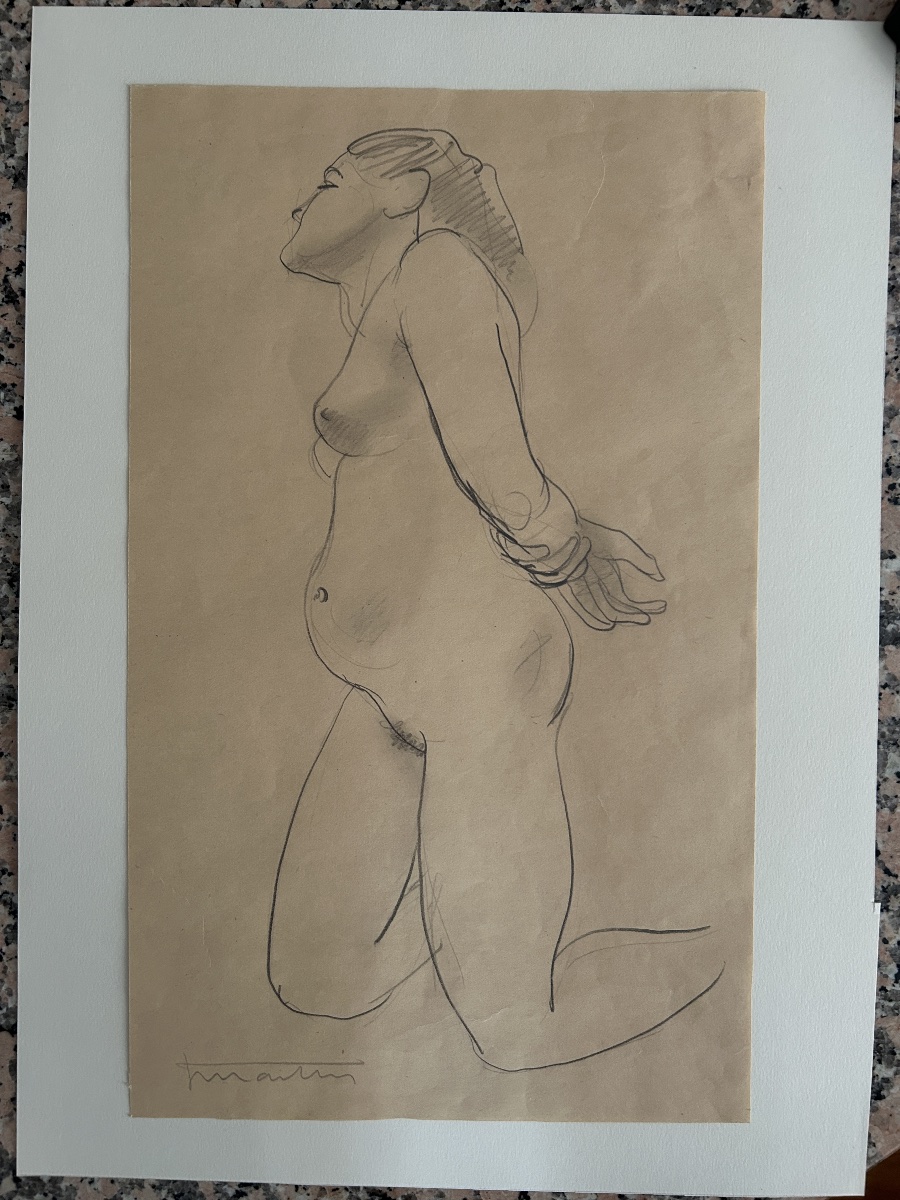
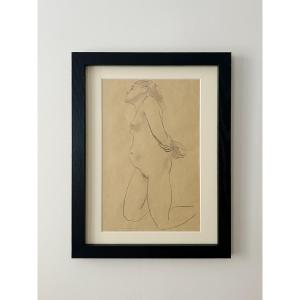


Jean Martin (1911–1996), Kneeling Female Nude, Pregnant, Circa 1940
Kneeling Female Nude, Pregnant, circa 1940
Graphite on paper
Signed lower left
34 × 22 cm
Frame: 40 × 30 cm
A self-taught painter born in Lyon in 1911, Jean Martin developed a style of painting reality that stood apart from the debates surrounding the realism controversy. He exhibited for the first time at the Salon d’Automne in 1933, at the Salon du Sud-Est (Lyon) the following year, and at the Salon des Indépendants beginning in 1935.
Jean Martin’s painterly style is marked by the influence of the 16th-century German masters, following in the footsteps ofMatthias Grünewald, Lucas Cranach and Albrecht Dürer, whose work he studied at length through reproductions of their works that he treasured. He was also strongly influenced by contemporary Flemish Expressionism. The Laethem-Saint-Martin School, which he discovered in 1927 during the exhibitionBelgian Artheld at the Grenoble Museum of Fine Arts, had a profound visual impact on the artist and particularly shaped his painting of the 1930s.
As early as 1933, Jean Martin befriended the gallery owner Marcel Michaud, who would be a great source of support to him. The two men shared a vision of social art inspired by the achievements of the Popular Front. The following year, his meeting with Henri Héraut, an art critic and founder of the group Forces Nouvelles, also proved to be a defining moment. In 1938, Jean Martin exhibited at the Billiet-Vorms Gallery in Paris during the group’s final exhibition, alongside Georges Rohner, Jean Lasne, Henri Jannot, and Robert Humblot. There he presented his masterpiece, Les Aveugles(1937), now housed at the Musée des Beaux-Arts in Lyon. These artists particularly disapproved of the systematic distortion of nature.
In 1940, the artist’s interest in books and the publishing world led him to collaborate with Marc Barbezat on the creation of the avant-garde magazine L’Arbalète, for which he designed the first cover. After the war, Jean Martin left Lyon for Paris, where he contributed to the revival of the performing arts. There, he rubbed shoulders with major figures in French theater, for whom he created numerous stage sets and costumes, sometimes in collaboration with Jean Bertholle, Christian Bérard, or even Pablo Picasso. In the early 1950s, he founded the galleryArt et tradition chrétienne, playing an active role in the revival of sacred art.
Period: 20th century
Style: Other Style
Condition: Good condition
Material: Paper
Reference (ID): 1787610
Availability: In stock