


Antonio Tibaldi (rome, C. 1633 – C. 1684), Still Life With Precious Objects...
Artist: Antonio Tibaldi (rome, Vers 1633 - Vers 1684)
Antonio Tibaldi (Rome, c. 1633 – c. 1684)
Still Life with Precious Objects, Brocade Fabrics, and a Plate of Sweets
c. 1650/1660
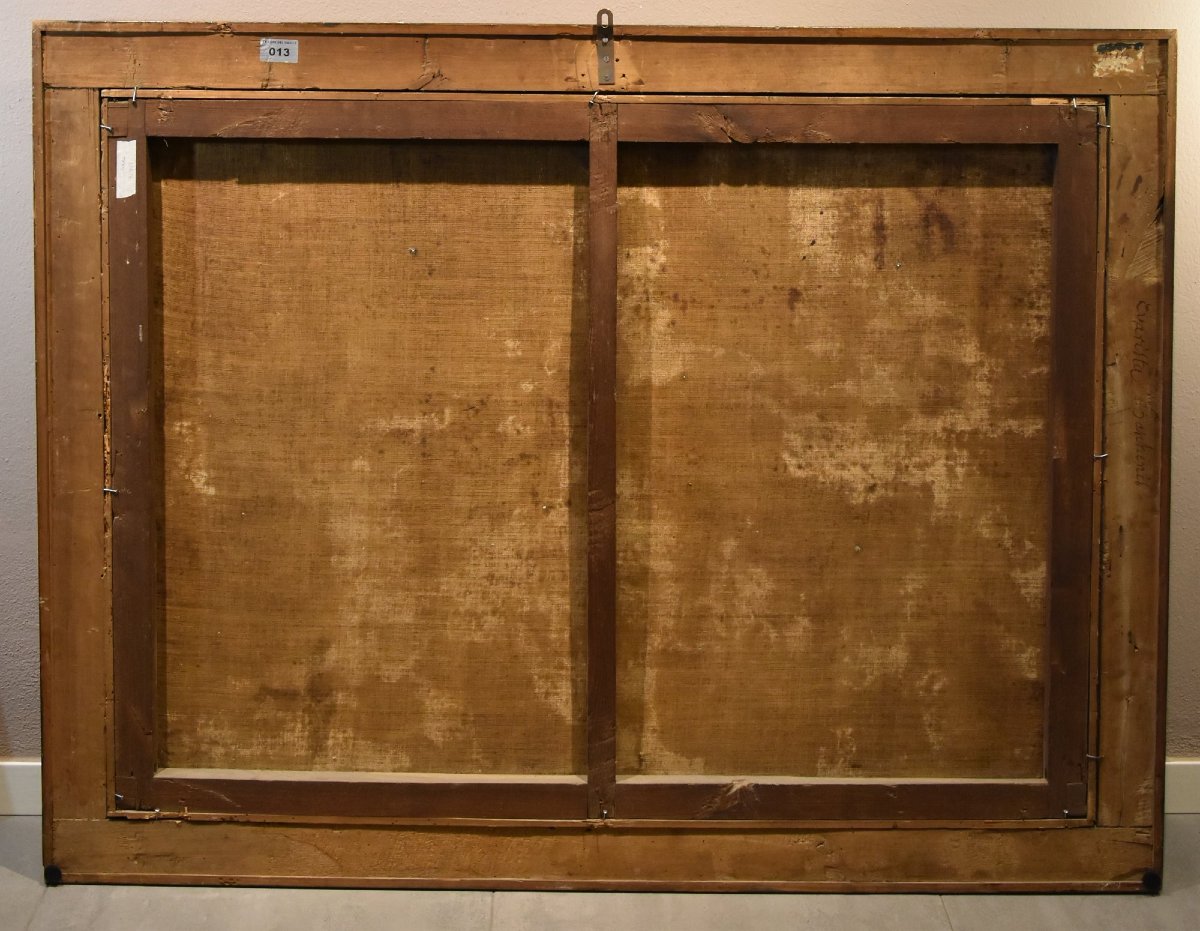
Oil on canvas (96 x 130 cm – Framed: 115 x 150 cm.)
For further information on the artist, see the essay: “Still-Life Painters in Rome. Italian Artists, 1630–1750’—Gianluca and Ulisse Bocchi—2005
Complete details of the work (click HERE)
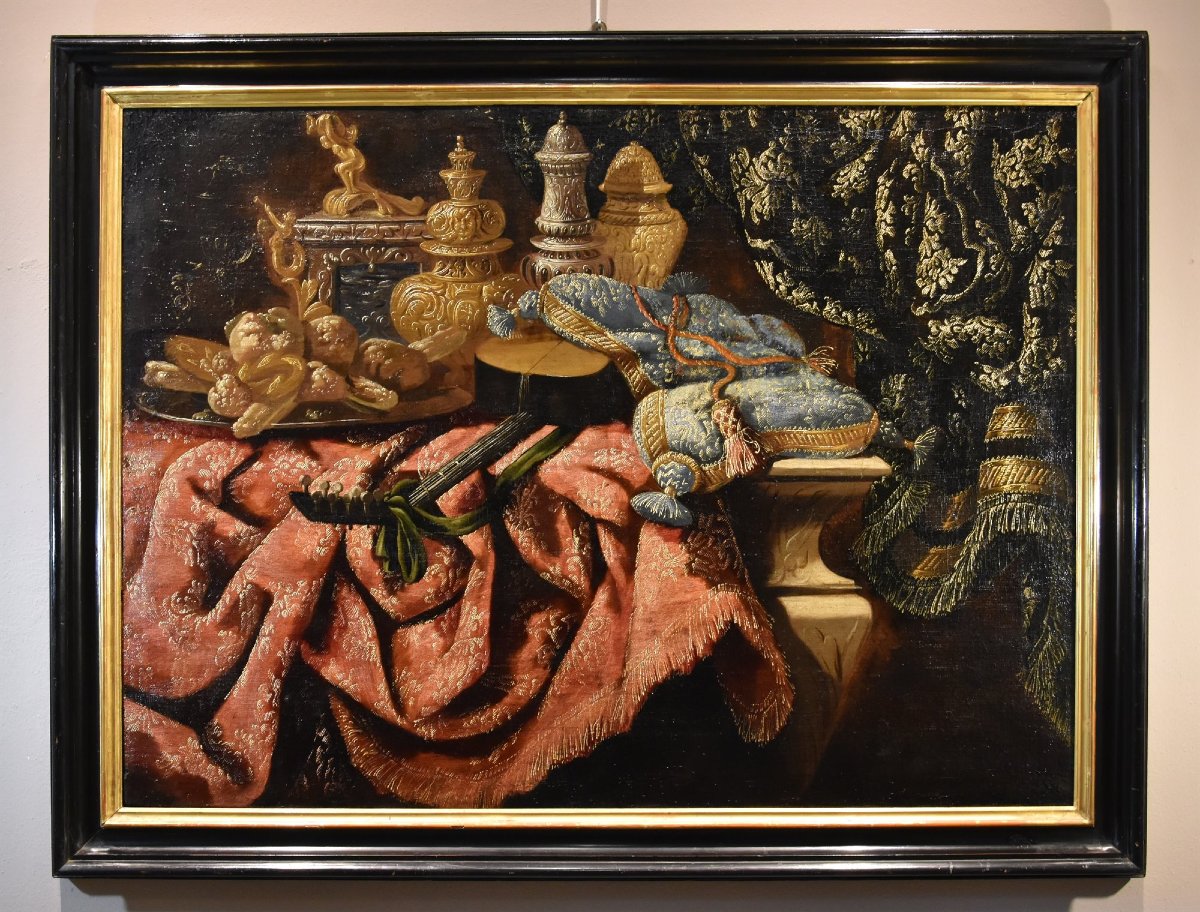
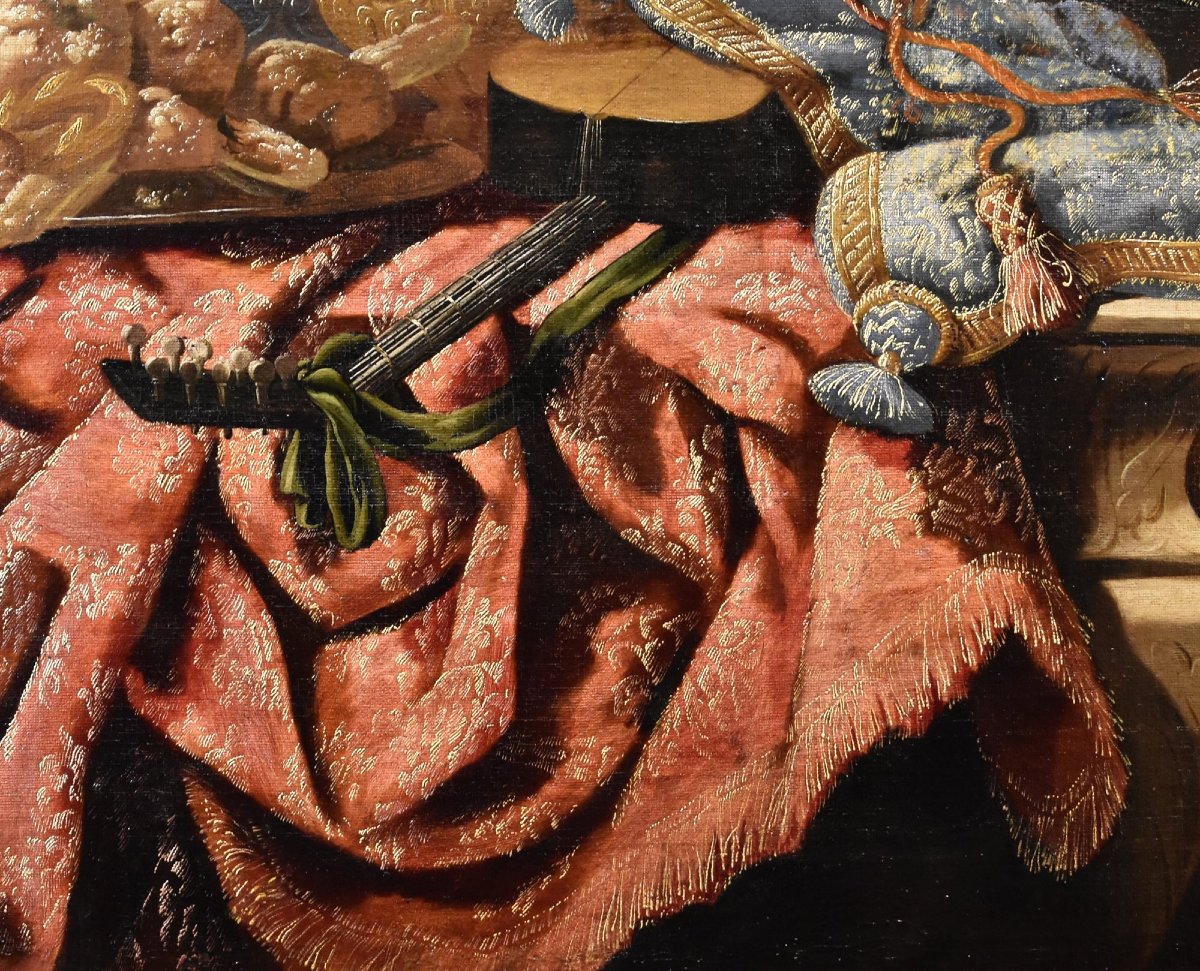
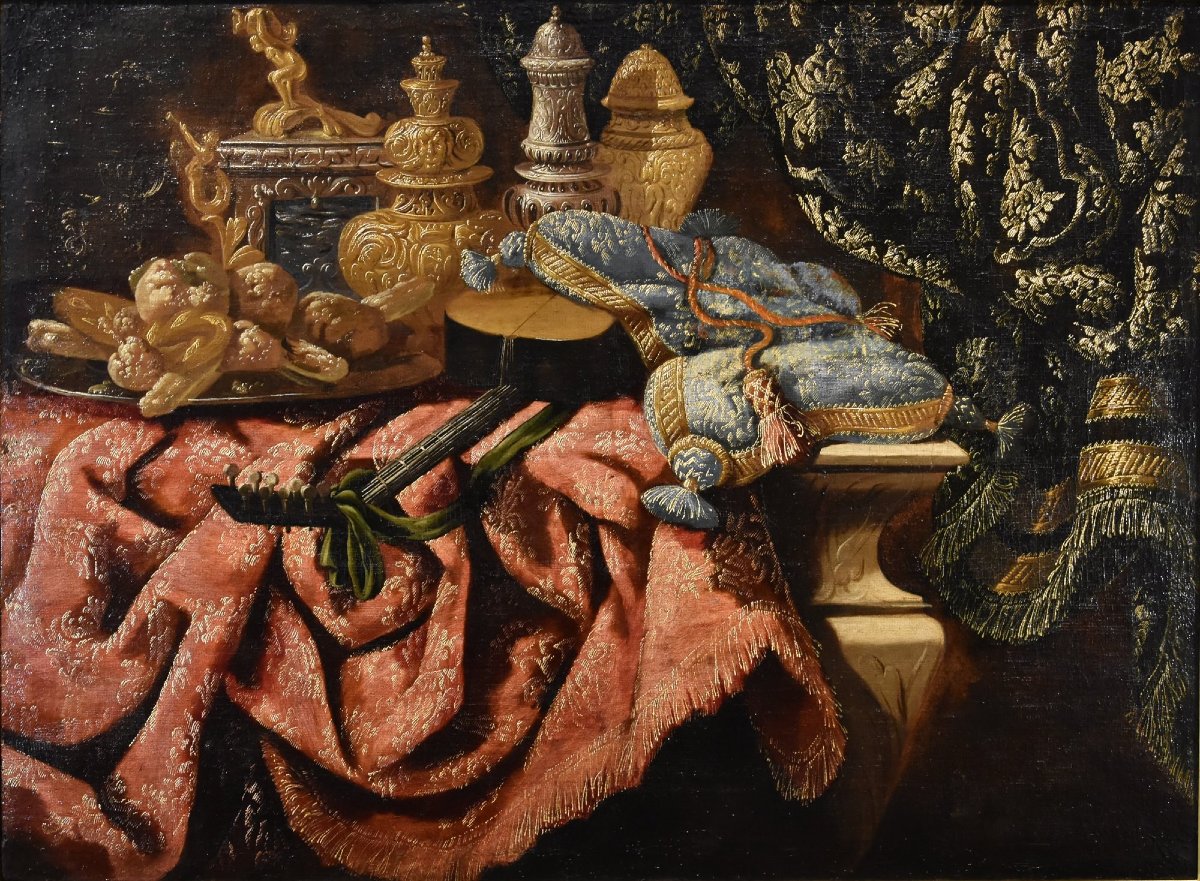
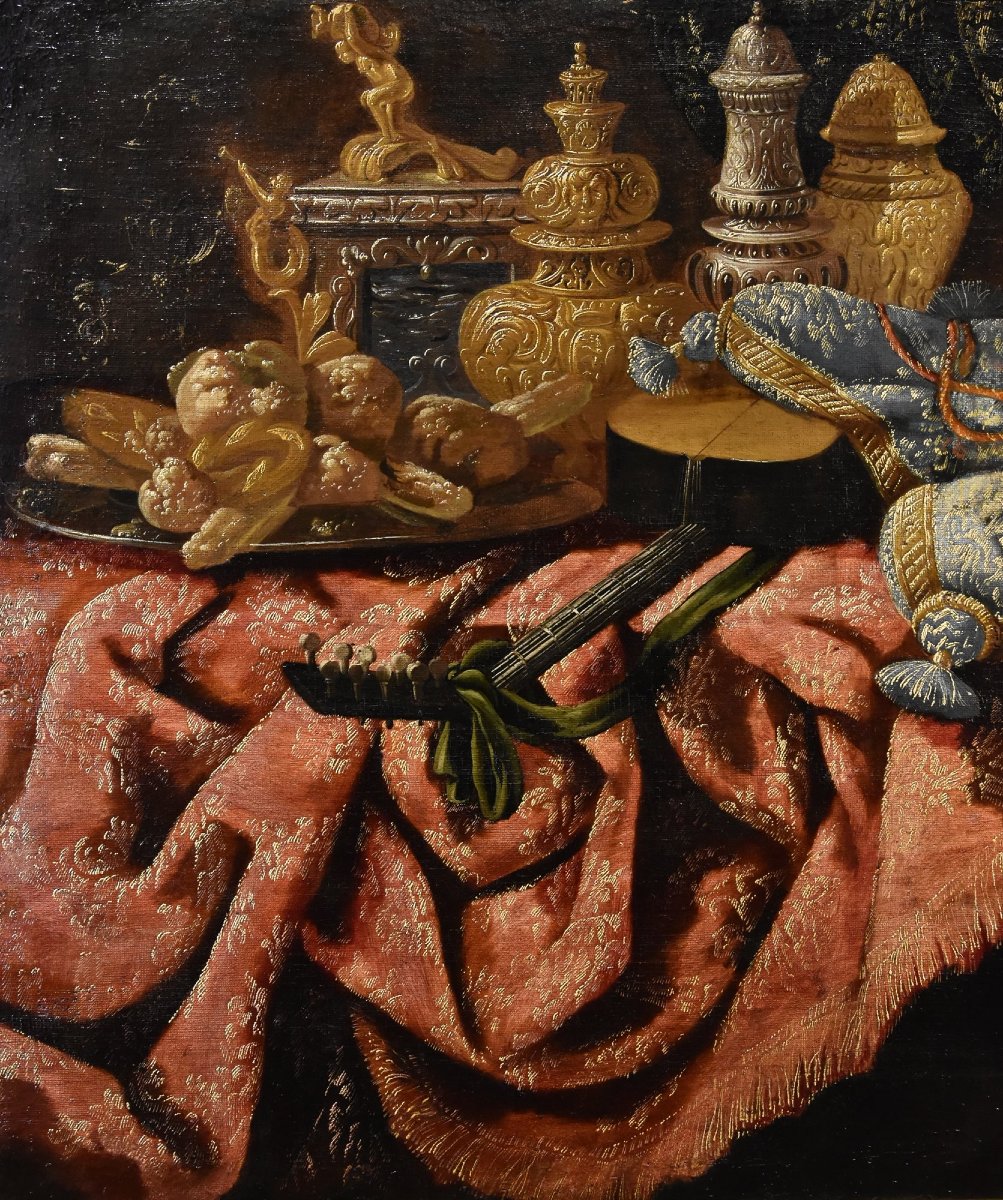
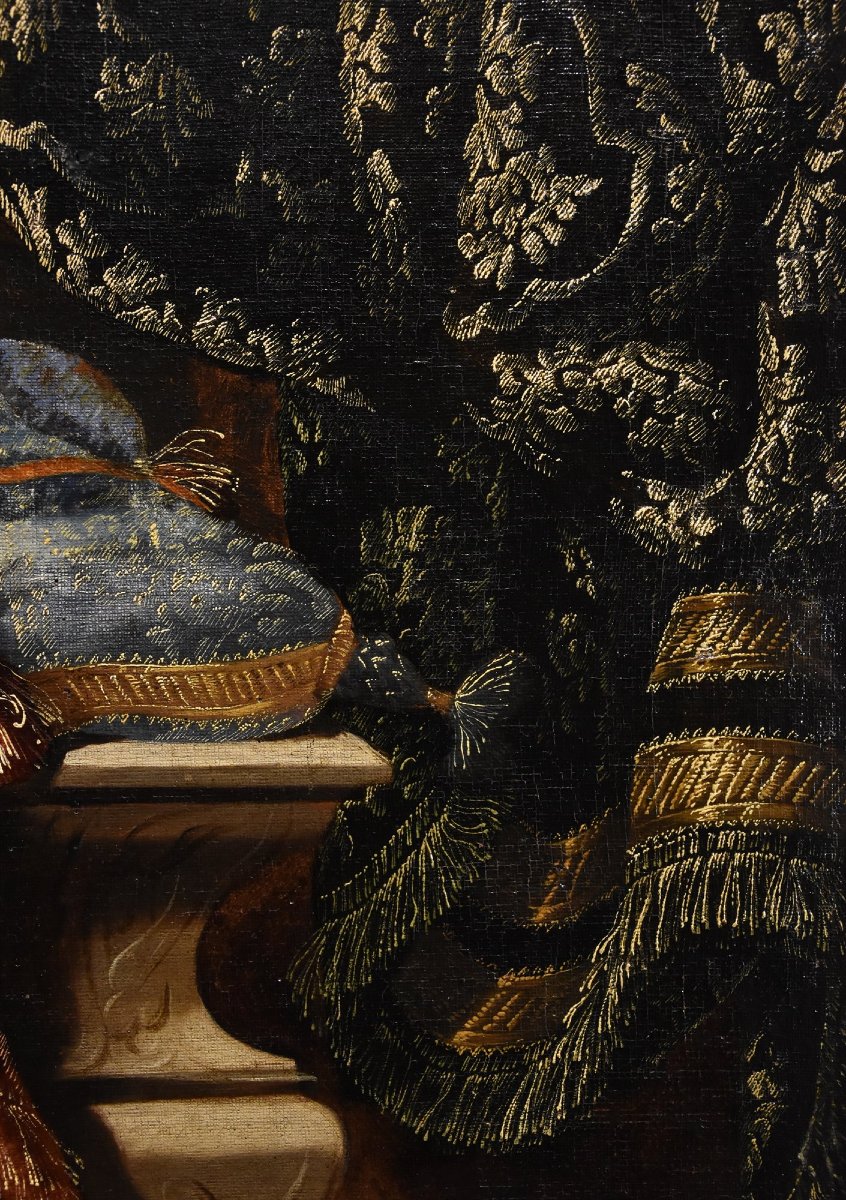
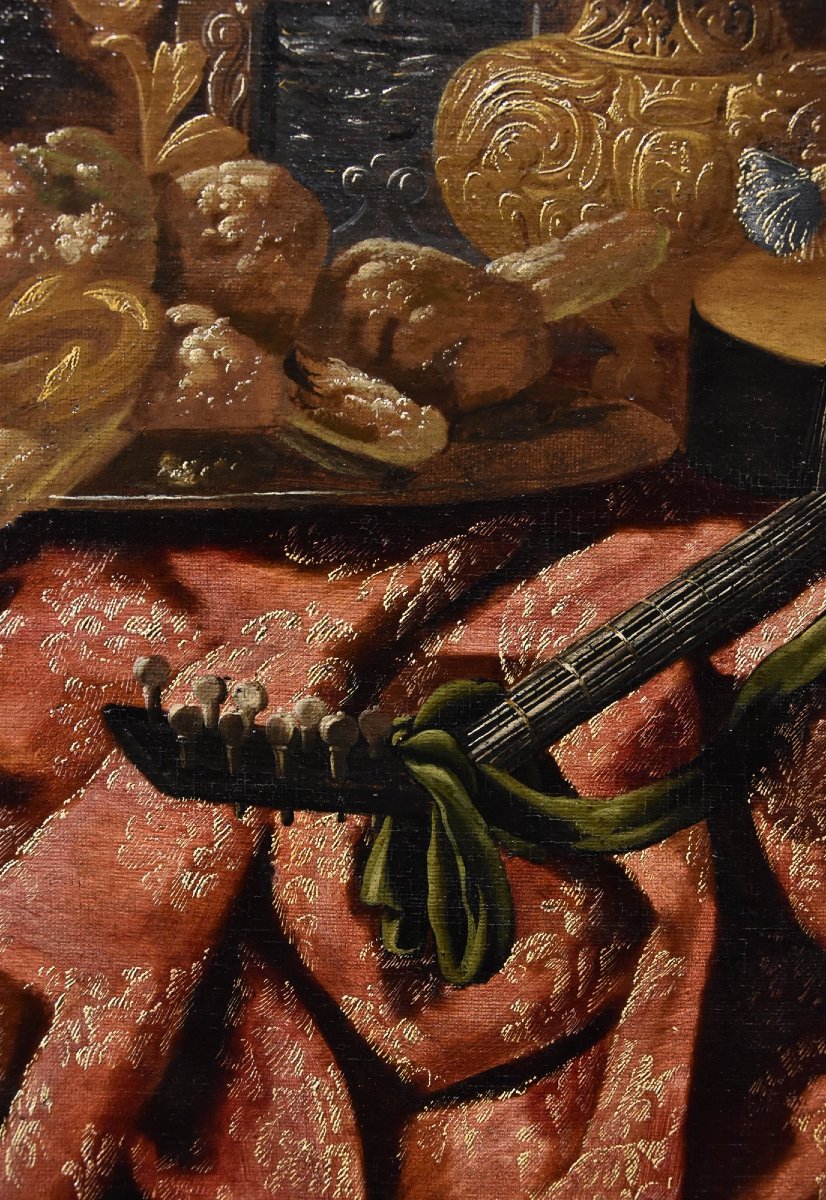
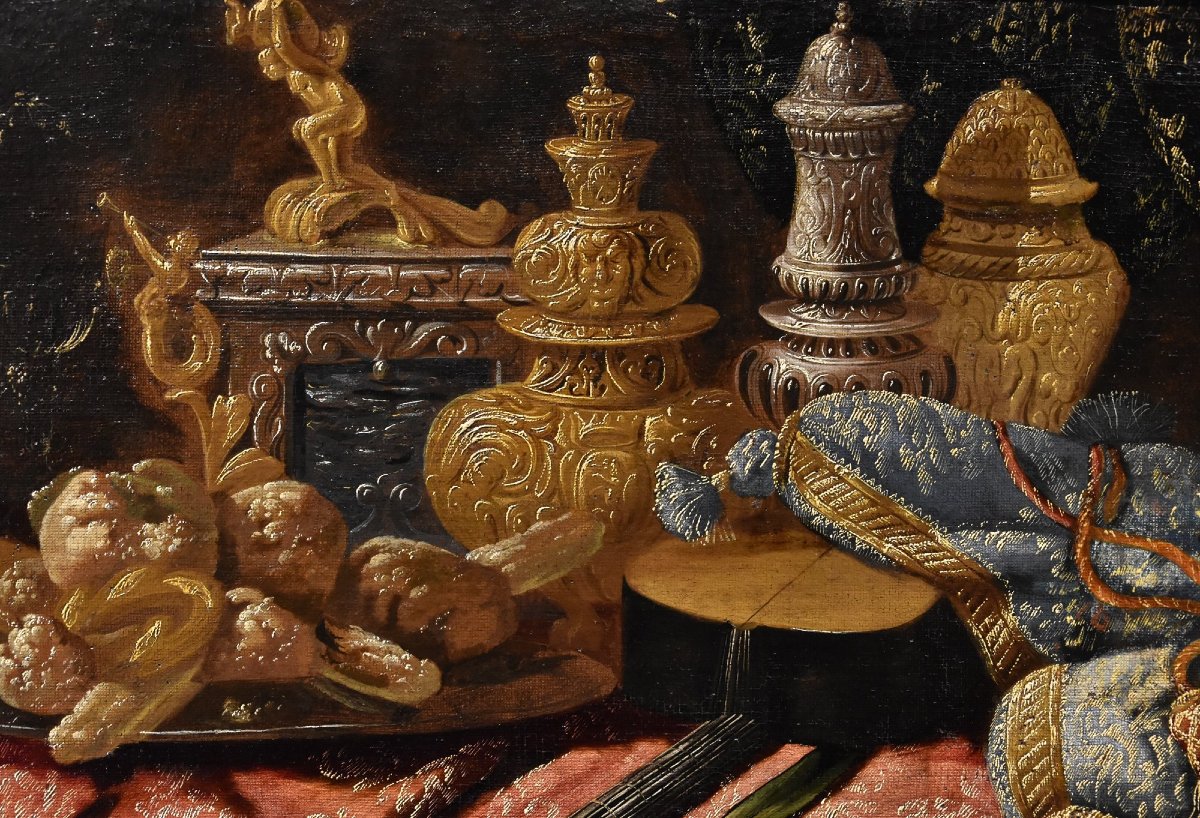
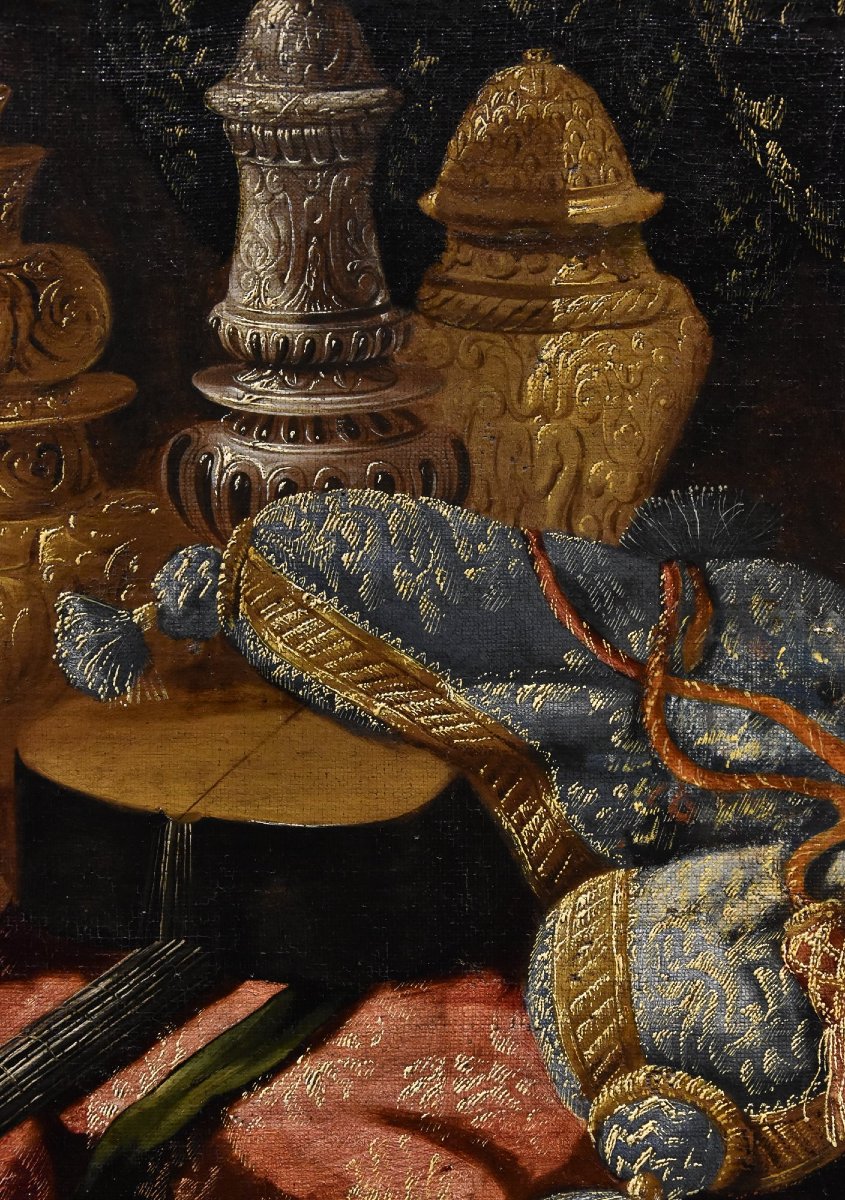
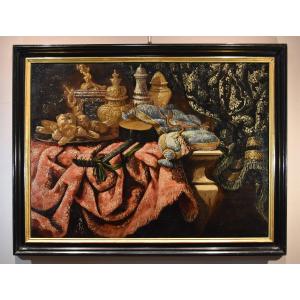
This prestigious still life, with its incredible visual impact, depicts a lavish display of precious objects, including vases, jugs, and plates made of precious metals, a stringed musical instrument—specifically a guitar—a cushion, and an elegant fabric embroidered with gold thread; while on the right, a luxurious damask curtain opens the scene like a theatrical curtain.
The large dimensions of the canvas correspond to the typically Roman format known as the “emperor’s canvas,” a Baroque term used to describe canvases measuring approximately 130 x 90 cm.
The painting is the work of the Roman painter Antonio Tibaldi, whose compositions enjoyed considerable success in Baroque Rome, thanks to his particular attention to rendering the exquisite details of the depicted objects, which make each of his works especially precious and elegant.
He worked contemporaneously with Carlo Manieri, with whom he partly shared compositional approaches; however, while Manieri lingered on the depiction of elaborate architectural structures, Tibaldi showed a more pronounced tendency toward saturating spaces and backgrounds enclosed by heavy drapery, in accordance with the style established by Francesco Maltese.
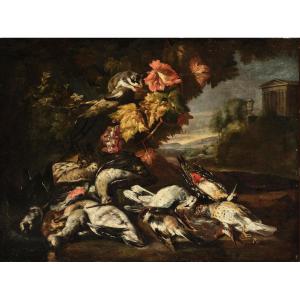
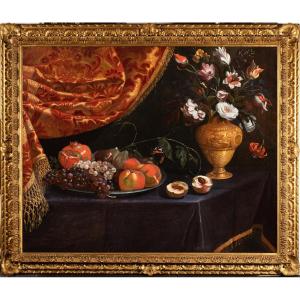
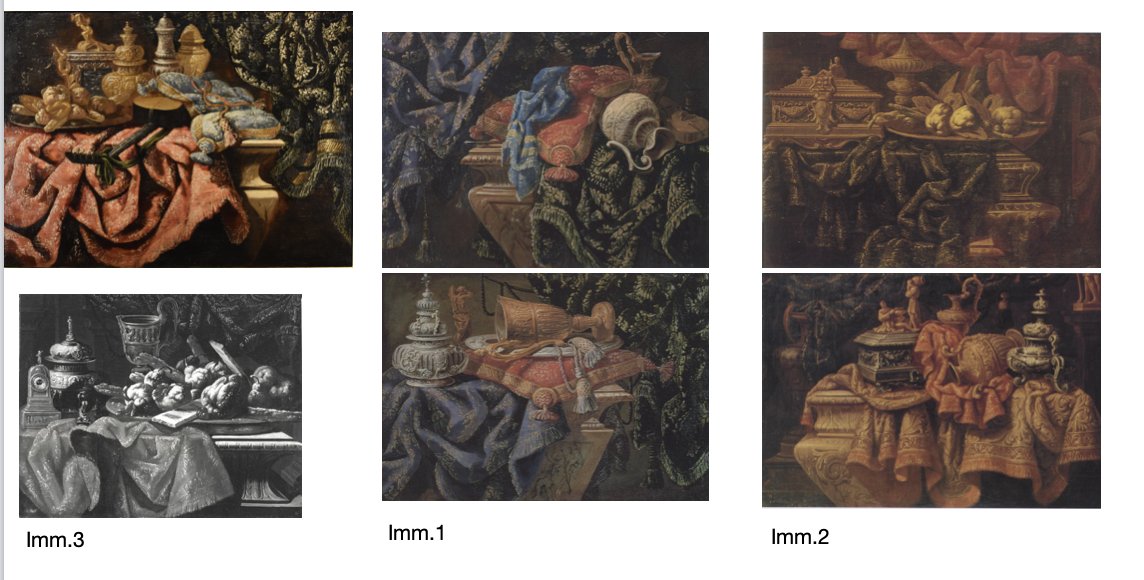
By way of comparison, and in support of our attribution, it is worth mentioning the two “Still Lifes with Brocades and Goldsmith’s Objects” housed at the Musée Fresch in Ajaccio, France (Fig. 1 - https://www.musee-fesch.com/tag/antonio-tibaldi ), commissioned around 1650 in Rome by Cardinal Fresch, which share more than one comparable element that we see echoed in the canvas presented here.
The pair of “Still Lifes with a Casket, Sweets, and Precious Objects,” correctly attributed to Tibaldi and sold on the Milanese antique market in 1987 (Fig. 2 - Finarte, Milan, May 6–7, 1987, lots 246 and 247, attributed to F. Fieravino) are virtually identical to ours. In one of the two paintings, the large, chiseled casket bears the heraldic emblem of the three bees, attesting to the commission by the Barberini family.
This attests to the fact that Antonio Tibaldi was held in high esteem by the Roman aristocracy, who were particularly fond of such grandiose depictions, and that he worked for the most powerful Roman families: among the most influential patrons, in addition to the Barberini (Pope Urban VIII), we know there were also the Chigi (Pope Alexander VII) and the Colonna.
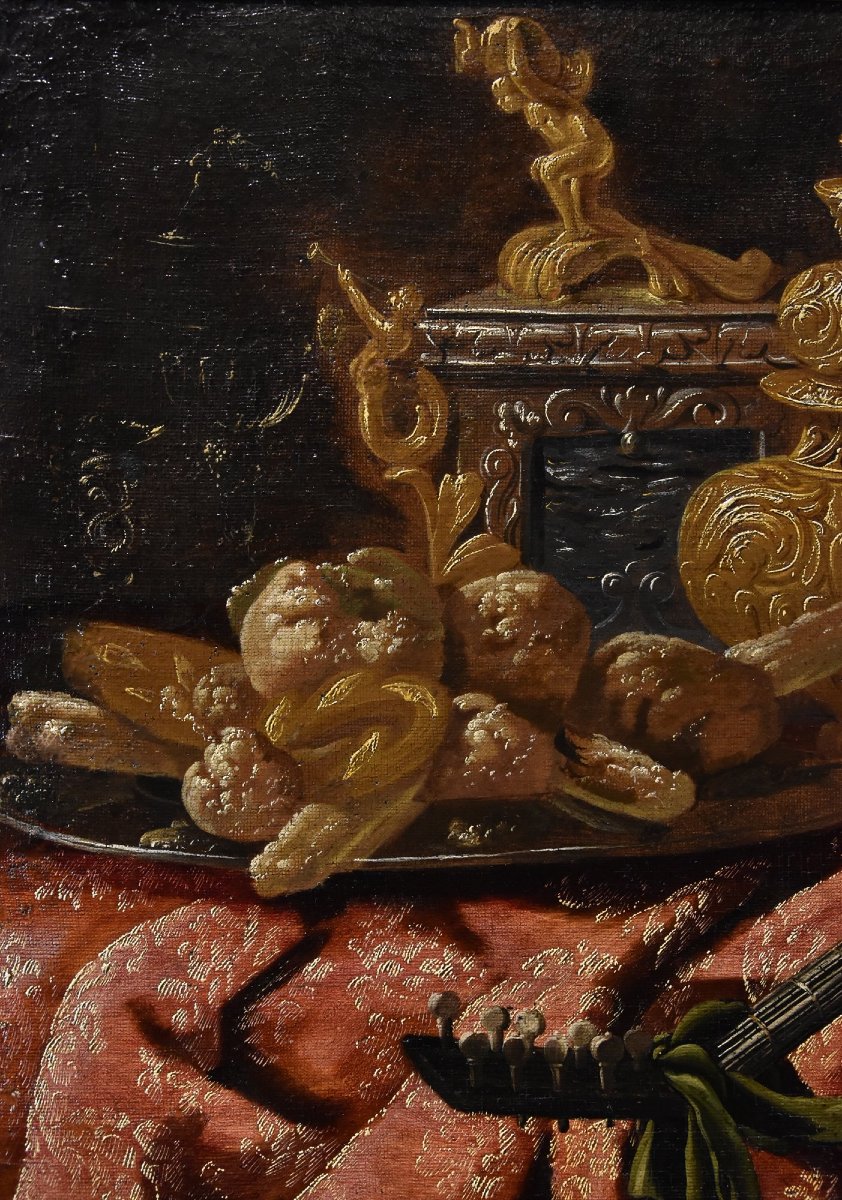
Our painting also features a coat of arms, although it is difficult to interpret (near the base band of the embossed gilded metal vase), depicting a rampant lion on an oval shield surmounted by a crown.
Tibaldi’s artistic output is characterized by a series of recurring motifs, which we also find in this work: among these is the tendency to fill the pictorial space as much as possible by placing carpets or damask fabrics on stone tables decorated with Renaissance-inspired motifs. But also the typical sugary confections, here arranged on a silver platter: these are cookies and candied fruit that Tibaldi rendered in a highly personal and distinctive manner, giving them the appearance of a “spongy” texture. We can find the same sweets, in addition to the works mentioned above, in the “Still Life with Rug, Plate of Candied Citrus Fruits, and Sweets…” sold at Christie’s in London (fig. 3 – December 8–9, 1994, lot 379) https://catalogo.fondazionezeri.unibo.it/scheda/opera/88018/.
ADDITIONAL INFORMATION:
The sold work comes complete with an attractive frame and is accompanied by a certificate of authenticity and warranty.
We handle and arrange shipping for purchased works, both within Italy and internationally, using professional, insured carriers. It is also possible to view the painting at our gallery in Riva del Garda; we would be delighted to welcome you and show you our collection of works.
Please feel free to contact us, with no obligation, for any additional information.
Follow us on:
INSTAGRAM https://www.instagram.com/galleriacastelbarco/?hl=it
FACEBOOK https://www.facebook.com/galleriacastelbarco/
Still Life with Precious Objects, Brocade Fabrics, and a Plate of Sweets
c. 1650/1660
Oil on canvas (96 x 130 cm – Framed: 115 x 150 cm.)
For further information on the artist, see the essay: “Still-Life Painters in Rome. Italian Artists, 1630–1750’—Gianluca and Ulisse Bocchi—2005
Complete details of the work (click HERE)
This prestigious still life, with its incredible visual impact, depicts a lavish display of precious objects, including vases, jugs, and plates made of precious metals, a stringed musical instrument—specifically a guitar—a cushion, and an elegant fabric embroidered with gold thread; while on the right, a luxurious damask curtain opens the scene like a theatrical curtain.
The large dimensions of the canvas correspond to the typically Roman format known as the “emperor’s canvas,” a Baroque term used to describe canvases measuring approximately 130 x 90 cm.
The painting is the work of the Roman painter Antonio Tibaldi, whose compositions enjoyed considerable success in Baroque Rome, thanks to his particular attention to rendering the exquisite details of the depicted objects, which make each of his works especially precious and elegant.
He worked contemporaneously with Carlo Manieri, with whom he partly shared compositional approaches; however, while Manieri lingered on the depiction of elaborate architectural structures, Tibaldi showed a more pronounced tendency toward saturating spaces and backgrounds enclosed by heavy drapery, in accordance with the style established by Francesco Maltese.
By way of comparison, and in support of our attribution, it is worth mentioning the two “Still Lifes with Brocades and Goldsmith’s Objects” housed at the Musée Fresch in Ajaccio, France (Fig. 1 - https://www.musee-fesch.com/tag/antonio-tibaldi ), commissioned around 1650 in Rome by Cardinal Fresch, which share more than one comparable element that we see echoed in the canvas presented here.
The pair of “Still Lifes with a Casket, Sweets, and Precious Objects,” correctly attributed to Tibaldi and sold on the Milanese antique market in 1987 (Fig. 2 - Finarte, Milan, May 6–7, 1987, lots 246 and 247, attributed to F. Fieravino) are virtually identical to ours. In one of the two paintings, the large, chiseled casket bears the heraldic emblem of the three bees, attesting to the commission by the Barberini family.
This attests to the fact that Antonio Tibaldi was held in high esteem by the Roman aristocracy, who were particularly fond of such grandiose depictions, and that he worked for the most powerful Roman families: among the most influential patrons, in addition to the Barberini (Pope Urban VIII), we know there were also the Chigi (Pope Alexander VII) and the Colonna.
Our painting also features a coat of arms, although it is difficult to interpret (near the base band of the embossed gilded metal vase), depicting a rampant lion on an oval shield surmounted by a crown.
Tibaldi’s artistic output is characterized by a series of recurring motifs, which we also find in this work: among these is the tendency to fill the pictorial space as much as possible by placing carpets or damask fabrics on stone tables decorated with Renaissance-inspired motifs. But also the typical sugary confections, here arranged on a silver platter: these are cookies and candied fruit that Tibaldi rendered in a highly personal and distinctive manner, giving them the appearance of a “spongy” texture. We can find the same sweets, in addition to the works mentioned above, in the “Still Life with Rug, Plate of Candied Citrus Fruits, and Sweets…” sold at Christie’s in London (fig. 3 – December 8–9, 1994, lot 379) https://catalogo.fondazionezeri.unibo.it/scheda/opera/88018/.
ADDITIONAL INFORMATION:
The sold work comes complete with an attractive frame and is accompanied by a certificate of authenticity and warranty.
We handle and arrange shipping for purchased works, both within Italy and internationally, using professional, insured carriers. It is also possible to view the painting at our gallery in Riva del Garda; we would be delighted to welcome you and show you our collection of works.
Please feel free to contact us, with no obligation, for any additional information.
Follow us on:
INSTAGRAM https://www.instagram.com/galleriacastelbarco/?hl=it
FACEBOOK https://www.facebook.com/galleriacastelbarco/
14 500 €
Period: 17th century
Style: Louis 14th, Regency
Condition: Excellent condition
Material: Oil painting
Width: encadré 150 cm.
Height: encadré 115 cm.
Reference (ID): 1782198
Availability: In stock
Print