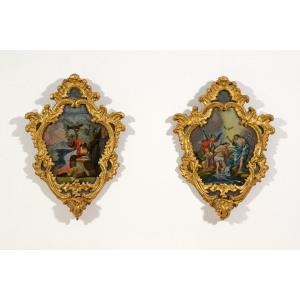


Pair Of Oil On Glass Paintings, Michele Antonio Milocco, Italy, 18th Century
Artist: Michele Antonio Milocco (turin, 1690 – Turin, 1772)
Michele Antonio Milocco (Turin, 1690 – Turin, 1772)
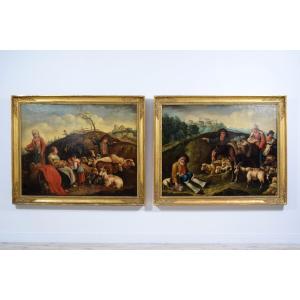
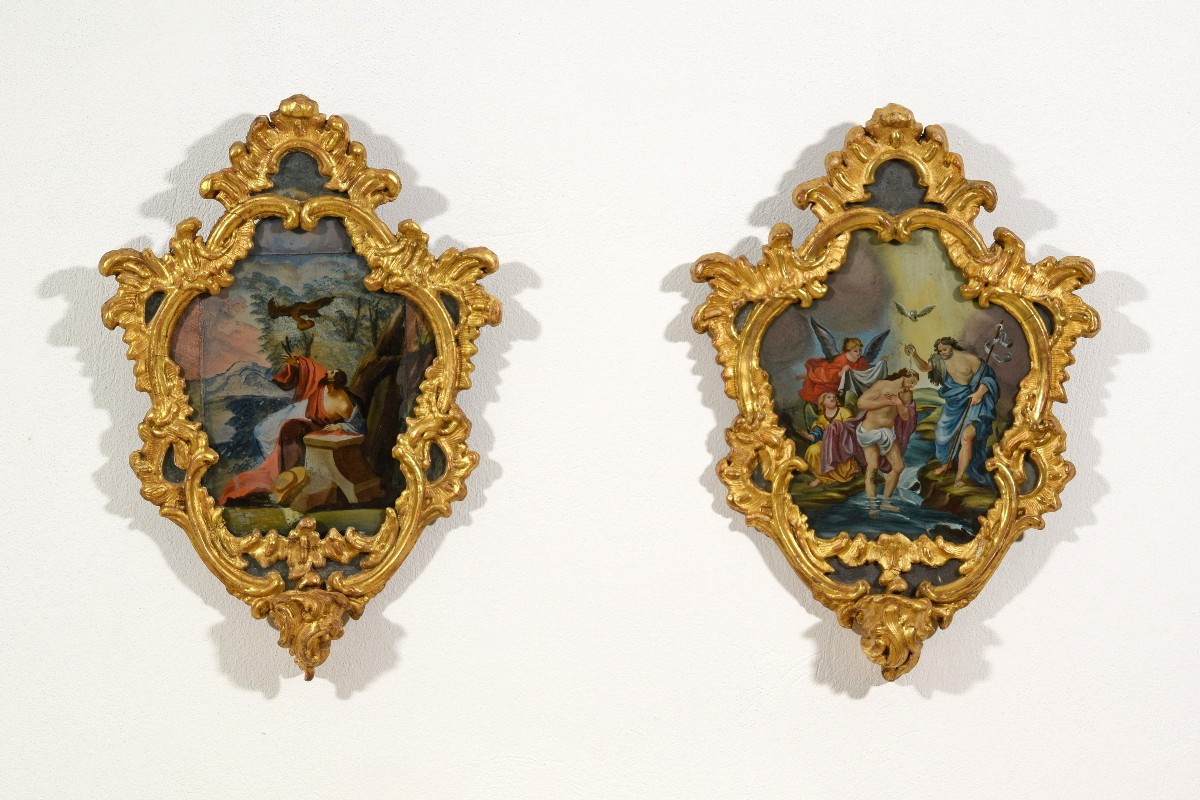
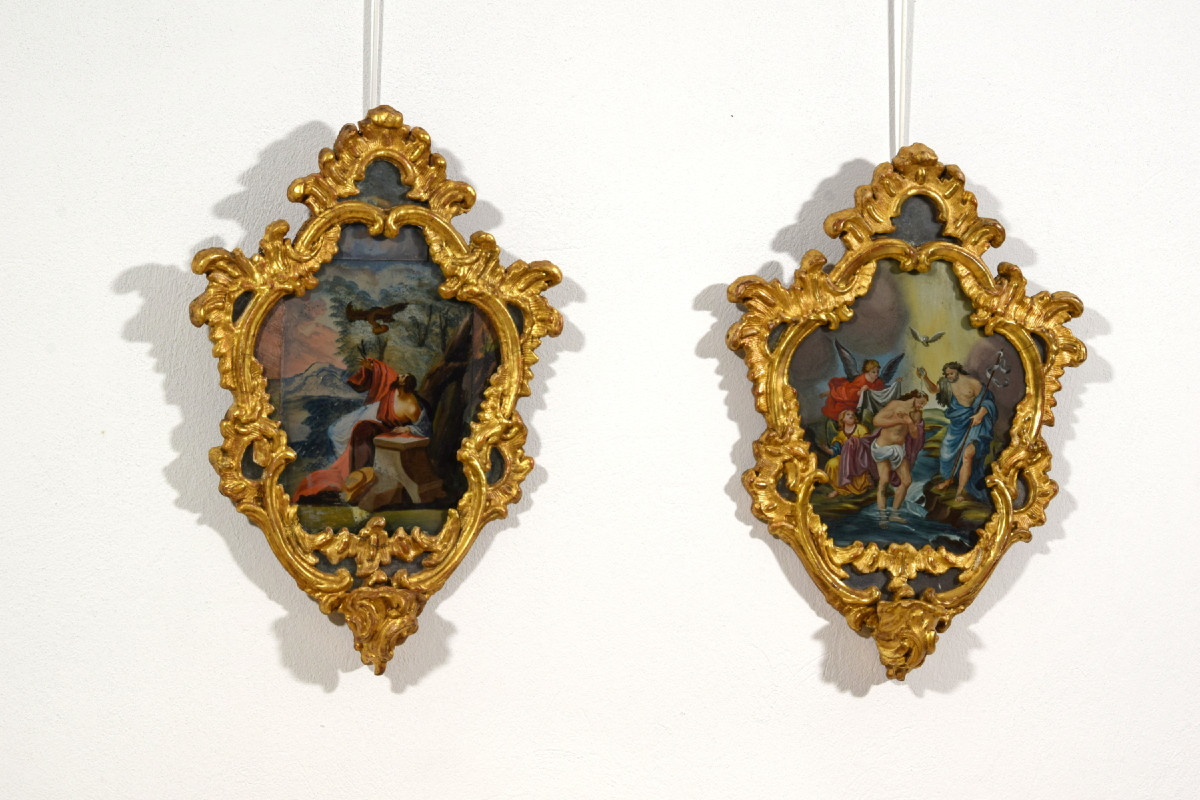
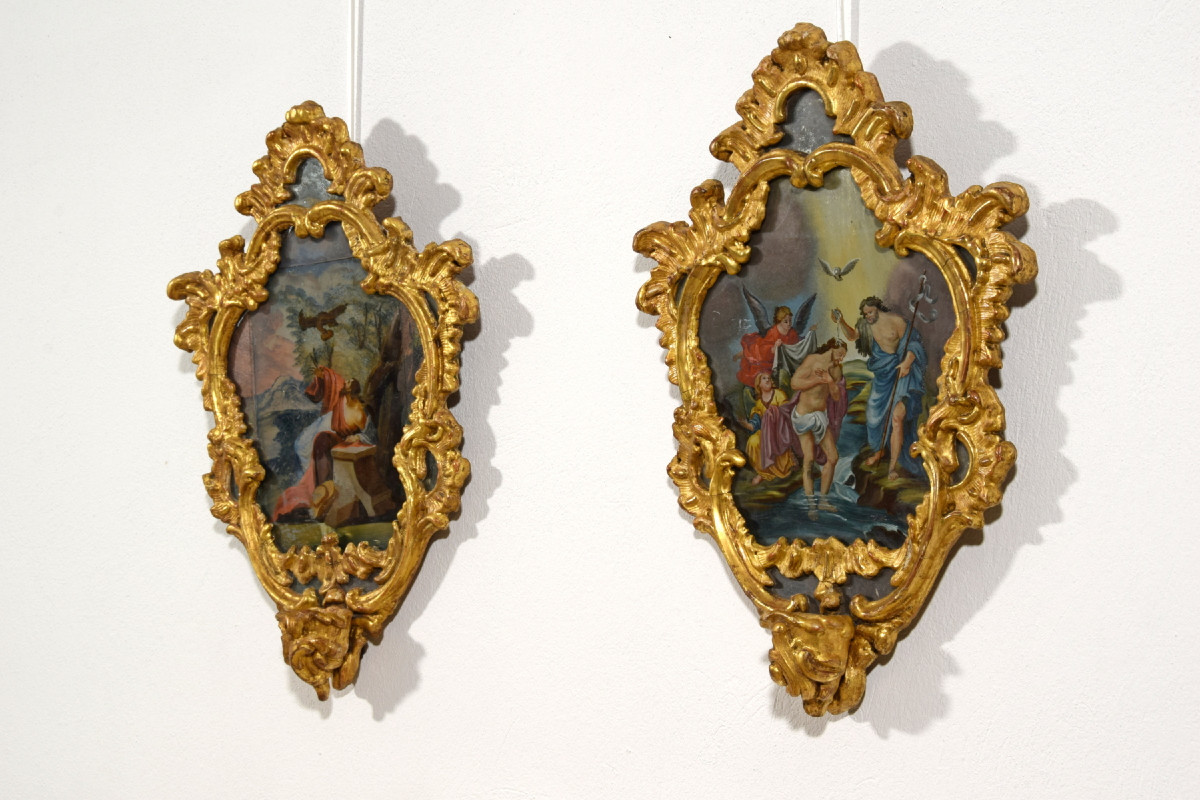
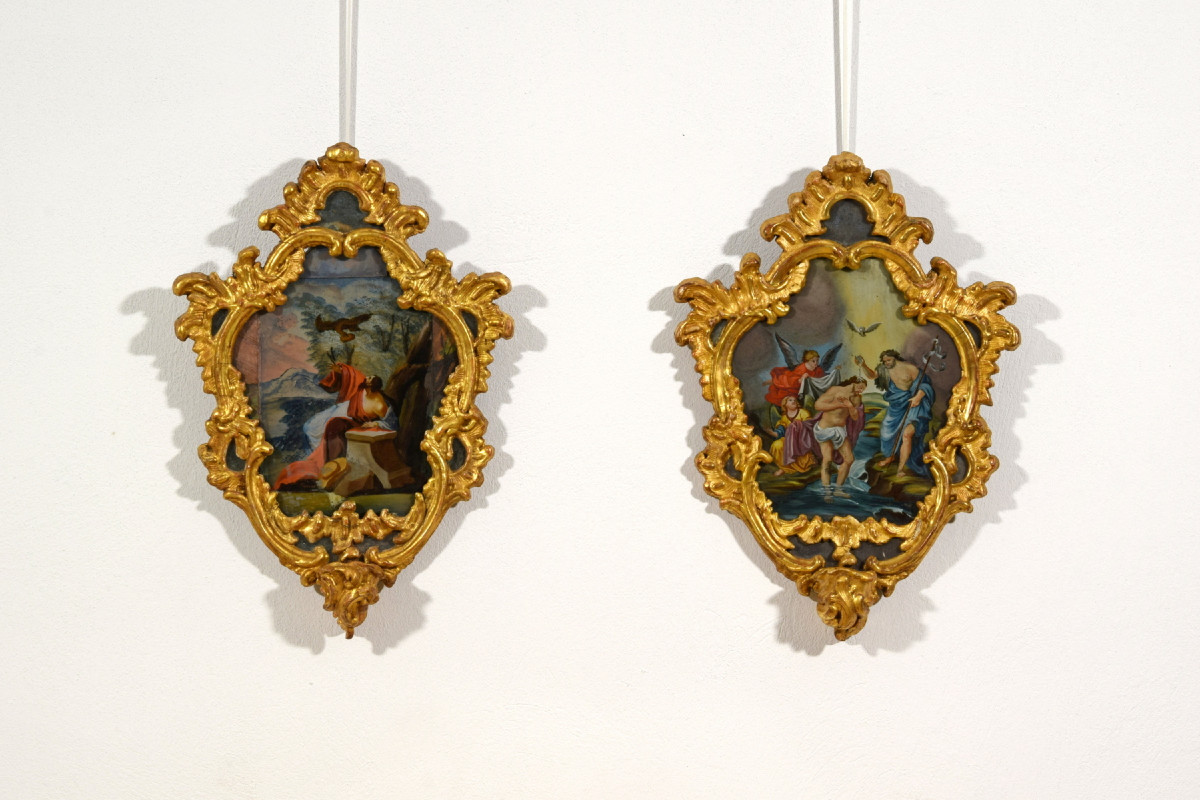
Elijah Fed by Ravens and The Baptism of Christ
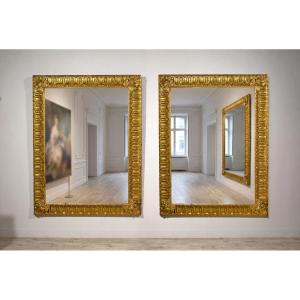
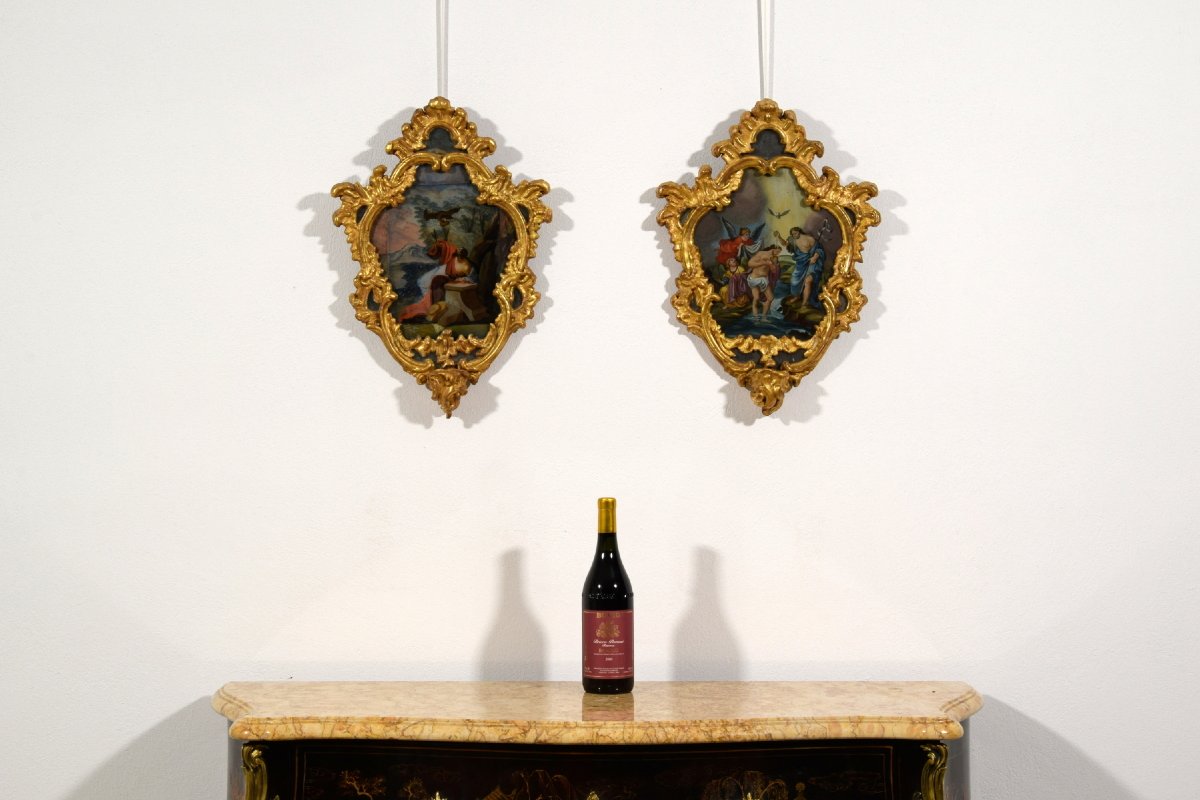
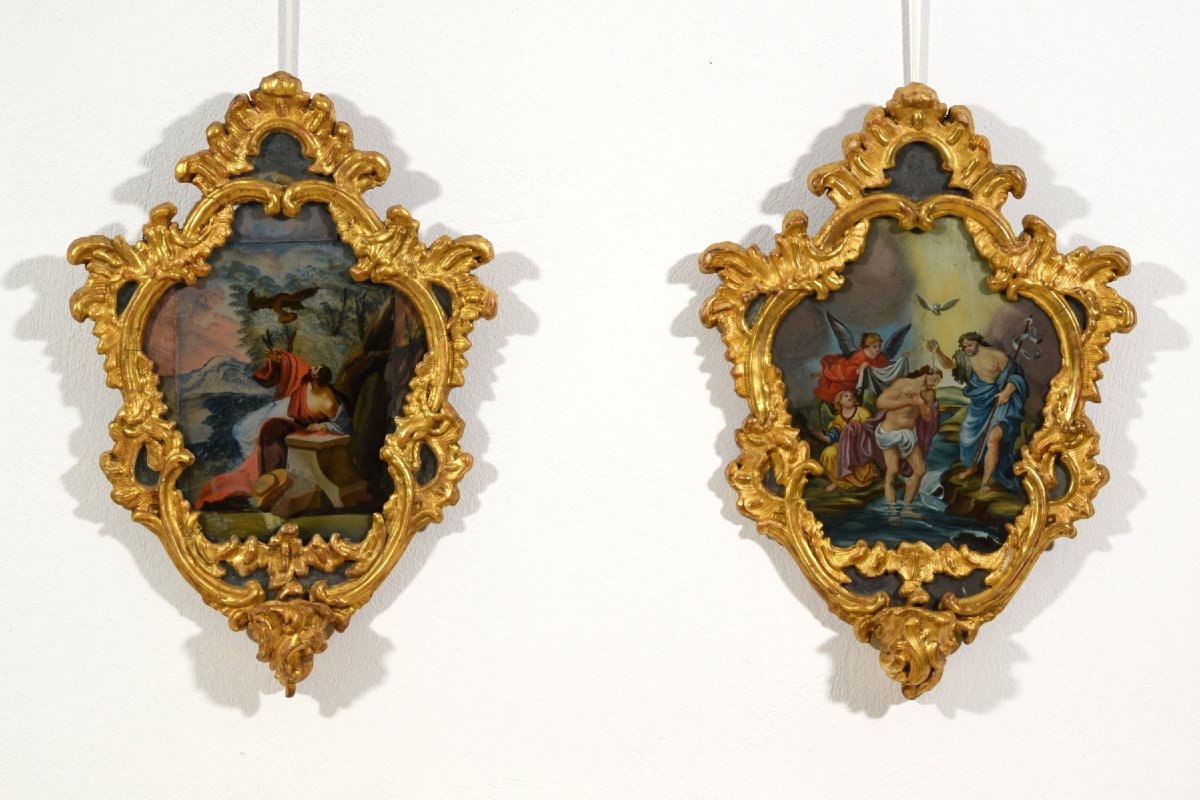
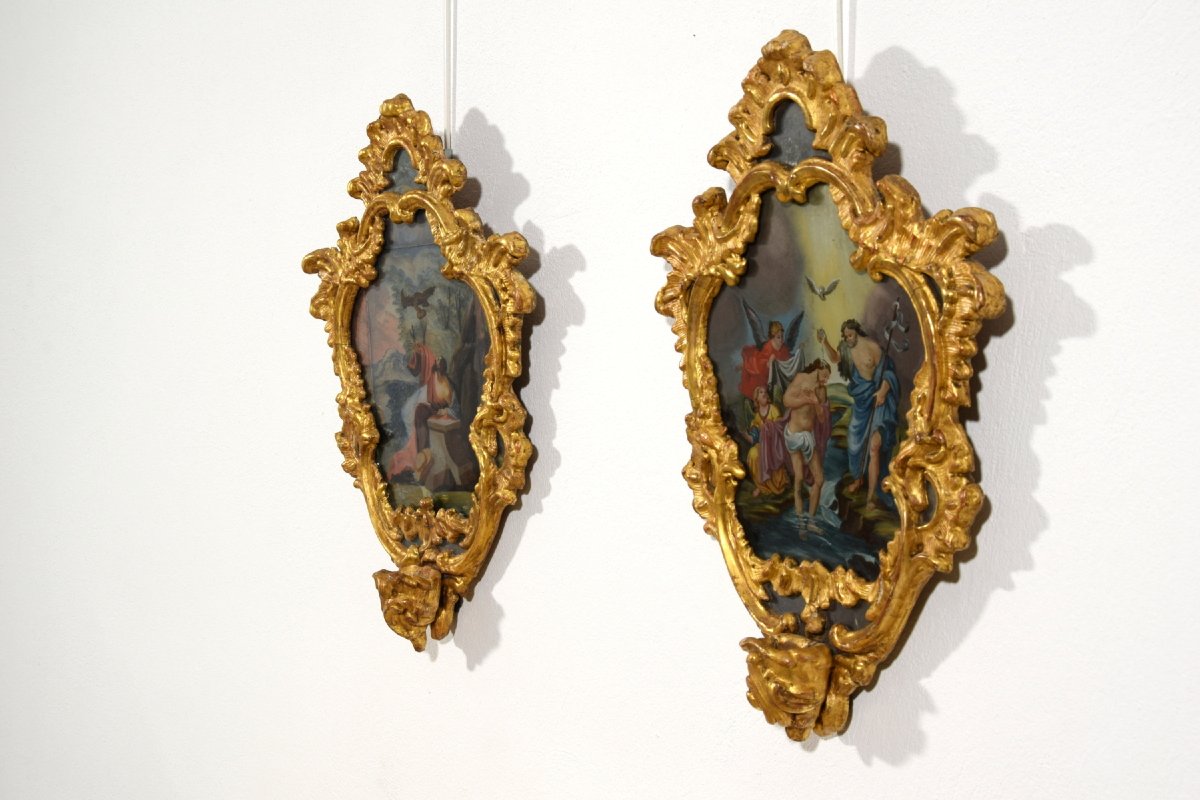
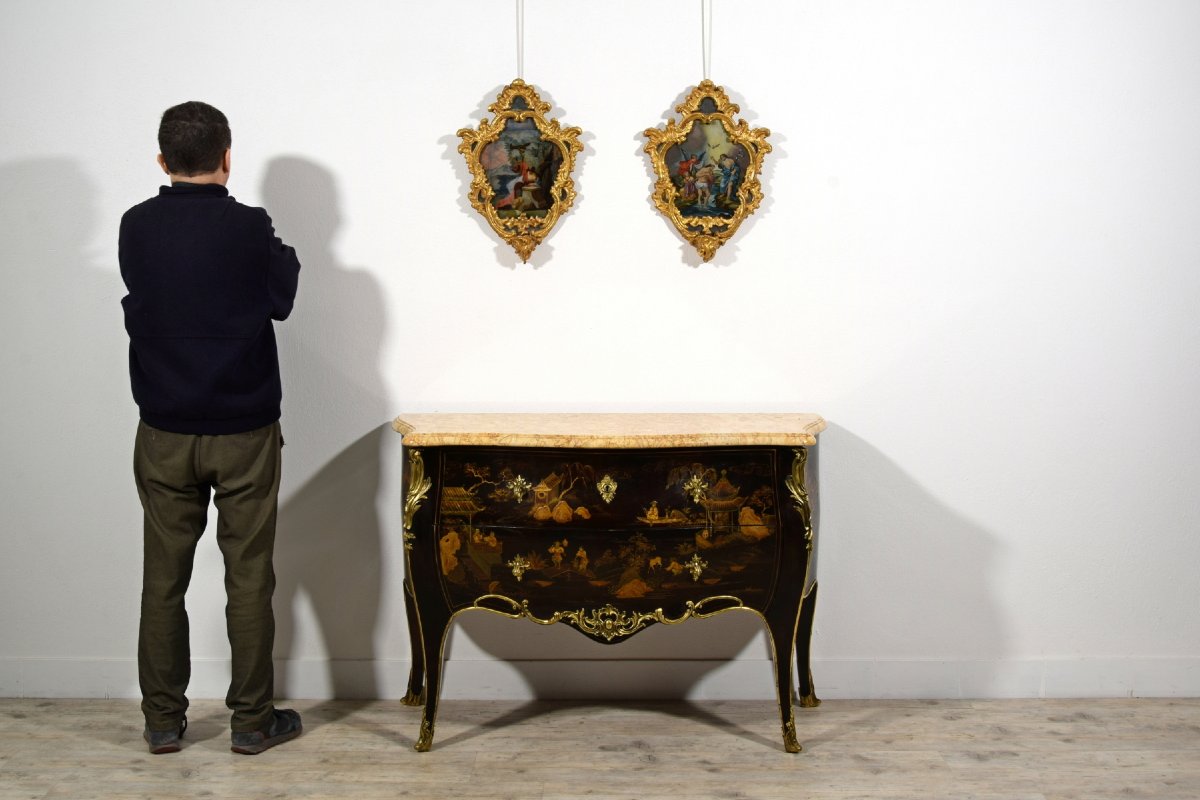
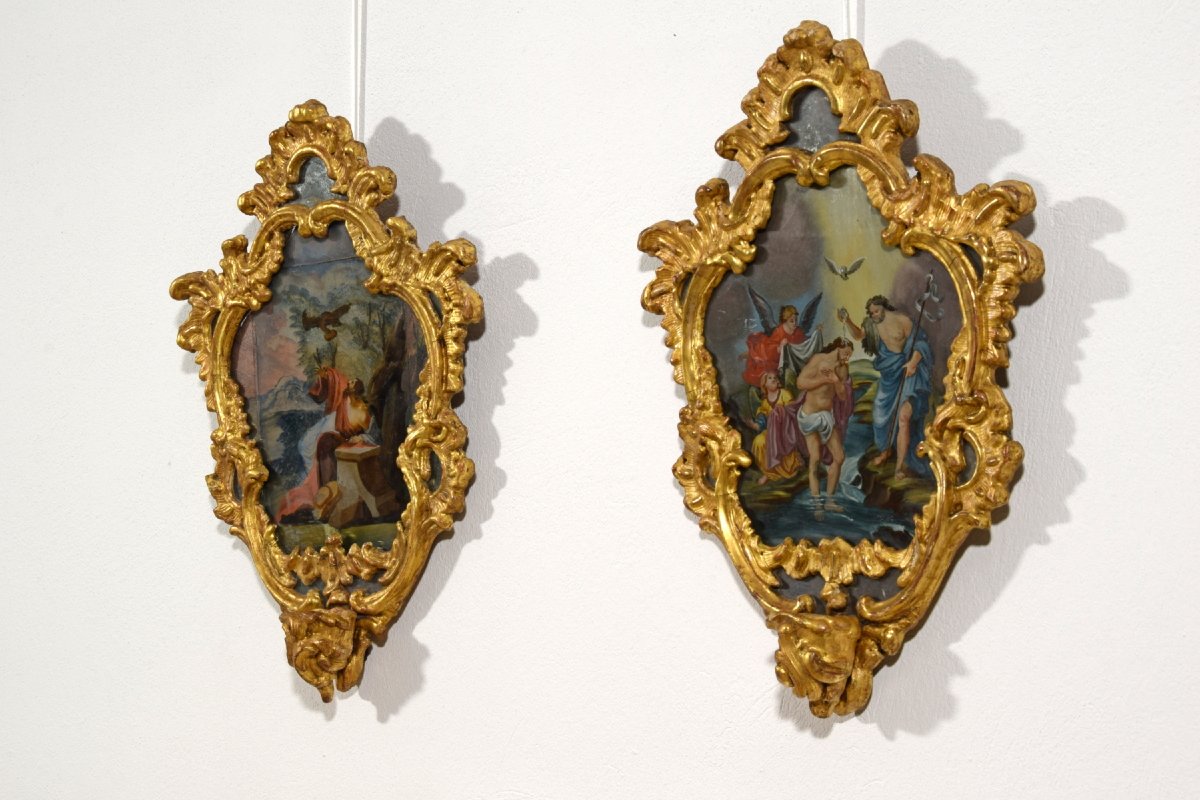
This fine pair of paintings was executed in oil on glass and is presented within Barocchetto-period mirrors, finely carved and gilded wooden frames dating to the mid-eighteenth century and made in Piedmont.
The two paintings respectively depict the biblical subjects Elijah Fed by Ravens and The Baptism of Christ and can be attributed, on stylistic grounds, to the Turin painter Michele Antonio Milocco (Turin, 1690 – Turin, 1772), who in his mature years complemented his large-scale fresco decoration with more intimate works intended for private devotion and noble interiors.
The choice of a glass support, with its highly luminous and precious effect, harmonises perfectly with the rocaille taste of the gilded frames, which set off the scenes like true wall-mounted treasures.
The difficulty of painting on glass lies in the different glide of the brush over the smooth vitreous surface, compared with canvas, and in the fact that the execution must be carried out in reverse and from the back.The painting is thus protected by the glass itself, which is set within the frame.
The episode of Elijah fed by ravens is recounted in the First Book of Kings, chapter 17, verses 1–7.
After announcing a long drought to King Ahab, the prophet Elijah receives from God the command to take refuge by the Wadi Cherith, to the east of the Jordan.
God promises Elijah that he will drink from the stream and that the ravens, at His command, will bring him food.
The prophet obeys and settles by the stream, where every day, morning and evening, he receives bread and meat from the ravens.
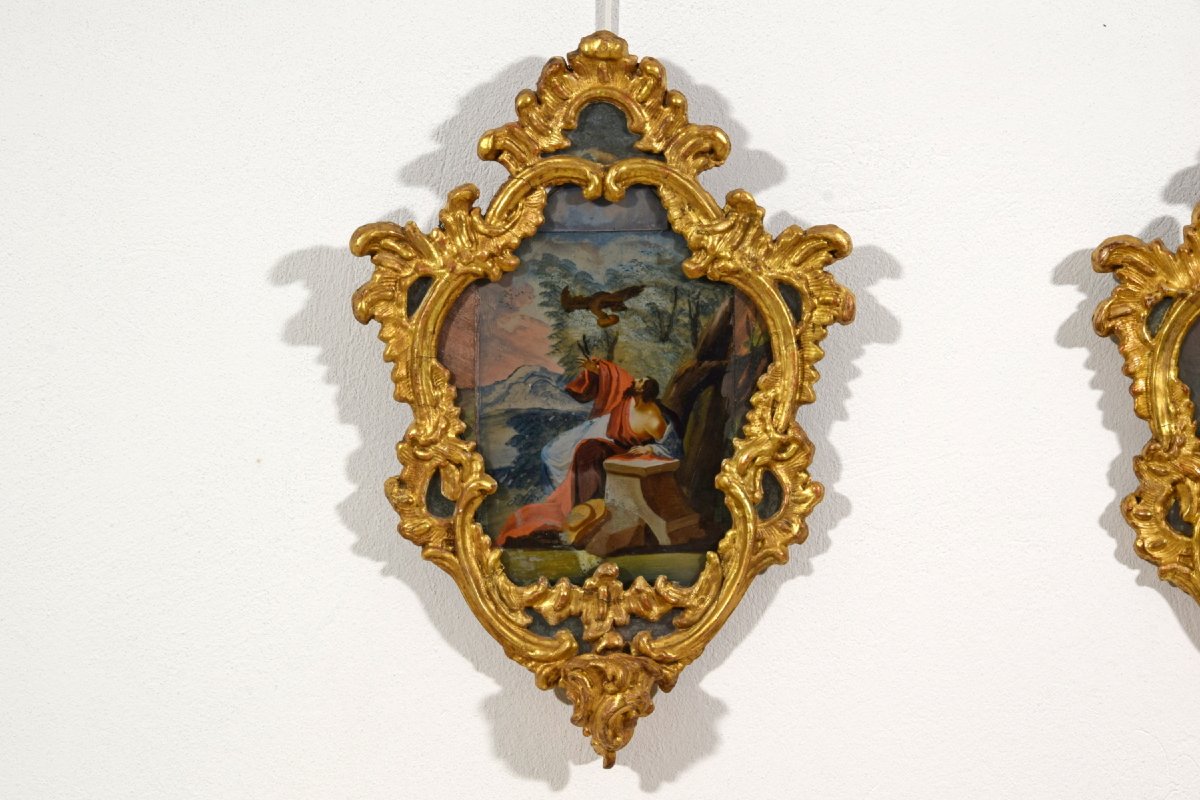
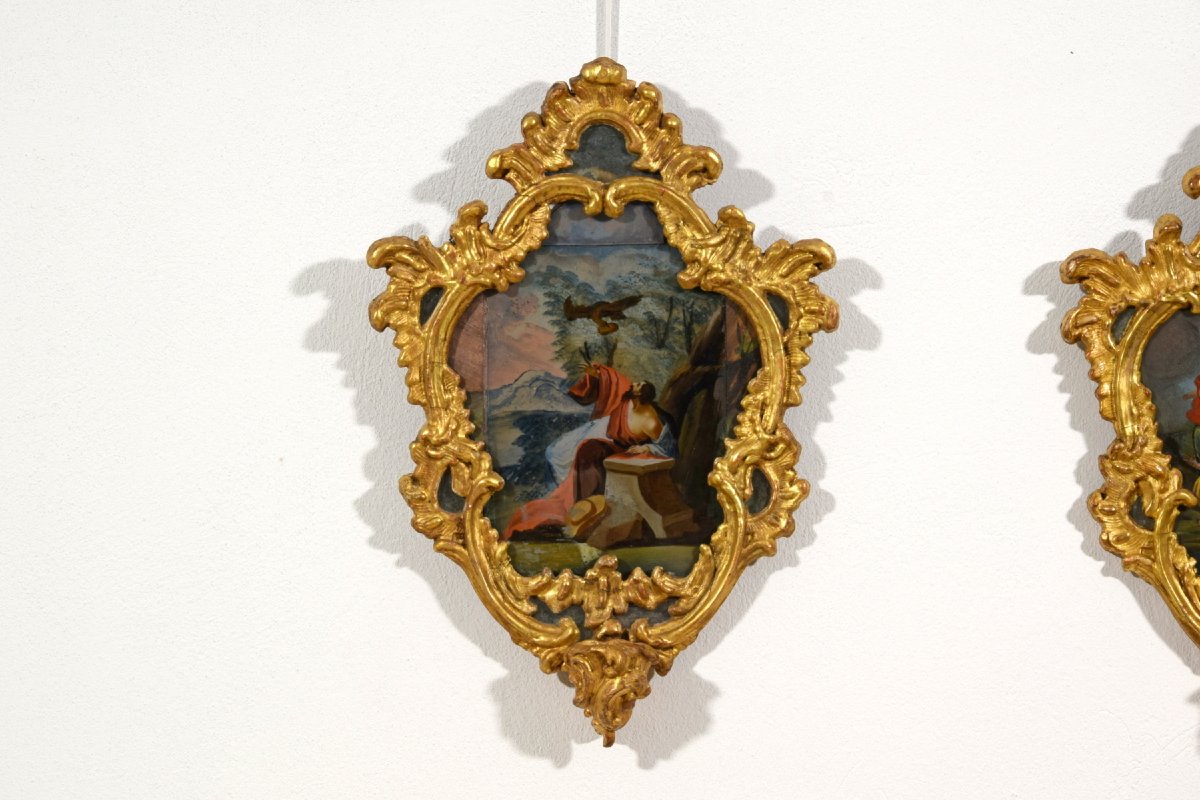
In the painting of Elijah, the artist focuses on the moment of trusting suspension: the prophet, seated on the rock, wearing a red garment and a light mantle that slips to reveal one shoulder, raises his arm towards the raven bringing him bread. The mountainous, stylised landscape, with a solitary tree and open sky, does not seek precise naturalism but rather a theatrical desert atmosphere, functional to the narrative.
Here the mediation of a print source is clearly perceptible, with close affinities to the engraving by Charles Grignion (1721–1810). Milocco interprets it with a softer line and a warm palette with sharp contrasts, adapting the model to the optical requirements of oil on glass.
The episode of the Baptism of Christ is narrated in the synoptic Gospels of Mark (1:9–11), Matthew (3:13–17) and Luke (3:21–22). Jesus came from Galilee to the River Jordan, where John the Baptist was preaching the coming of the Kingdom of God and administering baptism for the forgiveness of sins. Just after he was baptised, as Jesus was coming up out of the water, there was a manifestation of the Trinity: the heavens opened, the Holy Spirit descended upon him in the form of a dove, and a voice from heaven proclaimed, “You are my beloved Son; with you I am well pleased.”
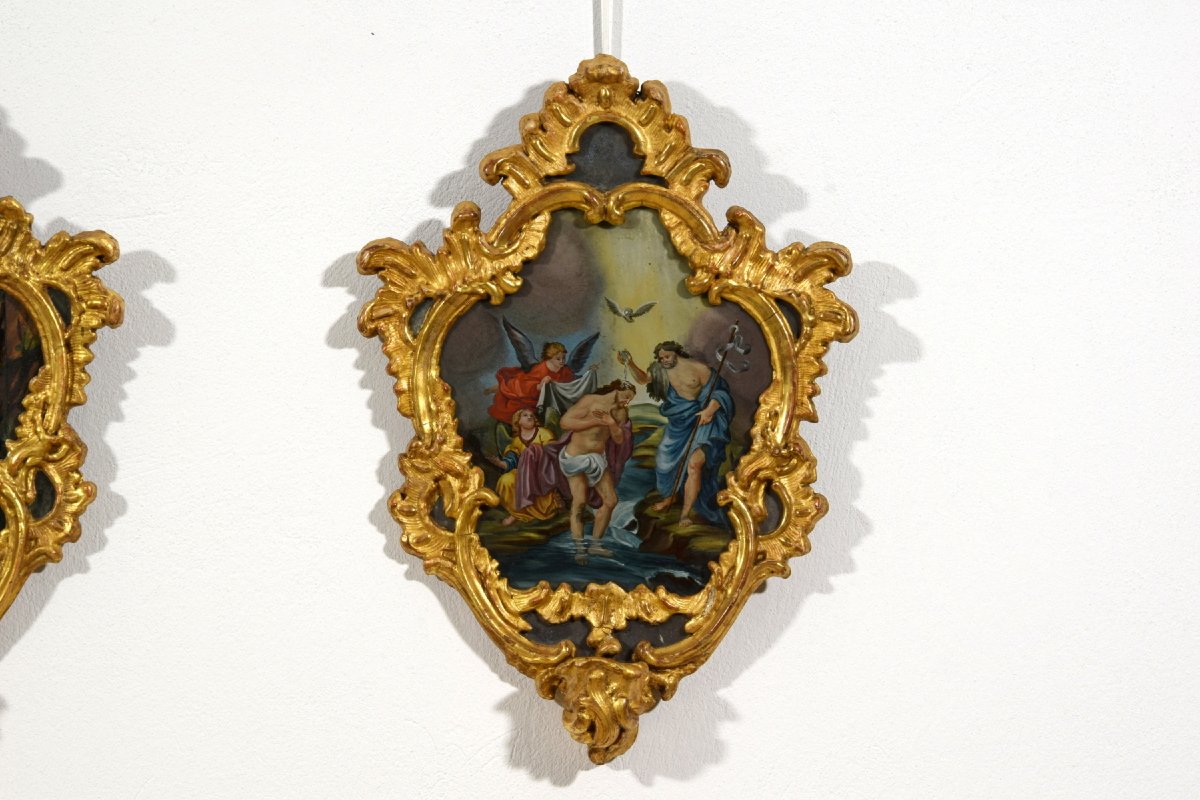
This moment represents the public revelation of Jesus as the Son of God. In Milocco’s painting, the inspiration from a model by Pierre Mignard is evident in the pyramidal construction of the scene: Christ stands at the centre of the river, slightly inclined as he receives the water, Saint John on the bank with the cross-staff, the group of kneeling angels to the left and, above, the opening in the heavens from which the dove of the Holy Spirit descends in a cone of light.
Pierre Mignard (Troyes 1612 – Paris 1695), portraitist and history painter, was called to Paris in 1657 by Louis XIV, who employed him at Versailles and, on the death of Le Brun in 1690, appointed him First Painter to the King. In 1666 he painted, for the majestic high altar of the church of Saint-Jean-au-Marché in Troyes, where he had been baptised, a Baptism of Christ. In 1667–1668 Mignard executed frescoes for the walls of the baptistery chapel of the church of Saint-Eustache in Paris, the most noble and prestigious church in the capital. [...] the Parisian Baptism of Christ was widely reproduced by engravers, including the print presented here, printed by Nicolas Bazin and chosen by Milocco as his source. [...] Read together, the two subjects outline a deliberately coherent theological path.
On the one hand Elijah, the prophet miraculously fed in the desert, emblem of absolute trust in Providence; on the other the Baptism, threshold of the new life in Christ, the moment when the heavens open and the divine voice acknowledges the beloved Son.
The thread that seems to unite the two panels is precisely the action of God: in the bread brought by the raven and in the water of the Jordan that washes and consecrates.
In a domestic setting or a small chapel, for which the two paintings were most likely conceived, this pendant could support meditation on spiritual nourishment.
From a stylistic point of view, these works, datable to the mid eighteenth century, reveal the quality of a confident hand: despite the limitations imposed by the format and the support, the painter handles anatomy and drapery with assurance, moderates movement without excess and maintains a certain elegance of line. Significant parallels emerge with the artistic output of Michele Antonio Milocco (Turin, 1690 – Turin, 1772), [...] one of the leading Piedmontese painters of the eighteenth century, active above all for the Savoy court. [...] The works examined in this study bear witness to a chapter of his “stanza” production, demonstrating the circulation of French and English models in the Piedmontese context and the painter’s ability, with effortless artistic skill, to translate them into refined devotional objects. The paintings are particularly decorative and appealing, both for the luminosity and carving of the gilded frames and for the painter’s palette, rich and vibrant.
In good overall condition, it should be noted that the glass of the work depicting Saint Elijah was probably enlarged to adapt to the profile of the frame and was then completed pictorially at a later stage.
We apologise for any errors in the translation from Italian.
Please click here for the expertise in Italian.
Elijah Fed by Ravens and The Baptism of Christ
This fine pair of paintings was executed in oil on glass and is presented within Barocchetto-period mirrors, finely carved and gilded wooden frames dating to the mid-eighteenth century and made in Piedmont.
The two paintings respectively depict the biblical subjects Elijah Fed by Ravens and The Baptism of Christ and can be attributed, on stylistic grounds, to the Turin painter Michele Antonio Milocco (Turin, 1690 – Turin, 1772), who in his mature years complemented his large-scale fresco decoration with more intimate works intended for private devotion and noble interiors.
The choice of a glass support, with its highly luminous and precious effect, harmonises perfectly with the rocaille taste of the gilded frames, which set off the scenes like true wall-mounted treasures.
The difficulty of painting on glass lies in the different glide of the brush over the smooth vitreous surface, compared with canvas, and in the fact that the execution must be carried out in reverse and from the back.The painting is thus protected by the glass itself, which is set within the frame.
The episode of Elijah fed by ravens is recounted in the First Book of Kings, chapter 17, verses 1–7.
After announcing a long drought to King Ahab, the prophet Elijah receives from God the command to take refuge by the Wadi Cherith, to the east of the Jordan.
God promises Elijah that he will drink from the stream and that the ravens, at His command, will bring him food.
The prophet obeys and settles by the stream, where every day, morning and evening, he receives bread and meat from the ravens.
In the painting of Elijah, the artist focuses on the moment of trusting suspension: the prophet, seated on the rock, wearing a red garment and a light mantle that slips to reveal one shoulder, raises his arm towards the raven bringing him bread. The mountainous, stylised landscape, with a solitary tree and open sky, does not seek precise naturalism but rather a theatrical desert atmosphere, functional to the narrative.
Here the mediation of a print source is clearly perceptible, with close affinities to the engraving by Charles Grignion (1721–1810). Milocco interprets it with a softer line and a warm palette with sharp contrasts, adapting the model to the optical requirements of oil on glass.
The episode of the Baptism of Christ is narrated in the synoptic Gospels of Mark (1:9–11), Matthew (3:13–17) and Luke (3:21–22). Jesus came from Galilee to the River Jordan, where John the Baptist was preaching the coming of the Kingdom of God and administering baptism for the forgiveness of sins. Just after he was baptised, as Jesus was coming up out of the water, there was a manifestation of the Trinity: the heavens opened, the Holy Spirit descended upon him in the form of a dove, and a voice from heaven proclaimed, “You are my beloved Son; with you I am well pleased.”
This moment represents the public revelation of Jesus as the Son of God. In Milocco’s painting, the inspiration from a model by Pierre Mignard is evident in the pyramidal construction of the scene: Christ stands at the centre of the river, slightly inclined as he receives the water, Saint John on the bank with the cross-staff, the group of kneeling angels to the left and, above, the opening in the heavens from which the dove of the Holy Spirit descends in a cone of light.
Pierre Mignard (Troyes 1612 – Paris 1695), portraitist and history painter, was called to Paris in 1657 by Louis XIV, who employed him at Versailles and, on the death of Le Brun in 1690, appointed him First Painter to the King. In 1666 he painted, for the majestic high altar of the church of Saint-Jean-au-Marché in Troyes, where he had been baptised, a Baptism of Christ. In 1667–1668 Mignard executed frescoes for the walls of the baptistery chapel of the church of Saint-Eustache in Paris, the most noble and prestigious church in the capital. [...] the Parisian Baptism of Christ was widely reproduced by engravers, including the print presented here, printed by Nicolas Bazin and chosen by Milocco as his source. [...] Read together, the two subjects outline a deliberately coherent theological path.
On the one hand Elijah, the prophet miraculously fed in the desert, emblem of absolute trust in Providence; on the other the Baptism, threshold of the new life in Christ, the moment when the heavens open and the divine voice acknowledges the beloved Son.
The thread that seems to unite the two panels is precisely the action of God: in the bread brought by the raven and in the water of the Jordan that washes and consecrates.
In a domestic setting or a small chapel, for which the two paintings were most likely conceived, this pendant could support meditation on spiritual nourishment.
From a stylistic point of view, these works, datable to the mid eighteenth century, reveal the quality of a confident hand: despite the limitations imposed by the format and the support, the painter handles anatomy and drapery with assurance, moderates movement without excess and maintains a certain elegance of line. Significant parallels emerge with the artistic output of Michele Antonio Milocco (Turin, 1690 – Turin, 1772), [...] one of the leading Piedmontese painters of the eighteenth century, active above all for the Savoy court. [...] The works examined in this study bear witness to a chapter of his “stanza” production, demonstrating the circulation of French and English models in the Piedmontese context and the painter’s ability, with effortless artistic skill, to translate them into refined devotional objects. The paintings are particularly decorative and appealing, both for the luminosity and carving of the gilded frames and for the painter’s palette, rich and vibrant.
In good overall condition, it should be noted that the glass of the work depicting Saint Elijah was probably enlarged to adapt to the profile of the frame and was then completed pictorially at a later stage.
We apologise for any errors in the translation from Italian.
Please click here for the expertise in Italian.
12 500 €
Period: 18th century
Style: Louis 15th - Transition
Condition: Good condition
Material: Glass
Width: 37
Height: 51
Depth: 9
Reference (ID): 1762601
Availability: In stock
Print