

A Follower Of Charles Le Brun (paris, 1619–1690), The Entry Of Alexander The Great Into Babylon
Follower of Charles le Brun (Paris, 1619 – 1690)
Entry of Alexander the Great into Babylon
Oil on canvas, 29 x 36 cm – with frame, 43 x 51 cm
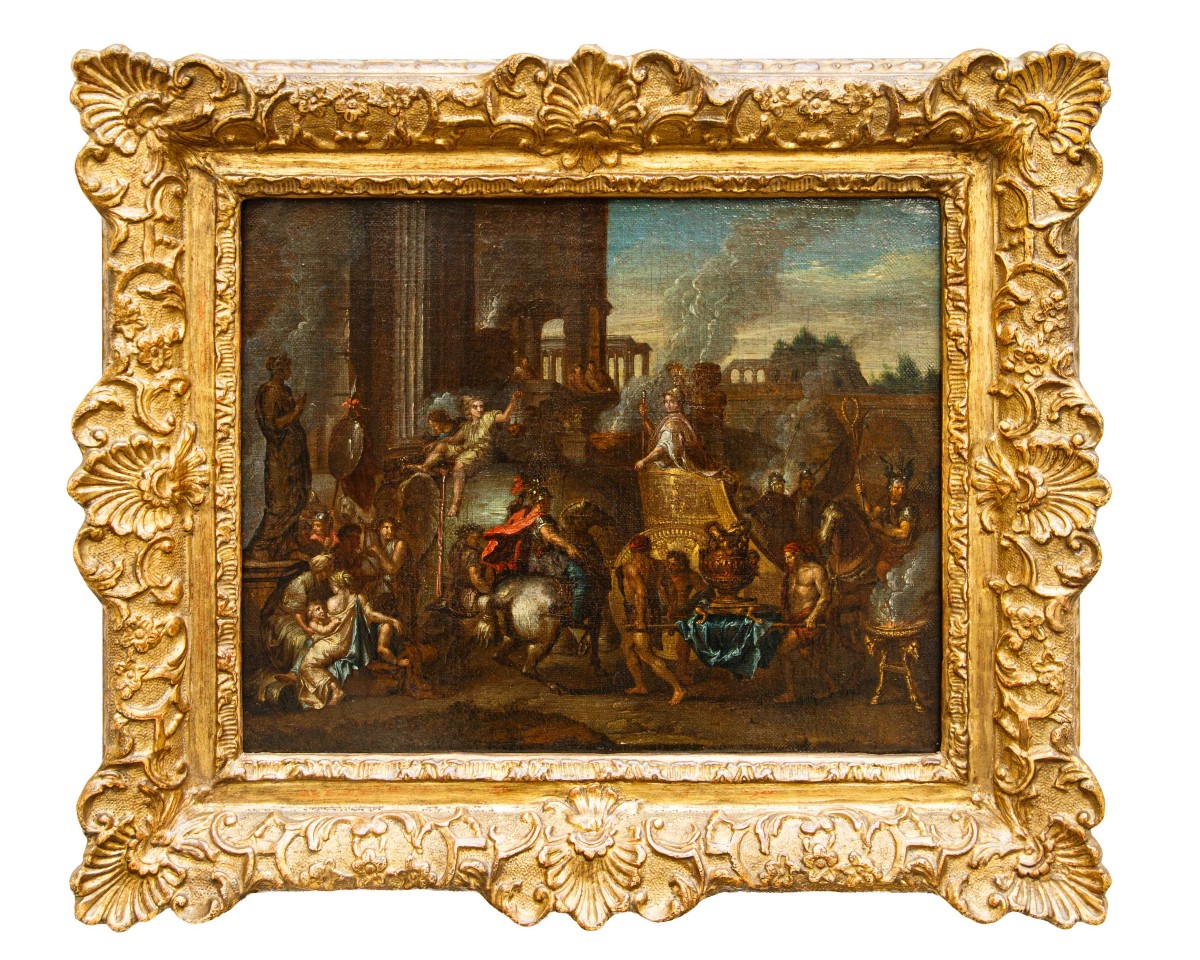
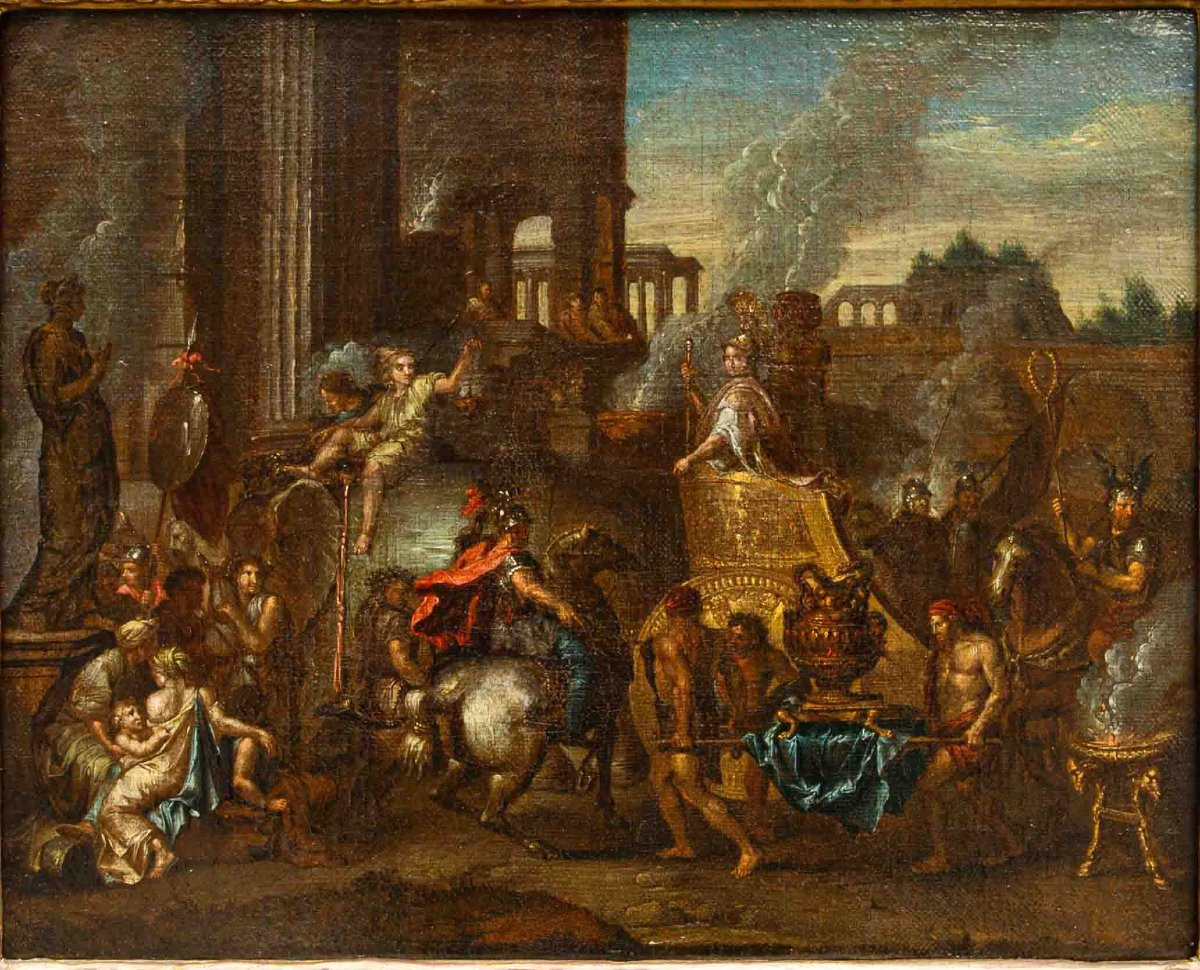
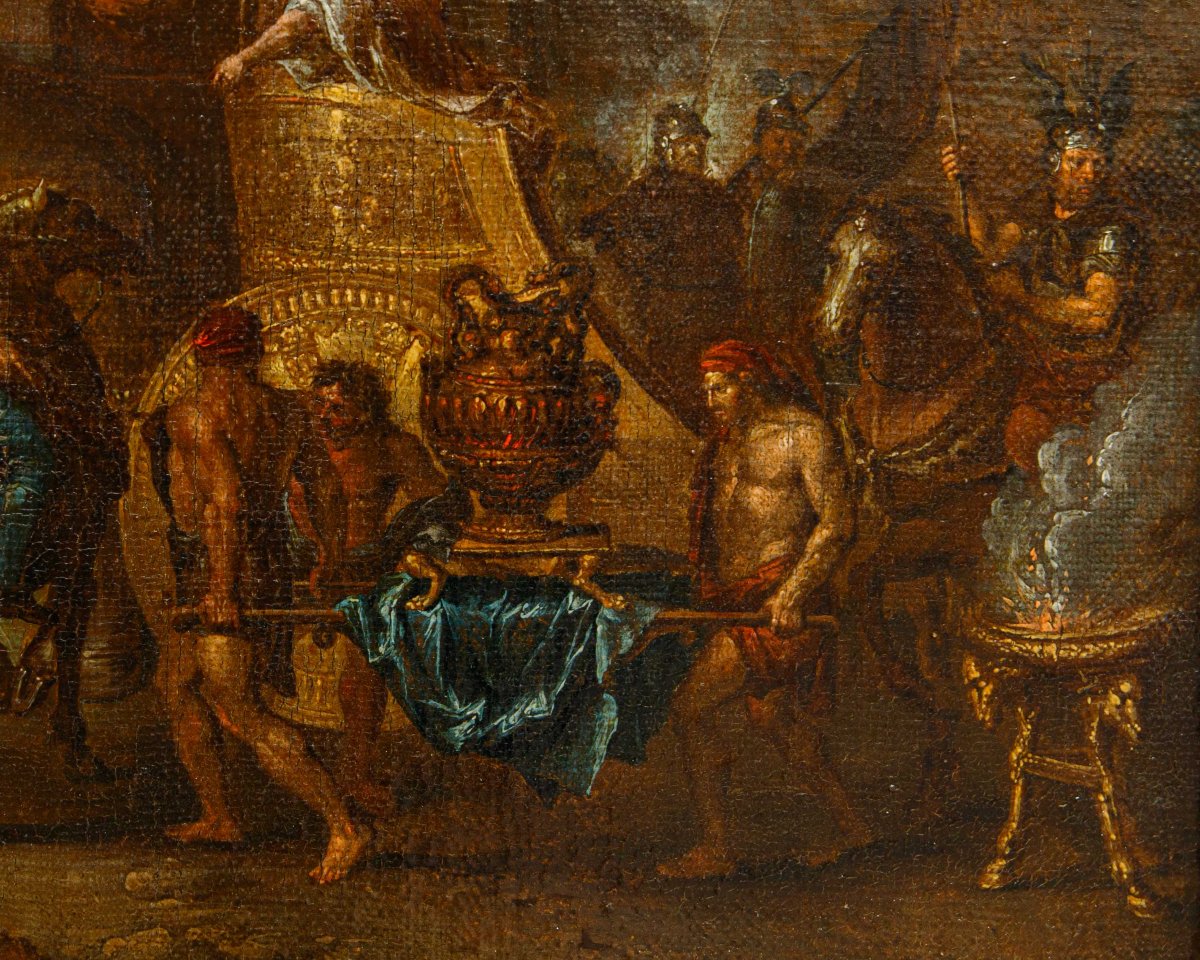
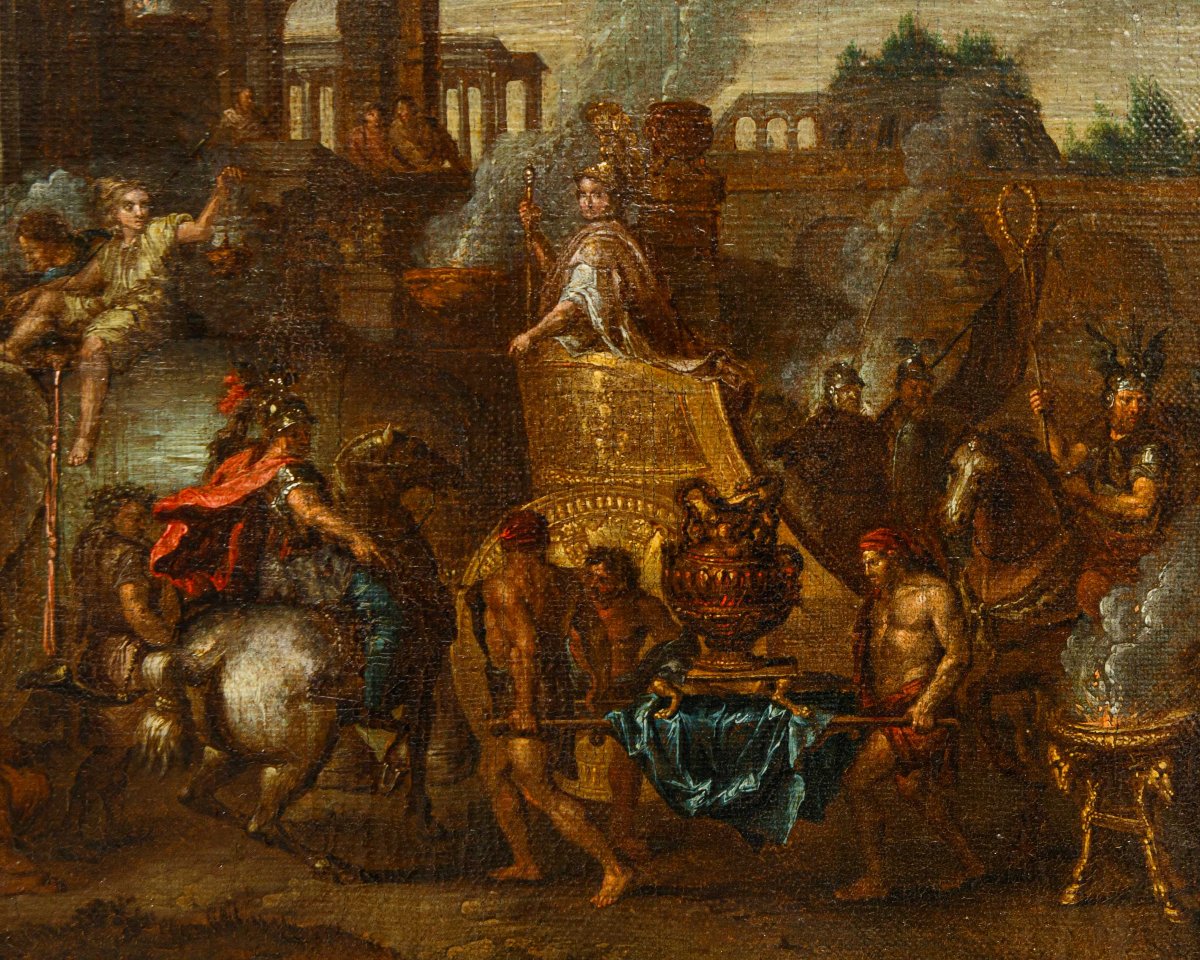
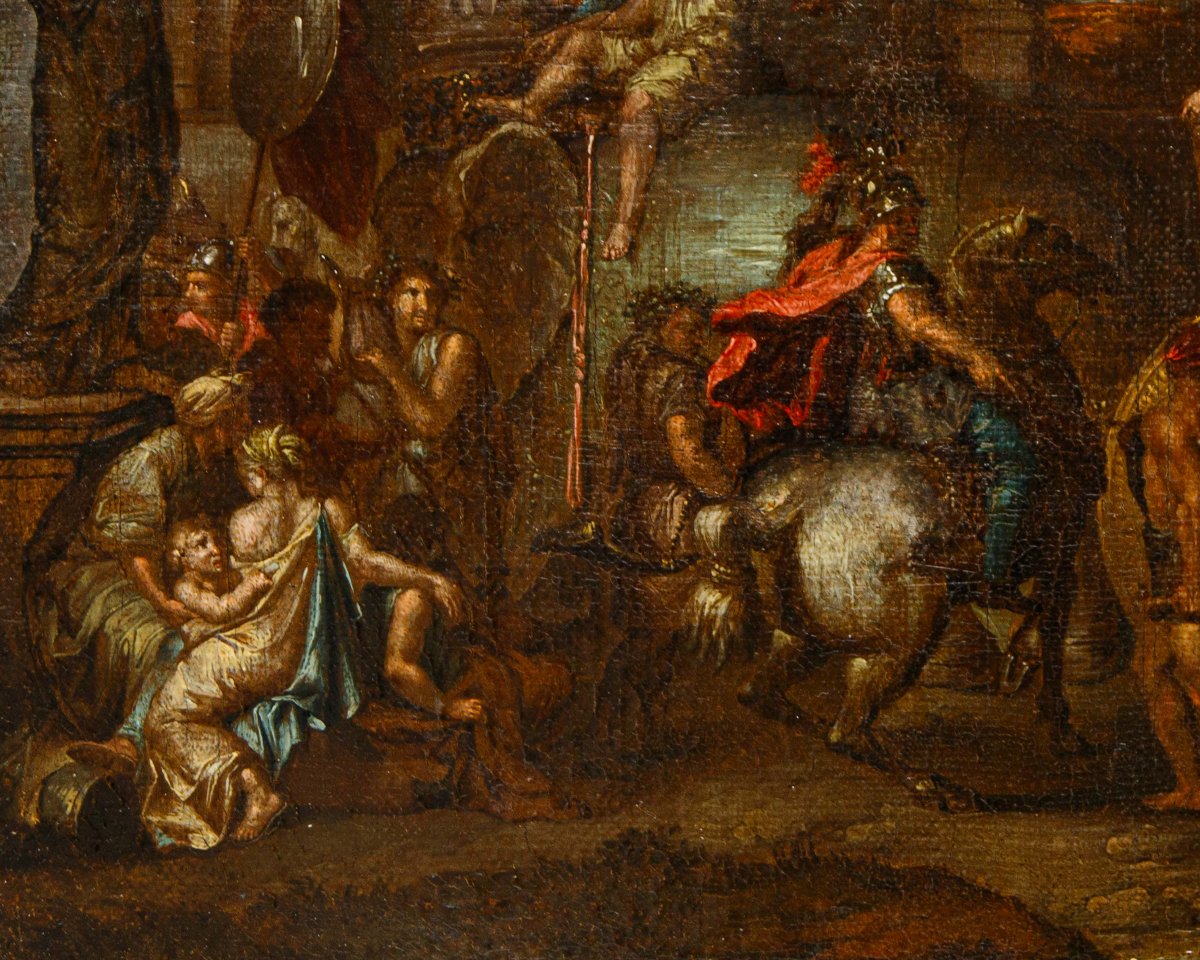
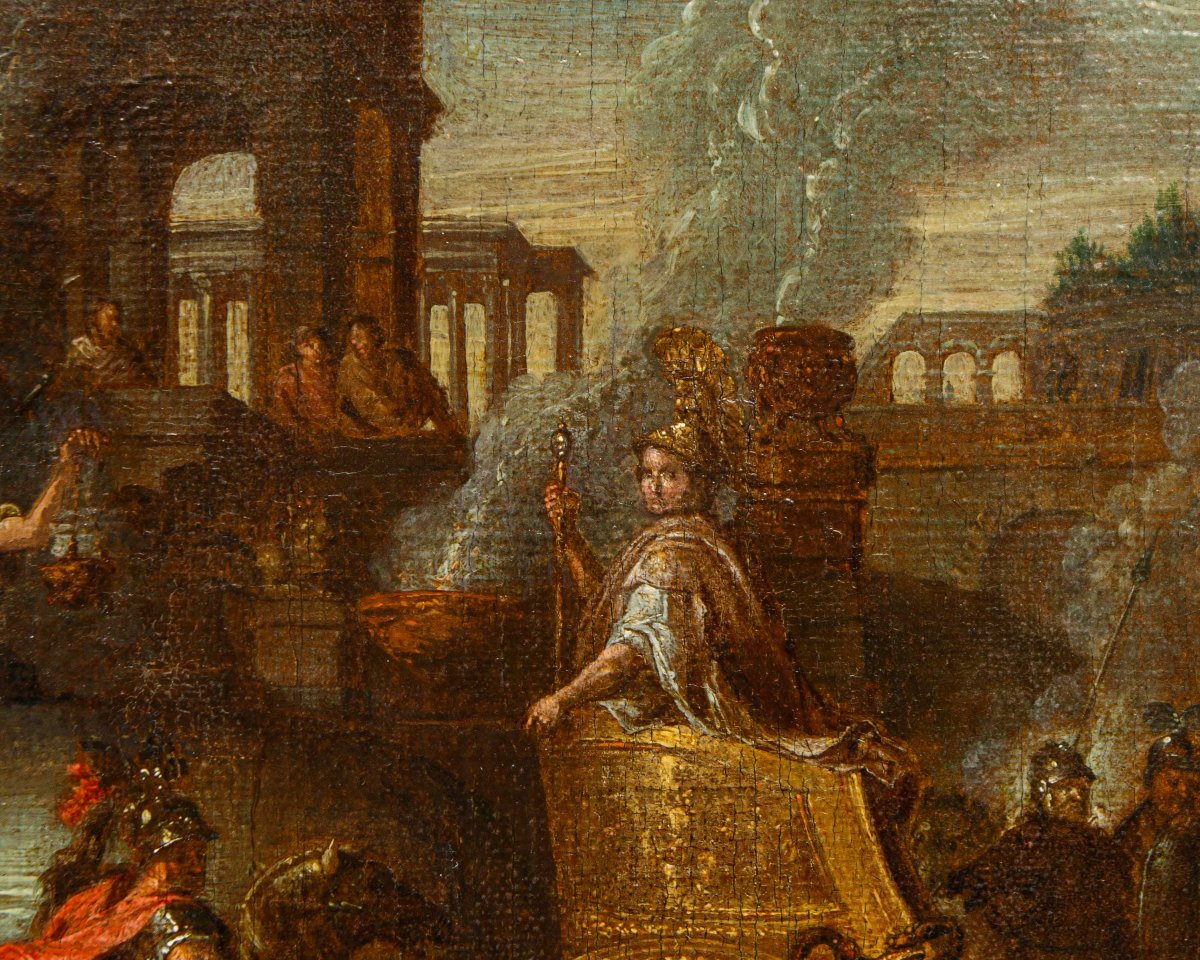
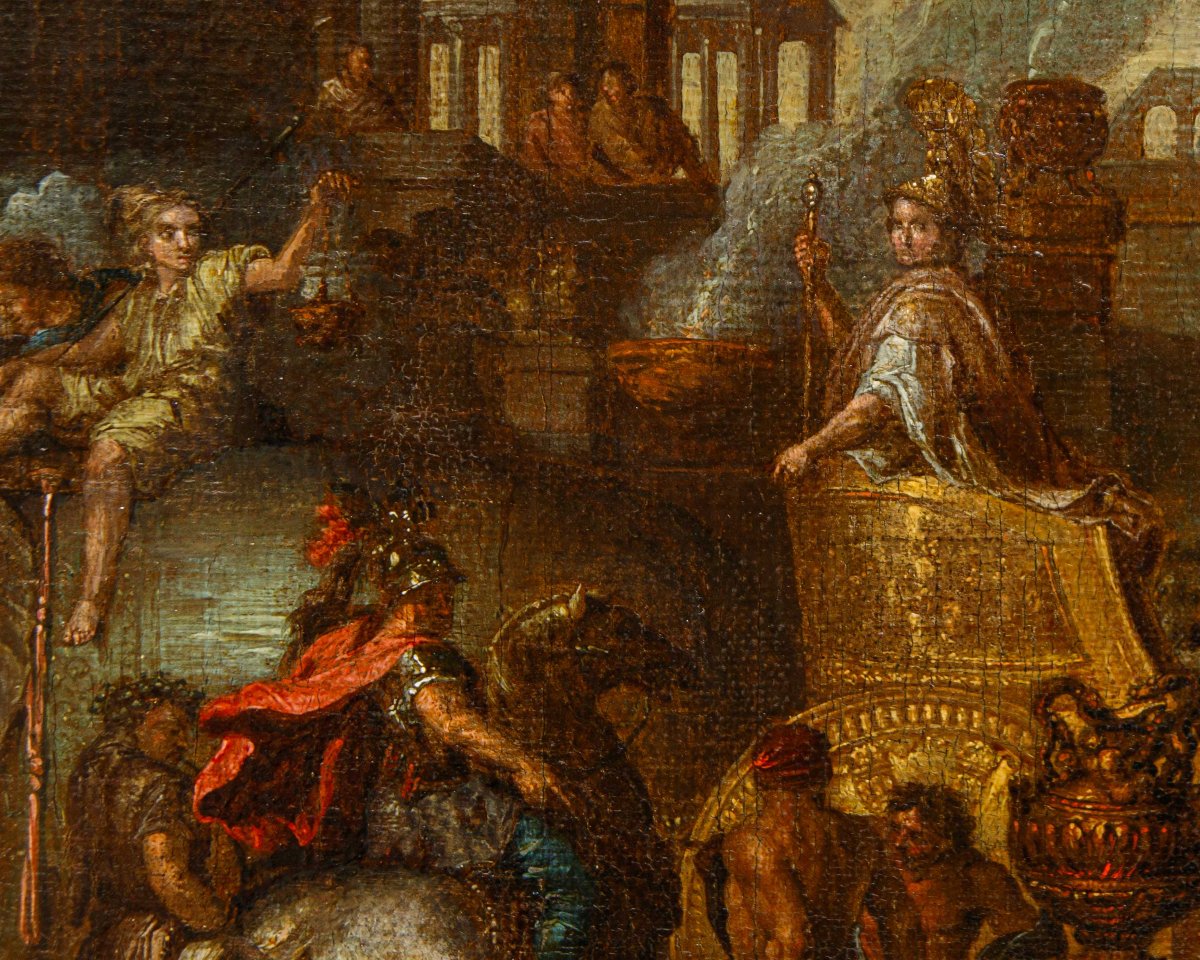
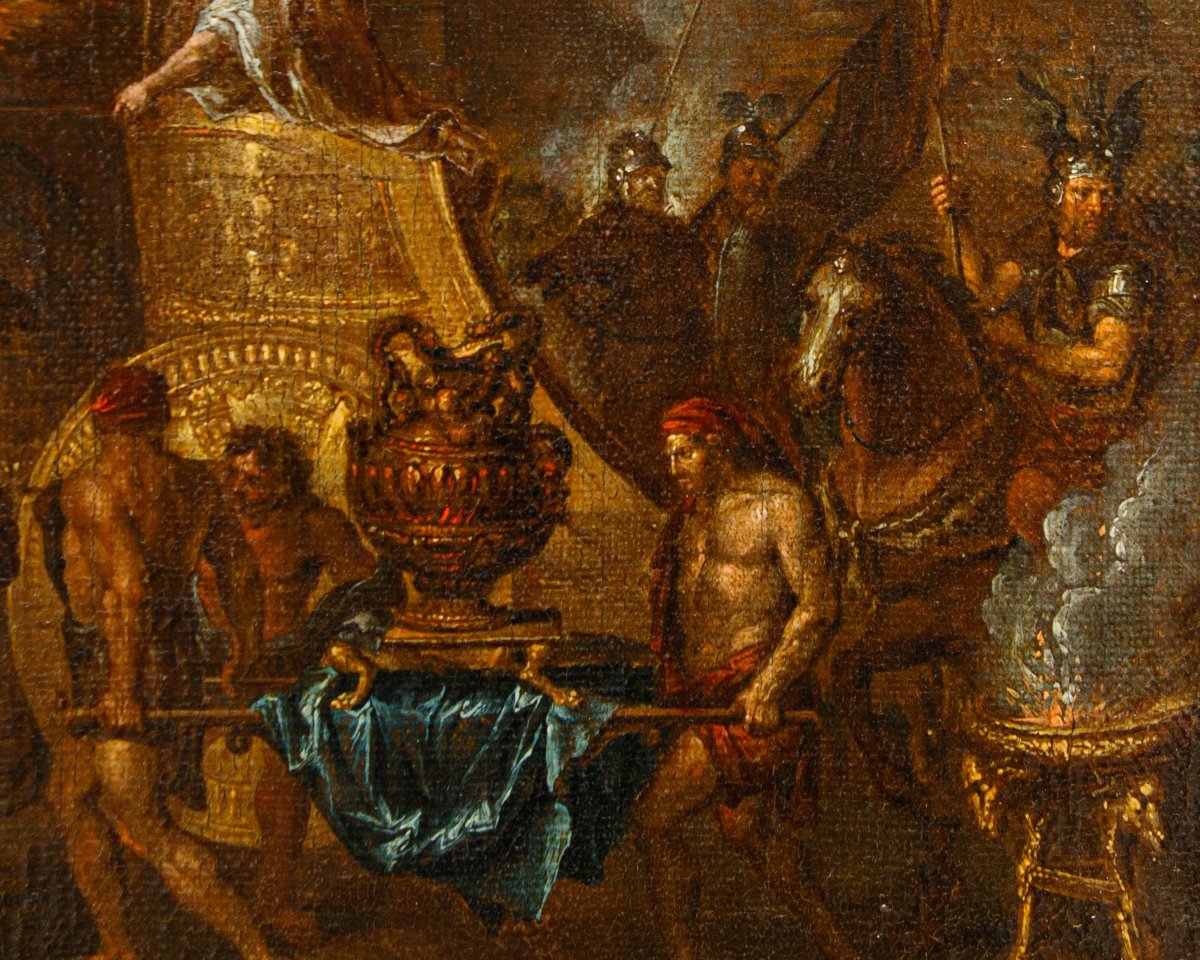
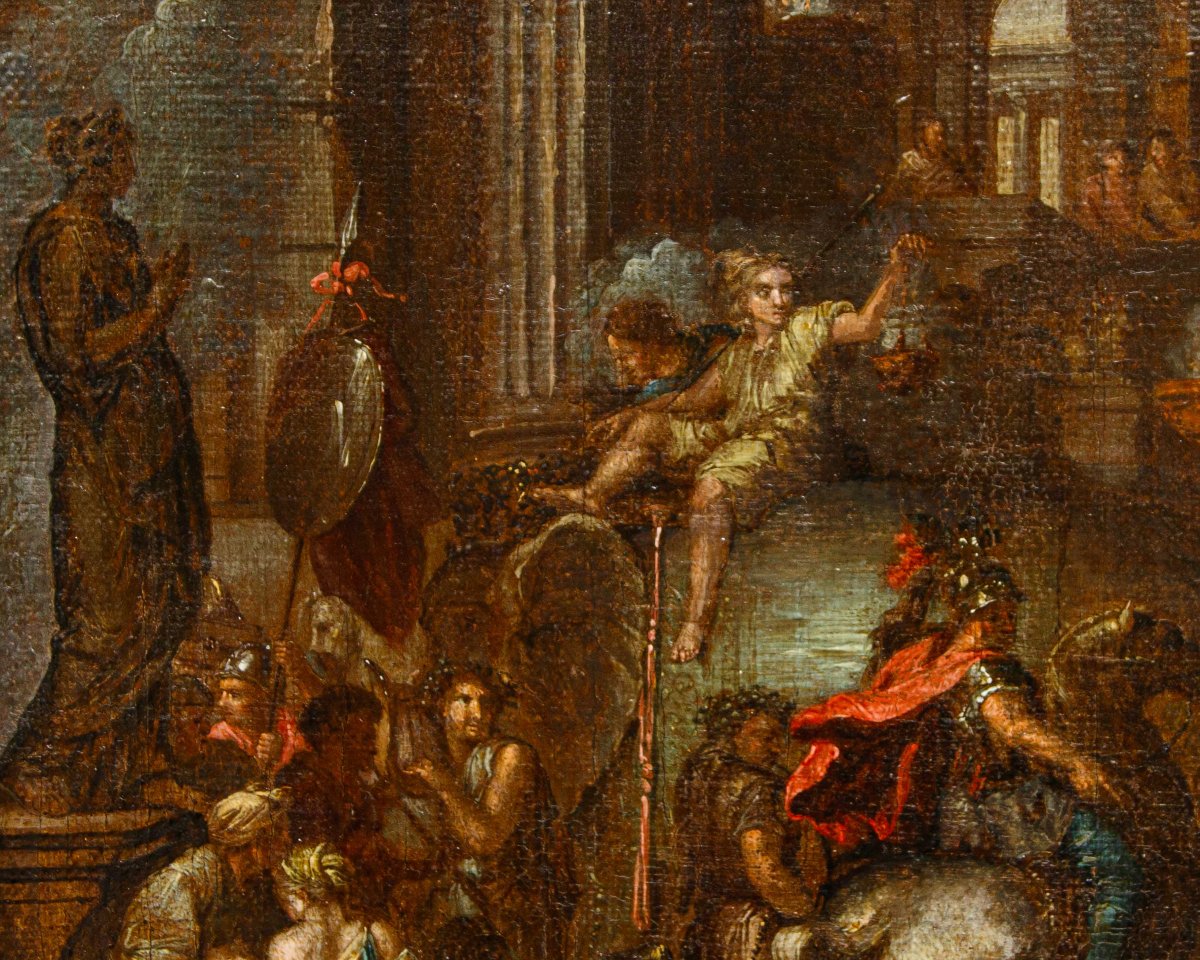
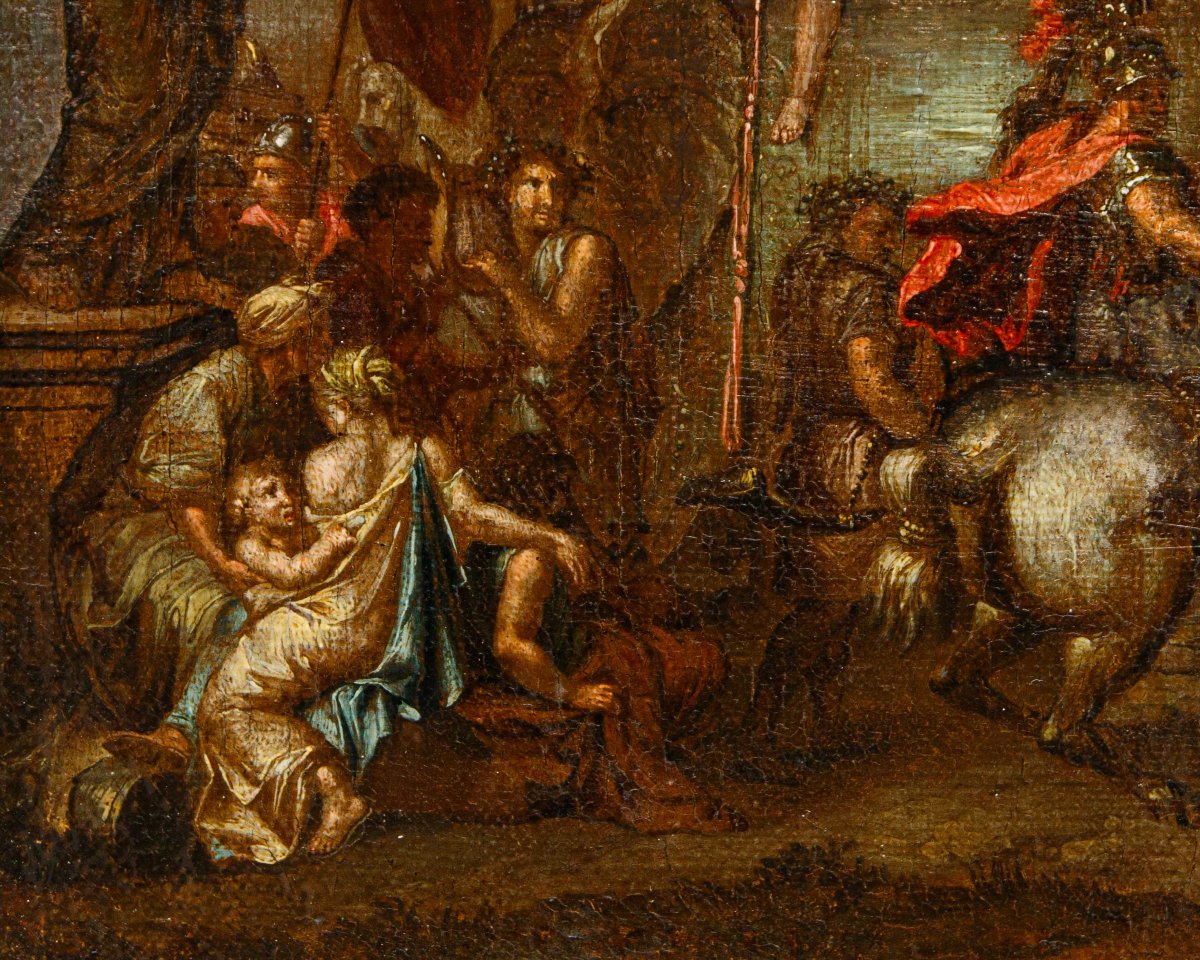
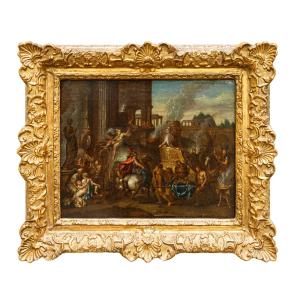
The Triumphal Entry of Alexander the Great into Babylon, a subject of great success in European art of the seventeenth and eighteenth centuries, is here returned in a reduced format by a painter and follower of Charles Le Brun who draws directly from the master's famous autograph composition preserved in the Louvre. The work, oil on canvas, condenses with remarkable narrative skill the entire stage machinery conceived by the French painter, re-proposing its fundamental compositional nuclei in a more collected version but with the same dramatic tension. The scene opens onto a fictional architectural landscape that evokes the oriental grandeur of Babylon through a backdrop of colonnades, arches and degrading terraces. In the background, temple structures and wall backdrops can be glimpsed, alluding to the legendary Hanging Gardens, one of the Seven Wonders of the Ancient World described by Quintus Curtius Rufus as supported by stone columns and irrigated by secret aqueducts. Alexander's elephant-drawn triumphal chariot dominates the center of the composition: the Macedonian leader, seated in a regal position and dressed in armor and a feathered helmet, holds the scepter of command in his hand. Around the chariot moves a varied crowd of soldiers, dignitaries, porters and popular figures who enliven the scene with agitated gestures and dynamic postures. In the left foreground, a group of female and child figures are rendered with particular attention to the pathetic: a woman sitting with an infant in her arms and another bent to the ground evoke the vanquished populations or subjects prostrate before the victor. On the far left, leaning against the architectural structure, stands the colossal statue of Semiramis, the legendary founding queen of Babylon, recognizable by the scepter held in one hand and the pomegranate in the other, a symbol of the unity of the state: Le Brun had been inspired for this figure by the Mattei-type Modesty preserved in the Vatican, and the painter and follower understood its austere and monumental character, while simplifying its rendering.
To fully understand the significance and success of a work like this, we must remember who Charles Le Brun was and what extraordinary role he played in the history of European art. Born in Paris in 1619 to a family of sculptors, Le Brun revealed an exceptional talent at an early age that attracted the attention of Chancellor Séguier, who financed his education in Rome from 1642 to 1645. In the Eternal City, the young painter studied with Nicolas Poussin, absorbing his compositional rigor and antiquarian culture, and directly confronted the great masters of the past and contemporary Baroque painting. Upon returning to France his career experienced a meteoric rise: in 1648 he was among the founders of the Académie Royale de Peinture et de Sculpture, an institution intended to codify the principles of the French Grand Goût and to train generations of artists according to a canon based on reason, on the imitation of the ancients and on the study of Raphael and Poussin. The real leap in quality came under the patronage of Louis XIV and his minister Colbert, who in 1661 appointed Le Brun director of the Gobelins Manufactory, the large royal workshop that produced tapestries, furniture, goldsmith's work and all kinds of decorative objects for the crown residences. In this capacity Le Brun became the absolute artistic director of the image of the Sun King, designing the decorative cycles of Versailles, conceiving the cartoons for the tapestries of the history of Alexander and the king, overseeing the Grande Galerie and the Galerie des Glaces. In 1664 he obtained the title of Premier peintre du Roi, the highest recognition the monarchy could give to an artist, and held this title unchallenged until Colbert's death in 1683, when court intrigues favored the rise of his rival Pierre Mignard. The pictorial cycle dedicated to Alexander the Great, of which the Entry into Babylon is a fundamental part together with the Battle of the Granicus, the Crossing of the Granicus, the Battle of Arbela and The Queens of Persia at Alexander's Feet, represents the pinnacle of his production and at the same time a sophisticated political programme, in which the deeds of the Macedonian leader transparently allude to Louis XIV's ambitions for greatness. The diffusion of the Lebrunian compositions occurred through multiple channels. Girard Audran engraved the Entry into Babylon in four large-format plates in 1676, and similar engravings were made for the other canvases in the cycle, allowing painters, decorators and craftsmen from across the continent to study and replicate those inventions. In France numerous followers and pupils of Le Brun produced abridged versions, copies and variants of his most famous works.
Entry of Alexander the Great into Babylon
Oil on canvas, 29 x 36 cm – with frame, 43 x 51 cm
The Triumphal Entry of Alexander the Great into Babylon, a subject of great success in European art of the seventeenth and eighteenth centuries, is here returned in a reduced format by a painter and follower of Charles Le Brun who draws directly from the master's famous autograph composition preserved in the Louvre. The work, oil on canvas, condenses with remarkable narrative skill the entire stage machinery conceived by the French painter, re-proposing its fundamental compositional nuclei in a more collected version but with the same dramatic tension. The scene opens onto a fictional architectural landscape that evokes the oriental grandeur of Babylon through a backdrop of colonnades, arches and degrading terraces. In the background, temple structures and wall backdrops can be glimpsed, alluding to the legendary Hanging Gardens, one of the Seven Wonders of the Ancient World described by Quintus Curtius Rufus as supported by stone columns and irrigated by secret aqueducts. Alexander's elephant-drawn triumphal chariot dominates the center of the composition: the Macedonian leader, seated in a regal position and dressed in armor and a feathered helmet, holds the scepter of command in his hand. Around the chariot moves a varied crowd of soldiers, dignitaries, porters and popular figures who enliven the scene with agitated gestures and dynamic postures. In the left foreground, a group of female and child figures are rendered with particular attention to the pathetic: a woman sitting with an infant in her arms and another bent to the ground evoke the vanquished populations or subjects prostrate before the victor. On the far left, leaning against the architectural structure, stands the colossal statue of Semiramis, the legendary founding queen of Babylon, recognizable by the scepter held in one hand and the pomegranate in the other, a symbol of the unity of the state: Le Brun had been inspired for this figure by the Mattei-type Modesty preserved in the Vatican, and the painter and follower understood its austere and monumental character, while simplifying its rendering.
To fully understand the significance and success of a work like this, we must remember who Charles Le Brun was and what extraordinary role he played in the history of European art. Born in Paris in 1619 to a family of sculptors, Le Brun revealed an exceptional talent at an early age that attracted the attention of Chancellor Séguier, who financed his education in Rome from 1642 to 1645. In the Eternal City, the young painter studied with Nicolas Poussin, absorbing his compositional rigor and antiquarian culture, and directly confronted the great masters of the past and contemporary Baroque painting. Upon returning to France his career experienced a meteoric rise: in 1648 he was among the founders of the Académie Royale de Peinture et de Sculpture, an institution intended to codify the principles of the French Grand Goût and to train generations of artists according to a canon based on reason, on the imitation of the ancients and on the study of Raphael and Poussin. The real leap in quality came under the patronage of Louis XIV and his minister Colbert, who in 1661 appointed Le Brun director of the Gobelins Manufactory, the large royal workshop that produced tapestries, furniture, goldsmith's work and all kinds of decorative objects for the crown residences. In this capacity Le Brun became the absolute artistic director of the image of the Sun King, designing the decorative cycles of Versailles, conceiving the cartoons for the tapestries of the history of Alexander and the king, overseeing the Grande Galerie and the Galerie des Glaces. In 1664 he obtained the title of Premier peintre du Roi, the highest recognition the monarchy could give to an artist, and held this title unchallenged until Colbert's death in 1683, when court intrigues favored the rise of his rival Pierre Mignard. The pictorial cycle dedicated to Alexander the Great, of which the Entry into Babylon is a fundamental part together with the Battle of the Granicus, the Crossing of the Granicus, the Battle of Arbela and The Queens of Persia at Alexander's Feet, represents the pinnacle of his production and at the same time a sophisticated political programme, in which the deeds of the Macedonian leader transparently allude to Louis XIV's ambitions for greatness. The diffusion of the Lebrunian compositions occurred through multiple channels. Girard Audran engraved the Entry into Babylon in four large-format plates in 1676, and similar engravings were made for the other canvases in the cycle, allowing painters, decorators and craftsmen from across the continent to study and replicate those inventions. In France numerous followers and pupils of Le Brun produced abridged versions, copies and variants of his most famous works.
3 600 €
Period: 17th century
Style: Other Style
Condition: Good condition
Material: Oil painting
Width: 36
Height: 29
Reference (ID): 1762376
Availability: In stock
Print