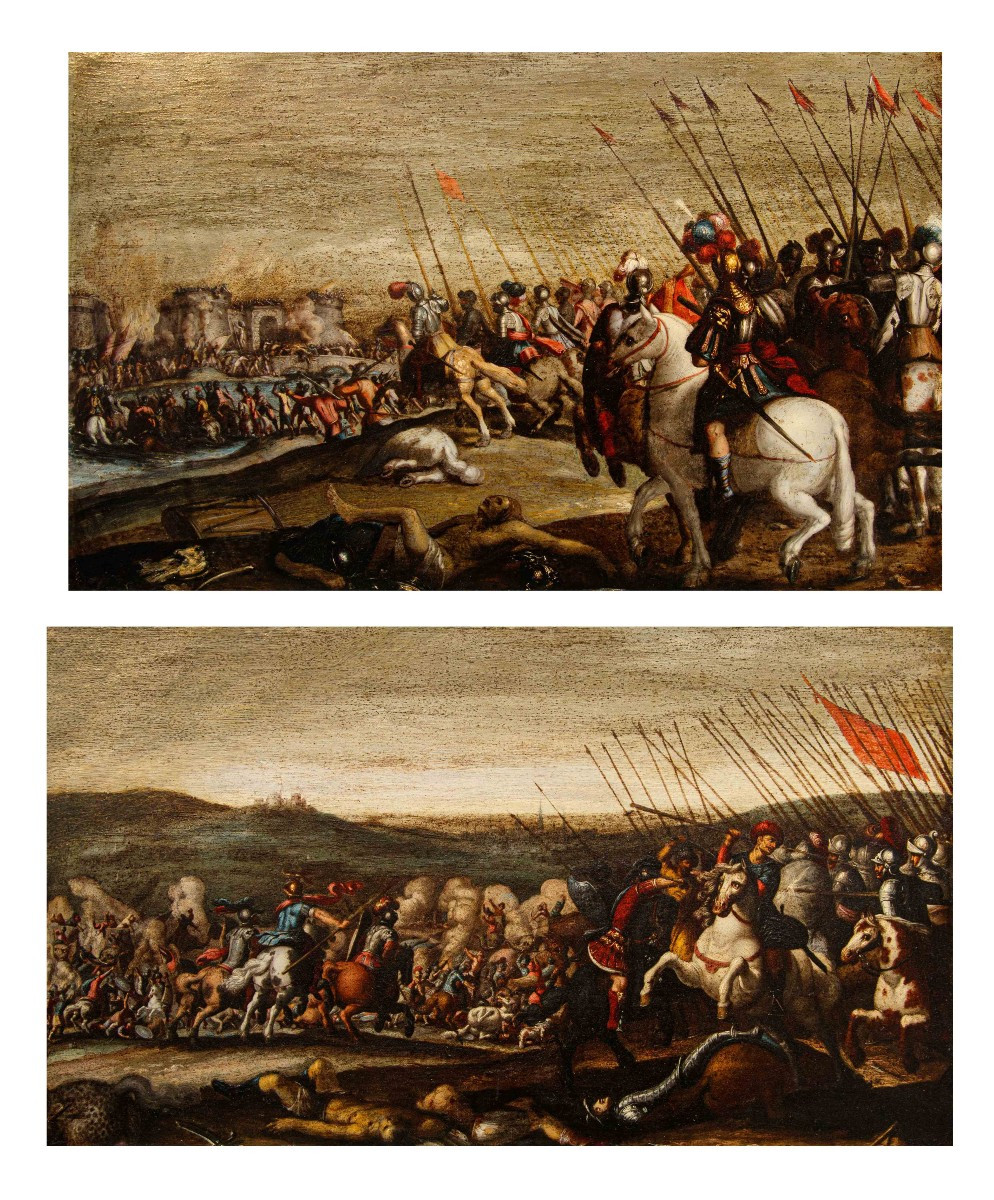
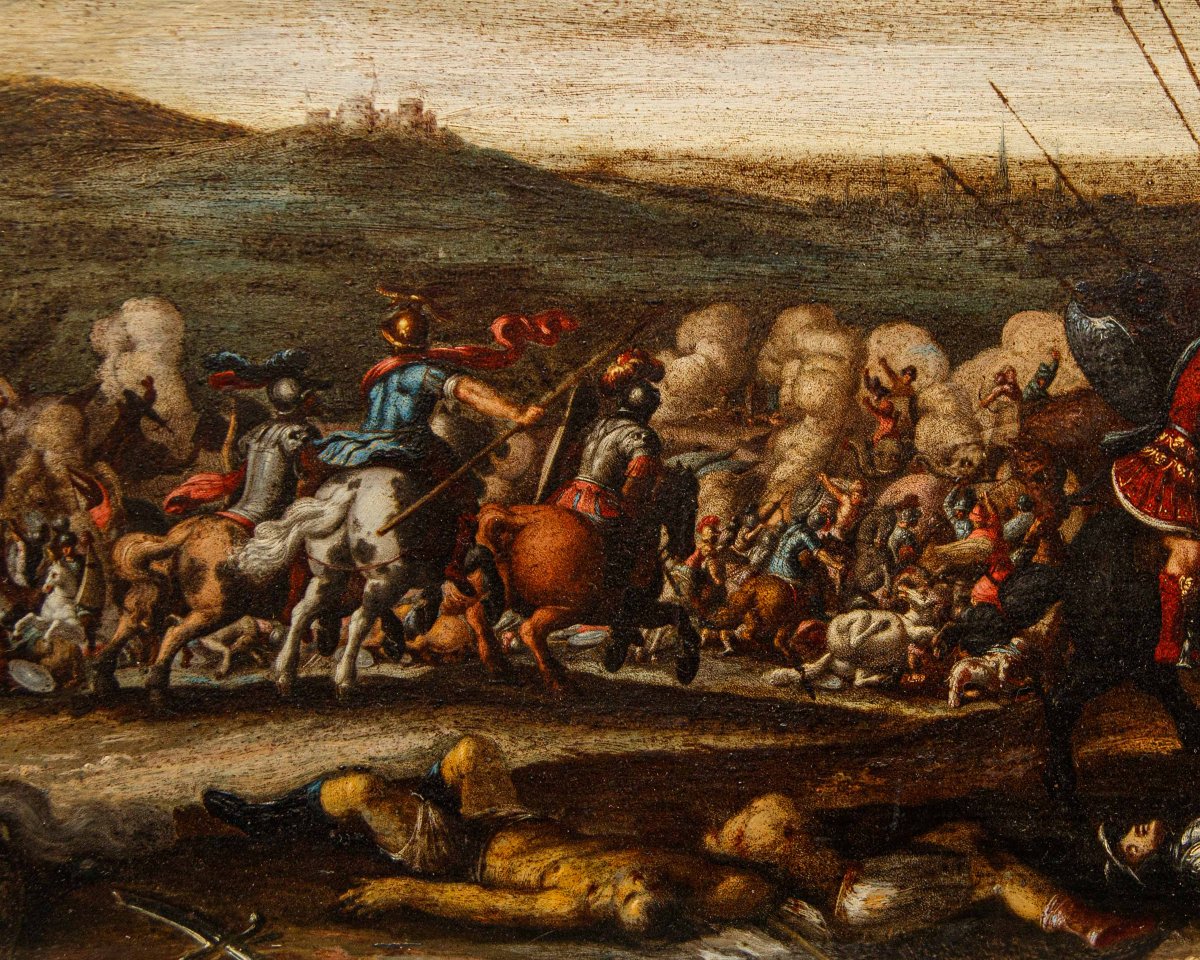
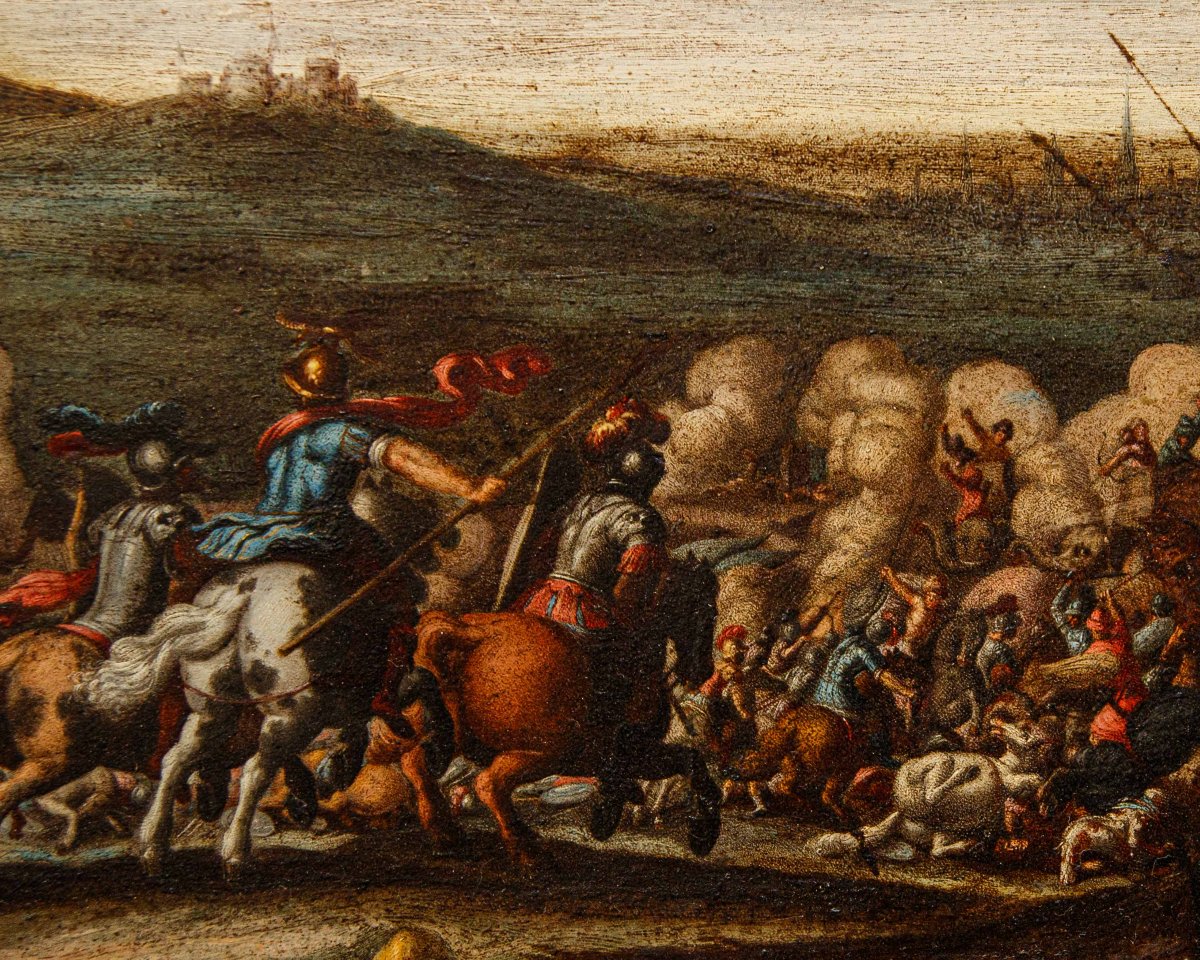
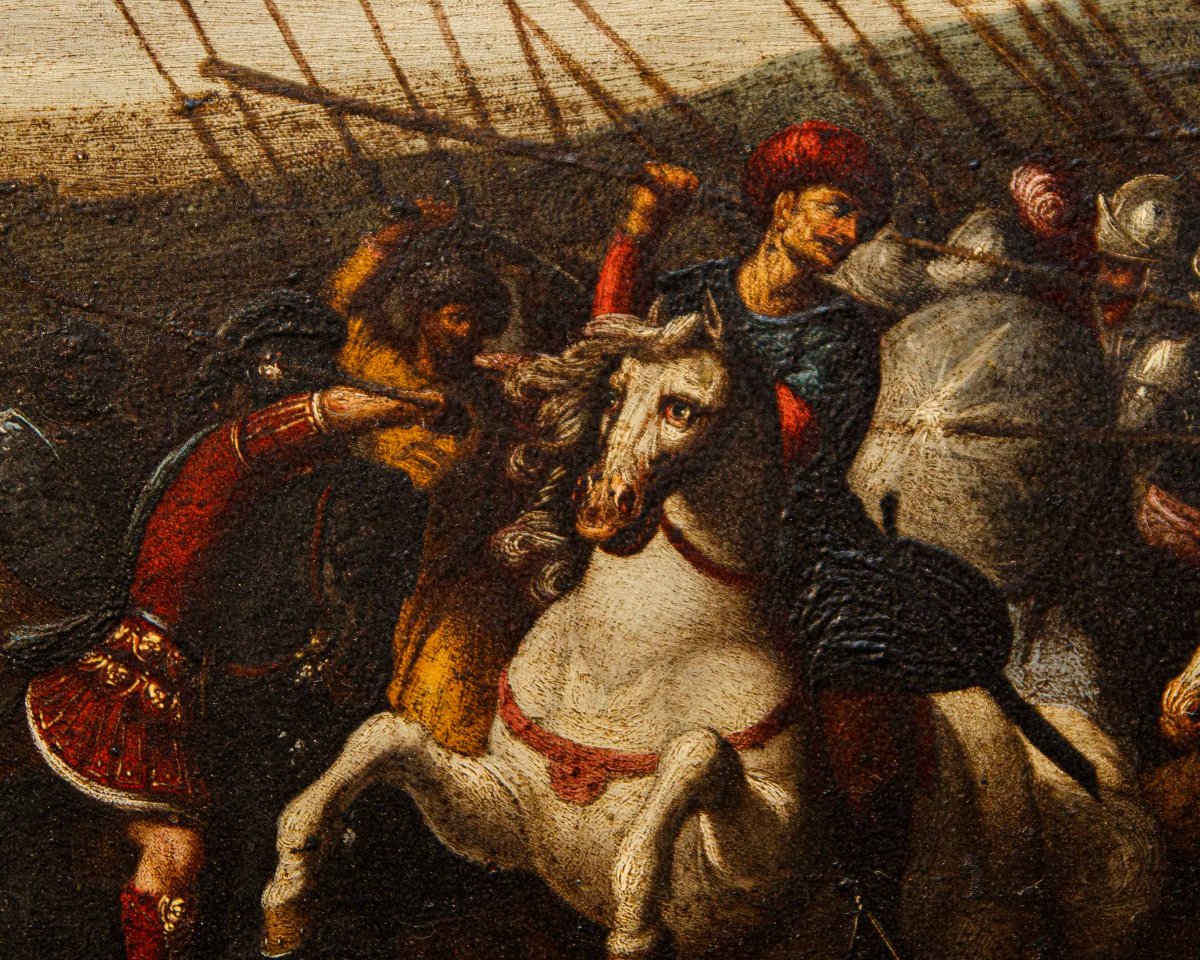
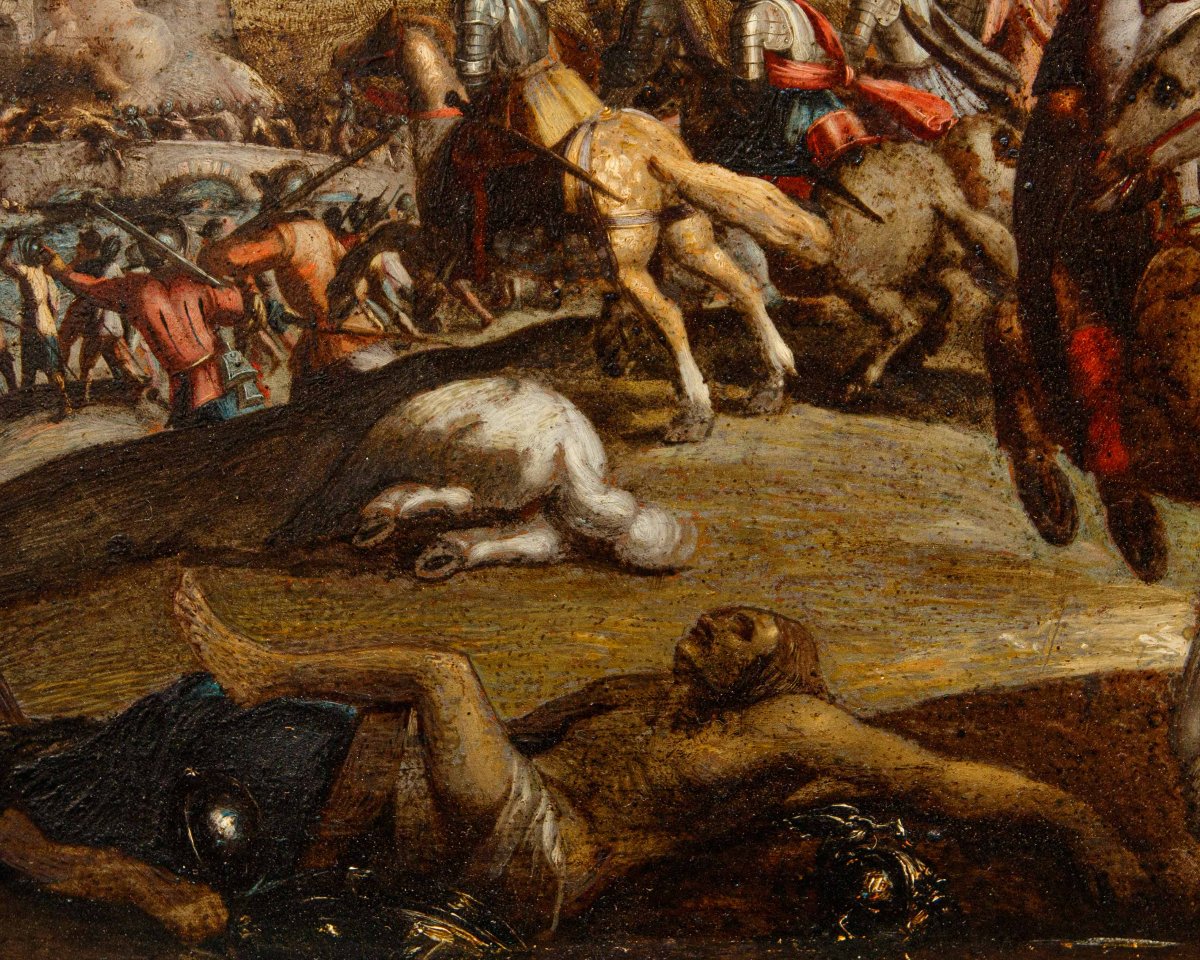


Antonio Tempesta (florence, 1555 – Rome, 1630), Attributed, Battle Scenes
Antonio Tempesta (Florence, 1555 – Rome, 1630) attr.
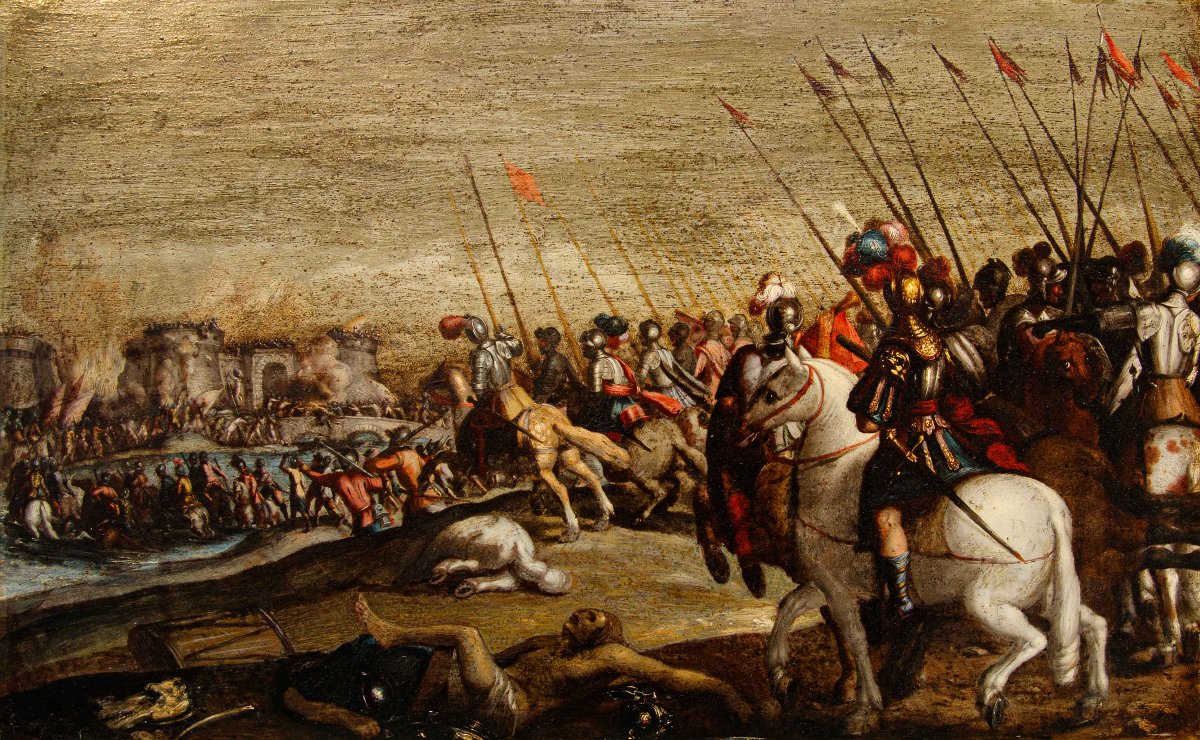
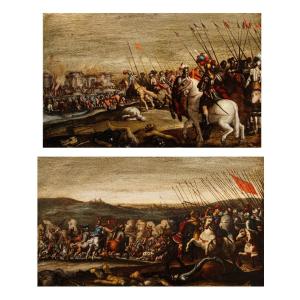
Battle scenes (Battle of Bicocca)
Oil on copper, 30 x 48.5 cm – with frame, 38 x 57 cm
Antonio Tempesta, a Florentine painter and engraver, trained in the workshop of Giovanni Stradano before moving to Rome, where he developed an extraordinary specialization in battle, hunting, and historical subject painting. His graphic output, comprising over 1,500 engravings, enjoyed widespread circulation throughout Europe, profoundly influencing generations of war-genre painters.
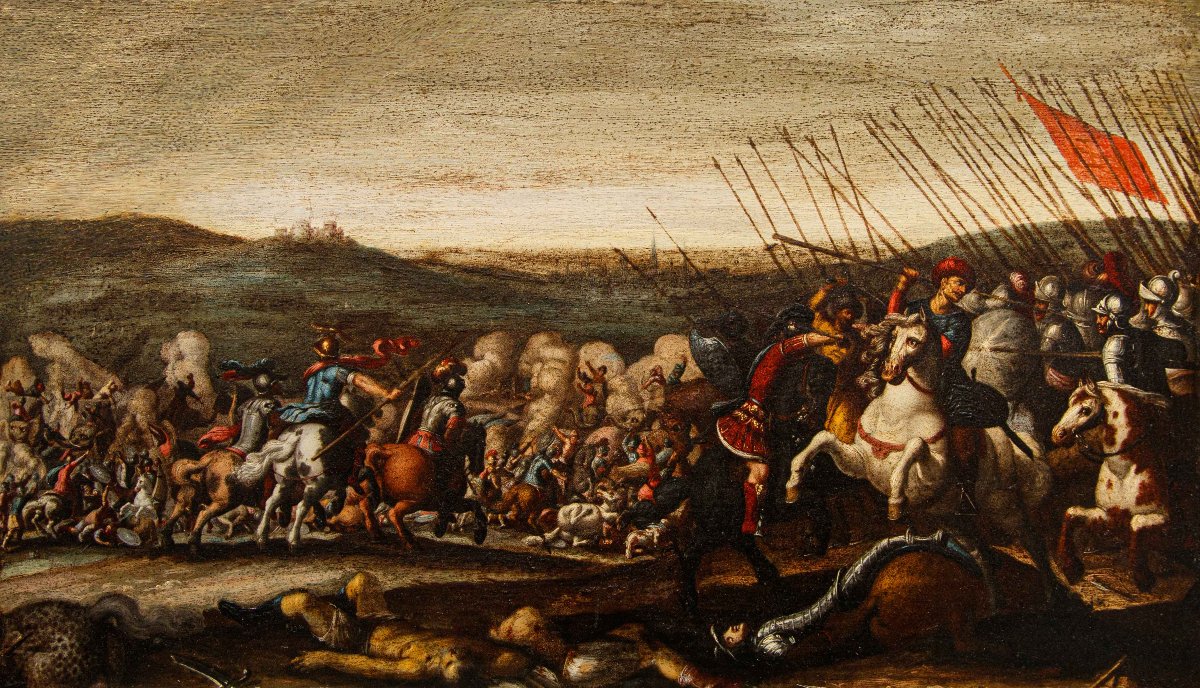
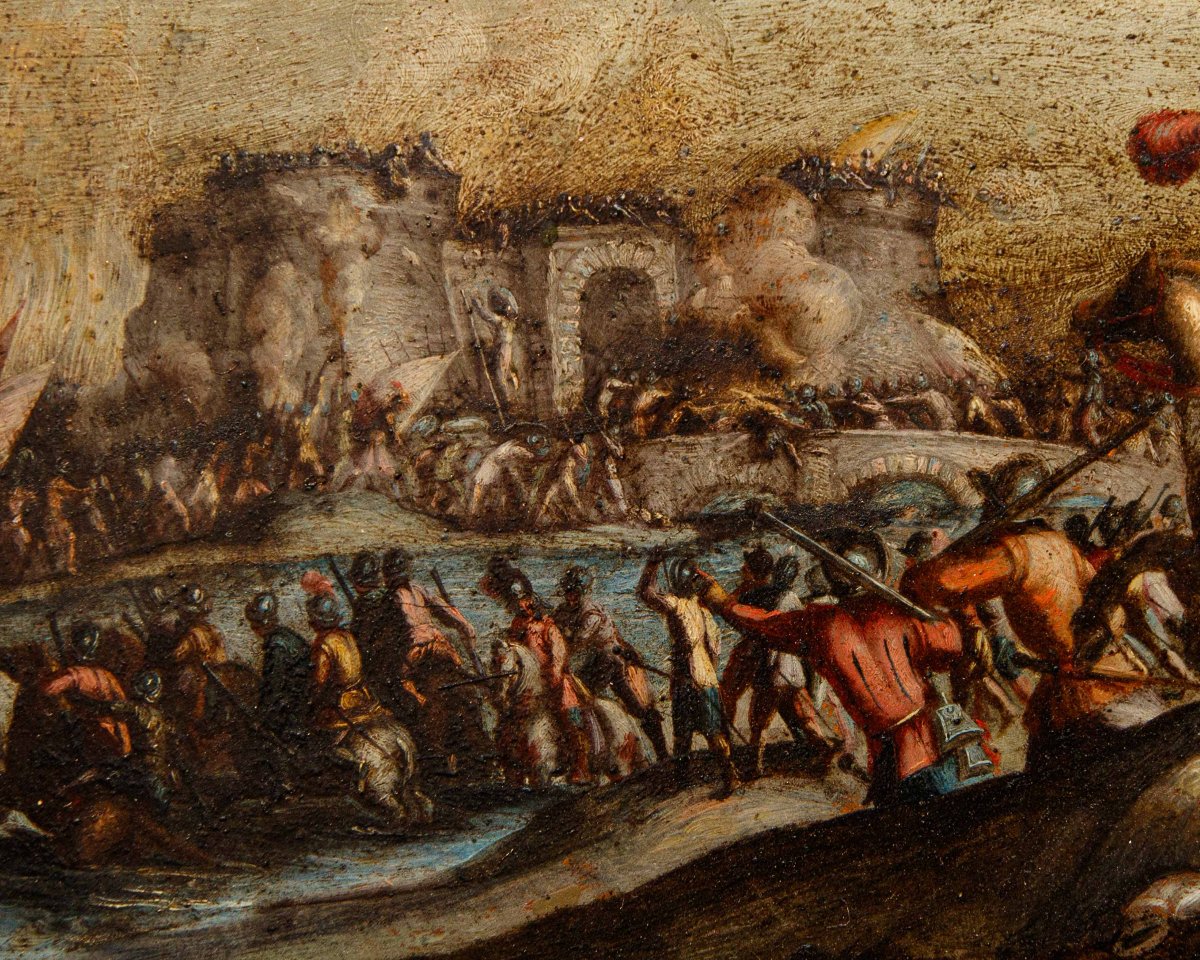
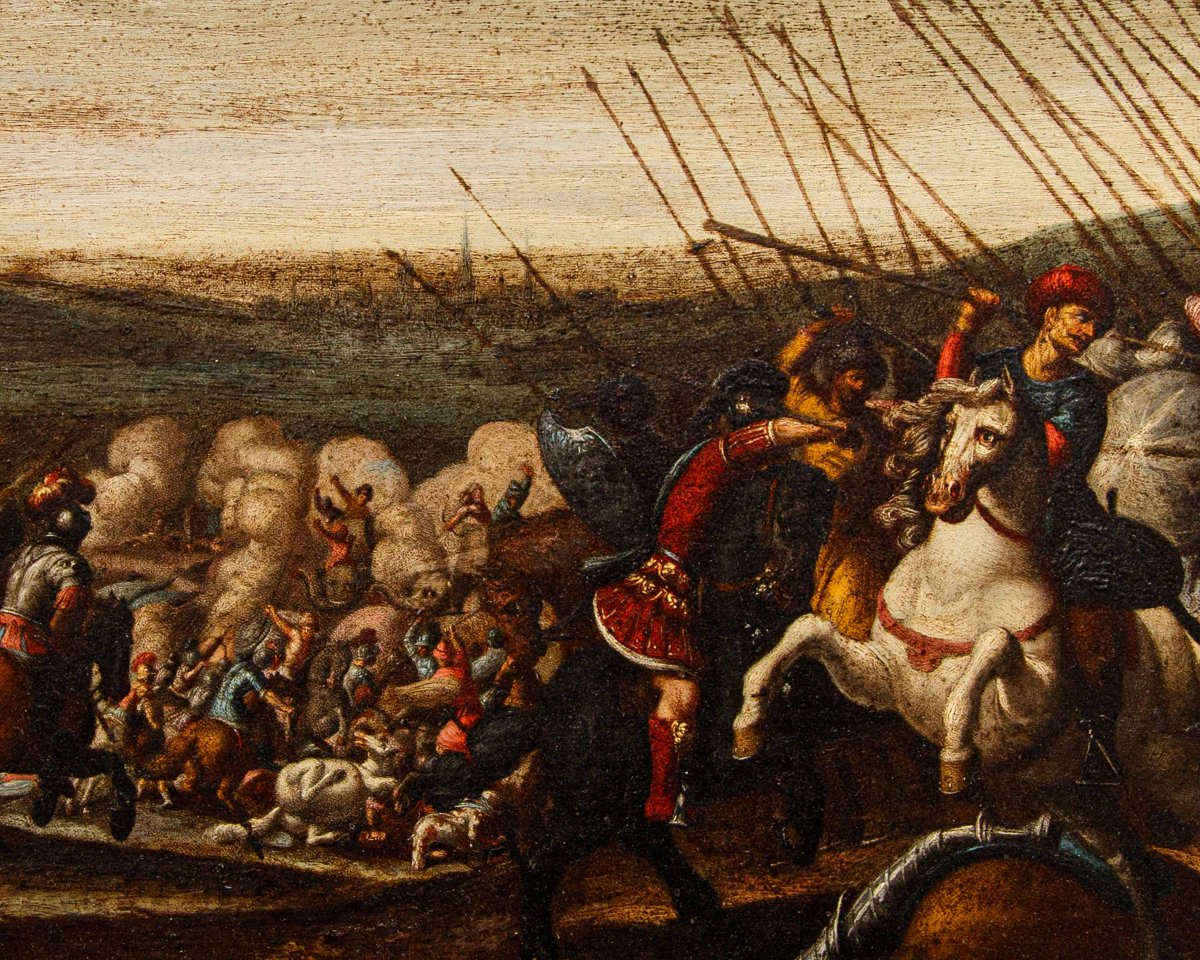
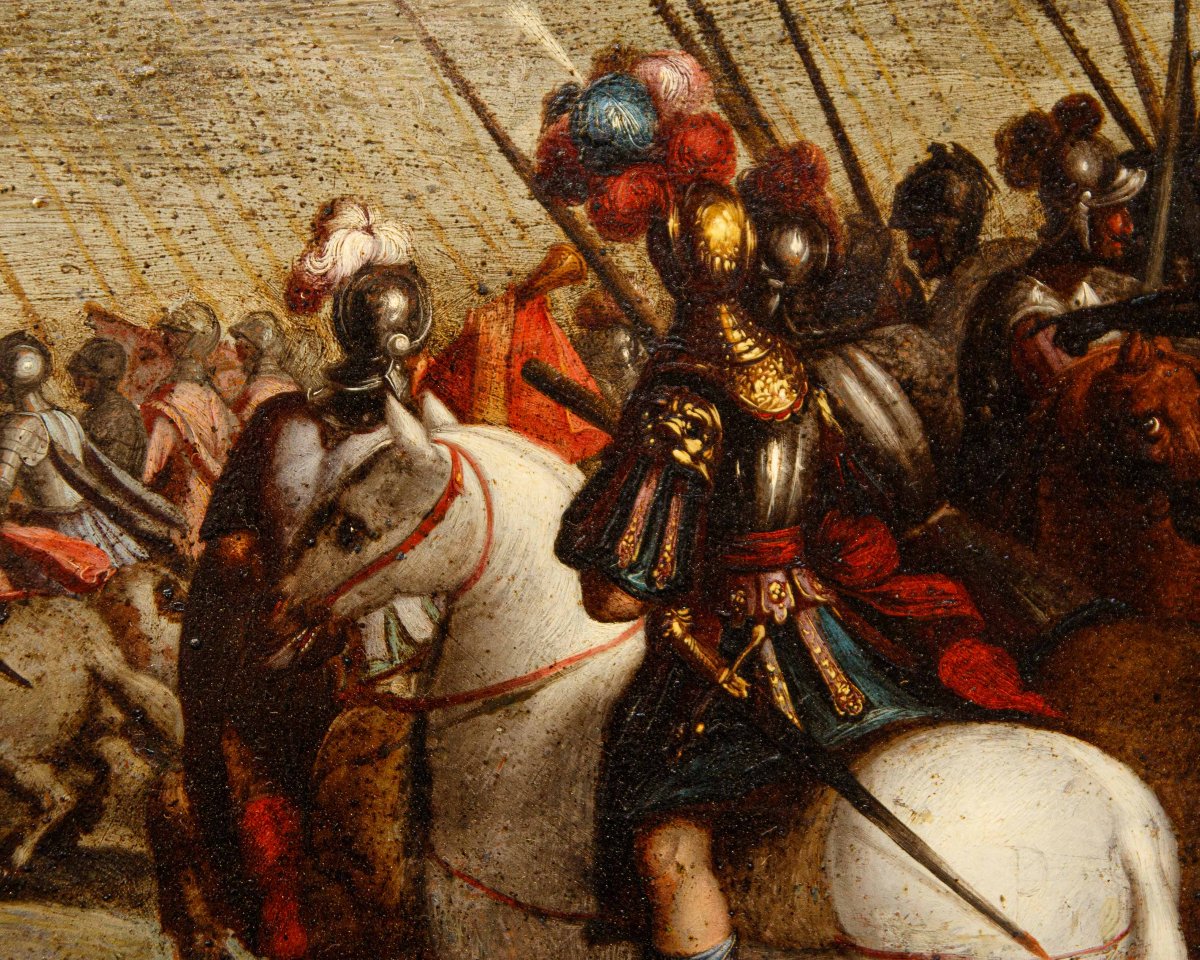
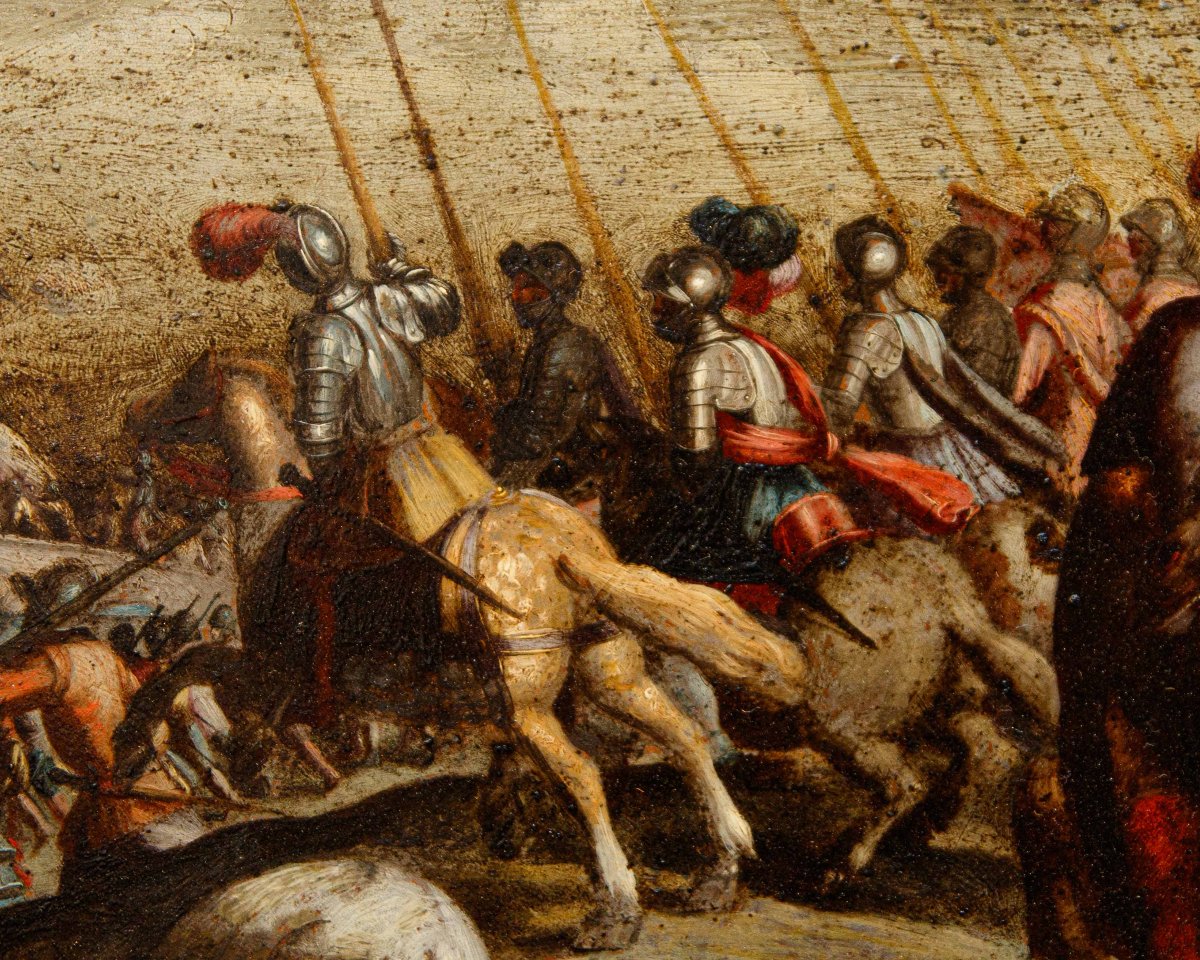
The pair of paintings under consideration, executed in oil on copper, is attributable to his hand and constitutes an emblematic example of 17th-century battle painting. The copper support, favored by late Mannerist artists for its ability to render minute details and luminous chromatic glazes, enhances the artist’s rapid and energetic brushwork, amplifying the metallic reflections of the armor and the vibrancy of the scenes of fire. In the first composition, the eye is drawn to the assault on a stronghold surrounded by ramparts, where the fortress appears engulfed in flames and explosions while the background grows smoky and indistinct toward a low, leaden horizon. In the second scene, the action shifts to open ground, with a cavalry charge in which Christian troops, recognizable by their burnished armor and colorful plumage, clash with Ottoman units. In both compositions, the lances serve as a structural element and almost a stylistic signature: the tightly packed shafts, slanted diagonally and topped by red banners fluttering in the wind, impart rhythm and dramatic tension, guiding the eye into the depth according to a perspective solution that Tempesta had codified in his engravings. The sculptural rendering of the rearing horses, the precision in the reflections on the armor, and the handling of masses across overlapping narrative planes consistently reflect the Florentine artist’s compositional sensibility.
The painting depicts the Battle of Bicocca, fought on April 27, 1522, at the fortress of the same name, strategically located between Milan and Monza. At the time, La Bicocca was a fortified villa serving as a stronghold for the imperial armies of Charles V. The clash pitted the Spanish and imperial defensive forces against the besieging troops of the Franco-Venetian-Swiss coalition, led on behalf of Francis I by Marshal Lautrec and, for the Venetian side, by Andrea Gritti (who would later become Doge of Venice). The battle was extremely bloody: chronicles report the deaths of over 3,000 soldiers, most of whom were among the Swiss and Venetian ranks.
An element of great iconographic interest is the presence of pikes in the hands of the infantrymen. These long weapons bear witness to a military doctrine now in decline, captured precisely at the moment of transition toward the widespread use of firearms, which would soon revolutionize European battlefields. Furthermore, within the depiction, one can make out several Turkish soldiers, a detail that recalls the then-scandalous strategic alliance forged by Francis I with the Ottoman Empire in an attempt to curb the overwhelming power of Charles V.
Despite the imposing deployment, the French failed to drive out the Spanish, who secured a decisive victory. This episode is part of the long and complex mosaic of the Italian Wars, a period of instability and conflict that came to a definitive end only in 1559, with the signing of the Peace of Cateau-Cambrésis.
Period: 17th century
Style: Other Style
Condition: Good condition
Material: Oil painting on copper
Width: 48,5
Height: 30
Reference (ID): 1759922
Availability: In stock