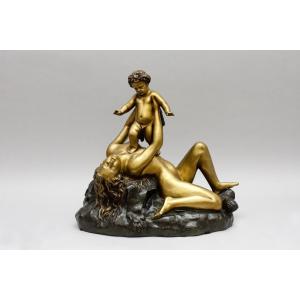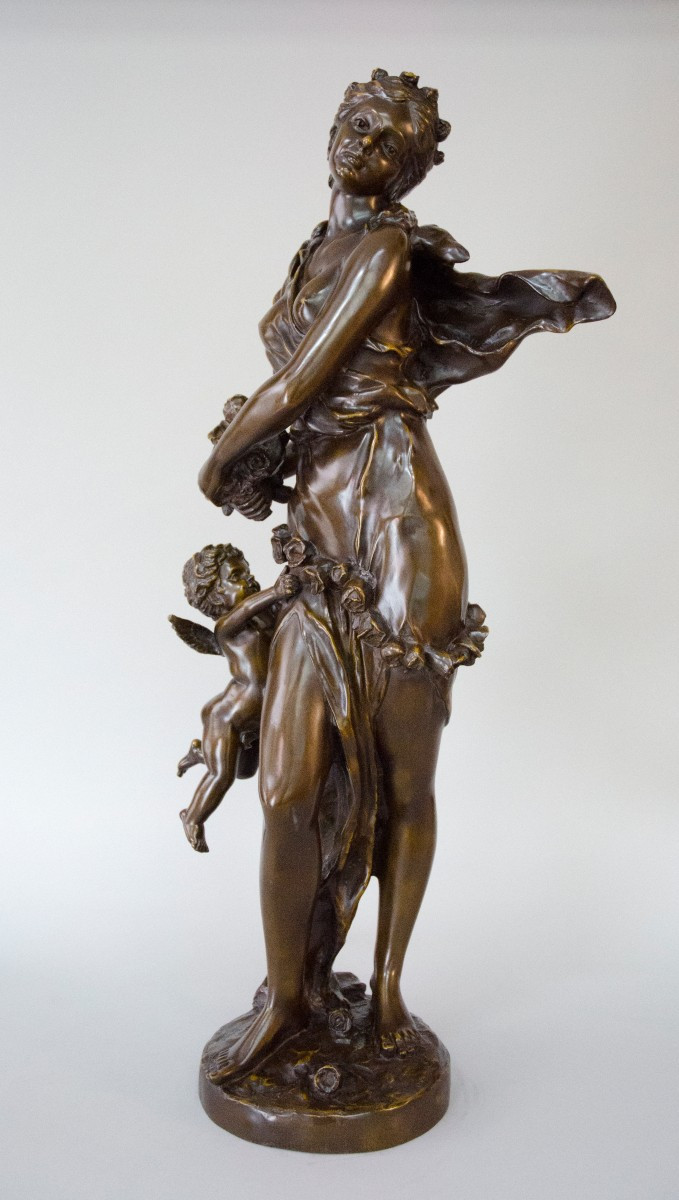


Large Bronze "venus And Cupid" Hippolite Moreau , End 19th Cent
Artist: Hippolyte Moreau
Large
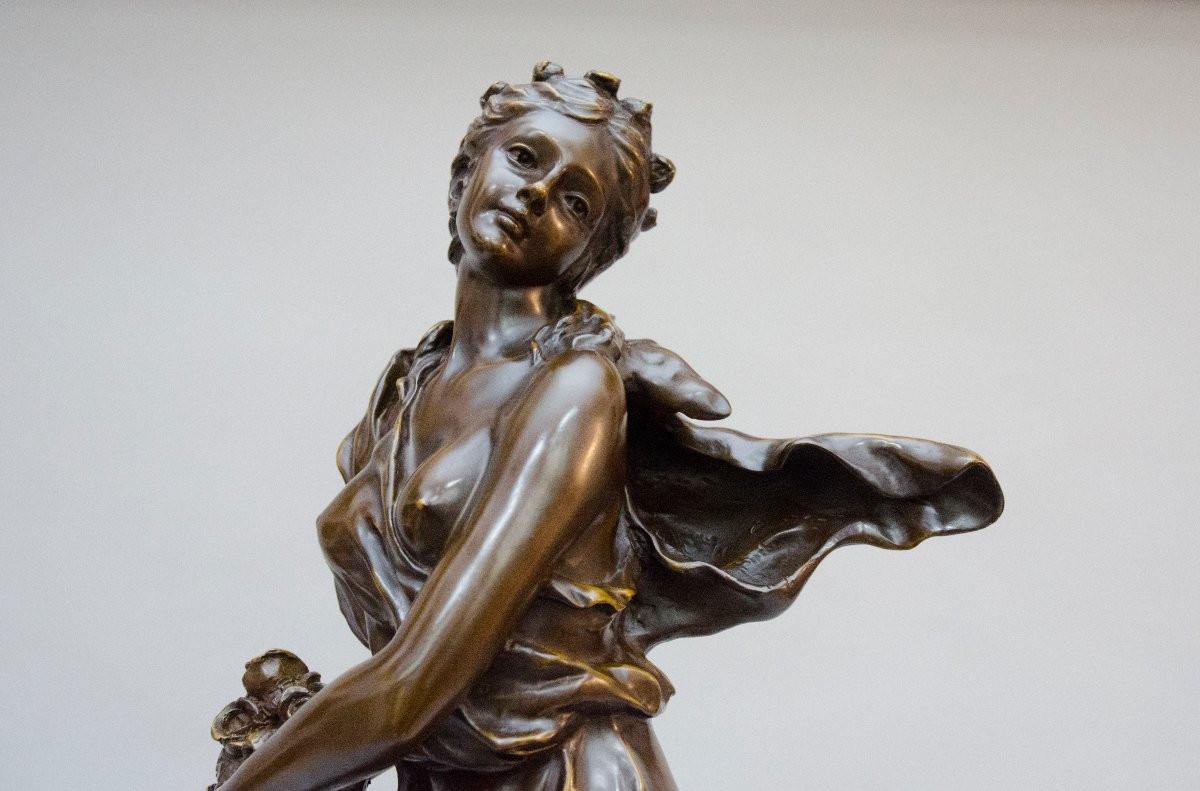
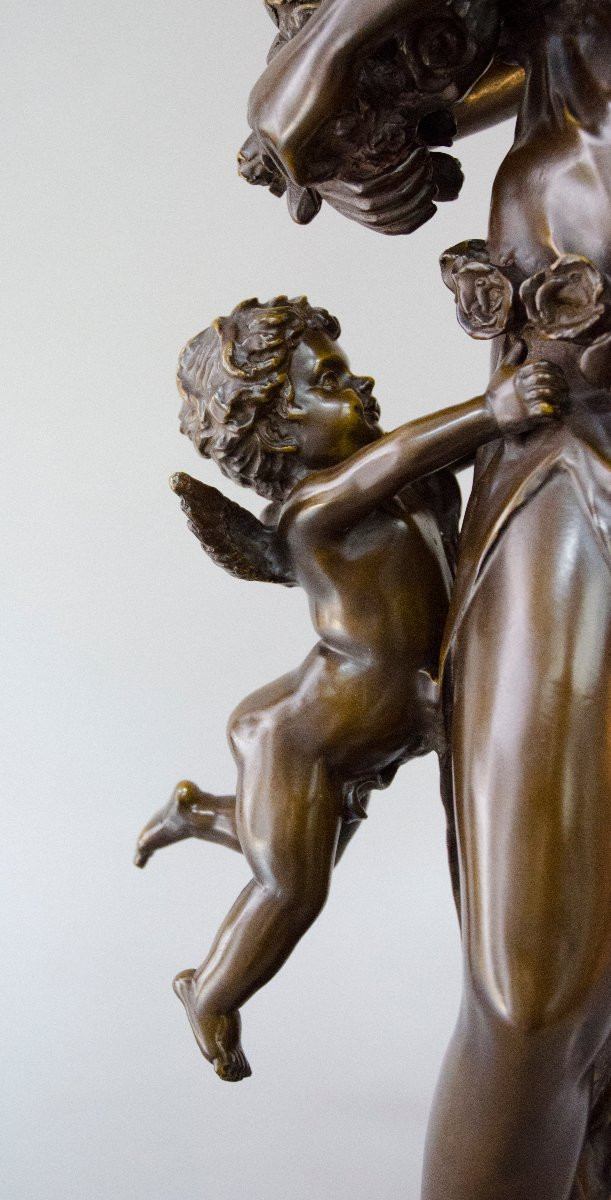
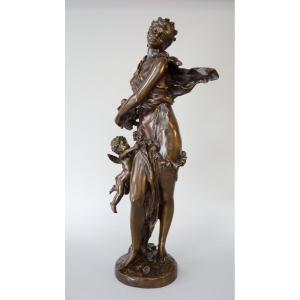
bronze sculpture of Venus and Cupid. She wears a light dress that reveals her
bosom, a symbol of fertility. She carries a basket of flowers, whilst Cupid
grasps the garland of flowers at her side. She has a charming smile. She looks
away.
Dimensions: H 79cm
Late 19th-century French school.
Biography: Hippolyte Moreau, whose real first name was François, was born in Dijon on 1 April 1832 into a family of artists: he was the second son of the sculptor Jean-Baptiste-Louis-Joseph Moreau, in whose studio he received his early training. In the 1850s, he left Burgundy with his two brothers, Mathurin and Auguste, to settle in Paris, where they enrolled at the École des Beaux-Arts to further their studies under the guidance of François Jouffroy. The bulk of his work consists of charming figures depicting children and young women, mostly of an allegorical nature, in a style often reminiscent of that of his brother Auguste. From 1863 to 1914, he exhibited regularly at the Salon des Artistes Français, where he presented decorative subjects most often inspired by the 18th century. He won a medal at the 1878 World’s Fair and another at the 1900 World’s Fair. He produced mainly medium-sized works as well as decorative or utilitarian objects—vases, statuettes, letter openers, and trinket trays—made of bronze, nickel silver, or pewter. Among his monumental works, the statue of Alexis Claude Clairaut, an 18th-century French mathematician, stands out; it was unveiled in 1880 on one of the façades of Paris City Hall on Rue de Lobau. Most of his works are now held at the Musée des Beaux-Arts in Dijon. Hippolyte Moreau died in Neuilly-sur-Seine in 1926 or 1927, leaving behind a prolific body of work that bears witness to a constant commitment to the grace and ornamental elegance characteristic of the Belle Époque.
Dimensions: H 79cm
Late 19th-century French school.
Biography: Hippolyte Moreau, whose real first name was François, was born in Dijon on 1 April 1832 into a family of artists: he was the second son of the sculptor Jean-Baptiste-Louis-Joseph Moreau, in whose studio he received his early training. In the 1850s, he left Burgundy with his two brothers, Mathurin and Auguste, to settle in Paris, where they enrolled at the École des Beaux-Arts to further their studies under the guidance of François Jouffroy. The bulk of his work consists of charming figures depicting children and young women, mostly of an allegorical nature, in a style often reminiscent of that of his brother Auguste. From 1863 to 1914, he exhibited regularly at the Salon des Artistes Français, where he presented decorative subjects most often inspired by the 18th century. He won a medal at the 1878 World’s Fair and another at the 1900 World’s Fair. He produced mainly medium-sized works as well as decorative or utilitarian objects—vases, statuettes, letter openers, and trinket trays—made of bronze, nickel silver, or pewter. Among his monumental works, the statue of Alexis Claude Clairaut, an 18th-century French mathematician, stands out; it was unveiled in 1880 on one of the façades of Paris City Hall on Rue de Lobau. Most of his works are now held at the Musée des Beaux-Arts in Dijon. Hippolyte Moreau died in Neuilly-sur-Seine in 1926 or 1927, leaving behind a prolific body of work that bears witness to a constant commitment to the grace and ornamental elegance characteristic of the Belle Époque.
3 200 €
Period: 19th century
Style: Napoleon 3rd
Condition: Excellent condition
Material: Bronze
Height: 79cm
Reference (ID): 1758834
Availability: In stock
Print