

Cabinet Of Curiosities Or Bookcase
This piece of furniture, described as Genoese shipowner's style, offers a spectacular reinterpretation of the "bamboo" cabinets designed in Genoa during the late 16th and 17th centuries.
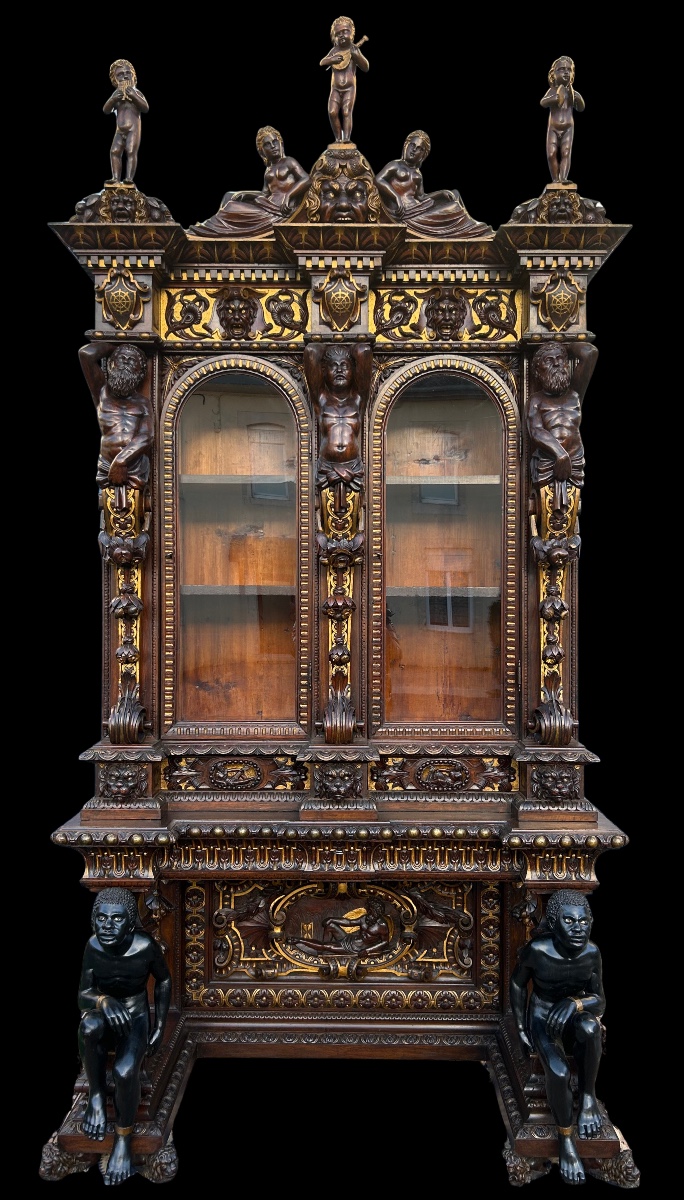
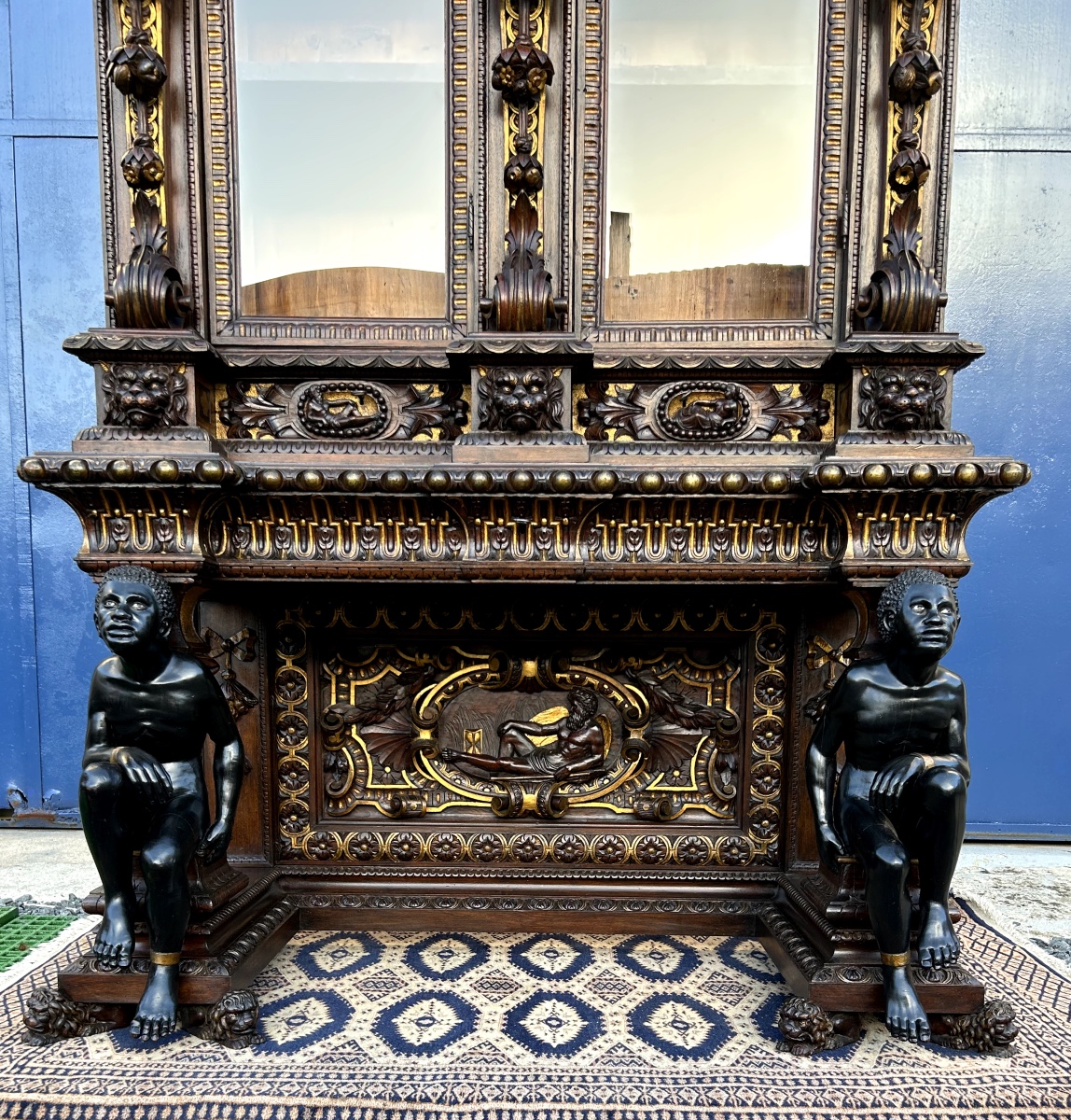
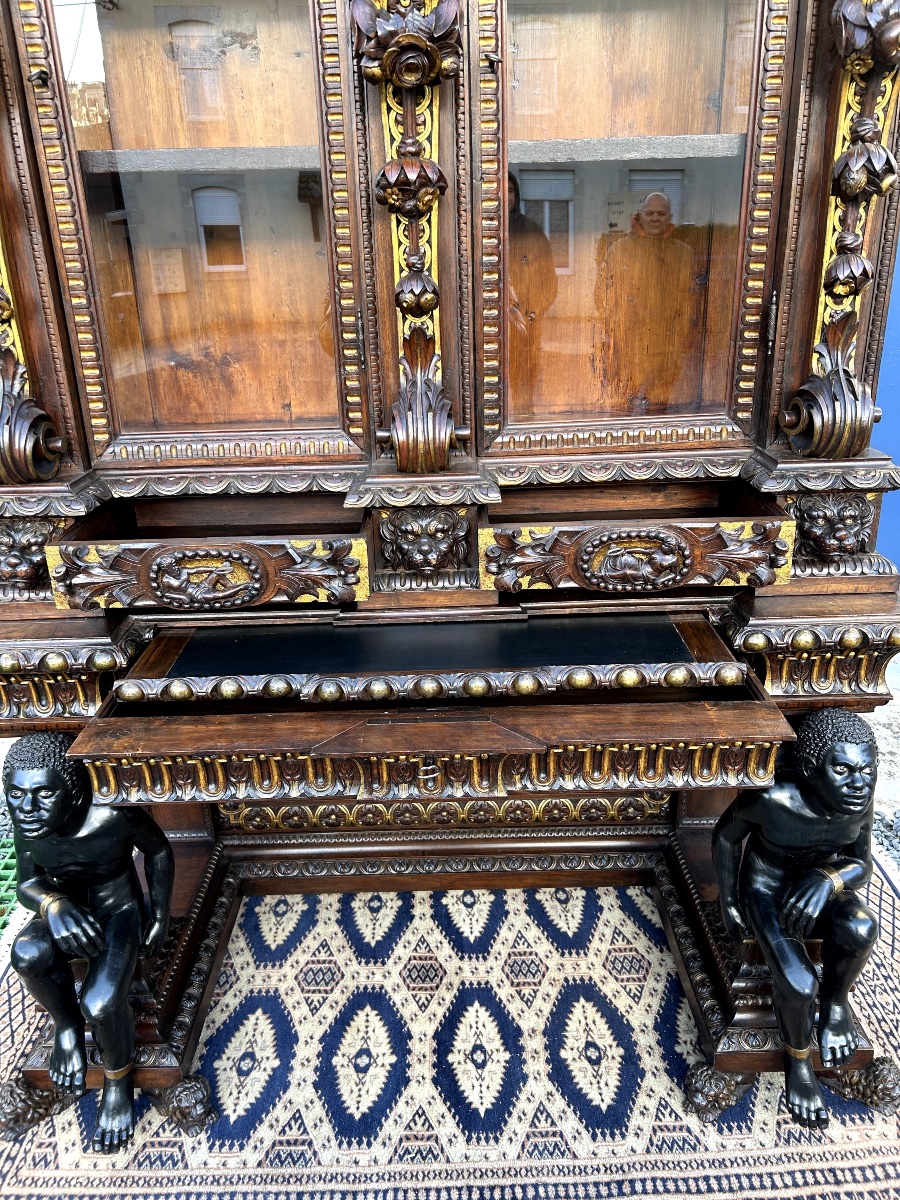
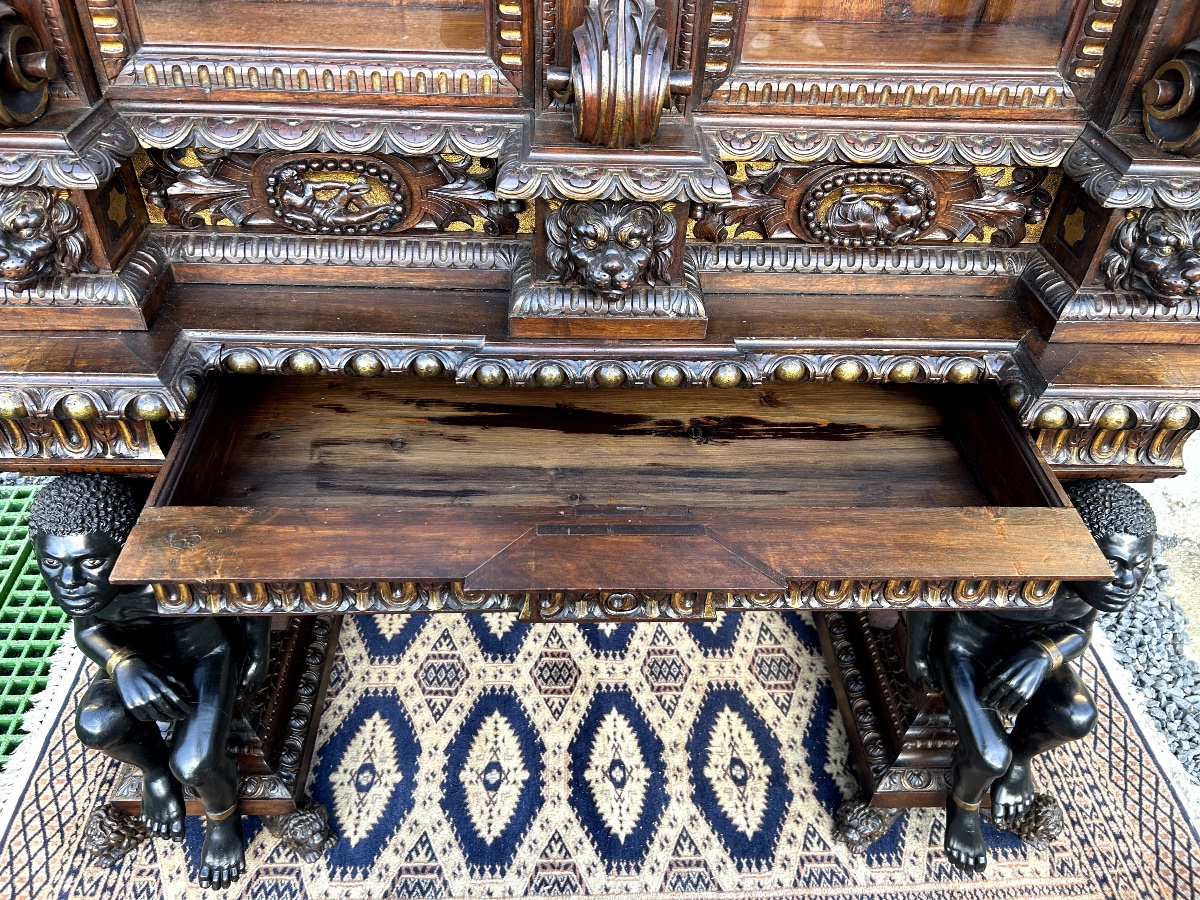
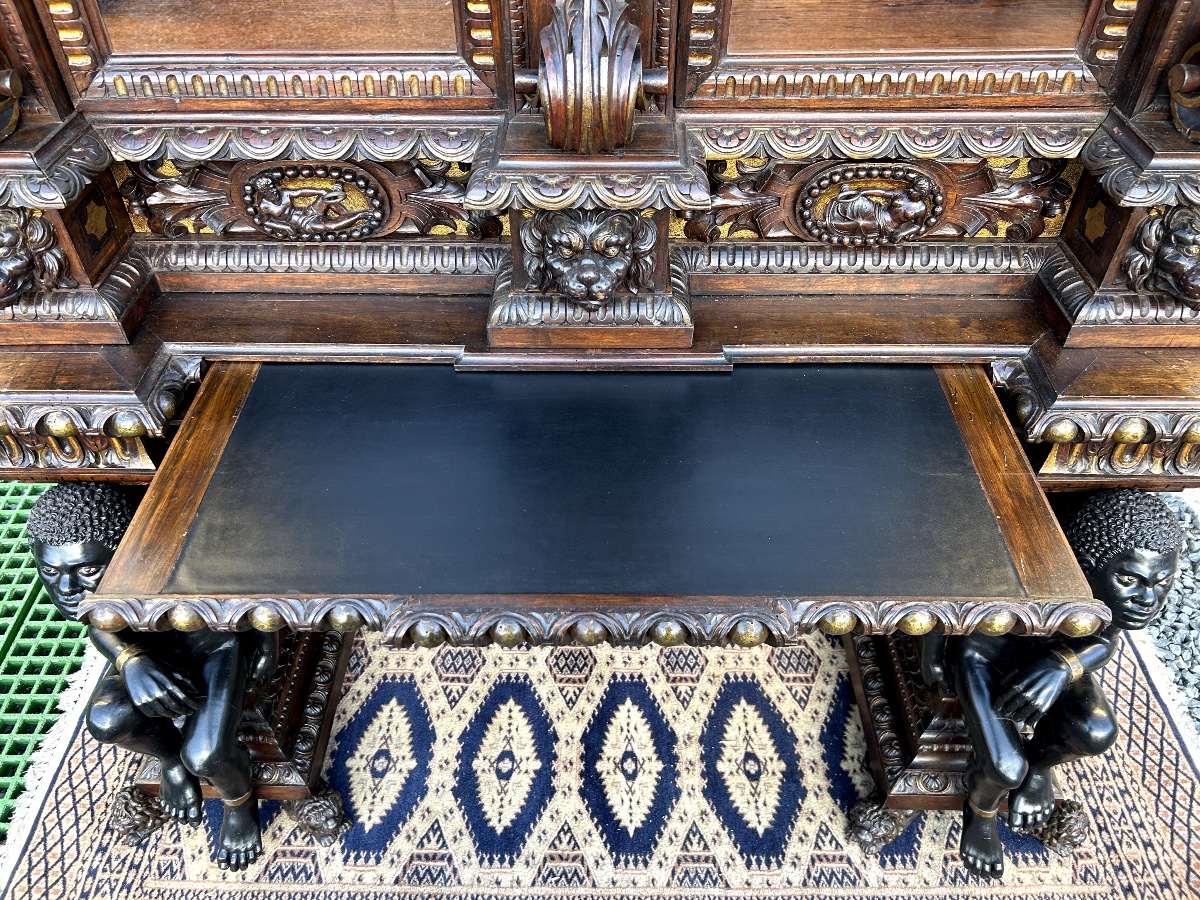
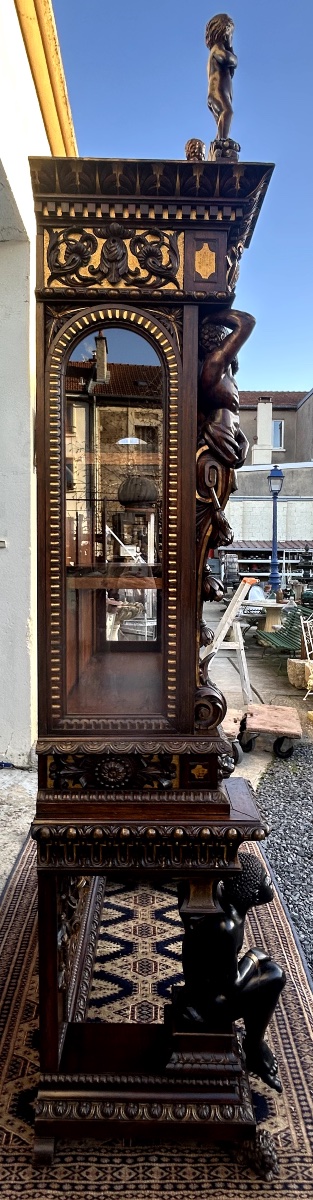
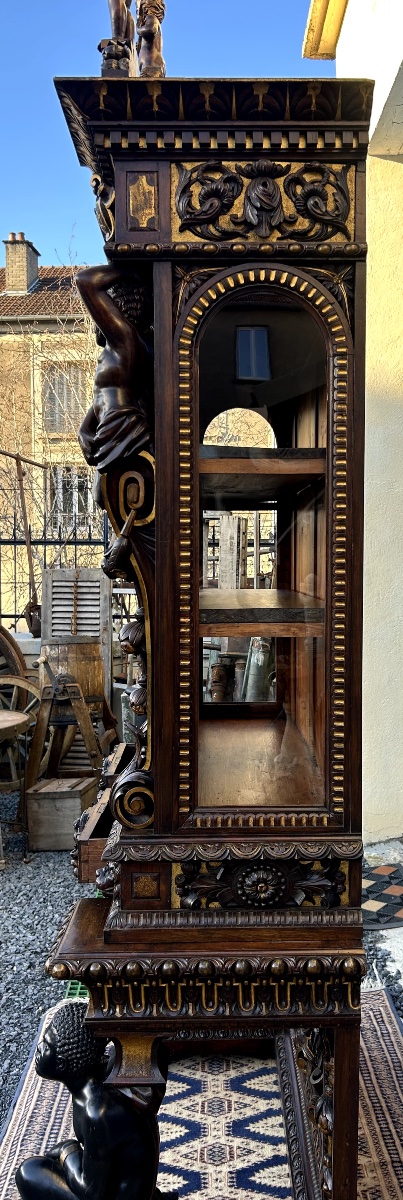
The theatrical glass-fronted cabinet, which opens in the frieze to reveal a writing tablet and a drawer, is supported by two kneeling Moors sculpted in the round.
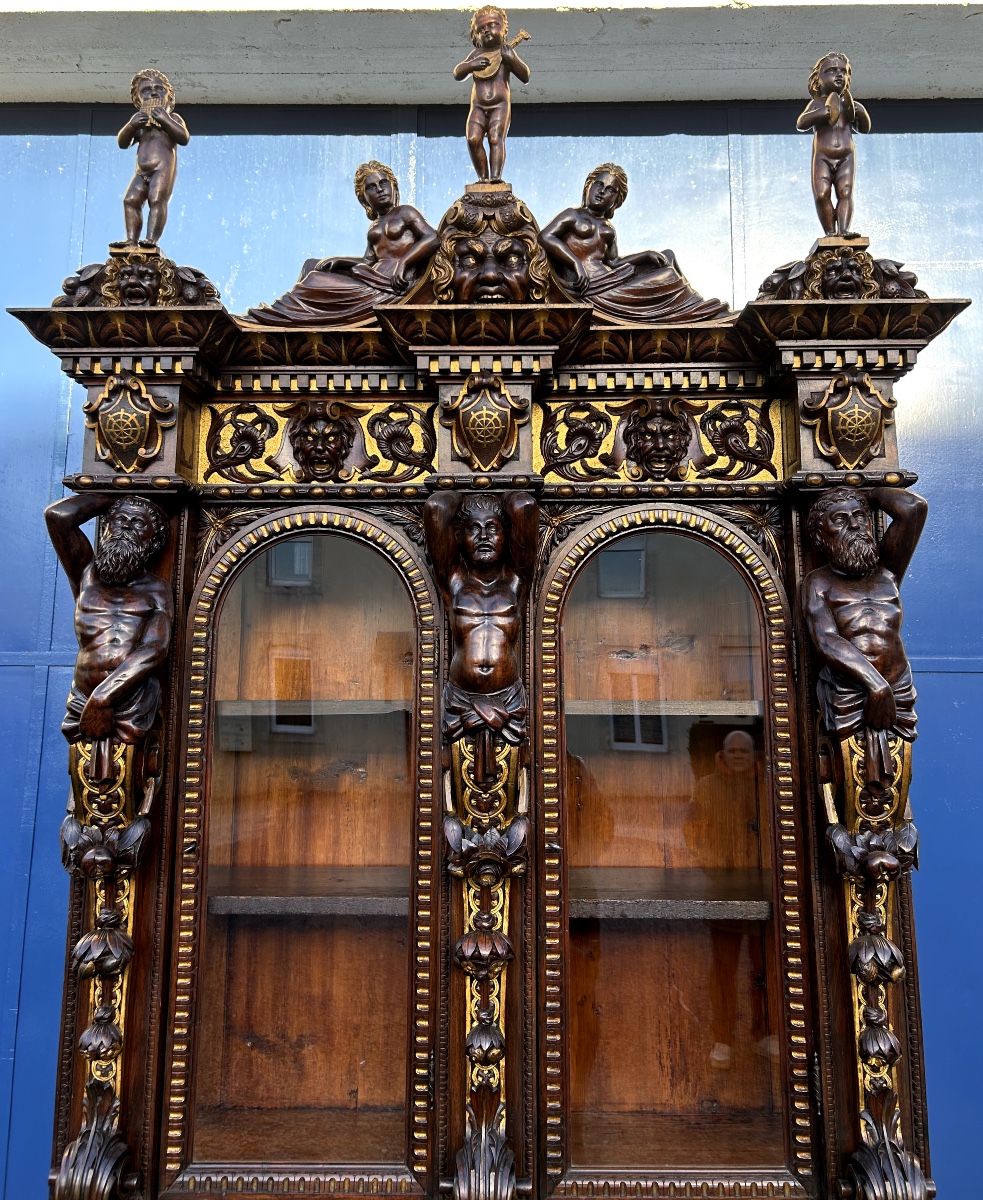
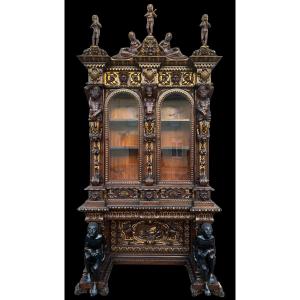
The façade is organized like an architecturally designed stage front, topped by a projecting entablature upon which stand three musical putti, each perched atop a Tragedy mask.
The central putto plays the lute, the one on the left blows into a syrinx, and the one on the right strikes cymbals. Between them, two bare-breasted female figures listen intently.
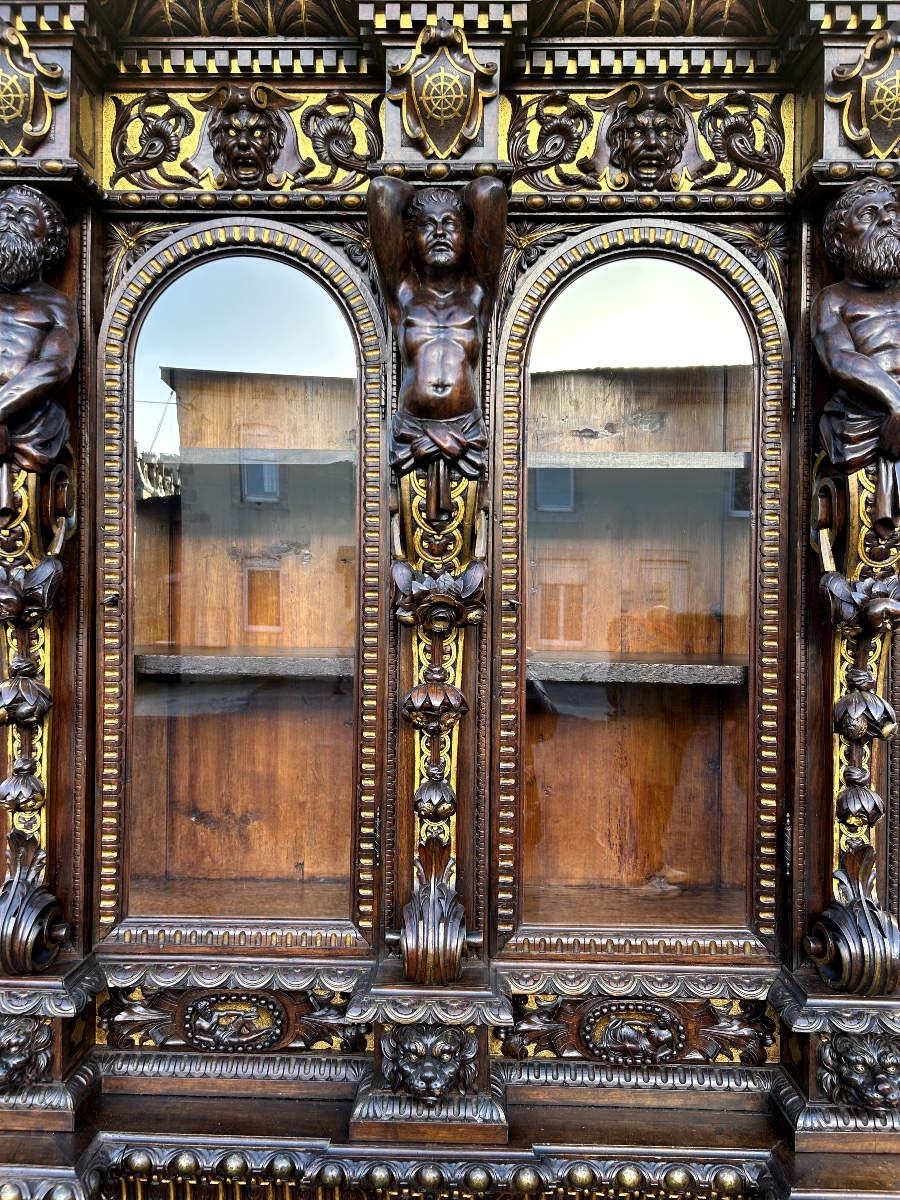
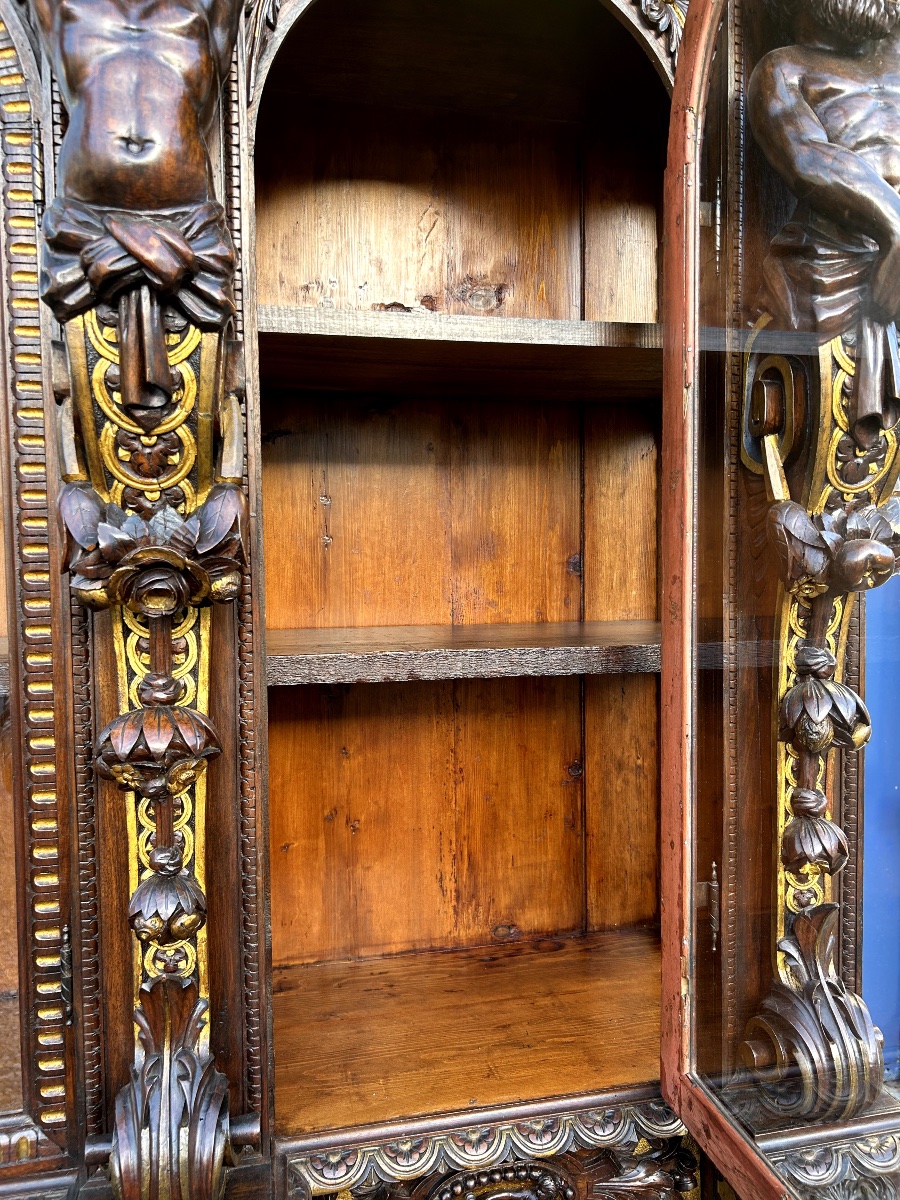
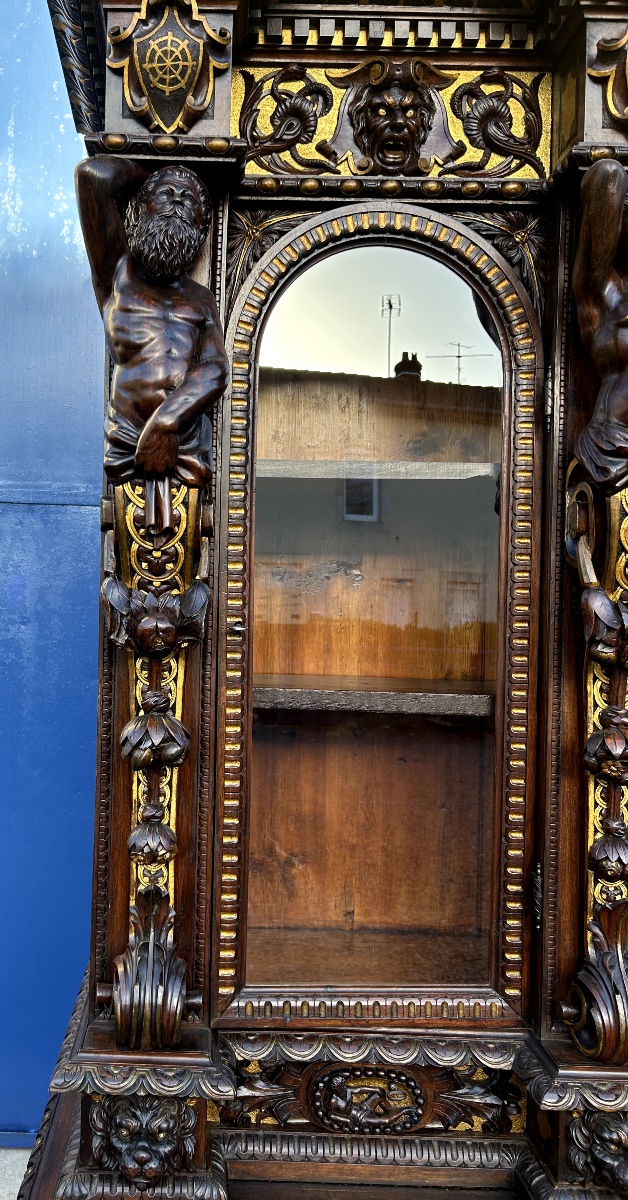
The uprights are adorned with terms draped at the waist and cascades of fruit. The male figures are carved in high relief, in a symmetrical yet dynamic composition. Their gaze is turned towards the heavens.
The men positioned at the ends hold the fabric with one hand; with the other, they support the entablature. The clearly Baroque inspiration of the main decoration blends with the Renaissance vocabulary of the secondary decoration.
The scrolling and grotesque motifs stand out against the gold background of the entablature, while the base of the cabinet is enlivened by three lion heads between which are interspersed a reclining nymph and her male counterpart.
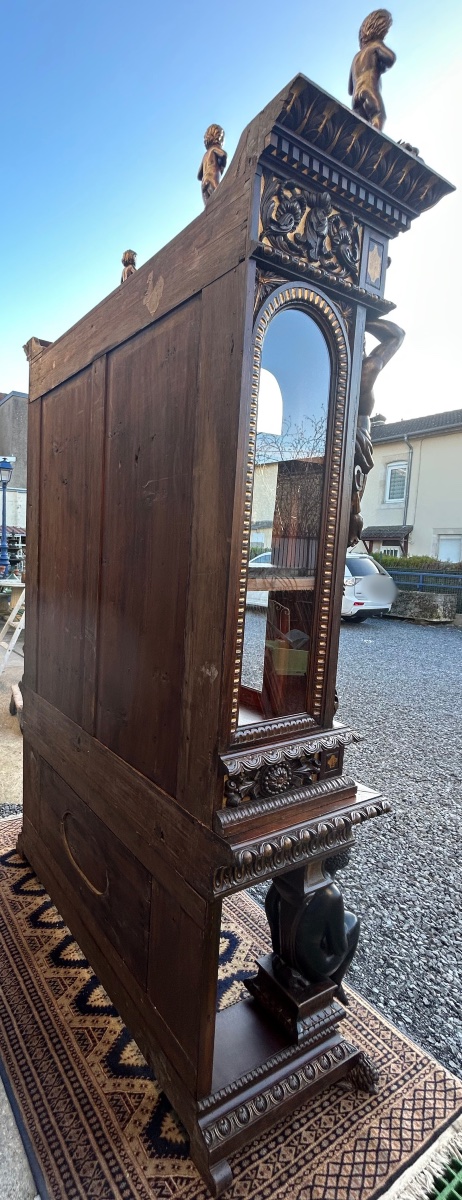
These echo, in the lower part of the piece, the figure of Time, Chronos, sculpted in a cartouche with coiled leather motifs on the back panel.
The profusion of the sculpted decoration proclaims the opulence of its owner, probably a shipowner. Indeed, the three escutcheons that surmount the cabinet's pediment suggest a maritime city: they are adorned with a ship's wheel, an invention no earlier than the 18th century.
Whether a cabinet of curiosities, a writing desk, or a bookcase, this piece of furniture belongs to the tradition of furniture designed in Northern Italy for the major exhibitions organized in European and American cities to celebrate the advent of the new industrial era in the second half of the 19th century.
At that time, the young Kingdom of Italy incorporated Genoa (1861) and then Venice (1866) into its territory.
Genoa experienced a commercial and mercantile revival. Its maritime traffic shifted westward toward America and eastward toward India.
It established itself as the most important port city in Italy.
The decorative arts bear witness to this: Genoese furniture was reinventing itself.
Selected bibliography:
Christopher Payne, European Furniture of the 19th Century, 1989, p. 386 ff. Alvar Gonzalez-Palacios, Il Mobile in Liguria, Genova, 1996 Monique Riccardi-Cubitt, The Cabinet: a European art, from the Renaissance to the modern era, Paris, 1996
We are available to answer any questions you may have. Please contact us by phone (06 80 88 81 23) or email (alexis.foerst55@orange.fr).
Delivery is available.
The theatrical glass-fronted cabinet, which opens in the frieze to reveal a writing tablet and a drawer, is supported by two kneeling Moors sculpted in the round.
The façade is organized like an architecturally designed stage front, topped by a projecting entablature upon which stand three musical putti, each perched atop a Tragedy mask.
The central putto plays the lute, the one on the left blows into a syrinx, and the one on the right strikes cymbals. Between them, two bare-breasted female figures listen intently.
The uprights are adorned with terms draped at the waist and cascades of fruit. The male figures are carved in high relief, in a symmetrical yet dynamic composition. Their gaze is turned towards the heavens.
The men positioned at the ends hold the fabric with one hand; with the other, they support the entablature. The clearly Baroque inspiration of the main decoration blends with the Renaissance vocabulary of the secondary decoration.
The scrolling and grotesque motifs stand out against the gold background of the entablature, while the base of the cabinet is enlivened by three lion heads between which are interspersed a reclining nymph and her male counterpart.
These echo, in the lower part of the piece, the figure of Time, Chronos, sculpted in a cartouche with coiled leather motifs on the back panel.
The profusion of the sculpted decoration proclaims the opulence of its owner, probably a shipowner. Indeed, the three escutcheons that surmount the cabinet's pediment suggest a maritime city: they are adorned with a ship's wheel, an invention no earlier than the 18th century.
Whether a cabinet of curiosities, a writing desk, or a bookcase, this piece of furniture belongs to the tradition of furniture designed in Northern Italy for the major exhibitions organized in European and American cities to celebrate the advent of the new industrial era in the second half of the 19th century.
At that time, the young Kingdom of Italy incorporated Genoa (1861) and then Venice (1866) into its territory.
Genoa experienced a commercial and mercantile revival. Its maritime traffic shifted westward toward America and eastward toward India.
It established itself as the most important port city in Italy.
The decorative arts bear witness to this: Genoese furniture was reinventing itself.
Selected bibliography:
Christopher Payne, European Furniture of the 19th Century, 1989, p. 386 ff. Alvar Gonzalez-Palacios, Il Mobile in Liguria, Genova, 1996 Monique Riccardi-Cubitt, The Cabinet: a European art, from the Renaissance to the modern era, Paris, 1996
We are available to answer any questions you may have. Please contact us by phone (06 80 88 81 23) or email (alexis.foerst55@orange.fr).
Delivery is available.
18 000 €
Period: 19th century
Style: Other Style
Condition: Excellent condition
Material: Wallnut
Length: 147 cm
Width: 64 cm
Height: 295 cm
Reference (ID): 1748085
Availability: In stock
Print