




Table Clock With Astronomical Dial And Mahogany Case. Amsterdam, 18th Century.
Table clock with astronomical dial and mahogany case. Amsterdam, 18th century. Johannes Pieter Kroese (1702-1778).
Half-hourly striking, alarm and music. Mechanism in perfect working order.
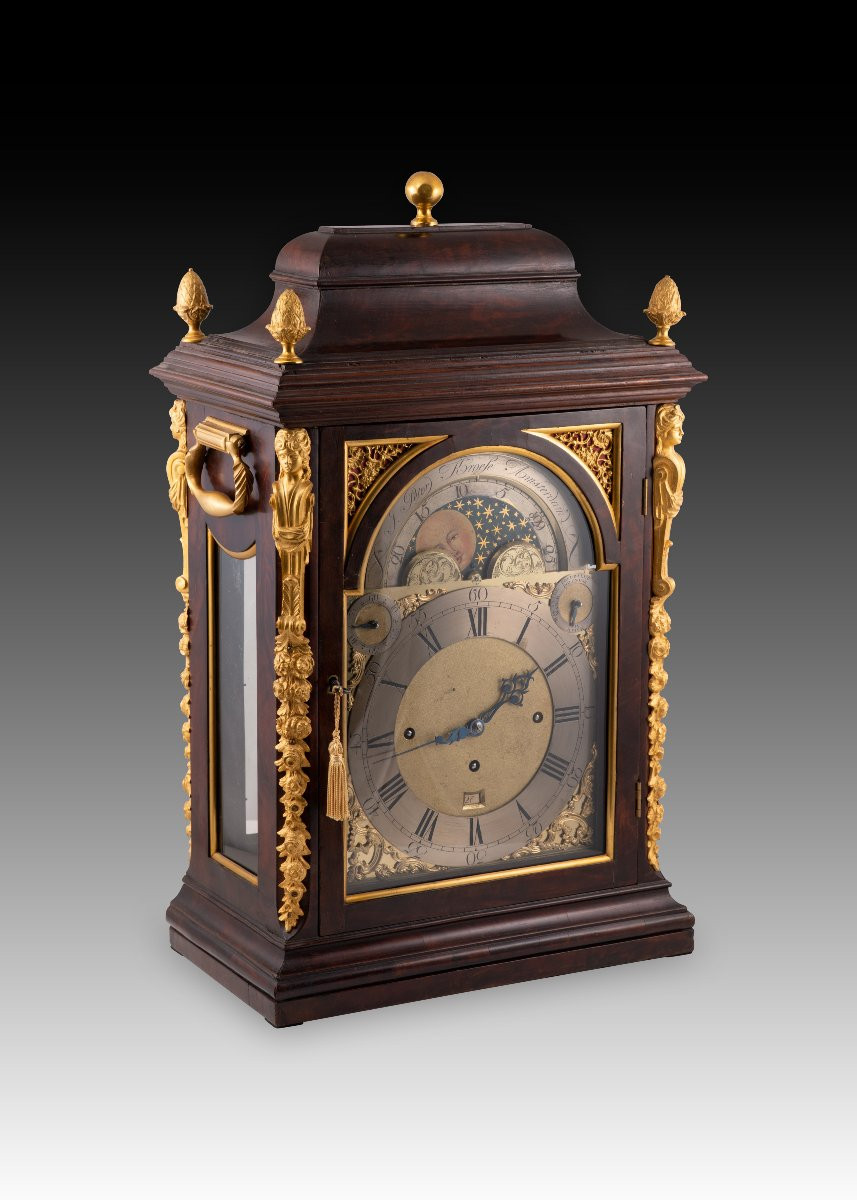
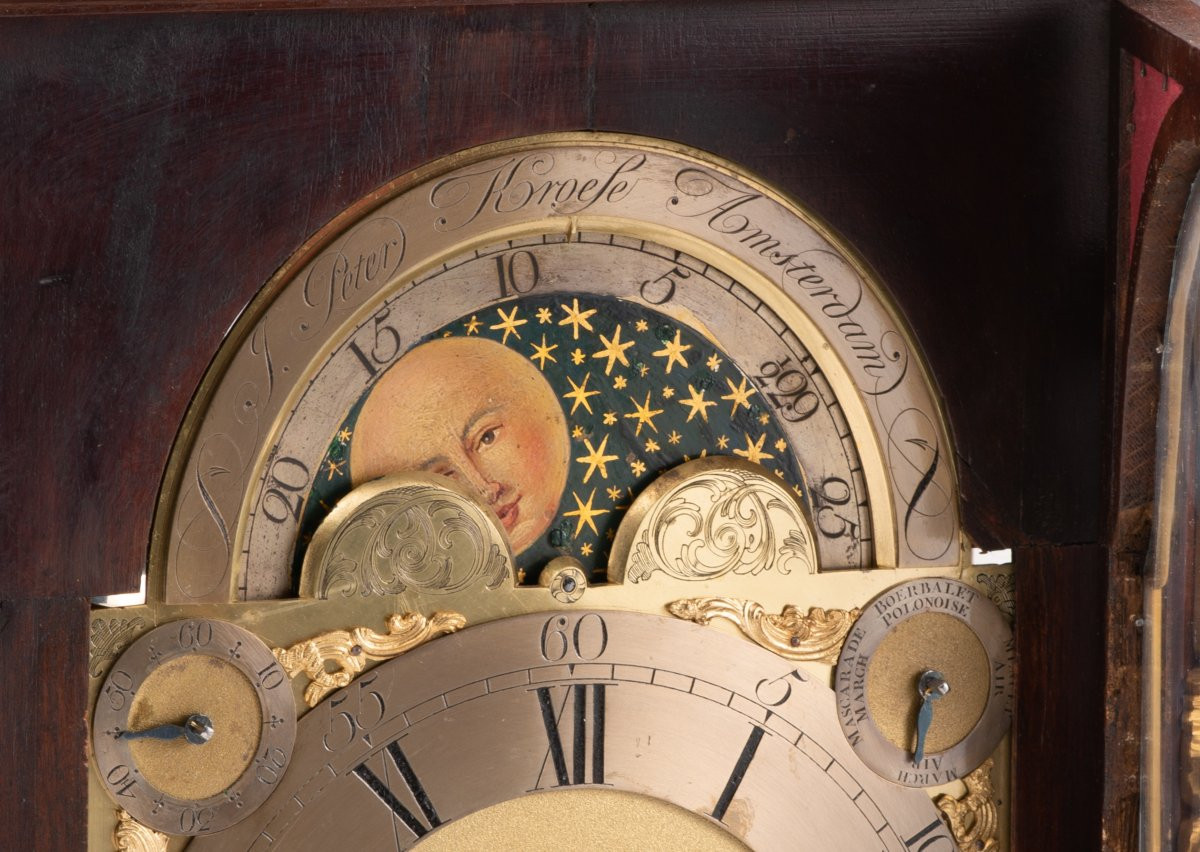
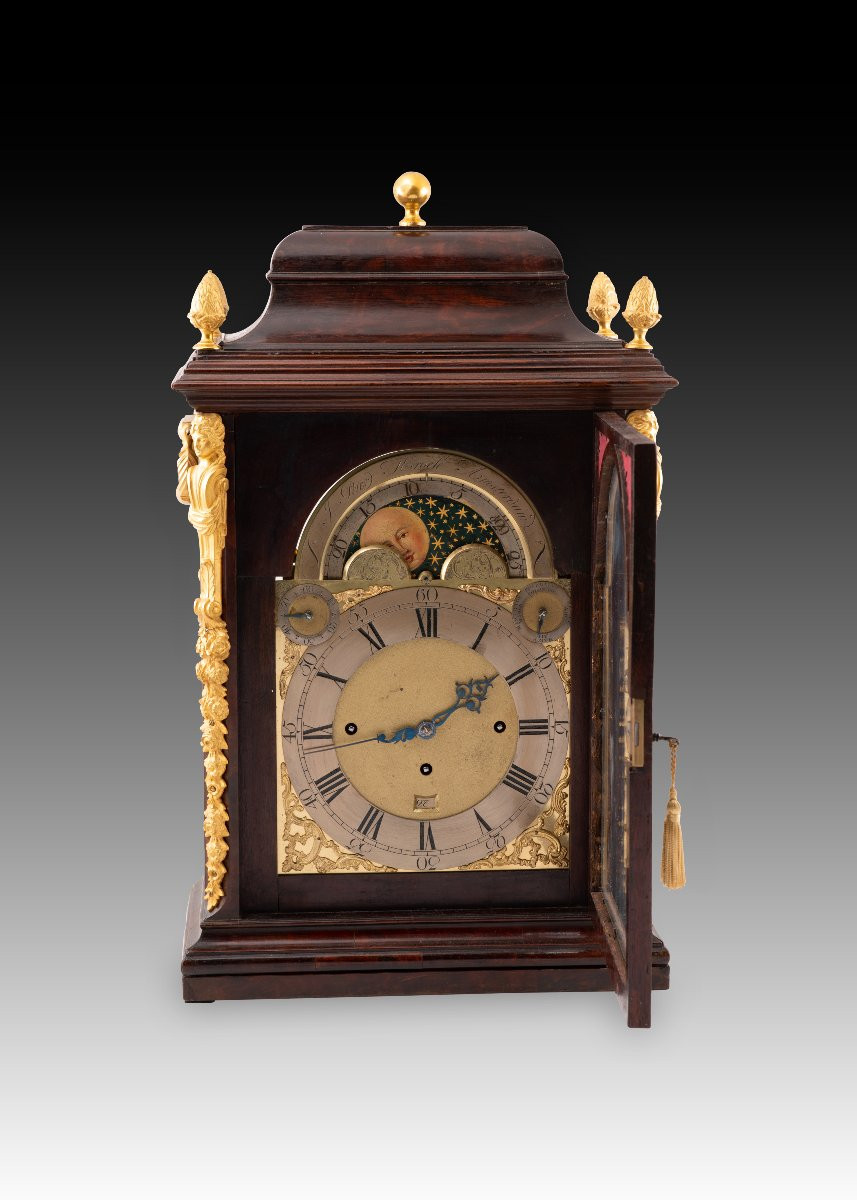
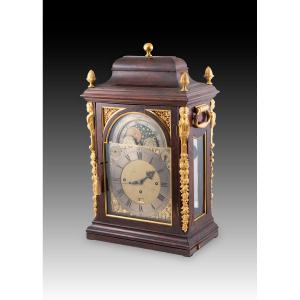
The clock case has a rectangular base and is adorned at the corners with ormolu sconces depicting plant motifs surmounted by grotesque female busts. Pine cones and a pearl adorn the upper part, which rises towards the center and features softened lines. The dial, protected by a front door, displays Roman numerals, with lines and Arabic numerals every five minutes. It features a rectangular aperture for the day and is surrounded by plant motifs reminiscent of the rocaille style. In the two corners are a dial for the alarm and another for various chimes. At the top, a half-sphere, surrounded by a metal band engraved with the signature, displays the phases of the moon using a disc representing a starry sky with a human face painted on it. The pendulum mechanism is engraved on the outside with plant motifs, as can be seen on the back of the case, which also features a small glass door. This style is typical of Northern European clocks of the 17th century, developed mainly in England and designed to emphasize the quality of the clock movement, in contrast to French models, which placed greater emphasis on the aesthetics of the exterior. Thus, the structure is much simpler than in France, but the mechanism was far more precise, and the technical subtleties found in examples like this (music box, calendar, chime, alarm, etc.) were more common than in French clocks. Johannes Pieter Kroese was a master clockmaker from Wuppertal (Kruse) who worked in Amsterdam from around 1729 in his workshop, where his son, Pieter Kroese, also worked before succeeding him in 1775. He was particularly renowned for his astrological clocks, some more complex (with zodiac) and others simpler, like the one shown here. Examples of this master's astronomical clocks can only be found in important private collections, in the hands of his descendants, or in renowned institutions such as the Dutch National Clock Museum in Zaandam. -
Dimensions: 33 x 19 x 55 cm
Half-hourly striking, alarm and music. Mechanism in perfect working order.
The clock case has a rectangular base and is adorned at the corners with ormolu sconces depicting plant motifs surmounted by grotesque female busts. Pine cones and a pearl adorn the upper part, which rises towards the center and features softened lines. The dial, protected by a front door, displays Roman numerals, with lines and Arabic numerals every five minutes. It features a rectangular aperture for the day and is surrounded by plant motifs reminiscent of the rocaille style. In the two corners are a dial for the alarm and another for various chimes. At the top, a half-sphere, surrounded by a metal band engraved with the signature, displays the phases of the moon using a disc representing a starry sky with a human face painted on it. The pendulum mechanism is engraved on the outside with plant motifs, as can be seen on the back of the case, which also features a small glass door. This style is typical of Northern European clocks of the 17th century, developed mainly in England and designed to emphasize the quality of the clock movement, in contrast to French models, which placed greater emphasis on the aesthetics of the exterior. Thus, the structure is much simpler than in France, but the mechanism was far more precise, and the technical subtleties found in examples like this (music box, calendar, chime, alarm, etc.) were more common than in French clocks. Johannes Pieter Kroese was a master clockmaker from Wuppertal (Kruse) who worked in Amsterdam from around 1729 in his workshop, where his son, Pieter Kroese, also worked before succeeding him in 1775. He was particularly renowned for his astrological clocks, some more complex (with zodiac) and others simpler, like the one shown here. Examples of this master's astronomical clocks can only be found in important private collections, in the hands of his descendants, or in renowned institutions such as the Dutch National Clock Museum in Zaandam. -
Dimensions: 33 x 19 x 55 cm
20 000 €
Period: 18th century
Style: Other Style
Condition: Good condition
Material: Other
Width: 33 cm
Height: 55 cm
Depth: 19 cm
Reference (ID): 1746181
Availability: In stock
Print