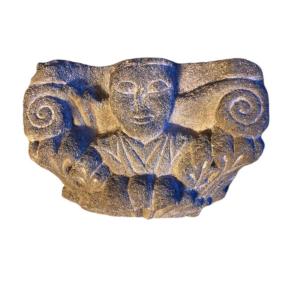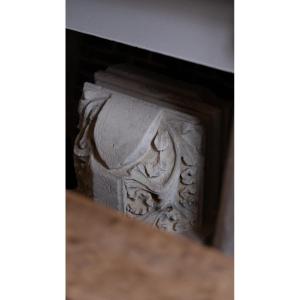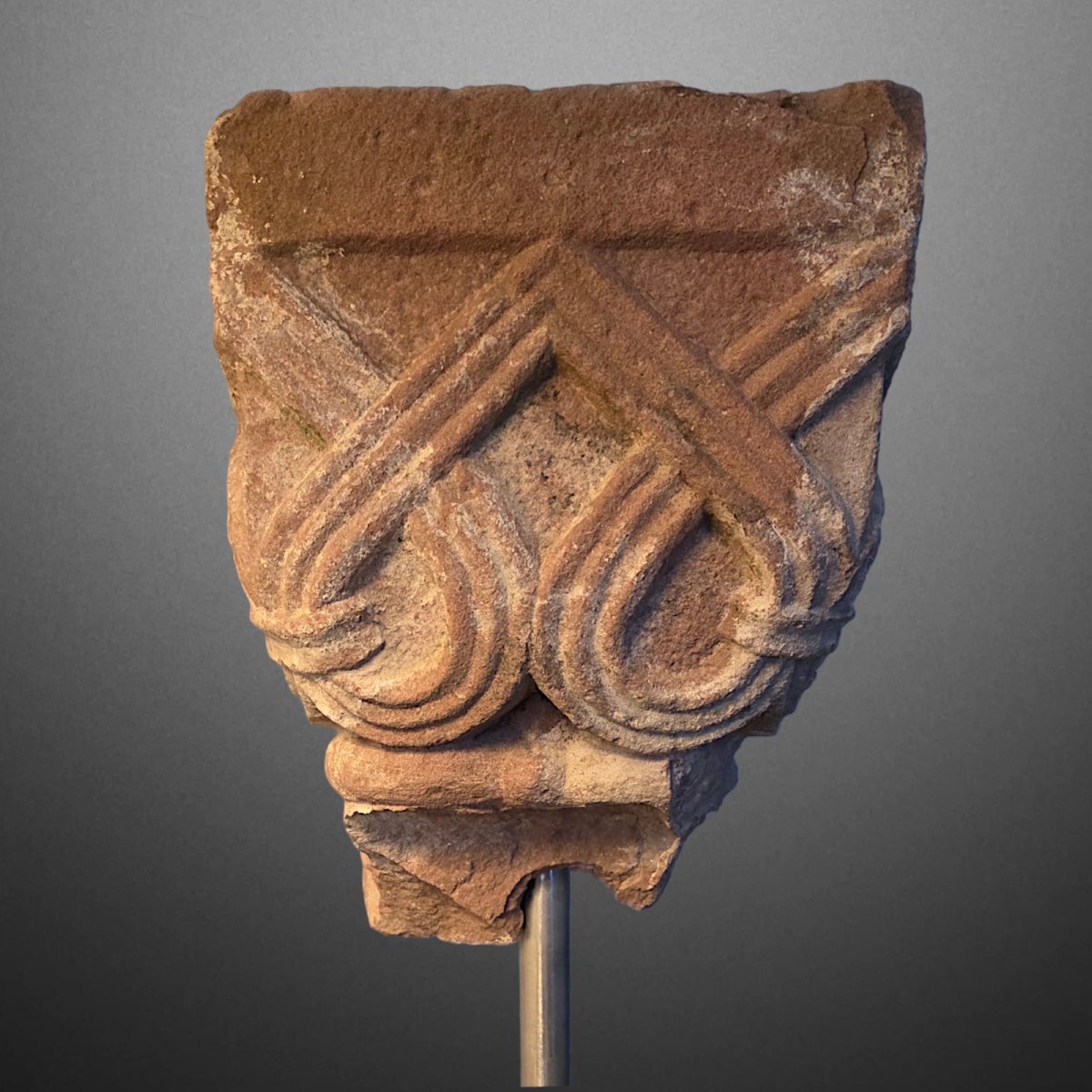
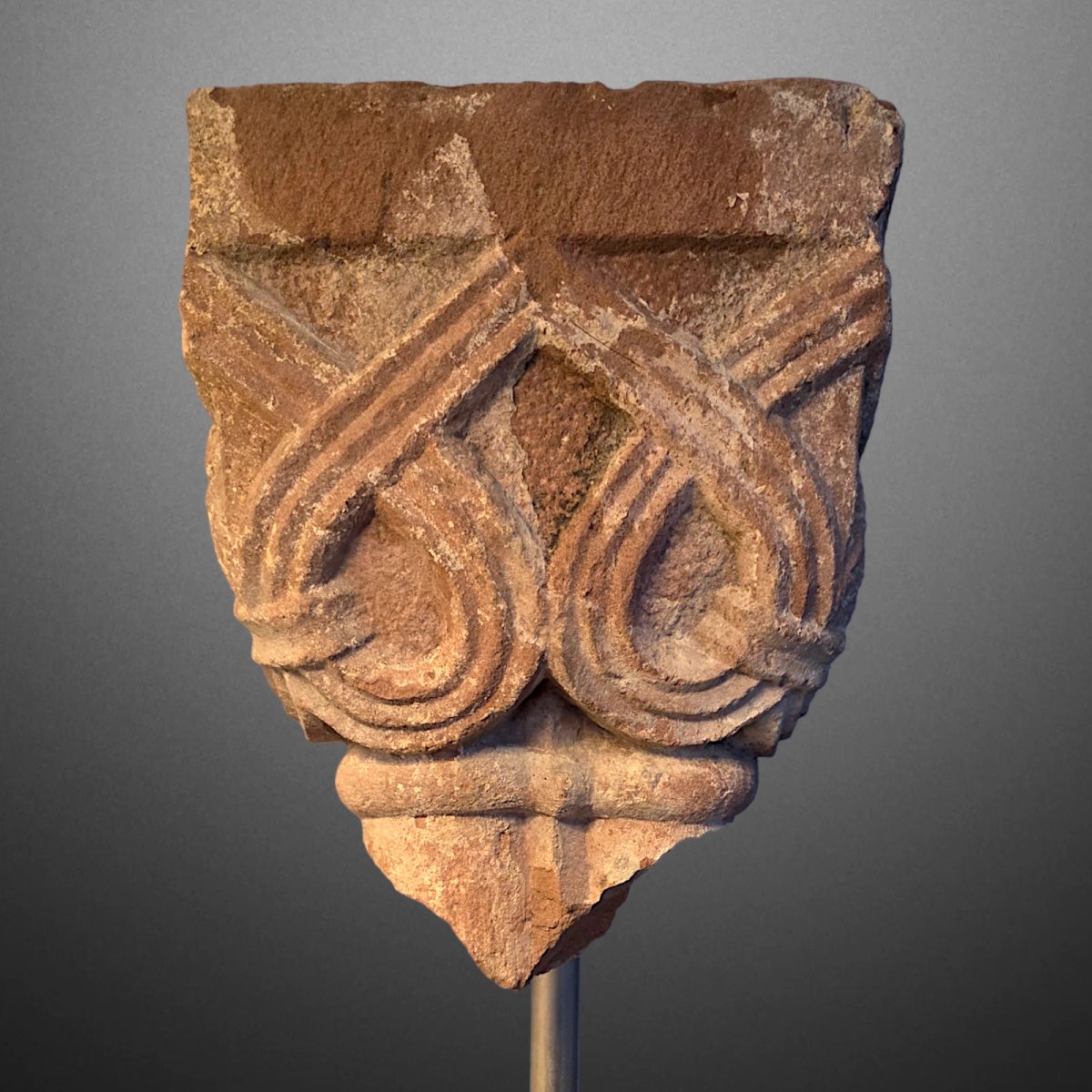
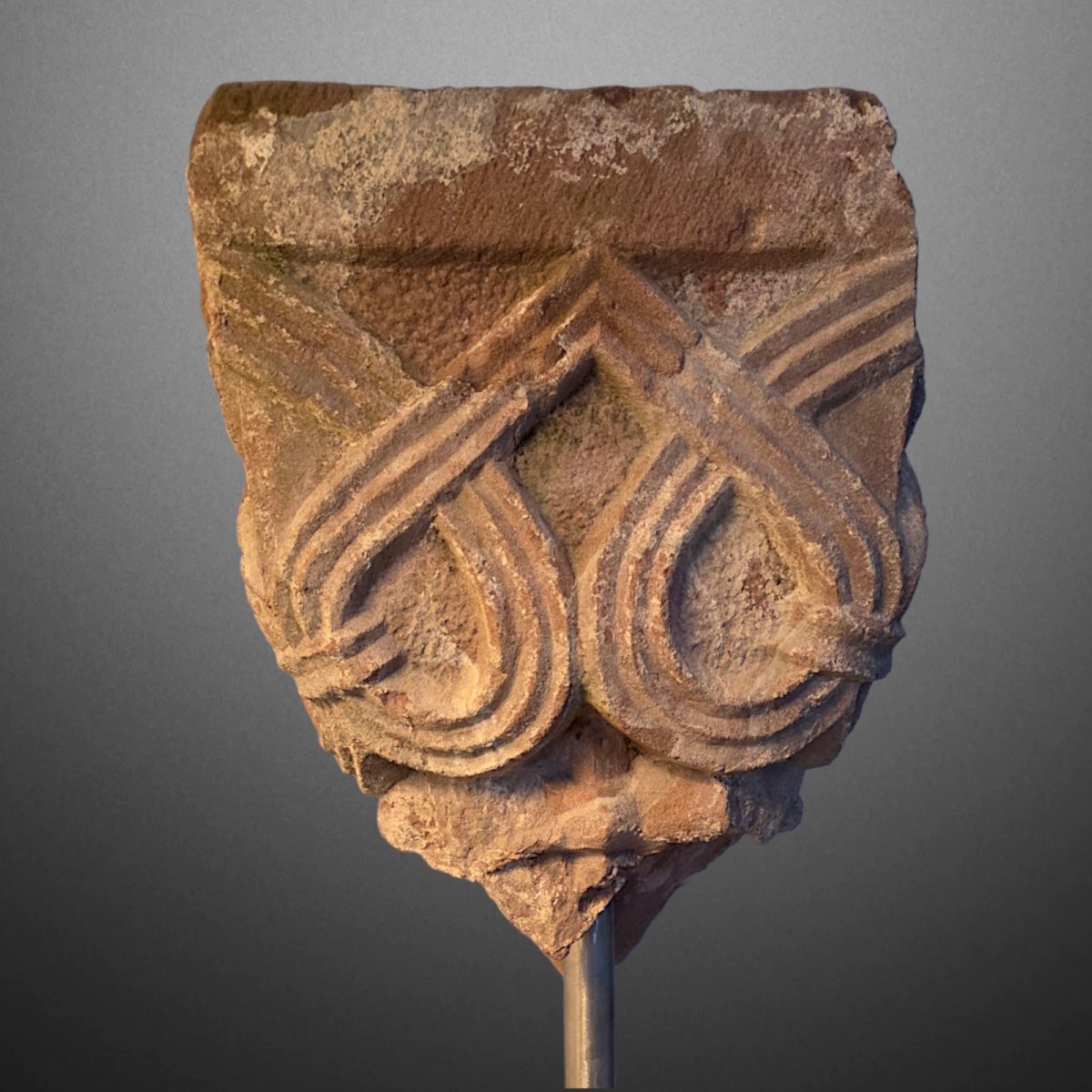
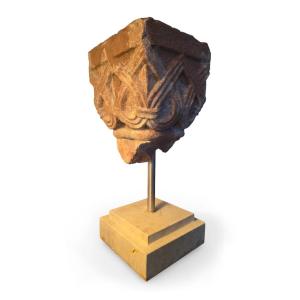


Romanesque Capital With Interlacing Decoration. Franconia, 12th Century.
Columnette capital in pink sandstone typical of the Main basin. Carved on all sides, it probably comes from a cloister or arcature. The corbel, inverted truncated cone shape, flares out to join an integrated parallelepipedal abacus. The decoration is entirely governed by a ribboned interlacing composition of great geometric rigor. This capital is distinguished by the use of tripartite ribbons, where each band is divided by two longitudinal incisions creating three parallel cords. In the lower corners of the basket, the ribbons are joined by transverse ligatures. This ornamental grammar, typical of Empire art under the Hohenstaufens, takes us back to the Würzburg workshops in the second half of the 12th century, circa 1150-1170.
The use of pink sandstone (Buntsandstein of the Main) is common in the Würzburg region, as is the motif of intertwined ribbons forming "heart" or "lyre" loops, which is a strong marker of Franconian sculpture in the middle and second half of the 12th century. Influences from Ottonian goldsmithing and Carolingian interlacing are still present in this region. The ribbon ligatures in the corners bring this capital into line with a similar-sized pink sandstone capital (inv. H 17769) in the Museum für Franken in Würzburg, from the Benedictine priory of Holzkirchen near Würzburg, dated to the end of the 12th century.
Full file on request.
Period: Before 16th century
Style: Renaissance, Louis 13th
Condition: Some scratches and chips
Material: Sandstone
Length: h. 25,5cm l. 21cm p.19,5cm
Width: 21cm
Height: 25,5cm
Depth: 19,5cm
Reference (ID): 1738908
Availability: In stock