19th-century Solid Terracotta Sculpture
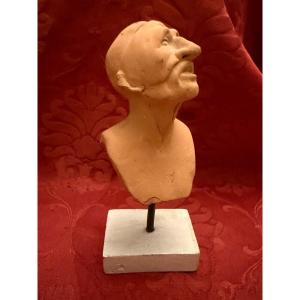
Magnificent, strikingly realistic full terracotta sculpture of a man seated in a slumped posture. He appears tired or overwhelmed, his head bent downwards, with a sad or exhausted expression. His body is partially covered in torn fabric, reinforcing the impression of vulnerability or suffering. Traces of modeling lend a raw, expressive look. The details of the face, hands and muscles show a fairly realistic artistic work.
This sculpture seems to be part of an artistic tradition focused on the expression of human emotions and suffering. It may bring to mind several possible influences:
Realism and naturalism, which seek to represent the human body faithfully, with its imperfections and fragility.
Expressionism, where the emphasis is on emotion - here fatigue, sadness or despondency.
Works like Auguste Rodin's The Thinker, but in a harsher, more vulnerable version: instead of a man in powerful reflection, we see a weakened man here.
Some religious or humanist representations, especially figures of suffering (such as saints, beggars or biblical figures), where the body conveys an inner ordeal.
The torn fabric and posture also evoke social themes, close to the work of committed artists.
A closer look at the posture, treatment of the body and expression refines the likely influences:
Influence of Auguste Rodin (expressive realism). The modelling of the body (muscles, hands, face) is reminiscent of a very "living" work of material, then a closeness to Alberto Giacometti (existentialism)
Although the proportions are more realistic, the mood evokes his fragile human figures
.
This sculpture seems to be part of an artistic tradition focused on the expression of human emotions and suffering. It may bring to mind several possible influences:
Realism and naturalism, which seek to represent the human body faithfully, with its imperfections and fragility.
Expressionism, where the emphasis is on emotion - here fatigue, sadness or despondency.
Works like Auguste Rodin's The Thinker, but in a harsher, more vulnerable version: instead of a man in powerful reflection, we see a weakened man here.
Some religious or humanist representations, especially figures of suffering (such as saints, beggars or biblical figures), where the body conveys an inner ordeal.
The torn fabric and posture also evoke social themes, close to the work of committed artists.
A closer look at the posture, treatment of the body and expression refines the likely influences:
Influence of Auguste Rodin (expressive realism). The modelling of the body (muscles, hands, face) is reminiscent of a very "living" work of material, then a closeness to Alberto Giacometti (existentialism)
Although the proportions are more realistic, the mood evokes his fragile human figures
.
2 880 €
Period: 19th century
Style: Other Style
Condition: Good condition
Material: Terracotta
Length: 48
Height: 43
Reference (ID): 1735188
Availability: In stock
Print