

Demetrio Monteserín (1876-1958) - Aux Jardins De Versailles / Era Un Aire Suave
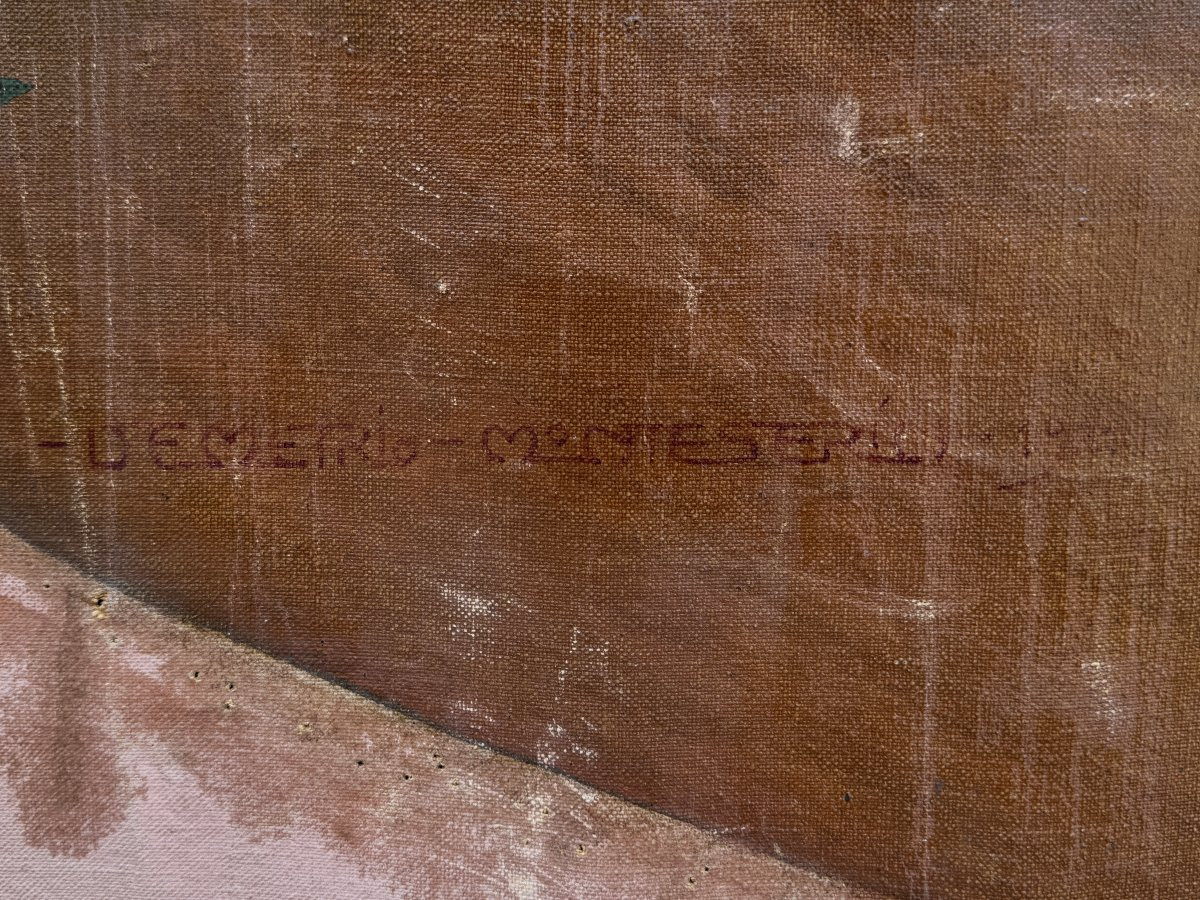
Oil on canvas. Original canvas. Unframed.
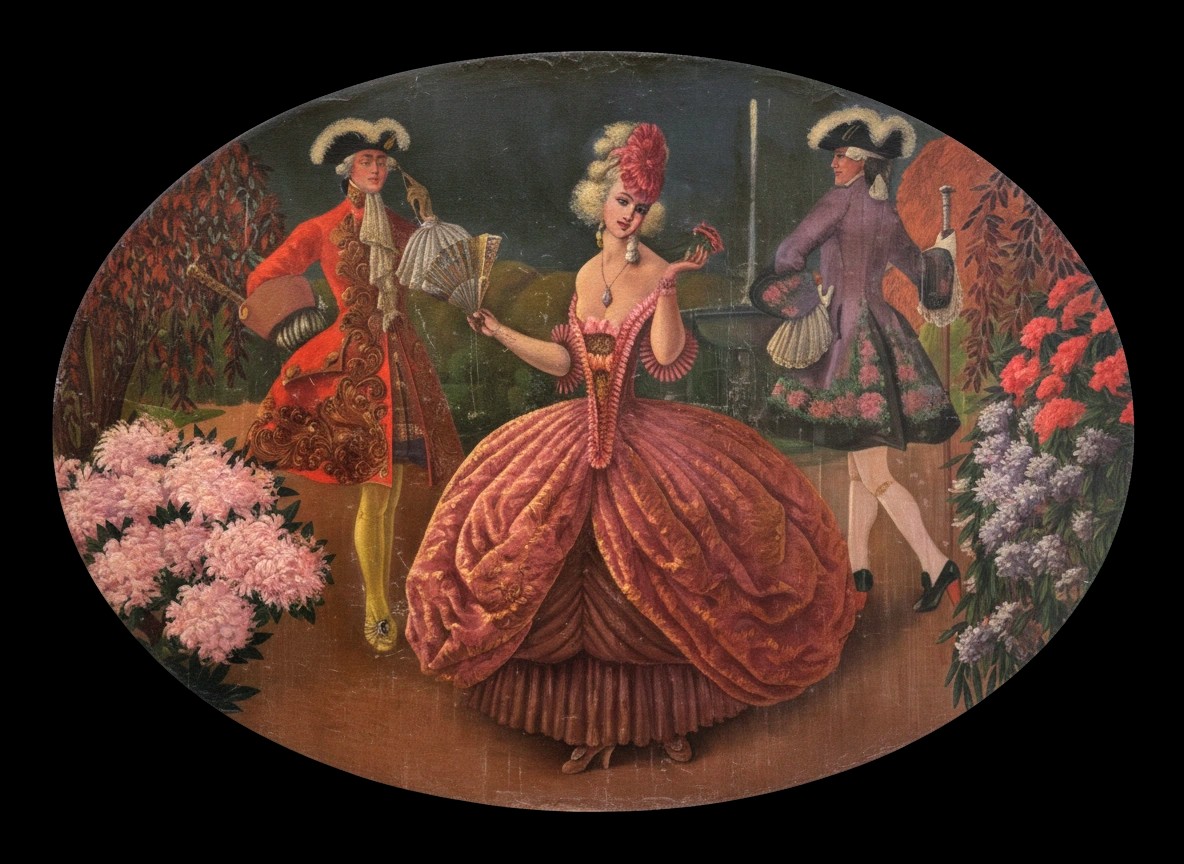
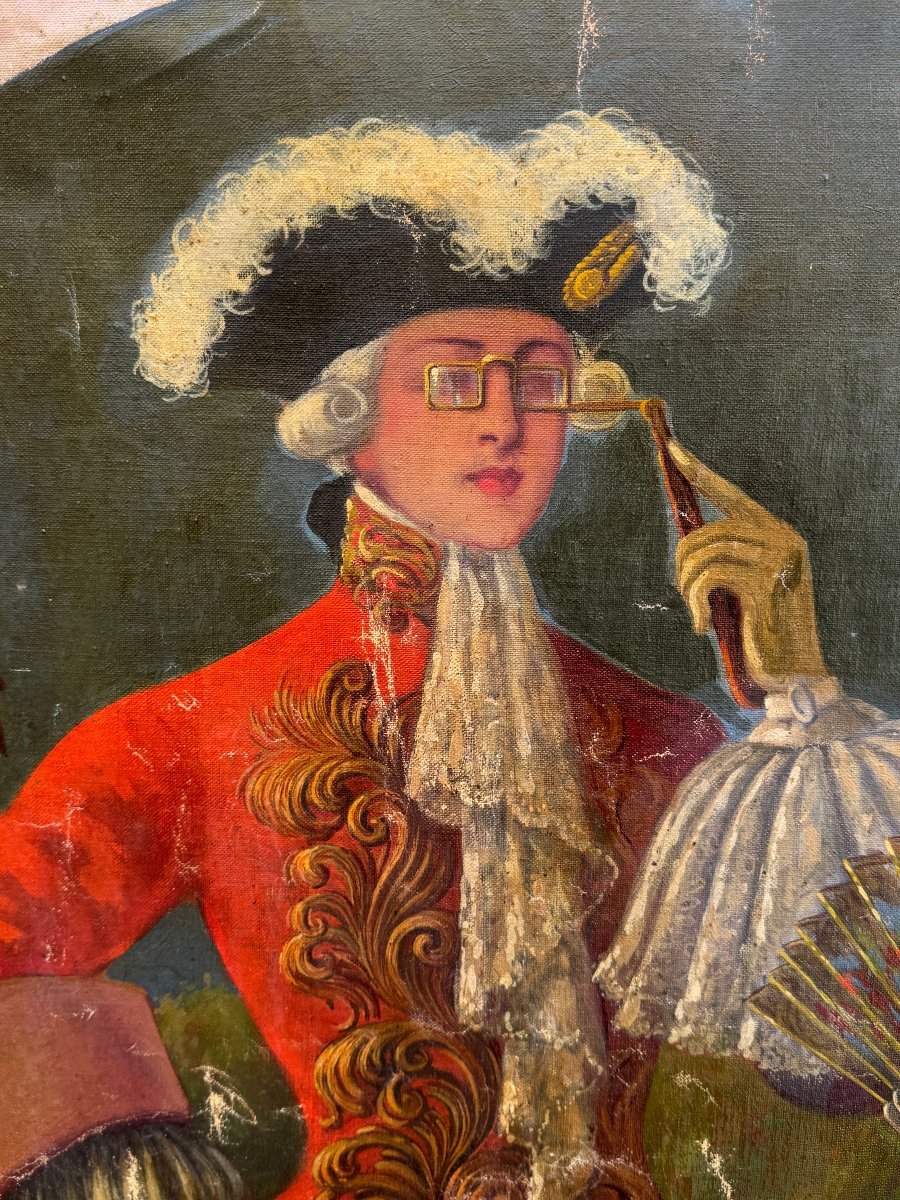
This monumental symbolist fresco by Demetrio Monteserín, offered up for contemplation like a jewel of sophisticated languor, is an explosion of Art Nouveau sensuality that exudes the fragrant essence of an imaginary Rococo Versailles. In an oval format that accentuates its decorative character, the work transcends mere historical representation to become a visual embodiment of Rubén Darío's lines from his seminal poem "Era un aire suave" (It was a sweet air), collected in Prosas Profanas (Profane Prose). Monteserín, with the technical facility characteristic of his brushstrokes as a painter of ballrooms, casinos and lavish spas, is not content to paint a courtly scene, but captures the very essence of the modernist ideal championed by Théophile Gautier in Spanish-speaking countries: an art that seeks pure beauty and escape into realms of gallant fantasy.
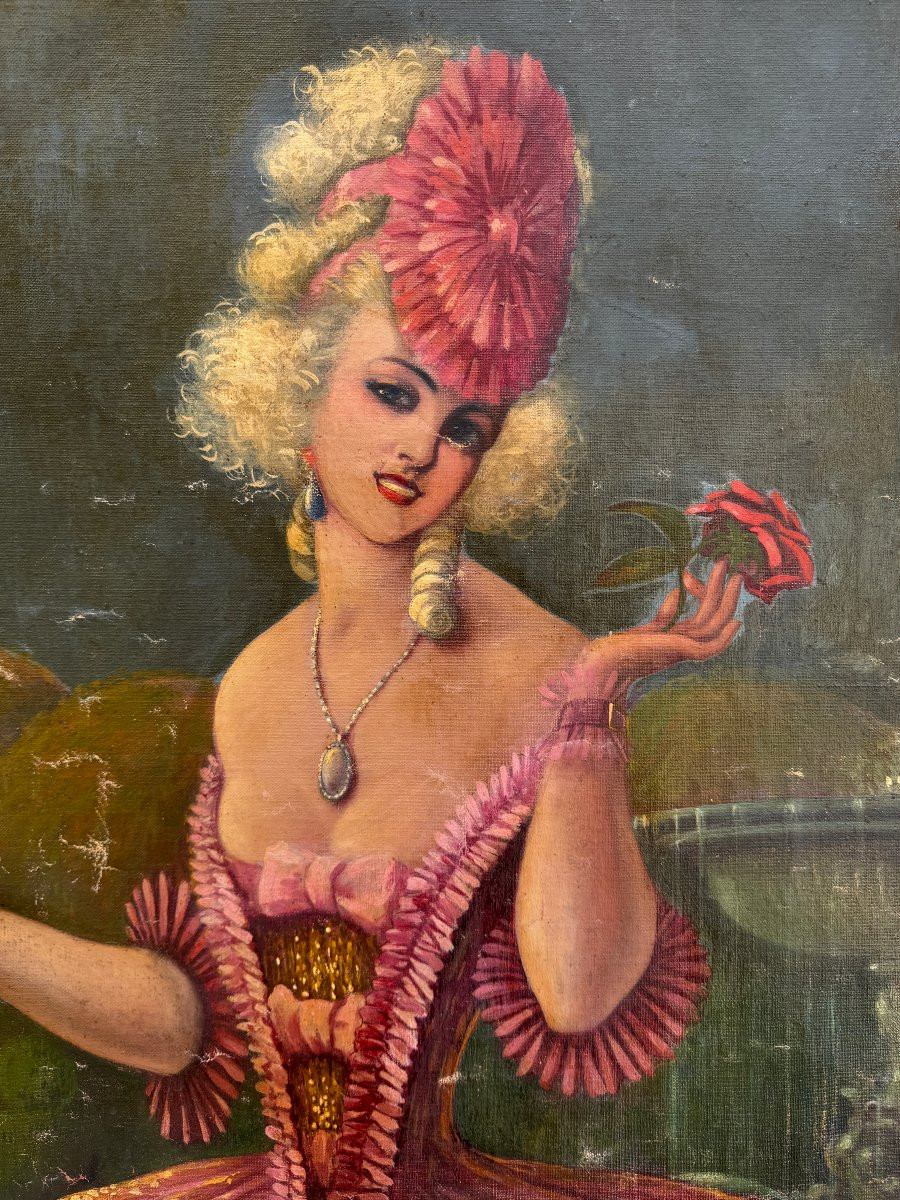
The composition is a minuet of shapes and colors where technical rigor mingles with unbridled fantasy. The central figure, the poem's Marquise Eulalia, a wasp-waisted woman in feather finery evoking the height of 18th-century fashion, brandishes her fan - a Daronian symbol par excellence of coded conversation and caprice - before two gallants in gold and mauve embroidered garments, whose powdered faces reflect an aristocratic melancholy. The background, far from being a peaceful garden, is a "modernist Arcadia" of rhododendrons and fountains hidden in shadow, enveloping the figures in an atmosphere of mysticism and mystery. Monteserín's touch, sometimes impasto and faithful in the texture of the clothes, sometimes diffuse in the foliage, creates a scene of sophisticated languor where time seems to have stopped in an eternal offering to love and beauty. In short, it's a testament to the triumph of modernity over tradition, a work that, like Darío's verses, finds divinity not in eternity, but in heroic transience and frivolity elevated to the sacred ritual of a perfect moment.
- Demetrio Monteserín (Villafranca del Bierzo, 1876 - Madrid, 1958) was a virtuoso of pictorial technique who navigated brilliantly from the local customs of León to the mysticism of the most refined modernism. Trained by masters such as Muñoz Degrain at the San Fernando Academy, his brushstrokes attained an overwhelming sincerity that enabled him to capture both the harshness of the land and the sophisticated languor of the Parisian salons, where he lived and soaked up the influence of the Symbolist avant-garde. His work, often awarded prizes at national exhibitions, is distinguished by its vibrant impasto and a unique ability to elevate the anecdotal to the level of sacred ritual, whether in his monumental frescoes with Daronian resonances or in his portraits with their deep, circumspect psychology. In Monteserín's work, tradition and modernity do not clash, but merge in a light that establishes him as one of the most cultivated and versatile interpreters of Spanish art in the first half of the 20th century.
- Unframed image size: 150 x 220 cm
This monumental symbolist fresco by Demetrio Monteserín, offered up for contemplation like a jewel of sophisticated languor, is an explosion of Art Nouveau sensuality that exudes the fragrant essence of an imaginary Rococo Versailles. In an oval format that accentuates its decorative character, the work transcends mere historical representation to become a visual embodiment of Rubén Darío's lines from his seminal poem "Era un aire suave" (It was a sweet air), collected in Prosas Profanas (Profane Prose). Monteserín, with the technical facility characteristic of his brushstrokes as a painter of ballrooms, casinos and lavish spas, is not content to paint a courtly scene, but captures the very essence of the modernist ideal championed by Théophile Gautier in Spanish-speaking countries: an art that seeks pure beauty and escape into realms of gallant fantasy.
The composition is a minuet of shapes and colors where technical rigor mingles with unbridled fantasy. The central figure, the poem's Marquise Eulalia, a wasp-waisted woman in feather finery evoking the height of 18th-century fashion, brandishes her fan - a Daronian symbol par excellence of coded conversation and caprice - before two gallants in gold and mauve embroidered garments, whose powdered faces reflect an aristocratic melancholy. The background, far from being a peaceful garden, is a "modernist Arcadia" of rhododendrons and fountains hidden in shadow, enveloping the figures in an atmosphere of mysticism and mystery. Monteserín's touch, sometimes impasto and faithful in the texture of the clothes, sometimes diffuse in the foliage, creates a scene of sophisticated languor where time seems to have stopped in an eternal offering to love and beauty. In short, it's a testament to the triumph of modernity over tradition, a work that, like Darío's verses, finds divinity not in eternity, but in heroic transience and frivolity elevated to the sacred ritual of a perfect moment.
- Demetrio Monteserín (Villafranca del Bierzo, 1876 - Madrid, 1958) was a virtuoso of pictorial technique who navigated brilliantly from the local customs of León to the mysticism of the most refined modernism. Trained by masters such as Muñoz Degrain at the San Fernando Academy, his brushstrokes attained an overwhelming sincerity that enabled him to capture both the harshness of the land and the sophisticated languor of the Parisian salons, where he lived and soaked up the influence of the Symbolist avant-garde. His work, often awarded prizes at national exhibitions, is distinguished by its vibrant impasto and a unique ability to elevate the anecdotal to the level of sacred ritual, whether in his monumental frescoes with Daronian resonances or in his portraits with their deep, circumspect psychology. In Monteserín's work, tradition and modernity do not clash, but merge in a light that establishes him as one of the most cultivated and versatile interpreters of Spanish art in the first half of the 20th century.
- Unframed image size: 150 x 220 cm
3 500 €
Period: 20th century
Style: Art Nouveau
Condition: Good condition
Material: Oil painting
Reference (ID): 1734396
Availability: In stock
Print