THIS OBJECT WAS SOLD
Printed Paper Fan With Bone Ribs, Duvelleroy Elysée Palace Hotel, Circa 1900
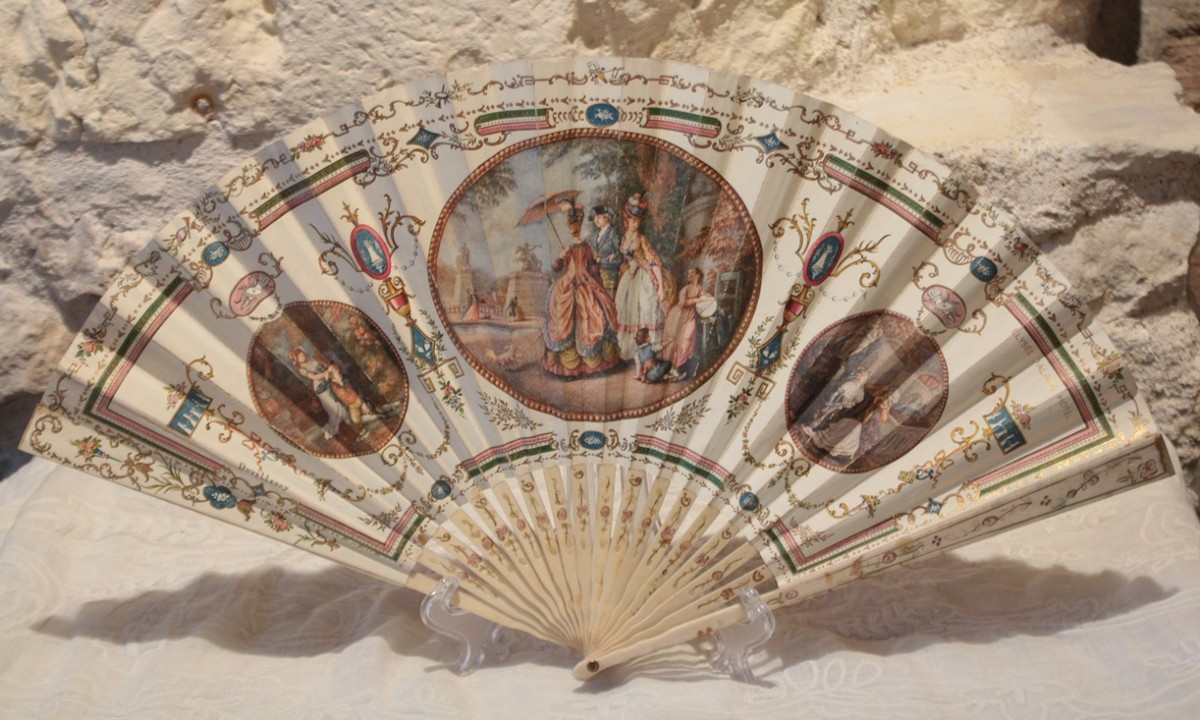


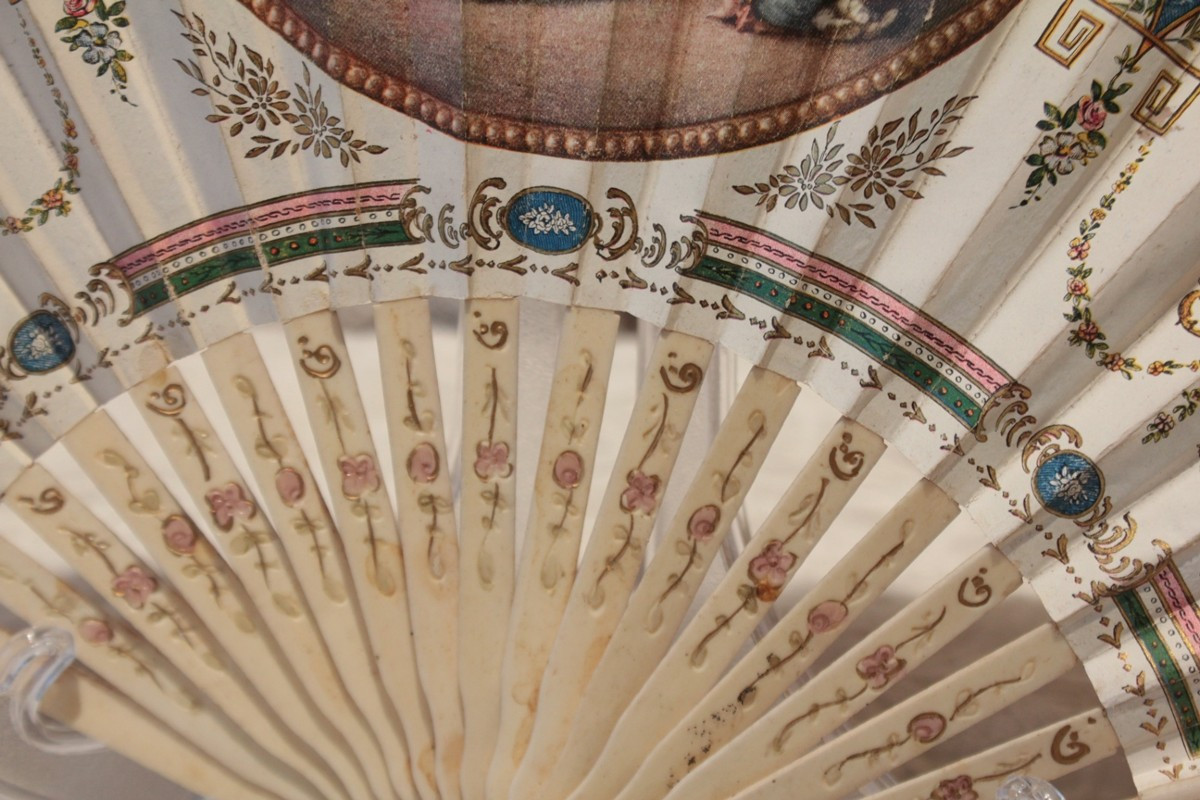


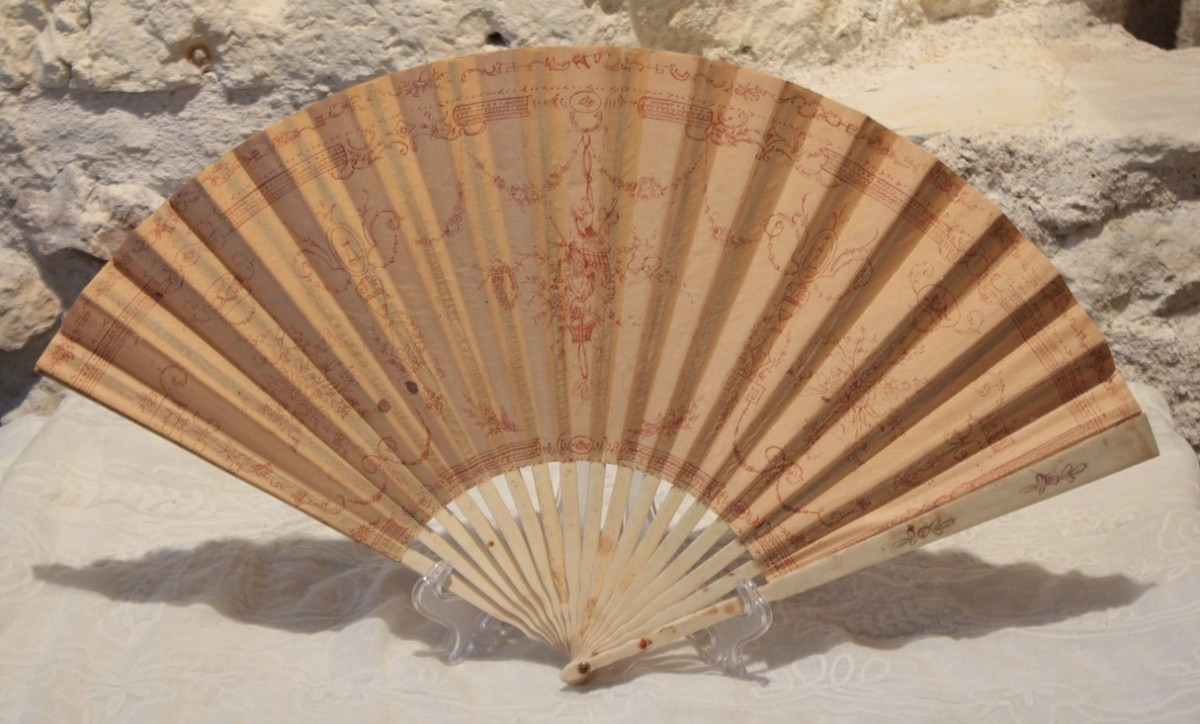

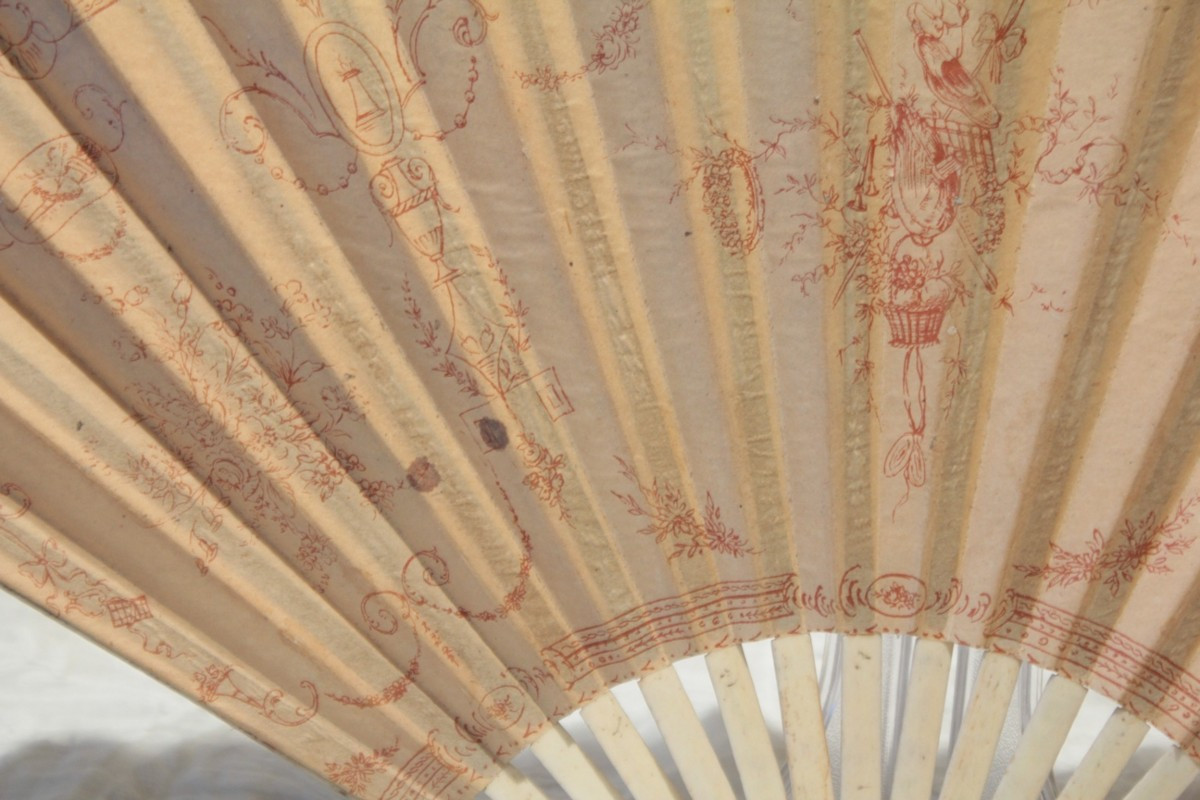


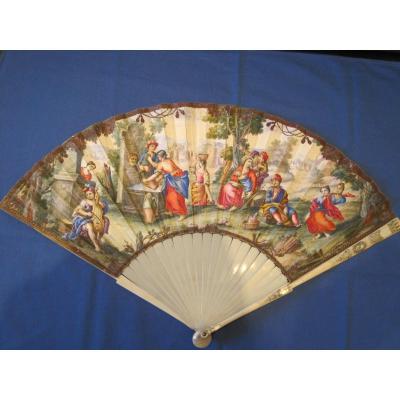
An 18-rib bone fan with a double-sided paper leaf engraved with cartouches depicting gallant scenes inspired by the 18th century (see below). The reverse is engraved with a monochrome ornamental design. Signed "Duvelleroy" on both sides, and "Elysée Hotel Palace" on the front. Some stains and wear are present.
Circa 1900.
Dimensions: open: H 25.5 x W 46.5 cm, closed: H 25.5 x W 2 x D 2.5 cm.
The three circular medallions shown are based on engravings from the late 18th century. The central medallion is inspired by an engraving by Jean-Michel Moreau the Younger (1741-1814) entitled "The Rendezvous at Marly," circa 1777. This example is typical of the classic fans produced by the Duvelleroy firm during this period, which borrowed Baroque and Rococo decorative details to create an 18th-century pastiche in order to appeal to a more conservative public.
The Duvelleroy firm occupies an important place in the history of 19th-century decorative arts, particularly in the redefinition of the fan as a fashion accessory and luxury item. Founded in Paris in 1827 by Jean-Pierre Duvelleroy, the firm emerged in a context where the fan, very fashionable under the Ancien Régime, had largely disappeared from use after the French Revolution. Duvelleroy would play a decisive role in its revival. Drawing on a keen understanding of fashionable tastes and an innovative business strategy, first in France, then throughout Europe, the company quickly grasped that this object could once again become a powerful social marker, both aesthetically and symbolically.
Under the Second Empire, the rise of high society fully fueled the resurgence of the fan. Duvelleroy established itself as one of the leading Parisian fan makers. The company acquired an international reputation and became a supplier to several European courts, notably in the United Kingdom and Russia. This official recognition helped solidify its prestige and spread its style far beyond the French capital. At the end of the 19th century, Duvelleroy reached its zenith. The fan was then ubiquitous in women's social lives and was no longer limited to a purely utilitarian function. It became a true instrument of communication, integrated into a refined code of gestures that the company itself helped to formalize and disseminate. In this context, each fan is conceived as a piece that is both decorative and expressive.
Duvelleroy's creations are distinguished by the high quality of their materials and the diversity of techniques employed. Participation in major international events, such as the 1878 Universal Exhibition, also contributed to Duvelleroy's renown. These events offered an ideal opportunity to showcase French craftsmanship and establish the fan within the realm of recognized decorative arts.
The Hôtel Élysée Palace was built between 1897 and 1899, on the eve of the 1900 Universal Exhibition. Located on the Champs-Élysées, it became one of the first luxury hotels in the area. Designed by the architect Georges Chedanne, the building is distinguished by its Art Nouveau style and innovative layout. The hotel is much more than a luxury hotel; it is a place to live. It offers a range of services, including boutiques, an art gallery, and a photography studio. It thus attracts a wealthy international clientele, linked to grand luxury rail journeys, and becomes a symbol of the Belle Époque's high society. The hotel is often associated with the famous spy Mata Hari because she is said to have stayed there during her visits to Paris.
Circa 1900.
Dimensions: open: H 25.5 x W 46.5 cm, closed: H 25.5 x W 2 x D 2.5 cm.
The three circular medallions shown are based on engravings from the late 18th century. The central medallion is inspired by an engraving by Jean-Michel Moreau the Younger (1741-1814) entitled "The Rendezvous at Marly," circa 1777. This example is typical of the classic fans produced by the Duvelleroy firm during this period, which borrowed Baroque and Rococo decorative details to create an 18th-century pastiche in order to appeal to a more conservative public.
The Duvelleroy firm occupies an important place in the history of 19th-century decorative arts, particularly in the redefinition of the fan as a fashion accessory and luxury item. Founded in Paris in 1827 by Jean-Pierre Duvelleroy, the firm emerged in a context where the fan, very fashionable under the Ancien Régime, had largely disappeared from use after the French Revolution. Duvelleroy would play a decisive role in its revival. Drawing on a keen understanding of fashionable tastes and an innovative business strategy, first in France, then throughout Europe, the company quickly grasped that this object could once again become a powerful social marker, both aesthetically and symbolically.
Under the Second Empire, the rise of high society fully fueled the resurgence of the fan. Duvelleroy established itself as one of the leading Parisian fan makers. The company acquired an international reputation and became a supplier to several European courts, notably in the United Kingdom and Russia. This official recognition helped solidify its prestige and spread its style far beyond the French capital. At the end of the 19th century, Duvelleroy reached its zenith. The fan was then ubiquitous in women's social lives and was no longer limited to a purely utilitarian function. It became a true instrument of communication, integrated into a refined code of gestures that the company itself helped to formalize and disseminate. In this context, each fan is conceived as a piece that is both decorative and expressive.
Duvelleroy's creations are distinguished by the high quality of their materials and the diversity of techniques employed. Participation in major international events, such as the 1878 Universal Exhibition, also contributed to Duvelleroy's renown. These events offered an ideal opportunity to showcase French craftsmanship and establish the fan within the realm of recognized decorative arts.
The Hôtel Élysée Palace was built between 1897 and 1899, on the eve of the 1900 Universal Exhibition. Located on the Champs-Élysées, it became one of the first luxury hotels in the area. Designed by the architect Georges Chedanne, the building is distinguished by its Art Nouveau style and innovative layout. The hotel is much more than a luxury hotel; it is a place to live. It offers a range of services, including boutiques, an art gallery, and a photography studio. It thus attracts a wealthy international clientele, linked to grand luxury rail journeys, and becomes a symbol of the Belle Époque's high society. The hotel is often associated with the famous spy Mata Hari because she is said to have stayed there during her visits to Paris.
Explore similar pieces and discover your ideal find:
hand fans