


Portrait Of Mary Churchill, Mrs Joseph Damer 1715, Attributed To Jonathan Richardson
Artist: Jonathan Richardson The Elder (1667–1745)
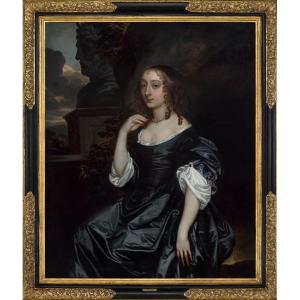
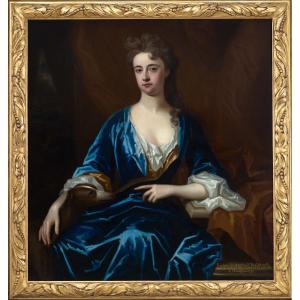
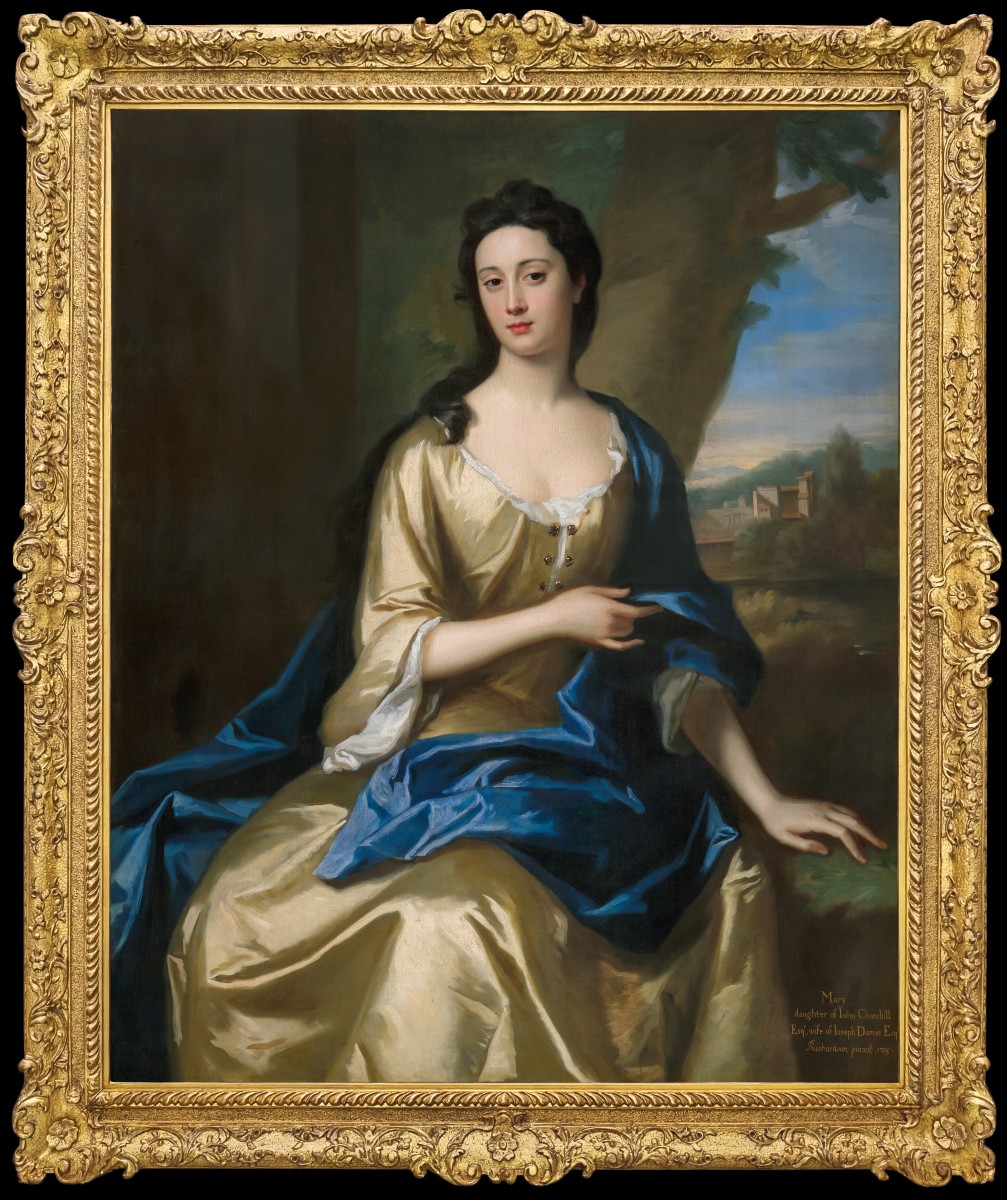
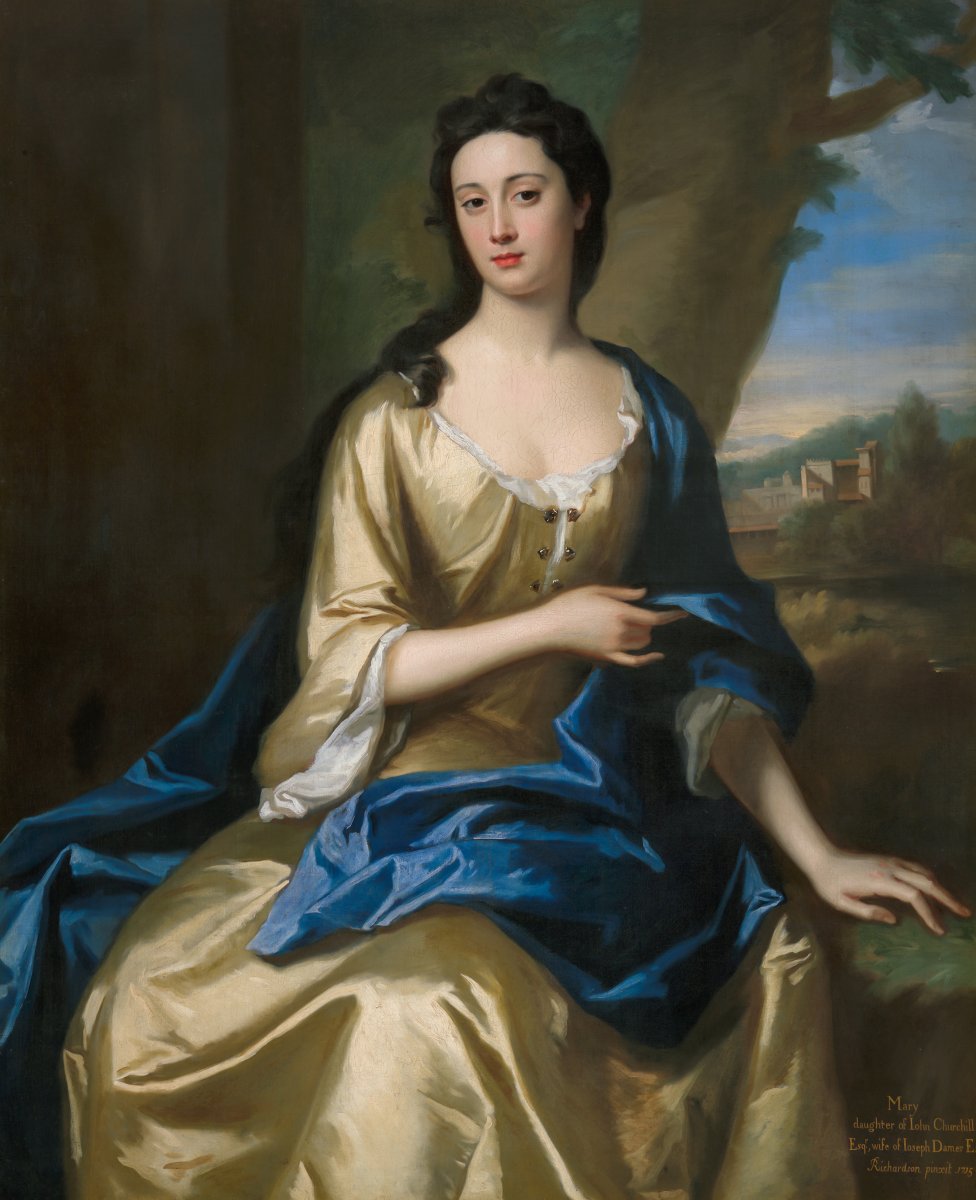
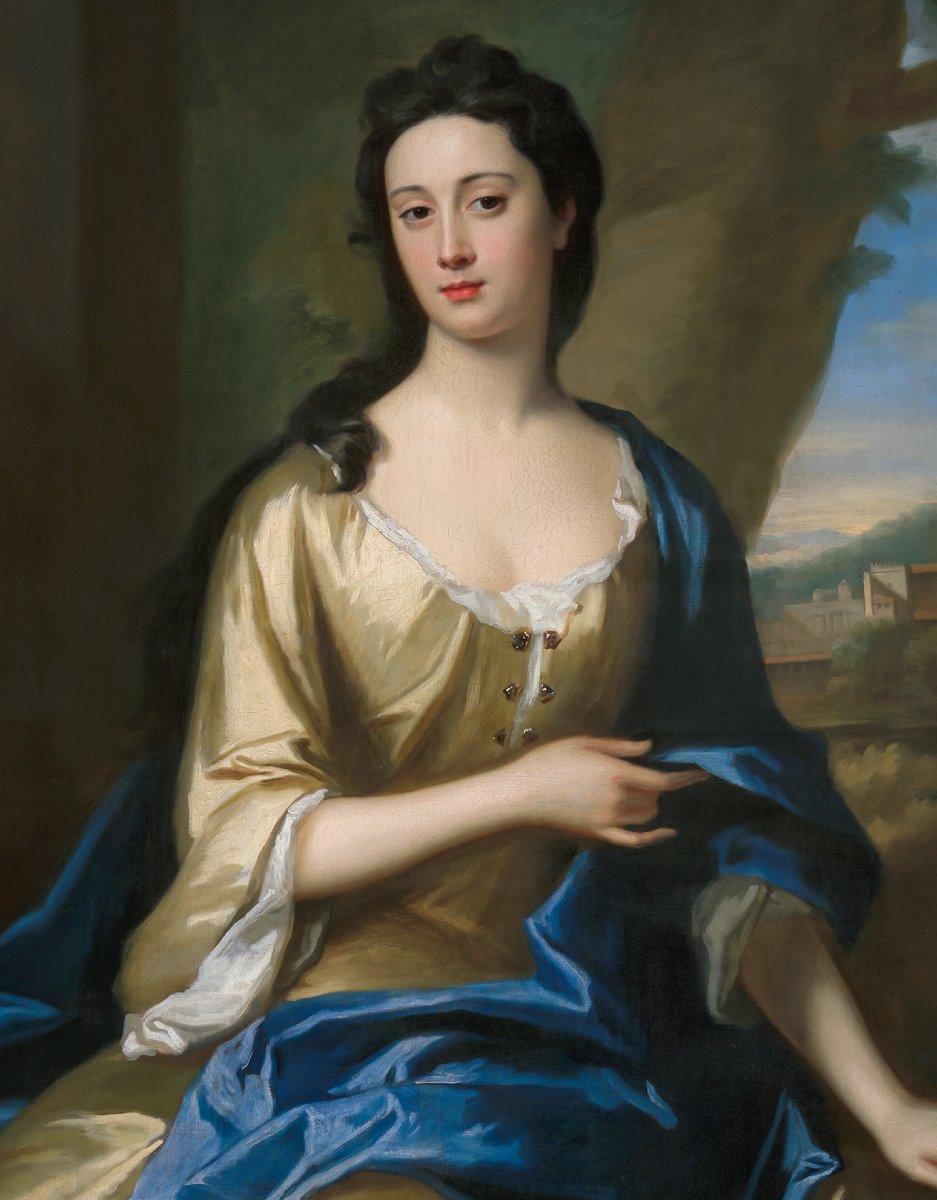
This is an exceptionally refined and compelling portrait, distinguished by its compositional balance, psychological presence, and notably fine state of preservation. The paint surface remains remarkably fresh, allowing Richardson’s subtle modelling—particularly in the flesh tones and the handling of drapery—to be appreciated with unusual clarity. The sitter emerges with a quiet authority and cultivated poise, qualities that place the work among the more distinguished female portraits of the English early Georgian period.
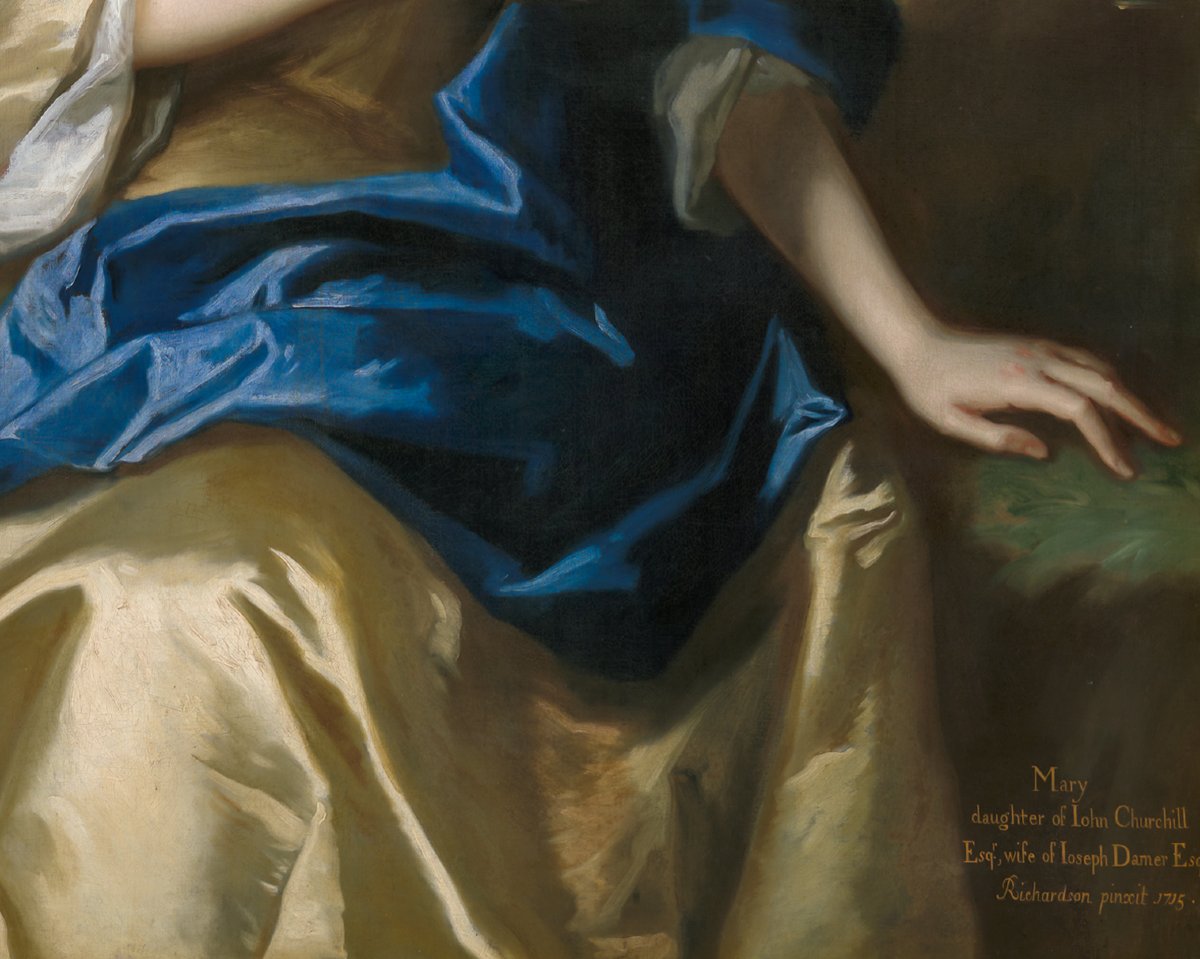
The sitter is identified by a contemporary inscription as: “Mary, Daughter of John Churchill Esq., wife of Joseph Damer Esq. Richardson Pinxt 1715.” Mary Churchill was the daughter of John Churchill of Henbury in Dorset, a member of the landed gentry whose family, while distinct from the ducal line of the Marlborough Churchills, nonetheless formed part of the wider social and political milieu associated with that name. The Churchills of this branch were established provincial landowners, embedded within the structures of county society and representative of that class of educated and ambitious gentry whose influence was increasingly felt in both local and national affairs in the late Stuart and early Hanoverian periods. Through more distant connections, they participated in the broader cultural orbit of John Churchill, 1st Duke of Marlborough, and the name itself carried considerable social resonance.
Her marriage to Joseph Damer (1676–1737), solemnised on 6 December 1714, united this inherited social standing with a family whose trajectory was defined by rapid financial and political ascent. The Damers rose from mercantile and financial origins to become substantial landowners, particularly in Ireland, where they acquired extensive estates in Tipperary. By the early 18th century, Joseph Damer had established himself as a figure of consequence, serving as a Member of Parliament and consolidating estates in both England and Ireland. Their principal associations lay in Dorset, at Winterborne Came, and within their Irish holdings, reflecting the increasingly interconnected nature of land, politics, and wealth across the Irish Sea.
Within this context, the portrait’s date of 1715 becomes especially significant. Painted in the immediate aftermath of the couple’s marriage, it can be understood as both a personal and strategic commission: a visual affirmation of a newly established union that brought together lineage and ambition at a formative moment in the family’s history. The timing also coincides with the accession of George I following the Hanoverian Succession of 1714, a period of profound political realignment in which families connected to parliamentary life sought to consolidate and project their status. It is highly likely that the portrait was commissioned in London, where Jonathan Richardson the Elder was at the height of his career, and where Joseph Damer’s political and social connections would have brought the couple into the orbit of the capital’s leading portraitist. The work thus operates not merely as a likeness, but as a statement of identity, legitimacy, and aspiration at a pivotal moment of transition.
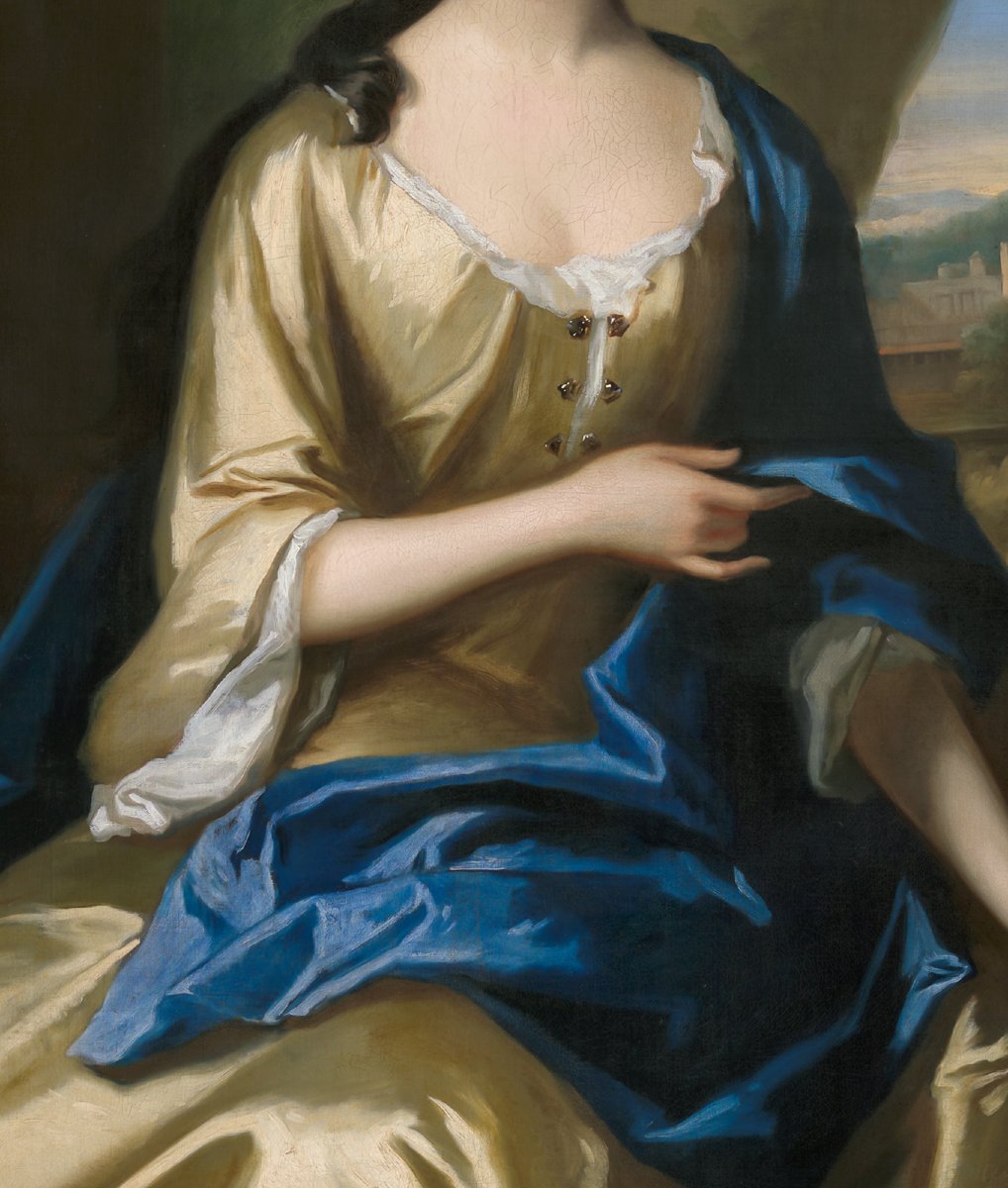
The sitter’s attire supports the dating with notable precision. She wears a formal silk mantua of the second decade of the 18th century, the bodice structured over stays and opening to reveal a finely edged white chemise. The low, broad neckline—typical of elite portraiture of the period—is handled with restraint, and the absence of overt jewellery places emphasis on the quality of the fabric and the composure of the sitter rather than on display. Draped across her shoulders is a rich blue mantle, a painterly device rather than a functional garment, used to introduce chromatic depth and to elevate the figure within the composition. The balance between richness and restraint is telling: this is not the ostentation of established aristocracy, but the carefully judged elegance of a family in ascent. Her softly arranged hair, naturalistic and without excessive artifice, further confirms a date in the years around 1715.
The painting is presented in a fine carved and gilded frame, whose restrained ornament and warm tonality complement the work and enhance its visual coherence without competing for attention.
The later history of the portrait is illuminated by comparison with works known to have remained within the family. Of particular importance is a large-scale portrait of Mary Damer by Angelica Kauffman, recorded in the collection of the Earls of Portarlington and on loan to the Travellers’ Club, London, in 1981. That work is explicitly described as painted after Richardson and retains reference to the 1715 prototype, indicating that the present portrait served as the compositional source. The existence of this Kauffman version confirms that the original likeness was known, valued, and considered sufficiently important to warrant reinterpretation in the later 18th century, when the family, now fully established within the aristocracy, sought to express its status through grander and more fashionable forms of portraiture.
Jonathan Richardson the Elder (1667–1745) was one of the most influential portrait painters in early 18th-century England. Trained in London, he established a highly successful practice serving the intellectual and political elite, and he played a central role in shaping the direction of British portraiture in the decades preceding Reynolds. In addition to his work as a painter, he was an important theorist and writer on art, contributing significantly to the development of artistic discourse in Britain. His portraits are characterised by their psychological depth, compositional restraint, and a departure from the more theatrical conventions of the late Baroque.
The present portrait offers a rare combination of aesthetic quality, historical significance, and condition. It represents a sitter of genuine genealogical importance at a pivotal moment in her family’s ascent; it stands as the likely prototype for a later, documented work by Angelica Kauffman; and it is executed by one of the leading portraitists of early 18th-century England at the height of his powers. Its inscribed identification, coherent historical narrative, and strong attribution distinguish it within the market, while its visual presence—elegant, composed, and quietly authoritative—ensures its continued appeal both as a work of art and as a document of social history.
Provenance:
Painted for the sitter, Mary Churchill, and her husband Joseph Damer, c.1715;
By descent in the Damer family, Dorset and/or Irish estates;
Descended within the extended Damer / Dawson-Damer (Portarlington) orbit into the 19th century;
Sold, (most likely) at a UK auction, 23 January 1975 (as indicated by chalk inscription verso: “Lot 77, 23-1-75”);
Private collection, United States
Measurements:
Height 144cm, Width 121cm framed (Height 56.5”, Width 47.5” framed)
The sitter is identified by a contemporary inscription as: “Mary, Daughter of John Churchill Esq., wife of Joseph Damer Esq. Richardson Pinxt 1715.” Mary Churchill was the daughter of John Churchill of Henbury in Dorset, a member of the landed gentry whose family, while distinct from the ducal line of the Marlborough Churchills, nonetheless formed part of the wider social and political milieu associated with that name. The Churchills of this branch were established provincial landowners, embedded within the structures of county society and representative of that class of educated and ambitious gentry whose influence was increasingly felt in both local and national affairs in the late Stuart and early Hanoverian periods. Through more distant connections, they participated in the broader cultural orbit of John Churchill, 1st Duke of Marlborough, and the name itself carried considerable social resonance.
Her marriage to Joseph Damer (1676–1737), solemnised on 6 December 1714, united this inherited social standing with a family whose trajectory was defined by rapid financial and political ascent. The Damers rose from mercantile and financial origins to become substantial landowners, particularly in Ireland, where they acquired extensive estates in Tipperary. By the early 18th century, Joseph Damer had established himself as a figure of consequence, serving as a Member of Parliament and consolidating estates in both England and Ireland. Their principal associations lay in Dorset, at Winterborne Came, and within their Irish holdings, reflecting the increasingly interconnected nature of land, politics, and wealth across the Irish Sea.
Within this context, the portrait’s date of 1715 becomes especially significant. Painted in the immediate aftermath of the couple’s marriage, it can be understood as both a personal and strategic commission: a visual affirmation of a newly established union that brought together lineage and ambition at a formative moment in the family’s history. The timing also coincides with the accession of George I following the Hanoverian Succession of 1714, a period of profound political realignment in which families connected to parliamentary life sought to consolidate and project their status. It is highly likely that the portrait was commissioned in London, where Jonathan Richardson the Elder was at the height of his career, and where Joseph Damer’s political and social connections would have brought the couple into the orbit of the capital’s leading portraitist. The work thus operates not merely as a likeness, but as a statement of identity, legitimacy, and aspiration at a pivotal moment of transition.
The sitter’s attire supports the dating with notable precision. She wears a formal silk mantua of the second decade of the 18th century, the bodice structured over stays and opening to reveal a finely edged white chemise. The low, broad neckline—typical of elite portraiture of the period—is handled with restraint, and the absence of overt jewellery places emphasis on the quality of the fabric and the composure of the sitter rather than on display. Draped across her shoulders is a rich blue mantle, a painterly device rather than a functional garment, used to introduce chromatic depth and to elevate the figure within the composition. The balance between richness and restraint is telling: this is not the ostentation of established aristocracy, but the carefully judged elegance of a family in ascent. Her softly arranged hair, naturalistic and without excessive artifice, further confirms a date in the years around 1715.
The painting is presented in a fine carved and gilded frame, whose restrained ornament and warm tonality complement the work and enhance its visual coherence without competing for attention.
The later history of the portrait is illuminated by comparison with works known to have remained within the family. Of particular importance is a large-scale portrait of Mary Damer by Angelica Kauffman, recorded in the collection of the Earls of Portarlington and on loan to the Travellers’ Club, London, in 1981. That work is explicitly described as painted after Richardson and retains reference to the 1715 prototype, indicating that the present portrait served as the compositional source. The existence of this Kauffman version confirms that the original likeness was known, valued, and considered sufficiently important to warrant reinterpretation in the later 18th century, when the family, now fully established within the aristocracy, sought to express its status through grander and more fashionable forms of portraiture.
Jonathan Richardson the Elder (1667–1745) was one of the most influential portrait painters in early 18th-century England. Trained in London, he established a highly successful practice serving the intellectual and political elite, and he played a central role in shaping the direction of British portraiture in the decades preceding Reynolds. In addition to his work as a painter, he was an important theorist and writer on art, contributing significantly to the development of artistic discourse in Britain. His portraits are characterised by their psychological depth, compositional restraint, and a departure from the more theatrical conventions of the late Baroque.
The present portrait offers a rare combination of aesthetic quality, historical significance, and condition. It represents a sitter of genuine genealogical importance at a pivotal moment in her family’s ascent; it stands as the likely prototype for a later, documented work by Angelica Kauffman; and it is executed by one of the leading portraitists of early 18th-century England at the height of his powers. Its inscribed identification, coherent historical narrative, and strong attribution distinguish it within the market, while its visual presence—elegant, composed, and quietly authoritative—ensures its continued appeal both as a work of art and as a document of social history.
Provenance:
Painted for the sitter, Mary Churchill, and her husband Joseph Damer, c.1715;
By descent in the Damer family, Dorset and/or Irish estates;
Descended within the extended Damer / Dawson-Damer (Portarlington) orbit into the 19th century;
Sold, (most likely) at a UK auction, 23 January 1975 (as indicated by chalk inscription verso: “Lot 77, 23-1-75”);
Private collection, United States
Measurements:
Height 144cm, Width 121cm framed (Height 56.5”, Width 47.5” framed)
14 450 €
Period: 18th century
Style: Louis 15th - Transition
Condition: Excellent condition
Material: Oil painting
Width: 121
Height: 144
Depth: 7
Reference (ID): 1727646
Availability: In stock
Print