






Venetian Painter Of The First Half Of The 18th Century, Madonna Del Latte And Saint Joseph
Venetian painter of the first half of the 18th century
Madonna del Latte and Saint Joseph
Oil on canvas, 80 x 100.5 cm – with frame, 91 x 111 cm
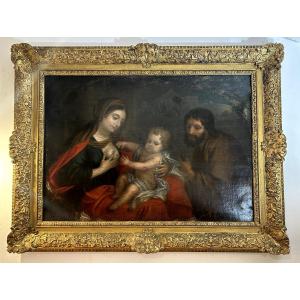
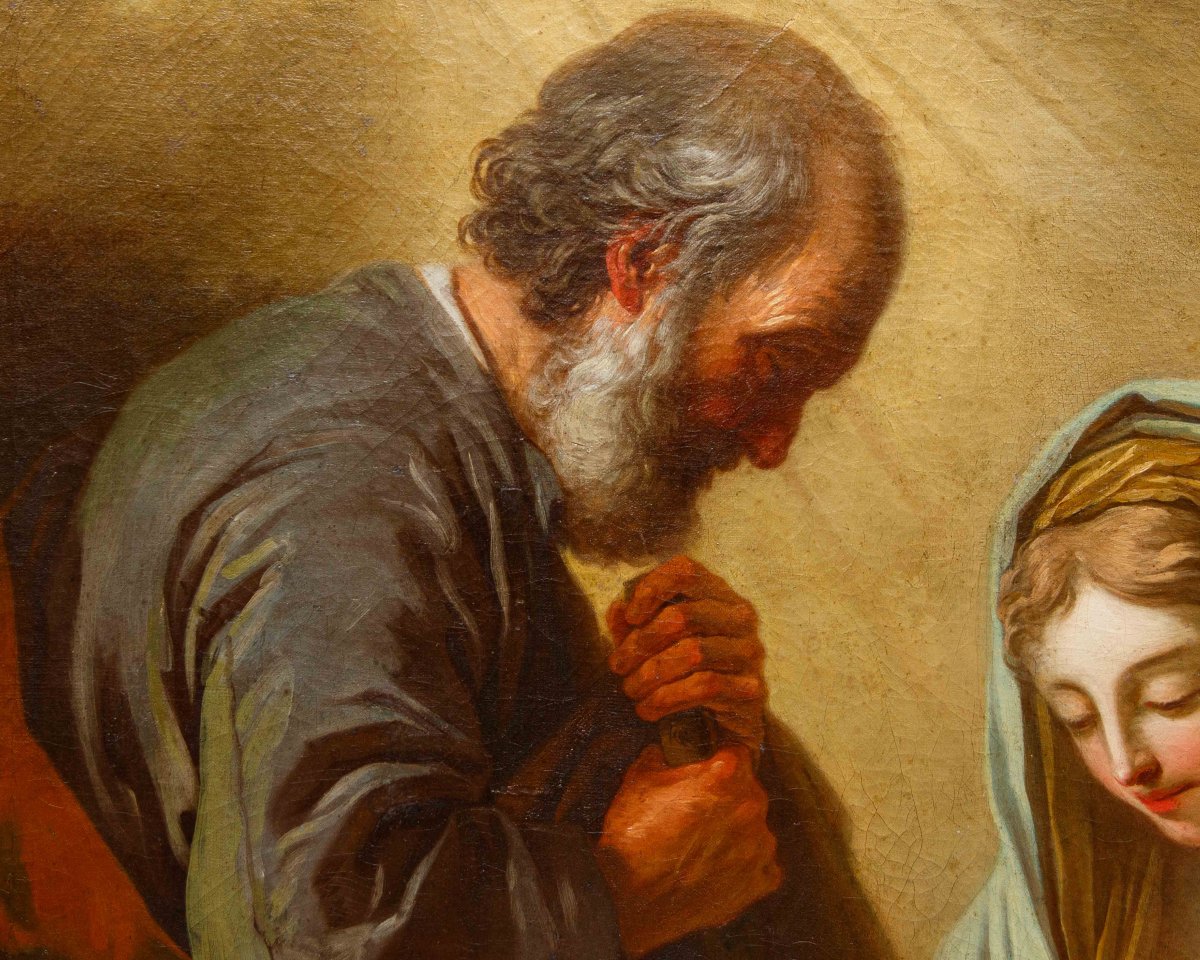
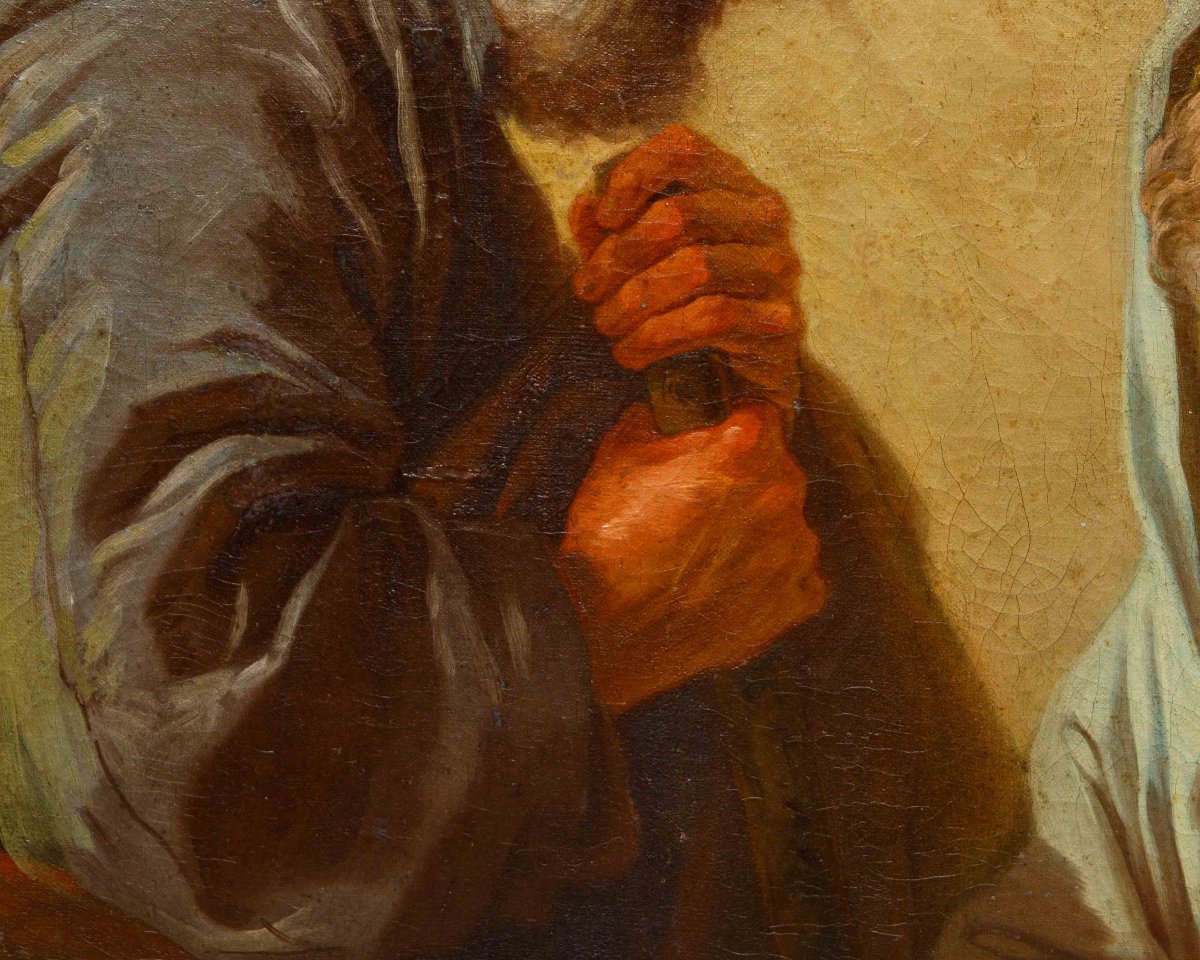
This valuable Madonna del Latte with Saint Joseph represents a significant document of the stylistic vivacity that characterized Venetian painting between the end of the seventeenth century and the beginning of the eighteenth century, a moment of crucial transition towards a clearer and more modern luminosity. The work stages the iconography of the Virgo Lactans with a profound charge of humanity and naturalness: at the center of the composition, the Virgin is wrapped in a blue cloak while holding in her arms the Baby Jesus, captured during the moment of breastfeeding. The light slips from the top left, shaping the volumes and igniting the palette with a quality that is not only functional to the plastic rendering, but imbued with a sacral valence. On the left, the figure of Saint Joseph observes the scene in an attitude of humble and profound meditation, leaning on the staff, with a darker and more marked complexion that intentionally contrasts with the Eburnean smoothness of the Virgin's face, while in the background on the right two cherub heads emerge from the clouds, participating in the supernatural dimension of the event. Within Venetian painting at the turn of the century, the painting fits into that climate of overcoming Baroque tenebrism towards the classical trends in vogue in the lagoon city. In some respects, the movement of the figures and the composition recall the work of Antonio Arrigoni and his skillful movement among the influences of Sebastiano Ricci, Antonio Molinari and Antonio Balestra. However, the pictorial consistency manifested here appears different and more vibrant, a sign that the author has carefully looked at the innovations introduced by Sebastiano Ricci upon his return from Parma. The debt to Ricci's lesson in the management of brushstrokes is clearly felt, which become looser and less chalky than Balestra's pure classicism, influenced by the comparison with Emilian softness. In filigree, the canvas also reveals memories of the culture of Nicolò Bambini and Antonio Bellucci, while maintaining its own specific execution that makes it difficult, at the moment, to attribute it to a certain name. The grace of the figure of the Virgin ideally refers to the Madonna and Child with Angels, which presents the plan of a building in Sebastiano Ricci's Galleria Nazionale della Pilotta, as well as to the Holy Family with Saint Anne and the Madonna and Child with Saint Joseph by the same artist in private collections. At the same time, a comparison with Antonio Molinari's Madonna and Child with Saint Mauro the Abbot, now in the Venetian church of the Madonna dell'Orto, highlights a similar solidity of structure, although in the painting under examination the pictorial material appears softer and pervaded by a light that now fully foreshadows the taste of the mid-eighteenth century Venice. The work therefore remains an excellent example of that border culture, capable of combining the solemnity of history painting with the tenderness of a domestic and divine scene.
Madonna del Latte and Saint Joseph
Oil on canvas, 80 x 100.5 cm – with frame, 91 x 111 cm
This valuable Madonna del Latte with Saint Joseph represents a significant document of the stylistic vivacity that characterized Venetian painting between the end of the seventeenth century and the beginning of the eighteenth century, a moment of crucial transition towards a clearer and more modern luminosity. The work stages the iconography of the Virgo Lactans with a profound charge of humanity and naturalness: at the center of the composition, the Virgin is wrapped in a blue cloak while holding in her arms the Baby Jesus, captured during the moment of breastfeeding. The light slips from the top left, shaping the volumes and igniting the palette with a quality that is not only functional to the plastic rendering, but imbued with a sacral valence. On the left, the figure of Saint Joseph observes the scene in an attitude of humble and profound meditation, leaning on the staff, with a darker and more marked complexion that intentionally contrasts with the Eburnean smoothness of the Virgin's face, while in the background on the right two cherub heads emerge from the clouds, participating in the supernatural dimension of the event. Within Venetian painting at the turn of the century, the painting fits into that climate of overcoming Baroque tenebrism towards the classical trends in vogue in the lagoon city. In some respects, the movement of the figures and the composition recall the work of Antonio Arrigoni and his skillful movement among the influences of Sebastiano Ricci, Antonio Molinari and Antonio Balestra. However, the pictorial consistency manifested here appears different and more vibrant, a sign that the author has carefully looked at the innovations introduced by Sebastiano Ricci upon his return from Parma. The debt to Ricci's lesson in the management of brushstrokes is clearly felt, which become looser and less chalky than Balestra's pure classicism, influenced by the comparison with Emilian softness. In filigree, the canvas also reveals memories of the culture of Nicolò Bambini and Antonio Bellucci, while maintaining its own specific execution that makes it difficult, at the moment, to attribute it to a certain name. The grace of the figure of the Virgin ideally refers to the Madonna and Child with Angels, which presents the plan of a building in Sebastiano Ricci's Galleria Nazionale della Pilotta, as well as to the Holy Family with Saint Anne and the Madonna and Child with Saint Joseph by the same artist in private collections. At the same time, a comparison with Antonio Molinari's Madonna and Child with Saint Mauro the Abbot, now in the Venetian church of the Madonna dell'Orto, highlights a similar solidity of structure, although in the painting under examination the pictorial material appears softer and pervaded by a light that now fully foreshadows the taste of the mid-eighteenth century Venice. The work therefore remains an excellent example of that border culture, capable of combining the solemnity of history painting with the tenderness of a domestic and divine scene.
7 000 €
Period: 18th century
Style: Other Style
Condition: Good condition
Material: Oil painting
Width: 100,5
Height: 80
Reference (ID): 1726360
Availability: In stock
Print