



Mattia Bolognini, Leda With The Swan – Danae Covered In Gold Coin Rain
Mattia Bolognini (Montevarchi, 1605 – Siena, 1667)
Leda with the Swan – Danae Covered in Gold Coin Rain
Oil on canvas, 50 x 134 cm
Prof. Criticism Sheet. Marco Ciampolini
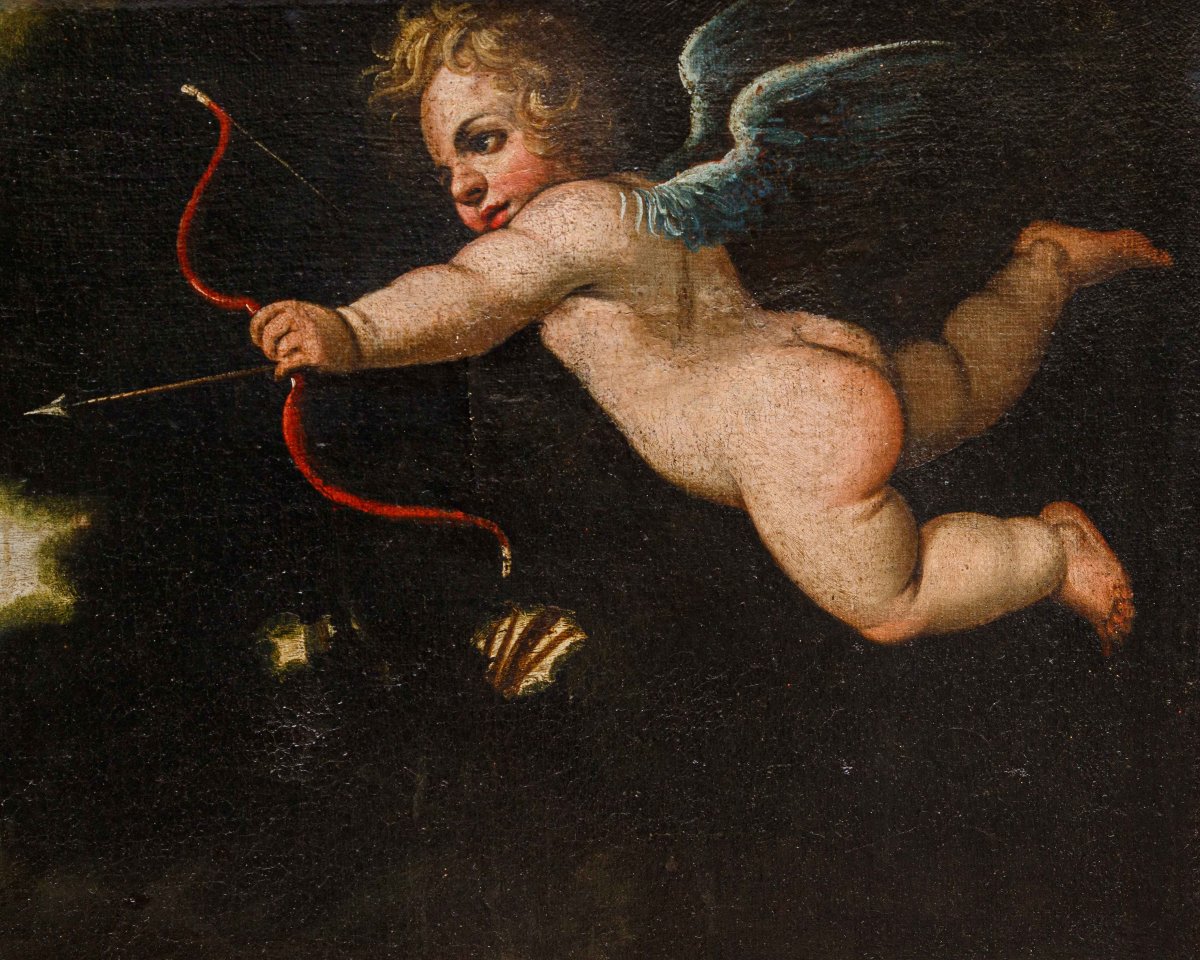
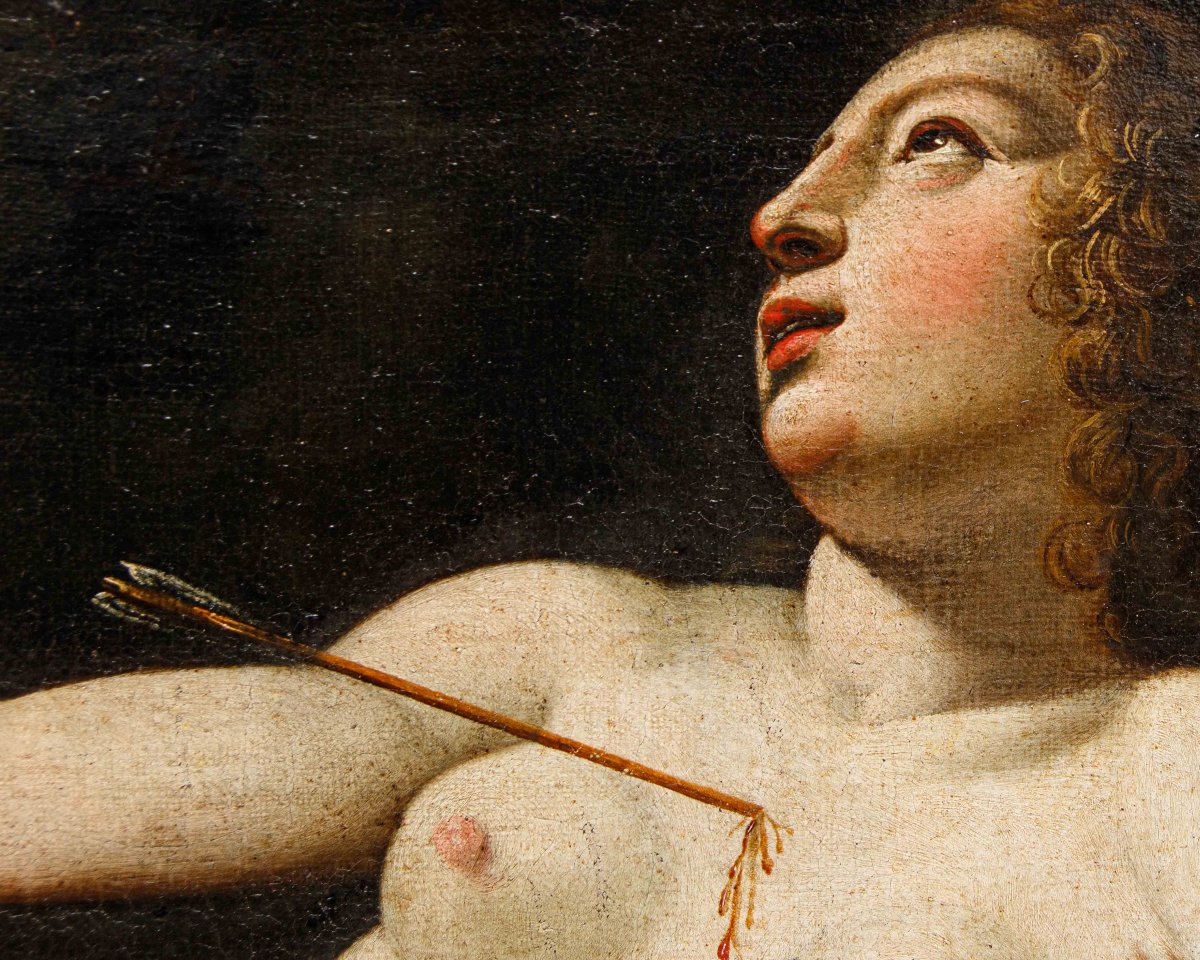
The pair of paintings illustrate two of the mythological themes most dear to the figurative culture of the time, focusing on the amorous metamorphoses of Jupiter. In the first episode, Leda is depicted sensually lying on a red cloth while giving herself to the kiss of the swan, a form assumed by the father of the gods to seduce her. From their union, as handed down by myth, the Dioscuri (Castor and Pollux) and Clytemnestra would have originated. The stylistic signature of the composition appears as an explicit homage to Michelangelo's famous invention for Alfonso d'Este, an essential model for the success of the subject in modern times. In the second canvas, Princess Danae is portrayed at the climax of the myth: pierced by Cupid's arrow, she is fertilized by the shower of gold, a further divine manifestation of Jupiter. Here too, the cultured references are evident: the pose of the putto, in fact, precisely recalls the figure of the child that appears in Guido Reni's Aurora, testifying to a refined visual culture indebted to the great Baroque and Renaissance tradition. Despite the quote from the master of classicism, our canvases are imbued with an unfiltered reality, a love of reality that treats female bodies not as perfect goddesses, but as ordinary women. This poetics, combined with the use of cold colours and incisive design, recalls the language of the Sienese Rutilio Manetti (1571–1639). Here the painter reworks these ideas towards a neo-Venetian vision, as evidenced by his attention to the landscape; he is therefore an artist close to Rutilio, but attentive to the pictorial speed of time. This is Mattia Bolognini, a painter originally from Valdarno Aretino. Baptized in Montevarchi in 1605, he probably trained in the orbit of Giovanni da San Giovanni, from whom he drew a formal rigor and humoral sensitivity alien to the prevailing Caravaggism. Having moved to Siena, where he is documented permanently from 1636, he consolidated his career through prestigious public and private commissions, collaborating for a long time with the Hospital of Santa Maria della Scala, for which he created the Sant'Antonio Abate in 1638. Over time, Bolognini absorbed the influence of Bernardino Mei and the suggestions of the Roman Baroque, as demonstrated by his Maddalene, whose sculptural poses echo Bernini's Truth. Their relationship was so profound that Bolognini is today considered the natural continuator of Mei's workshop after the latter's departure for Rome in 1657. In this phase, his painting evolved towards a greater material fluidity, evident both in sacred works such as the Vision of Saint Andrew Gherardi — which reveals openings towards the neo-Venetian and Roman landscape painting of Andrea Sacchi. In addition to painting altarpieces, Bolognini stood out as one of the most committed and sharp portraitists of the mid-century, capable of interpreting Sustermans's insight through a fragrant brushstroke and profound psychological introspection. Significant examples of this are the portrait of Aregofila Incontri or that of the Gori Pannilini couple, where physiognomic truth and attention to material details are combined with a monumental approach. The work that best sums up his artistic maturity is Pelago's Saint Anthony of Padua. Despite uncertainties about the precise dating, due to gaps in the inscription, the painting is a masterpiece of balance: it blends a solemn melodramatic tone with quotations of "raw reality" and an almost theatrical flavor. His activity, documented until his death in Siena in 1667, testifies to an artistic parable capable of combining analytical realism from beyond the Alps with the elegance and light of Italian classicism.
Leda with the Swan – Danae Covered in Gold Coin Rain
Oil on canvas, 50 x 134 cm
Prof. Criticism Sheet. Marco Ciampolini
The pair of paintings illustrate two of the mythological themes most dear to the figurative culture of the time, focusing on the amorous metamorphoses of Jupiter. In the first episode, Leda is depicted sensually lying on a red cloth while giving herself to the kiss of the swan, a form assumed by the father of the gods to seduce her. From their union, as handed down by myth, the Dioscuri (Castor and Pollux) and Clytemnestra would have originated. The stylistic signature of the composition appears as an explicit homage to Michelangelo's famous invention for Alfonso d'Este, an essential model for the success of the subject in modern times. In the second canvas, Princess Danae is portrayed at the climax of the myth: pierced by Cupid's arrow, she is fertilized by the shower of gold, a further divine manifestation of Jupiter. Here too, the cultured references are evident: the pose of the putto, in fact, precisely recalls the figure of the child that appears in Guido Reni's Aurora, testifying to a refined visual culture indebted to the great Baroque and Renaissance tradition. Despite the quote from the master of classicism, our canvases are imbued with an unfiltered reality, a love of reality that treats female bodies not as perfect goddesses, but as ordinary women. This poetics, combined with the use of cold colours and incisive design, recalls the language of the Sienese Rutilio Manetti (1571–1639). Here the painter reworks these ideas towards a neo-Venetian vision, as evidenced by his attention to the landscape; he is therefore an artist close to Rutilio, but attentive to the pictorial speed of time. This is Mattia Bolognini, a painter originally from Valdarno Aretino. Baptized in Montevarchi in 1605, he probably trained in the orbit of Giovanni da San Giovanni, from whom he drew a formal rigor and humoral sensitivity alien to the prevailing Caravaggism. Having moved to Siena, where he is documented permanently from 1636, he consolidated his career through prestigious public and private commissions, collaborating for a long time with the Hospital of Santa Maria della Scala, for which he created the Sant'Antonio Abate in 1638. Over time, Bolognini absorbed the influence of Bernardino Mei and the suggestions of the Roman Baroque, as demonstrated by his Maddalene, whose sculptural poses echo Bernini's Truth. Their relationship was so profound that Bolognini is today considered the natural continuator of Mei's workshop after the latter's departure for Rome in 1657. In this phase, his painting evolved towards a greater material fluidity, evident both in sacred works such as the Vision of Saint Andrew Gherardi — which reveals openings towards the neo-Venetian and Roman landscape painting of Andrea Sacchi. In addition to painting altarpieces, Bolognini stood out as one of the most committed and sharp portraitists of the mid-century, capable of interpreting Sustermans's insight through a fragrant brushstroke and profound psychological introspection. Significant examples of this are the portrait of Aregofila Incontri or that of the Gori Pannilini couple, where physiognomic truth and attention to material details are combined with a monumental approach. The work that best sums up his artistic maturity is Pelago's Saint Anthony of Padua. Despite uncertainties about the precise dating, due to gaps in the inscription, the painting is a masterpiece of balance: it blends a solemn melodramatic tone with quotations of "raw reality" and an almost theatrical flavor. His activity, documented until his death in Siena in 1667, testifies to an artistic parable capable of combining analytical realism from beyond the Alps with the elegance and light of Italian classicism.
10 000 €
Period: 17th century
Style: Other Style
Condition: Good condition
Material: Oil painting
Width: 134
Height: 50
Reference (ID): 1721935
Availability: In stock
Print