



Francesco Antoniani (milan, 1700/1710 - Turin, 1775), Port View With Sailing Ships
Francesco Antoniani (Milan, 1700/1710 - Turin, 1775)
Port view with sailing ships
Oil on canvas, 108 x 147 cm
with the frame, 94 x 133 cm
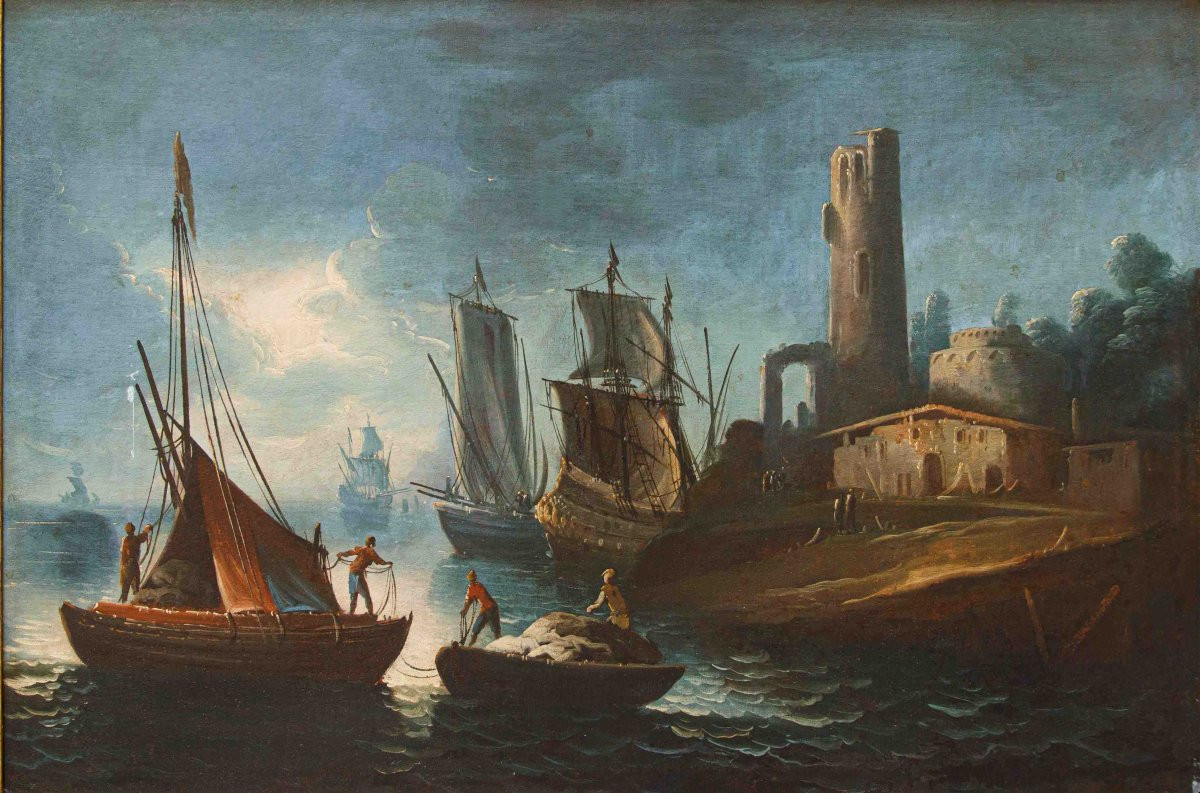
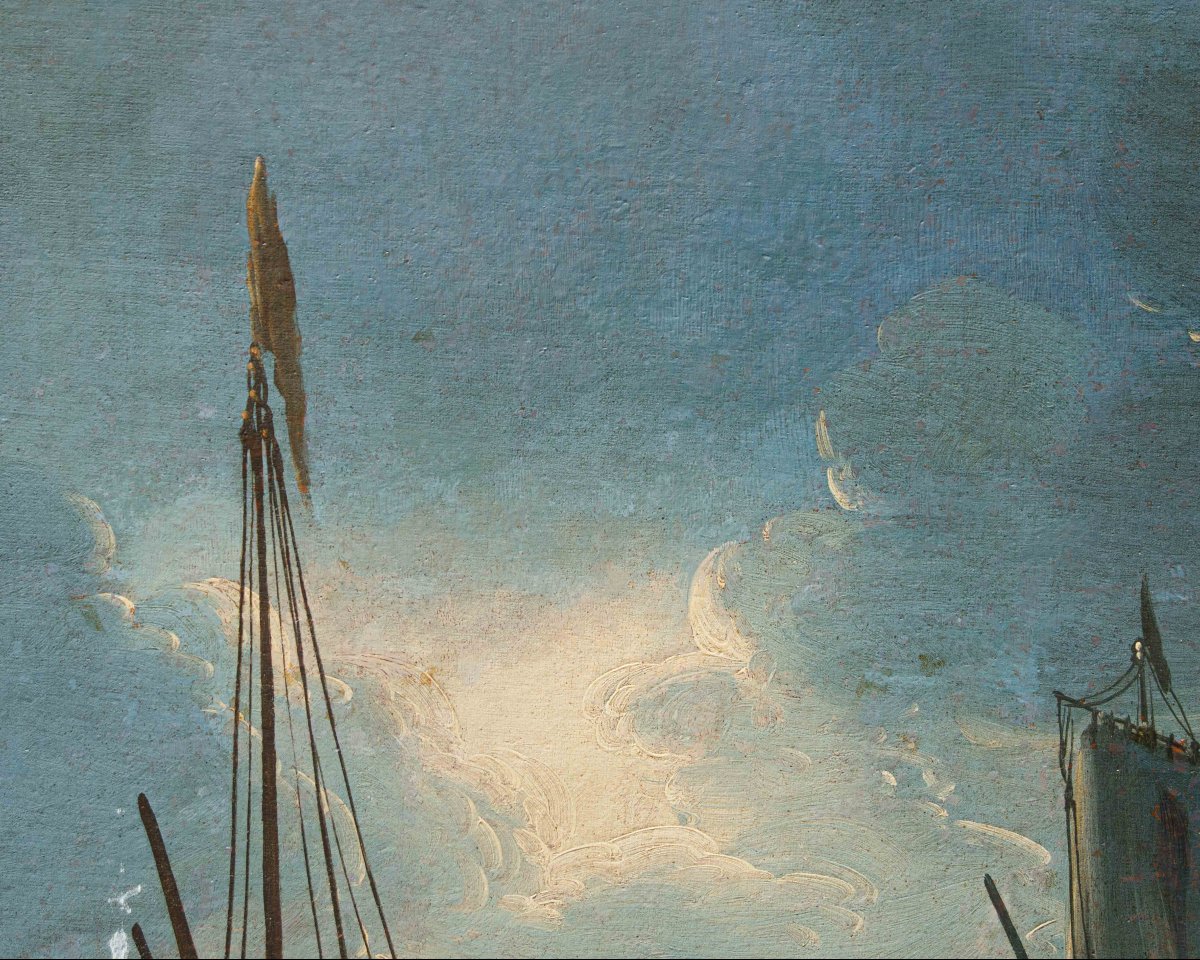
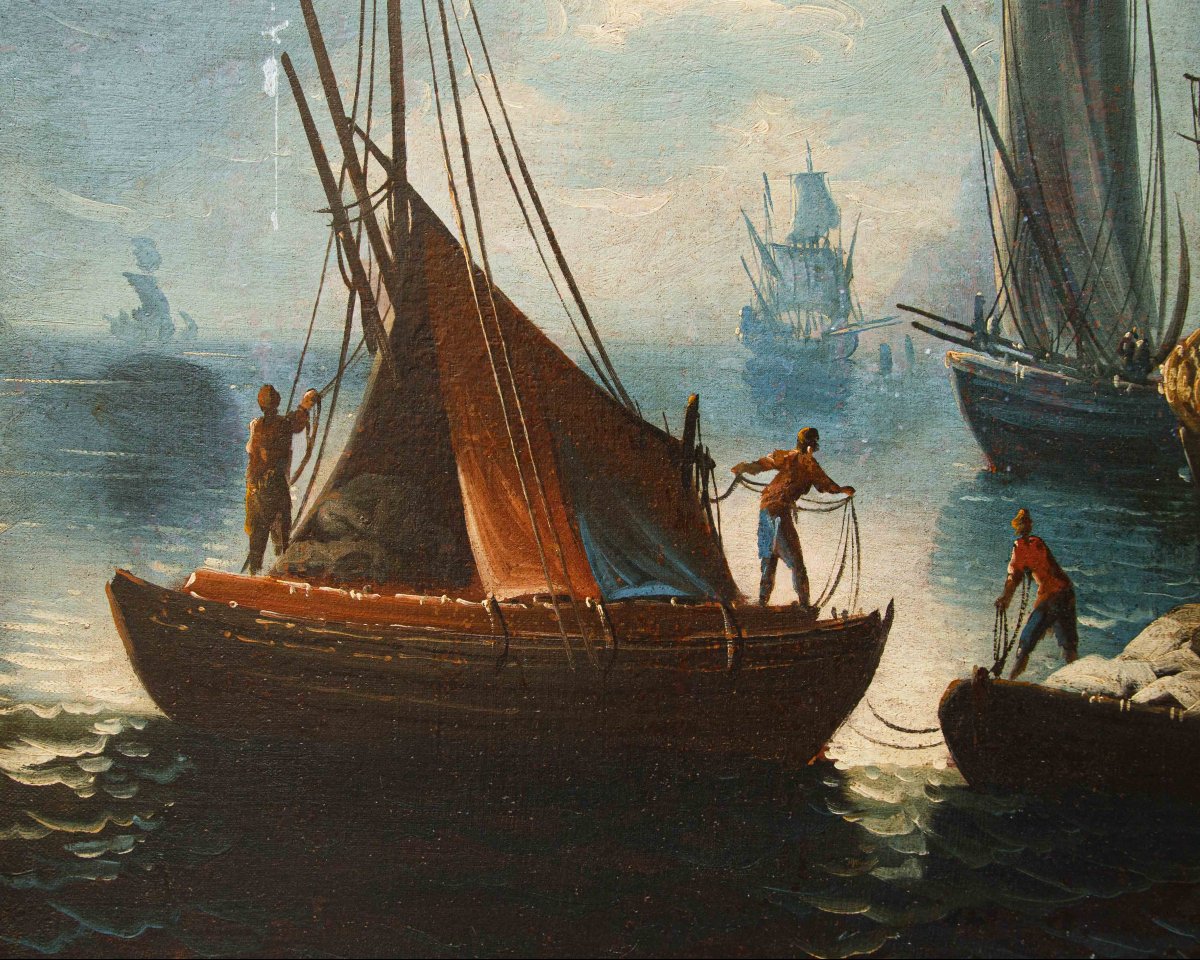
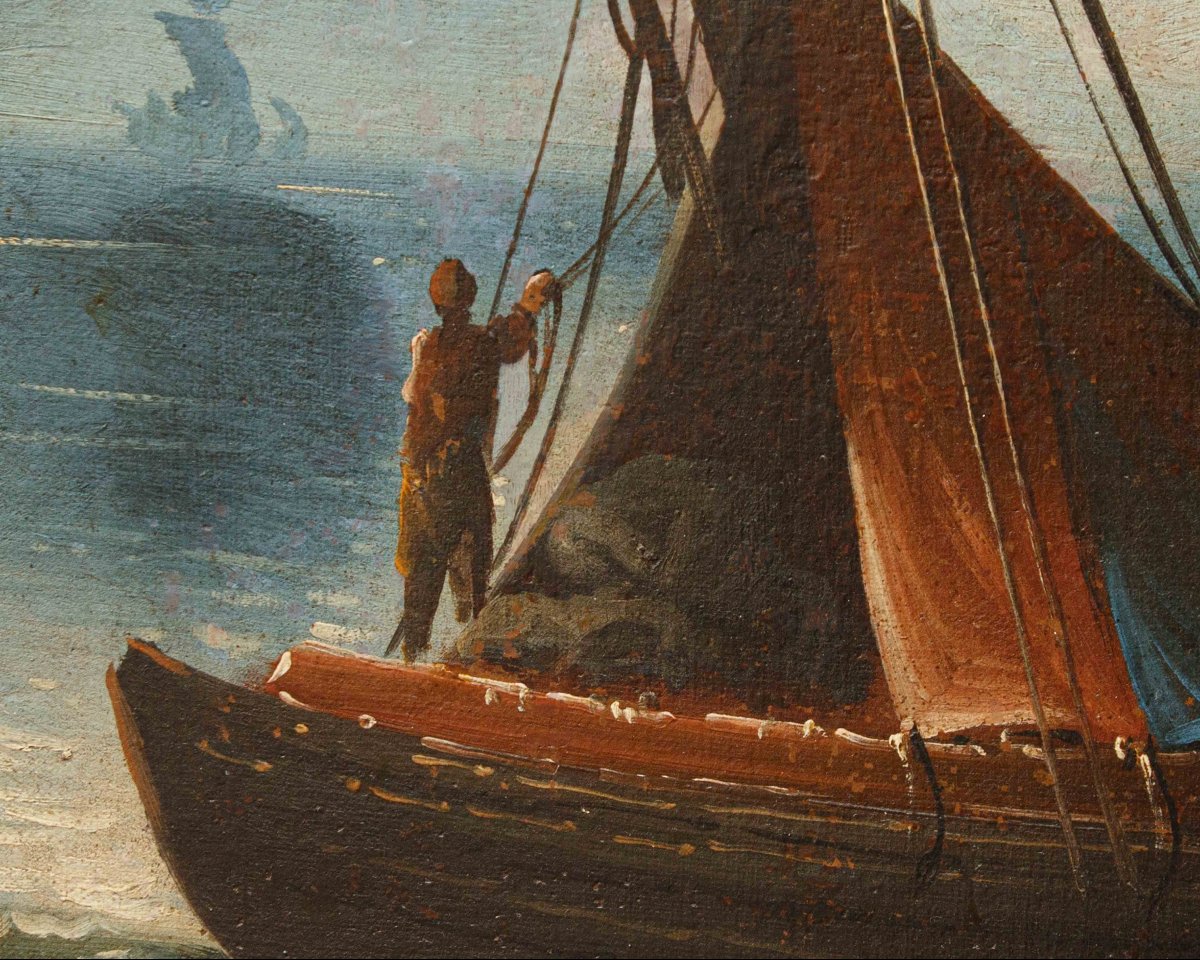
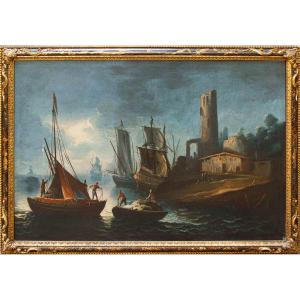
The oil on canvas painting Port View with Sailing Ships, attributed to Francesco Antoniani, is part of the genre of ideal seascapes in eighteenth-century style, a genre in which the Turin artist achieved particularly high-quality results. The scene depicts a coastal landing stage animated by boats of various types: in the foreground, a boat with a lowered sail and figures intent on maneuvers visually dialogues with a second vessel loaded with goods, while in the background, sailing ships at anchor stand out, expanding the perspective depth. On the right, an architectural complex dominated by a tower and partly ruined wall structures. The light, coming from the sea horizon, creates an atmospheric contrast between the illuminated area of the waters and the shadowy masses of the architecture, generating a scenographic effect that accentuates the narrative dimension of the whole. The pictorial quality is manifested through a broad and vibrant chromatic application, with loose brushstrokes that define the surfaces without descriptive rigidity. The tonal passages are carefully modulated, especially in the transitions between sky and sea, where the glazes create a sense of atmospheric depth consistent with the tradition of 18th-century European landscape painting. The figures, although small in size, are constructed with gestural effectiveness and contribute to lending vitality to the scene, suggesting daily activities related to trade and navigation. Francesco Antoniani was the main exponent of a family of painters active in Turin in the eighteenth century and developed a production largely intended for Savoy patrons, engaged in the ornamentation of royal residences with landscapes, seascapes and imaginary views. This context explains the orientation towards idealized rather than topographically recognizable images, conceived for decorative and celebratory purposes. Sources mention the artist active in important decorative projects such as Stupinigi, Moncalieri and the Royal Palace, where he created overdoors and ornamental apparatus, coming into contact with the figurative experiences of other landscape painters working in the Piedmont area, including Vittorio Amedeo Cignaroli. This cultural dialogue contributed to the definition of an elegant pictorial language, capable of merging naturalism and scenographic invention. The subject of the navy with ruins and boats finds comparisons in the international tradition inaugurated by masters such as Joseph Vernet, Carlo Bonavia, Adrian Manglard and Lacroix de Marseille, artists who spread an iconographic model based on imagined Mediterranean coasts, animated by maritime traffic and evocative architecture. The work considered here shows affinities with such examples for its compositional approach and attention to light effects, while maintaining a recognizable personal figure in the construction of the masses and in the warm and golden chromatic range.
Port view with sailing ships
Oil on canvas, 108 x 147 cm
with the frame, 94 x 133 cm
The oil on canvas painting Port View with Sailing Ships, attributed to Francesco Antoniani, is part of the genre of ideal seascapes in eighteenth-century style, a genre in which the Turin artist achieved particularly high-quality results. The scene depicts a coastal landing stage animated by boats of various types: in the foreground, a boat with a lowered sail and figures intent on maneuvers visually dialogues with a second vessel loaded with goods, while in the background, sailing ships at anchor stand out, expanding the perspective depth. On the right, an architectural complex dominated by a tower and partly ruined wall structures. The light, coming from the sea horizon, creates an atmospheric contrast between the illuminated area of the waters and the shadowy masses of the architecture, generating a scenographic effect that accentuates the narrative dimension of the whole. The pictorial quality is manifested through a broad and vibrant chromatic application, with loose brushstrokes that define the surfaces without descriptive rigidity. The tonal passages are carefully modulated, especially in the transitions between sky and sea, where the glazes create a sense of atmospheric depth consistent with the tradition of 18th-century European landscape painting. The figures, although small in size, are constructed with gestural effectiveness and contribute to lending vitality to the scene, suggesting daily activities related to trade and navigation. Francesco Antoniani was the main exponent of a family of painters active in Turin in the eighteenth century and developed a production largely intended for Savoy patrons, engaged in the ornamentation of royal residences with landscapes, seascapes and imaginary views. This context explains the orientation towards idealized rather than topographically recognizable images, conceived for decorative and celebratory purposes. Sources mention the artist active in important decorative projects such as Stupinigi, Moncalieri and the Royal Palace, where he created overdoors and ornamental apparatus, coming into contact with the figurative experiences of other landscape painters working in the Piedmont area, including Vittorio Amedeo Cignaroli. This cultural dialogue contributed to the definition of an elegant pictorial language, capable of merging naturalism and scenographic invention. The subject of the navy with ruins and boats finds comparisons in the international tradition inaugurated by masters such as Joseph Vernet, Carlo Bonavia, Adrian Manglard and Lacroix de Marseille, artists who spread an iconographic model based on imagined Mediterranean coasts, animated by maritime traffic and evocative architecture. The work considered here shows affinities with such examples for its compositional approach and attention to light effects, while maintaining a recognizable personal figure in the construction of the masses and in the warm and golden chromatic range.
6 000 €
Period: 18th century
Style: Other Style
Condition: Good condition
Material: Oil painting
Width: 147
Height: 108
Reference (ID): 1721513
Availability: In stock
Print