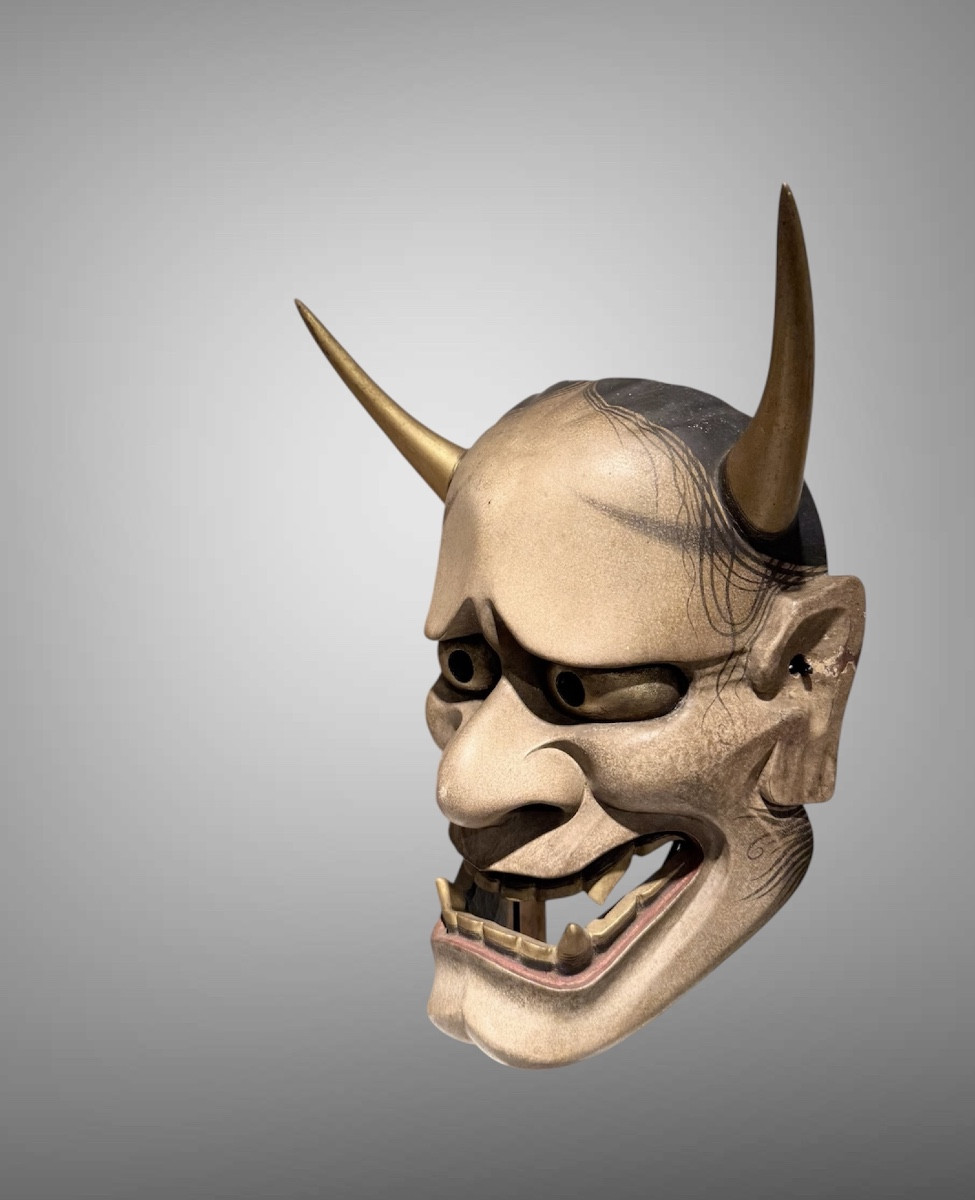


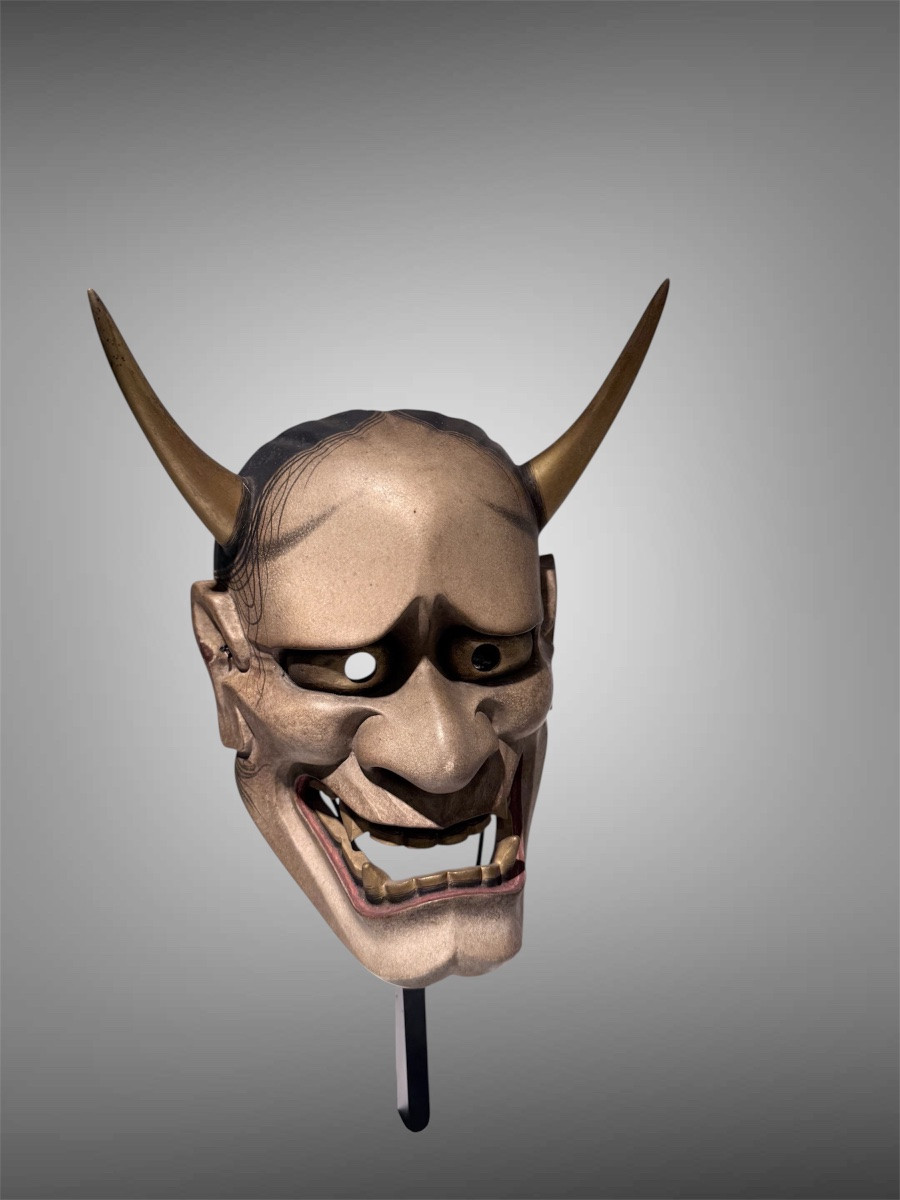
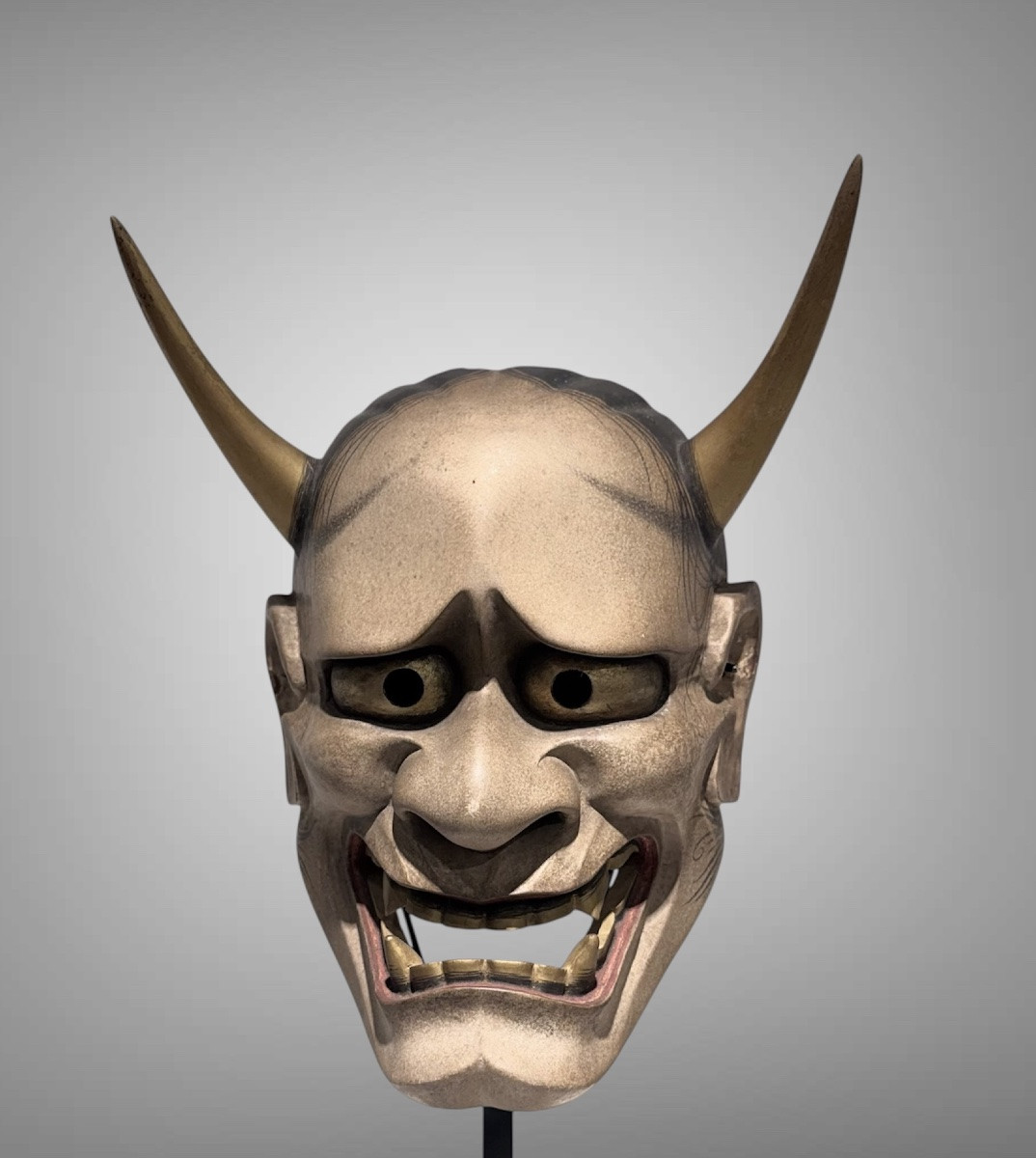
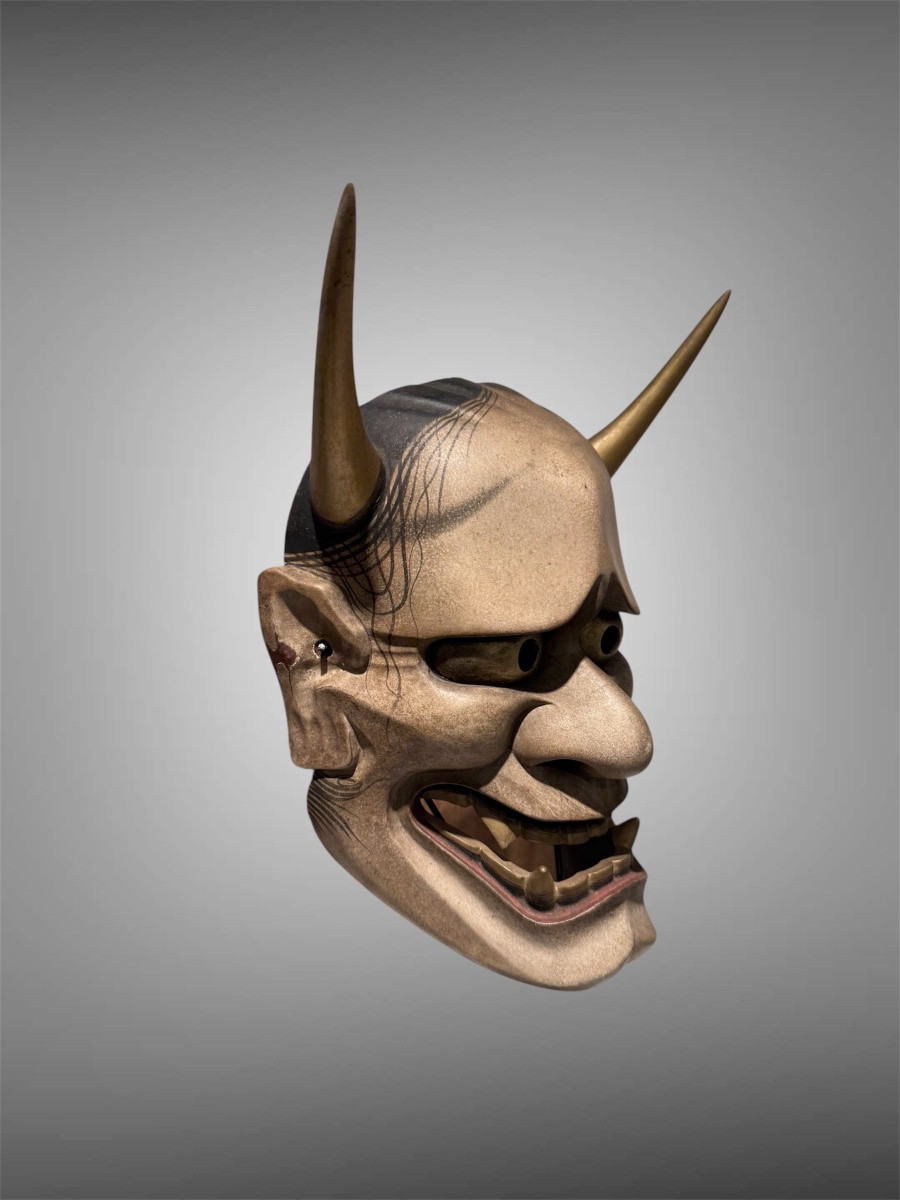
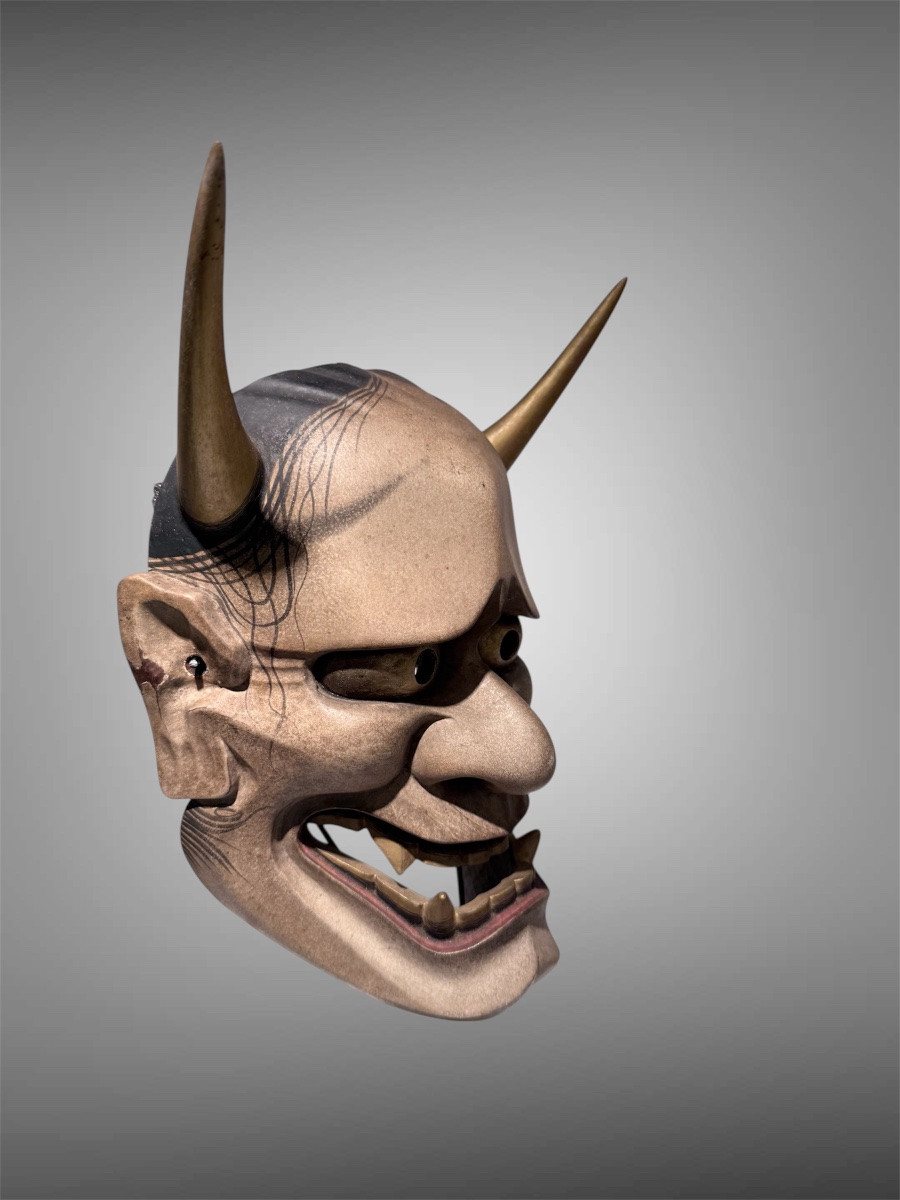
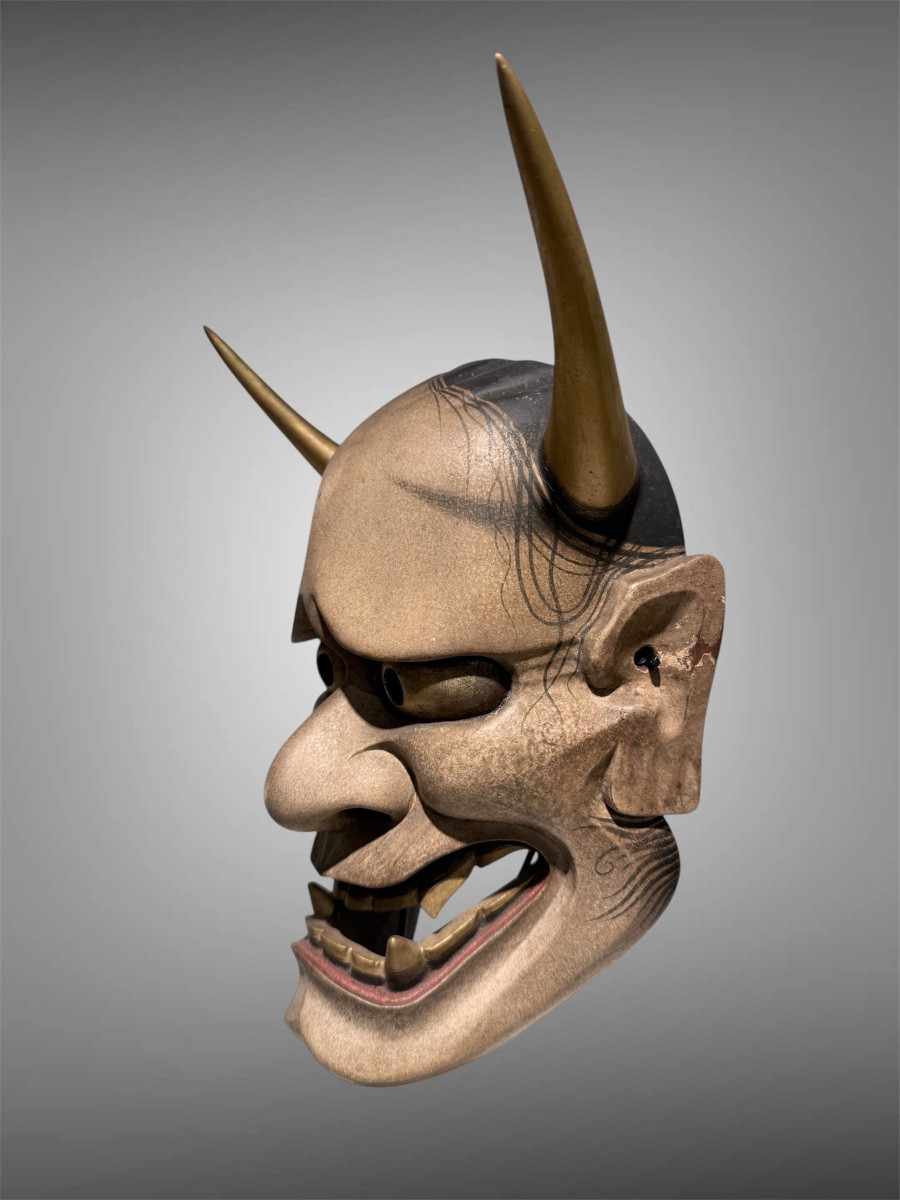
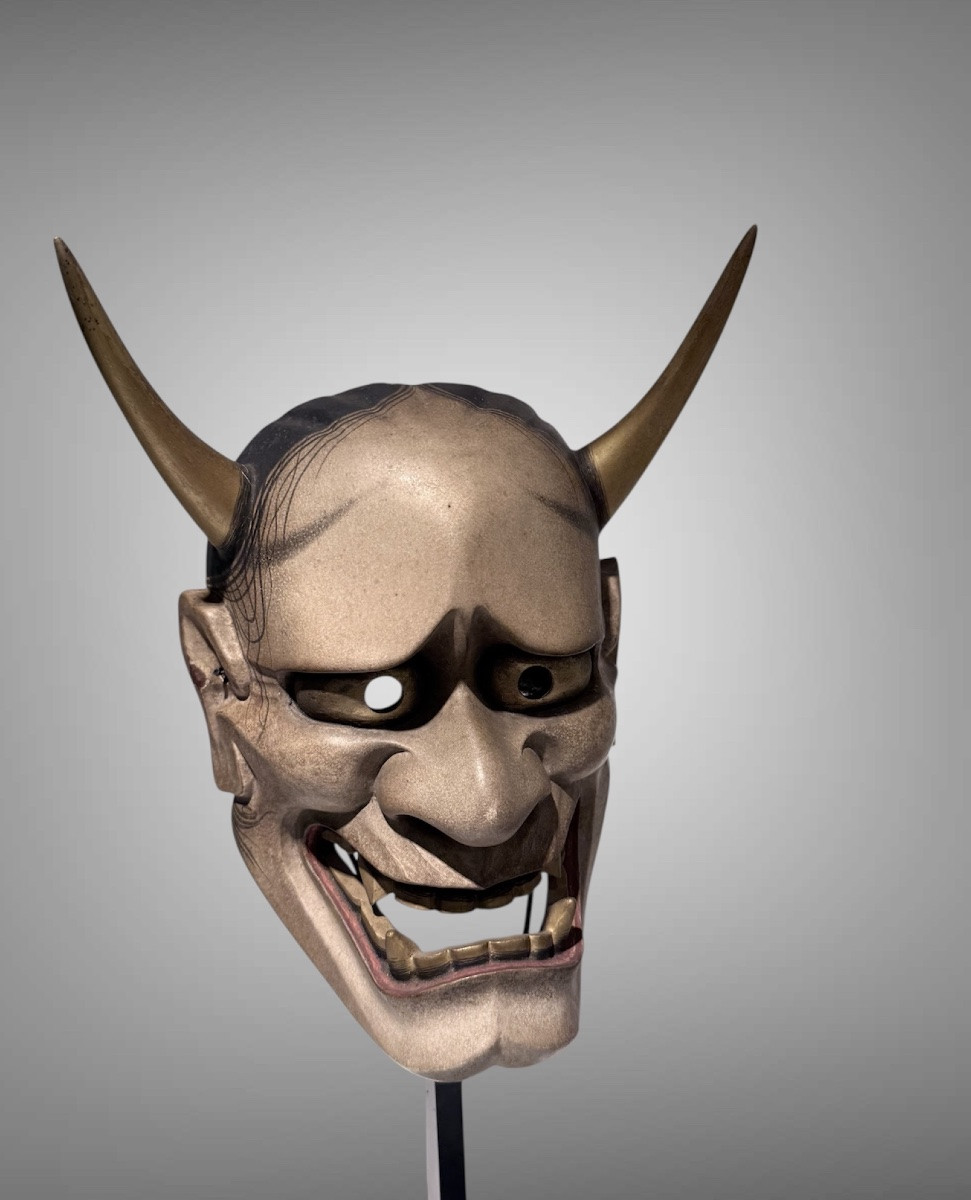
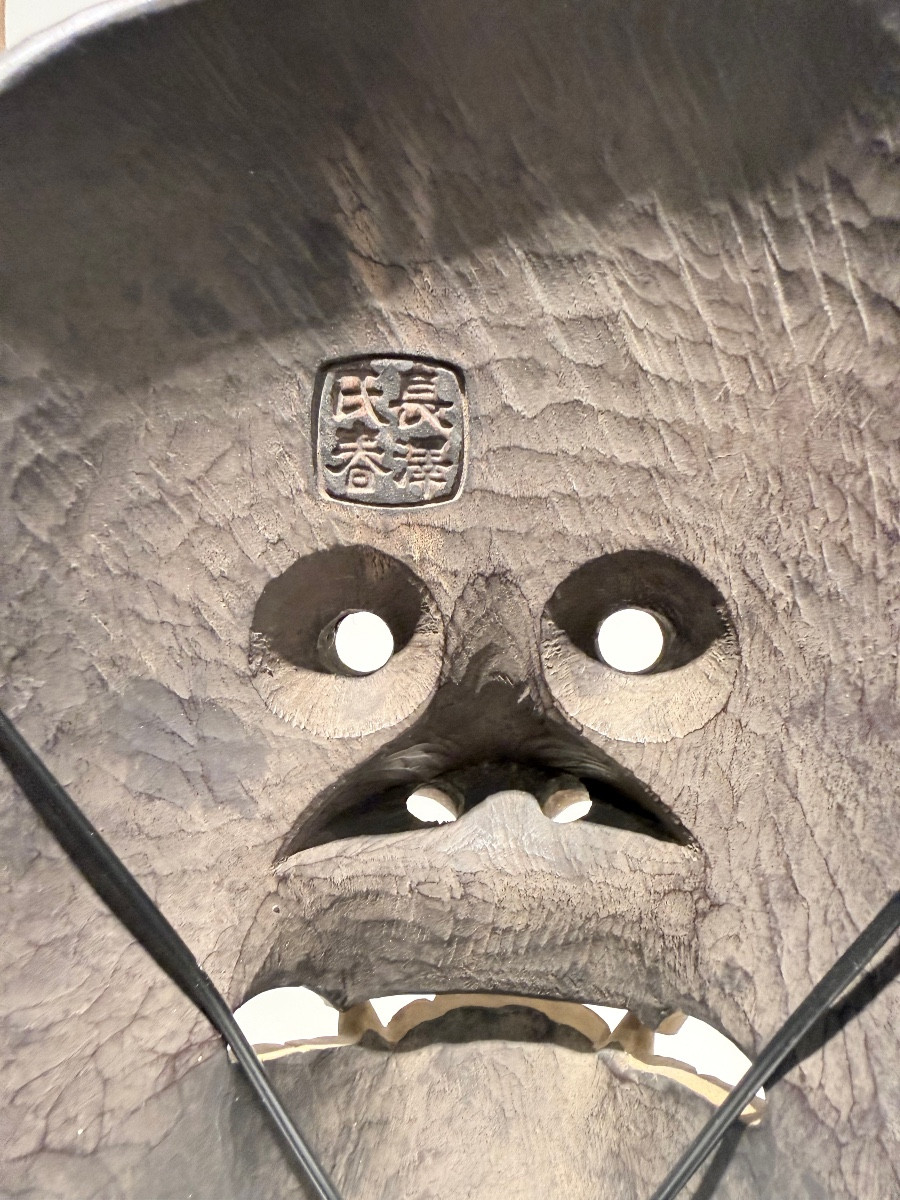
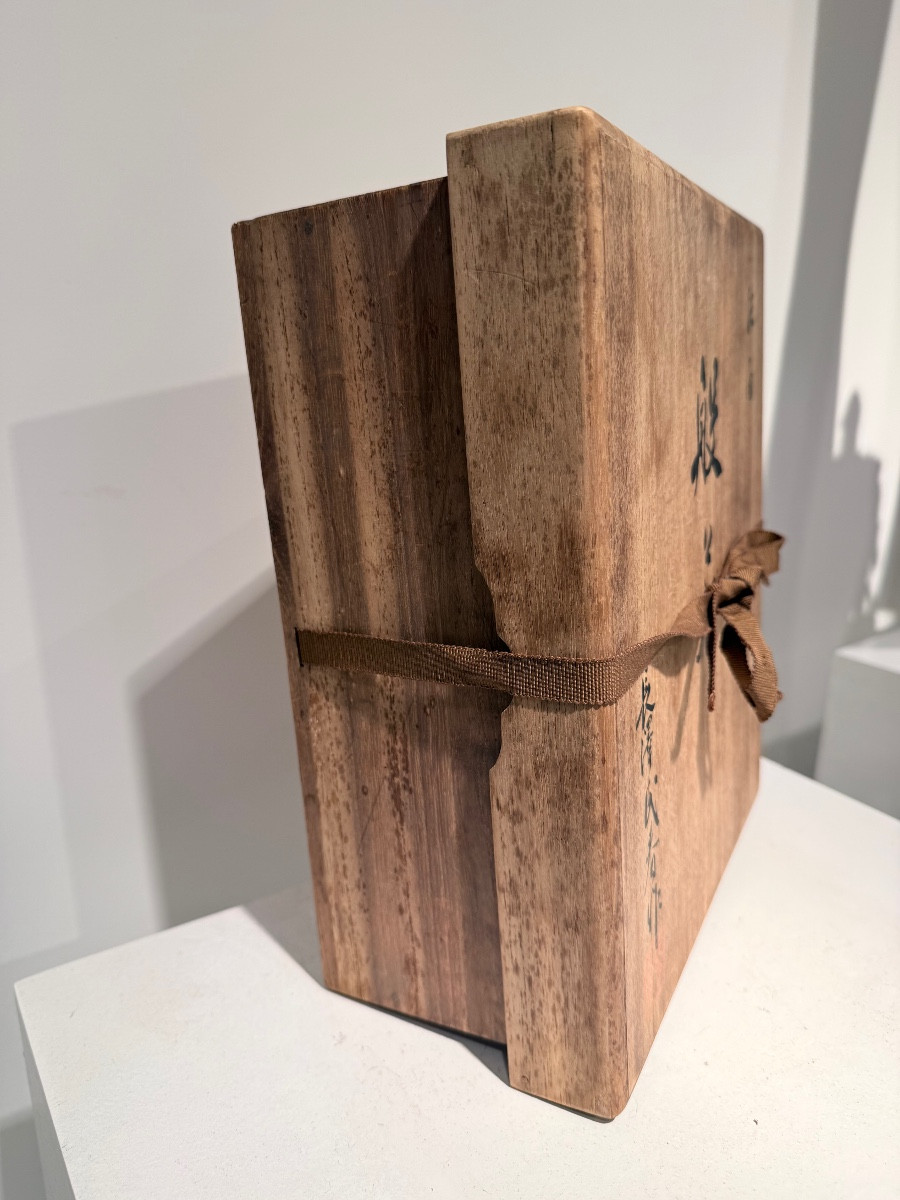


Hannya Mask Signed Ujiharu Nagasawa National Treasure
Artist: Ujiharu Nagasawa
Hannya (般若の面 in Japanese) is the ghost of a young woman who returned from the dead to exact her revenge. Her distinctive face, a veritable mask of suffering, often appears in Japanese fiction and tattoos. The Hannya mask derives from "ja" but is more human; Hannya has ears but no tongue. The character appeared in the second half of the 16th century. At first glance, Hannyah exudes nothing but malevolence, but her expression is more complex: she radiates bitterness and resentment, yet through the actor's subtle manipulation, other expressions emerge. This mask is designed for an actor who constantly turns their head. By tilting it downwards, revealing only her feminine hair and concealing her bulging eyes, she appears depressed and weakened, ultimately conveying profound sadness. When the head is suddenly raised, the fury of her expression reappears and strikes the audience like a punch. Hannyah's character offers a great deal of versatility to a Noh actor. The mask is designed with exaggerated features, the horns embedded in the head. A concave space is carved between the bony ridge of the eyebrows and the nose, amplifying the mask's dramatic effect. Long strands of hair fall to the side of the face. The standard hannya character has a predominantly flesh tone, but from the 17th century onwards, artists gave different pigments to the character. Shirohannya has a pale ivory tone, which embodies more of a princess character. Akahannya, which is redder, can substitute for the role of hannya; it is of more rustic origin, as is Kurohannya. The horns are generally golden. In some examples, veins are seen on the forehead, but it is generally smooth. The eyes are covered with brass so that no red coloration appears; Along the nose, a groove runs to the edge of the lips. Its growling mouth reveals gold and black teeth. Hannyah is a Sanskrit name meaning wisdom. The artist Shakuzuru wished to design a mask of the dragon god but lacked inspiration. He withdrew to the imperial gardens, "Shinsen-en," where rain was invoked. On the morning of the 17th day, he awoke from a dream in which a giant serpent had appeared, emerging from a nearby pond, providing him with the model for his mask. He rejoiced, and observing the pond, he saw the trunk of a willow tree floating on the surface. He interpreted this as a sign from the gods. He took the trunk and fashioned the dragon mask from its wood. Considered the mask emanating from the wisdom Shakuzuru had acquired, this type of mask was named Hannya. The artist's mask is the precious possession of the Hosho family. The mask was named "ukiki no hannya." According to the Kakiage troupe, in 1721 Shakuzuru prayed to the goddess Kannon (Avalokiteshvara) while fasting at the temple to receive inspiration for his dragon mask. After a week of fasting, the calm waters became turbulent, and the dragon appeared in a torrential downpour. The storm broke a tree, and shortly afterward, the turbulent waters carried a willow tree into the current. According to Noh enthusiasts, the two most iconic masks are the hannya and the ko omote (young girl).
Ujiharu Nagasawa (1912-2003) was born in Kyoto to a family of gardeners responsible for the gardens of the Imperial Palace. He was chosen by Nagasawa Kinshirou. From the age of fourteen, he studied under Tachibana Seigo, with whom he quickly mastered the art of mask making and soon became independent. However, it wasn't until he was forty that he was able to dedicate himself fully to this art and achieve renown. He was designated a "Living National Treasure" in 1979, becoming the first mask maker to receive this honor.
Ujiharu Nagasawa (1912-2003) was born in Kyoto to a family of gardeners responsible for the gardens of the Imperial Palace. He was chosen by Nagasawa Kinshirou. From the age of fourteen, he studied under Tachibana Seigo, with whom he quickly mastered the art of mask making and soon became independent. However, it wasn't until he was forty that he was able to dedicate himself fully to this art and achieve renown. He was designated a "Living National Treasure" in 1979, becoming the first mask maker to receive this honor.
3 500 €
Period: 20th century
Style: Asian art
Condition: Good condition
Material: Painted wood
Height: 28
Reference (ID): 1718616
Availability: In stock
Print