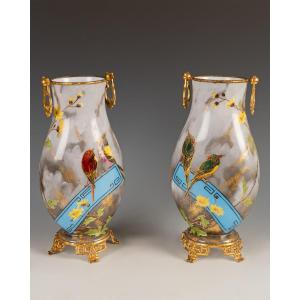


Baccarat, Pair Of "bird" Vases, France Circa 1880
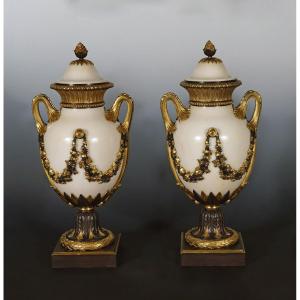
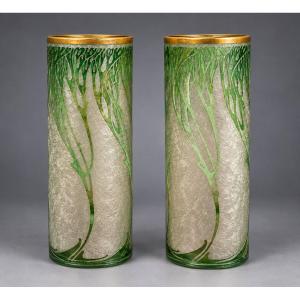
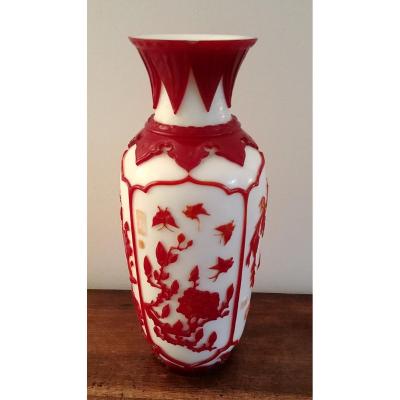
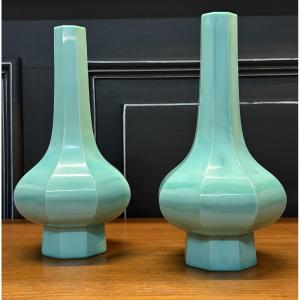
Fine pair of baluster-shaped opaline vases of Japanese inspiration attr. to Baccarat, adorned with a chiselled and gilded bronze mount imitating bamboo, extending up the neck with two movable ring handles. The body is composed of translucent opaline glass with a predominantly cloudy grey ground, heightened with gilding that enhances its optical depth. The decoration unfolds across the belly and depicts two birds with plumage in red, green, yellow, and violet, rendered with naturalistic precision in the treatment of the feathers, while their posture remains decorative and symmetrical. They are perched upon a stylized turquoise-blue cartouche ornamented with simplified Greek motifs, amidst flowering branches bearing yellow blossoms accompanied by finely outlined green foliage. The whole rests on four double feet in stylized bamboo form.
The combination of cloudy opaline glass and a Japanese inspired gilded bronze mount points to a luxury production intended for bourgeois or aristocratic interiors. This type of object belongs to the vogue for Japonisme that marked the French decorative arts from the 1860s to the 1880s. The gilded bronze mounts, through their finely chased treatment and their structuring role, align with the tradition of mounted objects, a practice inherited from the eighteenth century.
Biography :
The famous crystal manufactory of Baccarat, whose origins date back to the eighteenth century, won its first gold medal at the 1823 Exposition des Produits de l’Industrie, where it was praised for the “brilliance and fineness of its crystal,” thereby becoming the foremost crystalworks in France. Baccarat was undoubtedly the only French industrial enterprise to be consistently and magnificently represented at the various exhibitions in which it participated, consequently earning high honors and prestigious awards. One recurring expression, “the perfection of the material and of the cutting”, appears in all the reports of the Universal Exhibitions between 1855 and 1867, during which the Baccarat crystalworks dominated through the quality of its crystal, considered superior to that of Bohemia and England. In order to retain its wealthy clientele, among whom were, of course, members of the Royal Family, Baccarat was compelled to discover and introduce new fashions, new decorative schemes, and new materials.
The combination of cloudy opaline glass and a Japanese inspired gilded bronze mount points to a luxury production intended for bourgeois or aristocratic interiors. This type of object belongs to the vogue for Japonisme that marked the French decorative arts from the 1860s to the 1880s. The gilded bronze mounts, through their finely chased treatment and their structuring role, align with the tradition of mounted objects, a practice inherited from the eighteenth century.
Biography :
The famous crystal manufactory of Baccarat, whose origins date back to the eighteenth century, won its first gold medal at the 1823 Exposition des Produits de l’Industrie, where it was praised for the “brilliance and fineness of its crystal,” thereby becoming the foremost crystalworks in France. Baccarat was undoubtedly the only French industrial enterprise to be consistently and magnificently represented at the various exhibitions in which it participated, consequently earning high honors and prestigious awards. One recurring expression, “the perfection of the material and of the cutting”, appears in all the reports of the Universal Exhibitions between 1855 and 1867, during which the Baccarat crystalworks dominated through the quality of its crystal, considered superior to that of Bohemia and England. In order to retain its wealthy clientele, among whom were, of course, members of the Royal Family, Baccarat was compelled to discover and introduce new fashions, new decorative schemes, and new materials.while their posture remains decorative and symmetrical. They are perched on a stylized turquoise blue cartouche decorated with simplified Greek key patterns, amidst flowering branches of yellow blossoms accompanied by finely outlined green foliage. The whole rests on four double feet of stylized bamboo. The combination of cloudy opaline glass and the Japanese-inspired gilt bronze mount suggests a luxury production intended for bourgeois or aristocratic furnishings. This type of object reflects the vogue for Japonisme that influenced French decorative arts from the 1860s to the 1880s. The gilt bronze mounts, with their finely chiseled finish and structural role, are part of the tradition of mounted objects, a practice inherited from the 18th century. Biography: The renowned Baccarat crystalworks, whose origins date back to the 18th century, won its first gold medal at the 1823 Exhibition of Industrial Products, where it was praised for “the brilliance and finesse of its crystal” and became the leading crystalworks in France. Baccarat is undoubtedly the only French industry that was consistently and masterfully represented at the various exhibitions in which it participated, thereby winning honors and prestigious awards. A key phrase, “perfection of material and cut,” recurs in all the reports of the Universal Expositions between 1855 and 1867, where the Baccarat crystalworks dominated due to the quality of its crystal, considered superior to that of Bohemia and England. In order to retain its wealthy clientele, which naturally included members of the Royal Family, Baccarat had to discover and launch new styles, new designs, and new materials.
The combination of cloudy opaline glass and a Japanese inspired gilded bronze mount points to a luxury production intended for bourgeois or aristocratic interiors. This type of object belongs to the vogue for Japonisme that marked the French decorative arts from the 1860s to the 1880s. The gilded bronze mounts, through their finely chased treatment and their structuring role, align with the tradition of mounted objects, a practice inherited from the eighteenth century.
Biography :
The famous crystal manufactory of Baccarat, whose origins date back to the eighteenth century, won its first gold medal at the 1823 Exposition des Produits de l’Industrie, where it was praised for the “brilliance and fineness of its crystal,” thereby becoming the foremost crystalworks in France. Baccarat was undoubtedly the only French industrial enterprise to be consistently and magnificently represented at the various exhibitions in which it participated, consequently earning high honors and prestigious awards. One recurring expression, “the perfection of the material and of the cutting”, appears in all the reports of the Universal Exhibitions between 1855 and 1867, during which the Baccarat crystalworks dominated through the quality of its crystal, considered superior to that of Bohemia and England. In order to retain its wealthy clientele, among whom were, of course, members of the Royal Family, Baccarat was compelled to discover and introduce new fashions, new decorative schemes, and new materials.
The combination of cloudy opaline glass and a Japanese inspired gilded bronze mount points to a luxury production intended for bourgeois or aristocratic interiors. This type of object belongs to the vogue for Japonisme that marked the French decorative arts from the 1860s to the 1880s. The gilded bronze mounts, through their finely chased treatment and their structuring role, align with the tradition of mounted objects, a practice inherited from the eighteenth century.
Biography :
The famous crystal manufactory of Baccarat, whose origins date back to the eighteenth century, won its first gold medal at the 1823 Exposition des Produits de l’Industrie, where it was praised for the “brilliance and fineness of its crystal,” thereby becoming the foremost crystalworks in France. Baccarat was undoubtedly the only French industrial enterprise to be consistently and magnificently represented at the various exhibitions in which it participated, consequently earning high honors and prestigious awards. One recurring expression, “the perfection of the material and of the cutting”, appears in all the reports of the Universal Exhibitions between 1855 and 1867, during which the Baccarat crystalworks dominated through the quality of its crystal, considered superior to that of Bohemia and England. In order to retain its wealthy clientele, among whom were, of course, members of the Royal Family, Baccarat was compelled to discover and introduce new fashions, new decorative schemes, and new materials.while their posture remains decorative and symmetrical. They are perched on a stylized turquoise blue cartouche decorated with simplified Greek key patterns, amidst flowering branches of yellow blossoms accompanied by finely outlined green foliage. The whole rests on four double feet of stylized bamboo. The combination of cloudy opaline glass and the Japanese-inspired gilt bronze mount suggests a luxury production intended for bourgeois or aristocratic furnishings. This type of object reflects the vogue for Japonisme that influenced French decorative arts from the 1860s to the 1880s. The gilt bronze mounts, with their finely chiseled finish and structural role, are part of the tradition of mounted objects, a practice inherited from the 18th century. Biography: The renowned Baccarat crystalworks, whose origins date back to the 18th century, won its first gold medal at the 1823 Exhibition of Industrial Products, where it was praised for “the brilliance and finesse of its crystal” and became the leading crystalworks in France. Baccarat is undoubtedly the only French industry that was consistently and masterfully represented at the various exhibitions in which it participated, thereby winning honors and prestigious awards. A key phrase, “perfection of material and cut,” recurs in all the reports of the Universal Expositions between 1855 and 1867, where the Baccarat crystalworks dominated due to the quality of its crystal, considered superior to that of Bohemia and England. In order to retain its wealthy clientele, which naturally included members of the Royal Family, Baccarat had to discover and launch new styles, new designs, and new materials.
11 500 €
Period: 19th century
Style: Asian art
Condition: Good condition
Material: Opale
Width: 16
Height: 35,5
Depth: 12
Reference (ID): 1714310
Availability: In stock
Print