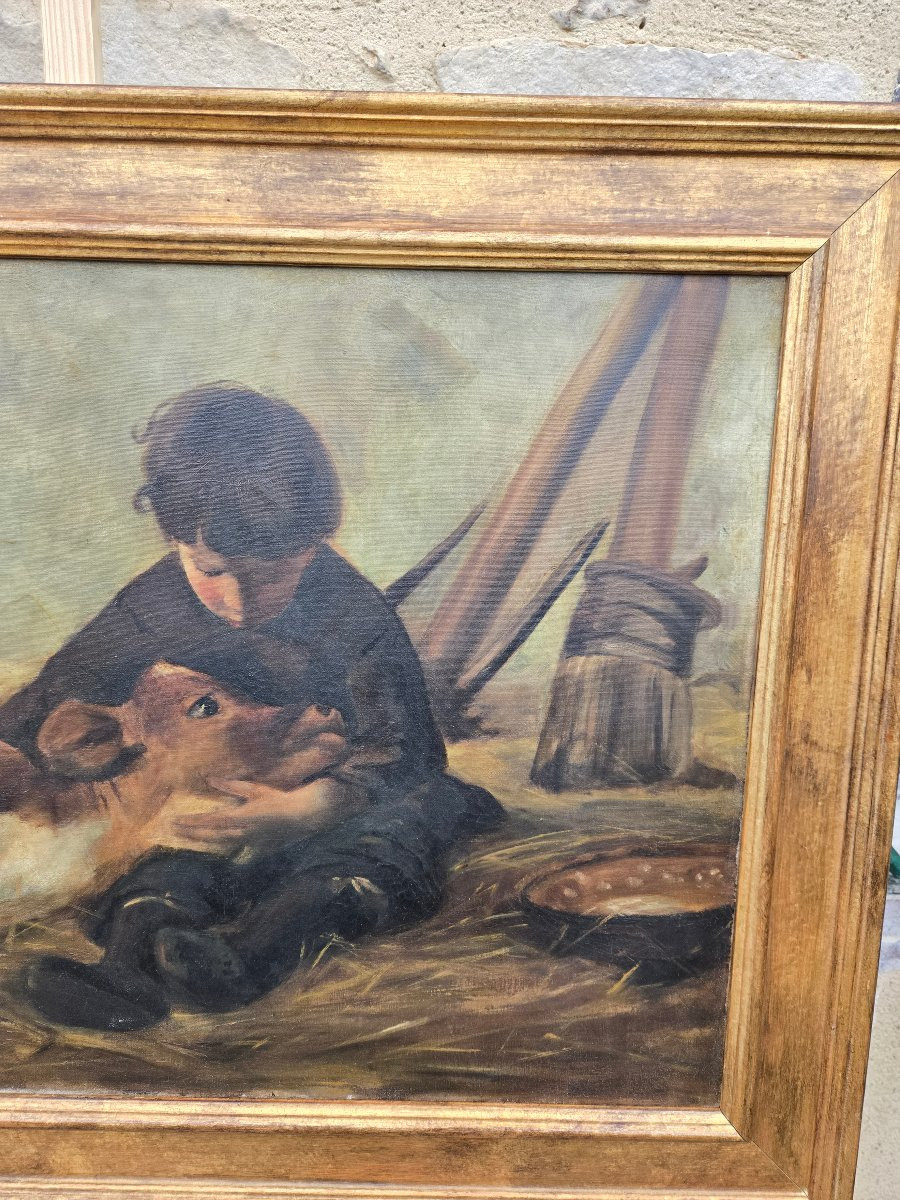
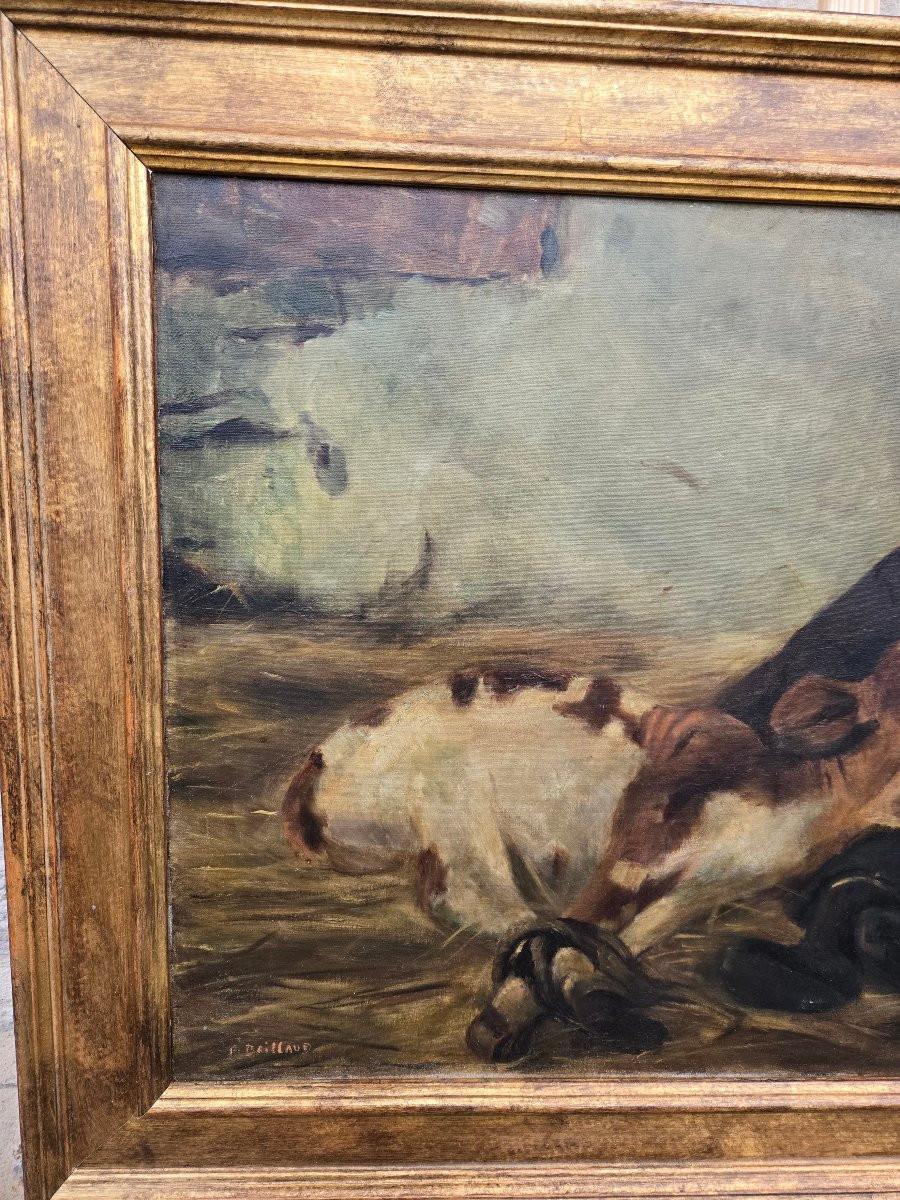
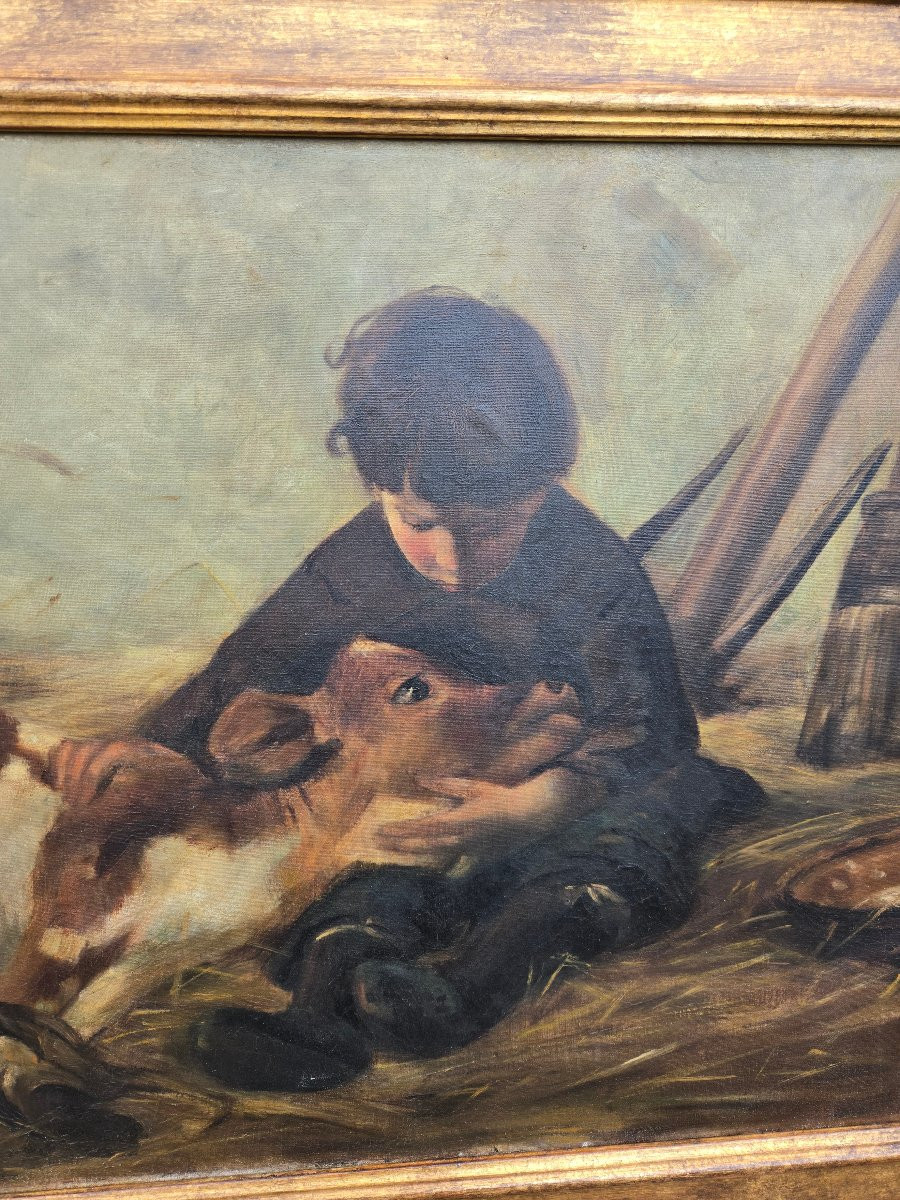
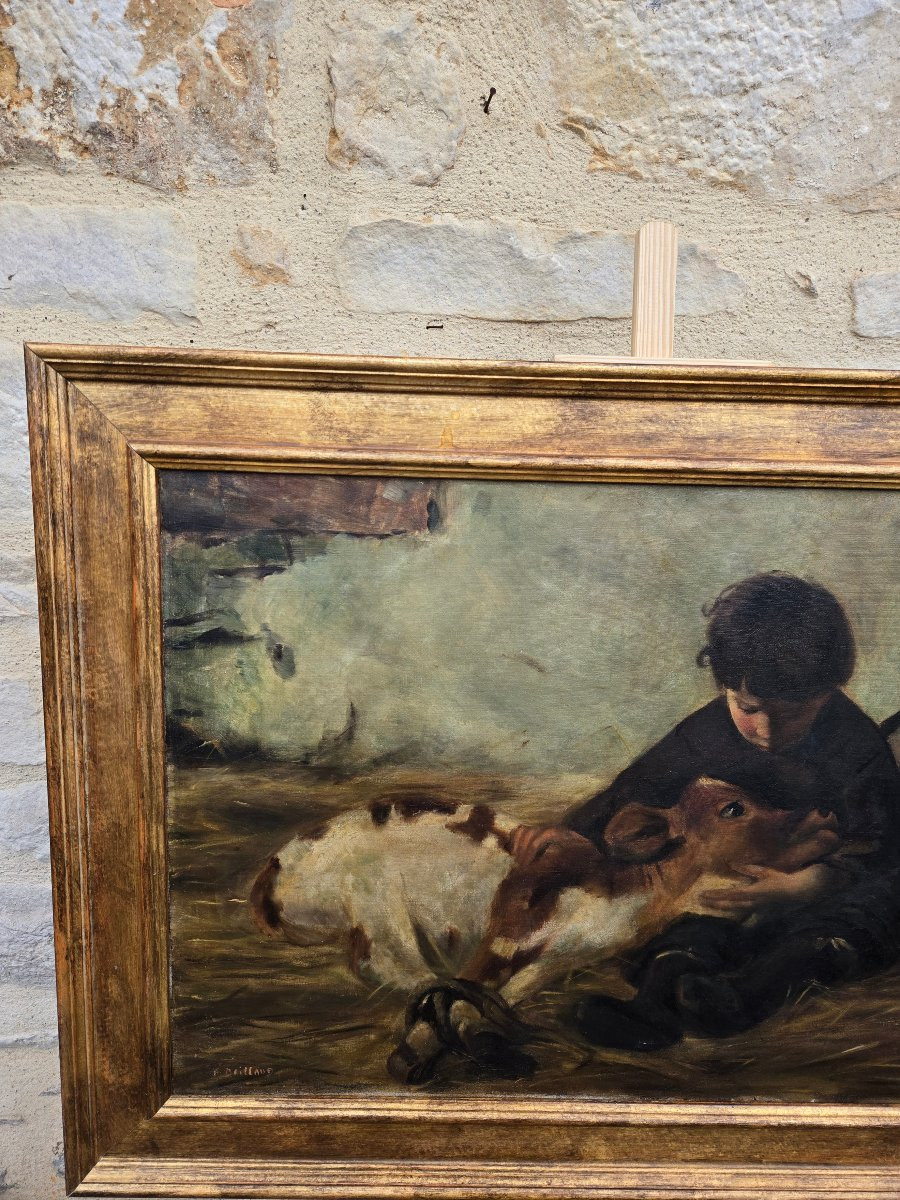
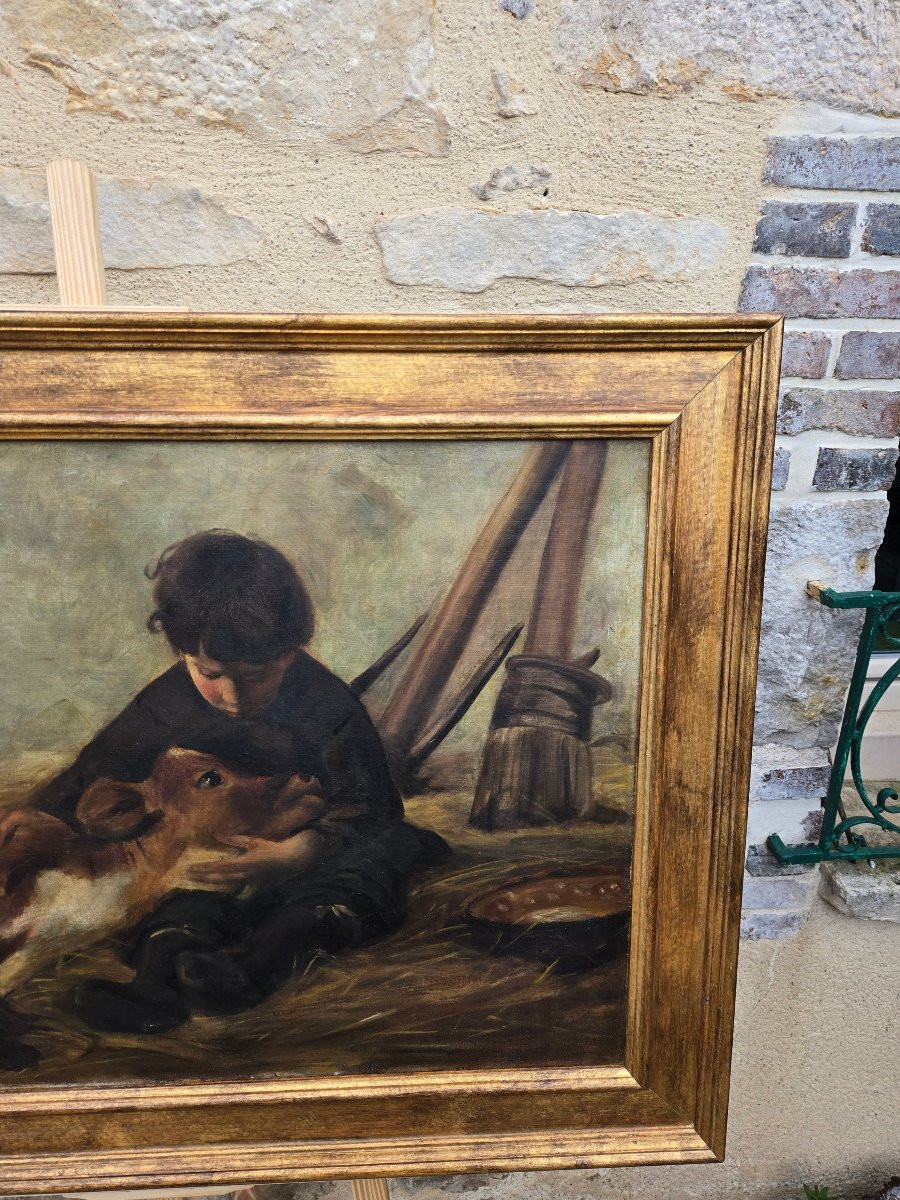
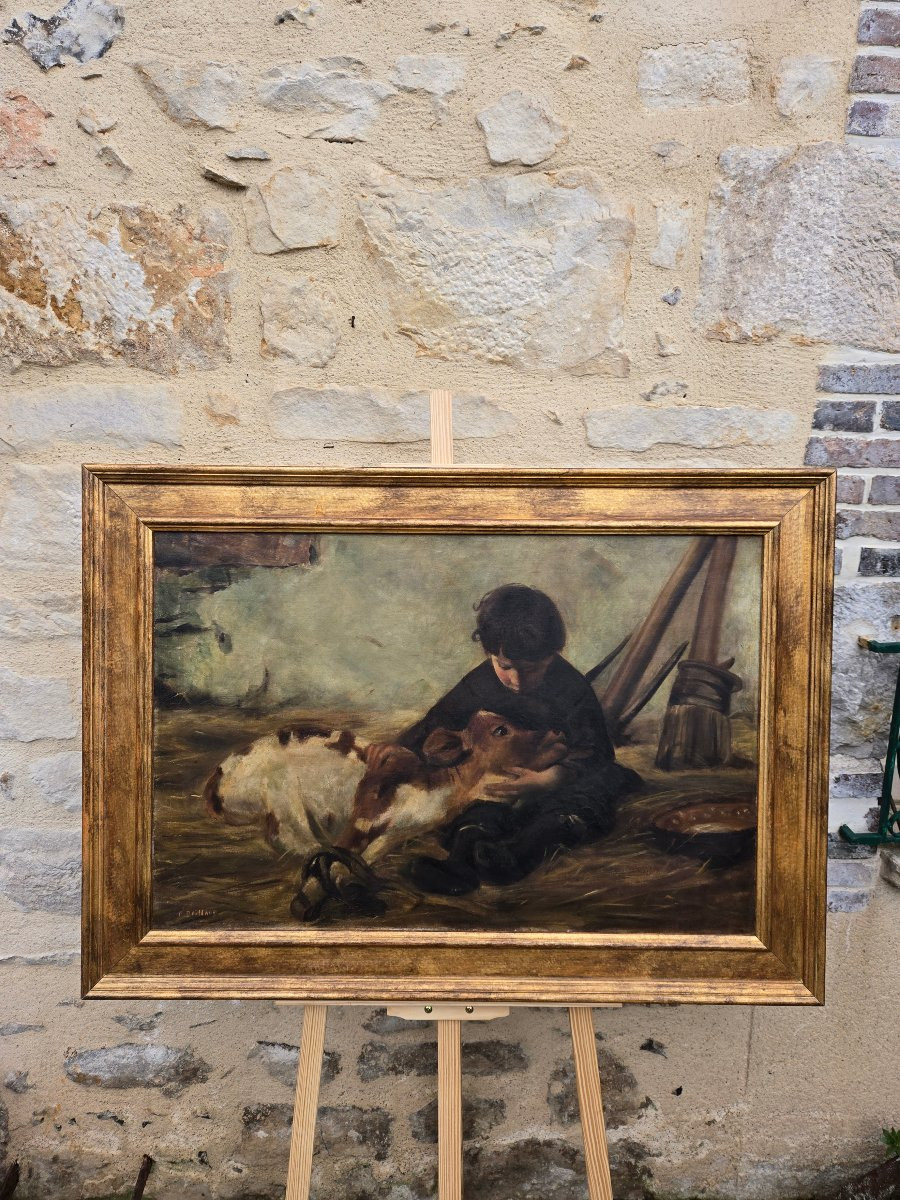
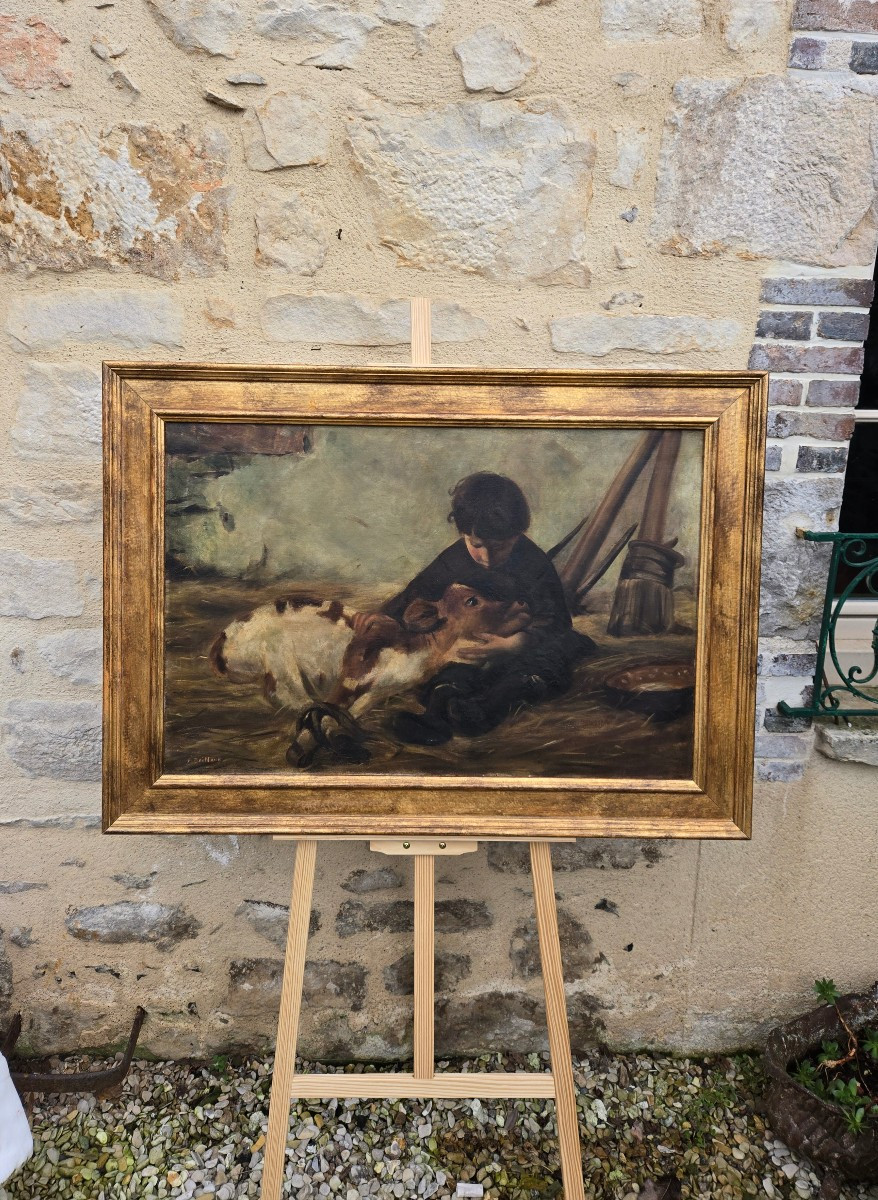
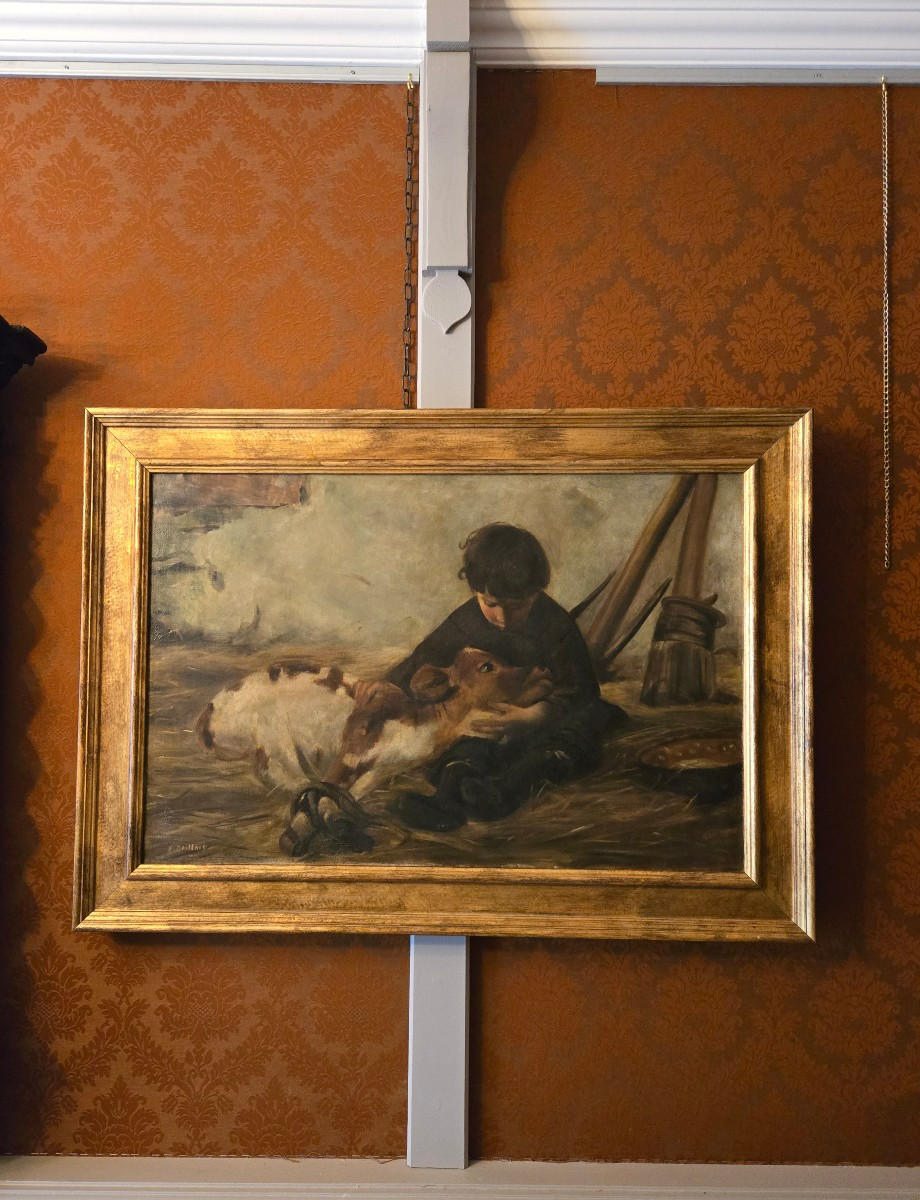
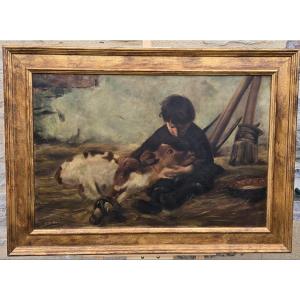


"François Eugène Brillaud (1846–1916) Young Boy And His Calf – Rural Naturalist Scene. "
This moving scene depicts a young boy sitting in the straw of a barn, tenderly holding the head of a young calf lying against him. The animal's gaze, raised towards the child, echoes the quiet gravity of the youthful figure. The atmosphere is intimate, contemplative, almost suspended. The composition rests on a simple and effective balance: the two figures form a dense central core, rendered in a range of warm browns and enveloping halftones. The soft, diffused light models the forms without harshness and lends the whole a remarkable psychological depth. The treatment of the flesh, the sensitive modeling of the calf, the anatomical accuracy of the hands, and the restraint of the setting all testify to a solid academic mastery, nourished by the French naturalist tradition. The artist: François Eugène Brillaud, born in Cugand in 1846, was a student of Isidore Pils and especially of Jules Breton, from whom he inherited a taste for peasant scenes imbued with dignity and restraint. He exhibited at the Paris Salon from 1877 onwards and pursued a steady career between Paris and Nantes. He received an honorable mention in 1904 at the Salon des Artistes Français. Several of his works are now held at the Musée des Beaux-Arts in Nantes and the Musée Municipal in La Roche-sur-Yon. A painter of portraits and genre scenes, Brillaud fully embraced the naturalist movement of the late 19th century, attentive to the truth of gestures, the sincerity of expressions, and the nobility of the rural world. Artistic context: In the 1880s, Paris was a major center of European naturalism. Around Jules Breton, Bastien-Lepage, and their students, a renewed interest developed in scenes of peasant life, treated with restrained emotion and poetic realism. François Brillaud moved in these Parisian artistic circles from the 1870s onward, exhibiting regularly at the Salon, while many foreign artists came to Paris to train and absorb this aesthetic. It is interesting to note that a similar composition was created by Marianne Stokes around the same time, illustrating the shared interest in these scenes of rural intimacy within Parisian naturalist circles. These iconographic correspondences testify to the artistic emulation characteristic of this period, although no definitive link of precedence can be established between the works. Stylistic analysis: The work is distinguished by: A warm and deliberately restrained palette; An introspective, almost meditative atmosphere; A composition focused on emotional connection; A fluid technique, without excessive decorative detail; A restrained yet profoundly human expression; The scene does not seek a theatrical effect. It prioritizes the sincerity of the moment, in a sensitive and direct approach. Conclusion: This work subtly illustrates François Eugène Brillaud's naturalist sensibility and his attachment to scenes of rural life. It belongs to an artistic period when painters, both French and foreign, shared a common vision of the dignity of simple gestures and the poetry of everyday peasant life. A touching and masterful composition, emblematic of late 19th-century French naturalism. Custom-made modern frame. Dimensions: Image size: 91 x 60 cm Framed size: 111 x 80 cm 













 Le Magazine de PROANTIC
 TRÉSORS Magazine
 Rivista Artiquariato