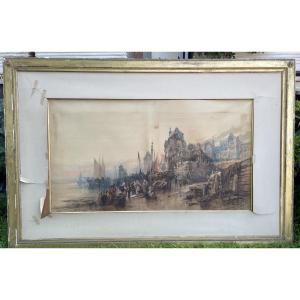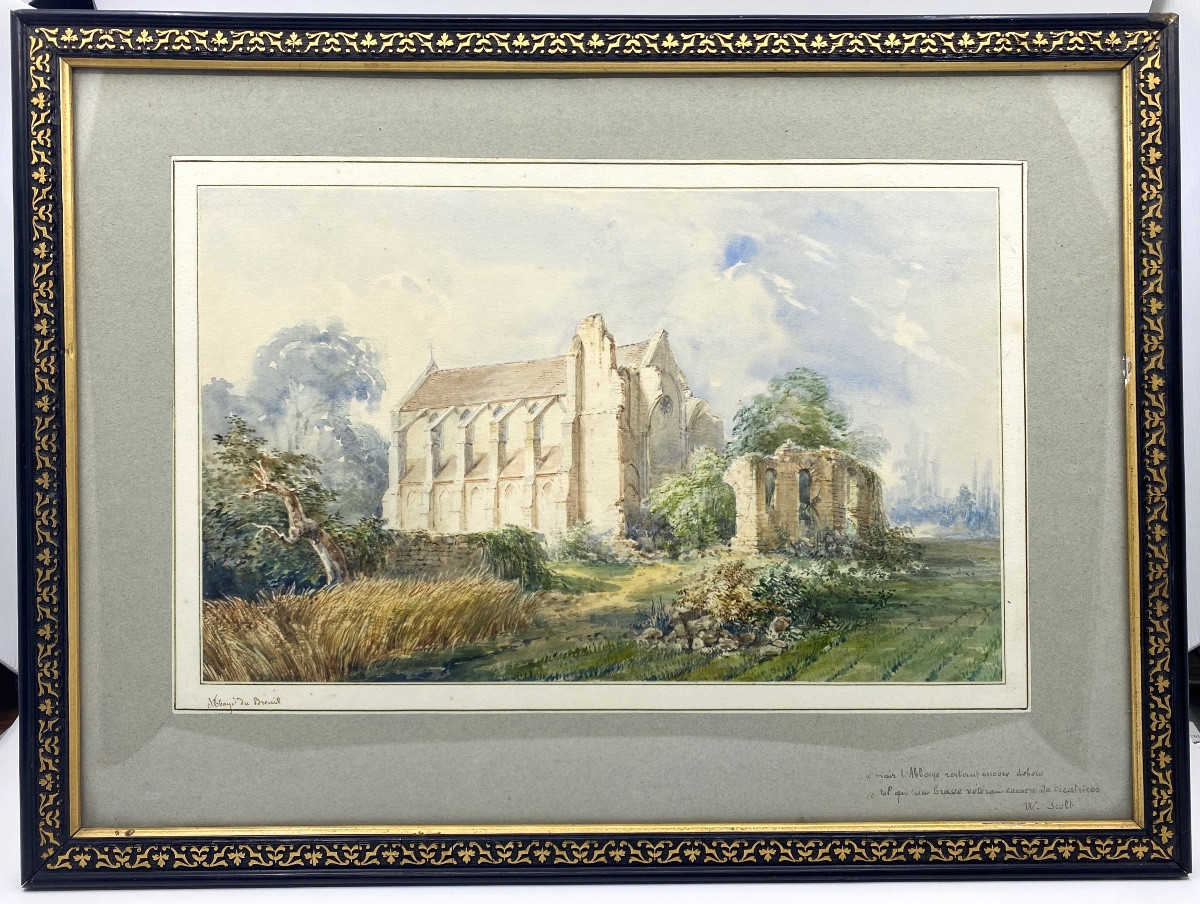
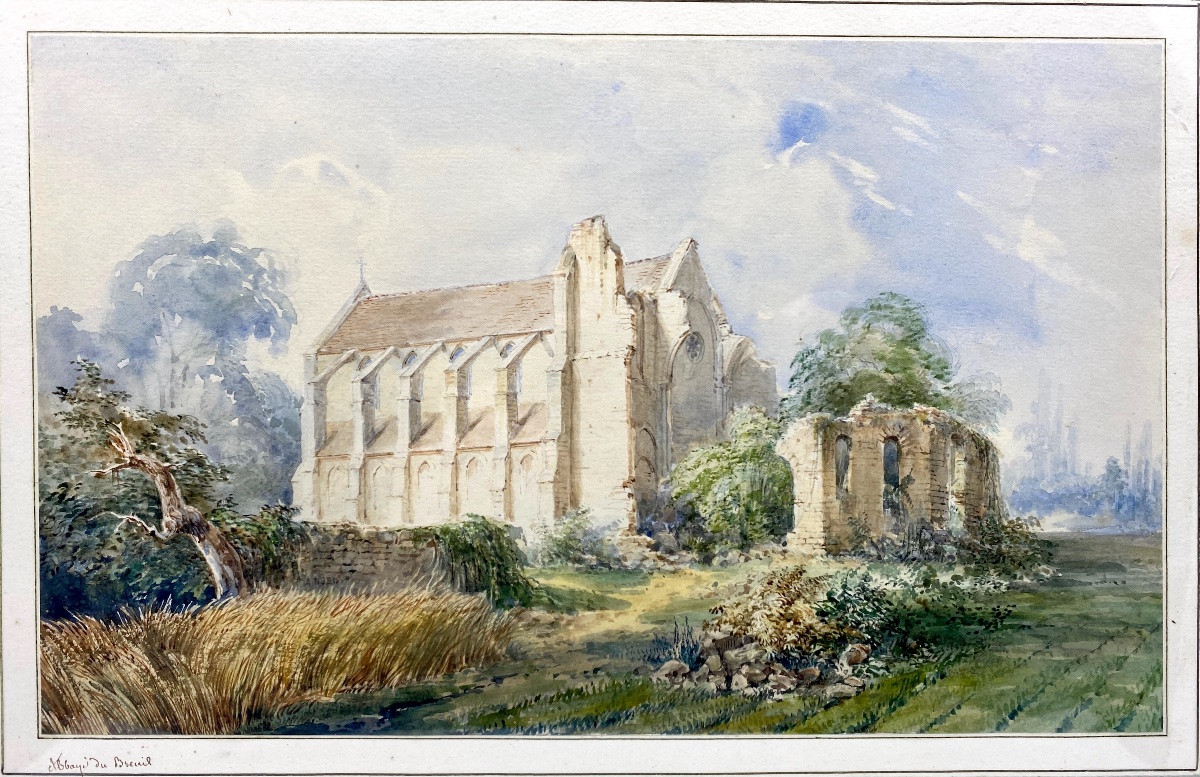


Watercolor Of The Breuil-benoît Abbey, Late 19th Century (original Napoleon III Frame)
Artist: Inconnu
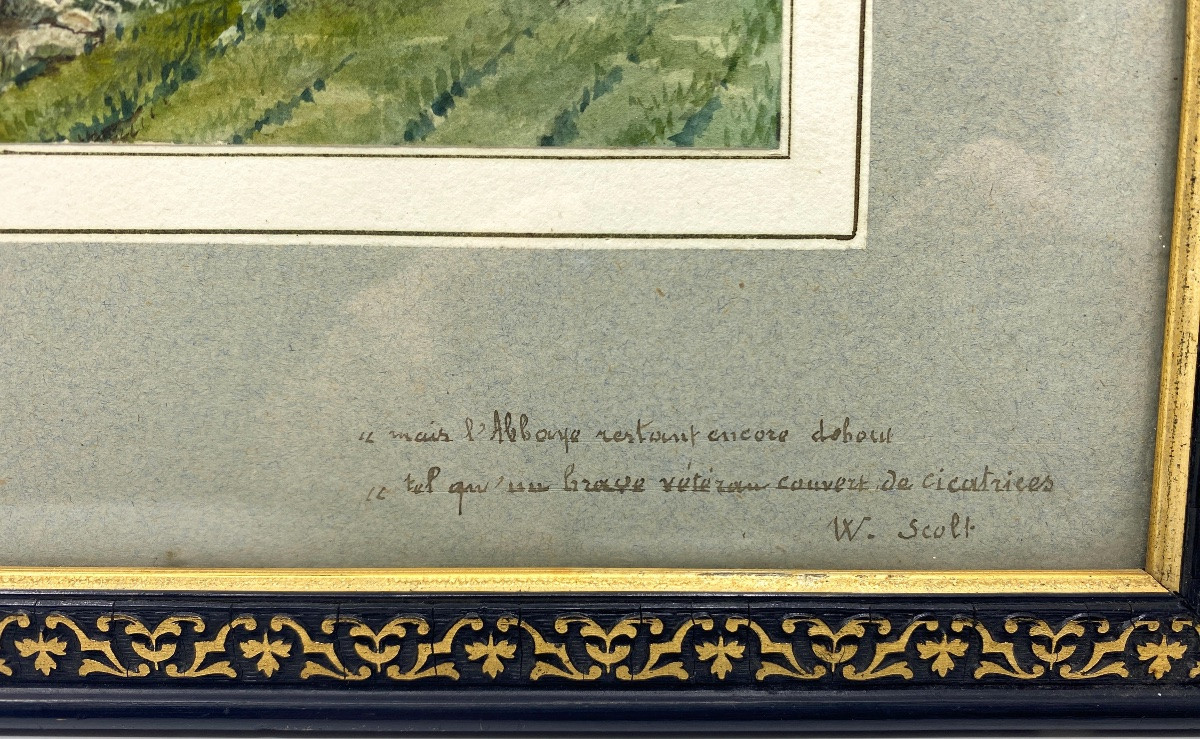
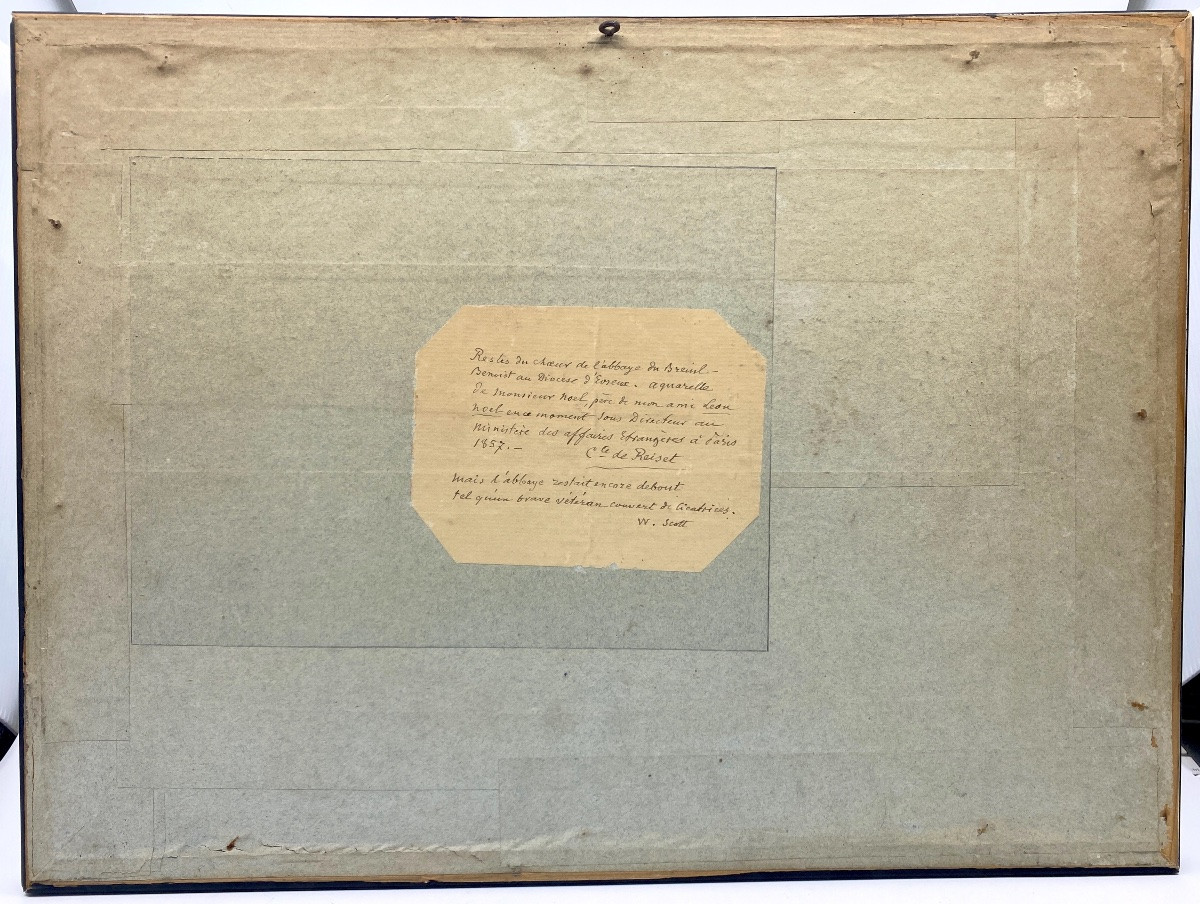
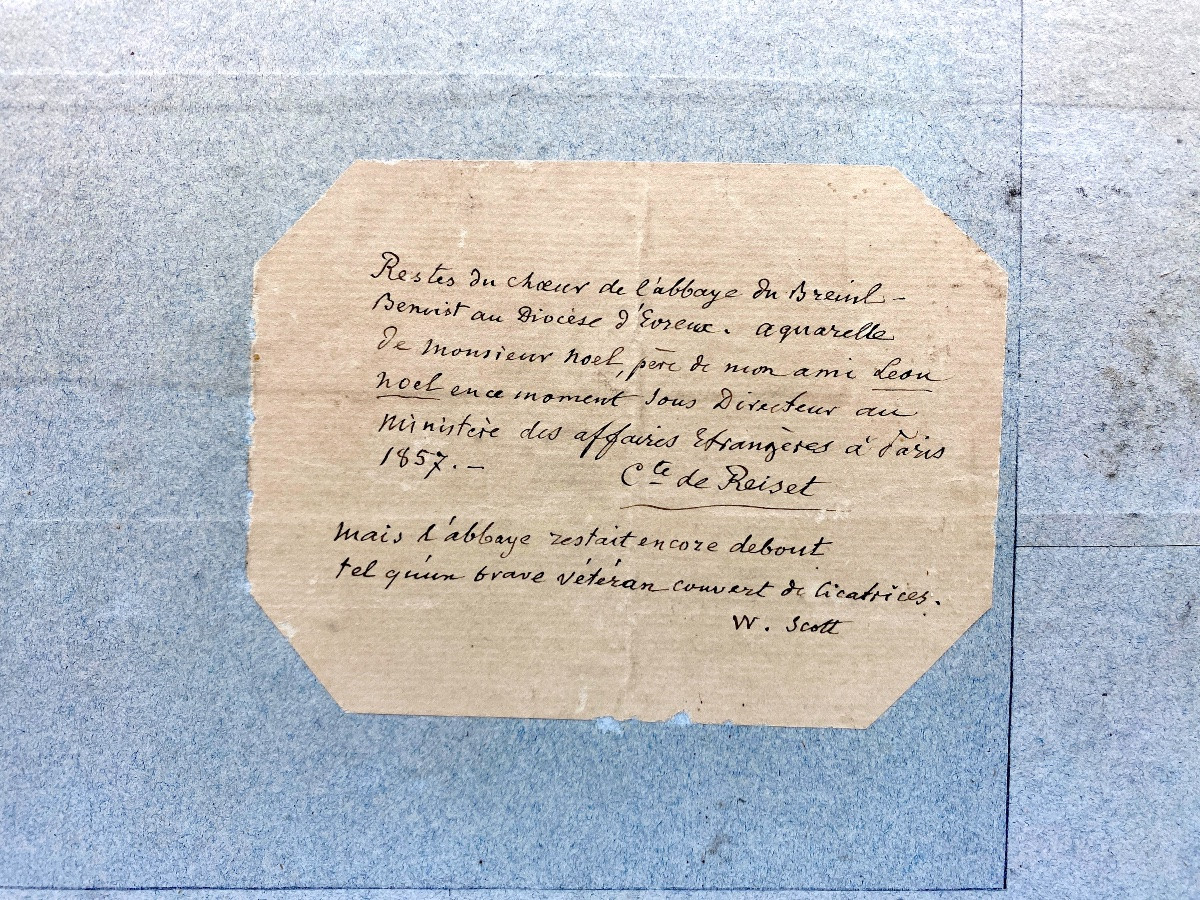
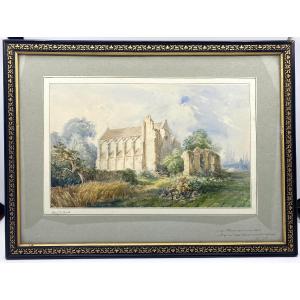
Watercolor depicting the Breuil-Benoît Abbey at the end of the 19th century (original Napoleon III frame). Dimensions: 31.5 x 19.5 cm; 45 x 33.5 cm (with frame). The work is unsigned. However, on the back, there is an annotation dated 1857 by Gustave-Armand-Henri, Count of Reiset, born July 13, 1821, in Mont-Saint-Aignan and died March 2, 1905, at the Breuil-Benoît Abbey (French diplomat, writer, and collector). The annotation reads: "Remains of the choir of the Breuil-Benoît Abbey in the Diocese of Evreux. Watercolor by Monsieur Noël, father of my friend Léon Noël, currently Deputy Director at the Ministry of Foreign Affairs in Paris." This is followed by a quote from Walter Scott: "But the abbey still stood, like a brave veteran covered in scars." Léon Noël was a French diplomat and politician, born on March 28, 1888, in Paris, and died on August 6, 1987, at his estate, Les Monins, in Toucy (Yonne). A senior civil servant and then ambassador before the war, he represented the Ministry of Foreign Affairs during the armistice negotiations in the clearing of Rethondes in May 1940, which he refused to sign. Committed to the Resistance, a Gaullist, he would be the first president of the Constitutional Council of the Fifth Republic from 1959 to 1965. From the upper middle class, a fervent Catholic, son of a State Councillor, Léon Noël obtained a doctorate in law in 1912. An auditor at the Council of State in 1913, he was, from 1912 to 1914, chief of staff to Maurice Colrat de Montrozier, deputy and minister. He returned to the Council of State, where he served as a Master of Requests from 1924 to 1926, Deputy Chief of Staff to the Minister of the Interior in 1921, and Chief of Staff to General Guillaumat, Minister of War, in 1926. More information on the Abbey of Breuil-Benoît: The former Abbey of Breuil-Benoît, located in the Eure department, in the commune of Marcilly-sur-Eure, was founded on May 8, 1137, by Foulques de Marcilly, thanks to the arrival of monks from the Abbey of Vaux-de-Cernay. Its name derives from the Rule of Saint Benedict, to which it was subject at its founding in a place called Le Breuil. The Latin name of the abbey is Brolium Benedicti. In 1147, it became a Cistercian abbey. The abbey church, dedicated to Mary and Saint John the Baptist, was built thanks to the generosity of William de Marcilly upon his return from the Crusade, beginning in 1190. It was consecrated in 1224 jointly by the Bishops of Évreux, Richard and Gautier de Chartres. One of its abbots was Thibaut de Marly, from 1235 to 1247. Later, Michel Poncet de La Rivière (d. 1728) served as commendatory abbot, the last abbot being Denis Péguilhan de Harboust (d. 1804). Sold as national property, part of the buildings was demolished (notably the transept) to reuse the stones. Purchased by Gustave de Reiset, brother of Frédéric de Reiset (director of the Louvre museums), the abbey was restored starting in 1842. The church, reduced to the six bays of the nave, was reconsecrated in 1854. Count de Reiset established a museum with themes adapted to the layout of the buildings (abbey's residence, church, conventual outbuildings, etc.). Following the Count's death in 1905, his widow died in the 1920s. The collections were partly dispersed at public auctions, notably in 1922; the abbey ceased to be maintained. In the 21st century, the abbey church remains the only Cistercian church in Normandy. It has been listed as a historical monument since December 17, 1993. Starting in 1995, new owners undertook its restoration.
450 €
Period: 19th century
Style: Napoleon 3rd
Condition: Excellent condition
Material: Water color
Width: 31,5 cm
Height: 19,5 cm
Reference (ID): 1708557
Availability: In stock
Print