




Jean Dufau Large Painting Landscape Forest Barbizon Fontainebleau Impressionist 1920
Artist: Jean Duffau
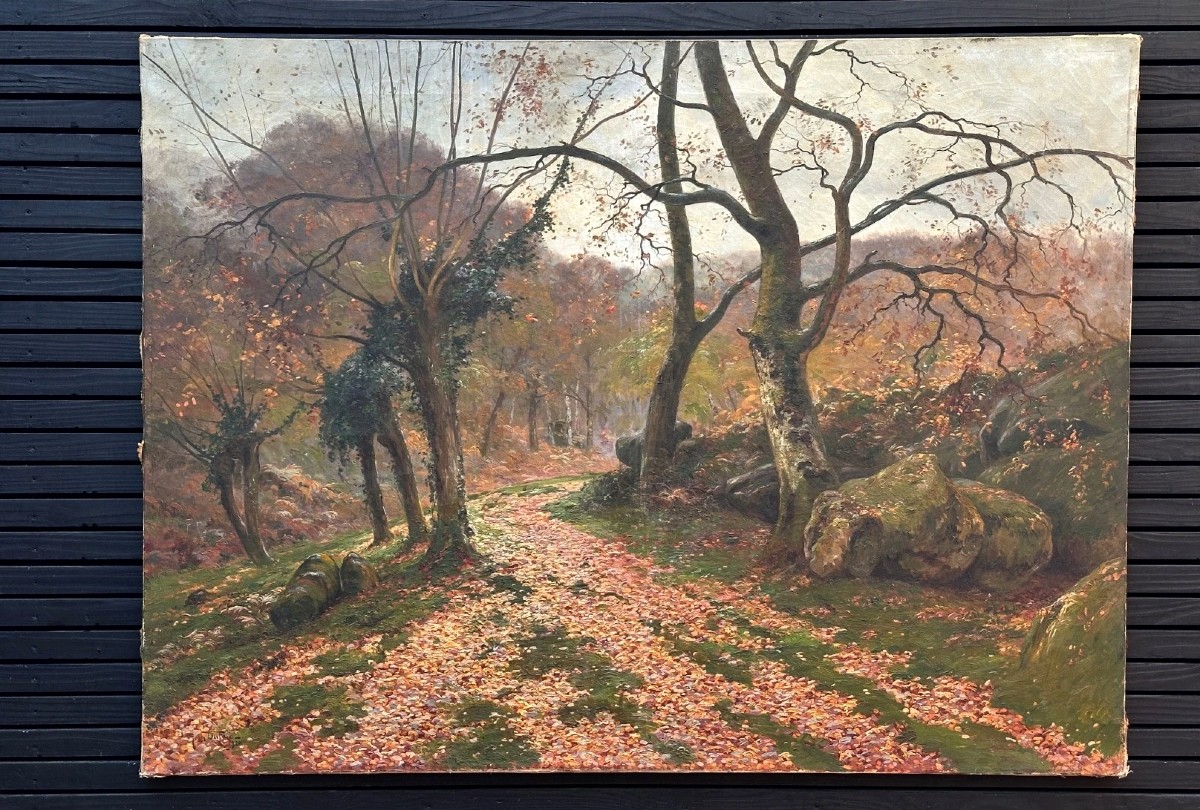
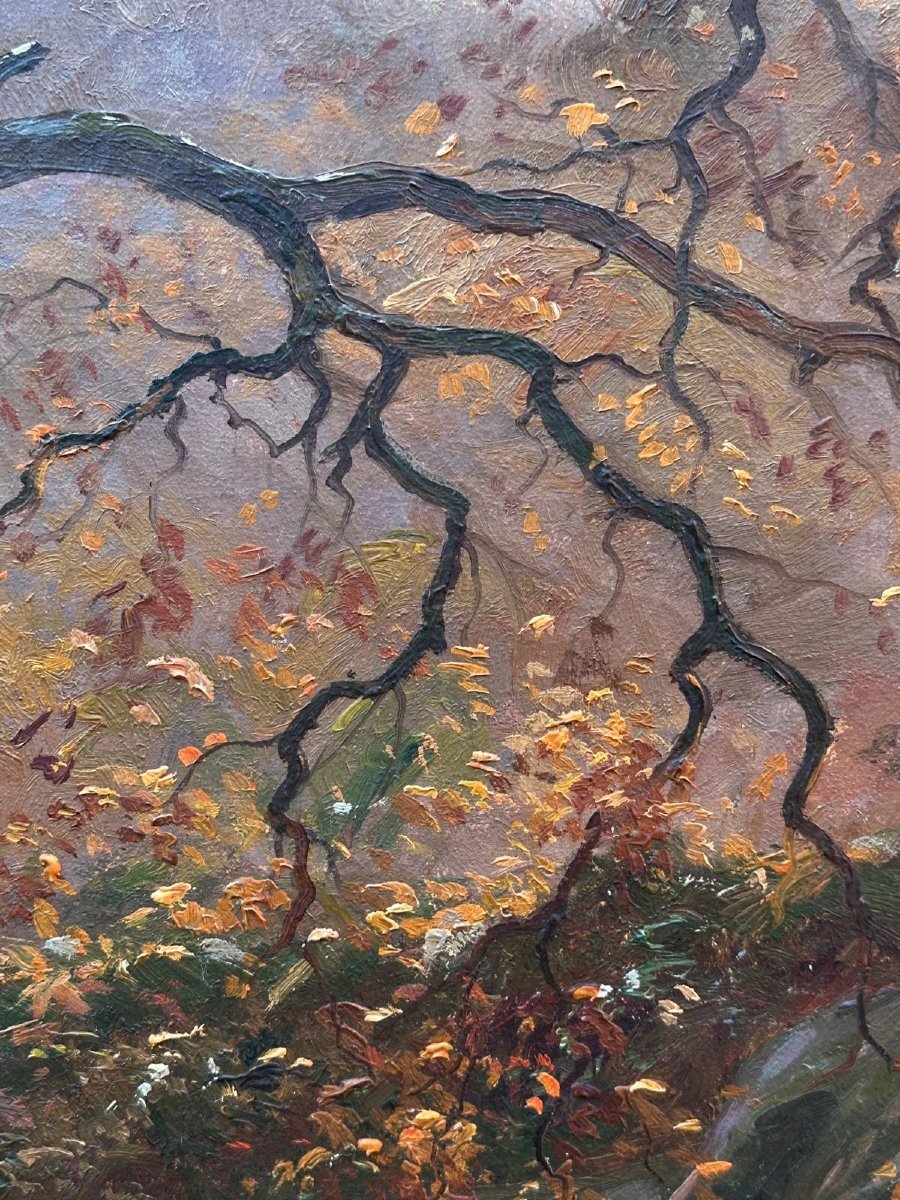
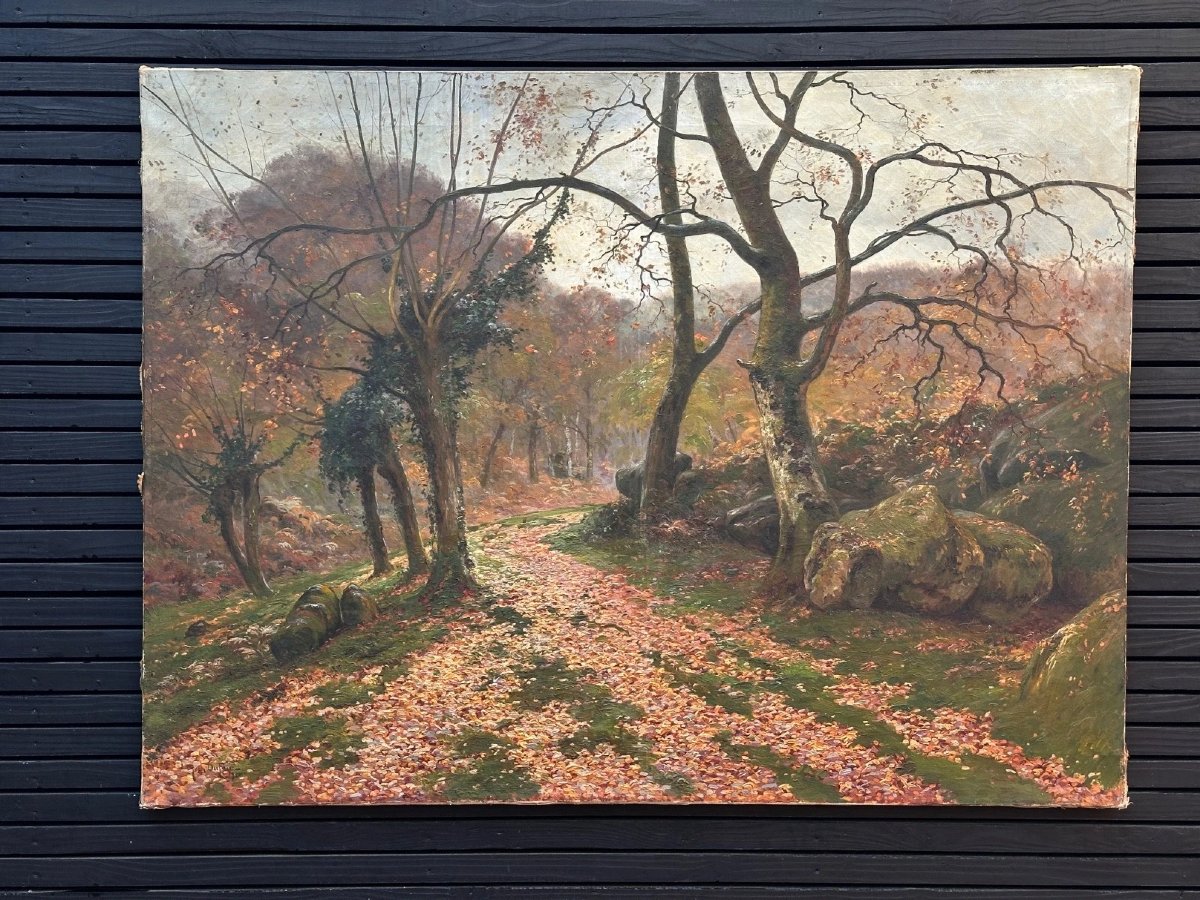
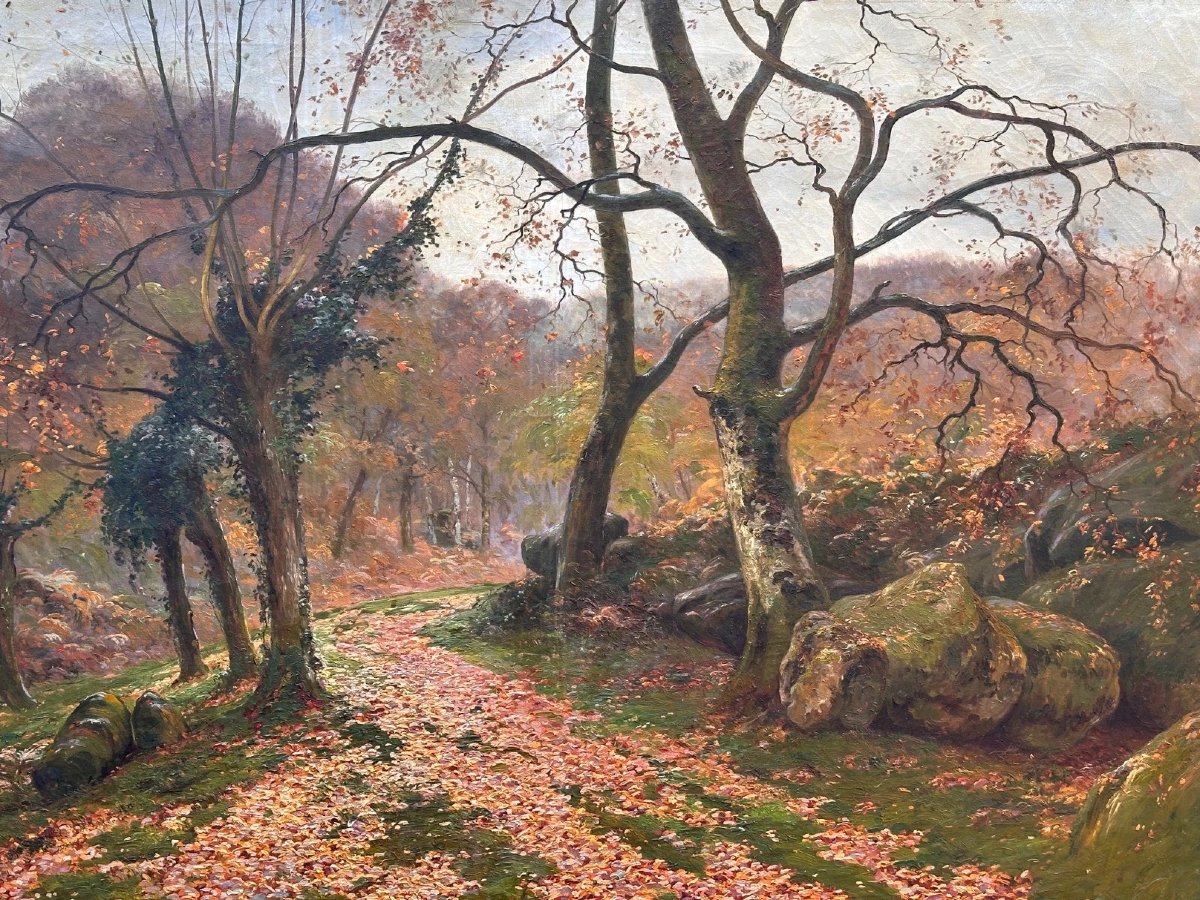
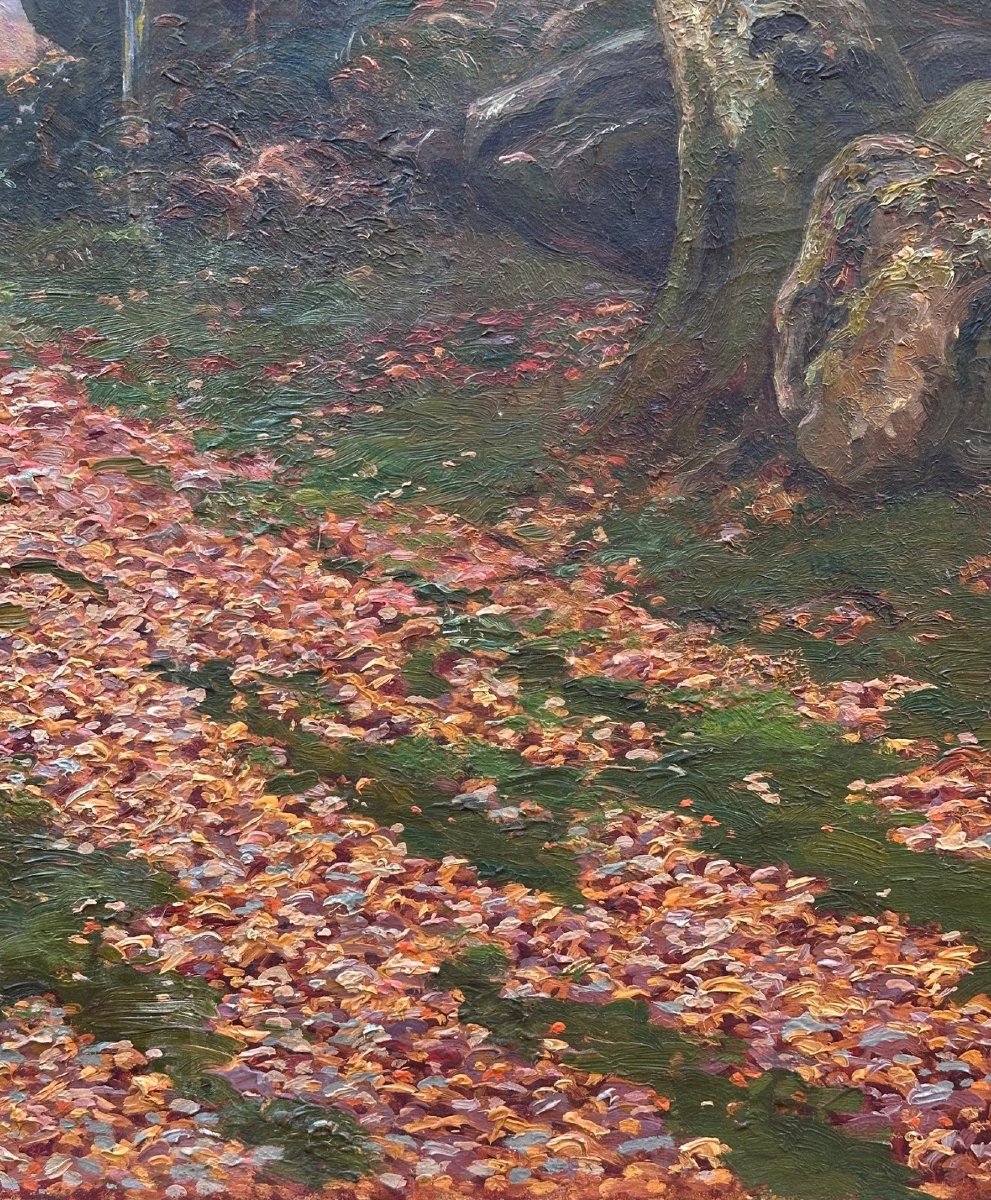
Forest Path in Autumn, circa 1920. Oil on canvas. 112 × 150 cm. Signed and dated lower left: Jean Dufau, 1920. This large landscape composition is fully in keeping with the French Post-Impressionist aesthetic of the first quarter of the 20th century. Jean Dufau depicts a forest path winding through the heart of an autumnal undergrowth, punctuated by slender tree trunks, mossy rocks, and a dense carpet of fallen leaves. The scene is constructed around a subtle backlighting: the light, filtered through the sparse foliage, illuminates the central path and catches the russet, orange, and gold leaves, while the tree masses stand out in darker silhouettes. The brushwork is free, thick in places, clearly worked with a palette knife and brush, with a generous impasto that animates the surface of the canvas. The impasto emphasizes the leaf-strewn ground and the textures of the bark, lending the whole a typically Impressionist chromatic vibrancy, while maintaining a solid structure inherited from naturalist landscape painting. The sinuous and nervous lines of the branches structure the composition and guide the eye into the depths of the undergrowth. The palette, dominated by muted greens, ochres, earthy reds, and warm browns, evokes a late-season atmosphere, both melancholic and luminous.
The treatment of backlighting reinforces the sensation of forest dampness and raking light, giving the scene a tactile dimension. Jean Dufau devoted the majority of his work to the forest landscapes of Île-de-France, considered major motifs in modern painting. He primarily painted the forests of Barbizon and Fontainebleau, whose paths, undergrowth, and clearings he tirelessly explored. Like the painters of the Barbizon School, he favored working from life and direct observation of nature, while incorporating a freer brushstroke and a more expressive approach inherited from Post-Impressionism.
These emblematic sites, already celebrated in the 19th century, find a later interpretation under his brush, sensitive to seasonal variations and the effects of filtered light. A French painter active at the turn of the 19th and 20th centuries, linked to the Post-Impressionist landscape tradition, and trained in a context marked by the legacy of the Barbizon School and the contributions of late Impressionism, he developed a body of work centered on nature, forests, rural paths, and woodland landscapes. His work is characterized by a particular attention to the effects of light, the seasons, and the texture of paint. Dufau favored a sensitive style of painting, where the visible brushstroke and color take precedence over descriptive detail, while maintaining a clear understanding of the subject.
The treatment of backlighting reinforces the sensation of forest dampness and raking light, giving the scene a tactile dimension. Jean Dufau devoted the majority of his work to the forest landscapes of Île-de-France, considered major motifs in modern painting. He primarily painted the forests of Barbizon and Fontainebleau, whose paths, undergrowth, and clearings he tirelessly explored. Like the painters of the Barbizon School, he favored working from life and direct observation of nature, while incorporating a freer brushstroke and a more expressive approach inherited from Post-Impressionism.
These emblematic sites, already celebrated in the 19th century, find a later interpretation under his brush, sensitive to seasonal variations and the effects of filtered light. A French painter active at the turn of the 19th and 20th centuries, linked to the Post-Impressionist landscape tradition, and trained in a context marked by the legacy of the Barbizon School and the contributions of late Impressionism, he developed a body of work centered on nature, forests, rural paths, and woodland landscapes. His work is characterized by a particular attention to the effects of light, the seasons, and the texture of paint. Dufau favored a sensitive style of painting, where the visible brushstroke and color take precedence over descriptive detail, while maintaining a clear understanding of the subject.
1 200 €
Period: 20th century
Style: Napoleon 3rd
Condition: Good condition
Material: Oil painting
Width: 150
Height: 112
Reference (ID): 1703386
Availability: In stock
Print