

Bronze Basin Decorated In High Relief, Japan, Meiji Era, 1880-1900, Very Good Condition, Collector's Item
Artist: Signé
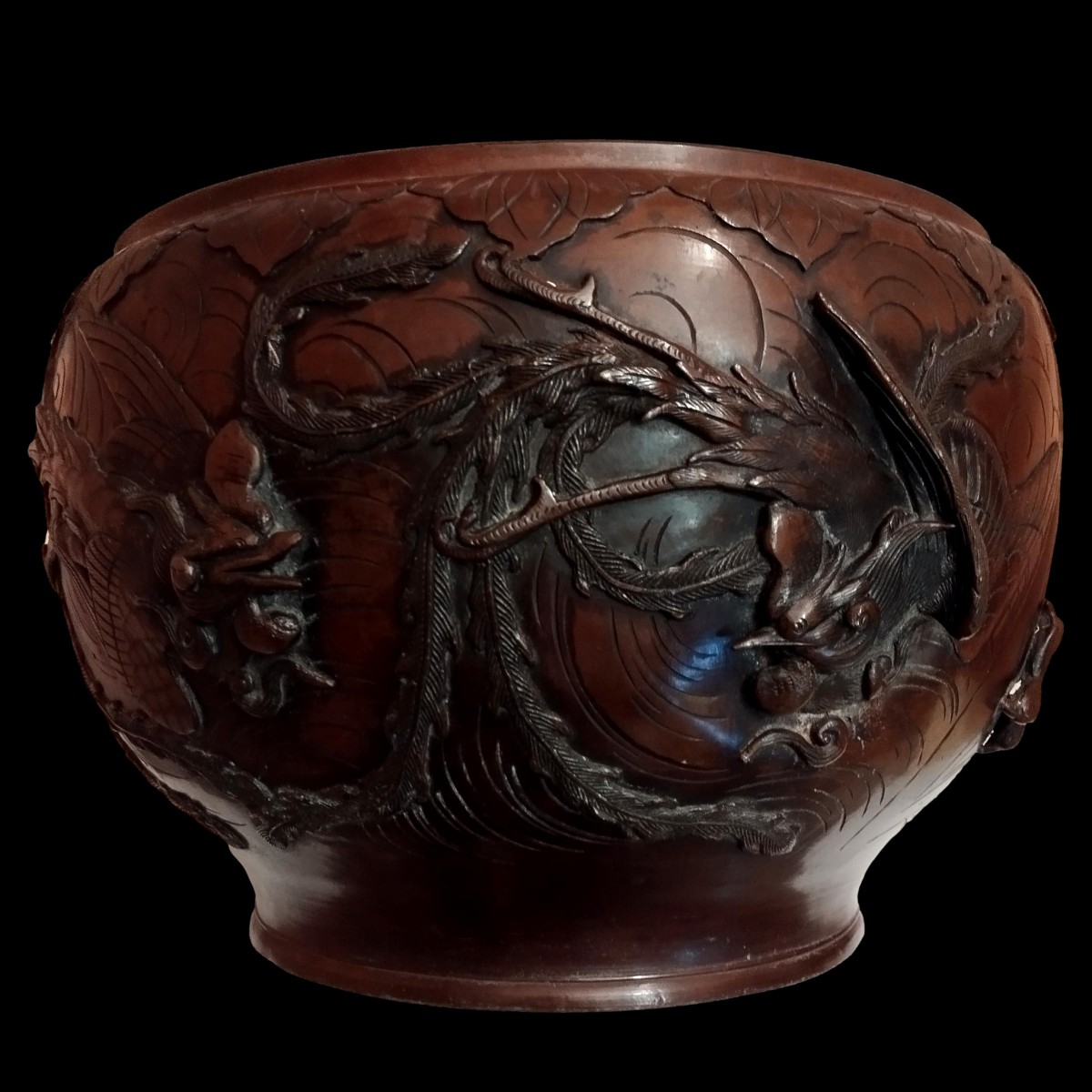
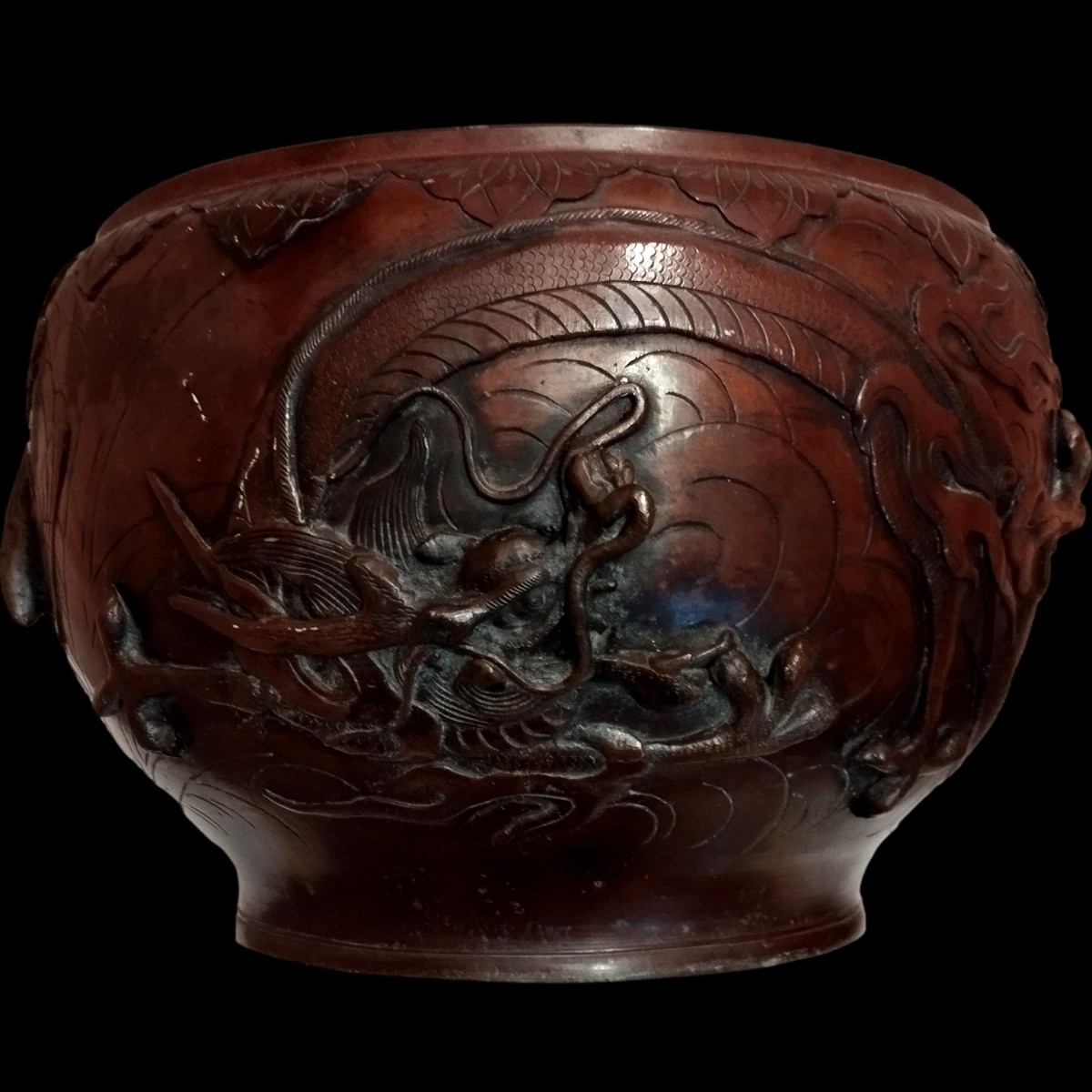
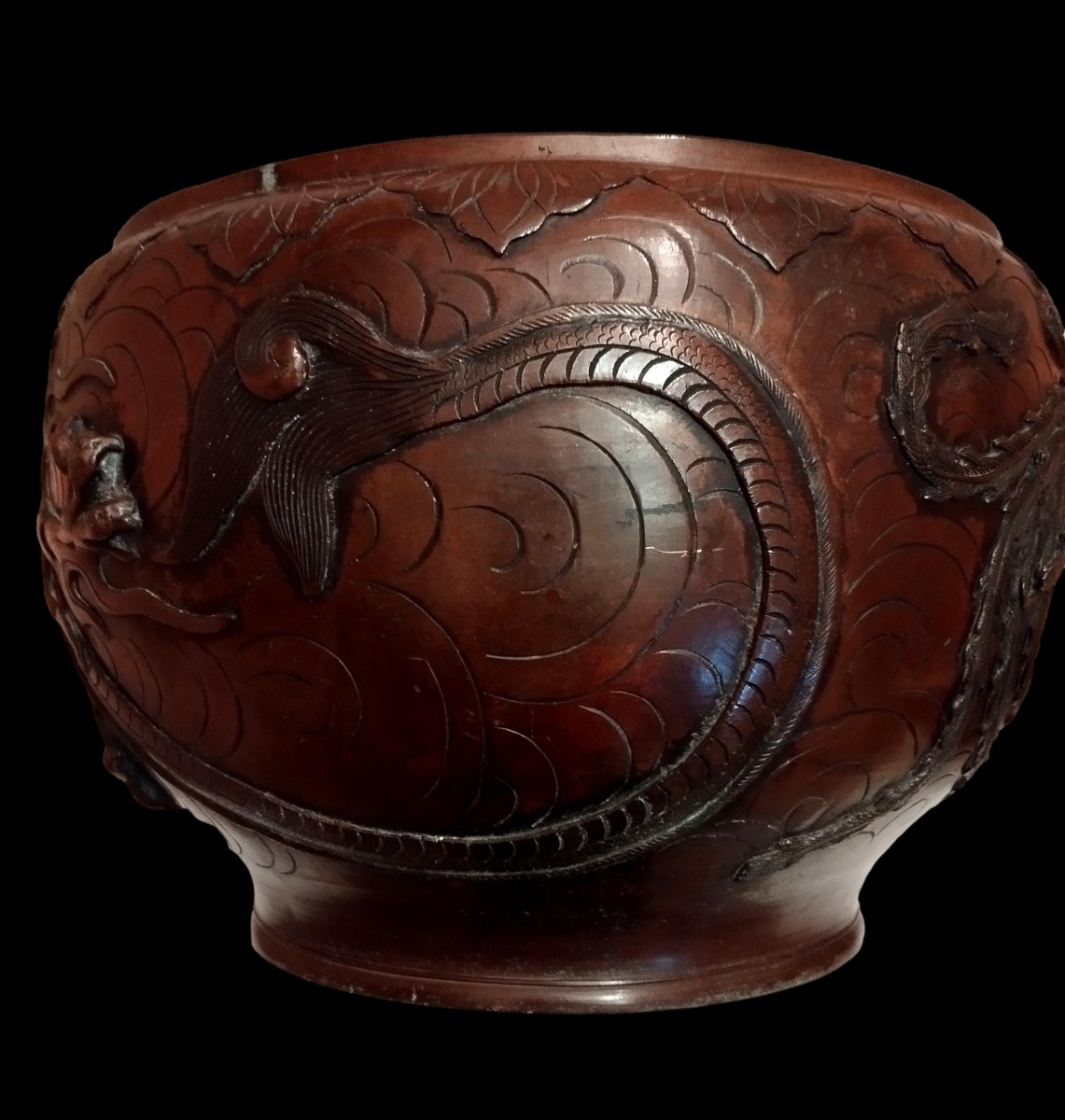
Large and powerful decorated bronze basin, Meiji era Japan. 19th century.
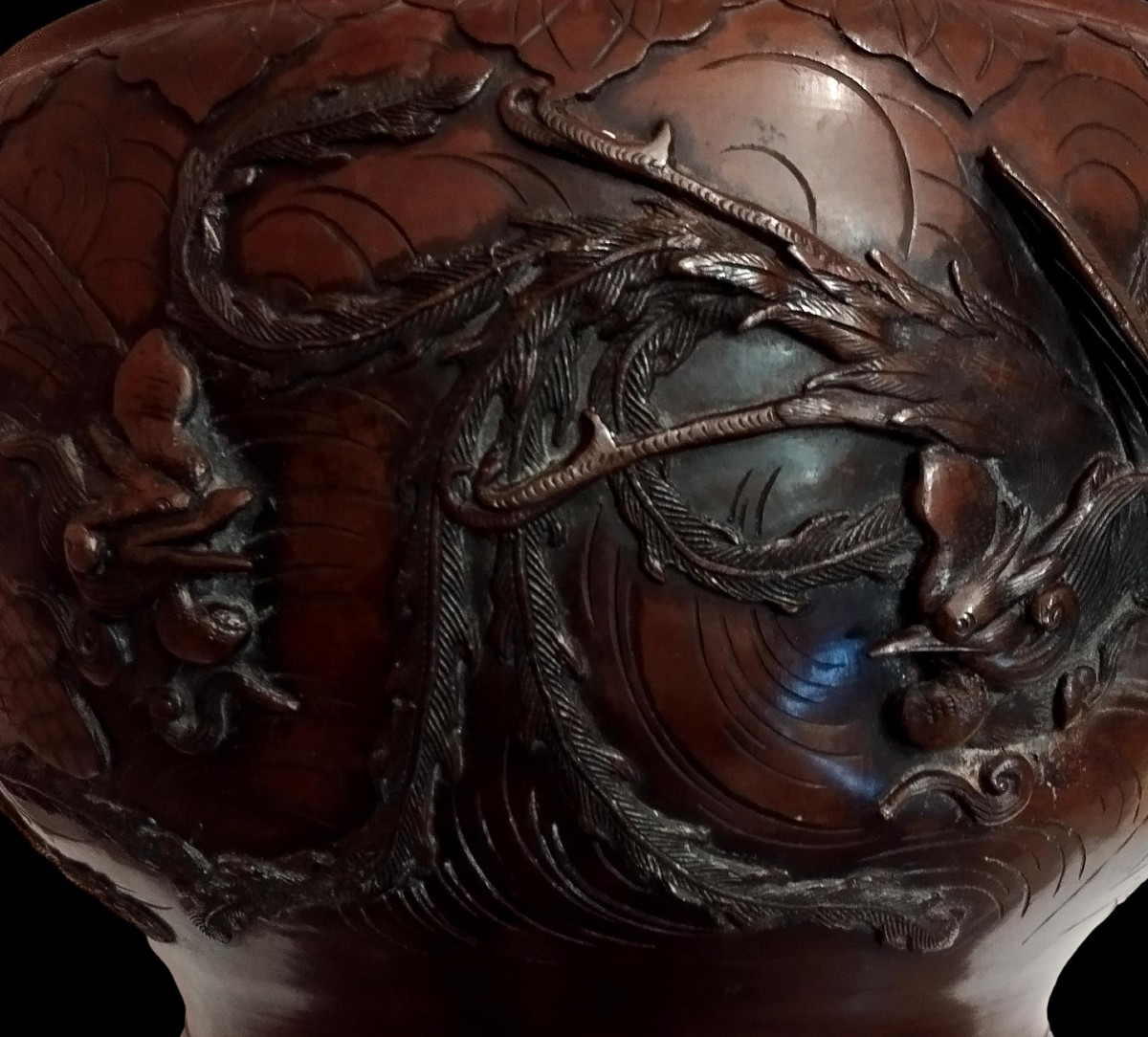
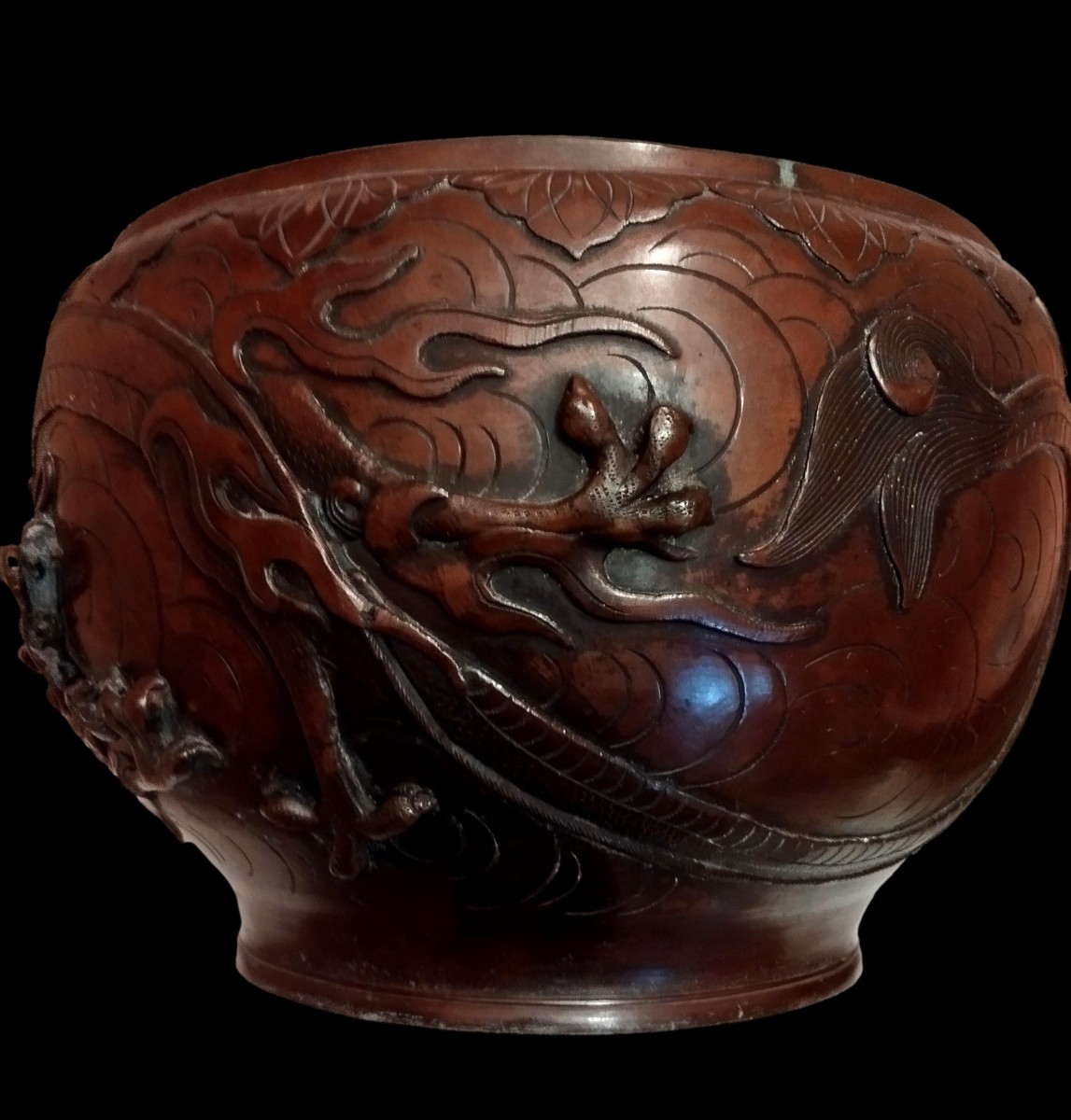
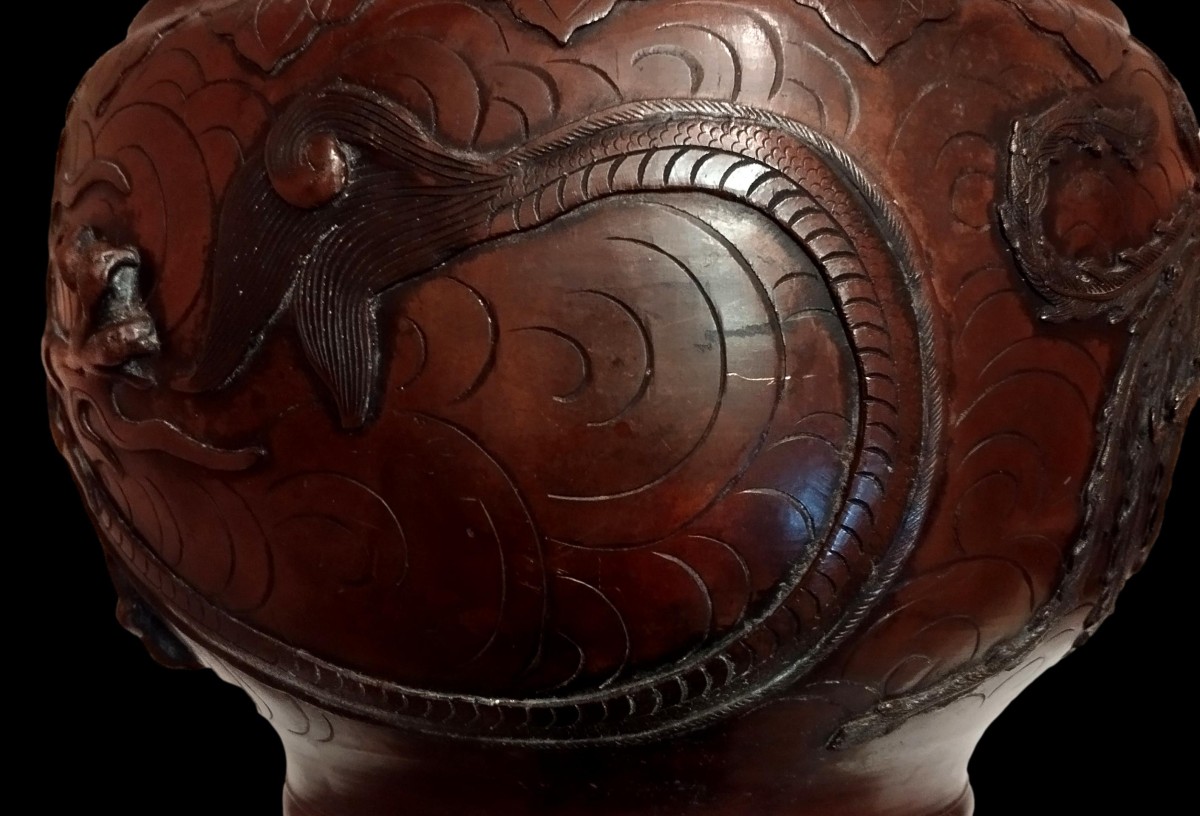
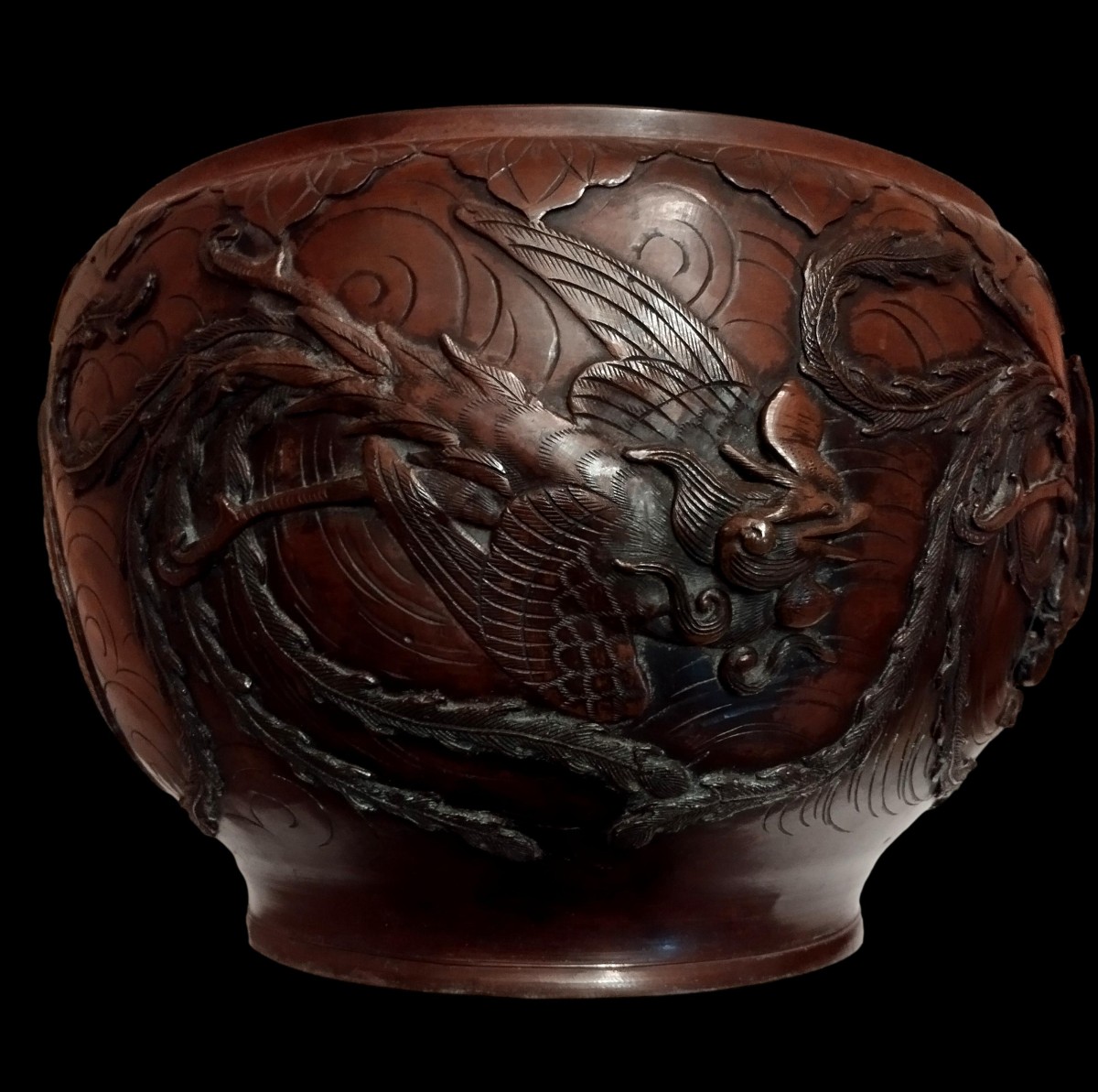
Powerful in the dexterity of its high-relief sculptures surrounding the object on all sides, and large in its imposing size.
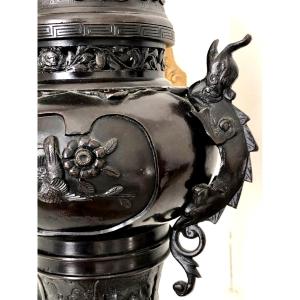
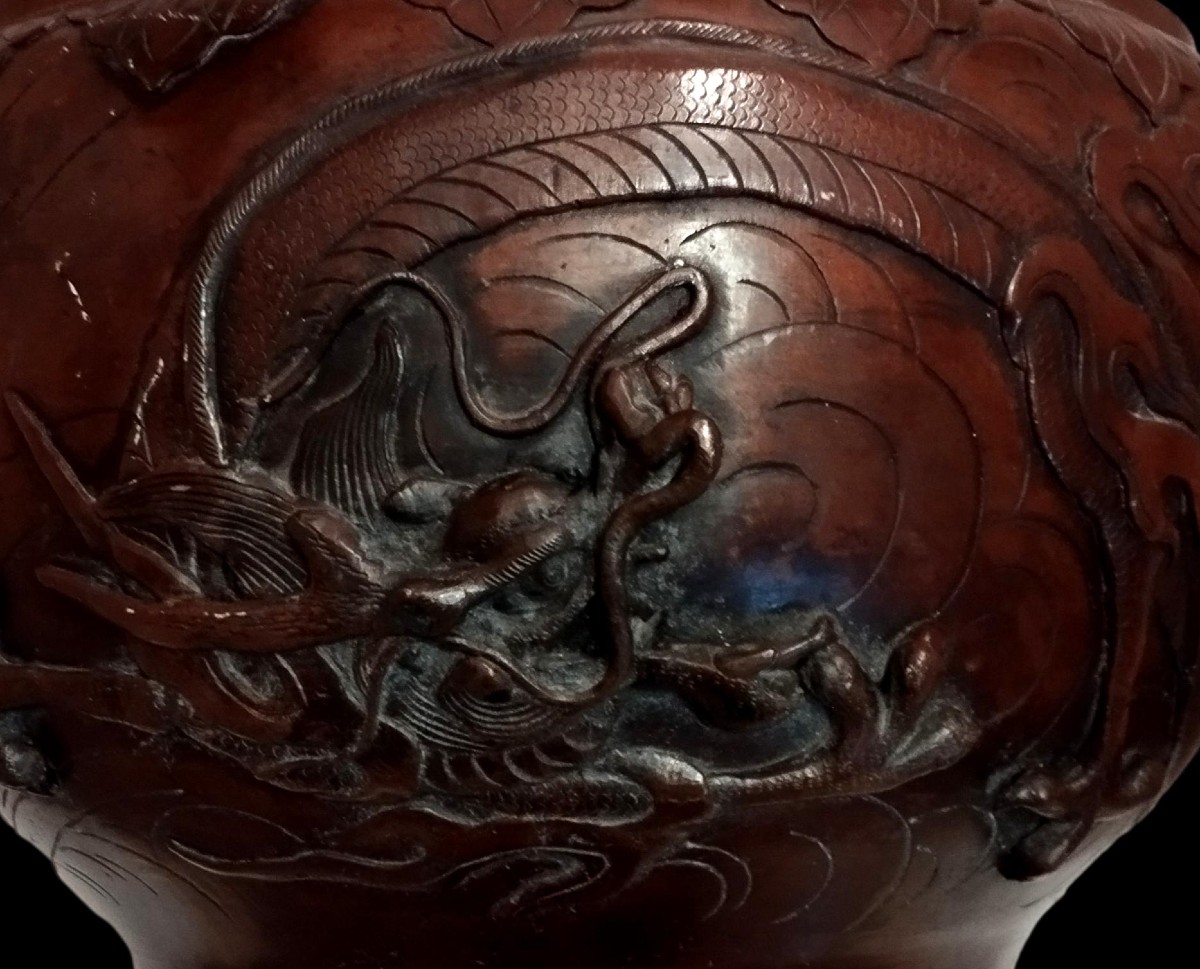
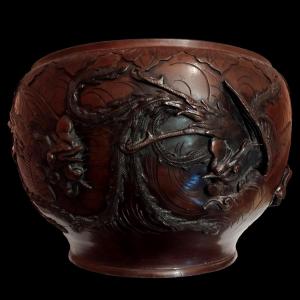
Indeed, this beautiful basin features, on half of its convex surface, a depiction of a combative dragon, mouth open and claws extended. The Japanese dragon is a symbol of power, strength, and unpredictable nature, embodying the raw forces of nature.
Yet, despite its destructive potential, it is generally perceived as a good omen, bringing happiness, wealth, and success.
Ryūjin (龍神) is the god of the sea in Japanese mythology.
He is a dragon, a symbol of the ocean's power, with a wide mouth and the ability to take human form.
He lives in Ryūgū-jō, from where he controls the tides with magical jewels.
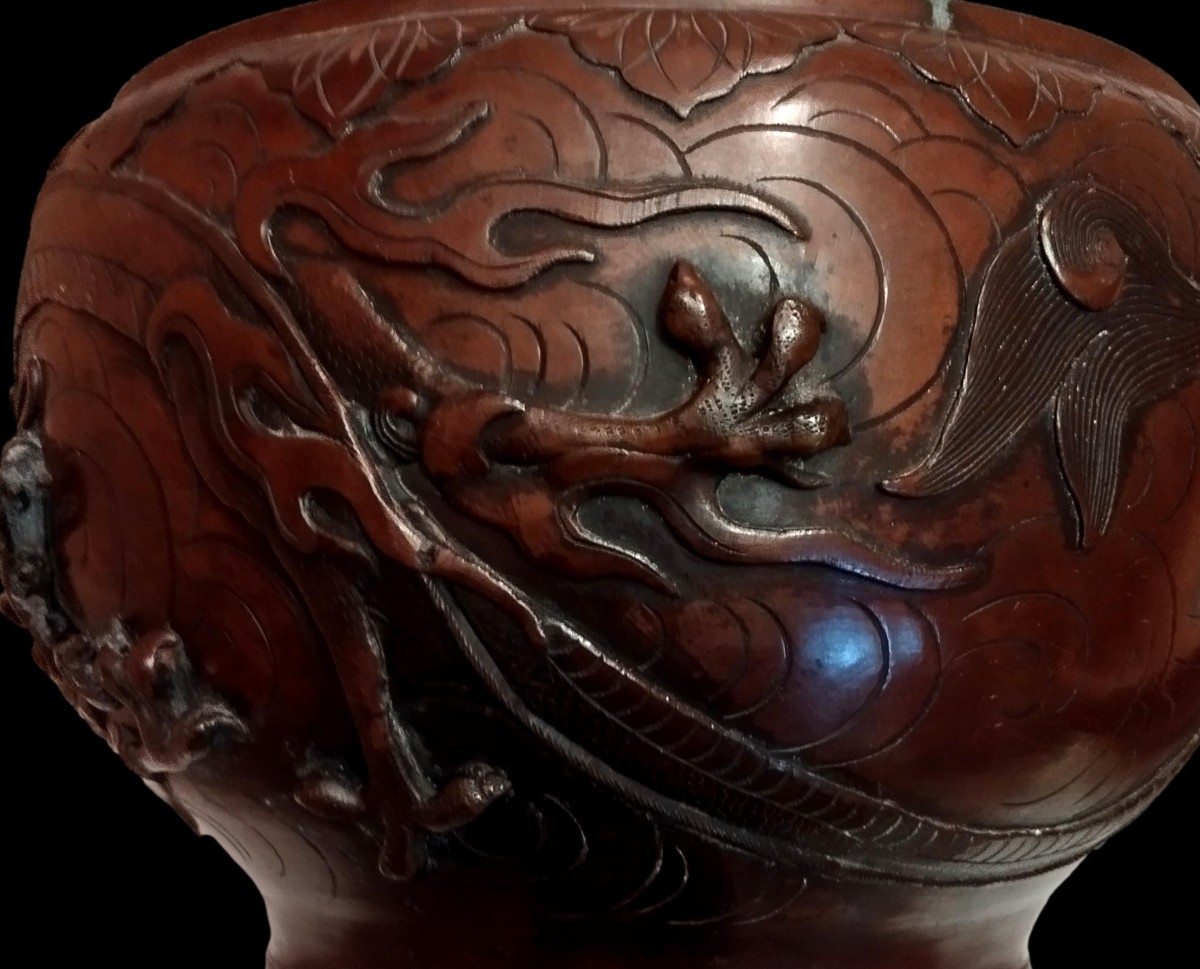
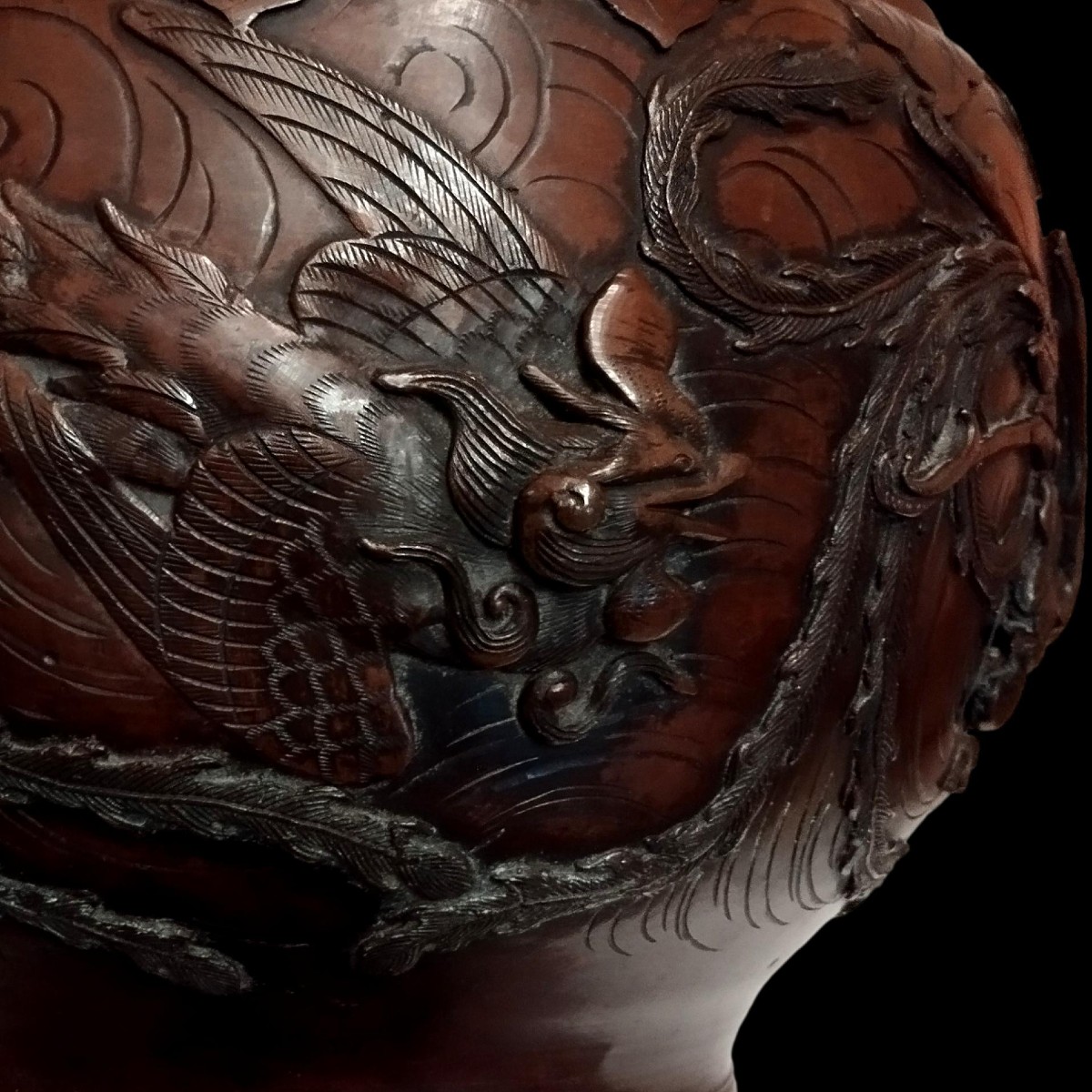
The other side depicts a fight between two roosters in flight, face to face, claws and feathers.
Exuberant. In Japan, the land of the rising sun (literally, Japan means "root of the sun"), it is the rooster that manages to coax the sun goddess Amaterasu out of the cave where she is hidden.
Japanese mythology relating to the rooster is just as solar as Western and Middle Eastern mythology.
Thus, the ancestor of all roosters, through the power of his crow and the use of a sacred mirror, the shintai, coaxed Amaterasu, the Sun Goddess, out of the cave where she had hidden herself.
It is interesting to note that the rooster's crow alone is not enough to make the sun rise.
It also needs the octagonal mirror "intended to capture the benevolent rays and spirit of the goddess," meaning that the organ of sight also plays a role.
The rooster must see the rays of light for the sun to appear on the horizon.
He sees them first, before anyone else, when the celestial body is still shrouded in darkness (the cave), and this is undoubtedly why he is attributed with the gift of second sight.
The shintai is located in Ise at a shrine where sacred roosters are kept.
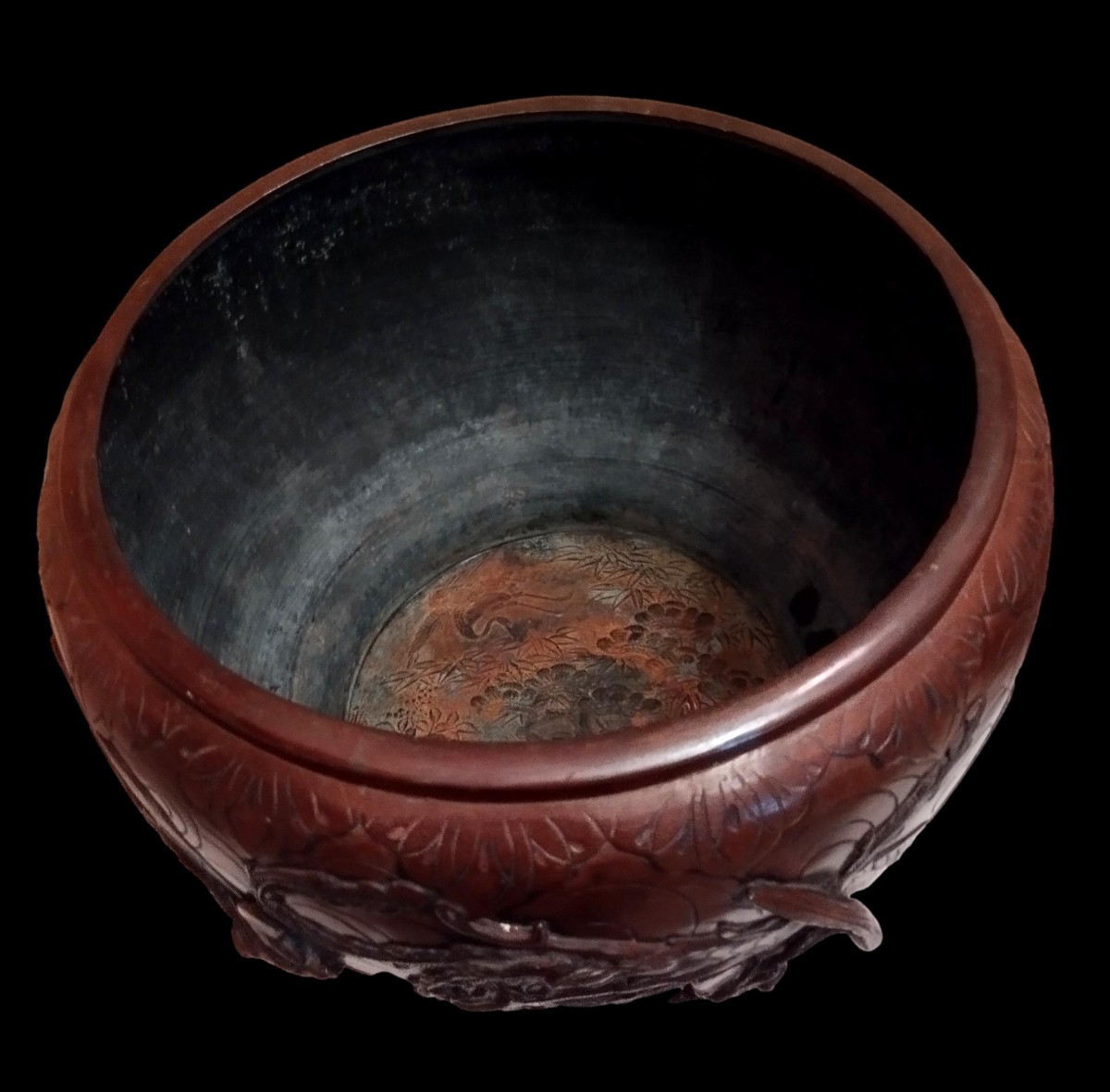
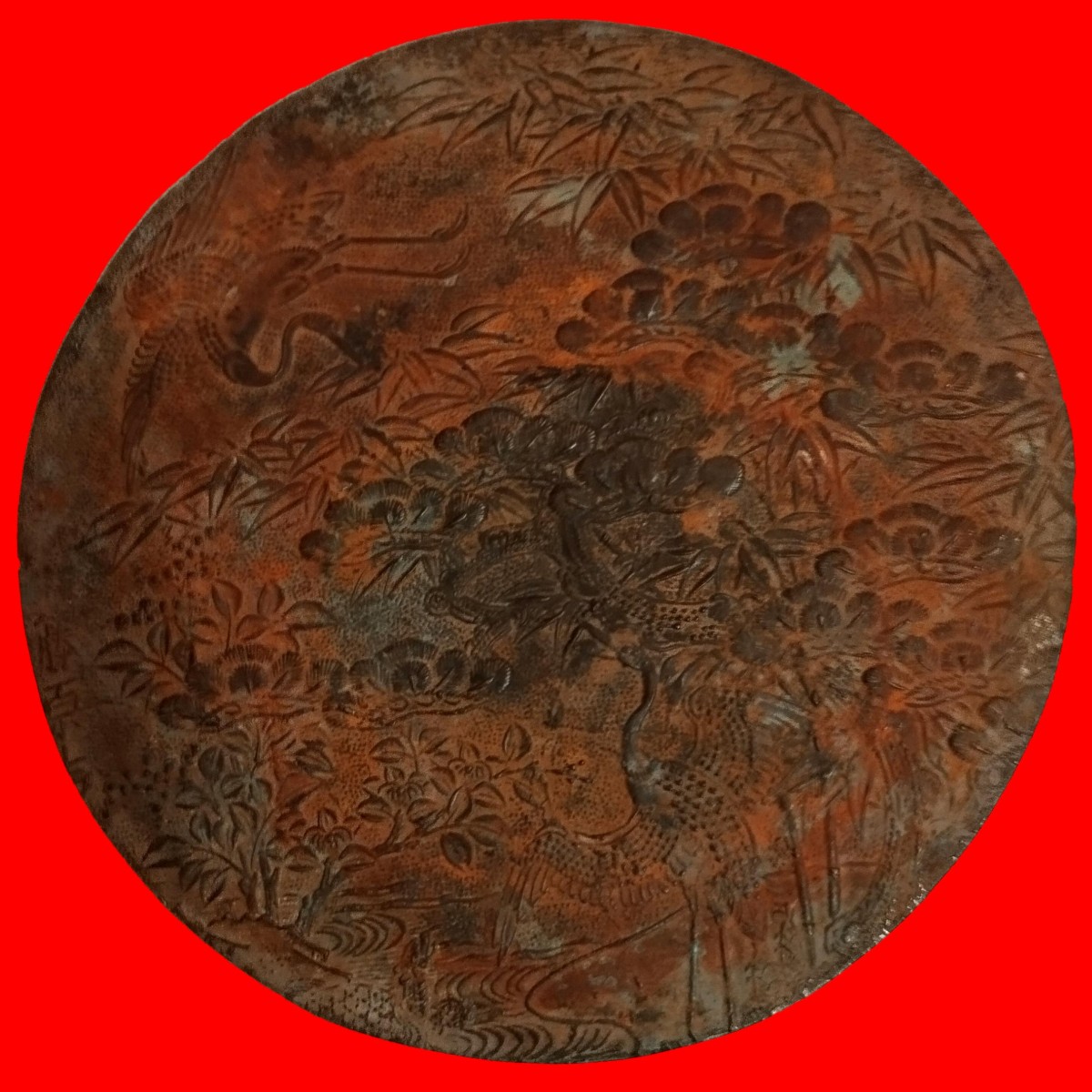
The bottom of the removable basin features a signature on the rim, as well as two cranes frolicking in a landscape of river, trees, and bamboo.
The Japanese crane is a wading bird with white plumage, but the tips of its wings and its head are black.
A true emblem of the country, it is visible on 1000 yen notes as well as on kimono fabrics, even though it is not very common in the country.
In Japanese folklore, cranes are believed to live for a thousand years and are divine messengers.
Their graceful movements and elegance make them popular symbols at weddings and festivities, representing eternal love and prosperity. In short, a room extensively decorated with a strong and Powerful relief.
This vase is complemented by a very beautiful medal patina. 1870 - 1900
# Meiji Period: The Meiji era refers to the reign of Emperor Mutsuhito between 1868 and 1912.
This period is characterized by major transformations in all areas.
The bronze work reveals great technical mastery, alternating polished surfaces, sculpted reliefs, and incised engravings.
The deep, nuanced, antique patina testifies to the age and authenticity of the piece.
The base bears a Japanese workshop mark, a signature, confirming traditional Meiji-era production.
Very good collector's condition — This antique object may show some wear, such as small scratches and other signs of use, which is normal for an artifact of the Meiji culture.
Dimensions:
Height: 22 cm (9") --- Diameter: 34 cm (13.5") ----- Opening: 26 cm (10") and Base: 19.7 cm (8") Weight: 2680 g FREE SHIPPING WITHIN FRANCE €0 / EUROPE €25 / WORLD €100
For more information, you can contact me at +33 6 13 36 09 30 or at winsteinprovence@gmail.com
www.winsteinprovence.com
ref winstein 1544
Powerful in the dexterity of its high-relief sculptures surrounding the object on all sides, and large in its imposing size.
Indeed, this beautiful basin features, on half of its convex surface, a depiction of a combative dragon, mouth open and claws extended. The Japanese dragon is a symbol of power, strength, and unpredictable nature, embodying the raw forces of nature.
Yet, despite its destructive potential, it is generally perceived as a good omen, bringing happiness, wealth, and success.
Ryūjin (龍神) is the god of the sea in Japanese mythology.
He is a dragon, a symbol of the ocean's power, with a wide mouth and the ability to take human form.
He lives in Ryūgū-jō, from where he controls the tides with magical jewels.
The other side depicts a fight between two roosters in flight, face to face, claws and feathers.
Exuberant. In Japan, the land of the rising sun (literally, Japan means "root of the sun"), it is the rooster that manages to coax the sun goddess Amaterasu out of the cave where she is hidden.
Japanese mythology relating to the rooster is just as solar as Western and Middle Eastern mythology.
Thus, the ancestor of all roosters, through the power of his crow and the use of a sacred mirror, the shintai, coaxed Amaterasu, the Sun Goddess, out of the cave where she had hidden herself.
It is interesting to note that the rooster's crow alone is not enough to make the sun rise.
It also needs the octagonal mirror "intended to capture the benevolent rays and spirit of the goddess," meaning that the organ of sight also plays a role.
The rooster must see the rays of light for the sun to appear on the horizon.
He sees them first, before anyone else, when the celestial body is still shrouded in darkness (the cave), and this is undoubtedly why he is attributed with the gift of second sight.
The shintai is located in Ise at a shrine where sacred roosters are kept.
The bottom of the removable basin features a signature on the rim, as well as two cranes frolicking in a landscape of river, trees, and bamboo.
The Japanese crane is a wading bird with white plumage, but the tips of its wings and its head are black.
A true emblem of the country, it is visible on 1000 yen notes as well as on kimono fabrics, even though it is not very common in the country.
In Japanese folklore, cranes are believed to live for a thousand years and are divine messengers.
Their graceful movements and elegance make them popular symbols at weddings and festivities, representing eternal love and prosperity. In short, a room extensively decorated with a strong and Powerful relief.
This vase is complemented by a very beautiful medal patina. 1870 - 1900
# Meiji Period: The Meiji era refers to the reign of Emperor Mutsuhito between 1868 and 1912.
This period is characterized by major transformations in all areas.
The bronze work reveals great technical mastery, alternating polished surfaces, sculpted reliefs, and incised engravings.
The deep, nuanced, antique patina testifies to the age and authenticity of the piece.
The base bears a Japanese workshop mark, a signature, confirming traditional Meiji-era production.
Very good collector's condition — This antique object may show some wear, such as small scratches and other signs of use, which is normal for an artifact of the Meiji culture.
Dimensions:
Height: 22 cm (9") --- Diameter: 34 cm (13.5") ----- Opening: 26 cm (10") and Base: 19.7 cm (8") Weight: 2680 g FREE SHIPPING WITHIN FRANCE €0 / EUROPE €25 / WORLD €100
For more information, you can contact me at +33 6 13 36 09 30 or at winsteinprovence@gmail.com
www.winsteinprovence.com
ref winstein 1544
1 890 €
Period: 19th century
Style: Asian art
Condition: Excellent condition
Material: Bronze
Diameter: 34 cm - 13,5"
Height: 22 cm - 9"
Reference (ID): 1703026
Availability: In stock
Print