THIS OBJECT WAS SOLD
Large Sienese Triptych From The Trecento - Tempera On A Gold Ground - Circle Of Ambrogio Lorenzetti

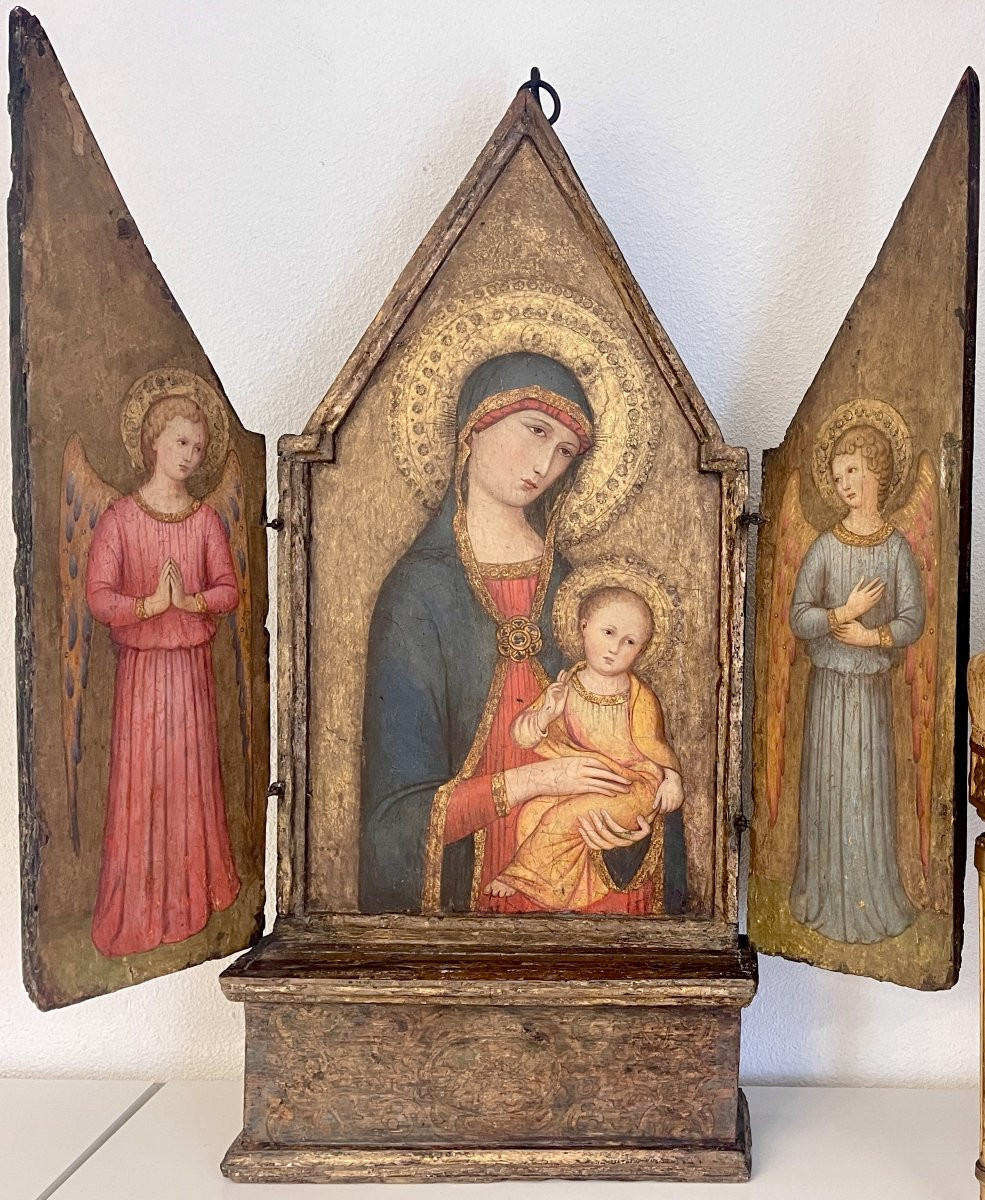


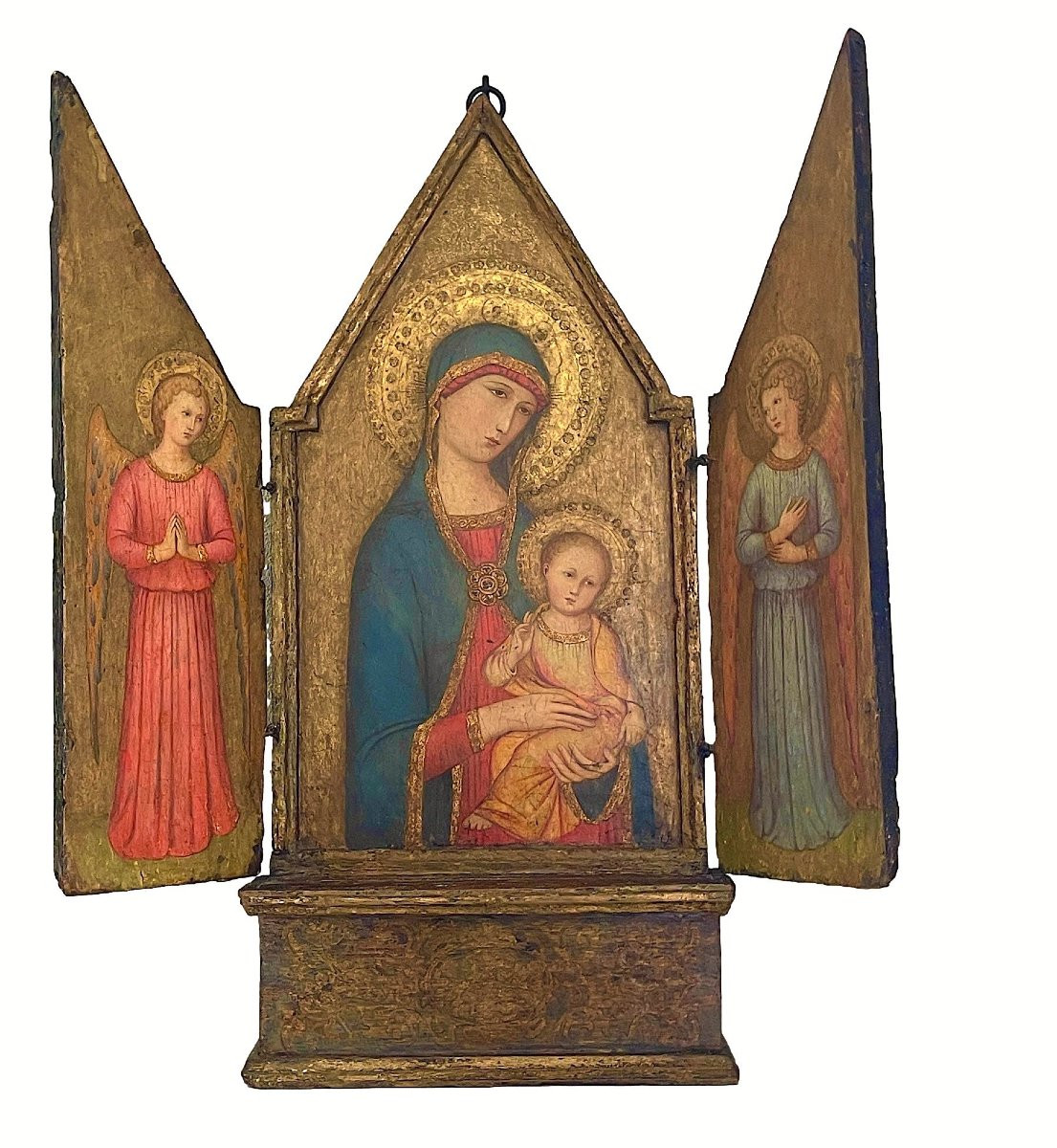



An exceptional portable triptych for private devotion dating from the 14th century, circle of Ambrogio Lorenzetti. This important Italian devotional triptych of the Trecento, painted in egg tempera on wooden panels and enriched with a finely punched gold ground, depicts the Virgin Mary holding the Infant Jesus in a tender and humane relationship, flanked by two adoring angels on the side panels. The whole is distinguished by its strong spiritual presence, the delicacy of its faces, and a coherent spatial construction, characteristic of the great Sienese tradition of the 14th century.
Stylistic attribution: Sienese School of the 14th century, a work created in the stylistic circle of Ambrogio Lorenzetti, in the tradition of Duccio di Buoninsegna. The supple modeling of the flesh tones, the Virgin's affectionate inclination, the volume of the Child, and the individualization of the angelic figures all reveal a clear affinity with the Lorenzettian style.
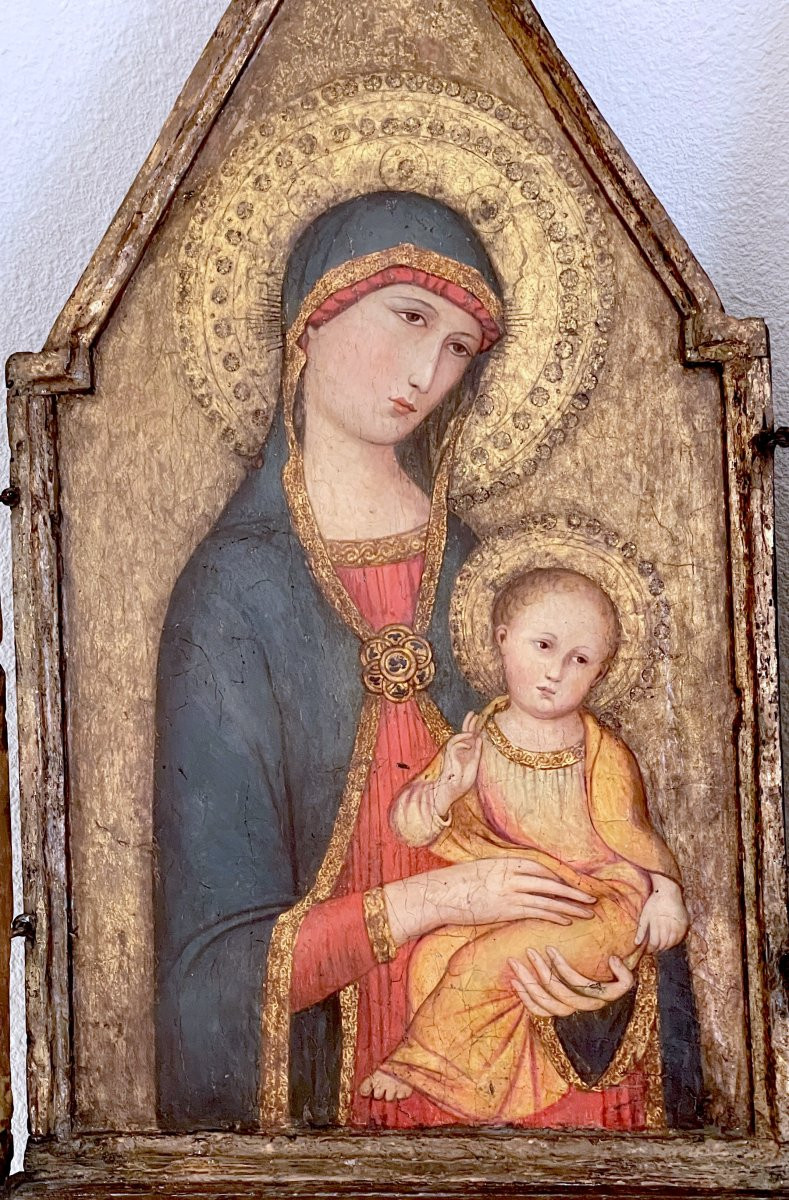
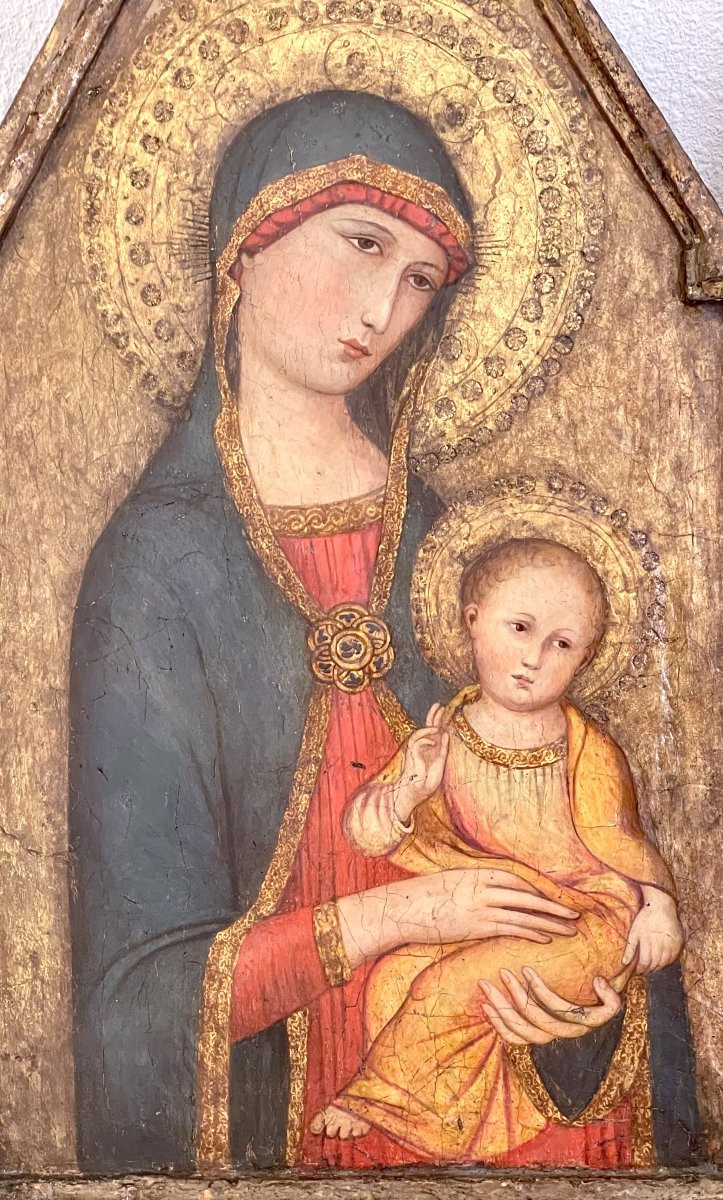
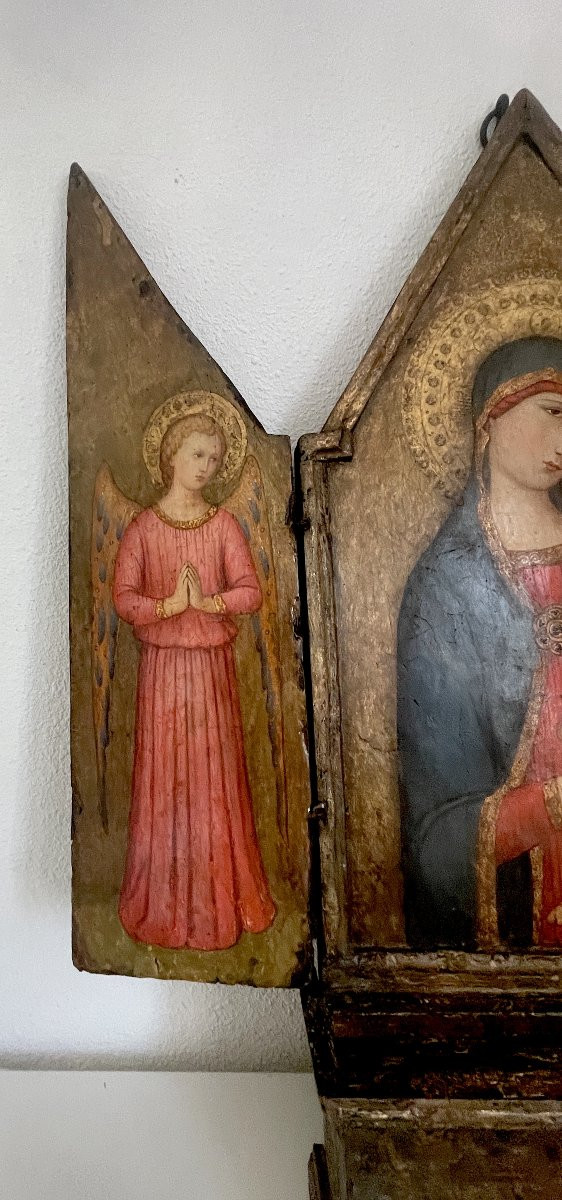
The central panel, surmounted by a pointed gable, depicts the Virgin with an introspective gaze, holding the blessing Child. The finely incised halos, arranged in concentric circles, structure the space and enliven the gilded surface. The side panels feature two angels with polychrome wings and distinct gestures, reinforcing the narrative and solemn dimension of the whole. The architecturally structured, predella-like base lends the triptych an almost monumental presence.
Technique and Colors: Egg tempera on wood, burnished and stamped gold ground. The palette is dominated by the deep blues of the Virgin's mantle, the warm reds and ochres of the tunics, enhanced by finely worked gold borders.
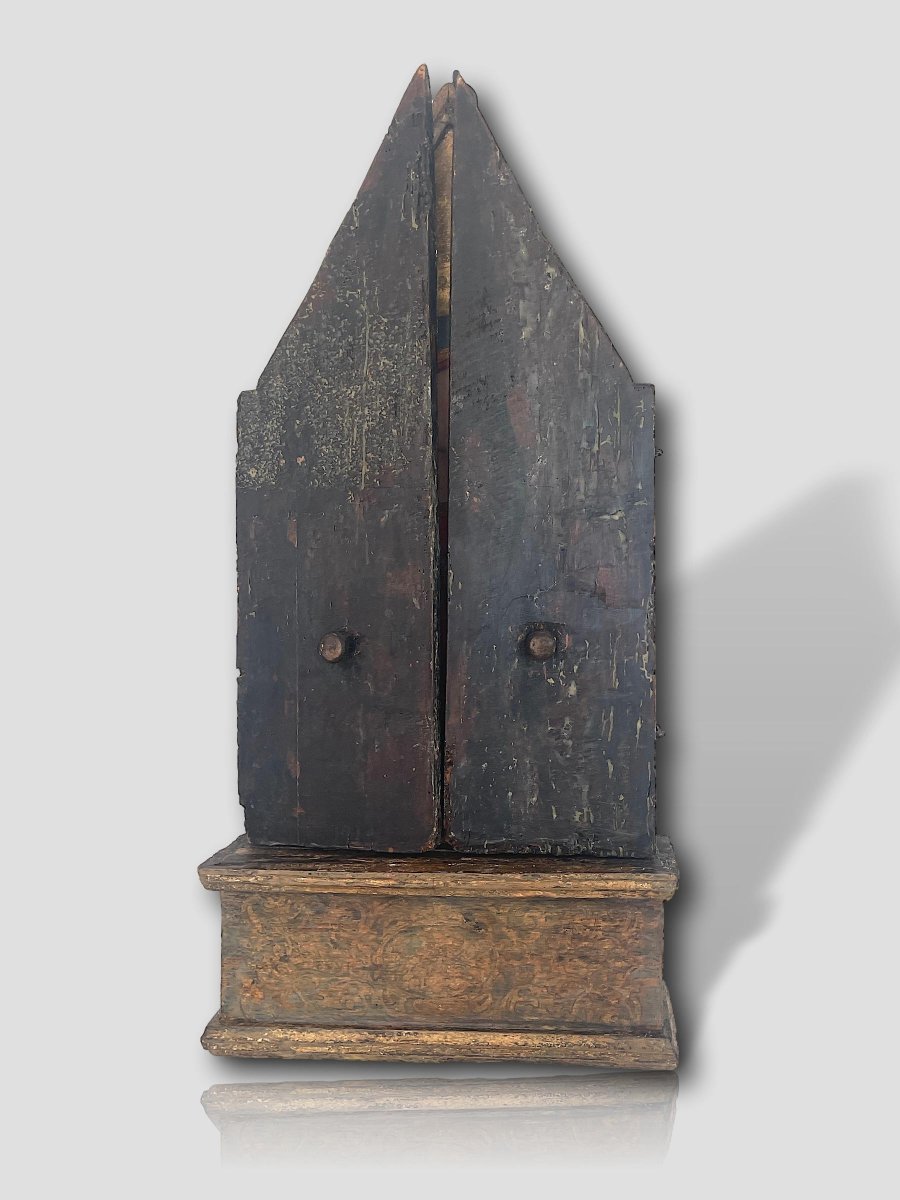
Condition: Homogeneous antique patina. Occasional wear and losses to the borders and gold ground, consistent with the age of the work. Antique wooden structure with visible joints and hinges on the reverse.
Depicting the Madonna and Child surrounded by adoring angels, this work testifies to Italian Gothic art at its height, a pivotal period between the Byzantine tradition and the innovations of the Tuscan Proto-Renaissance.
Monumental and possessing a rare spiritual presence, this large 14th-century Italian triptych is a remarkable example of Italian Gothic painting at the dawn of the Trecento. Executed in egg tempera on wood panels and enhanced by a sumptuous gold ground, it depicts the Virgin and Child enthroned in the center, flanked by two angels in adoration, displayed on the side panels.
The work is distinguished by the nobility of its composition, the harmony of its proportions, and the quality of execution of its faces, with delicate features imbued with a gentle inner peace, characteristic of the great Italian workshops of the late 13th and 14th centuries.
The central panel, surmounted by a trefoil gable, presents the Virgin Mary holding the Infant Jesus in a hieratic composition typical of the period. The Madonna, dressed in an azure blue mantle over a vermilion red robe, wears a headdress adorned with a gold band. Her face, gently inclined with tenderness, reveals the delicate features characteristic of the Sienese or Florentine school. The Child, dressed in a golden and red tunic, adopts a posture of blessing, his clasped hands expressing both humanity and divinity. The side panels, each crowned with a pointed arch, feature two angels in an attitude of adoration: on the left, an angel in a carmine-pink robe with hands clasped in prayer; on the right, an angel in a sky-blue tunic with polychrome orange and gold wings, in a gesture of veneration. The gold background, finely punched around the halos, creates a subtle play of light that animates the pictorial surface and recalls the original liturgical function of this triptych, intended for a private oratory or chapel.
The three main figures are surrounded by finely punched gilt halos, a technique typical of Trecento panel painting. Graphic details and pictorial techniques: The work is executed in egg tempera on fruitwood (cherry or walnut) according to the traditional methods of the medieval workshop. The gold ground, applied in leaves and then punched with circular and floral decorative motifs, creates the transcendent luminosity characteristic of Gothic sacred art. The flesh tones display the subtle modeling achieved by superimposing greenish glazes (verdaccio) and pinkish tones. The drapery reveals a nascent sense of volume, with tubular folds treated in chiaroscuro, foreshadowing the evolution towards the Giottesque naturalism...
Color palette used: Color analysis and techniques
The color palette is typical of the medieval Italian tradition:
The deep blue of the Virgin's mantle, probably made from azurite or a similar pigment, symbolizes purity and royalty.
Warm reds and ochres for the tunics, evoking life, sacrifice, and the divine presence.
Burned and stamped gold for the backgrounds and halos, giving the scene a celestial and timeless dimension.
Egg tempera, applied in thin layers, allows for a precise rendering of flesh tones and drapery, while offering remarkable color preservation despite the centuries.
The representation of the Virgin and Child between two angels is one of the major themes of medieval Christian devotion. It follows in the tradition of Byzantine models, while gradually incorporating a Western sensibility marked by greater humanity and gentleness in the expressions.
This depiction belongs to the tradition of the *Maestà* (Majesty), an iconographic formula developed by Sienese masters such as Duccio di Buoninsegna and Simone Martini. The presence of adoring angels alludes to the concept of the *Corte Celeste* (Celestial Court), illustrating the Virgin as Queen of Heaven surrounded by her angelic court.
This type of triptych was commonly used as a altarpiece for a Chapel allowing the faithful to pray in a private setting. It testifies to the central place of the Virgin in the spirituality of the Italian Trecento.
This work belongs to the great tradition of the 14th-century Italian schools, within the sphere of influence of masters such as Duccio di Buoninsegna, Simone Martini, and the early Florentine and Sienese painters. It embodies the balance between the hieratic style inherited from the Christian East and the pursuit of nascent naturalism, foreshadowing the advances of the Renaissance.
The 14th century marks the transition from the Byzantine Duecento to the proto-Renaissance Trecento. This work is situated within this transition, retaining the hieratic style and gold background of the Byzantine tradition while incorporating a humanization of the figures and a nascent sense of volume, a legacy of Giotto di Bondone and the Florentine school.
School of Painting and Possible Attribution
Through its treatment of faces, the delicacy of the incised halos, and the linear elegance of the drapery, this triptych can be linked to the Sienese or Tuscan school of the early 14th century. An attribution to a workshop active in the circle of the Trecento masters is conceivable, particularly within the stylistic circle of Ambrogio Lorenzetti, as the workshop productions of this period lack a known signature.
This stylistic analysis suggests an attribution to a **Tuscan workshop active between 1330 and 1380**, probably within the sphere of influence of the schools of **Siena** or Florence. Several elements point towards this attribution: **The treatment of the faces**: elongated ovals, almond-shaped eyes, thin noses, typical of the Sienese school; **The color palette**: predominance of precious blues and refined pinks, a Sienese signature; **The punching of the halos**: a technique particularly developed in the workshops of Siena and Florence; **The architectural structure**: characteristic of Tuscan portable triptychs. Comparisons with catalogued works: The work can be compared to: - **Triptychs by Bernardo Daddi** (active 1312-1348), a follower of Giotto in Florence; - **Works from the workshop of Lippo Memmi** (active 1317-1347), brother-in-law of Simone Martini. **Works by Segna di Bonaventura** (active 1298-1331) and his son Niccolò di Segna - **Portable Triptychs by the Maestro della Madonna Strauss**, an anonymous Sienese artist from the mid-14th century
Condition and Quality of Execution
The work displays a uniform, aged patina, attesting to its authenticity and age. Minor wear and occasional losses to the edges and the gold ground do not detract from the legibility of the scene, but rather enhance its historical character.
The quality of the painting, the delicacy of the lines, and the balance of the composition demonstrate a high level of craftsmanship, intended for a clientele of notable rank.
Dimensions and Shape
• Height: 90 cm
• Width: 40 cm (closed), 82 cm (open)
• Wooden triptych structure, hinged panels, pointed arch, and predella-like base.
Visual and professional expertise
This triptych meets the criteria for museum-quality works through:
• Stylistic consistency with the Italian Trecento
• Tempera technique and stamped gold background
• The architecturally structured construction
Shipping & Insurance:
Packaging is entrusted to MBE (Mail Boxes Etc.) – Narbonne, guaranteeing professional and secure packaging. Shipping is handled by UPS, FedEx, or GLS, with international tracking. For any purchase exceeding €4,000, Trans-Pass ad valorem insurance is automatically purchased, covering the artwork throughout its entire journey.
#GothicTriptych #MedievalArt #ItalianPrimitives #14thCentury #TuscanSchool #SienaSchool #VirginAndChild #TemperaOnWood #GoldGround #SacredArt #Trecento #BernardoDaddi #SimoneeMartini #DuccioDiBuoninsegna #GothicArt #ItalianPainting #MedievalMasterpiece #PrivateCollection #ChristianArt #MarianIconography #AuthenticWork #AntiquePatina #PortableTriptych #ReligiousArt #AncientPigments #AzuriteAndVermilion #StampedNimbus #ProtoRenaissance #TuscanWorkshop #MuseumRarity
Stylistic attribution: Sienese School of the 14th century, a work created in the stylistic circle of Ambrogio Lorenzetti, in the tradition of Duccio di Buoninsegna. The supple modeling of the flesh tones, the Virgin's affectionate inclination, the volume of the Child, and the individualization of the angelic figures all reveal a clear affinity with the Lorenzettian style.
The central panel, surmounted by a pointed gable, depicts the Virgin with an introspective gaze, holding the blessing Child. The finely incised halos, arranged in concentric circles, structure the space and enliven the gilded surface. The side panels feature two angels with polychrome wings and distinct gestures, reinforcing the narrative and solemn dimension of the whole. The architecturally structured, predella-like base lends the triptych an almost monumental presence.
Technique and Colors: Egg tempera on wood, burnished and stamped gold ground. The palette is dominated by the deep blues of the Virgin's mantle, the warm reds and ochres of the tunics, enhanced by finely worked gold borders.
Condition: Homogeneous antique patina. Occasional wear and losses to the borders and gold ground, consistent with the age of the work. Antique wooden structure with visible joints and hinges on the reverse.
Depicting the Madonna and Child surrounded by adoring angels, this work testifies to Italian Gothic art at its height, a pivotal period between the Byzantine tradition and the innovations of the Tuscan Proto-Renaissance.
Monumental and possessing a rare spiritual presence, this large 14th-century Italian triptych is a remarkable example of Italian Gothic painting at the dawn of the Trecento. Executed in egg tempera on wood panels and enhanced by a sumptuous gold ground, it depicts the Virgin and Child enthroned in the center, flanked by two angels in adoration, displayed on the side panels.
The work is distinguished by the nobility of its composition, the harmony of its proportions, and the quality of execution of its faces, with delicate features imbued with a gentle inner peace, characteristic of the great Italian workshops of the late 13th and 14th centuries.
The central panel, surmounted by a trefoil gable, presents the Virgin Mary holding the Infant Jesus in a hieratic composition typical of the period. The Madonna, dressed in an azure blue mantle over a vermilion red robe, wears a headdress adorned with a gold band. Her face, gently inclined with tenderness, reveals the delicate features characteristic of the Sienese or Florentine school. The Child, dressed in a golden and red tunic, adopts a posture of blessing, his clasped hands expressing both humanity and divinity. The side panels, each crowned with a pointed arch, feature two angels in an attitude of adoration: on the left, an angel in a carmine-pink robe with hands clasped in prayer; on the right, an angel in a sky-blue tunic with polychrome orange and gold wings, in a gesture of veneration. The gold background, finely punched around the halos, creates a subtle play of light that animates the pictorial surface and recalls the original liturgical function of this triptych, intended for a private oratory or chapel.
The three main figures are surrounded by finely punched gilt halos, a technique typical of Trecento panel painting. Graphic details and pictorial techniques: The work is executed in egg tempera on fruitwood (cherry or walnut) according to the traditional methods of the medieval workshop. The gold ground, applied in leaves and then punched with circular and floral decorative motifs, creates the transcendent luminosity characteristic of Gothic sacred art. The flesh tones display the subtle modeling achieved by superimposing greenish glazes (verdaccio) and pinkish tones. The drapery reveals a nascent sense of volume, with tubular folds treated in chiaroscuro, foreshadowing the evolution towards the Giottesque naturalism...
Color palette used: Color analysis and techniques
The color palette is typical of the medieval Italian tradition:
The deep blue of the Virgin's mantle, probably made from azurite or a similar pigment, symbolizes purity and royalty.
Warm reds and ochres for the tunics, evoking life, sacrifice, and the divine presence.
Burned and stamped gold for the backgrounds and halos, giving the scene a celestial and timeless dimension.
Egg tempera, applied in thin layers, allows for a precise rendering of flesh tones and drapery, while offering remarkable color preservation despite the centuries.
The representation of the Virgin and Child between two angels is one of the major themes of medieval Christian devotion. It follows in the tradition of Byzantine models, while gradually incorporating a Western sensibility marked by greater humanity and gentleness in the expressions.
This depiction belongs to the tradition of the *Maestà* (Majesty), an iconographic formula developed by Sienese masters such as Duccio di Buoninsegna and Simone Martini. The presence of adoring angels alludes to the concept of the *Corte Celeste* (Celestial Court), illustrating the Virgin as Queen of Heaven surrounded by her angelic court.
This type of triptych was commonly used as a altarpiece for a Chapel allowing the faithful to pray in a private setting. It testifies to the central place of the Virgin in the spirituality of the Italian Trecento.
This work belongs to the great tradition of the 14th-century Italian schools, within the sphere of influence of masters such as Duccio di Buoninsegna, Simone Martini, and the early Florentine and Sienese painters. It embodies the balance between the hieratic style inherited from the Christian East and the pursuit of nascent naturalism, foreshadowing the advances of the Renaissance.
The 14th century marks the transition from the Byzantine Duecento to the proto-Renaissance Trecento. This work is situated within this transition, retaining the hieratic style and gold background of the Byzantine tradition while incorporating a humanization of the figures and a nascent sense of volume, a legacy of Giotto di Bondone and the Florentine school.
School of Painting and Possible Attribution
Through its treatment of faces, the delicacy of the incised halos, and the linear elegance of the drapery, this triptych can be linked to the Sienese or Tuscan school of the early 14th century. An attribution to a workshop active in the circle of the Trecento masters is conceivable, particularly within the stylistic circle of Ambrogio Lorenzetti, as the workshop productions of this period lack a known signature.
This stylistic analysis suggests an attribution to a **Tuscan workshop active between 1330 and 1380**, probably within the sphere of influence of the schools of **Siena** or Florence. Several elements point towards this attribution: **The treatment of the faces**: elongated ovals, almond-shaped eyes, thin noses, typical of the Sienese school; **The color palette**: predominance of precious blues and refined pinks, a Sienese signature; **The punching of the halos**: a technique particularly developed in the workshops of Siena and Florence; **The architectural structure**: characteristic of Tuscan portable triptychs. Comparisons with catalogued works: The work can be compared to: - **Triptychs by Bernardo Daddi** (active 1312-1348), a follower of Giotto in Florence; - **Works from the workshop of Lippo Memmi** (active 1317-1347), brother-in-law of Simone Martini. **Works by Segna di Bonaventura** (active 1298-1331) and his son Niccolò di Segna - **Portable Triptychs by the Maestro della Madonna Strauss**, an anonymous Sienese artist from the mid-14th century
Condition and Quality of Execution
The work displays a uniform, aged patina, attesting to its authenticity and age. Minor wear and occasional losses to the edges and the gold ground do not detract from the legibility of the scene, but rather enhance its historical character.
The quality of the painting, the delicacy of the lines, and the balance of the composition demonstrate a high level of craftsmanship, intended for a clientele of notable rank.
Dimensions and Shape
• Height: 90 cm
• Width: 40 cm (closed), 82 cm (open)
• Wooden triptych structure, hinged panels, pointed arch, and predella-like base.
Visual and professional expertise
This triptych meets the criteria for museum-quality works through:
• Stylistic consistency with the Italian Trecento
• Tempera technique and stamped gold background
• The architecturally structured construction
Shipping & Insurance:
Packaging is entrusted to MBE (Mail Boxes Etc.) – Narbonne, guaranteeing professional and secure packaging. Shipping is handled by UPS, FedEx, or GLS, with international tracking. For any purchase exceeding €4,000, Trans-Pass ad valorem insurance is automatically purchased, covering the artwork throughout its entire journey.
#GothicTriptych #MedievalArt #ItalianPrimitives #14thCentury #TuscanSchool #SienaSchool #VirginAndChild #TemperaOnWood #GoldGround #SacredArt #Trecento #BernardoDaddi #SimoneeMartini #DuccioDiBuoninsegna #GothicArt #ItalianPainting #MedievalMasterpiece #PrivateCollection #ChristianArt #MarianIconography #AuthenticWork #AntiquePatina #PortableTriptych #ReligiousArt #AncientPigments #AzuriteAndVermilion #StampedNimbus #ProtoRenaissance #TuscanWorkshop #MuseumRarity
Explore similar pieces and discover your ideal find:
religious paintings