THIS OBJECT WAS SOLD
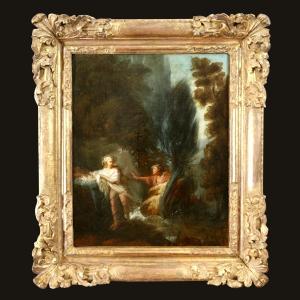
Claude-joseph Vernet (1714–1789) And His Workshop, Circa 1745/55. The Florentine Fishermen.
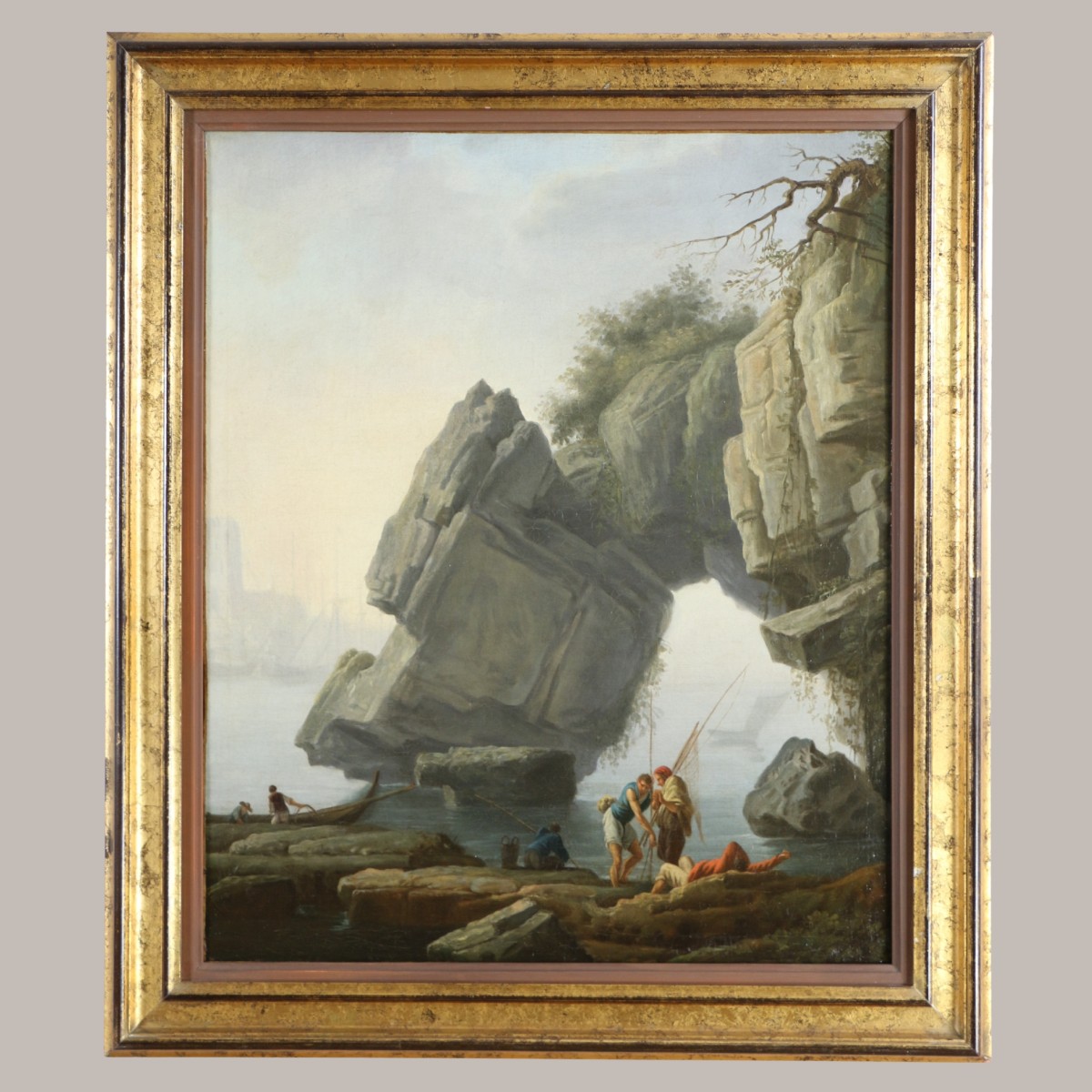
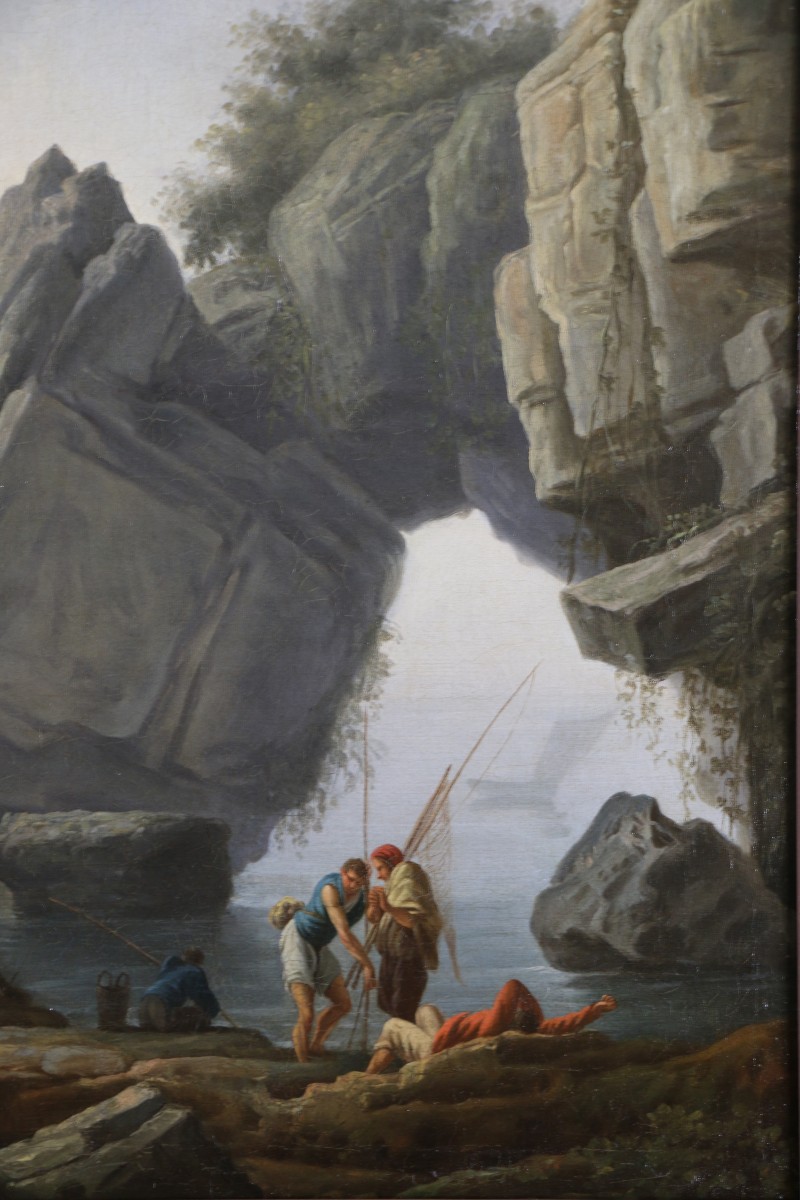
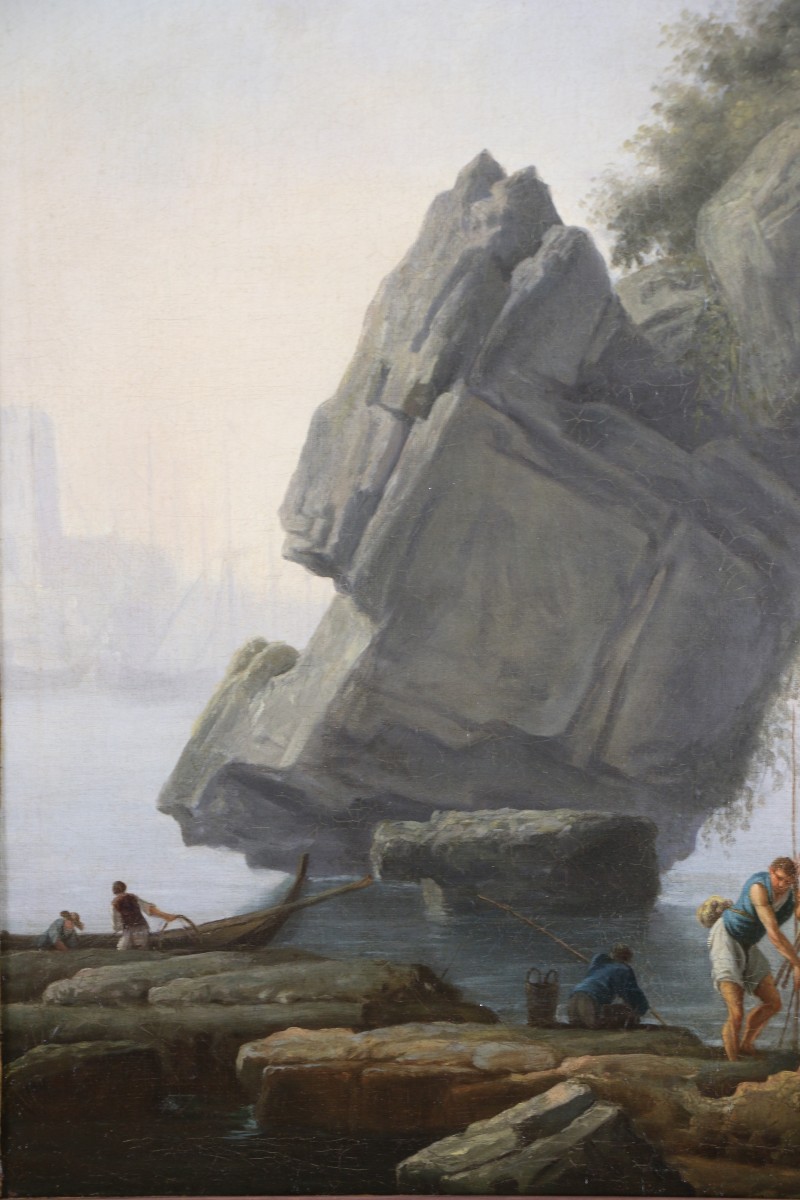
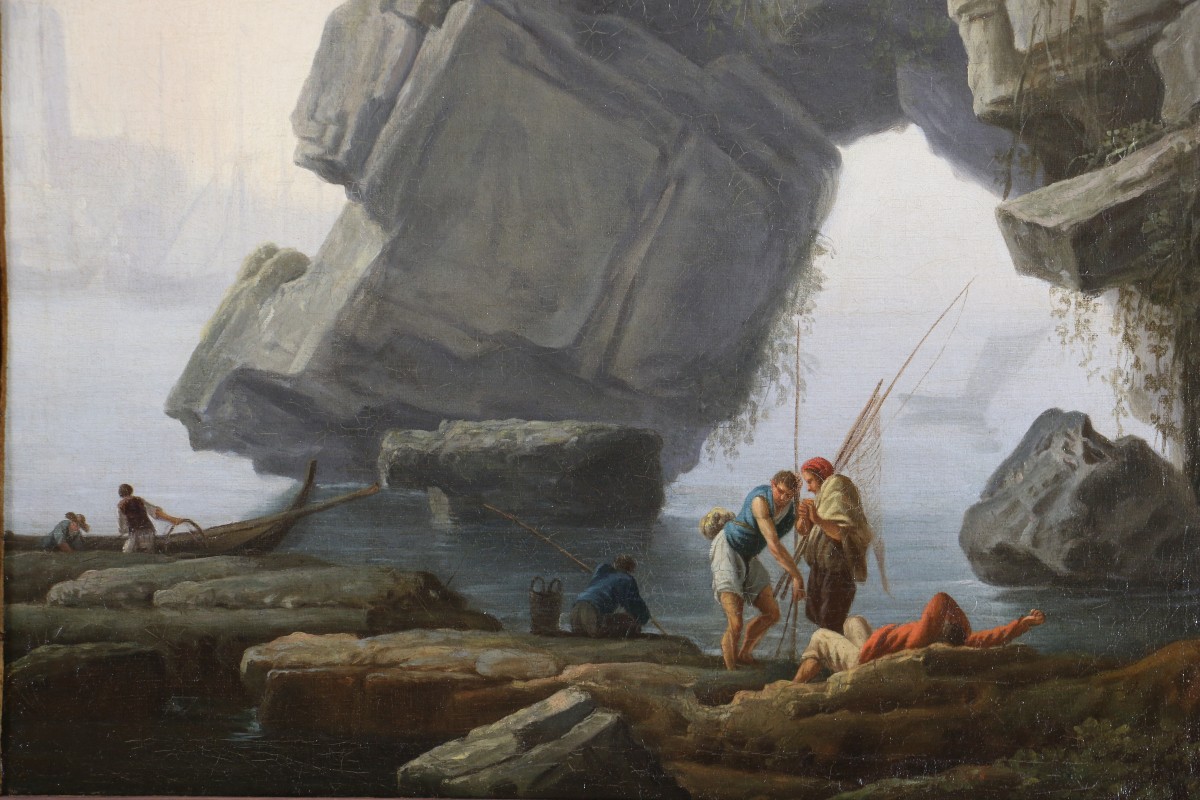

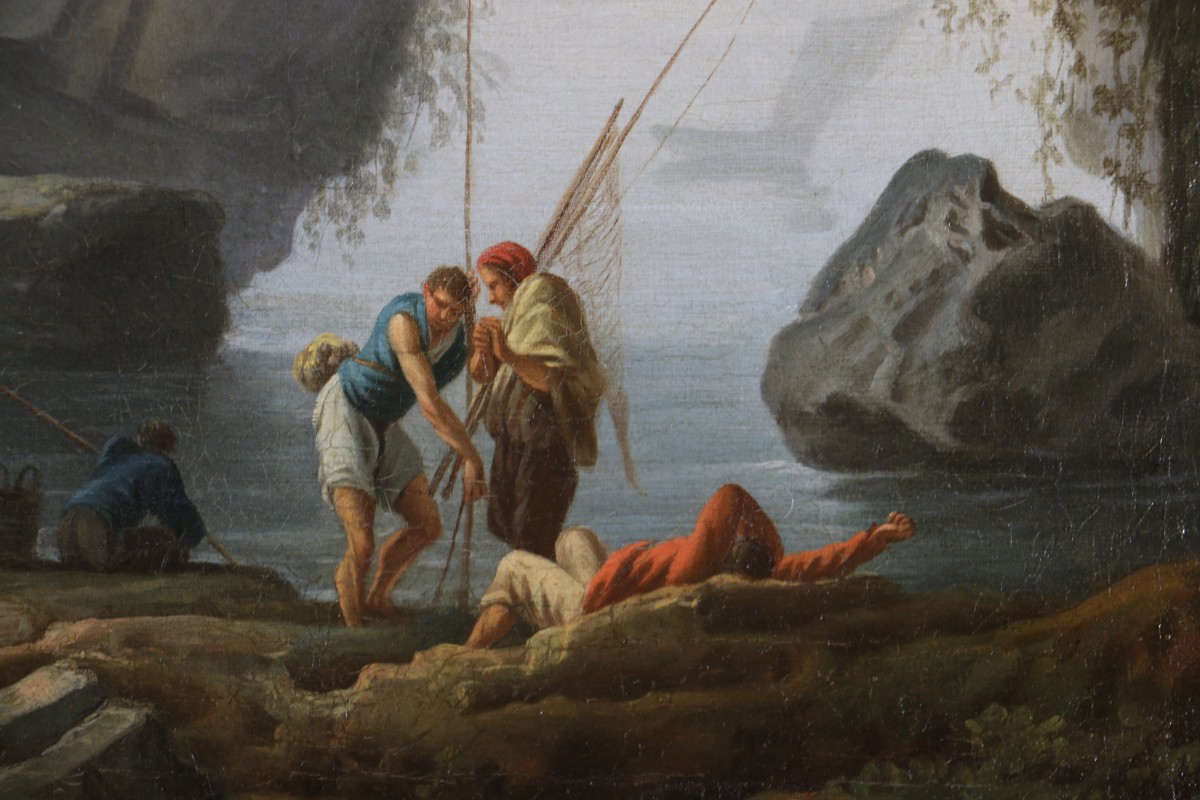
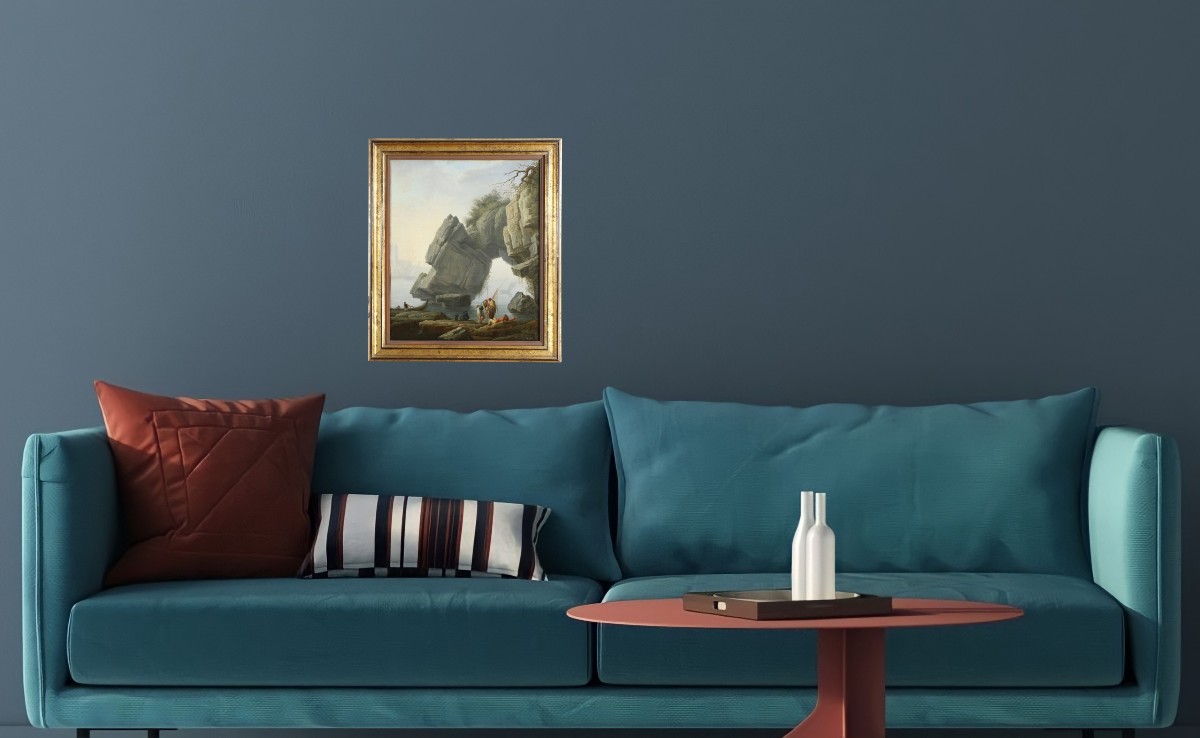



Claude-Joseph Vernet (1714–1789) and his workshop, circa 1745/55. The Florentine Fishermen.
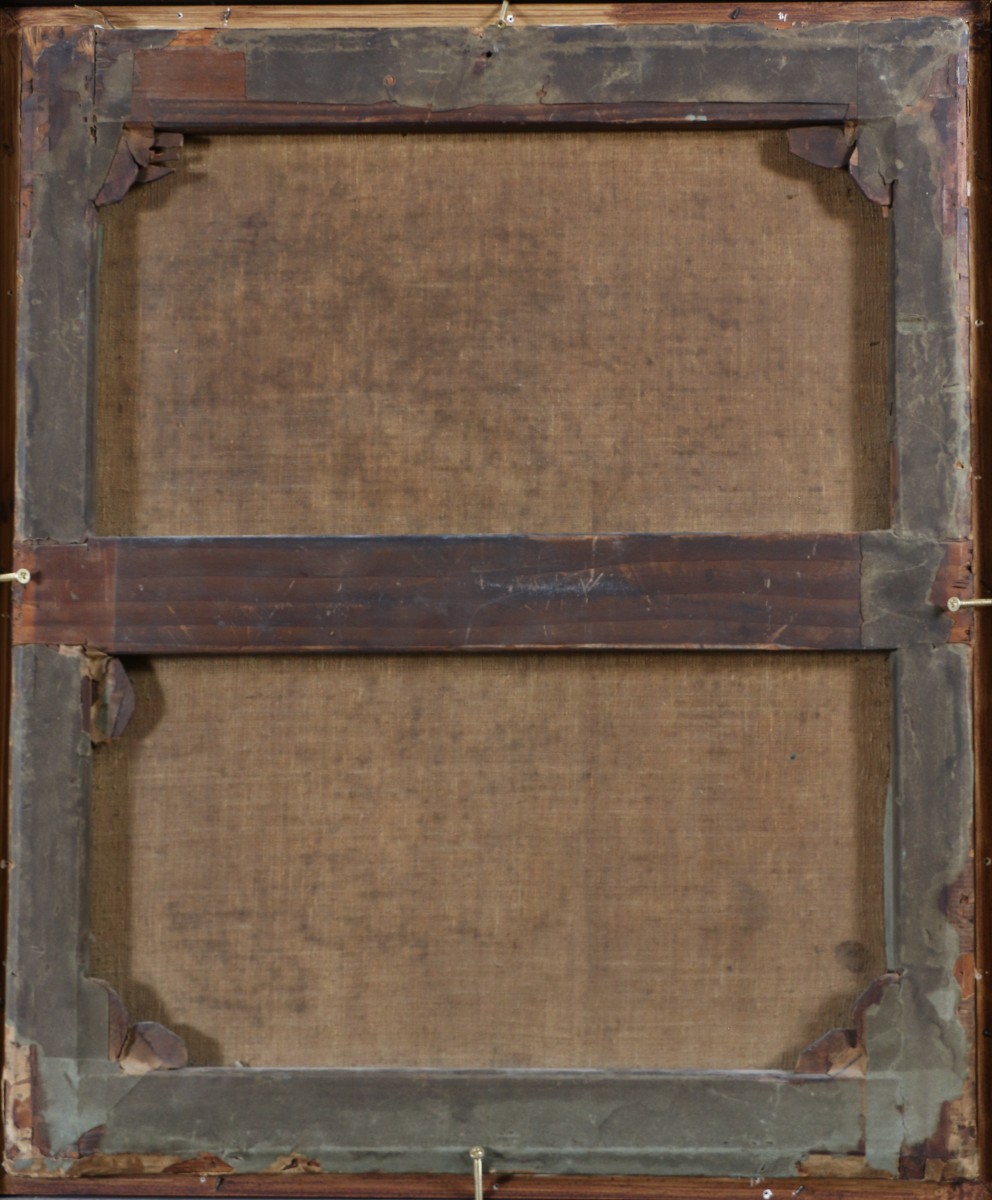
Relined canvas, 62 cm x 51.5 cm.
Frame, 76 cm x 65 cm.
Vernet's original work, "The Florentine Fishermen," known through the engraving by Anne Philiberte Coulet (1736–1775), has since been lost.
Until now, we were unaware of any workshop versions. Our painting is therefore a remarkable discovery.
Our research and analysis lead us to conclude that this is indeed a workshop version, with the artist's probable involvement in the overall design and certain key elements.
Indeed, the quality of execution of the figures, particularly evident in the modeling of the bodies, the rendering of the hands and drapery, as well as the atmospheric treatment of the sky and water, not to mention the reversed direction of execution, completely rules out the hypothesis of a copy after an engraving.
The composition unfolds fluidly and coherently, without graphic rigidity or any overt dependence on the printed model. The rocky masses are constructed through successive planes and plays of value, according to a pictorial vocabulary characteristic of Vernet and his immediate circle during his Italian years.
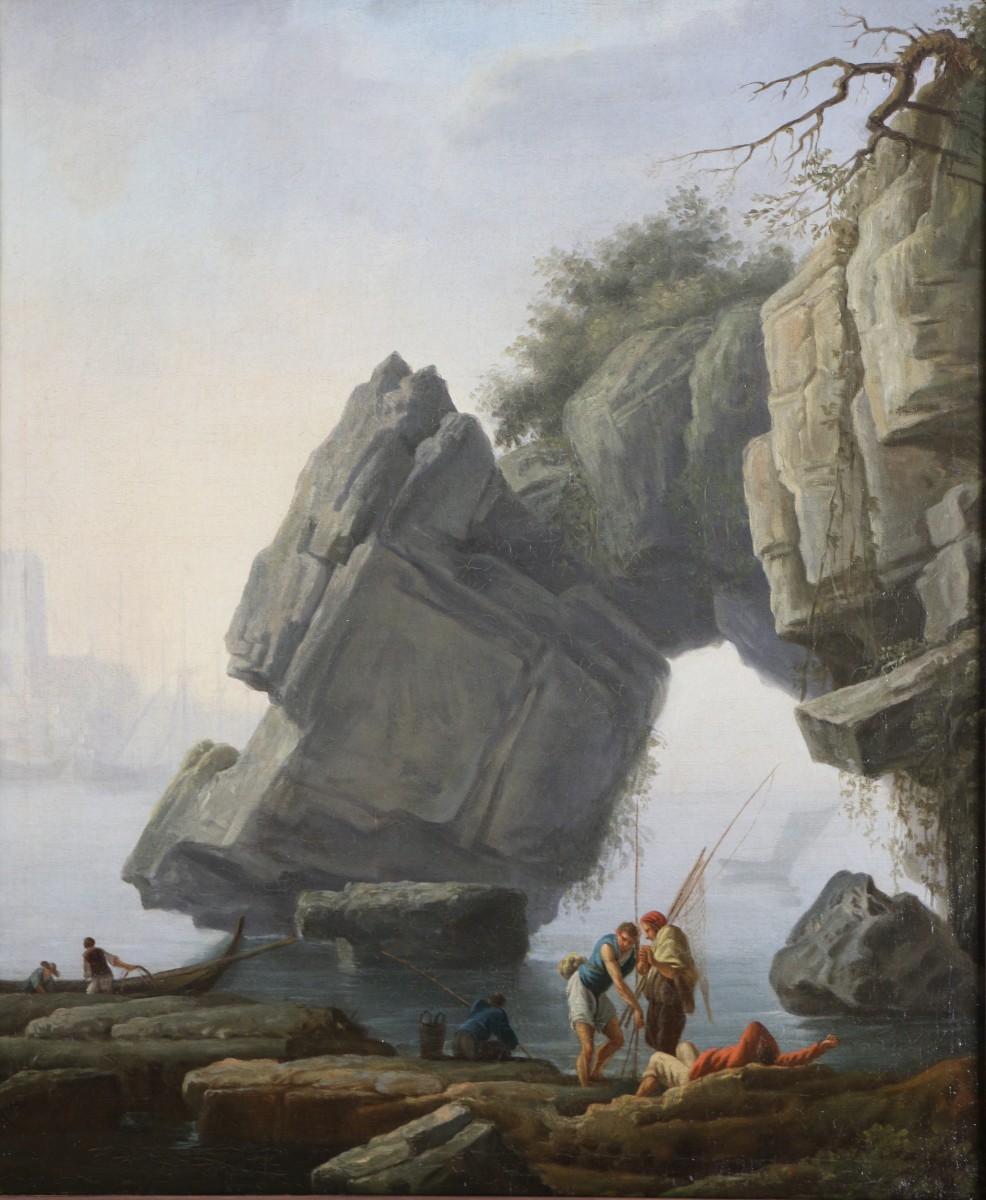
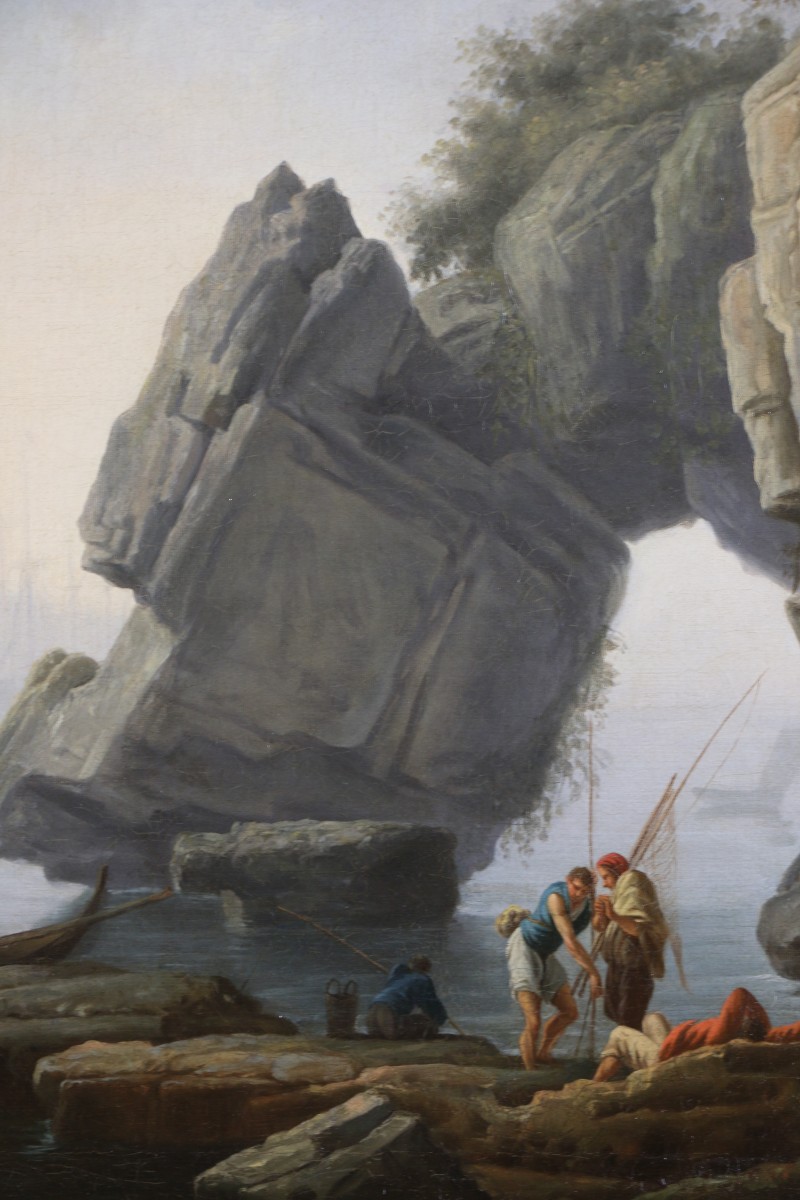
The scene depicts a coastal landscape enlivened by a group of fishermen, dominated by an imposing rock arch that structures the composition. This mineral mass, rendered with broad planes and subtle variations in tone, gives the painting a strong visual presence while allowing the whole to breathe. The landscape is not a mere backdrop: it constitutes the very framework of the scene.
In the foreground, the figures of the fishermen are arranged with naturalness and balance. Their varied and believable poses reflect a careful observation of everyday life. The modeling of the bodies, the quality of the drapery, and the attention to gestures, particularly in the rendering of the hands, testify to meticulous execution. The reclining figure dressed in red introduces a splash of color that enlivens the composition and guides the viewer's eye.
The sea is rendered with finesse, through delicate passages of bluish and greenish tones, enlivened by subtle reflections. It blends harmoniously into the landscape and contributes to the depth of the scene. The slightly hazy distance and the clear sky contribute to a peaceful atmosphere, typical of 18th-century Italian landscapes.
The whole conveys an impression of calm and balance, where human activity is naturally integrated into the grand setting of the landscape.
Joseph Vernet (1714-1789)
Claude Joseph Vernet trained in southwestern France. His teachers included Louis René Vialy, Philippe Sauvan, and then Adrien Manglard. In 1734, Vernet went to Rome to study the work of landscape and marine painters such as Claude Lorrain, whose style and subjects are reflected in his canvases. He built a solid international network during this trip, and subsequently in Paris through salons, the Royal Academy, and Masonic lodges. The cosmopolitan social connections this network fostered allowed him to deploy his social skills to deliberately launch, as his account book shows, the fashion for marine paintings throughout Europe, notably by skillfully exploiting the buzz generated by the largest royal commission of paintings during the reign of Louis XV: the commission, in 1753, of twenty paintings of French ports. The King commissioned him to paint twenty-four pictures of French ports to depict life in the ports; Only fifteen paintings were completed, between 1753 and 1765 (Marseille, Bandol, Toulon, Antibes, Sète, Bordeaux, Bayonne, La Rochelle, Rochefort, and Dieppe); some ports are depicted several times. Vernet was asked to represent, in the foreground of each painting, the activities specific to the region. These paintings are therefore true testimonies of life in the ports 250 years ago, and make him one of the greatest marine painters. They earned him recognition during his lifetime from most of the nobles most devoted to the navy—for example, the Marquis de Laborde. From then on, Vernet could sell his seascapes at a premium, "for a fortune," according to Pierre-Jean Mariette. Indeed, the list of his patrons was as varied and international as it was prestigious; it included, among other famous figures, Catherine II of Russia. An admirer of Poussin and Claude Lorrain, whose sunset and moonlit seascapes he also emulated, Vernet nevertheless managed, through sheer hard work, to create his own style. He generally depicted nature, giving considerable prominence to the sky; he also knew how to enliven each scene with figures and scenes of daily life. His son Carle Vernet, his grandson Horace Vernet, and his great-grandson Émile Vernet-Lecomte were also painters. An English painter, Gabriel Mathias, acted as Joseph Vernet's agent in Great Britain.
Explore similar pieces and discover your ideal find:
Seascapes, Marine Paintings