THIS OBJECT WAS SOLD
Milanese Cabinet, 17th Century


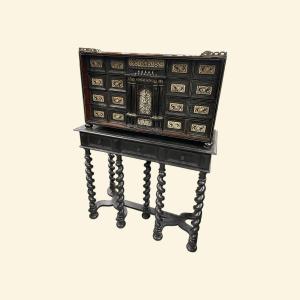


Italy, Lombardy – Second half of the 17th century
Later base, 19th century
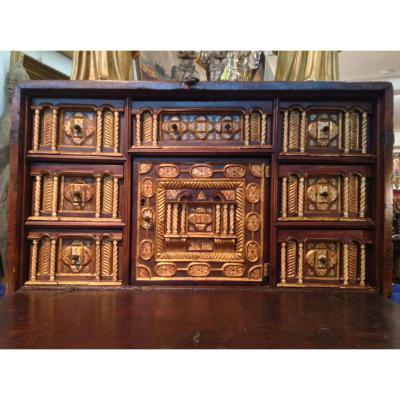
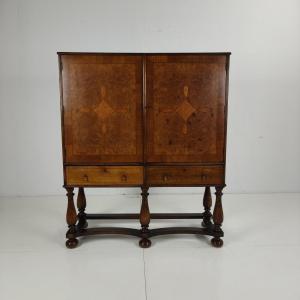
This important and rare Lombard cabinet dates from the second half of the 17th century and exemplifies Milanese production of the Seicento. The upper section is crafted in blackened wood—probably walnut or fruitwood—using a cabinetmaking technique intended to imitate ebony, a practice widely employed in Lombard workshops of the period.
The architecturally structured façade opens to reveal a refined internal arrangement, with multiple drawers symmetrically disposed on either side of a central panel conceived like a small altarpiece. The rigor of the composition is emphasized by moulded panels and rectangular recesses, enriched with finely executed inlays, probably in bone, forming geometric and ornamental motifs. This strong architectural language, combined with a late Mannerist sensibility, is characteristic of 17th-century Lombard furniture.
The central decoration, treated as a miniature arcaded structure, forms the focal point of the cabinet. It evokes the learned and scholarly function of such furniture, originally intended for a cultivated interior or a cabinet of curiosities. The quality of the workmanship, the precision of the inlays and the balance of the façade attest to the work of a high-level workshop.
The cabinet is in very good overall condition. It rests on a later base dating from the 19th century, made of ebonized wood—probably pearwood—featuring twisted columns. This well-proportioned base was likely added during a historical restoration and integrates harmoniously with the original structure, without detracting from its authenticity.
Striking both in its decorative presence and sculptural character, this cabinet is a refined and rare example of northern Italian taste in the 17th century. It is ideally suited to a distinctive interior, a gallery setting, or the collection of a discerning collector.
DetailsOrigin: Lombardy, Milano
Period: Second half of the 17th century
Base: Later addition, 19th century
Materials: Blackened wood (probably walnut or fruitwood); later ebonized wood base (probably pearwood)
Provenance: Private collection, Provençal château
Condition: Very good overall condition
Dimensions:
Height: 171 cm
Width: 95.5 cm
Depth: 40 cm
Explore similar pieces and discover your ideal find:
cabinets